Deconstructing Design Research
Paul A. Rodgers
a, Loura Conerney
a, Francesco Mazzarella
a a ImaginationLancaster, Lancaster University, United Kingdom* Corresponding author e-mail: [email protected]
Abstract:
This paper presents a novel conceptual framework for assessing design
research projects. Present-day design research is typified by projects, which traverse
disciplinary, methodological, and conceptual boundaries that often have
wide-ranging social, cultural, and economic impact to industry, government bodies, and
the wider public. Given design’s application in addressing serious issues ranging from
antimicrobial resistance to mobility, from ageing to migration it can be difficult to
understand and unpick the exact nature and scale of design research and the roles
that design researchers and designing (both processes and outcomes) play. The
design research conceptual framework has been developed as a communicative tool
for illustrating levels of design involvement in a project. The paper highlights the
design input involved in current design research and provides a comparative measure
of design’s role in a wide range of projects that fall under the umbrella term of
“design research” in the UK.
Keywords:
Design research, Conceptual framework, Design ladder, Design
content score
1. Introduction
Design plays a vitally important role in the social, cultural and economic fabric of the UK.
Additionally, the UK is home to some of the world’s most successful design organisations and iconic brands including the likes of Jaguar Land Rover, Virgin Atlantic, Dyson, and the BBC. It is hardly surprising, therefore, that design contributes over £70 billion annually to the UK and makes up 7.2% of the country’s total Gross Value Added (GVA) (Design Council, 2018). Design employs 1.6 million people with around 580,000 of these working in the UK’s 72,340 design industry firms. Furthermore, a further 1 million people are employed in design roles across a range of other sectors such as
aerospace, healthcare and finance. Within the context of UK Research and Innovation (UKRI) funding, design plays a vital role in the AHRC’s and other funding councils’ wide-ranging portfolio. Design, with its application across disciplines and fields, is being used to address issues ranging from antimicrobial resistance to mobility, from healthy ageing to migration. And with its inherent agility and applicability, design drives the technological advances which are transforming the world around us (Rodgers, 2018).
2
is the key act of research. Typically, in design contexts this research will take on several forms including observing what people do in various situations, asking end-users questions, searching for information, making and testing prototypes, provoking the status quo through disruptive
interventions, challenging conventional wisdom by critical discourse, experimenting with materials and processes, and speculating on fictional future visions amongst many others (Rodgers and Yee, 2015).
Contemporary design research manifests itself in a multitude of ways. Moreover, design research today, including how it is seen and heard and enacted upon, typically fosters inquiry into a whole host of areas of research and regularly opens up new interdisciplinary and multidisciplinary dialogues beyond single disciplinary spaces. A multitude of voices means many different ways of speaking and Ranulph Glanville (2015) reminds us that variety is crucial and we should be careful to guard different ways of thinking, exploring, writing and doing design, and we should value this variety whilst
ensuring that we do not privilege certain types of design research over others (Glanville, 2015). In short, we should celebrate the plurality, depth and richness of design research at the moment. That is, we should support the wide range of conceptual, methodological and theoretical approaches that are evident in contemporary design research and in the vast array of disciplines in and around emerging forms of design research and from researchers in interdisciplinary, cross-disciplinary, multi-disciplinary and trans-multi-disciplinary contexts.
Given this heady mix of different disciplines, issues, concepts, approaches, and methods it can sometimes be difficult to understand and unpick the nature and scale of design research and the roles that design researchers and designing (both processes and outcomes) play in contemporary forms of design research. This paper, part of the first author’s ongoing AHRC-funded Design Leadership Fellowship, interrogates the terrain of contemporary design research in the UK. Furthermore, it presents a novel conceptual framework that will allow researchers to deconstruct design research projects to reveal greater levels of understanding in relation to the issues, roles, approaches, methods, impact, and knowledge that make up the design research landscape in the UK and further afield today.
2. Deconstructing Design Research Methodology
The stages and processes behind the development of the “deconstructing design research”
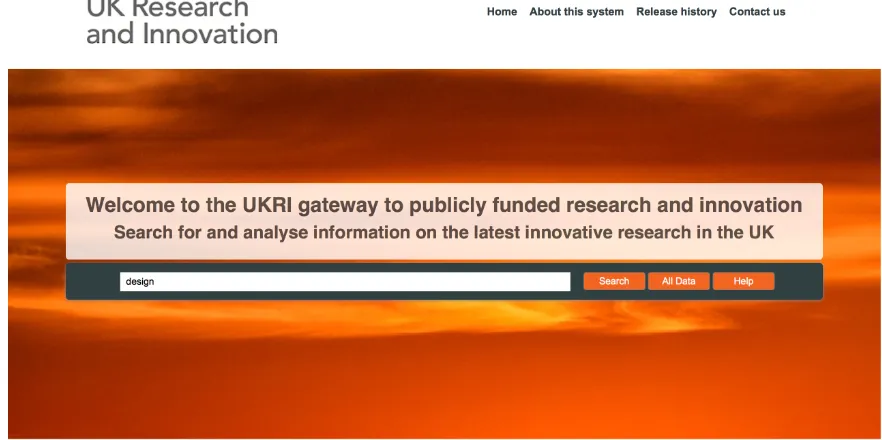
Figure 1. UKRI Gateway to Research Website
A quick search of Gateway to Research using the keyword “design” currently returns almost 19,000 projects. All of these projects will have the word “design” in their title and/or abstract. A more precise search, based on how each principal investigator has self-classified his/her project, dramatically reduces the number of Arts and Humanities Research Council (AHRC) funded design research projects to 359. Each one of these 359 projects are deemed a “design” project from the research proposal classification submitted by the principal investigator of the research project (Figure 2). These 359 “design” projects cover a period of over 10 years (i.e. from 2006 to 2018 inclusive).
[image:3.595.70.319.503.750.2]4
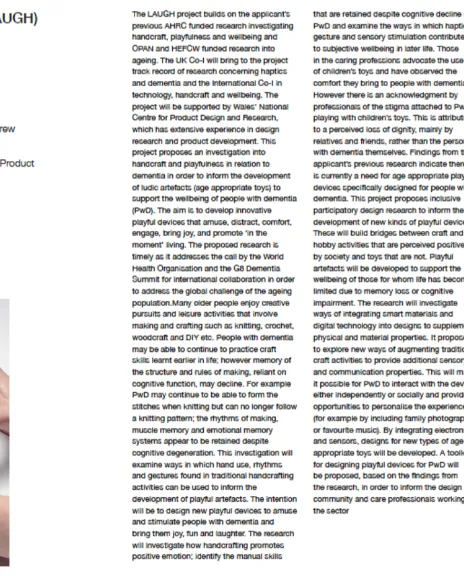
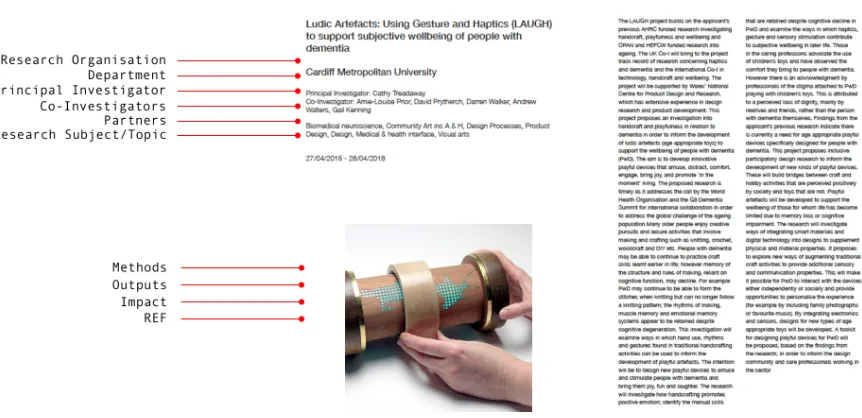
[image:4.595.237.469.150.438.2]We have harvested data from Gateway to Research for each one of the past and present 359 design research projects and produced a one-page overview for each project that includes important information such as project title, organisation where the grant is held, investigators’ names, research subject(s) and topic(s), and summary of the research proposal (Figure 3).
Figure 3. Design Research Project One Page Overview
The next stage of this work involved the construction of the novel design research conceptual framework (Figure 4) based on data held within Gateway to Research. The aim here is to facilitate a greater level of scrutiny to design research and unpick the wide range of disciplines, issues, concepts, approaches, and methods that are commonly found in modern day design research projects.
Figure 4. Design Research Conceptual Framework Schema
The novel conceptual framework (Figure 4) comprises 10 key components. These components cover 3 main aspects of design research:
1. the Environment (made up of Research Organisation, Department, Principal
Investigator, Co-Investigators, Project Partners) where the design research occurs;
2. the Impact (i.e. Outputs, Impact, and Research Excellence Framework (REF)) that the
design research produces; and
3. the contribution to Design Knowledge (in terms of the Research Subject/Topic, and Methods developed).
To scrutinize design research more effectively and to identify and better understand the nature and scale of design research in contemporary design research we used a series of questions under each conceptual framework component:
1. Research Organisation
Does the Research Organisation have a Design department, faculty, or school? Does the Research Organisation have a reputation and/or record in Design? Does the Research Organisation return its staff to the Design REF Unit of Assessment (UoA)?
2. Department
Is this a Design department? Does the Design department have a strong reputation in Design? (e.g. ranked within the top 100 Design schools globally). Does the
Department return its staff to the Design REF UoA?
3. Principal Investigator
Is the Principal Investigator (PI) a recognized Design researcher? What qualifications, experience, skills, and expertise does the PI have in Design? Is the PI returned to the REF Design REF UoA?
4. Co-Investigators
6
5. Project Partners
Are the Partners recognized Design organisations? What qualifications, experience, background do the Partners have in Design? Do the Partners add Design expertise and/or value to the project?
6. Research Subject/Topic
Is this a Design-led project? How significant is the role that Design is playing in this project? Is Design only playing a supporting role to other subjects/disciplines in this project?
7. Methods
Are the methods used in this project relevant to Design? Do the methods contribute to the canon of Design research? Are they Design methods?
8. Outputs
Are the outputs generated from this project relevant to Design? Do the outputs contribute to the canon of Design research? Will the outputs be returned to the Design REF UoA?
9. Impact
Will this project have impact on how Design is practiced, researched, taught, etc.? Will this impact contribute to the reputation of Design in general? Will the impact of this project feature in the Design REF UoA?
10. REF
Is this project returnable to the Design REF UoA? Will this project feature in the Design REF UoA? Is this project a potential Design REF UoA Impact Case Study?
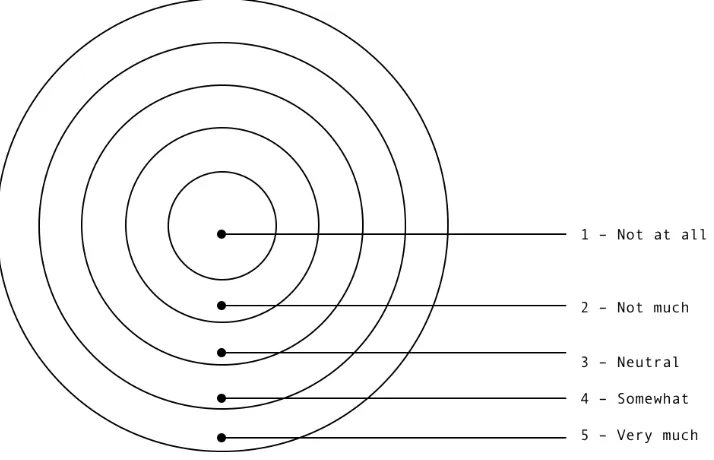
Figure 5. Likert Scale
In so doing, we can allocate an overall design content score (between 1 and 5) to every design research project funded in the UK in order to conceptualize and compare the significance of design’s role, its scope, focus, and potential for impact across all of the wide range of projects that fall under the umbrella term of “design research” in the UK (Figure 6). Similar to the Danish Design Ladder, developed in 2001 as a communicative tool for illustrating the variation in a company’s use of design (Danish Design Centre, 2001), where Step 1 means that “design is not applied systematically”
through to Step 4 where “design is used as a key strategic element”, the framework developed here adopts a 5-point design research assessment schema that unpicks and articulates the degree of “designerly” (Cross, 2006) content and application in the research project.
Figure 6. Scoring a Design Research Project
3. The Design Research Conceptual Framework
Like the Danish Design Ladder, developed in 2001 as a communicative tool for illustrating the
[image:7.595.79.539.478.641.2]8
a comparative measure of design’s role (both processes and outcomes) in the wide range of projects that fall under the umbrella term of “design research” in the UK.
As such, we can analyse AHRC-funded design research projects and classify them against the 5 steps of the Design Research Conceptual Framework “ladder”, built upon previous work (Danish Design Centre, 2001; Hernandez et al., 2016), using the following design content score descriptions:
• Design-Driven (average design content score = 5): Design is the key strategic element driving the research. Design-driven projects will typically be located within Research Organisations and Departments that have a “strong” reputation for design and/or a Principal Investigator and Co-Investigators whose research outputs and impact is assessed as “world-leading in terms of originality, significance and rigour” (REF, 2014). Design-driven projects will produce knowledge that is “outstandingly novel” in developing design concepts, techniques or outcomes that is “exceptionally significant”.
• Design-Focused (average design content score = 4): Design is the focal point of the research. Design-focused projects tend to be focused within Research Organisations and Departments that have a “solid” reputation for design and/or a Principal Investigator and Co-Investigators whose research quality (originality, significance and rigour) is deemed either “internationally excellent” or
“recognised internationally”. Design-focused projects will produce “important knowledge, ideas and/or techniques, which are likely to have a lasting influence” (REF, 2014).
• Design-Led (average design content score = 3): Design is used as an integrated element in the research process. Design-fed projects will be located in Research Organisations and Departments that may or may not have a design specialism and/or a Principal Investigator and Co-Investigators whose research quality makes a valuable contribution through “incremental and cumulative advances in knowledge in the field” (REF, 2014).
• Design-ed (average design content score = 2): Design is unsystematically applied as a peripheral element in the research. Design-ed projects may or may not be based in Research Organisations and Departments that have a design specialism and/or a Principal Investigator and Co-Investigators whose research generates “useful knowledge, but unlikely to have more than a minor influence in the field” (REF, 2014).
4. Scoring Design Research - Results
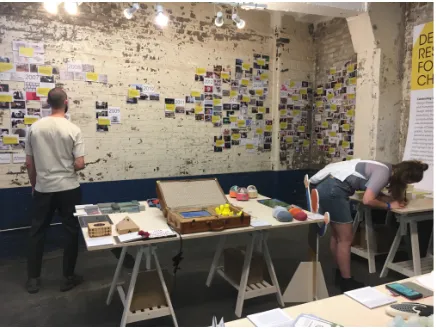
Given the word limits, this paper will focus on 67 of the 359 AHRC-funded design research projects aforementioned. The 67 AHRC-funded design research projects are those that have recently been selected by experienced design researchers and exhibited as part of the AHRC-funded “Design Research for Change” Showcase at the London Design Festival in September 2018 (Figure 7). These projects, which traverse disciplinary, methodological, and conceptual boundaries, typify the diversity of AHRC-funded design research and show the wide-ranging social, cultural, and economic impact of this work to industry, government bodies, and publics (Rodgers, 2018). These projects highlight the significant roles that UK-based design researchers play in some of the most challenging issues we face, both in the UK and globally, such as creating new products with reduced environmental impact, design research that enhances policy-making through greater citizen involvement, gaming
interventions that prioritise the rights of girls and women to live a life free from violence, and design research that helps address recidivism by reframing prison industries as holistic “creative hubs”. Given the current high priority of design research in the UK and its wide-ranging application across numerous disciplines and fields, design methods, tools and approaches are being used to address issues ranging from antimicrobial resistance to poverty, from greater cultural awareness to
10
Figure 7. AHRC “Design Research for Change” Showcase at London Design Festival, September 2018
Each one of the 67 AHRC-funded design research projects were scored using the 5-point Likert scale (Figure 5) to identify the degree of design content in each one. A score was assigned to each of the 10 conceptual framework components for each of the 67 projects (Figure 8) and an average score calculated, which returned an overall score between 1 (An “Un-Design-ed” project meaning design lies at the edges or tangential to the focus of the research) through to 5 (A “Design-Driven” project where design is the key strategic element driving the research).
[image:10.595.72.511.527.718.2]4.1 Design Content Scores - Overview
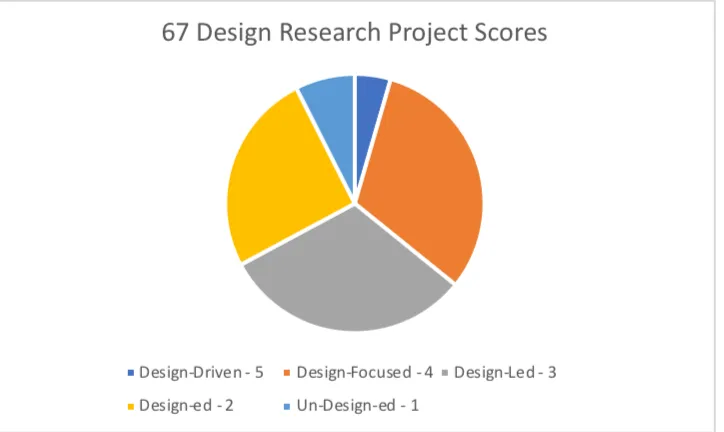
Figure 9 highlights the design content scores across all of the 67 AHRC-funded design research projects analysed. Here, we can see that only 5% of the 67 AHRC-funded design research projects achieve the highest rating of 5 meaning they are “Design-Driven” projects wheredesign plays a key strategic role driving the research. The greatest number (62%) of the 67 projects are rated as either “Design-Focused”, where design is the focal point of the research or “Design-Led”, where design is used as an integrated element in the research process. One quarter of the 67 projects are assessed as “Design-ed”, where design is unsystematically applied as a peripheral element in the research. Finally, 8% of the projects are rated as “Un-Design-ed” meaning that design lies at the edges or is tangential to the focus of the research.
Figure 9. 67 AHRC-funded Design Research Project Scores
4.2 Design Content Scores – Research Team Sizes
12
Figure 10. 67AHRC-funded Design Research Project Team Size and Design Scores
4.3 Design Content Scores – Project Partner Organisations
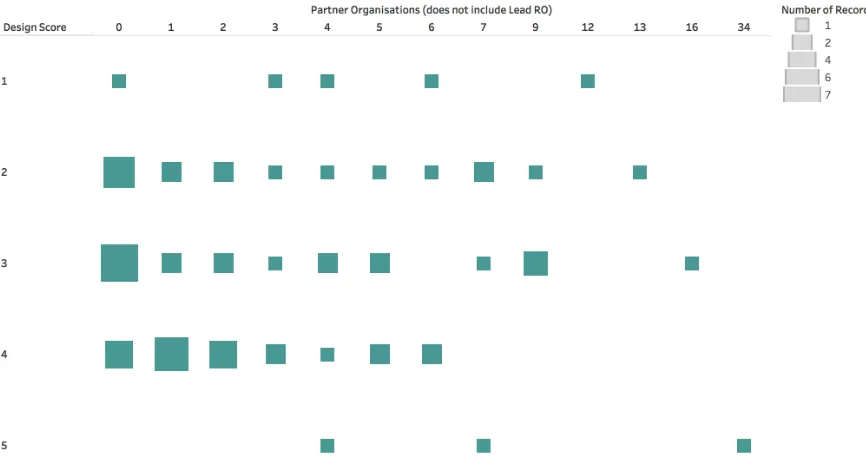
Similarly, we can see from Figure 11 that the number of partner organisations involved in the 67 design research projects reinforces the findings of the Beazley Designs of the Year 2017 catalogue wherein most contemporary design projects involve teams of less than 10 individuals. It is also noticeable that a large set of projects rated as 3 or 4 involve teams of less than 6 people.
Figure 11. 67AHRC-funded Design Research Project Partners and Design Scores
4.4 Design Content Scores – Geographical Location
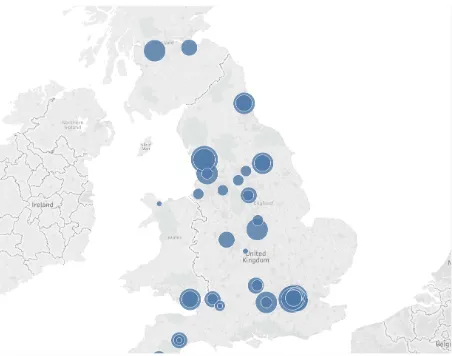
[image:12.595.73.506.407.641.2]acknowledged as “strong design researchers” whose research outputs and impact is regularly assessed as “world-leading in terms of originality, significance and rigour.” Also, “Design-Driven” projects produce knowledge that is “outstandingly novel” in developing design concepts, techniques or outcomes that are “exceptionally significant”.
Figure 12. 67AHRC-funded Design Research Project Design Scores and PI Research Organisation Location
4.5 Design Content Scores – Project Start Date
14
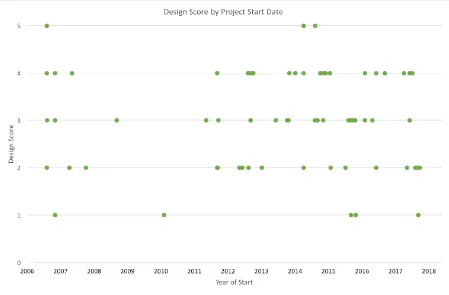
[image:14.595.74.523.71.366.2]Figure 13. 67AHRC-funded Design Research Project Design Scores and Project Start Dates
4.6 Design Content Scores – Funded Value of Project
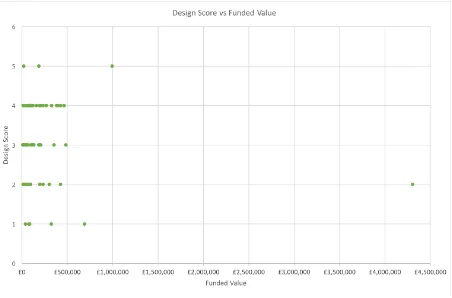
The final analysis using the design research conceptual framework scoring system assesses the 67 AHRC-funded design research projects against the amount of funding awarded to them. As can be seen in Figure 14, 64 of the 67 projects cost less than £500,000. It is interesting to note that two of the three design research projects receiving more than £500,000 achieve only a design content score of 1 and 2. In other words, these projects are rated as “applying design unsystematically as a
Figure 14. 67 AHRC-funded Design Research Project Design Scores and Project Funded Value (in £)
5. Design Research Content Scores – Analysis
As outlined in the previous section, it is disappointing to note that only 5% of the 67 AHRC-funded design research projects are assessed as “Design-Driven” projects wheredesign plays a key strategic role driving the research. Equally disappointing is the result that one-third of the 67 AHRC-funded projects are rated as either “Design-ed”, where design is unsystematically applied as a peripheral element in the research or “Un-Design-ed”, where design resides at the edges or tangential to the main focus of the research. Given the widely acknowledged benefits and capacity of design research to enact significant positive change, these findings suggest that design research may not be being applied or used to its full potential across the UK.
It is clear from the assessment of the 67 AHRC-funded design research projects that those rated at 3 and above (i.e. projects assessed as being either “Design-Driven”, “Design-Focused” or “Design-Led”) have small research teams (3 researchers or smaller). Moreover, a large portion of the projects rated as 3 or 4 (i.e. “Design-Focused” or “Design-Led”) have project partners of less than 6 people. This finding resonates with other analyses of contemporary design teams that highlight the lean, agile, and flexible nature of present-day design organisations and their workforce.
From a geographical context, London and the North West are the only two regions in the UK with projects that achieve the highest design content score of 5 (i.e. “Design-Driven”). However, there is a good geographical spread of projects assessed as “Design-Led” or “Design- Focused” across the length and breadth of the UK (see Figure 12).
16
[image:16.595.71.376.232.288.2]such as “Connected Communities”, “Design in Action”, “Lifelong Health and Wellbeing”, “Design Fellowships”, “Bristol + Bath x Design”, and “Protopublics”. All of these programmes have their own aims and ambitions, but the overriding rationale is to promote design research and its application across a wide array of different disciplines and fields. These initiatives have certainly helped increase the quality and quantity of design-led research, but over two-thirds of the 67 AHRC-funded design research projects assessed in this paper have a design score of 3 or less (i.e. they are rated as either “Design-Led”, “Design-ed” or “Un-Design-ed”). This suggests that more work is needed here to ensure that greater numbers of projects where “design is the key strategic element driving the research” are funded across the UK.
Table 1. Average funding awards for “design research” projects.
AHRC £197,000
EPSRC £912,000
ESRC £387,000
Finally, the analysis of the funded value of the 67 AHRC-funded design research projects against their design score reveals some interesting points. Only three of the 67 design research projects have received more than £500,000 of funding and two of these three projects achieved only a design content score of 1 and 2. In other words, these two relatively heavily-funded projects are rated as “applying design unsystematically as a peripheral element in the research” (score = 2) and a project where “design lies at the edges or tangential to the focus of the research (score = 1). Examining design research funding more widely, we can reveal that the average funding award of the 67 AHRC-funded design research projects discussed in this study is £197,000. As a comparison the average funding award for a “design research” project funded by the Engineering and Physical Sciences Research Council (EPSRC) and the Economic and Social Research Council (ESRC) is £912,000 (5 times higher than AHRC) and £387,000 (twice as high as AHRC) respectively (Table 1).
6. Conclusions
References
Bryman, A. (2001). Social Research Methods. Oxford, UK: Oxford University Press.
Cooper, R. et al. (2016). Design Value: The Role of Design in Innovation. Lancaster, UK: Lancaster University.
Cooper, R. et al. (2016). Design Value: The Role of Design in Innovation. Lancaster, UK: Lancaster University.
Cross, N. (2006). Designerly Ways of Knowing. London, UK: Springer.
Danish Design Centre. (2001). The Design Ladder. Copenhagen, Denmark: Danish Design Centre. Glanville, R. (2015). The Sometimes Uncomfortable Marriages of Design and Research. In P.A.
Rodgers & J. Yee (Eds.), The Routledge Companion to Design Research (pp. 9-22). Oxon, UK: Routledge.
Hernandez, R. J., Cooper, R., Tether, B. and Murphy, E. (2017). The Value of Design in Innovation: Results from a Survey Within the UK Industry. The Design Journal, 20(1), S691-S704.
REF (2014). Assessment Criteria and Level Definitions. Retrieved January 2, 2019, from https://www.ref.ac.uk/2014/panels/assessmentcriteriaandleveldefinitions/
Rodgers, P.A., Brodhurst, L. and Hepburn, D. (2005). Crossing Design Boundaries. London, UK: Taylor and Francis.
Rodgers, P.A. & Yee, J. (2015). The Routledge Companion to Design Research. Oxon, UK: Routledge. Rodgers, P.A. (2018). Design Research for Change. Lancaster, UK: Lancaster University.
Watson, E. (2017). “Design by the Numbers: A Graphic Overview of this Year’s Nominees”, in D. Sudjic and G. Adamson (Eds.), Beazley Designs of the Year 2017, The Design Museum, London, pp. 21-30.
About the Authors:
Paul A. Rodgers is Professor of Design at Imagination, Lancaster University. He is also the
Arts and Humanities Research Council (AHRC) Design Leadership Fellow in the UK. He is a co-founder of the Design Disruption Group who focus their research on making positive change in health and social care and elsewhere.
Loura Conerney is visualisations and communications officer at Imagination, Lancaster
University. She is responsible for all communications and data analytics work for the AHRC Design Leadership Fellowship working under the direction of the leadership fellow Professor Paul Rodgers.
Francesco Mazzarella is a research associate at Imagination, Lancaster University working
with the AHRC Design Leadership Fellow on “Design Research for Change” projects. He is also a post-doctoral research Fellow at the Centre for Sustainable Fashion, exploring ways in which design activism can create counter-narratives towards sustainability in fashion.
Acknowledgements: The authors gratefully acknowledge the support of the Arts and