www.wjpr.net Vol 4, Issue 06, 2015.
1949
MULTIPARTICULATE DRUG DELIVERY SYSTEM AND THEIR
PROCESSING TECHNIQUES
Harshal Gavali*, Divya Nair and Dhanik Patel
Dr. L H Hiranandani College of Pharmacy, Ulhasnagar, 421004.
ABSTRACT
Multiparticulates are discrete particles that make a multiple unit
system. In pharmaceutical industry pellets can be defined as small, free
flowing, spherical particulate manufactured through the cluster of fine
powder or granules of drug substances and excipients using
appropriate handling equipment. A present review outlines the
transient account of all important manufacturing and evaluation
technique of pellets. The manufacturing techniques are as
spheronization and exctrusion, pelletization by solution layering,
hot-melt exctrusion, cryopelletization, freeze pelletization have been
deliberated
KEYWORD: pellets, spheronization, extrusion, cryopelletization, freeze pelletization.
INTRODUCTION
Orally modified drug delivery systems can be classified in to two extensive group single unit
dosage forms & multiple unit dosage forms. Multiple unit dosage forms (MUDF’s), such as
granules, pellets. The insight of MUDF’s was initially presented in 1950s. The production of
MUDF’s is a common policy to control the release of drug as shown by their reducibility of
the release profiles when compared to the ones obtained with single unit dosage form
(SUDF’s).The progress of mini matrices is a hopeful area in pharmaceutical research
concerned with a high control over the release rate of the drug combined with a high
flexibility on the adjustment of both the dose and the release of drugs and has attracted some
attention in the 1990s. Similar too their MUDF’s several mini tablets can either be filled in to
hard capsules or compacted in to bigger tablets. Then after disintegration, they may release
these sub-units as multiple dosage forms. There has been increasing interest in the
development of MUDF’s incorporated into tablets instead of hard gelatine capsules in order
Volume 4, Issue 6, 1949-1960. Review Article ISSN 2277– 7105
Article Received on 15 April 2015,
Revised on 05 May 2015, Accepted on 27 May 2015
*Correspondence for
Author
Harshal Gavali
Dr. L H Hiranandani
College of Pharmacy,
www.wjpr.net Vol 4, Issue 06, 2015.
1950
to overcome the higher reduction costs of capsules. In contrast to Monolithic dosage forms a
multiple unit dosage forms offer several advantages.[1]
HISTORY OF PELLETS
In the pharmaceutical industry pellets can be defined as agglomerates of fine powders or
granules of bulk drugs and excipients. They consist of small, free-flowing, spherical or
semi-spherical solid units, typically from about 0.5 mm to 1.5 mm, and are proposed usually for
oral administration.
The pelletized products can expand the safety and efficacy of the active agent. These
multiple-unit doses are usually formulated in the form of suspensions, capsules or
disintegrating tablets, showing a number of advantages over the single-unit dosage system. In
multiple-unit systems, the total drug dose is divided over many units. Failure of a few units
may not be as consequential as failure of a single-unit system. This is apparent in sustained
release (SR) single-unit dosage forms, where a failure may lead to dose-dumping of the
drug.[2,3,4,5]
When it comes to pharmaceutical industry, it was early in the 1950’s, in response to a desire
to sustained the release of drug over an extended period of time, that the pharmaceutical
industry develop a keen interest in the technology. And it’s been from 1970’s advantages of
pellets over single unit dosage form have been recognized.
In time further research was conducted to develop a pelletization technique and major
experiment allocated toward exploring method that were faster, cheaper and more efficient
both in term of formulation and processing equipment.[6.,7]
Therapeutic advantages of pellets over single unit dose system When taken orally
Disperse freely in gastro intestinal tract.
Maximise drug absorption, reduced peak plasma fluctuation, minimise irritation of
mucosa by certain irritation of drug and minimise potential side effect appreciably lowering
drug bioavailability.
No risk of dose dumping.
Improves safety and efficacy of drug.
www.wjpr.net Vol 4, Issue 06, 2015.
1951
ADVANTAGES OF PELLETS
In case of immediate release products larger surface area of pellets produce better
distribution.
The smooth surface and uniform size of pellets permit uniform coating not only each
pellets but also from batch to batch.
Chemically incompatible product formed into pellets and deliver in a single dose by
encapsulating them.
The thickness of coat on the pellets dictates the rate at which the drug or content
released from coated particles.
By selecting the proper formulation, processing conditions and processing equipment,
it is possible to get smooth surface and uniform pellets.
They offer a great degree of flexibility in design and development of oral dosage form
like tablet, capsule, suspension.
Disadvantages of pellets
The manufacturing of multiple unit dosage form is more expensive and complicated.
The filling into gelatine capsule is difficult to accomplish especially in case where
different subunit are involve.
Methods for pellets preparation
The most widely used pelletization processes in the pharmaceutical industry are-
EXTRUSION AND SPHERONIZATION [9]
Extrusion-Spheronization was developed in 1960s as pelletization technique. The
extrusion-spheronization process is usually used in pharmaceutical industry to make uniform sized
spheroids. It is valuable for making dense granules with a high drug loading for controlled
release oral solid dosage form with a minimum amount of excipient. An extrusion is a second
step of process and consists of shaping the wet mass into long rod, which is commonly
termed extrude. The third step of extrusion and spheronization including dumping of cylinder
onto spheronizers spinning plate, known as friction plate upon which the extract broken up
into smaller cylinder with a length is equal to diameter. A spheronizer is a device that
consists of vertical hollow cylinder with a horizontal rotating disc located inside. The fourth
and final step of pellets includes drying of pellets. The pellets can be dried at room
www.wjpr.net Vol 4, Issue 06, 2015.
1952
in a forced circulation in oven or in microwave oven. Pellets quality can be depend on the
type of dryer used. [8]
EQUIPMENT
Extruders for extrusion process have been generally classified as screw, sieve and basket, roll
and ram extruders. Screw extruders are strictly continuous extrusion devices, since product
can exit in a smooth continuous flow. The remainder of extrusion device produce surge of
material. Based on the fade mechanism used to transport the mass towards die they had been
classified as screw, gravity or piston type extruders.
Screw feed extruder have screws that rotate along horizontal axis that transport the material
horizontally, they may be radial or axial. Die plate positioned axially in axial type extruder.
In radial extruder the transport zone is short; the material is extruded radially through screen
mounted around the horizontal axis of the screw.
Gravity fed extruder includes the cylinder and rotatory gear extruders, which differ mainly in
the design of the tow counter rotating cylinder is hallow and perforated, whereas the other
cylinder act as a pressure roller. Rotatory gear extruders, which differ mainly in the design of
two counter rotating cylinders. In the rotator cylinder extruder one of two the counter rotating
cylinder is hollow and perforated, where as other cylinder is act as pressure roller. Rotatory
gear extruder has two counter rotating gears with the counter bored holes.
In ram extruder piston displaced and forced the material through die at the end. Ram extruder
is preferentially used in the development phase because they can also be used in the
determination of rheological properties of formulation.
Spheronizer also known as merumerizer consist of hallow cylinder with a horizontal rotating
disk where extrude is broken up into smaller segment by contact with friction plate or other
particle or with wall. The friction plate is responsible for providing the energy necessary to
produce pellets and for controlling the extent of pellets growth and is responsible for inter
particulate friction.
The friction plate, a rotating disk with a characteristically grooved surface to increase the
friction forces is the most important component of the equipment. Two geometric patterns are
generally used. A crossed hatched pattern with grooved running at right angle to one another
www.wjpr.net Vol 4, Issue 06, 2015.
1953
In air assisted spheronizer the small amount of dry air allow the granule to slide across each
other more easily and facilitates the mechanically induced fluidization. The friction plate
looks rather similar to plate standard merumerizer, except for what appear to be propeller like
device that are mounted on top. The base is perforated so that air can be distributed
throughout the product.
Recently different type of fluidised bed rotatory processors have been developed more
successfully for preparing compaction type pellets such as extrusion spheronization process
in a one step process. This technique have solved many problems related to multiple step
extrusion and spheronization process; it consume less time and lower labour costs and less
space.
Procedure for extrusion and spheronization
On basic of term extrusion and spheronization process comprises four steps
Granulation- preparation of wet mass
Extrusion- shaping the wet mass into cylinder
Spheronization- breaking up the extrude and rounding off the particle into round
sphere.
Drying- Drying of pellets.
Palletizations by solution and Suspension layering[10,11]
Layering process is probably the most well controlled and straight forward palletization
techniques that’s have been used over a year. Solution and suspension layering involve the
deposition of successive layer of solution and substances, respectively, on the other started
seeds that may be inert material or granules or crystals of the same drug. In principle the
factor that control coating processes applying directly to solution or suspension layering and
as a result require basically the same process equipment. Over the year the conventional
coating pan, fluid bed centrifugal granulators or wurster coating have been used manufacture
www.wjpr.net Vol 4, Issue 06, 2015.
1954
Figure1: Liquid layering
A.Top Spray B. Bottom Spray C. Tangential Spray
Figure2: Spraying techniques
A: Top Spray
This process is used to spray binder solution for powder granulation. Particles are fluidized in
the flow of heated air, which is introduced into the product container via a base plate. The
binder solution is sprayed into the fluid bed from above against the air flow (counter
current)by using nozzle. Air volume is adjusted to have the center of the particle stream very
www.wjpr.net Vol 4, Issue 06, 2015.
1955
preferred when a taste masking coating is applied, additionally suitable for the application of
hot melt coating. Continuous spray coater is particularly suitable for protective coating.
B. Bottom Spray
The process is suitable for pellet suspension coating or film/sugar coating, particularly useful
for a control release active ingredients. In this process, a complete sealing of the surface can
be achieved with a low usage of coating substance. When the hot air flows through the
bottom screen of container and coating column, it will generate the siphonage principle.
Convection is created through the strong force from bottom towards top the granules will
then fall down and will be sucked into the coating column again, while the bottom spray gun
will spray towards top to achieve coating purpose. As the particle continue travelling upward
they dry and fall out side the the wruster tube back towards the base plate. Preferred for the
application of modified release coating to a wide variety of multi particulate and also suitable
for drug layering when drug dose is in the low to medium range.
C: Tangential spray coating
This process is particularly suitable for pellets powder coating, suspension coating or
film/sugar coating. In this process the cores are placed on the turntables and hot air is blown
upward between the turntables and the granulation area. The passage of air causes the course
to roll on the turntables. at the same time, the coating solution is sprayed on the rolling cores
through the pump and spray gun. The process involves simultaneous coating and drying of
the cores, layer after layer, until the repeated action achieve the desired coating thickness or
granule size. It is suitable for the application of modified release film coating to a wide range
of multi particulate products, ideal for drug layering when the dose is medium to high and
also useful as a spheronizing process for producing spheres from powders.
PROCESS
During solution and suspension layering, all the components of the formulation are dissolved
suspended in the application medium and hence determine the solid content and viscosity of
the liquid sprayed. As the solution or suspension spread on the pellets bed, the droplet
impinge on starter seed or cores and sprayed evenly on the surface, provided that the drying
conditions and fluid dynamics are favourable. This is followed by a drying phase which
allows dissolve material to crystallize and form a solid bridge between core and initial layer
of the drug substance as well as among the successive layer of drug substances. The process
www.wjpr.net Vol 4, Issue 06, 2015.
1956
achieved. The rate of particle growth is rather same due to particle population remain the
same; the size of pellets is increase as a function of time and as a result total mass of pellets
increase.
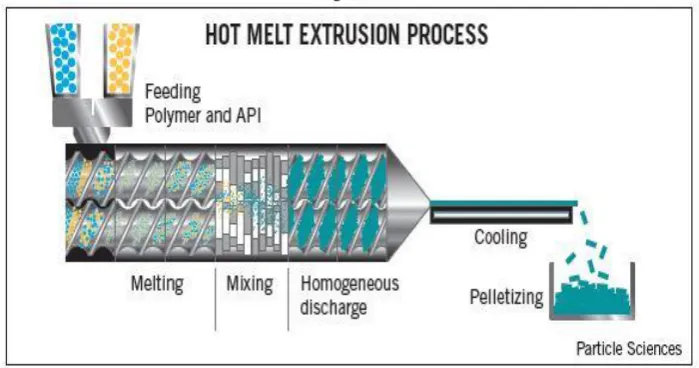
Hot Melt Extrusion[12]
This is newly modified variation of extrusion spheronization method. Here a drug substance
and excipient are converted into molten or semi-molten state and subsequently shaped using
appropriate equipment to provide solid spear or pellets. This is simple, efficient and
continuous process which requires fewer processing stages. It doesn’t require lengthy drying
[image:8.595.136.486.301.485.2]stage since it involve addition of water or other solvent, it disparity to granulation process.
Figure 3: Hot melt extrusion process
CRYOPELLETIZATION[13]
In cryopelletization droplets of liquid formulation are converted into solid spherical particles
or pellets by employing liquid nitrogen as the fixing medium. The pellets are dried in
conventional freeze dryer. The small size of droplets, and hence the large surface area
facilitating the drying process. The most critical step in cryopelletization is droplet
formulation which is influenced not only by formulation related variables, but also by
equipment design and corresponding processing variables. The diameter and design of the
shearing edge of the holes on the container plates are critical.
Freeze Pelletisation[14,15]
Freeze pelletization is a simple and novel technique for producing spherical matrix pellets
www.wjpr.net Vol 4, Issue 06, 2015.
1957
active ingredient is introduced as droplets into an inert and immiscible column of liquid. The
technique involves less process variables and also offers several advantages over other
pelletization methods, In terms of quality of pellets and process cost. The pellets produced by
this technique are spherical in shape with narrow size distribution. Since the pellets are solid
at room temperature, they do not require drying.
Molten solid carriers are introduced as droplets into the column of liquid in which the molten
solid is immiscible. These droplets can move either in upward or downward direction
depending on their density with respect to the liquid in the column and solidify into spherical
pellets. Carrier may be hydrophilic or hydrophobic in nature and re-melted at a temperature
5-10°C higher than the melting point of the carrier solids.
Two type of equipment are used and the selection of equipment depends upon the density of
the molten solid carrier. The column of both the apparatus is divided into two parts, initial
portion from which the molten solid carrier is introduced and maintained between 25-100°C,
and the cooling portion in which droplets solidification occurs and is maintained between 0 to
-40°C using cooling mixture of acetone and dry ice.
The active constituent and other excipients are mixed with the molten carrier to form solution
or dispersion. This solution or dispersion is introduced as droplets using needle or nozzles
into the inlet column of liquid and dropped from a certain height, so that droplets remain
intact as they fall into the liquid column. Size of needle gauge from 16-31 depending on the
size of the pellets desired. In case of freeze pelletizer the molten solid carrier are introduced
from the upper portion of the column because density of the solid carriers is more than the
density of the liquid used in the column and the carriers solidify in the bottom portion, while
in case of freeze pelletizer II the molten solid carrier is introduced from the bottom of the
column because density of the solid carriers low as compared to the liquid used in the column
and the carrier solidify at the top.
Suitable carrier for freeze pelletization are those, which are solid at room temperature and
have melting point below 100°C in order to minimize degradation of the active constituent.
For freeze pelletizer I, hydrophilic carrier such as polyvinyl alcohol, polyethylene glycol and
low melting point sugars (dextrose, maltose) are used. Suitable liquids for column are low
www.wjpr.net Vol 4, Issue 06, 2015.
1958
For freeze pelletizer II, hydrophobic carriers of low density such as glyceryl palmitostearate,
glyceryl behenate and glyceryl monostearate are used as solid carriers. Suitable liquids for
column are high density hydrophilic liquids such as liquid glycol, ethyl alcohol, glycerine and
water. For sustained release pellets containing mixture of hydrophilic and hydrophobic solids,
liquids that are immiscible with both hydrophilic and hydrophobic molten solids are used as
cooling liquid in the column.
Christy M. Wyandt,et.al., studied drug release from Wax-based sustained release Matrix
pellets prepared by a novel freeze pelletization technique II. They examined the Drug release
significantly depended on the wax type used and the aqueous drug solubility. The drug
release decreased as the hydrophobicity of wax increased and the drug release increased as
the aqueous drug solubility increased. In glyceryl monostearate(GMS) pellets, drug release
rate decreased as the loading of theophylline increased. On the contrary, the release rate
increased as the drug loading of diltiazem HCl increased in precirol pellets. Theophylline at
low drug loads existed in a dissolved state in GMSpellets and the release followed desorption
kinetics. At higher loads theophylline existedin a crystalline state and the release followed
dissolution-controlled constant release for all the waxes studied.
Evaluation of pellets[17,18] Size of pellets
Size of pellets has a great importance because it has significant effect on release kinetics. Size
determination studies are performed with the help of mechanical sieve shaker or Vernier
caliper.
Surface morphology
Scanning Electron Microscopy has been used to study the surface morphology and cross
section of pellets.
Pellets Shape
Sphericity is the most important characteristic is important characteristic and lots of method
are used to determine it. The shape factor estimates the amount by which the projected image
of particles deviate from a circle and it is calculated by means of projected area of the pellets
and its circumference. For acceptable quality of pellets the roundness index/shape factor
should be between 1 and 1.2. for a perfectly circular projected image, the shape factor should
www.wjpr.net Vol 4, Issue 06, 2015.
1959
by microscope is and stereomicroscope is another method to determine shape of pellets one
plane critical stability which an angle at which a plane has to be tilted before a particle begin
to roll, is one of the important method.
Friability
The mechanical properties of pellets are important for processing. Pellets flake off during
handling and coating process resulting in formulation of dust. In the case of subsequent
coating it is desirable to have pellets with a low friability. Friability of pellets are determined
by using Erweka type pellets friabilator or turbuls mixture for fixed period of time combined
with a glass bed of certain diameter in order to generate abrasion. Friability can also be
determined by fluidised bed with wurster insert by using stream of air.[17]
REFERENCE
1. Manivannan R, parthiban KG, Sandeep G, balasubramaniam A, Senthikumar N,
multiparticulate drug gelivery system : pellets and pelletization technique. Drug invention
Today, 2010; 2(5): 233-237.
2. Davices GSI. Pharmaceutical Pelletization technology Vol. 37 Marcell Dekker INC;
1989; 30-100.
3. Ragnnarrson G, sandberg A, Johnsson MO,Sjogren J, Development of a new controlled
release metoprolol, product. Drug Dev Indpharma, 1987; 13: 1495-1509.
4.KristensenHG,Schaefer T, Granulation A review of pharmaceutical wet granulation. Drug
devind pharm, 1987; 13: 803-872.
5. EskilsonC.controlled release by microencapsulation Manufchem, 1985; 56: 33-41.
6. Hirjau M, nicoara AC, hirjau V, LupuleasaD.Pelletization techniques used in
pharmaceutical fields.PracticaFarmaceutica, 2014; 3(4): 206-11.
7. Ghai D. Pelletization: an alternate to granulation pharma Times 2011 January, 2011;
43(1): 13-15.
8. Davices GSI. Pharmaceutical Pelletization Technology. Marcel Dekker inc., 1989; 37;
30-100.
9. Special delivery: Advances in Drug Therapy, The Research News,University of
Michigan1986.1
10.Nakahara N.Method and Apparatus for Making Spherical Granules US Patent, 1964; 3:
www.wjpr.net Vol 4, Issue 06, 2015.
1960
11.11.Harris MR.Ghebre-Sellasie I Formulation Variables. In: Pharmaceutical Pelletization
Technology. Ghebre-Sellassie I, Editor.New York; Marcel dekkar Inc, 1989; 217-39.
12.Wong TW, Cheong WS, Heng PWS, Melt Granulation and PelletizationIn;HandbookOf
Pharmaceutical Granulation Technology. Parikh DM, Editor. Taylor & Francis Group,
2005; 385-406.
13.AtilaHA,Suhelya KH. Preparation of MicropelletsBy Spray Congealling. In:
Multiparticulate Oral Drug Delivery. Ghebre-Sellasie Editor New York: Marcel
DekkarInc, 1937; 17-34.
14.Cheboyina s, Chabliss WG, Wyandt CM. Wax based sustained release matrix pellets
prepared by novel freeze pelletizationtechniues I. Formulation and Process variables
affecting pellets characteristic.Int J Pharma, 200; 359; 158-66.
15.Cheboyina S, ChablissWg, Wyandt CM. A novel pelletization technique for freeze
preparing matrix pellets, Pharma Tech, 2004; 28: 98-108.
16.Indian Pharmacopiea 2007; I.
17.SteckelH;Mindermann-Nogly F. Production of chitosan pellets by extrusion
Spheronization. Eur. J. Pharm. Biopharm, 2004; 57: 107-13.
18. WiwattanapatapeeR; Pengnoo A., Kanjanamaneesathian M, Matchavanich, L.
Janatharangsri, A. Floatting pellets containing bacterial agonist for control sheath blight
of rice formulation, viability and bacterial release studies J.control release, 2004; 95:
455-61.
19. Santosh H .,VeigaF.,Pina MSousa J.J. A study on the effect of drying on the mechanical
properties of pellets and compacted pellets.Eur.J.Pharm.Sci, 2004; 21: 119-29.
20. Lian-Dong H; Yang L, Xing T., Qian Z.,Preparation and invitro/ invivo evaluation of
sustained release Metformine Hydrochloride pellets . Eur. J. Pharm Biopharm, 2006; 64:
185-92.
21.21. Mezreb N., Charrueau C., Boy P.,Allian P.,chaumeil J.C. Production of Carbapol
947P and Carbapol 971P pellets by extrusion spheronization. Optimisation of the