www.wjpr.net Vol 8, Issue 13, 2019.
1172
DEVELOPMENT AND VALIDATION OF RP-HPLC METHOD FOR
SIMULTANEOUS ESTIMATION OF CEFTOLOZANE AND
TAZOBACTAM IN INJECTION
Sujatha J., Maneesh M., Nagamallika G.* and Chandrashekhar B.
Department of Pharmaceutical Chemistry, St. Pauls College of Pharmacy, Nagarjuna Sagar
Road, Turkayamjal, Hyderabad, Telangana 501510, India.
ABSTRACT
A simple, selective, linear, precise and accurate reverse-phase
high-performance liquid chromatography technique was urbanized and
validated for the concurrent determination of Ceftolozane and
Tazobactam in powder for injection. The chromatographic separation
was achieved on Altima C18 4.6×150mm, 5.0 µm column by means of
a mobile phase consisting a mixture of Methanol: Water in a
proportion of 65:35v/v at a flow rate of 1ml/min at room temperature
and detection was carried out at 285nm. The clear chromatography
peaks were identified with retention times of 2.09min for Ceftolozane
and 6.07 min for Tazobactam. The proposed technique was validated
according to ICH guidelines with respect to specificity, linearity,
accuracy, precision, LOD, LOQ and robustness. The linearity was
observed in the concentration range of 10-40µg/ml for Ceftolozane and
5-25µg /ml for Tazobactam. A linear regression coefficient for both drugs was 0.999. The
percentage recovery of Ceftolozane and Tazobactam was 100.9% and 99.6%. The %RSD for
repeatability and intermediate precision was less than 2%. LOD was 0.8µg/ml and 0.9µg/ml
and LOQ was 2.5µg/ml and 2.9µg/ml for Ceftolozane and Tazobactam respectively. The
results of validation parameters were met ICH requirements. Hence, the projected method can
be used for the estimation of Ceftolozane and Tazobactam in powder for injection during
regular and quality-control analysis.
KEYWORDS: Ceftolozane, Tazobactam, Simultaneous estimation, RP-HPLC, Injection.
Volume 8, Issue 13, 1172-1188. Research Article ISSN 2277– 7105
Article Received on 22 Oct. 2019,
Revised on 12 Nov. 2019, Accepted on 02 Dec. 2019,
DOI: 10.20959/wjpr201913-16270
*Corresponding Author
Nagamallika G.
Department of
Pharmaceutical Chemistry,
St. Pauls College of
Pharmacy, Nagarjuna Sagar
Road, Turkayamjal,
Hyderabad, Telangana
INTRODUCTION
Ceftolozane (CZ) is a semisynthetic fifth-generation cephalosporin antibiotic effective
against Gram-negative and positive bacterial infections such as Pseudomonas aeruginosa
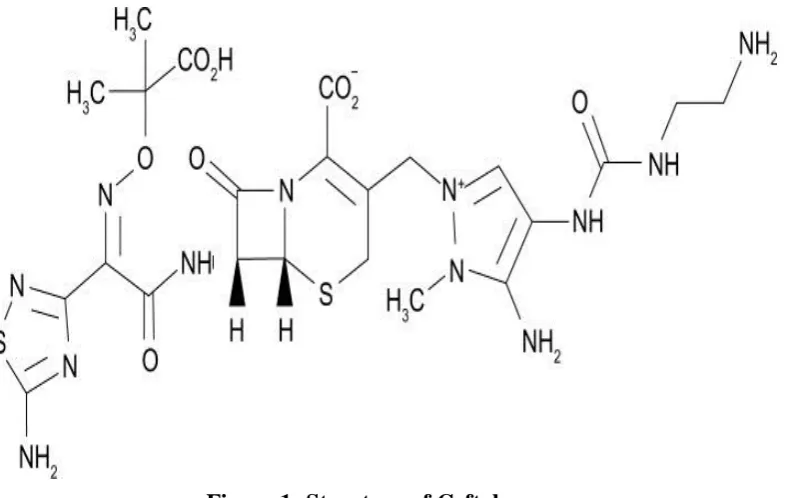
and Escherichia coli. It consisting a β- lactum ring fused with thiadiazole, and is chemically
(6R,7R)-3-[[3-amino-4-
(2-aminoethylcarbamoylamino)-2-methylpyrazol-1-ium-1-yl]methyl]-7- [[(2Z)-2-(5-amino-1,2,4-thiadiazol-3-yl)-2-(2-carboxypropan-2-yloxyimino)
acetyl]amino]-8-oxo-5-thia-1-azabicyclo[4.2.0]oct-2-ene-2-carboxylate, Figure 1 with the
molecular formula of C23H30N12O8S2 and molecular weight is 666.689. It is a white to
off-white powder, soluble in water (0.0884mg/ml). Ceftolozane is penicillin-binding proteins
(PBPs) inhibitor. The bactericidal action is due to inhibition of cell wall biogenisis, by
binding to PBPs of situated on the internal membrane of the bacterial cell wall.[1] Tazobactam
(TZ) is a pencillin antibiotic, and is a penicillanic acid sulfone derivative with antibacterial
activity, chemically it is
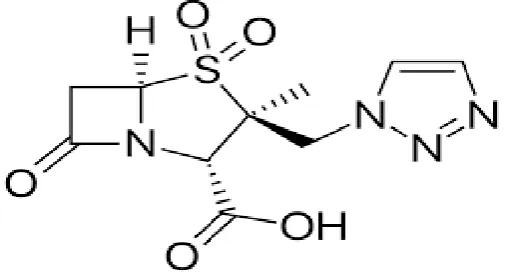
(2S,3S,5R)-3-methyl-4,4,7-trioxo-3-(1H-1,2,3-triazol-1-ylmethyl)-4λ⁶-thia-1-azabicyclo[3.2.0] heptane-2-carboxylic acid, Figure 2with a molecular formula of
C10H12N4O5 and molecular weight is 300.289g/mol. Tazobactam is a crystalline white powder
that is readily soluble in water and moderately soluble in ethanol. Tazobactam is an inhibitor
of beta-lactamase. It irreversibly attaches to effective site of beta-lactamase, thereby
permanently inhibits enzymatic activity and increases the effectiveness of added beta-lactam
antibiotics by protecting them from beta-lactamase catalysis. Tazobactum is also employed as
an antimicrobic and anti-infective agent.[2,4] Because of increasing bacterial resistance
to cephalosporins, sucessfull efforts has been attentive on association of antipseudomonal
ceftolozane with tazobactam for antimicrobial activity against Pseudomonas aeruginosa and
enterobacteriaceae.[5,6] Ceftolozane/tazobactam is a novel antibaterial/β-lactamase inhibitor
approved by the FDA in January 2015 and is marketed under the brand name Zerbaxa™ by
Cubist Pharmaceuticals U.S, from January 22, 2015, is at present a completely owned
subsidiary of Merck & Co., Inc.[7] Ceftolozane/ tazobactam 1.5g(1g/0.5g) fixed dose
combination as powder for injection has been used for treatment of problematical urinary
tract Infections such as pyelonephritis caused by Escherichia coli, Klebsiella pneumoniae,
and in conjuction with metronidazole for cubersome Intra-abdominal Infections produced by
Enterobacteriaceae, Escherichia coli and bacterial pneumonia. Most recently, in June 2019, it
is approved for the cure of hospital-acquired pneumonia, including ventilator-associated
pneumonia.[8] Number of drugs are introducing into the market yearly. There is a time delay
between the date of the preface of a drug into the market and the date of its inclusion in
combination of drugs might not be formal in the pharmacopeias. Some analytical procedures
are not approachable in the piblications due to patent regulations. Therefore, it becomes
essential to build up a newer analytical procedure for such drugs. Literature survey reveals
many analytical methods have been published for simultaneous estimation of Ceftolozane
and Tazobactum in bulk, pharmaceutical dosage forms and in biological samples. These
include high performance liquid chromatography,[9-14] stability indicating,[15,16] and
LC-MS/MS methods.[17-20] The purpose of our study is that HPLC has an increasing growth in the
analysis for the ascertainment of API in various pharmaceutical formulations, which make it
the most accepted and suitable technique for the determination. There are very few HPLC
methods are described for the analysis of Ceftolozane and Tazobactum in powder for
injection. In view of that, a need was felt to develop a suitable HPLC method for the analysis
of CZ and TZ. A fruitful strive has been done to design and develop a new, simple, accurate,
reproducible, and economical method for simultaneous estimation of Ceftolozane and
Tazobactum in powder for injection by RP-HPLC. The projected method was validated in
consonance to specificity, linearity, precision, accuracy, LOD, and LOQ, and robustness as
requisite by the International Conference on Harmonization Q2 (R1) guidelines to support the
[image:3.595.105.499.434.683.2]suitability of the method.[21]
Figure 2: Structure of Tazobactum.
MATERIALS AND METHODS
Materials
Ceftolozane and Tazobactam standard drugs were obtained as contribution samples from
Cubist pharmaceuticals, Hyderabad, India. Methanol and water of HPLC grade were
procured from Lichrosolv, Merck (India) Ltd. Worli, Mumbai, India. The 0.45µ nylon filters
were purchased from Millipore.1g of Ceftolozane equivalent to 1.147g of Ceftolozane
sulphate and 0.5gm of Tazobactam equivalent to 0.537gm of tazobactam sodium powder for
injection as Zerbaxawere purchased from pharmacy, Hyd.
Instruments
The HPLC system (Waters) auto sampler separation module 2695 consisted of high-
pressure pump, PDA detector 996, and 10μL capacity injector loops. The system was well
equipped with empower 2 software for monitoring and processing of data. Other types of
equipment like Sartorius digital weighing balance, Lab India pH meter, and Lab man digital
ultra sonicator were used for sample and standard preparations. The analytical column used
was Altima C18 4.6×150mm packed with a particles size of 5.0μ.
METHODOLOGY
Experimental
The main objective of this experiment was to develop and validate a novel RP-HPLC
method for simultaneous estimation of Ceftolozane and Tazobactum in powder for injection
Selection of wavelength by UV-spectroscopy
From the UV-visible Spectro Photometric results, a detection wavelength of 285nm was
selected. At this wavelength both the drugs exhibited maximum absorbance with superior
peak intensity, excellent peak shape and height.
Selection of the method
Option of the technique be based on the nature of the sample such as Ionic or neutral
molecule, molecular weight and solubility. The drugs used in the current study were polar;
and hence RP- HPLC method was preferred for the original separation because of its
accessibility and appropriateness.
Method Development
The starting point for method developments was following preface studies for the sample.
Preparation of solutions
Mobile phase
650ml of Methanol and 350ml of Water were mixed collectively and the solution was
degassed in digital ultrasonic water bath for 10 minutes and then filtered through 0.45µ filter
under vacuum.
Mobile phase was used as a diluent.
Standard solutions of Ceftolozane and Tazobactam
Each 10mg of Ceftolozane and Tazobactam working standards were accurately weighed and
transferred into a 10ml of the clean dry volumetric flask respectively; about 7ml of diluent
was added, sonicated for 30minutes and made up the volume to 10ml with diluent. From the
above stock solutions, 30µg/ml of Ceftolozane and of 15µg/ml Tazobactam were prepared
by diluting 0.3ml of Ceftolozane and 0.15ml of Tazobactam stock solutions to 10ml with the
diluent.
Preparation of sample solutions
One vial powder was weighed and then the weight equivalent to 10mg of Ceftolozane and
Tazobactam powder for injection was transferred into a 10ml of the clean, dry volumetric
flask, dissolved completely in sufficient diluent, Sonicated for 30min, filtered the solution
solution 30µg/ml of Ceftolozane and 15µg/ml of Tazobactam were prepared by
diluting 0.3ml of Ceftolozane and 0.15ml of Tazobactam to 10 ml with diluent.
Method development Experimental Trials
Various trials were accomplished through diverse chromatographic conditions during the
progress of RP- HPLC.
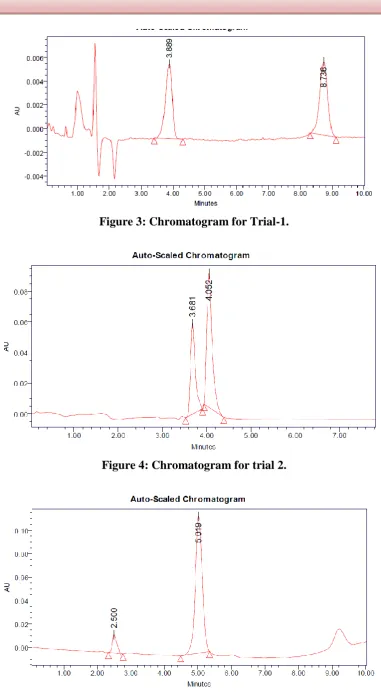
Trial-1 Two peaks were observed. Tazobactum was eluted at 3.889mn and ceftolozane was
eluted at 8.736mn. The peaks were recorded with improper baseline even though resolution
was good.
Trial-2 Tazobactum was eluted at 3.681mn and ceftolozane was eluted at 4.052mn. Peaks
shapes were good but, resolution of chromatogram was not acceptable. So, more trials were
required for obtaining good peaks.
Trial-3 Tazobactum was eluted at 2.50mn and ceftolozane was eluted at 5.019mn. This trial
showed less plate count. So, further trials were needed.
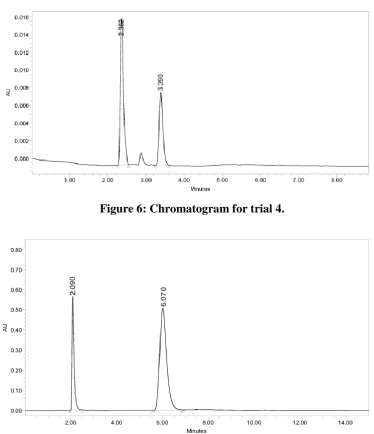
Trial-4 Ceftolozane was eluted at 2.362mn and tazobactum was eluted at 3.390mn. The
peaks were separated with improper base line even the resolution and peaks shapes were
good. So, further trials were essential.
Optimized chromatographic conditions
Optimization of mobile phase was considered from diverse parameters for example
theoretical plate’s count, resolution, and retention time. A mobile phase of Methanol and
Water in the proportion of 65:35% v/v was found to be the most suitable for ideal separation
of Ceftolozane and Tazobactam on Altima C18 4.6×150mm, 5µ column. At this ratio, mobile
phase was forced with a flow rate of 1 ml/min. At this flow rate, the peaks were with good
resolution. So, 1ml/min was remaining constant for entire analysis. The column was set at
ambient temperature and had been equilibrated with mobile phase for 30minutes before the
solutions were injected. 10μl of five replicates of both standard and sample solutions was
introduced into the chromatographic system and the areas of Ceftolozane and Tazobactam
peaks were measured. The detection of drugs was monitored at 285nm. The runtime was set
at 15min. Under these optimized chromatographic conditions, the retention time for both the
drugs was recorded from chromatogram and the % assay was also calculated using the
AS: Average peak area of standard preparation
AT: peak area of assay preparation,
WS: standard weight of ivacaftor/ lumacaftor in mg
WT: Weight of sample in assay preparation
DT: Dilution of assay preparation
DS: dilution of standard preparation
P: purity of ivacaftor /lumacaftor
AV: average weight of tablets in mg
LC: labelled claim of ivacaftor/lumacaftor
Method validation
Validation of the analytical method confirm that the uniqueness of the method if they
persuade the requirements of the method. After progress of method, it was intended to
method validation according to ICH Q2 (R1) guidelines. Method validation includes different
analytical presentation parameters such as specificity, linearity, accuracy, precision, LOD,
LOQ and robustness.
RESULTS AND SCUSSION
Method development trials
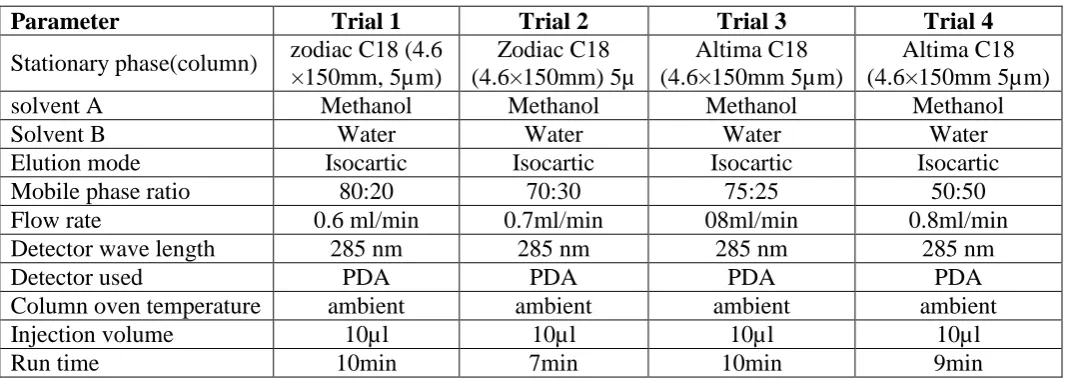
Based on the observations of all trials performed in method development at various
chromatographic conditions are noted in Table 1 and chromatograms are displayed from
Figures 1-4, improved retention times, well resolved peaks and good peak intensity were
observed at optimised chromatographic conditions are listed in Table 2. Hence, this was
considered as the ultimate optimized method in the development process.
Method optimization
In simultaneous estimation of Ceftolozane and Tazobactam by RP-HPLC, the method was
optimized through the evaluation of several solvent mixtures. A solvent system of Methanol:
Water 65:35%v/v on Altima C18 4.6×150mm, 5µ column resulted in sharp, well-defined
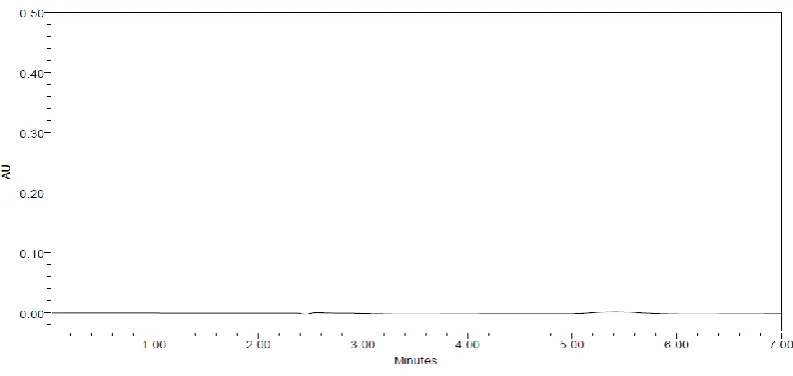
peaks with good resolution and low retention times were about 2.090min for Ceftolozane and
6.070min for Tazobactam at a flow rate of 1 ml/min. The optimized chromatogram is in
100.3% for Ceftolozane and 99.6% for Tazobactam respectively. Assay Results are revealed
[image:8.595.32.573.145.336.2]in Table 4.
Table No 1: HPLC Parameters for trials.
Parameter Trial 1 Trial 2 Trial 3 Trial 4
Stationary phase(column) zodiac C18 (4.6 ×150mm, 5µm) Zodiac C18 (4.6×150mm) 5µ Altima C18 (4.6×150mm 5µm) Altima C18 (4.6×150mm 5µm)
solvent A Methanol Methanol Methanol Methanol
Solvent B Water Water Water Water
Elution mode Isocartic Isocartic Isocartic Isocartic
Mobile phase ratio 80:20 70:30 75:25 50:50
Flow rate 0.6 ml/min 0.7ml/min 08ml/min 0.8ml/min
Detector wave length 285 nm 285 nm 285 nm 285 nm
Detector used PDA PDA PDA PDA
Column oven temperature ambient ambient ambient ambient
Injection volume 10µl 10µl 10µl 10µl
Run time 10min 7min 10min 9min
Table No 2: HPLC Parameters for optimised method.
Parameters Description
Stationary phase(column) Altima C18 4.6×150mm, 5µ
solvent A Methanol
Solvent B Water
Elution mode Isocartic
Mobile phase ratio 65:35
Flow rate Iml/min
Detector wave length 285nm
Detector used PDA
Column oven temperature 30
Injection volume 10µl
Run time 15min
Table No 3: Results for optimized parameters.
Name of the Drug Retention time(min) Peak Area Resolution Tailing factor Theoritical plates
Ceftolozane 2.090 3468547
5.5 1.0 5565.5
Tazobactam 6.070 16289441 1.1 5355.2
Table No 4: Assay Results of Ceftolozane and Tazobactam.
parameters Ceftolozane Tazobactam Standard Sample Standard Sample
Average area 16266580 16276602.33 3438839 3468837
weight of powder 1.5gm
Standard weight 10mg 10mg
Sample weight 0.0102g 0.0279g
Labeled amount 1.147g 0.537g
Std.purity 99.7% 99.7%
Figure 3: Chromatogram for Trial-1.
Figure 4: Chromatogram for trial 2.
[image:9.595.119.476.70.249.2][image:10.595.111.479.64.263.2]
Figure 6: Chromatogram for trial 4.
Figure 7: Optimized Chromatogram.
METHOD VALIDATION
System suitability
After equilibration of the column with mobile phase, five replicates of 10μl standard
solutions were injected. The System suitability of the method was evaluated using parameters
from the recorded chromatograms. The % RSD of replicating injections was less than 1%.
Table No 5: System suitability results for Ceftolozane and Tazobactam
Ceftolozane Tazobactam
Injection No
Rt (min)
Peak Area
Plate count
Tailing factor
Rt (min)
Peak Area
Plate count
Tailing
factor Resolution
1 2.080 3569412 5568.0 1.0 6.056 3582264 5568.0 1.0 5.5
2 2.080 3465125 6359.2 1.1 6.056 3586491 5359.2 1.1 5.5
3 2.080 3598154 5565.5 1.0 6.056 3598154 5565.5 1.0 5.5
4 2.081 3586491 5355.2 1.1 6.057 3564125 5355.2 1.1 5.5
5 2.081 3582694 6348.0 1.0 6.057 3569412 5568.0 1.0 5.5
Mean 3560375 3580089
SD 54225.61 13609.81
%RSD 1.523031 0.380153
Specificity
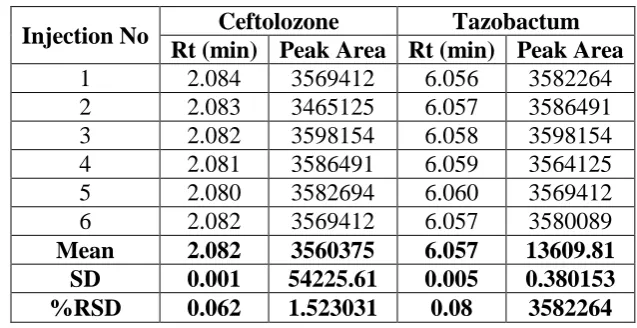
The specificity of the process was evaluated by injecting blank, sample, and standard
preparations into the chromatographic system and chromatograms were compared. It was
distinguished absolutely there was no interference due to excipients from the tablet dosage
form and from solvent at the retention time of analytes peaks and furthermore peaks showed
[image:11.595.99.496.401.589.2]good resolution. The chromatogram of blank preparation is in Figure 6.
Figure 6: Chromatogram of blank preparation.
Linearity
The linearity of response (peak area) for Ceftolozane and Tazobactam was determined in a
concentration range of 10-50μg/ml for Ceftolozane and 5-25μg/ml for Tazobactam. Each
concentration level was injected in replicate into the HPLC system. The linearity was
assessed by the value of the regression coefficient. The correlation coefficient for both drugs
was 0.999 and good correlation was acquired among the peak area and concentration as in
[image:12.595.119.478.272.425.2]
Figure 6: Calibration curve of Ceftolozone.
Figure 7: Calibration curve of Tazobactum.
Table No 6: Linearity results for Ceftolozone and Tazobactum.
Ceftolozone Tazobactum
S. No Concentration (µg/ml)
Average Peak Area
Concentration (µg/ml)
Average Peak Area
1 10 8040800 5 101025
2 20 1431841 10 204937
3 30 2108798 15 307270
4 40 2791392 20 392106
5 50 3458474 25 495281
Slope 68375 1972
Y-intercept 56388 3533
Correlation
coefficient (R2) 0.999 0.999
Accuracy
The accuracy of the technique was resolute by recovery experiments and was performed by the
standard addition method at three concentration levels of 50%, 100%, and 150%. Each strength
was injected thrice into the chromatographic system and the percentage and mean % recoveries
Table No 7: Recovery results of Ceftolozone and Tazobactum.
Ceftolozone Tazobactum
Accuracy Level (%) Amount added (in µg) Amount recovered (in µg) % Reco very Mean % recovery %RSD Amount added (in µg) Amount recovered (in µg) % Recovery Mean % recovery % RSD
50 15 15 100
100.0 0.2
7.5 7.5 100
99.96 0.12
50 15 15.05 100.3 7.5 7.49 99.8
50 15 14.98 99.8 7.5 7.51 100.1
100 30 30 100
100.02 0.06
15 15 100
100.08 0.04
100 30 30.03 100.1 15 15.01 100.06
100 30 29.98 99.96 15 15.02 100.1
150 45 44.7 99.3
99.3 0.06
22.5 22.47 99.86
99.77 0.07
150 45 44.9 99.7 22.5 22.45 99.77
150 45 44.6 99.1 22.5 22.43 99.68
Precision
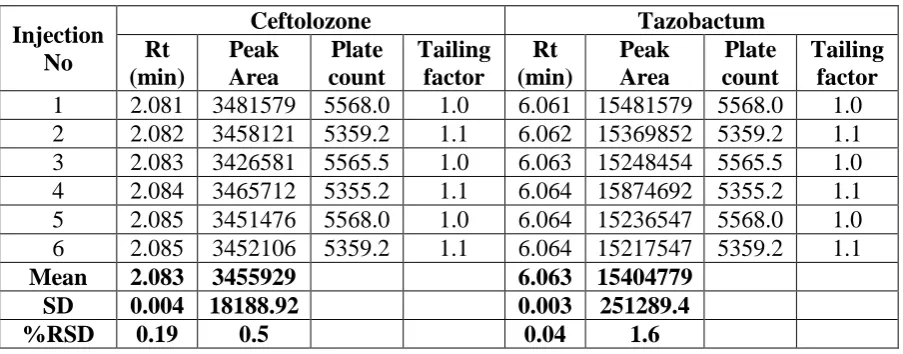
The precision of the method was evaluated by repeatability and intermediate precision
studies. Intraday precision was assessed by six replicates of 100% accuracy and inter-day
precision was evaluated by analyzing six injections of sample solution following the
description of the analytical method by different analysts on dissimilar days using diverse
HPLC and columns of the similar make but dissimilar lot number. The % RSD for the
response factor of both drugs was found to be < 2% and results are revealed in Tables 8 and
9.
Table No 8: Repeatability Results of Ceftolozone and Tazobactum.
Injection No Ceftolozone Tazobactum
Rt (min) Peak Area Rt (min) Peak Area
1 2.084 3569412 6.056 3582264
2 2.083 3465125 6.057 3586491
3 2.082 3598154 6.058 3598154
4 2.081 3586491 6.059 3564125
5 2.080 3582694 6.060 3569412
6 2.082 3569412 6.057 3580089
Mean 2.082 3560375 6.057 13609.81
SD 0.001 54225.61 0.005 0.380153
%RSD 0.062 1.523031 0.08 3582264
Table No 9: Intermediate precision Results of Ceftolozone and Tazobactum.
Injection No
Ceftolozone Tazobactum
Rt (min)
Peak Area
Plate count
Tailing factor
Rt (min)
Peak Area
Plate count
Tailing factor
1 2.081 3481579 5568.0 1.0 6.061 15481579 5568.0 1.0
2 2.082 3458121 5359.2 1.1 6.062 15369852 5359.2 1.1
3 2.083 3426581 5565.5 1.0 6.063 15248454 5565.5 1.0
4 2.084 3465712 5355.2 1.1 6.064 15874692 5355.2 1.1
5 2.085 3451476 5568.0 1.0 6.064 15236547 5568.0 1.0
6 2.085 3452106 5359.2 1.1 6.064 15217547 5359.2 1.1
Mean 2.083 3455929 6.063 15404779
SD 0.004 18188.92 0.003 251289.4
%RSD 0.19 0.5 0.04 1.6
Limit of detection (LOD) and limit of quantification (LOQ)
The limit of detection and quantification was calculated from the signal to noise ratio. This
ratio for LOD is 3:1 and LOQ is 10:1. The limit of detection and quantification was
evaluated from the calibration curves by applying statistical calculations and results are
shown in Table 10.
The limit of detection and quantification were expressed as:
LOD=3.3 σ/S
LOQ=10.0 σ/S Where;
σ = Standard deviation of the response
S = Slope of the regression line
Table No 10: LOD and LOQ results for Ceftolozone and Tazobactum.
Name of the analyte LOD µg/ml LOQ µg/ml
Ceftolozone 0.8 2.5
Tazobactum 0.9 2.9
Robustness
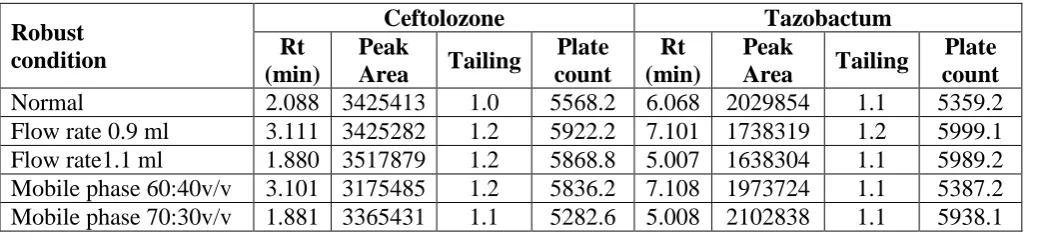
Robustness of the method was demonstrated by analyzing the system suitability parameters
under intentionally modified chromatographic conditions such as flow rate, and mobile phase
ratio on the lower and higher side of the normal values. There was no considerable change in
the retention time between the original method and modifications to the method. The
Table No 11: System suitability results for robustness study of Ceftolozone and
Tazobactum.
Robust condition
Ceftolozone Tazobactum
Rt (min)
Peak
Area Tailing
Plate count
Rt (min)
Peak
Area Tailing
Plate count
Normal 2.088 3425413 1.0 5568.2 6.068 2029854 1.1 5359.2
Flow rate 0.9 ml 3.111 3425282 1.2 5922.2 7.101 1738319 1.2 5999.1
Flow rate1.1 ml 1.880 3517879 1.2 5868.8 5.007 1638304 1.1 5989.2
Mobile phase 60:40v/v 3.101 3175485 1.2 5836.2 7.108 1973724 1.1 5387.2
Mobile phase 70:30v/v 1.881 3365431 1.1 5282.6 5.008 2102838 1.1 5938.1
CONCLUSION
In the present study, quantitative method of analysis of Ceftolozane and Tazobactum in
injection was developed. The proposed solvent system gives good peak symmetry and
resolution between the peaks and method is specific as no interference is observed from the
solvent. ICH Q2 (R1) guidelines were used for validation of the meyhod. As of the
experimental and validation results, the urbanized method for the concurrent estimation of
Ceftolozane and Tazobactum in injection by RP-HPLC is simple, appreciably sensitive,
precise, accurate, and high resolution. Also, the lesser solvent consumption and shorter
retention time show the way to more acceptable, commercial and Eco- friendly
chromatographic procedures. Hence, it can be suitably adopted for routine analysis of API
content in the pharmaceutical formulations of Ceftolozane and Tazobactum in Educational
institutions and Quality control laboratories.
CONFLICTS OF INTEREST
The authors have indicated that they have no competing interest regarding the content of this
article.
ACKNOWLEDGEMENTS
This work was supported by St. Pauls College of pharmacy and Sura labs Pvt. Ltd. The
authors would like to thank for providing research facilities.
REFERENCES
1. https://pubchem.ncbi.nlm.nih.gov/compound/53234134.
2. https://pubchem.ncbi.nlm.nih.gov/compound/Tazobactam.
[image:15.595.42.563.112.232.2]
4. Bonomo RA, Rudin SA, Shlaes DM. Tazobactum is a potent inactivator of selected
inhibitor-resistant class A beta-lacatmases. FEMS Microbiol Lett, 1997; 148(1): 59-62.
5. Shortridge D, Pfaller MA, Castanheira M, Flamm RK. Antimicrobial Activity of
Ceftolozane-Tazobactam Tested against Entero bacteriaceae and Pseudomonas
aeruginosa with Various Resistance Patterns Isolated in U.S. Hospitals (2013-2016) as
Part of the Surveillance Program: Program to Assess Ceftolozane-Tazobactam
Susceptibility. Microb Drug Resist, 2018;24(5): 563-577.
6. Snydman DR, McDermott LA, Jacobus NV. Activity of ceftolozane-tazobactam against a
broad spectrum of recent clinical anaerobic isolates. Antimicrob. Agents Chemother,
2014; 58(2): 1218–23.
7. https://www.drugbank.ca/drugs/DB09050.
8. ZERBAXA (ceftolozane/tazobactam) for Injection, for intravenous use Initial U.S.
Approval: 2014 https://www.accessdata.fda.gov.Reference ID: 3676595.
9. Ashok Marrapu, Veenaeesh, Kartheek Siripurapu, Mani Kumar G. Simultaneous
Estimation of Cefepime HCL and Tazobactam Sodium in Injection Dosage form by
Using RP-HPLC. Int J Pharm Biol Sci, 2013; 3(4): 188-192.
10.Sherif Abdel-Naby Abdel-Gawad, Abdullah Alyalkahtani, Elsadig Hassan Khamis.
Simultaneous Quantification of Ceftolozane and Tazobactam by Reversed Phase – HPLC
in Pure and Dosage Forms. Int J Biol Pharm Alli Sci, 2015; 4(10): 6211-6219.
11.Shabana Sulthana MD, Anuradha V, Mandava V Basaveswara Rao. Determination of
Ceftalazone and Tazobactum in Bulk and Pharmaceutical Dosage Forms by RP-HPLC.
Der Pharma Chemica, 2017; 9(12): 157-162.
12.Vegesna Swetha, N.L. Durga Bhavani, S. V. U. M. Prasad. Method Development and
Validation for the Simultaneous Estimation of Ceftolozane and Tazobactam by RP-HPLC
Method in Pure and Pharmaceutical Dosage Form. Asian J Pharm Anal Med Chem,
2017; 5(1): 23-31.
13.Subbareddy P, Divakar TE. Analytical Method Development and Validation for the
Simultaneous Estimation of Ceftolozane and Tazobactum in Bulk and Pharmaceutical
Dosage Form by RP-HPLC. Int J Res Pharm Sci, 2018; 1(10): 704-709.
14.Dr. K. Nageswara Rao, Raghava Doonaboyina, R. Mahesh Babu. Analytical Method
Development and Validation for the Simultaneous Estimation of Ceftolozane and
Tazobactam in Its Bulk and Pharmaceutical Dosage Forms. Am J Chem Pharm
15.Bangaruthalli J, Nagabharathi M, Hemalatha N, Sailaja Kumari R, Kusumapriya N.
Development and Validation of Stability Indicating Method for Simultaneous Estimation
of Ceftolozane and Tazobactum by Using RP-HPLC. Int J Sci Dev Res, 2019; 4(1):
292-299.
16.Vipul J. Panchal, Hemant T. Desai, Ashwin G. Dave. Development and Validation of
Stability Indicating Method for Simultaneous Estimation Of Ceftriaxone and Tazobactam
Injection Using RP-HPLC Method. Int J Pharm Sci Res, 2014; 5(6): 2398-2405.
17.Ezquer-Garin C, Ferriols-Lisart R, Alós-Almiñana M, Aguilar-Aguilar G, Belda-Nacher
JF, Carbonell JA. Validated HPLC-UV Detection Method For The Simultaneous
Determination of Ceftolozane and Tazobactam In Human Plasma. Bioanalysis, 2018;
10(7): 461-473.
18.Kratzer A, Schieber S, Matzneller P, Wulkersdorfer B, Zeitlinger M, Schlossmann J, et al.
Determination of Total and Free Ceftolozane and Tazobactam In Human Plasma And
Interstitial Fluid By HPLC-UV. J Pharm Biomed Anal, 2019; 163: 34-38.
19.Raúl Rigo-Bonnina, Joan Gomez-Junyentb, Laura García-Tejadaa, Eva Benaventb, Laura
Soldevilab, Fe Tubauc, et al. Measurement of Ceftolozane and Tazobactam
Concentrations in Plasma by UHPLC-MS/MS. Clinical Application in the Management
of Difficult-To-Treat Osteoarticular Infections. Clin Chim Acta, 2019; 488: 50-60.
20.Christina A. Sutherland, David P. Nicolau. Development of an HPLC Method for the
Determination of Ceftolozane/Tazobactam in Biological and Aqueous Matrixes. J
Chromatogr Sci, 2016; 54(6): 1037–1040.