FORMULATION AND EVALUATION OF PHASE CHANGE
SOLUTION BY USING DIFFERENT TRIGGERING MECAHNISM
FOR OPHTHALMIC GEL
Deepak G. Wagh*, Dr. Sadhana R. Shahi, Mangesh Kahane, Priyanka D. Dabir, Sagar Patil
Department of pharmaceutics, Government College of Pharmacy, Opp. Govt. Polytechnic,
Osmanpura, Aurangabad, Maharashtra, India.
ABSTRACT
The optimal drug concentration required at the site of action for the
ocular treatment cannot be attained mainly due to precorneal drug loss;
tear turn over, solution drainage by gravity and naso-lachrymal
drainage. The purpose of present work was to overcome these
problems by developing an in situ gel forming systems. Major progress
has been made recently in ophthalmic drug delivery systems in the
form of improved levels of patient acceptance and more specifically
development of droppable gels (in situ forming gels).The droppable
gels are liquid upon instillation and they undergo a phase transition in
the ocular cul de sac to form a viscoelastic gel and this provides a
response to environmental changes. Parameters that can change and
trigger the phase transition of droppable gels include pH, temperature
and ionic strength. In addition to this combination system also reported. Three methods have
been employed to cause phase transition on the surface because of change in temperature, pH
and ion composition.[1]
KEYWORDS: In situ ophthalmic gel, Nepafenac, Gelrite, Ion sensitive gelling system, HPMC E 50LV, Xanthan gum.
INTRODUCTION
Ocular drug delivery has remained as one of the most challenging task for pharmaceutical scientists. The unique structure of the eye restricts the entry of drug molecules at the required
Volume 6, Issue 6, 667-678. Research Article ISSN 2277– 7105
*Corresponding Author
Deepak Wagh
Department of
pharmaceutics, Government
College of Pharmacy, Opp.
Govt. Polytechnic,
Osmanpura, Aurangabad,
Maharashtra, India. Article Received on 23 March. 2017,
Revised on 13 April. 2017, Accepted on 03 May. 2017
site of action. Topical application of drugs to the eye is the most popular and well-accepted route of administration for the treatment of various eye disorders. The challenge to the
formulator is to circumvent the protective barriers of the eye without causing permanent
tissue damage.[2]
Conventional systems like eye drops, suspensions and ointments cannot be considered optimal in the treatment of vision threatening ocular diseases. However, more than 90% of the marketed ophthalmic formulations are in the form of eye drops. These formulations mainly target the anterior segment eye diseases. Most of the topically applied drugs are washed off from the eye by various mechanisms (lacrimation, tear dilution and tear turnover) resulting in low ocular bioavailability of drugs. Moreover, human cornea comprising of epithelium, substantia propria and endothelium also restricts the ocular entry of drug molecules. As a result of these factors less than 5% of administered drug enters the eye. The bioavailability of ophthalmic drugs is, however, very poor due to efficient protective
mechanisms of the eye. Blinking, baseline and reflex lachrymation, and drainage remove
rapidly foreign substances, including drugs, from the surface of the eye. Moreover, the
anatomy, physiology and barrier function of the cornea compromise the rapid absorption of
drugs[2]
A considerable amount of effort has been made in ophthalmic drug delivery since the
1970s.The various approaches attempted in the early stages can be divided into two main
categories: bioavailability improvement and controlled release drug delivery.
An ideal ophthalmic drug delivery system should possess following characteristics,
1. A good corneal penetration.
2. A prolonged contact time with corneal tissue.
3. Simplicity of instillation for the patient. [2-3]
This novel drug delivery system promotes the ease and convenience of administration,
deliverance of accurate dose as well as to prolong residence time of drug in contact with
mucosa, that problems generally encountered in semisolid dosage forms.[2-4] In situ gel formation occurs due to one or combination of different stimuli like pH change, temperature
modulation and solvent exchange. Smart polymeric systems represent promising means of
forming gels are liquid upon instillation and undergo phase transition in the ocular cul-de-sac
to form viscoelastic gel and this provides a response to environmental changes.[4]
MATERIALS AND METHOD
Nepafenac was received as gift sample from Ajanta Pharma Ltd Mumbai, Gellan gum,
Sodium alginate, Pluronic F-127, Hydroxyethylcellulose and Hypromellose METHOCEL E
50 LV, Carbopol-940, were procured as gift samples from Signet and Dow chemical,
Mumbai. Benzalkonium Chloride, mannitol, gift sample from Merck
All other reagents and chemicals used of analytical grade.
EXPERIMENTAL
IA. Phase transition solution of nepafenac based on ion sensitive mechanism (Gellan
gum)
Gellan gum which is known to undergo transition from sol to gel in the presence of captions
present in tear fluid (Ca2+, Na+) was used in different concentration to form in situ gelling ophthalmic solutions of Nepafenac.[5]
Preparation of solution A
Accurately weighed quantity of SBE-β-cyclodextrin was dissolved in 30 ml deionized water
followed by the addition of accurately weighed quantity of nepafenac. The mannitol, Boric
acid and Benzalkonium chloride was added to above mixture with continuous stirring.
Preparation of solution B
The Gellan gum were sprinkled over 50 ml of boiling water and was allowed to hydrate for
15 min to produce a clear solution.
Compounding of ophthalmic solution
The solution B was mixed slowly to solution A with continuous mechanical stirring to
produce clear and transparent solution. The pH of formulation was checked and adjusted with
0.1 N NaOH and volume was made up with deionized water to 100ml.
Sterilization /Filtration of ophthalmic formulation
The final formulation was sterilized by autoclaving at 121°C for 15 min or by filtration
RESULTS AND DISCUSSION
1 Characteristics of individual polymers for in situ gelling ophthalmic formulations
Gelling ability of ophthalmic formulations prepared using individual polymers i.e., sodium
alginate, gellan gum and poloxamer 407 is found to be dependent on both the type and the
concentration of the gelling polymers. The range of individual polymer concentration was
selected as per literature. It was observed that gellan gum showed gelling ability in very less
concentration (> 0.5%) while sodium alginate required 1-2 % concentration. In case of
poloxamer 407, unlike the gellan gum and sodium alginate, the concentration required to
form satisfactory gels is much higher (more than 16%).
Table 1: In situ gelling ophthalmic formulations of Nepafenac using gellan gum
Code Drug (% w/v) Gellan gum (%w/v) Mannitol (%w/v) Boric acid (%w/v) Benzalkonium chloride (%w/v) Double Distilled water
G1 0.3 0.1 5 0.3 0.01
q. s. up to 100 ml
G2 0.3 0.2 5 0.3 0.01
G3 0.3 0.3 5 0.3 0.01
G4 0.3 0.4 5 0.3 0.01
G5 0.3 0.5 5 0.3 0.01
Table 2: In situ gelling ophthalmic formulations of Nepafenac using gellan gum and various viscosity modifiers
Code* Drug (%w/v) Gellan gum (%w/v) HEC (%w/v) Methocel E50 LV (%w/v)
Carbopol (%w/v) Xanthan Gum (%w/v) Double Distilled water
GE1 0.3 0.5 0.1 - - -
q.s up to 100 ml
GE2 0.3 0.5 0.2 - - -
GE3 0.3 0.5 0.3 - - -
GM1 0.3 0.5 - 0.2 - -
GM2 0.3 0.5 - 0.4 - -
GM3 0.3 0.5 - 0.6 - -
GC1 0.3 0.5 - - 0.1 -
GC2 0.3 0.5 - - 0.2 -
GC3 0.3 0.5 - - 0.3 -
GX1 0.3 0.5 - - - 0.1
GX2 0.3 0.5 - - - 0.2
GX3 0.3 0.5 - - - 0.3
*each formulation contains 5 %w/v mannitol ,boric acid 0.3% and 0.01 %w/v Benzalkonium
[image:4.595.35.561.290.395.2]IB. Phase transition solution of nepafenac based on ion sensitive mechanism (sodium
alginate)
Preparation of solution A
Accurately weighed quantity of SBE-β-cyclodextrin was dissolved in 30 ml deionized water
followed by the addition of accurately weighed quantity of nepafenac. The mannitol, Boric
acid and Benzalkonium chloride was added to above mixture with continuous stirring.
Preparation of solution B
The sodium alginate were sprinkled over 50 ml of boiling water and was allowed to hydrate
for 15 min to produce a clear solution.
Compounding of ophthalmic solution
The solution B was mixed slowly to solution A with continuous mechanical stirring to
produce clear and transparent solution. The pH of formulation was checked and adjusted with
0.1 N NaOH and volume was made up with deionized water to 100ml.
Sterilization /Filtration of ophthalmic formulation
The final formulation was sterilized by autoclaving at 121°C for 15 min or by filtration
through 0.22µ PVDF filter 47mm (make: Millipore)
Table 3: In situ gelling ophthalmic formulations of Nepafenac using sodium alginate
Code Drug (% w/v)
Sodium alginate (%w/v)
Mannitol (%w/v)
Boric acid (%w/v)
Benzalkonium chloride(%w/v)
Double Distilled water
S1 0.3 0.5% 5 0.3 0.01
q.s. to 100ml
S2 0.3 1% 5 0.3 0.01
S3 0.3 1.5% 5 0.3 0.01
S4 0.3 2% 5 0.3 0.01
S5 0.3 2.5% 5 0.3 0.01
Table 4: In situ gelling ophthalmic formulations of Nepafenac using sodium alginate and various viscosity modifiers
Code Drug (%w/v)
Sodium alginate (%w/v)
HEC (%w/v)
Methocel E50 LV (%w/v)
Carbopol 940 (%w/v)
Xanthan Gum (%w/v)
Double Distilled water
SE1 0.3 2 0.1 - - -
q.s to 100ml
SE2 0.3 2 0.2 - - -
SE3 0.3 2 0.3 - - -
SM1 0.3 2 - 0.2 - -
SM2 0.3 2 - 0.4 - -
SM3 0.3 2 - 0.6 - -
SC2 0.3 2 - - 0.2 -
SC3 0.3 2 - - 0.3 -
SX1 0.3 2 - - - 0.1
SX2 0.3 2 - - - 0.2
SX3 0.3 2 - - - 0.3
*each formulation contains 5 %w/v mannitol ,Boric acid 0.3% and 0.01 %w/v Benzalkonium
chloride
II. Phase transition solution of nepafenac based on Temperature sensitive mechanism(poloxamer 407)
Poloxamer which is known to undergo transition from sol to gel at the physiological
temperature (35-37°C) was used in different concentration to form in situ gelling ophthalmic
solutions of brimonidine tartrate.[6]
Table 5: In situ gelling ophthalmic formulations of Nepafenac using poloxamer 407
Code Drug (% w/v) Poloxamer (%w/v) Mannitol (%w/v) Boric acid (%w/v) Benzalkonium chloride(%w/v) Double Distilled water
P1 0.3 14 5 0.3 0.01
q.s. to 100 ml
P2 0.3 16 5 0.3 0.01
P3 0.3 18 5 0.3 0.01
P4 0.3 20 5 0.3 0.01
P5 0.3 22 5 0.3 0.01
Table 6: In situ gelling ophthalmic formulations of Nepafenac using poloxamer and various viscosity modifiers
Code Drug (%w/v) Poloxamer (%w/v) HEC (%w/v) Methocel E50 LV (%w/v) Carbo pol 940 (%w/v)
Xanthan Gum (%w/v)
Double Distilled water
PE1 0.3 18 0.1 - - -
q.s. to 100 ml
PE2 0.3 18 0.2 - - -
PE3 0.3 18 0.3 - - -
PM1 0.3 18 - 0.2 - -
PM2 0.3 18 - 0.4 - -
PM3 0.3 18 - 0.6 - -
PC1 0.3 18 - - 0.1 -
PC2 0.3 18 - - 0.2 -
PC3 0.15 18 - - 0.3 -
PX1 0.15 18 - - - 0.1
PX2 0.15 18 - - - 0.2
PX3 0.15 18 - - - 0.3
*each formulation contains 5 %w/v mannitol, Boric acid 3% and 0.01 %w/v Benzalkonium
1.1 Physical characteristics of ophthalmic formulations prepared with the individual polymer
Table 7: Physical characteristics of ophthalmic formulations prepared with gellan gum
Code Drug (% w/v)
Gellan gum
Appearance
and clarity Ph Osmolality Gelling ability
G1 0.15 0.1 +++ 6.42 271 -
G2 0.15 0.2 +++ 6.62 276 ++
G3 0.15 0.3 +++ 6.65 288 +++
G4 0.15 0.4 +++ 6.75 292 +++
G5 0.15 0.5 +++ 6.83 311 +++
Table 8: Physical characteristics of ophthalmic formulations prepared with gellan gum and with viscosity modifier
Code Appearance
& clarity pH Gelling ability
G3 +++ 6.65 +++
GE1 +++ 6.72 +++
GE2 +++ 6.75 +++
GE3 +++ 6.79 +++
GM1 +++ 6.74 +++
GM2 +++ 6.80 +++
GM3 +++ 6.85 +++
GC1 + 4.28 +++
GC2 + 4.23 +++
GC3 + 4.19 +++
GX1 ++ 6.66 +++
GX2 ++ 6.73 +++
GX3 ++ 6.79 +++
Clarity (-) Turbid
(+) Slightly turbid
(++) Clear solution
(+++) Clear and transparent
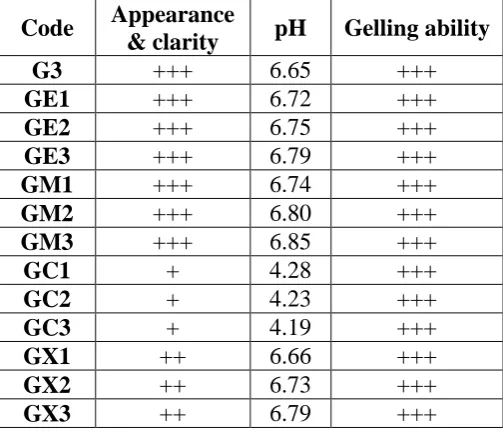
Formulations with gellan gum in polymer concentration 0.3% w/v and viscosity modifiers i.e.
Hydroxyethylcellulose, xanthan gum in concentration 0.1% to 0.3% and Methocel E50 LV in
concentration 0.2%,0.4%,0.6% were found to be clear. The carbopol formulations GC1, GC2,
GC3 were found to be slightly turbid, this is because carbopol at lower pH shows hazy
behavior within 60 seconds and had stable gel structure. pH of all the formulations were in
the range of 4.19-6.85.
The plain gellan gum formulation (G3) gels showed moderate mucoadhesive property
because of anionic nature. By addition of HPMC polymers (HEC, Methocel E50 LV) in
gellan gum, there was marginal increase in mucoadhesive property. While addition of
carbopol and xanthan gum showed increase in mucoadhesive property because of anionic
nature of both polymers, free COOH group in these polymers forms hydrogen bonds with
mucin. As concentration of mucoadhesive polymer increased there was increase in
mucoadhesive property.
Gelling ability (-) No phase transition
(+) Phase transition after 60 sec, collapse of gel structure within 1-2 hrs
(++) Phase transition after 60 sec, collapse of gel structure within 3-4 hrs
(+++) Phase transition within 60 sec and gel structure stable for more than 6 hrs
1.2 Appearance/ clarity
The formulations were found to be clear. All the formulations were free from any suspended
particulate matter when observed carefully against a dark and white background.
1.3 pH of ophthalmic formulations
pH of the ophthalmic formulations prepared using gellan gum as gelling agent ranged
between 6.42-6.83. These pH values are considered to be acceptable since the ophthalmic pH
ranges between 4.4 –7.4. Hence, no discomfort excessive tear flux may occur on installation.
The appearances of formulations containing gellan gum in varying concentrations, 0.1% to
0.5% w/v were found to be clear. The formulation G1 was not forming gel at 37oC in STF. The formulation G2 required more time to form gel in STF. Also formulations G4, G5 were
very thick solution and forms gel immediately in STF. The formulation G3 has good clarity
and gelling property. So among all the formulations, G3 was selected for further studies.
1.4 Osmolality of Ophthalmic formulations
Osmolality of ophthalmic formulation prepared by using all triggering mechanism ranged
between 260-320 mOsm/Kg. it should be matching with tear lacrimal fluid to avoid the
Table 9: Physical characteristics of ophthalmic formulations prepared with sodium alginate
Code Drug
(% w/v)
Sodium alginate (%w/v)
Appearance
and clarity pH Osmolality
Gelling ability
S1 0.15 0.5 ++ 6.18 270 -
S2 0.15 1 ++ 6.57 275 ++
S3 0.15 1.5 ++ 6.86 280 ++
S4 0.15 2 ++ 6.80 290 +++
S5 0.15 2.5 - 6.94 310 +++
Table 10: Physical characteristics of ophthalmic formulations prepared with sodium
alginate and viscosity modifier
Code Appearance &
clarity pH Gelling ability
S4 ++ 6.80 +++
SE1 ++ 6.87 +++
SE2 ++ 6.83 +++
SE3 ++ 6.62 +++
SM1 ++ 6.29 +++
SM2 ++ 6.48 +++
SM3 ++ 6.69 +++
SC1 + 4.61 +++
SC2 + 4.54 +++
SC3 + 4.45 +++
SX1 ++ 5.61 +++
SX2 ++ 5.52 +++
SX3 ++ 5.34 +++
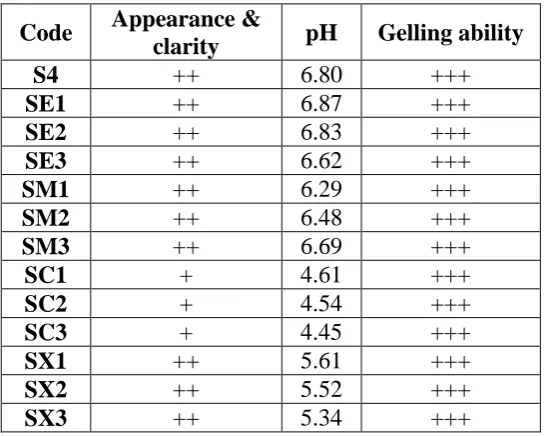
Formulations with sodium alginate in polymer concentration 2% w/v and viscosity modifiers
i.e. hydroxyethylcellulose, xanthan gum in concentration 0.1% to 0.3% and Methocel E50
LV in concentration 0.2%,0.4%,0.6% were found to be clear. While formulation SC1, SC2
and SC3 contains carbopol 940 as viscosity modifier was found to be slightly turbid, this is
because carbopol at lower pH shows hazy appearance. The gelling ability of the selected
formulations was also having phase transition behavior within 60 seconds and had stable gel
structure. pH of all the formulations were in the range of 4.45-6.87.
The plain sodium alginate (S4) formulations gels are inhomogeneous appearance. They
showed moderate mucoadhesive property because of anionic nature. By addition of HPMC
polymers (HEC, Methocel E 50 LV) only marginal increase in mucoadhesive strength, this is
because HPMC was poor mucoadhesive polymer due to its neutral nature. With carbopol and
[image:9.595.68.514.112.216.2] [image:9.595.162.435.267.485.2]polymers. Free COOHgroup present in all these polymers forms hydrogen bonds with mucin.
As concentration of mucoadhesive polymer increased there was increase in mucoadhesive
property.
Table 11: Physical characteristics of ophthalmic formulations prepared with poloxamer 407
Code Drug
(% w/v)
Poloxamer (%w/v)
Appearance
and clarity pH Osmolality
Gelling ability
P1 0.15 14 +++ 6.15 272 -
P2 0.15 16 +++ 5.82 274 -
P3 0.15 18 +++ 5.90 285 +++
P4 0.15 20 +++ 5.65 297 +++
P5 0.15 22 +++ 6.3 302 +++
Table 12: Physical characteristics of ophthalmic formulations prepared with poloxamer 407 with viscosity modifier
Code Appearance
& clarity pH Gelling ability
P3 +++ 5.90 +++
PE1 +++ 5.94 +++
PE2 +++ 5.98 +++
PE3 +++ 6.04 +++
PM1 +++ 5.97 +++
PM2 +++ 6.02 +++
PM3 +++ 6.10 +++
PC1 + 4.54 +++
PC2 + 4.50 +++
PC3 + 4.46 +++
PX1 ++ 5.71 +++
PX2 ++ 5.78 +++
PX3 ++ 5.81 +++
The formulations were found to be clear. All the formulations were free from any suspended
particulate matter when observed carefully against a dark and white background. pH of the
ophthalmic formulations prepared using poloxamer 407 as gelling agent ranged between
5.65-6.3. These pH values are considered to be acceptable since the ophthalmic pH ranges
between 4.4 –7.4. Hence, no discomfort excessive tear flux may occur on installation.
The poloxamer containing formulations at varying concentrations, 14% to 22% w/v were
found to be very clear. But formulations P1, P2 were not forming gel at 37oC in STF. formulation P4,P5 was formed gel immediately at room temperature. Hence, the formulation
The increase in concentration of individual polymers increased gellability of the ophthalmic
formulations and imparted greater shear thinning property. However, the gels were less
viscous and could not remain stable. Hence, different polymers were added to modify the
viscosity and to prolong the release of drug.
Viscosity modifying polymers like hydroxyethylcellulose, carbopol 940 and xanthan gum in
concentration 0.1% to 0.3% and Methocel E50 LV in concentration 0.2%, 0.4% and 0.6%
were added in formulations containing selected concentration of in situ gelling polymer.
Formulations with poloxamer 407 in polymer concentration 18% w/v and viscosity modifiers
i.e. hydroxyethylcellulose, xanthan gum in concentration 0.1% to 0.3% and methocel E50 LV
in concentration 0.2%,0.4%,0.6% were found to be glassy clear. While formulation PC1, PC2
and PC3 contains carbopol 940 as viscosity modifier was found to be slightly turbid, this is
because carbopol at lower pH shows hazy appearance. The gelling ability of the selected
formulations was also having phase transition behavior within 60 seconds and had stable gel
structure. pH of all the formulations were in the range of 4.46-6.10.
CONCLUSION
It can be concluded that different triggering mechanism successfully implemented to see the
effect of formulation parameters on in situ gel formulation with pH and gelling capacity.
Amount of Gelrite, sodium alginate and poloxomer identified and with different viscosity
agent. Based on that we employed to conduct design of experimentation. From the
experiments, it can be concluded that if formulation parameters were operated within the
proposed pH and gelling agent ,From this study it can be concluded that formulation prepared
within specified limit to produce optimised gelling capacity and it can produce formulation
with acceptable
REFERENCES
1. Rajpal RK, Ross B. (Bromfenac ophthalmic solution for the treatment of postoperative
ocular pain and inflammation : safety, efficacy, and patient adherence). Patient Preference
and Adherence, 2014; 925-931.
2. Carreno E, Portero A, Galarreta DJ, Herreras JM. (Update on twice-daily bromfenac to
treat postoperative ocular inflammation following cataract extraction). Sci. Med.
3. Gill HK, Bhagat S. (A novel in situ gel for sustained ophthalmic delivery of
Ciprofloxacin hydrochloride and diclofenac sodium : design and characterization). World
Journal of Pharmacy and Pharmaceutical Sciences, 2015; 4(10): 1347-56.
4. Shaikh A, Farheen T, Shahi S, Zaheer Z. (Formulation development and evaluation of
ion sensitive in situ ophthalmic gel of Olapatadine hydrochloride). World Journal of
Pharmacy and Pharmaceutical Sciences, 2015; 4(10): 2059–71.
5. Rao M, Shelar SU. (Controlled release ion sensitive floating oral in situ gel of a
prokinetic drug using gellan gum). Indian Journal of Pharmaceutical Education and
Research, 2015; 49(2): 158-67.
6. Vengurlekar P, Singh A, Rathod S. (Microspheric in situ gel for ocular drug delivery
system of bromfenac sodium). International Journal of Pharma Sciences and Research,