A NEW ANALYTICAL METHOD DEVELOPMENT & VALIDATION
FOR THE ESTIMATION OF OLMESARTAN MEDOXOMIL AND
CILNIDIPINE IN ITS PHARMACEUTICAL DOSAGE FORM BY UPLC
AS PER ICH GUIDE LINES
K. Santhosh Nayak* and K. Pramod
Venkateshwara Institute of Pharmaceutical Sciences, Nalgonda.
ABSTRACT
A simple, accurate, precise, sensitive, rapid UPLC method has been
developed and validated for determination of Olmesartan medoxomil
and Cilnidipine in its pharmaceutical dosage form. Chromatographic
separation was achieved on a BEH C18 column(100 ×2.1mm,1.7), by a
mobile phase consisted of Ph3.5 buffer, maintained with ortho
phosphoric acid and methanol in 35:65(V/V) ratio with a flow rate of
0.3 ml/min. The detection wavelength was set at 254 nm. Olmesartan
medoxomil and Cilnidipine was subjected to different stress
conditions. The degradation products, when any, were well resolved
from the pure drug with significantly different retention time values. The method was linear
(r = 0.999) at a concentration range of 0.2-0.3μg/ml. The intra and inter day precisions were
satisfactory; the relative standard deviations did not exceed 2%. The accuracy of the method
was proved; the mean recovery of Olmesartan medoxomil and Cilnidipine was
99.04-101.58%. The proposed method has high throughput as the analysis involved short run-time
(3.20 mins). The method met the ICH/FDA regulatory requirements. The proposed method
was successfully applied for the determination of Olmesartan medoxomil and Cilnidipine
with acceptable accuracy and precisions; The results demonstrated that the method can be
applied successfully for routine use in quality control industry laboratories.
KEYWORDS: Olmesartan medoxomil and Cilnidipine, UPLC.
Volume 6, Issue 12, 1046-1057. Research Article ISSN 2277– 7105
Article Received on 15 August 2017,
Revised on 05 Sept. 2017, Accepted on 25 Sept. 2017
DOI: 10.20959/wjpr201712-9760
*Corresponding Author
K. Santhosh Nayak
Venkateshwara Institute of
Pharmaceutical Sciences,
1. INTRODUCTION
Cilinidipine is a dihydropyridine calcium channel blocker and chemically it is 3-O-(2-
Methoxyethyl)5-O-[(E)-3-phenylprop-2-enyl]2,6-dimethyl-4-(3-nitrophenyl)-1,4-dihydropyridine-3,5-dicarboxylate and it is a unique Ca2+ channel blocker with an
inhibitoryaction on the sympathetic N-type Ca2+ channels, which is used for patients with
hypertension and its Molecular formula: C27H28N2O7 Molecular weight : 492. Olmesartan is an
angiotensin II receptor blocker and chemically it is 4-(2-hydroxypropan-2-
yl)-2-propyl-1-({4-[2-(1H-1, 2, 3, 4-tetrazol-5-yl) phenyl] phenyl} methyl)-1H-imidazole-5- carboxylic acid.
The molecular weight is 558.59, molecular formula is C29H30N6O6. It selectively inhibits
the binding of angiotensin II to AT1, which is found in many tissues such as vascular smooth
muscle and the adrenal glands. This effectively inhibits the AT1-mediated vasoconstrictive
and aldosterone-secreting effects of angiotensin II and results in a decrease in vascular
resistance and blood pressure.
Literature review reveals very few methods are reported for the assay of Olmesartan
medoxomil & cilnidipine in Tablet dosage forms using RP-HPLC &UV method and no
method has been developed by UPLC. The proposed UPLC method utilizes economical
solvent system and having advantages like Less time consuming, better retention time, less
flow rate, very sharp and symmetrical peak shapes. The aim of the study was to develop a
simple, precise, economic and accurate UPLC method for the estimation of Olmesartan
medoxomil & Cilnidipine in Tablet dosage forms.
[image:2.595.118.509.515.704.2]
(A) Olmesartan (B) Cilnidipine
MATERIALS AND METHODS
UPLC system (Waters Acquity equipped with Empower2 software, auto sampler &
PDAdetecter), Waters Acquity UPLC C18 BEH column 2.1X50mm.
Chemicals and reagents
Gifted sample of Olmesartan medoxomil & cilnidipine pure sample and dosage form
“Benicar” marketed by REDDY’S was purchased from local pharmacy. Other chemicals all
are of HPLC grade and LR grade.
Preparation of Potassium Phosphate buffer
Weighed 6.8grams of Potassium di hydrogen orthophosphate into 1000ml beaker dissolved
and diluted to 1000ml with HPLC water. Adjusted the pH to 3.5 With Orthophosporic acid.
Preparation of mobile phase
Mix a mixture of above buffer 350 mL (35%) and 650ml methanol HPLC (65%) and degas in
ultrasonic water bath for 5 minutes. Filter through 4.5µ filter under vacuum filtration.
Diluents Preparation
Use the Mobile phase as Diluents.
Preparation of the Olmesartan & Cilnidipine Standard & Sample Solution
Standard Solution Preparation
Accurately weigh and transfer 20mg of Olmesartan & 10 mg of Cilnidipine working standard
into a 10ml clean dry volumetric flask add Diluents and sonicate to dissolve it completely and
make volume up to the mark with the same solvent.
Stock solution
Further pipette 1.0 ml of Olmesartan & Cilnidipine of the above stock solution into a 10ml
volumetric flask and dilute up to the mark with Diluents.
Further pipette 3 ml & 3ml of Olmesartan & Cilnidipine of the above stock solution into a
10ml volumetric flask and dilute up to the mark with Diluents.
Sample Solution Preparation
Accurately weigh and transfer equivalent to 20mg of Olmesartan & 10mg Cilnidipine
Diluents and sonicate to dissolve it completely and make volume up to the mark with the
same solvent.
Stock solution
Further pipette 1.0 ml of Olmesartan & Cilnidipine of the above stock solution into a 10ml
volumetric flask and dilute up to the mark with Diluents.
Further pipette 3 ml & 3ml of Olmesartan & Cilnidipine of the above stock solution into a
10ml volumetric flask and dilute up to the mark with Diluents.
Procedure
Inject 20 L of the standard, sample into the chromatographic system and measure the areas
for the Olmesartan & Cilnidipine peaks and calculate the %Assay by using the formulae.
Method optimization: The chromatographic separation was performed using Waters Acquity
UPLC BEH C18 (100 mm X 2.1 mm, 1.7µm) column. For selection of mobile phase, various
mobile phase compositions were observed for efficient elution and good resolution. The
mobile phase consisting of Mobile phase [pH 3.5 Buffer: ACN (50:50 % v/v)] was found to
be the optimum composition for efficient elution of analyte. The mobile phase was injected to
the column at a flow rate of 0.3 ml/min for 3min. The column temperature was maintained at
25oC. The analyte was monitored at 254 nm using UV-detector. The retention time of the
drugs was found to be 0.594min for OLM, 0.819min for CIL. Mobile phase was used as
diluent during the standard and test samples preparation. The optimized chromatographic
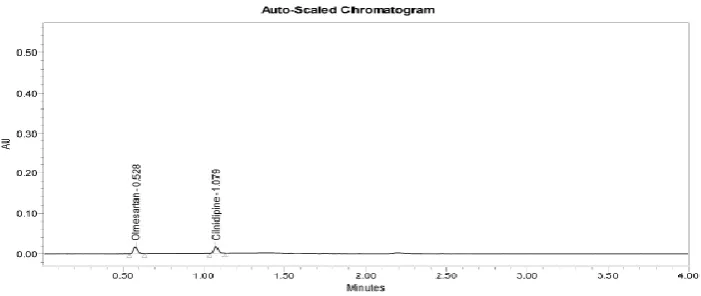
conditions are mentioned in Table-1 and chromatogram for standard was shown in the figure
no: 3.
RESULTS
Method Validation
System suitability
System suitability tests are an integral part of method validation and are used to ensure
adequate performance of the chromatographic system. Retention time (RT), number of
theoretical plates (N) or column efficiency and tailing factor (T) were evaluated for six
injections of standard solution at a solution of 5µg/ml of Olmesartan medoxomil Cilnidipine.
The results are tabulated in the table no-2 and the chromatogram was shown in the figure no-
Specificity
Specificity is the ability of analytical method to measure accurately and specifically the
analyte in the presence of components that may be expected to be present in the sample. The
specificity of method was determined by spiking possible impurities at specific level to
standard drug solution (5ppm). The diluent and placebo solutions were also injected to
observe any interference with the drug peak.There was no blank and placebo interference was
found.
Linearity
Linearity is the ability of the method to produce results that is directly proportional to the
concentration of the analyte in samples with given range. The linearity of Olmesartan
medoxomil & cilnidipine was in the concentration range of 5-25ug/ml. From the linearity
studies calibration curve was plotted and concentrations were subjected to least square
regression analysis to calculate regression equation. The regression coefficient was found to
be 0.9999 shows good linearity. The results are tabulated in the table no-4 and the
chromatogram was shown in the figure no- 7, 8, 9.
Accuracy
Accuracy is the closeness of results obtained by a method to the true value. It is the measure
of exactness of the method. Accuracy of the method was evaluated by standard addition
method. Recovery of the method was determined by spiking an amount of the pure drug
(50%,100% ,150%) at four different concentration levels in its solution has been added to the
pre analyzed working standard solution of the drug. The results are tabulated in the table
no-5, 6, 7.
Precision
The precision of the analytical method was studied by analysis of multiple sampling of
homogeneous sample. The Precision expressed as standard deviation or relative standard
deviation.
System precision
System precision was performed by injecting a standard solution of Olmesartan medoxomil
Method precision
Method precision was performed by analyzing a sample solution of Olmesartan medoxomil
& cilnidipine by injecting six replicates of the same sample preparations at a concentration of
0.3ppm/mL. The results are tabulated in the table no-9.
Intermediate precision(Ruggedness)
Intermediate precision was performed by analyzing a standard and sample solutions of
Olmesartan medoxomil by injecting six replicates of the same standard and sample
preparations at a concentration of 0.3 ppm/mL. The results are tabulated in the table no-9.
Robustness
Robustness shows the reliability of an analysis with respect to deliberate variations in method
parameters. If measurements are susceptible to variations in analytical conditions, the
analytical conditions should be suitably controlled or a precautionary statement should be
included in the procedure. The results are tabulated in the table no-4.
LOD and LOQ
Calibration curve was repeated for five times and the standard deviation (SD) of the
intercepts was calculated. The results shows, the limit of detection with a signal to noise ratio
of 3:1 was found to be 0.010 µg/ml. the limit of quantification with a signal to noise ratio of
10:1 was found to be 0.032 µg/ml.
Chromatographic Parameters
Table.1: Optimized chromatogram conditionsolmesartan & cilnidipine.
Equipment : Ultra performance liquid chromatography equipped with Auto Sampler and PDA detector
Column : Inspire C18 (2.1 x 50mm, 1.8m,) or equivalent
Flow rate : 0.3 mL per min
Wavelength : 254 nm
Injection volume : 5 l
Column oven : Ambient
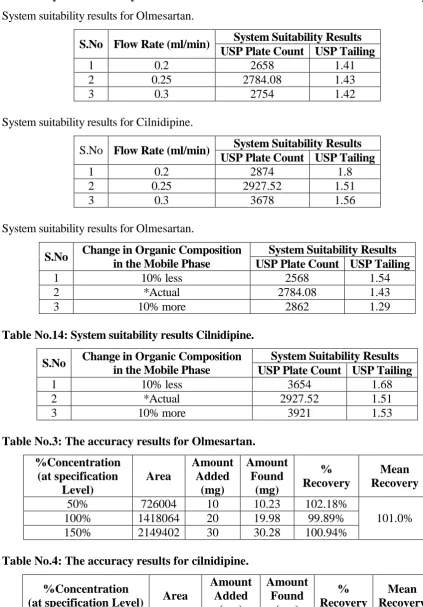
Table.2. System suitability & Robustness Data for Olmesartan medoxomil&cilnidipine.
System suitability results for Olmesartan.
S.No Flow Rate (ml/min) System Suitability Results
USP Plate Count USP Tailing
1 0.2 2658 1.41
2 0.25 2784.08 1.43
3 0.3 2754 1.42
System suitability results for Cilnidipine.
S.No Flow Rate (ml/min) System Suitability Results USP Plate Count USP Tailing
1 0.2 2874 1.8
2 0.25 2927.52 1.51
3 0.3 3678 1.56
System suitability results for Olmesartan.
S.No Change in Organic Composition
in the Mobile Phase
System Suitability Results USP Plate Count USP Tailing
1 10% less 2568 1.54
2 *Actual 2784.08 1.43
3 10% more 2862 1.29
Table No.14: System suitability results Cilnidipine.
S.No Change in Organic Composition
in the Mobile Phase
System Suitability Results USP Plate Count USP Tailing
1 10% less 3654 1.68
2 *Actual 2927.52 1.51
3 10% more 3921 1.53
Table No.3: The accuracy results for Olmesartan.
%Concentration (at specification Level) Area Amount Added (mg) Amount Found (mg) % Recovery Mean Recovery
50% 726004 10 10.23 102.18%
101.0%
100% 1418064 20 19.98 99.89%
150% 2149402 30 30.28 100.94%
Table No.4: The accuracy results for cilnidipine.
%Concentration
(at specification Level) Area
Amount Added (mg) Amount Found (mg) % Recovery Mean Recovery
50% 966975 5 5.01 100.26%
99.36%
100% 1912156 10 9.91 99.13%
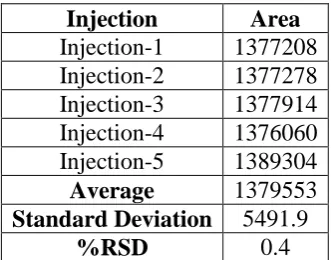
Table No.5: The Precision results for Olmesartan.
Injection Area
Injection-1 1377208
Injection-2 1377278
Injection-3 1377914
Injection-4 1376060
Injection-5 1389304
Average 1379553
Standard Deviation 5491.9
%RSD 0.4
Table No.6: The Precision results for Cilnidipine.
Injection Area
Injection-1 2043780
Injection-2 2025801
Injection-3 2022977
Injection-4 2033312
Injection-5 2057106
Average 2036595
Standard Deviation 14009.5
%RSD 0.7
Table No.7: Linearity Results: For Olmesartan.
S.No Linearity Level Concentration Area
1 I 20ppm 676099
2 II 40 ppm 1226320
3 III 60 ppm 1705005
4 IV 80 ppm 2350334
5 V 100 ppm 2904688
Correlation Coefficient 0.999
Table No.8: Linearity Results: (for Cilnidipine).
S.No Linearity Level Concentration Area
1 I 30ppm 909469
2 II 60 ppm 1610151
3 III 90 ppm 2374209
4 IV 120 ppm 3164470
5 V 150 ppm 3837500
Table No.9: The Interday precision results for Olmesartan.
Injection Area
Injection-1 1350592
Injection-2 1372286
Injection-3 1354685
Injection-4 1360384
Injection-5 1332603
Injection-6 1351712
Average 1353710.3
Standard Deviation 13036.7
%RSD 1.0
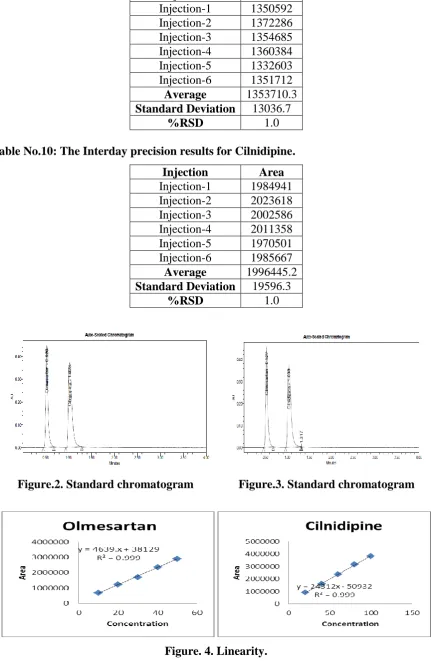
Table No.10: The Interday precision results for Cilnidipine.
Injection Area
Injection-1 1984941
Injection-2 2023618
Injection-3 2002586
Injection-4 2011358
Injection-5 1970501
Injection-6 1985667
Average 1996445.2
Standard Deviation 19596.3
[image:9.595.81.513.106.778.2]%RSD 1.0
Figure.2. Standard chromatogram Figure.3. Standard chromatogram
Figure. 2: Chromatogram for specificity.
DISSCUSSION
System suitability
From the system suitability studies it was observed that retention time of Olmesartan
medoxomil & cilnidipine was found to be 3.42 min. % RSD of peak area was found to be
0.4for olm, 0.7 for cil. Theoretical plates were found to be more than 2568. USP tailing factor
was found to be 1. All the parameters were within the limit.
Specificity: The Chromatograms of Standard and Sample are identical with nearly same
Retention time. There is no interference with blank and placebo to the drugs. Hence the
proposed method was found to be specific.
Linearity: From the Linearity data it was observed that the method was showing linearity in
the concentration range of 5-25μg/ml. Correlation coefficient was found to be 0.9999. 4.4.
Accuracy: The recoveries of pure drug from the analyzed solution of formulation were in the
range of 98%-102%, which shows that the method was accurate.
Precision
System precision
The percentage relative standard deviation (RSD) for the peak area 1.0.
Method precision
Ruggedness
Comparison of both the results obtained for two different Analysts shows that the method
was rugged for Analyst-Analyst variability. The %RSD for intermediate precision was 1.0.
Robustness
As the % RSD of retention time and asymmetry were within limits for variation in flow rate
(± 0.2 ml). Hence the allowable flow rate should be within 0.3 ml to 1.7 ml. As the % RSD of
retention time and asymmetry were within limits for variation (+ 50C) in column oven
temperature. Hence the allowable variation in column oven temperature is + 50C. The results
obtained were satisfactory and are in good agreement as per the ICH guidelines.
ACKNOWLEDGEMENT
The authors thankful to pharmatrain lab Hyd. for providing necessary facilities to carry out
the research work.
CONCLUSION
Finally it concludes that all the parameters are within the limits and meet the acceptance
criteria of ICH guidelines for method validation. The proposed method was simple, accurate,
specific, precise, robust, rugged and economical. Hence this method is validated and can be
used for routine sample analysis.
REFERENCES
1. Prof. Clemens F Kaminski⋅⋅⋅ Part I Chemical Engineering Section 2 (ex-ET)
ANALYTICAL CHEMISTRY 8 lectures, 2013; 2(1): 115-130.
2. Skoog DA, West DM, Holler FJ, Crouch SR, Fundamentals of Analytical chemsistry,
2007; 2(1): 644-655.
3. Prabhakar K. Verma et al, International Journal of Chem Tech Research, April-June
2010; 2(2): 1129-1134.
4. Chimalakonda Kameswara Rao et al, American Journal of Analytical Chemistry, 2012;
3(3): 153-160.
5. Mohammad M. Safhi et al, Oriental Journal of chemistry, 2013; 29(1): 131-134.
6. Mital Sidhdhapara et al, Scholars Research Library Der Pharma Chemica, 6(3): 175-178.
7. Manzoor Ahmed, Rashmi D.R et al, World Journal of Pharmacy and Pharmaceutical
8. Isha J. Soni et al. Indian Journal of Pharmaceutical and Biological Research (IJPBR),
2014; 2(1): 76-81.
9. TUSHAR K. KADIA et al, International Journal of Pharmacy and Pharmaceutical
Sciences, 2014; 6(6): 558-565.
10.Amit S. Minase et al, Journal of Advanced Scientific Resezarch, 2014; 5(3): 34-38.
11.Nehal C. Ghelani, Pharma Tutor Magazine, 2014; 2(6): 220-225.
12.N. Sunitha et al, International Journal of Pharmaceutical Research & Allied Sciences,