Master Thesis
for the study programme MSc. Business Information Technology
D E V O P S U N D E R C O N T R O L
o l i v i a h. p l a n t
Development of a framework for achieving internal control and effectively managing risks in a DevOps environment
March 2019
Olivia H. Plant:DevOps under control,Development of a framework for achieving internal control and effectively managing risks in a DevOps environment Master Thesis,University of Twente,March2019
au t h o r:
Olivia H. Plant, MSc candidate
Study Programme: MSc Business Information Technology
Track: IT Management & Innovation
E-Mail: [email protected]
g r a d uat i o n c o m m i t t e e: Dr. Klaas Sikkel
Faculty: Electrical Engineering, Mathematics and Computer Science
Department: Services and Cybersecurity
Email: [email protected]
Prof. Dr. Jos van Hillegersberg
Faculty: Behavioural, Management and Social Sciences
Department: Industrial Engineering and Business Information Systems
Email: [email protected]
Frank van Praat, MA MSc RE
Company: KPMG Nederland
Department: IT Assurance & Advisory Noord
Position: Senior Manager
M A N A G E M E N T S U M M A R Y
Although multiple definitions of the DevOps concept exist, DevOps is generally considered to be an Agile software development approach with the goal of combining development and operations and emphasizing frequent and fast software deployment. Four main aspects of DevOps arecollaboration,automation, measurementandmonitoring. While the DevOps approach offers great benefits, many companies are struggling with the implementation of DevOps and with maintaining control of their processes due to the required autonomy of the DevOps teams and the high degree of automation. At the same time, they struggle with demonstrating this control towards external auditing parties. This study therefore seeks to identify which types of risks companies using DevOps are generally exposed to and to develop a framework that helps companies control their processes and manage risks without hindering the speed and efficiency of the DevOps approach substantially.
The literature review suggests that many risk management controls concerning access management, change management, compliance and security can be auto-mated. However, research on DevOps is still scarce and specific risks applicable to DevOps are hardly mentioned. Furthermore, we conducted case studies in nine companies using DevOps which show that manners of implementing Dev-Ops differ widely and that many companies in practice use a combination of traditional and automated controls to manage their DevOps environment. This study also shows that soft aspects such as organizational culture, communication and team responsibility are of integral importance for effectively mitigating risks in DevOps.
Risks associated with DevOps can be grouped into five categories which are transitional, organizational, project, teamandproductrisks. It is further argued that there is no best way to implement DevOps and that the DevOps concept rather needs to be tailored to the needs of the company in question. Two main factors that influence companies in their decision how to manage their processes are the DevOps maturity and risk appetite. Based on these factors, a framework is developed that suggests four strategies with suitable controls to manage risks in DevOps.
The findings of this study implicate that companies first have to find a way to establish a solid DevOps culture before relying on automation practices. Likewise, auditors will have to find a way to assess these so-called "soft controls" in order to reliably give assurance on internal control. This thesis presents some first suggestions on how this can be done.
This study has both scientific and practical value:
• scientific: The study is one of the first of its kind and contributes to the scarce field of research about risk management in DevOps.
• practical: We provide guidelines for companies on how to integrate risk management practices into their DevOps processes.
• practical: We provide insights for auditors who want to provide assurance on internal control on how to audit DevOps processes.
The main research methods applied were a structured, multivocal literature review and multiple case studies that draw from semi-structured interviews as main input. The framework has been validated with four experts in the fields IT Risk, IT Audit and DevOps and with six of the case study participants.
The findings are mainly limited by the fact that some case studies draw from only a single interview as source of information and that the validation techniques applied were artificial instead of naturalistic. Directions for future research include implementation and auditing of soft controls, assessing DevOps maturity and general success factors for DevOps transitions.
P R E FA C E
After five and a half years, my life as a student at the University of Twente comes to an end. It has been a time full of adventures and personal growth, starting with a Bachelor in International Business Administration and finally finding my passion for IT Management and moving on to pursuing the MSc programme in Business Information Technology. This thesis is the result of nine months work and I am quite happy with how it turned out. Many people have contributed to this research over the past few months and I would like to thank some of them in the following:
I would firstly like to thank my supervisors Klaas Sikkel and Jos van Hillegers-berg. I could not have wished for a better combination of supervisors. Both of them have always made time for me, supported all of my ideas and given me valuable feedback. Thank you for the interesting meetings and the hours you must have spent on reading my drafts.
I would also like to thank my KPMG colleagues for their advice and interest in my thesis, especially my company supervisor Frank van Praat who always made time for me despite his busy schedule and my fellow internship companions who kept me motivated throughout both coffee breaks as well as stressful periods. I would also like to thank Henk Hendriks for pointing me towards this topic in the first place; this thesis has sparked my enthusiasm about Agile and DevOps even further and I thoroughly enjoyed working on it.
I am also grateful to all people who made time to participate in the case studies and/or give me feedback on the results. Their insights and contributions mark the core of this thesis and this research would have been much less interesting without their participation.
Most importantly, I would like to thank my friends and family, especially my parents and my boyfriend, for always supporting me throughout my studies. This thesis would not have been possible without you.
C O N T E N T S
1 i n t r o d u c t i o n 1
1.1 Thesis structure . . . 1
2 b a c k g r o u n d 3 2.1 What is DevOps? . . . 3
2.2 Risk management and internal control . . . 7
3 r e s e a r c h d e s i g n 9 3.1 Research objective and questions . . . 9
3.2 Research model . . . 11
4 l i t e r at u r e r e v i e w 13 4.1 Literature review method . . . 13
4.2 Internal environment . . . 15
4.3 Objective setting . . . 16
4.4 Event identification, risk assessment and risk response . . . 18
4.5 Control activities . . . 19
4.6 Information & communication . . . 23
4.7 Monitoring . . . 24
4.8 Discussion . . . 24
4.9 Conclusion . . . 25
5 r e s e a r c h m e t h o d 26 5.1 Case studies . . . 26
5.2 Validation . . . 28
6 c a s e s t u d y r e s u lt s 31 6.1 Summary of case study companies . . . 31
6.2 Overview of concepts . . . 33
6.3 Identified risk categories . . . 37
6.4 General risk mitigation mechanisms . . . 39
6.5 Identified controls . . . 41
6.6 The DevOps transformation at GeoTech . . . 54
7 t h e d e v o p s r i s k m a na g e m e n t f r a m e w o r k 56 7.1 Synthesizing literature and empirical findings . . . 56
7.2 DevOps risk governance components . . . 60
7.3 The DevOps risk management matrix (DRMM) . . . 62
8 va l i d at i o n 69 8.1 Senior manager - GRC Technology . . . 69
8.2 Senior manager - Digital Enablement . . . 71
8.3 Senior consultant - Enterprise Agility . . . 72
c o n t e n t s vii
8.4 Director - IT Assurance & Advisory . . . 74
8.5 Case study participants . . . 76
8.6 Summary and adjustments . . . 78
9 d i s c u s s i o n 79 9.1 Implications . . . 79
9.2 Validity and reliability of research . . . 82
9.3 Contributions to research and practice . . . 86
9.4 Related and future work . . . 87
10 c o n c l u s i o n 89 10.1 Research questions . . . 89
10.2 Key contributions and findings . . . 90
b i b l i o g r a p h y 93 a p p e n d i c e s a s t r u c t u r e d l i t e r at u r e r e v i e w: s e a r c h p r o t o c o l 99 a.1 Inclusion and exclusion criteria . . . 99
a.2 Search results . . . 99
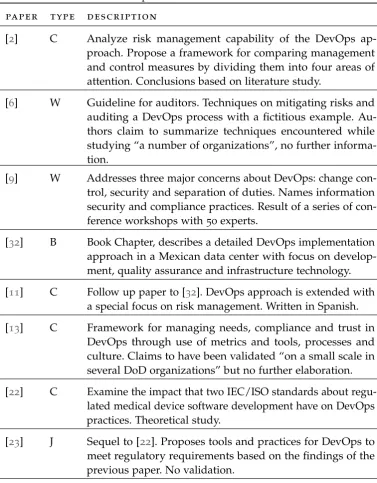
b s t r u c t u r e d l i t e r at u r e r e v i e w: r e s u lt s 100 b.1 Selected papers . . . 100
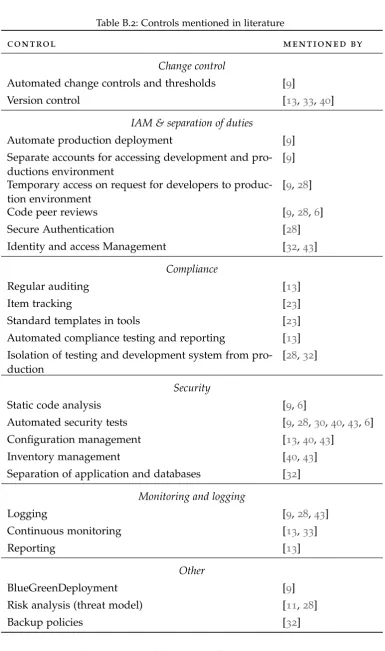
b.2 Controls mentioned in literature . . . 102
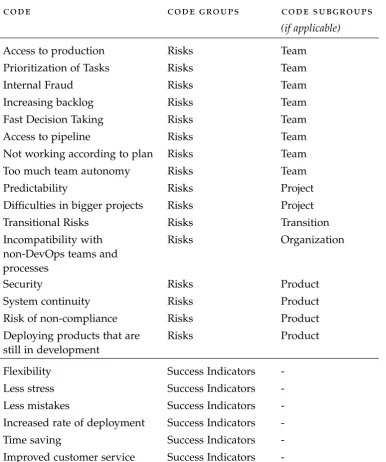
c c a s e s t u d y i n t e r v i e w s: c o d i n g 103
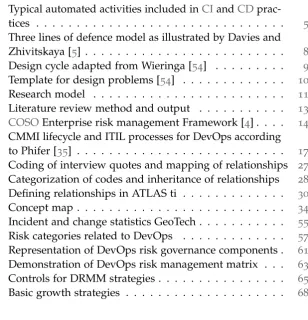
L I S T O F F I G U R E S
Figure2.1 Typical automated activities included inCIandCD
prac-tices . . . 5
Figure2.2 Three lines of defence model as illustrated by Davies and Zhivitskaya [5] . . . 8
Figure3.1 Design cycle adapted from Wieringa [54] . . . 9
Figure3.2 Template for design problems [54] . . . 10
Figure3.3 Research model . . . 11
Figure4.1 Literature review method and output . . . 13
Figure4.2 COSOEnterprise risk management Framework [4] . . . . 14
Figure4.3 CMMI lifecycle and ITIL processes for DevOps according to Phifer [35] . . . 17
Figure5.1 Coding of interview quotes and mapping of relationships 27 Figure5.2 Categorization of codes and inheritance of relationships 28 Figure5.3 Defining relationships in ATLAS ti . . . 30
Figure6.1 Concept map . . . 34
Figure6.2 Incident and change statistics GeoTech . . . 55
Figure7.1 Risk categories related to DevOps . . . 57
Figure7.2 Representation of DevOps risk governance components . 61 Figure7.3 Demonstration of DevOps risk management matrix . . . 63
Figure7.4 Controls for DRMM strategies . . . 65
Figure7.5 Basic growth strategies . . . 68
L I S T O F TA B L E S Table2.1 DevOps capabilities and enablers according to Smeds et al. [44] . . . 3
Table2.2 DASA DevOps competence areas [8] . . . 4
Table3.1 Design cycle phases applied to this research . . . 12
Table6.1 Overview of case study companies and interviewees . . 32
Table7.1 Examples of risks and controls . . . 58
Table8.1 Experts interviewed for artifact validation . . . 69
Table9.1 Guidelines for design-science research according to Hevner et al. [18] applied to this research . . . 84
Table B.1 Papers selected for literature review . . . 100
Table B.2 Controls mentioned in literature . . . 102
Table C.1 Overview of codes and categories created during case study analysis . . . 103
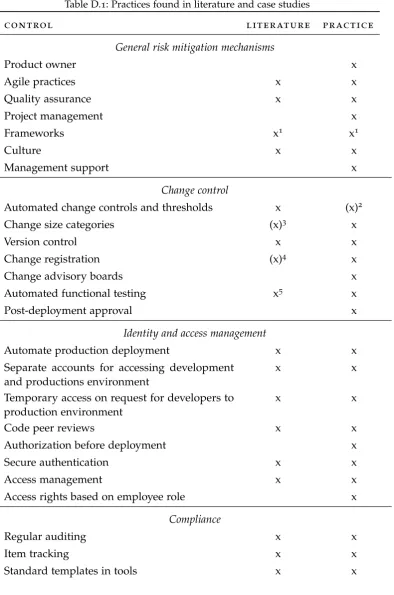
Table D.1 Practices found in literature and case studies . . . 107
[image:8.595.159.468.140.461.2]A C R O N Y M S
AWS Amazon Web Services
CAB Change Advisory Board
CD Continuous Deployment
CI Continuous Integration
COBIT Control Objectives for Information and related Technology
COSO Committee of Sponsoring Organizations of the Treadway Commission
DTAP Development-Testing-Acceptance-Production
ERM Enterprise risk management
GITC general IT controls
IaC Infrastructure as Code
SAFe Scaled Agile Framework
SOx Sarbanes–Oxley Act
1
I N T R O D U C T I O N
DevOps is often used as an umbrella term to describe software development approaches with the aim of increasing the pace of software development
pro-cesses and improving software quality [12]. Important practices often found A detailed
description of the DevOps
phenomenon is given inSection2.1 in DevOps teams are the shared responsibility for software development and
operations and sometimes at least partly automated software delivery pipelines and infrastructure.
Formerly known for its use in more technologically advanced companies such as Netflix, Etsy and Spotify, DevOps has also become interesting for more traditional companies [24] and is nowadays continuously gaining popularity [39, 10]. While many companies are enthusiastic about the opportunities that DevOps offers and are keen to implement it, they are struggling to maintain control of their processes due to the high degree of automation as well as the required autonomy of the DevOps teams and decentralized decision making structures. It is therefore beneficial to adopt a more tailored and risk-management based approach when designing the DevOps processes for a company. A second struggle for companies as well as for their auditors is to demonstrate this control in IT audits. Traditional control frameworks that stress aspects such as change control, access management and security are no longer compatible with DevOps and Agile ways of working and need to be adjusted.
Despite the obvious need for more rigorous investigations of these problems, academic research is only recently picking up on the DevOps trend with publi-cations having increased significantly over the past three years. However, much of the available literature is still concerned with defining what DevOps is in the first places or focuses only on the technical aspects of automation. The research at hand aims at setting a first step towards more structured risk management and process design in DevOps with the goal to increase internal control while remaining as agile as possible.
1.1 t h e s i s s t r u c t u r e
This thesis is structured as follows:
• Chapter2gives a detailed overview of the DevOps concept and attempted definitions by scholars as well as a short description of risk management and internal control terminology.
• Chapter3describes the design of this research and the steps to be under-taken during the course of its execution.
• Chapter4summarizes the academic literature available in the context of DevOps and risk management.
• Chapter5explains the empirical research methodologies in detail.
1.1 t h e s i s s t r u c t u r e 2
• Chapter6summarizes the empirical case study results.
• Chapter7 synthesizes the results of the literature and empirical studies and introduces the final risk management framework.
• Chapter8 summarizes the validation of the initial draft framework and accounts for the adjustments that were made to this.
• Chapter9discusses the implications of the results for scholars and practi-tioners and evaluates their validity, reliability and limitations.
2
B A C K G R O U N D
2.1 w h at i s d e v o p s?
DevOps is a combination of the wordsdevelopmentandoperationsand was first used during a presentation by Patrick Debois and Andrew Clay Shafers at the 2008Agile Conference [27]. The central philosophy of DevOps which scholars and practitioners agree on is that DevOps aims to bridge the gap between development and operations by assigning DevOps teams shared responsibility for both processes [26,44]. DevOps has been referred to as many different things among which a movement, a philosophy, a (development) practice, a mindset or a culture. Furthermore, there are tensions as to whether DevOps is mainly about culture or is more of a technical solution [26]. Lichtenberger [24] explicitly warns his readers that DevOps is no framework or standard that could be looked up in a codified book, but is rather a movement with the goal of becoming "better" and
"faster". Literature reviews have also shown that there is no uniform definition In order to apply to a wider context, this study purposely does not rely on one specific definition of DevOps.
of DevOps [12,25] although various studies have defined some general patterns that DevOps processes usually share. In the following we will first name some definitions of DevOps as encountered during a literature review. We will then elaborate on some practices that are often associated with DevOps.
Table2.1: DevOps capabilities and enablers according to Smeds et al. [44]
Capabilities
Continuous planning
Collaborative and continuous deployment Continuous integration and testing Continuous release and deployment
Continuous infrastructure monitoring and optimization Continuous user behavior monitoring and feedback Service failure recovery without delay
Cultural Enablers
Shared goals, definition of success, incentives
Shared ways of working, responsibility, collective ownership Shared values, respect and trust
Constant, effortless communication Continuous experimentation and learning
Technological Enablers
Build automation Test automation
Deployment automation Monitoring automation Recovery automation Infrastructure automation
Configuration management for code and infrastructure
2.1 w h at i s d e v o p s? 4
Lwakatare et al. [25] definedcollaboration,automation,measurementandmonitoring as the four main dimensions of DevOps. In another paper they added a fifth dimension calledculture[26]. Similarly, Smeds et al. [44] defined DevOps as a set of capabilities, cultural enablers and technological enablers which are shown in Table2.1. Jabbari et al. [20] found that“DevOps is a development methodology aimed
at bridging the gap between Development and Operations, emphasizing communication and collaboration, continuous integration, quality assurance and delivery with automated deployment utilizing a set of development practices".According to Nielsen et al. [33], DevOps incorporates three main principles which are working according to agile principles with continuous and frequent software delivery, collaboration with a culture based on trust, respect and communication andintegration of practices and tools. The software delivery process is divided into the four stages: plan & measure,develop & test,release & deploy, as well asmonitor & optimize. A literature review by Erich et al. [12] showed that research papers about DevOps emphasized the aspectsculture of collaboration,automation,measurement,sharing, services,quality assuranceandgovernance.
A model that is commonly used by DevOps practitioners is the competence model from the DevOps Agile Skills Association (DASA) [8] which emphasizes twelve skill and knowledge areas that should be present in DevOps teams. These areas are summarized inTable2.2. In the following, the four original dimensions of Lwakatare et al. are used to summarize the most common DevOps practices.
2.1.1 Collaboration
DevOps teams have shared goals, shared incentives and shared responsibilities for development and operations [20]. Collaboration is enforced through infor-mation sharing and broadening of team members’ skillsets [25]. Due to this new way of working, DevOps requires a complete shift in culture. DevOps culture is based on trust, respect and communication [33] and is one of the most difficult parts to implement for companies when moving towards DevOps [2].
Furthermore, DevOps is considered by many authors to be an extension of agile software development that aims to apply the agile principles not only to the development but also the operation of software [20,27]. Some authors see
Table2.2: DASA DevOps competence areas [8]
s k i l l a r e a s k n o w l e d g e a r e a s
Courage Business value optimization
Teambuilding Business analysis
DevOps leadership Architecture and design
Continuous improvement Programming
Continuous delivery Test specification
2.1 w h at i s d e v o p s? 5
Figure2.1: Typical automated activities included inCIandCDpractices
agile as an enabler for DevOps while only few authors see agile as a separate development methodology with similarities to DevOps [20]. Both focus on rapid and incremental releases, gathering feedback quickly and correcting problems [27].
2.1.2 Automation
According to Lwakatare et al. [25], increased automation of testing and deploy-ment processes is necessary to keep up with the increased pace of agile software development. Three terms that are repeatedly mentioned in combination with DevOps but are often used interchangeably are Continuous Integration, Con-tinuous Delivery and ConCon-tinuous Deployment [46].Continuous Integration (CI) is a development practice where team members integrate their work [46] by constantly merging working copies to a shared main branch [22]. Changes in code are directly tested and merged in order to continuously validate the code and detect problems as early as possible. As soon as a developer commits a change, the system detects this automatically and triggers a build, conducts automated tests and posts the build to a repository [52].Continuous Delivery builds on this concept by additionally preparing the software for release. In or-der to do so, automated acceptance tests are conducted and the code is deployed to a staging environment. The software can then be deployed with a single manual click on a button [36]. Finally,Continuous Deployment (CD)extends the two principles by also conducting an automated release process following the extensive testing [46]. In this case, no human interaction is needed in order to deploy a change once a piece of code is checked in by a developer and passes all automated tests.Figure2.1visualizes the described activities and differences between these three principles. While many companies organize their delivery process and corresponding environments according to the Development-Testing-Acceptance-Production (DTAP) approach, the exact order in which the described activities are conducted may vary per company. In order to build these auto-mated toolchains, developers can use automation software like Jenkins which connects and triggers the necessary applications.
2.1 w h at i s d e v o p s? 6
therefore be eliminated and features that are ready for delivery can be released immediately [22].
Another important principle that is frequently used within DevOps is known asInfrastructure as Code (IaC)and is often used for configuration management of servers that will run the applications. The desired state of infrastructure and configurations is defined in a domain-specific language [7]. This configuration information is then stored in source code repositories. Tools such as such as Chef, Puppet, Salt or Ansible allow developers to treat these configurations as code which can be versioned and tested and ultimately rolled out by ensuring that all systems have the defined configurations [40,43]. This can for example be used to ensure that the acceptance environment in which code is tested is the same as the actual production environment to which the changes will be deployed once they pass the tests successfully.
A similar technique that is gaining popularity in DevOps are containers like Docker. These containers are quick to set up and provide a separate environment for applications to be tested and developed in. They are often used to create virtual development, test and production environments in DevOps [26]. Docker containers are launched from images that contain information about their content such as applications and processes to be run once the container is launched. They can be distributed via registries which makes Dockers very portable. Different to virtual machines, Docker runs on top of the host operating system and does not require installment of another operating system. They are therefore very resource efficient [41]. However, configurations in Docker containers cannot be changed since containers cannot be updated. Updated software or configuration therefore requires a new image build [40].
2.1.3 Monitoring
Monitoring allows for fast detection and correction of problems which is cen-tral to DevOps. Systems and the underlying infrastructure should therefore be continuously monitored by operations personnel. Furthermore, continuous monitoring allows for appropriate assignment of resources [25]. Monitoring is conducted by implementing automated monitoring tools and logs. However, it can be difficult for development personnel to search the large amount of available logs to detect anomalies if the systems are not designed to show er-rors automatically. Furthermore, Continuous Deployment somewhat challenges monitoring due to its focus on speed and effectiveness. DevOps addresses these problems by emphasizing collaboration between development and operations personnel so systems are designed to expose relevant information quickly [25].
2.1.4 Measurement
2.2 r i s k m a na g e m e n t a n d i n t e r na l c o n t r o l 7
the operations and production data should drive decisions, improvements and changes to the system [26].
2.2 r i s k m a na g e m e n t a n d i n t e r na l c o n t r o l
The international risk management standard ISO31000 defines risk manage-ment as a set of principles, frameworks and processes for managing risk [45]. However, the Committee of Sponsoring Organizations of the Treadway Com-mission (COSO) [4] has shifted the focus to a more holistic view of risk man-agement with the establishment of its Internal control and Enterprise risk management (ERM) frameworks. In these frameworks,COSOadvocates for the implementation of appropriate risk-based controls throughout the enterprise to ensure the achievement of organizational objectives. This infers that risk manage-ment impacts organizational managemanage-ment as a whole instead of only applying to risk management processes [45]. Risk management therefore is also no longer just a function focused on financial and accounting risks but on management control throughout the whole enterprise [45]. Furthermore, internal control is an integral part ofERMaccording toCOSO[4].
2.2.1 The Sarbanes–Oxley Act
Corporate scandals in the early 2000s have lead to the establishment of the Sarbanes–Oxley Act (SOx) which requires companies to regularly report on their internal control structure and procedures concerning financial reporting together with independent auditors [1,49]. In order to do so, companies often adopt frameworks such as COSO which help them to structure their control processes. AlthoughCOSOis one of the most popular frameworks used forSOx compliance, one of its limitations is that it does not explicitly name any control concepts [42]. Another framework which is often used and does provide specific controls and processes is the Control Objectives for Information and related Technology (COBIT) framework [42]. Rubino et al. [42] advocate thatCOBITcan be a useful internal control framework for companies which overcomes some of COSO’s limitations.
2.2.2 IT audit and controls
The audit committee oversees the financial performance of the enterprise and ensures the reliability of its financial reporting [49]. Internal control is therefore important in IT Audits which are conducted as part of the financial statement audits but also for achieving (security) certifications. According to Gantz [15], IT Audit can help organizations ensure that assets are governed effectively i.e. they operate as intended and work in a way that complies with applicable regulations and standards.
2.2 r i s k m a na g e m e n t a n d i n t e r na l c o n t r o l 8
Figure2.2: Three lines of defence model as illustrated by Davies and Zhivitskaya [5]
integrity of the organizations operations and assets while technical controls are designed to achieve the organizations control objectives. Physical controls concern the access to facilities and assets. Auditors also distinguish between general IT controls (GITC) and application controls [19]. Application controls are integrated into applications which support the financial control objectives such as financial applications. Application controls for example includecompleteness and accuracy of the working of an application. The GITCare integrated into IT processes which ensure a reliable operating environment and support the application controls. Examples for these controls areaccess to programs and data andchanges to programs[19].
2.2.3 Three lines of defence model
Many companies arrange their corporate governance according to the "Three lines of defence" model. The model is particularly popular in financial institu-tions but also used in other sectors [47]. The exact origins of it are unknown and there are multiple subtly different version of it in which the boundaries between the three lines differ slightly [5]. The model divides organizational risk management activities into three "lines of defence". The first line of defence is designed to reduce operational risk in day-to-day activities. It contains manage-ment and internal controls and is performed by the individual employees and their superiors. The intention of this first line is to capture risks early and prevent them from happening [47]. The risk ownership is maintained by the business. The second line contains overseeing and supporting functions. Most importantly, this includes the central risk management organization but also supporting functions like compliance, legal and HR [5]. This line sets the company-wide rules and policies and provides risk owners from the first line with information about risks across the organization [47]. The third line of defence is the internal audit which provides assurance on the effectiveness of first two lines. As shown inFigure2.2, the lines of defence are overseen by the senior management and governing bodies and are assessed by external auditors.
3
R E S E A R C H D E S I G N
This research project contains a descriptive research part and design research.
The descriptive research is conducted in form of literature reviews and case For a description and motivation of the research
methodologies refer toSection4.1and Chapter5 studies and aims to answer knowledge questions whose understanding will
ulti-mately aid in designing an effective risk management framework. Throughout the whole project we will follow the design science methodology by Wieringa [54] which is aimed at conducting design research but also gives room for answering supporting knowledge questions. According to Wieringa, the goal of a design project is to (re)design an artifact so that it better contributes to the achievement of a goal. The design cycle describes the process of such a design research project and encompasses the phases problem investigation, treatment designandtreatment validation. The design cycle is part of a bigger engineering cycle which also incorporates the steps oftreatment implementationand implemen-tation evaluation. Depending on the outcome of the treatment validation phase, the cycle potentially has to be iterated several times until the designed artifact produces the desired effects. The design cycle and the question corresponding to each phase are shown in Figure3.1. Question marks represent knowledge questions while exclamation marks indicate design problems.
Figure3.1: Design cycle adapted from Wieringa [54]
As demonstrated by Wieringa himself, the design cycle follows essentially the same steps as the design science research methodology by Peffers et al. [34]. In this research it was decided to use the methodology by Wieringa because his approach encompasses a complete conceptual framework including classification of research problems, research questions and research methods that can be applied in every step of the design cycle.
3.1 r e s e a r c h o b j e c t i v e a n d q u e s t i o n s
Using the template for defining design problems (also known as technical research problems) by Wieringa inFigure3.2, the objective of this research can be formulated as toimprove risk management in DevOps by designing a framework
3.1 r e s e a r c h o b j e c t i v e a n d q u e s t i o n s 10
that satisfies agility requirements in order to help companies demonstrate control over their processes and create valid audit trails.
Improve <a problem context> by <(re)designing an artifact> that satisfies <some requirements>
in order to <help stakeholders achieve some goals>
Figure3.2: Template for design problems [54]
The main research question results from this design research objective and is formulated as follows:
What is a suitable framework that allows companies to mitigate risks and exercise control over their DevOps environment while remaining agile?
In order to design an effective risk management framework and the desired interaction with the problem context, two descriptive knowledge questions have to be answered first and suitable implementation strategies have to be designed. Firstly, the risks that companies are dealing with have to be identified. Under-standing these will aid in designing effective response strategies and controls. However, the risks are expected to differ per company and their respective environment. This research therefore aims at identifying risk categories and will investigate whether these categories differ per context. The first research sub-question is therefore defined as follows:
1. What types of risks are companies using DevOps exposed to?
The second sub-question aims at identifying specific practices that ensure an adequate management of risks in DevOps. This includes IT controls as well as existing strategies and frameworks. As indicated in the main research question, the goal of these practices is to mitigate the risks identified in research sub-question one while hindering the efficiency and agility of DevOps as little as possible. It is therefore necessary to not only consider whether these controls sufficiently mitigate risks but also to assess the impact they have on the efficiency of the process.
2. Which practices exist that can be incorporated into a DevOps process to demonstrate control and ensure the creation of valid audit trails?
Lastly, a suitable strategy for implementing these practices and addressing the identified risks has to be designed based on the outcome of the knowledge questions above.
3. Which strategy should companies drive in order to identify risks and implement suitable controls?
3.2 r e s e a r c h m o d e l 11
3.2 r e s e a r c h m o d e l
Combining the research design and questions leads to the research model presented inFigure3.3according to the notation by Verschuren and Doorewaard [51]. Data will be gathered both through a structured literature review as well as through case studies. This type of research was selected due to the evident lack of empirical research concerning risk management in DevOps. The individual outcomes of these studies will be synthesized to a conceptual model explaining the problem context, as well as risk mitigation strategies and controls which can be implemented in DevOps. This draft framework will then be discussed with risk management, audit and DevOps experts and will be presented to the interviewees of the case studies who will evaluate the use of the model for their company. Their input will be used to create the final DevOps risk management framework and guidelines. The arrows at the bottom of the diagram indicate the phase of the design cycle that corresponds to the particular actions. The application of the design cycle to this research is also demonstrated inTable3.1 in more detail.
3.2 r e s e a r c h m o d e l 12
Table3.1: Design cycle phases applied to this research
r e s e a r c h f o c u s m e t h o d c h a p t e r
Problem investigation
State of the art of risk management in DevOps research
Literature review 4
RQ1: What types of risks are compa-nies using DevOps exposed to?
Literature review Case studies
4,6
Treatment design
RQ2: Which practices exist that can be incorporated into a DevOps process to demonstrate control and ensure the creation of valid audit trails?
Literature review Case studies
4,6
RQ3: Which strategy should compa-nies drive in order to identify risks and implement suitable controls?
Literature review Case studies Framework design
4,6,7
Validation
Risk mitigation effectiveness Expert opinions
Case study respondents 8
Agility requirements Expert opinions
4
L I T E R AT U R E R E V I E W
4.1 l i t e r at u r e r e v i e w m e t h o d
In order to gain an overview of all relevant literature concerning risk man-agement and DevOps, a structured literature review following the procedure suggested by Kitchenham [21] was conducted. An important part of structured literature reviews is the search protocol which can be found inAppendix A. This protocol provides details of search terms and inclusion and exclusion criteria in order to ensure a coherent and non-biased selection of relevant literature. The search keys were created based on an exploratory literature review. The papers were selected by first scanning the titles of all results and excluding obviously non-relevant papers. Subsequently, the abstract of papers that seemed to meet the inclusion criteria was scanned and non-relevant papers were again excluded. Lastly, the full text of the remaining papers was read before deciding which papers should be included in the review. These steps were carried out conservatively, meaning that if it was doubtful whether a paper met inclusion criteria, it was taken to the next step and was only excluded once it was certain that it would not contribute to our research. This process as well as the amount of papers left after each step of the review is shown in Figure 4.1. A more detailed overview is given in the search protocol.
In order to assure the quality of the literature, only academic databases where researched in the first place and only journal articles and conference papers where considered for inclusion in the review. However, according to Garousi et al. [16] it is important to also include so called “grey literature” (non-peer reviewed literature) in software engineering research, especially if the field of research does not provide a substantial amount of literature like it is the case with DevOps. Grey literature can provide the researcher with state-of the art concepts that might not be mentioned in academic literature and may help
Figure4.1: Literature review method and output
4.1 l i t e r at u r e r e v i e w m e t h o d 14
avoiding publication bias. Since there was only very little academic literature available focusing specifically on risk management in DevOps, it was therefore decided to conduct a multivocal literature review for this item following the guidelines of the aforementioned authors [17]. However, it is important to pay special attention to the quality of the papers when conducting a multivocal literature review. We therefore only included first tier grey literature with a high credibility like whitepapers and books. During the database search only literature from2014onwards was selected in order to gain an overview of the state of the art research. However, during the reference searches older literature was included to gain a deeper understanding of the background of the papers. This review process resulted in a list of16papers. Another exploratory literature search conducted for verification purposes in Google Scholar yielded no new results so the final list is deemed to be complete.
Of the selected papers, nine papers are conference papers and five papers are A list of papers selected for the literature review and their validation methods can be found in Appendix B.1
white papers. Only one journal paper and one book chapter were included. Notably, a large amount of the papers (especially white papers) are solely based on expert opinions which are in many cases the personal opinions of the authors. Furthermore, some papers were based on literature studies. Only few researchers conducted empirical research like interviews and case studies or validated their models. However, according to Kitchenham [21], software engineering research usually has little empirical evidence and scholars in this domain often have to rely on expert opinions.
In order to structure the literature review and to put the available information in the context of risk management, the literature review follows the categories of the originalCOSOEnterprise Risk Management Framework [4] as shown in Figure4.2. TheERMframework was chosen because it is generally considered to be the most high-level risk management framework available and spans risk management categories throughout the whole enterprise. Although DevOps is not necessarily implemented throughout the whole enterprise, implementing DevOps in a department creates a separate entity with separate governance and risk management mechanisms which are comparable to those of an enterprise.
4.2 i n t e r na l e n v i r o n m e n t 15
4.2 i n t e r na l e n v i r o n m e n t
According to COSO [4], the internal environment is the basis for all other components of the ERM framework. It encompasses the culture within an organization and influences the risk consciousness and -appetite of its people. Relevant factors include risk appetite, ethical values and assignment of authority and responsibilities.
An important aspect of the internal environment within DevOps which is often mentioned in literature is the culture. Traditionally, development and opera-tions have different cultures which need to be replaced by a common mindset and values. The adoption of the DevOps culture is essential for a successful implementation of DevOps and will lead to failure of the transformation if not achieved [2]. A good DevOps culture is based on respect, trust and open communication and reinforces collaboration between team members [33]. These cultural changes towards DevOps can best be achieved by promoting learning and experimentation [2]. Farroha and Farroha [13] also stress that DevOps teams should treat failure as a learning experience “not to be learned more than once”. Teams should therefore focus on recovering fast from mistakes instead of not making any.
Other important aspects of the internal environment within DevOps are men-tioned by Wiedemann [53] who researched general governance mechanisms in the form of structures, processes and relational mechanisms that lead to success-ful implementation of DevOps. She concluded that DevOps teams should be given the freedom to be able to take over all the tasks of a given software delivery cycle and should have great autonomy with regards to decision making. Since DevOps is a very decentralized concept, teams also need highly implemented communication and knowledge sharing opportunities. Within an organization using DevOps, the IT team moves from being a service provider towards be-ing a partner of the business. Another important mechanism is therefore the assignment of a product owner who interacts regularly with the business side and is responsible for the generation and validation of requirements. In order to ensure a successful transition towards implementing DevOps, the employment of an agile coach has proven successful for organizations.
The importance of governance mechanisms in the context of DevOps is also supported by Muñoz and Díaz [32] who implemented DevOps in a Mexican datacenter in order to achieve a development that reduces the time of release. They considered governance to be a supporting mechanism of quality assur-ance which was based on the OWASP Software Assurassur-ance Maturity Model. Furthermore, they divided the employees into teams and assigned them specific strategic roles and responsibilities. The teams that were needed in this process are the development team, a revision control system team, a quality assurance team and a release management team. The teams were responsible for different stages of the deployment process. Wiedemann [53] supports the importance of clear roles by stating that assuming agile roles and responsibilities are essential in effectively governing DevOps teams.
4.3 o b j e c t i v e s e t t i n g 16
risk taking and increases risk appetite in the internal environment. However, DevOps culture can also potentially decrease operational risks due to the close collaboration of development and operations. Within DevOps, the team usually shares responsibility for development and operations of a system. Developers are therefore more likely to build a system with operational risks in mind and preventing them as much as possible.
4.3 o b j e c t i v e s e t t i n g
Setting objectives is a prerequisite to risk identification, assessment and response. Without objectives, no risks that threaten the achievement of these objectives can be identified. TheCOSOframework defines four objective categories which are strategic objectives,operations objectives,reporting objectivesandcompliance objectives. Besides describing these objectives, we also name some strategies to achieving them in this section.
4.3.1 Strategic objectives
Companies should start by setting their business goals at a strategic level based on the organization’s mission and vision. Furthermore, the objectives should also reflect the risk appetite determined by the organization [4]. The identified literature does not explicitly mention strategic objectives in combination with DevOps since these vary heavily depending on the company setting the objec-tives. The only generic strategic objective is mentioned by Farroha and Farroha [13] who state that the overall strategic DevOps objective is“to maximize
invest-ment outcome and ensure that customers continuously get increased service quality and features in a manner that satisfies their needs”.
4.3.2 Operations objectives
4.3 o b j e c t i v e s e t t i n g 17
Figure4.3: CMMI lifecycle and ITIL processes for DevOps according to Phifer [35]
4.3.3 Reporting objectives
Reporting objectives refer to the creation of reports that facilitate management’s decision making and monitoring but also external reports such as financial statements. Multiple papers mention the integration of logging applications into the delivery pipeline in order to ensure adequate reporting of events [43, 28]. This way, DevOps can facilitate the creation of operational reports that inform management about the quality of their processes. Reporting activities that do not concern operations directly are not mentioned in the literature and do not seem to be affected by the implementation of DevOps.
4.3.4 Compliance objectives
4.4 e v e n t i d e n t i f i c at i o n, r i s k a s s e s s m e n t a n d r i s k r e s p o n s e 18
restrict access to production environments for developers [28]. Multiple scholars therefore advocate for a hybrid environment in which the DevOps process is integrated into the specific environment as much as possible but stays restricted by applicable regulations [56,28].
While the examples mentioned above show compliance as an obstacle to deploy-ing an efficient and automated DevOps process, Laukkarinen et al. [22] use the example of medical device and health software IEC/ISO standards to show that DevOps can in certain cases also be used as a helpful tool to ensure compliance. They found that DevOps was beneficial for implementing most requirements. For example, clause5.8.6of IEC62304for medical device software requires that the procedure and environment of the software creation has to be documented. In DevOps, this can easily be done with development tools such as the project management tool JIRA, source code repositories like GIT and automation soft-ware like Jenkins. Furthermore, using invariable Docker containers allow for a repeatable installation and release process which is required by clause5.8.8. However, the authors also identified three obstacles that slow down theCIand CD procedures. Firstly, software units have to be verified which means that Continuous Integration can only happen after all units have passed unit testing. Secondly, all tasks and activities such as unfinished documentation have to be completed before the release of a software unit. Lastly, Continuous Deployment through remote updating to customer is not possible with IEC82304-1because the responsibility has to be transferred explicitly to the customer when taking the software into use. Whether DevOps is a benefit to achieving compliance or compliance is an obstacle to realizing DevOps therefore heavily depends on the regulations itself. In order to ensure compliance, the DevOps process in some cases needs to be slowed down or put on halt until other tasks are completed.
Laukkarinen et al. [23] concluded in a follow up paper on DevOps in regulated software environments that tighter integration between development tools, requirements management, version control and the deployment pipeline would aid the creation of regulatory compliance development practices. However the authors also note that regulations and accompanied standards could be improved to better relate regulations with DevOps practices.
4.4 e v e n t i d e n t i f i c at i o n, r i s k a s s e s s m e n t a n d r i s k r e s p o n s e
Event identification and risk assessment are processes which management conducts in order to identify and evaluate events that have an impact on the enterprise. While some events represent opportunities, other events have a negative impact on the achievement of priory defined enterprise objectives and therefore represent risks. Risk assessment aims at identifying to which extent these events can harm the enterprise objectives. After identifying relevant risks, companies have to decide whether to avoid, reduce share or accept these risks [4].
4.5 c o n t r o l a c t i v i t i e s 19
ISO/IEC2005norm and the OCTAVE Allegro methodology are used to identify, assess and respond to risks.
Bierwolf et al. [2] argue that due to the dynamic and uncertain environment in which DevOps is mostly deployed, companies should employ a risk dialogue approach instead of a risk log, meaning that a constant conversation between employees and management about observations and information is necessary in order to identify risks. A generic risk which is often mentioned in literature to which DevOps does not yet pay sufficient attention is that of security. Some practitioners therefore advocate for the integration of security principles into DevOps which is known as DevSecOps or SecDevOps. These preventional measures are discussed in the next section.
While multiple authors suggest approaches and frameworks on how to asses risks in DevOps and argue that control activities should be implemented based on these risk analyses, risks itself are hardly named. The few risks that are mentioned are usually only listed as a justification for implementing controls, however, no complete risk analysis is conducted. There is therefore no assurance that the proposed risk responses are sufficient or on the other hand unneces-sary because their corresponding risks are already covered by another control. Only DeLuccia IV et al. [6] show an example audit procedure in which a com-pany bases its controls on three main risks to information systems which are availability, integrity and confidentiality.
4.5 c o n t r o l a c t i v i t i e s
Control activities are the activities which ensure that the risk responses are carried out. Although research has not defined many specific risks and responses until now, various general controls were mentioned in literature with the aim of controlling and securing the DevOps process.
Bierwolf et al. [2] use a framework to define and compare management and con-trol measures which divides concon-trols into four categories beingculture,content, relations andprocess. They note that in DevOps, control measures concerning culture and collaboration are much more important than in the classical waterfall approach in which management and controls are usually focused on content
and process. Because these so-called "soft controls" are already covered in the An overview of all controls discussed in the following section can be found in AppendixB.2 other categories (e.g. internal environment and information & communication),
this section will mainly focus on the “hard controls” as means to implementing risk responses. The controls encountered in literature were grouped into six broad categories which are discussed in the following.
4.5.1 Change control
The DevOps Enterprise Forum [9] identifies change control as one major con-cern when it comes to DevOps practices and compliance with SOxand PCI regulations.
4.5 c o n t r o l a c t i v i t i e s 20
DevOps process by many companies since manual approvals block the rapid rate of change and delivery processes. However, the DevOps Enterprise Forum claims that many of the change approvals and verifications that are usually done manually (e.g. performance testing, security scan, verification of change sets) can also be automated by defining thresholds and automated controls throughout the delivery pipeline. Furthermore, delivering smaller changes more frequently as it is the case with DevOps, reduces risks compared to large releases with many changes as it is done in traditional waterfall development. However, this claim is disputed by other scholars who claim that the high rate of delivery poses a security problem that needs to be handled accordingly [30]. In order to quickly roll back deployments and trace changes, companies should always integrate version control into their DevOps processes. This can be done by using version control systems such as Git or Subversion [33].
4.5.2 Identity and access management and separation of duties
Secure authentication and access management are essential to controlling the critical systems [43, 32, 28]. Another concern that auditors often mention in combination with change control and access management is the separation of duties principle which is seemingly violated in DevOps since changes can be made by a single person. The DevOps Enterprise Forum [9] however notes that it is generally inefficient to employ a strict separation of duties where two separate human beings have to make and approve changes. In some cases it is sufficient to give DevOps engineers two accounts for the different environments e.g. with administrator rights in the development environment and restricted user level rights in the production environment. It is suggested to automate the production deployment process so no person can execute the deployment without passing the automated controls first. The same procedure should be used when deploying to non-production environments. Similarly, DeLuccia IV et al. [6] show, based on a fictitious audit procedure, that the underlying concerns that lead to the implementation of separation of duty can often be solved otherwise by defining the business objectives, identifying corresponding risks and mitigating these. In order to ensure that no single person has end-to-end control of a process without a separate check point, code that is checked-in should always be peer-reviewed [6, 9, 28]. This can be enforced by signing it with personal cryptographic signatures of the developers. When the code moves through the deployment pipeline it should be automatically checked after every step of the process that both signatures are still valid and that the code has not been tampered with [9].
4.5 c o n t r o l a c t i v i t i e s 21
In this case another multi-person authorization approach has to be used when making and approving changes.
4.5.3 Compliance
As mentioned earlier, compliance is often seen as hindering the DevOps pro-cess. However, multiple controls have been suggested in literature to achieve compliance while automating as many functions as possible. Firstly, Farroha and Farroha [13] stress the importance of enforcing regular audits to discover irregularities early. Furthermore, the testing and development systems should be connected to a network that is separate from the production network [32,28]. Applications that automatically test for and report compliance violations should be integrated into the process. They should terminate access if a threshold is exceeded and initiate alarms if a policy is not accepted [13].
Many norms demand that software items can be traced back to the requirements based on which they were developed. Laukkarinen et al. [23] therefore propose to introduce item tracking from requirement to the final product as a standard practice in DevOps. Software items related to requirements should be traced over the complete version history and at every point of its lifecycle. In order to enable this, workflow tools, version histories and CI tools have to form automatic connections. In order to achieve further compliance, tools should include standard templates that comply with regulations. These tools should work hierarchically by linking requirements, subsequent items and their test items and reports to each other. Lastly, the tools should guide the developer to follow the regulated workflow.
4.5.4 Security
Multiple papers have mentioned the integration of security aspects into DevOps in order to reduce (cyber) risks. Security is a common concern which limits the adoption of DevOps [30] and security experts have therefore investigated how to implement security practices into the DevOps process which is known as SecDevOps or DevSecOps. Mohan and Othmane [30] have performed a litera-ture review on these terms and found that important aspects which are often mentioned in DevSecOps literature aredefinition,security best practices,compliance, process automation, tools, software configuration, team collaboration, availability of activity data, andinformation secrecy.
4.5 c o n t r o l a c t i v i t i e s 22
Furthermore, companies should keep an inventory of authorized and unautho-rized devices and software in order to ensure platform security and version-and software management [40] and have a controlled environment for produc-tion and pre-producproduc-tion that separate applicaproduc-tions from databases to protect data in case an application is hacked [32]. During the development process, incremental changes can be made directly to components if the security impact is minimal. If this is not the case, security specialists and architects have to be involved. It is therefore important to integrate automatic checks into the deployment pipeline that halt the process if necessary. Changes to untrusted data processing for example require that updated data validation code has to be developed and integrated, before the changes can be deployed [28]. Once the code is checked in, a static code analysis should be executed [6,9]. This can for example be triggered using Jenkins. During the CIbuild, code should be screened for security vulnerabilities [30]. However, engineers should already pay attention to security issues during code design and peer-reviews by giving special attention to handling of unencrypted sensitive data and ensure secured access to application interfaces [9]. As a general rule, all threats meeting the security criteria must be fixed or mitigated before deployment can take place [28]. The automated deployment process should then be followed by automatic test execution [9].
The control that is mentioned most often are automated security tests [6,9,28, 30,40,43] which have to be integrated into the deployment pipeline. The testing phase of DevOps should not only focus on performance testing but should include security tests like penetration testing, and network testing and scanning [28]. Mohan and Othmane [30] refer to a presentation which advocates that companies should consider the depth of their dynamic and static security scans in the CI build chain as well the intensity of the scans and the consolidation which is the effectiveness of handling the findings. Another important control is configuration management. Hardware and software on servers should have secure configurations by using configuration management services that help rolling configurations of operating systems and application components out to all systems and keeping them in sync [40] (seeSection 2.1.2). Shackleford [43] adds to this that companies can implement applications that detect whether configurations have been changed and automatically roll them back to the desired state. He demonstrates how these controls can be integrated into the DevOps process for example by using automated configuration management tools andIaC. Robinson [40] also mentions container technologies like Docker as a secure way of ensuring correct configurations in testing environments. Companies however have to pay special attention to whether the containers they use contain outdated software or other vulnerabilities when using images from publicly available repositories.
4.5.5 Monitoring and logging
4.6 i n f o r m at i o n& c o m m u n i c at i o n 23
developers. Nielsen et al. [33] even define monitoring as an integral part of the DevOps concept. Continuous monitoring is not just a measure to reduce risk but also allows the team to continuously improve their processes. Farroha and Farroha [13] suggest that metrics such asmean time to repair (MTTR)andmean
time to restore service (MTRS) are more important to track than the mean time between failures (MTBF)in most cases because DevOps teams should focus on learning and moving on from mistakes instead of not making any. Other metrics they suggest are overall process quality, cost of development, cost of maintenance, accessibility,reliability,interoperability, andavailability for audits. Moreover, security measures such as unauthorized exposures and the capability to automatically prevent unauthorized access from internal and external sources should be taken into account. However, companies should also consider user friendliness metrics likeease of use,automation of processes,speed, andcontinuity. Lastly, tools should not only monitor and automatically report incidents such as compliance breaches [13] but should also continuously perform logging to create traceable processes and valid audit trails.
4.5.6 Others
Controls that could not be assigned to one of the previous aspects were classi-fied as “Others”. In order to allow for rollbacks and ease the release process of software, a “BlueGreenDeployment” pattern can be applied: Companies should have two production environments (a “blue” and a “green” one) of which one is live. During a release, the software is deployed to the other production environ-ment. Once it is running there, this environment including the release should go live and all incoming requests are routed to this production environment. In case of problems, a rapid rollback can be performed by just putting the first production environment live again [9]. Furthermore, Michener and Clager [28] advise that companies should organize their development activities around a threat model which they maintain. This threat model has to be updated if the threat landscape changes which can happen for example if changes with impacts on security or data processing are implemented. Lastly, companies should have backup policies and contingency plans for restoring lost data [32].
4.6 i n f o r m at i o n & c o m m u n i c at i o n
4.7 m o n i t o r i n g 24
not only focus on sharing explicit information about activities and events for better risk management but also focuses on knowledge sharing which leads to more skilled employees in general. Furthermore, Muñoz and Díaz [32] mention Scrum as a suitable methodology for DevOps that allows regular interaction between team members. Wiedemann [53] supports this statement by noting how a product owner can also bridge the communications gap between the Scrum team and the IT department.
4.7 m o n i t o r i n g
The monitoring category encompasses ongoing monitoring activities of the other components and separate evaluations.COSO[4] suggests to do this using internal and external auditors. While DevOps has a strong focus on monitoring operations and continuous improvement, no paper suggested monitoring the effectiveness of risk management processes such as risk responses and controls itself.
4.8 d i s c u s s i o n
As identified by Bierwolf et al. [2], DevOps has a strong focus on soft controls. It is therefore not surprising that DevOps inherently contributes to the “softer” categories of ERM such as the internal environment and information & com-munication. However, DevOps can also substantially contribute to achieving operational objectives and minimizing operational risks through automated testing and continuous monitoring. DevOps can either be a benefit or an ob-stacle to achieving enterprise objectives, especially compliance objectives. In certain cases the DevOps process needs adjustment or has to be molded into a hybrid environment in order to remain compliant which potentially slows the process down and causes DevOps to lose some of its benefits [28,56]. During the literature search it became evident that much of the available literature views DevOps as a purely technical approach focused on automating the development process as much as possible but substantially less research has been conducted taking the central philosophy and cultural dimension of DevOps into account.
4.9 c o n c l u s i o n 25
Although literature has shown that it is possible to conduct risk analysis in DevOps, only few risks have been named explicitly. The controls that were mentioned by authors are often not based on earlier identified risks but are rather suggested with the intention of bringing some kind of structure and control to the process or trying to achieve compliance with norms that do not always fit a DevOps process. Risks are only named occasionally to justify certain controls which gives no assurance that the whole process is secured. Furthermore, no attention has been given to monitoring these controls and risk responses so far.
The second issue that was identified in this review is the achievement of compli-ance objectives. Researchers have suggested various measurements to achieve compliance with software development norms and operational frameworks, some of which hinder the DevOps process. The real problem however, seems to be that the norms and laws are not designed for DevOps and agile ways of working. While the objectives of these frameworks are clear and important, the controls they demand are designed for traditional software development methods. It has been shown how DevOps can achieve many of these objectives using a different set of controls for example by letting developers peer review their code and implementing automated, secured controls instead of demanding a strict separation of duty. Institutes such as ISO and IEC but also best practices like ITIL should therefore consider adjusting their requirements to suit more contemporary ways of software development.
4.9 c o n c l u s i o n
The multivocal literature review has shown that there is a lack of empirical and validated research on risk management in DevOps which emphasizes the relevance of this study. While most papers have not conducted thorough risk analyses for DevOps, literature has provided a substantial amount of automated controls that can be used by companies to control their processes. However, no elaborate strategies for addressing risks and choosing controls were presented. The literature review has therefore contributed foremost to assessing the current state of research in this domain and to answering research sub-question 2. The empirical component of this research will have to give a more detailed impression of types of risks that companies using DevOps are dealing and whether these or other controls can be used to mitigate these risks.
5
R E S E A R C H M E T H O D
5.1 c a s e s t u d i e s
In order to address the lack of empirical research in the field of risk management in DevOps, it is imperative to conduct an empirical investigation in the context of this research. This will increase the reliability of conclusions and allow us to base the risk management framework in a real-world context. It was therefore decided to analyze processes related to DevOps in multiple companies and to incorporate the results into the framework design. The case studies took a multiple-case, holistic design, following a replication logic [57]. This means that the DevOps risk management process was the global unit of analysis per company and that multiple companies were analyzed in order to see whether the observations and conclusions were comparable. Evidence was collected through multiple sources:
• Semi-structured interviews: Interviews served as the main input for the case studies. In every case study at least one interview was conducted. This amounted to12interviews with in total17employees. Interviewees were selected based on their experience with DevOps processes in their company and their position. Both low-level views from developers as well as high-level views from managers or auditors were included. Interviews were held either individually or in sessions with multiple people. One interview was conducted via telephone. After the first part of the interview, respondents were shown important results from the literature review and were given the opportunity to give their opinion about these. This was done at the end in order to not influence their answers in the first part of the interview.
• Additional documentation: In two cases additional documentation was used for a deeper understanding of the organization and organizational pro-cesses.
• Observations: Five case studies included a guided tour through the company. Striking observations were written down after the visit and included in the analysis.
• Informal Conversations: Remarks made from employees or people connected to the company during lunch breaks, before or after the interviews as well as during exploratory meetings were taken in to account as long as these remarks did not concern confidential information or personal opinions that were made off the record.
5.1.1 Analysis of evidence
All interviews were recorded with permission of the respondents. After the sessions the recordings were transcribed manually aiming to be as complete as
5.1 c a s e s t u d i e s 27
Figure5.1: Coding of interview quotes and mapping of relationships
possible. In some cases, in-between conversations that did not directly contribute to answering the research questions were omitted; however, the rest of the transcript was verbatim. This amounted to an average transcript length of 8 pages per interview. The transcripts were then sent to the interviewees who were given the opportunity to give feedback. Interviews mostly lasted between40and 50minutes although some interviews were longer than this. In one company where multiple employees were interviewed, additional interviews took only about20 minutes.
The interviews and some additional documents were analyzed with the quali-tative data analysis software ATLAS ti following the concept ofopen coding[3]. Paragraphs and sentences were assigned one or multiple codes that summarized the topics discussed in this section (see Figure5.1). We followed the concept of deductive coding described by Miles and Huberman [29] by using the con-trols derived from the literature review as a starting point for creating codes. However, many more codes were added during the analysis of which not all of them directly related to IT controls or risks but aimed at capturing contextual information which might have an influence on risks and controls. During and after the open coding process, the codes were rearranged, in some cases merged or deleted if they were redundant and classified into categories. These categories served to identify the high-level processes that were important in managing
risks in DevOps. The total amount of codes left was86. Atlas ti also allows the An overview of all codes and (sub)categories designed during this process is given in Appendix C.
researcher to define relationships between codes, e.g. by defining whether one factor causes another factor as shown in Figure 5.3. This process of creating broader conceptual categories based on identified relationships between codes is also known asaxial coding[3]. In special cases, a code was assigned to more than one category if the concept contributed to multiple categories. Some large categories were divided into subcategories.