warwick.ac.uk/lib-publications
Original citation:
Jotheeswaran, A. T., Dias, Amit, Philp, Ian, Patel, Vikram and Prince, Martin. (2016)
Calibrating EASY-Care independence scale to improve accuracy. Age and Ageing, 45 (6). pp. 890-893.
Permanent WRAP URL:
http://wrap.warwick.ac.uk/84262
Copyright and reuse:
The Warwick Research Archive Portal (WRAP) makes this work of researchers of the University of Warwick available open access under the following conditions.
This article is made available under the Creative Commons Attribution 4.0 International license (CC BY 4.0) and may be reused according to the conditions of the license. For more details see: http://creativecommons.org/licenses/by/4.0/
A note on versions:
The version presented in WRAP is the published version, or, version of record, and may be cited as it appears here.
18. Sloane PD, Zimmerman S, Chen Xet al. Effect of a person-centered mouth care intervention on care processes and out-comes in three nursing homes. J Am Geriatr Soc 2013; 61:
1158–63.
19. Lam OL, McMillan AS, Samaranayake LP, Li LS, McGrath C.
Randomized Clinical Trial of Oral Health Promotion
Interventions Among Patients Following Stroke. Arch Phys
Med Rehabil 2013; 94: 435–43.
20. Czarkowski G, Allroggen S, Koster-Schmidt A,
Bausback-Schomakers S, Frank M, Heudorf U. Oral health hygiene
education programme for nursing personnel to improve oral health of residents in long-term care facilities 2010 in Frankfurt/Main, Germany. Gesundheitswesen 2013; 75:
368–75.
21. Tham R, Hardy S. Oral healthcare issues in rural residential
aged care services in Victoria, Australia. Gerodontology
2013; 30: 126–32.
Received 20 January 2016; accepted in revised form 23 May 2016
Age and Ageing2016;45:890–893 doi: 10.1093/ageing/afw106 Published electronically 11 July 2016
© The Author 2016. Published by Oxford University Press on behalf of the British Geriatrics Society. This is an Open Access article distributed under the terms of the Creative Commons Attribution License (http://creativecommons.org/licenses/by/4.0/), which permits unrestricted reuse, distribution, and reproduction in any medium, provided the original work is properly cited.
Calibrating EASY-Care independence scale to
improve accuracy
A. T. J
OTHEESWARAN1,2, A
MITD
IAS3, I
ANP
HILP4, V
IKRAMP
ATEL5,6, M
ARTINP
RINCE71
Indian Institute of Public Health, Hyderabad, Hyderabad, Telangana 500033, India 2
Institute of Psychiatry, King’s College London, London SE58AF, UK
3
Department of Preventive and Social Medicine, Goa Medical College, Goa, India 4
Hull and East Yorkshire Hospitals NHS Trust, Hull, UK 5
London School of Hygiene and Tropical Medicine, Centre for Global Mental Health, London, UK 6
Sangath, Goa, India 7
Health Service and Population Research Department, Institute of Psychiatry, Psychology & Neuroscience, and Centre for Global
Mental Health, King’s College London, London, UK
Address correspondence to: A. T. Jotheeswaran. Tel:+41 22 791 1248; Fax:+41 22 791 1585. Email: [email protected],
Abstract
Background:there is currently limited support for the reliability and validity of the EASY-Care independence scale, with little work carried out in low- or middle-income countries. Therefore, we assessed the internal construct validity and hierarchical and classical scaling properties among frail dependent older people in the community.
Objective:we assessed the internal construct validity and hierarchical and classical scaling properties among frail dependent older people in the community.
Methods:three primary care physicians administered EASY-Care comprehensive geriatric assessment for 150 frail and/or dependent older people in the primary care setting. A Mokken model was applied to investigate hierarchical scaling proper-ties of EASY-Care independence scale, and internal consistency (Cronbach’s alpha) of the scale was also examined.
Results:we found that EASY-Care independence scale is highly internally consistent and is a strong hierarchical scale, hence providing strong evidence for unidimensionality. However, two items in the scale (unable to use telephone and manage
finances) had much lower item Loevinger H coefficients than others. Exclusion of these two items improved the overall internal consistency of the scale.
Conclusions:the strong performance of the EASY-Care independence scale among community-dwelling frail older people is encouraging. This study confirms that EASY-Care independence scale is highly internally consistent and a strong hierarch-ical scale.
Keywords:dependence, independence, ageing, India, dependence scale, older people
at University of Warwick on January 10, 2017
http://ageing.oxfordjournals.org/
Care dependence is an important clinical outcome for older people and healthcare providers [1]. A shift from independ-ence to dependindepend-ence is conventionally measured using activ-ities of daily living (ADL) or instrumental activactiv-ities of daily living (IADL) scales [2]. Hierarchical scaling properties, where constituent items have different inherent‘item diffi -culties’, confer several desirable properties for measure-ment efficiency, including unidimensionality and simplified scaling metrics (the sum of the unweighted item scores approximating to the position on the underlying latent trait)— these properties have been demonstrated for several widely used scales in this domain of assessment [3]. The approach taken for the widely used EASY-Care scale was somewhat different, being based essentially on classical scaling princi-ples, with items weighted to reflect the presumed signifi -cance of endorsement for overall severity.
The EASY-Care independence scale was originally devel-oped from the Barthel Index and the Duke OARS IADL Scale [4]. It consists of 18 items ascertaining limitations in ADL and IADL. The weighted items include use of tele-phone, keeping up appearance, dressing, bathing, house-work, preparing meals, feeding, taking medications, urinary incontinence, faecal incontinence, ability to use the toilet, transferring from bed to chair, mobility inside the home, managing stairs, mobility outside home, ability to shop, use of public services and managing finances [5]. The total score ranges from 0 to 100, with higher scores denoting greater degree of dependence and need for care.
There is currently limited support for the reliability and validity of the EASY-Care independence scale, with little work carried out in low- or middle-income countries. Test– retest reliability at item level was adequate among 50 patients attending a UK geriatric rehabilitation facility [5]. Face validity of individual items was established in the UK/ USA cross-national consensus of professionals and older service users, although the importance attached to the items varied between these two groups [6]. The feasibility and utility of the scale was supported through evaluations of patients’ and clinicians’ experience in Colombia, Kerala, Lesotho, Tonga, Iran and UK [6]. The unidimension-ality of the EASY-Care independence scale has not been empirically tested, neither is it clear whether it has hierarch-ical scaling properties [7]. Therefore, given the salience of the EASY-Care independence scale, we assessed the internal construct validity and hierarchical and classical scaling properties among frail dependent older people in the community.
Methods
This study was conducted in a primary healthcare setting in Goa, India. Detailed information on participants’recruitment is described elsewhere [8]. Ten community health workers identified 152 frail and/or dependent older people at the community level and assessed their needs for care using methods developed by the 10/66 Dementia Research Group [9]. Intervals of care were rated in seven bands from‘cannot
be left on their own’ to‘more than 3 days’; intensity of care was rated as‘no needs for care’,‘needs care occasionally’and
‘needs care much of the time’. Mobility restriction was rated infive bands from‘fully mobile outside of the home’to‘ bed-bound’. Three primary healthcare physicians reassessed the older people with EASY-Care assessment. This study was conducted between 2013 and 2014. King’s College Research Ethics Committee and Institutional Ethics Committee of Public Health Foundation of India approved the study.
Statistical analysis
Internal consistency (Cronbach’s alpha) for the EASY-Care independence scale was calculated using SPSS 21.0 [10]. A Mokken model was applied to investigate hierarchical scal-ing properties usscal-ing STATA 11.0 after downloadscal-ing the LoevH add-on programme from http://www.anaqol.org. Mokken scaling involves the application of a non-parametric item response model [11] to measure the hierarchical properties of items in a scale, assessing if the items can be ordered by degree of difficulty, such that any individual who endorses a particular item will also endorse all the items ranked lower in difficulty. Three basic assumptions are required for a monotone homogeneity model: (i) unidimen-sionality (one latent variable summarises the variation in the item scores in the questionnaire), (ii) local independence (after conditioning on the position on the latent trait, the item scores are statistically independent) and (iii) monoton-icity (for all items, the probability of a positive response increases monotonically with increasing values of the latent trait). These assumptions being met, an individual’s pos-ition on the latent trait can conveniently be estimated as the rank of the highest item in the hierarchy that they endorse, or their total number of positive responses [12].
In addition, double monotonicity models was applied for values of the latent trait, to assess the probability of a posi-tive to decrease with the difficulty of the item. This means that the order of item difficulties remains invariant over all values of the latent trait and thus, the item response function curves do not intersect [13,14]. To assess single monoton-icity, we estimated Loevinger coefficients for each item (Hi) and for the whole scale (H), where values between 0.3 and 0.4 suggest weak scalability, values between 0.4 and 0.5 moderate and values above 0.5 strong scalability. We also tested formally for violations of monotonicity (using the Stata loevh monotonicity command) and non-intersection (using the Stata loevh nipmatrix command) between pairs of items (minimum violation 0.03, alpha = 0.05), using overall criteria values as an indication of the likelihood of assump-tion violaassump-tion; ≤40‘satisfactory’, 40–79 ‘questionable viola-tion’,≥80‘strongly suggesting an assumption violation’[15]. Concurrent validity of the EASY-Care independence scale was assessed by estimating the variance in this outcome accounted for by the extent of the needs for care as assessed by a Community Health Worker (CHW) (inter-vals of care, intensity of care) and mobility restriction, using univariate general linear models.
at University of Warwick on January 10, 2017
http://ageing.oxfordjournals.org/
Results
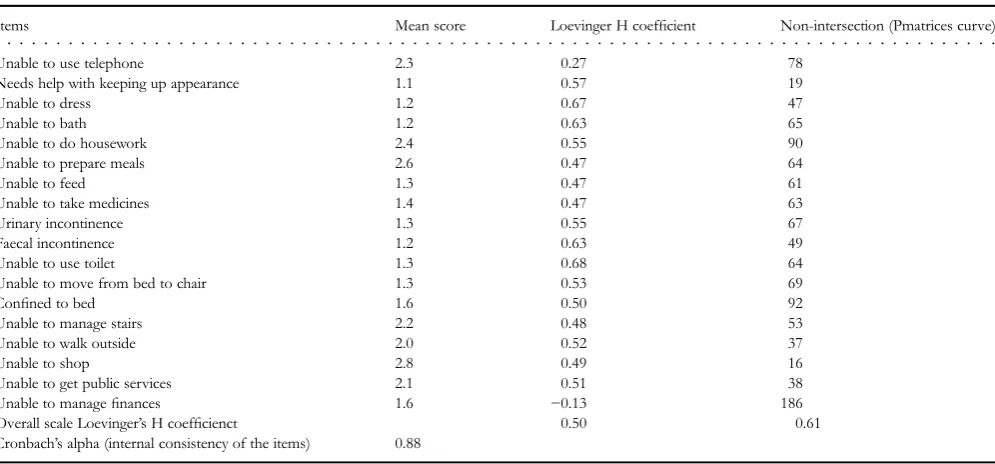
Cronbach’s alpha, reflecting internal consistency across the 18 EASY-Care independence scale items, was 0.89. Item and scale Loevinger H coefficients were estimated using a polytomous Mokken analysis. There was robust evidence that the EASY-Care independence scale and its constituent items conformed to a‘strong’ Mokken scale (Table1). The coefficient H values for individual items exceeded 0.47 (range 0.47–0.68) other than two items: unable to use tele-phone (0.27) and unable to manage finances (−0.13). The overall scale H coefficient was 0.50. There were no statistic-ally significant violations of monotonicity assumptions. However, there were a number of statistically significant viola-tions with respect to non-intersection (double monotonicity). Of these, only‘unable to do housework’, ‘confined to bed’ and‘unable to managefinances’were associated with criteria values >80, strongly suggesting an assumption violation. Internal consistency of the items (Cronbach’s alpha) was 0.88, providing further evidence of unidimensionality.
Concurrent validity
For the purposes of the analyses of concurrent validity, we used the weighted EASY-Care score, and then reassessed associations using the unweighted (raw) score. The correl-ation between weighted and unweighted scores was 0.990. Needs for care as identified by the CHW explained 35.9% of the variance in the independence scale score. Those
identi-fied with needs for care‘much of the time’had higher inde-pendence scale scores (mean 52.9, SD 21.3) than those with occasional needs for care (mean 30.1, SD 10.8) and those with no needs for care (mean 27.2, SD 8.6). Intervals of care as assessed by the CHW explained 21.4% of the variance in independence score, with scores increasing monotonically from the longest interval (more than 3 days, mean 24.2, SD
8.8) to the shortest (cannot be left alone, mean 48.1, SD 22.8). Mobility hierarchy explained 49.1% of the variance in independence score, with scores increasing monotonically from those with no mobility restriction (mean 23.2, SD 8.0) to those who were bedbound (mean 68.4, SD 22.3).
Discussion
This study confirms that EASY-Care independence scale has robust measurement properties. A scale is unidimen-sional if all the items of the scale measure one common latent variable. Hierarchical scales have particularly desir-able measurement properties in terms of precision and measurement efficiency. We found that EASY-Care inde-pendence scale is highly internally consistent and is a strong hierarchical scale, hence providing strong evidence for unidimensionality. Two items in the scale (unable to use telephone and manage finances) had much lower item Loevinger H coefficients than others. This is partly due to cultural appropriateness of the items in the scale. In India, it is common for older people to transfer financial manage-ment responsibilities to co-resident spouse or children after retirement [16]. In such a context, the question of inability to manage finances may be irrelevant, or at least less reli-ably discriminating than in other cultures where older people retain this role and responsibility other than in the context of incapacity. Likewise, telephone use is uncommon among older people particularly since telecommunications are generally conducted via personal mobile phones rather than fixed landlines [16]. The unidimensionality of the inde-pendence scale can be improved if these two items are dropped. Most earlier studies tested functional decline meas-ure in selected community population and validity of ADL measure on frail older people is less investigated [17].
The strong performance of the EASY-Care independ-ence scale among community-dwelling frail older people is
[image:4.612.66.564.504.736.2]. . . .
Table 1.Polytomous Mokken analysis with EASY-Care assessment independent scale
Items Mean score Loevinger H coefficient Non-intersection (Pmatrices curve)
Unable to use telephone 2.3 0.27 78
Needs help with keeping up appearance 1.1 0.57 19
Unable to dress 1.2 0.67 47
Unable to bath 1.2 0.63 65
Unable to do housework 2.4 0.55 90
Unable to prepare meals 2.6 0.47 64
Unable to feed 1.3 0.47 61
Unable to take medicines 1.4 0.47 63
Urinary incontinence 1.3 0.55 67
Faecal incontinence 1.2 0.63 49
Unable to use toilet 1.3 0.68 64
Unable to move from bed to chair 1.3 0.53 69
Confined to bed 1.6 0.50 92
Unable to manage stairs 2.2 0.48 53
Unable to walk outside 2.0 0.52 37
Unable to shop 2.8 0.49 16
Unable to get public services 2.1 0.51 38
Unable to managefinances 1.6 −0.13 186
Overall scale Loevinger’s H coefficienct 0.50 0.61
Cronbach’s alpha (internal consistency of the items) 0.88
at University of Warwick on January 10, 2017
http://ageing.oxfordjournals.org/
encouraging, since this will be a useful confirmatory indica-tor of disability and needs for care.
Key points
•This study confirms that EASY-Care independence scale has robust measurement properties.
•High internal consistency and hierarchical nature provides evidence for unidimensionality.
•The strong performance of EASY-Care independence scale is encouraging, Since this will be a useful confi rma-tory indicator of disability and needs for care in frail older people living in the community.
Acknowledgement
This work was supported by a Wellcome Trust Capacity Strengthening Strategic Award to the Public Health Foundation of India and a consortium of UK universities.
Con
fl
icts of interest
None declared.
References
1. McGhee D, Parker A, Fielding S, Zajicek J, Counsell C.
Using‘dead or dependent’as an outcome measure in clinical
trials in Parkinson’s disease. J Neurol Neurosurg Psychiatry
2015; 86: 180–5.
2. Jette AM. Improving Survey Measurement of Late-life
Disability: Beyond ADLs and IADLs. US: National Research Council (US) Committee on National Statistics; National
Research Council (US) Committee on Population.
Washington (DC): National Academies Press (US). 2009.
3. Sousa RM, Dewey ME, Acosta Det al. Measuring disability
across cultures–the psychometric properties of the
WHODAS II in older people from seven low- and middle-income countries. The 10/66 Dementia Research Group population-based survey. Int J Methods Psychiatr Res 2010;
19: 1–17.
4. Fillenbaum GG, Smyer MA. The development, validity, and
reliability of the OARS multidimensional functional
assess-ment questionnaire. J Gerontol 1981; 36: 428–34.
5. Philp I, Lowles RV, Armstrong GK, Whitehead C.
Repeatability of standardized tests of functional impairment and well-being in older people in a rehabilitation setting.
Disabil Rehabil 2002; 24: 243–9.
6. Philip KE, Alizad V, Oates Aet al. Development of
EASY-Care, for brief standardized assessment of the health and care needs of older people; with latest information about cross-national acceptability. J Am Med Dir Assoc 2014; 15:
42–6.
7. EASY-Care Standard [http://www.easycarehealth.co.uk]
8. AT J, Dias A, Philp I, Beard J, Patel V, Prince M. Identifying
common impairments in frail and dependent older people: validation of the COPE assessment for non-specialised health workers in low resource primary health care settings.
BMC Geriatr 2015; 15: 1–14.
9. Sousa RM, Ferri CP, Acosta D et al. The contribution of
chronic diseases to the prevalence of dependence among old-er people in Latin Amold-erica, China and India: a 10/66 Dementia Research Group population-based survey. BMC Geriatr 2010; 10: 53.
10. IBM Corp. IBM SPSS Statistics for Windows, Version 21.0.
In: Armonk NIC. Eds, 2012.
11. Mokken RJ. A Theory and Procedure of Scale Analysis.
Berlin, Germany: De Gruyter, 1971.
12. Dijkstra A, Buist G, Moorer P, Dassen T. Construct validity
of the nursing care dependency scale. J Clin Nurs 1999; 8:
380–8.
13. Hemker KSBT. A taxonomy of IRT models for ordering
per-sons and items using simple sum scores. J Educ Behav Stat
2000; 25: 391–415.
14. Andries van der Ark L, Croon MA, Sijtsma K. Possibilities
and challenges in Mokken scale analysis using marginal mod-els. In: New Trends in Psychometrics, 1st edn.: Universal
Academic Press, Tokyo, 2008; 525–32.
15. Molenaar AW. User’s Manual MSP5 for Windows. iec
ProGAMMA, 2000.
16. Mathuranath PS, George A, Cherian PJ, Mathew R, Sarma PS.
Instrumental activities of daily living scale for dementia
screen-ing in elderly people. Int Psychogeriatr 2005; 17: 461–74.
17. Freiberger E, de Vreede P, Schoene D, et al.
Performance-based physical function in older community-dwelling persons: a systematic review of instruments. Age Ageing 2012; 41:
712–21.
Received 15 April 2015; accepted in revised form 6 May 2016
at University of Warwick on January 10, 2017
http://ageing.oxfordjournals.org/