warwick.ac.uk/lib-publications
Original citation:
Castaldo, Rossana, Montesinos-Silva, Luis, Wan, Tim S., Serban, Andra, Massaro, Sebastiano
and Pecchia, Leandro (2017) Heart rate variability analysis and performance during a
repeated mental workload task. In: European Medical and Biological Engineering Confernce
Nordic-Baltic Conference on Biomedical Engineering and Medical Physics, Tampere, Finland,
11-15 June 2017. Published in: IFMBE Proceedings, 65 pp. 69-72. ISBN 9789811051227. ISSN
1680-0737. doi:10.1007/978-981-10-5122-7_18
Permanent WRAP URL:
http://wrap.warwick.ac.uk/106552
Copyright and reuse:
The Warwick Research Archive Portal (WRAP) makes this work by researchers of the
University of Warwick available open access under the following conditions. Copyright ©
and all moral rights to the version of the paper presented here belong to the individual
author(s) and/or other copyright owners. To the extent reasonable and practicable the
material made available in WRAP has been checked for eligibility before being made
available.
Copies of full items can be used for personal research or study, educational, or not-for profit
purposes without prior permission or charge. Provided that the authors, title and full
bibliographic details are credited, a hyperlink and/or URL is given for the original metadata
page and the content is not changed in any way.
Publisher’s statement:
The final publication is available at Springer via
http://dx.doi.org/10.1007/978-981-10-5122-7_18
A note on versions:
The version presented here may differ from the published version or, version of record, if
you wish to cite this item you are advised to consult the publisher’s version. Please see the
‘permanent WRAP url’ above for details on accessing the published version and note that
access may require a subscription.
Heart Rate Variability Analysis and Performance during a Repeated Mental
Workload Task
R.Castaldo
1, L. Montesinos
1, S. Wan
1, A. Serban
2, S. Massaro
3and L. Pecchia
11 University of Warwick, School of Engineering, Coventry, UK
2 Virginia Commonwealth University, School of Business, Richmond, Virginia, USA 3University of Warwick, Warwick Business School & GRP in Behavioral Science, Coventry, UK
Abstract— We designed and conducted an experiment using a repetitive task to investigate associations between mental workload, performance, and Heart Rate Variability (HRV) fea-tures across repetitions. According to the literature, we define mental workload as the interaction between a person and a task that causes task demands to exceed the person’s capacity to de-liver. Mental workload was triggered by the use of a highly-paced video game repeated over time. Before engaging with the task, each subject was assessed in controlled condition (i.e., re-laxing period) for a short time. Short term HRV features varia-tions between the baseline (i.e., control situation) and each re-petitive gaming session (i.e., mental task) were explored. The results show that HRV dynamics diminish with repetitions, while performance increases. Importantly, this suggests that HRV features can be well correlated with performance. Overall, this study advances the use of HRV analysis in the behavioral sciences at large, allowing the design of flexible neurophysiolog-ical lab-based experiments. Thus, it also opens the way to future autonomic behavioral neuroscience research.
Keywords— HRV, behavioral science, mental workload, mental stress, performance
I.
I
NTRODUCTIONSeveral physiological signals (e.g., ECG, EMG, and skin conductance) have been increasingly used in autonomic neu-roscience and behavioral science to assess mental workload and attention. Among them, cardiac activity and Heart Rate Variability (HRV) are some of the most investigated signals and methodologies used, respectively. Indeed, research has argued that HRV offers an index of the autonomic nervous system (ANS) activity, useful to investigate valence, arousal, attention, cognitive effort, and stress [1]. For instance, re-search shows that HRV is reduced as mental workload and attentional demands increase [2]. At the same time, this method allows overcoming sensitivity issues of self-reported approaches (e.g., surveys) in capturing behavioral constructs [3]. Added to this, HRV analysis is non-invasive, wearable, relatively inexpensive, and enables long-term registration, thus being applicable in the laboratory and easily transferable into real-life settings. Leveraging these benefits, HRV has been often used as indicator of mental stress and workload [4].
In this study, we sought to investigate to what extent mental workload can be assessed by measuring HRV varia-tions; we also sought to understand if performance is corre-lated with changes in HRV features during repeated tasks. Mental workload reflects the mental demand and physiolog-ical stress experienced by a subject during a task [5]. Here, mental workload was triggered by repetitive sessions of a highly paced video game. Indeed, video games have been shown to be good settings to trigger mental workload [6].
Put it in other words, this study sought to understand if short term HRV analysis can be a reliable indicator of mental workload inducted by a demanding task, and if performance is associated with changes in HRV features among repeated tasks.
To date, only a few studies [7-10] have attempted to tackle this problem using ECG recordings. For one, Henning et al. [8] show that reduced mental load is associated with slower heart rate (HR) [7]. For another, Lehrer et al. [9] investigate performance of air-pilots, showing that it is negatively corre-lated with the low-frequency/high-frequency ratio (LF/HF) and with mean HR. Finally, Fairclough et al. [10] investigate trends between physiological signals and performance by us-ing subtasks with increasus-ing demands, and showus-ing that the mean of inter-times among consecutive normal beats (MeanNN) and the vagal tone are lower during high demand-ing mental tasks. Yet, these studies were generally carried out on only a few subjects, lacking sufficient statistical power.
In the present experiment we tackle this gaps and investi-gate how mental workload affects HRV over repeated video gaming sessions in 54 subjects. As a secondary outcome, we also aim to demonstrate to what extent HRV features are cor-related with performance over time in the context of our re-peated task.
II.
M
ETHODS AND MATERIALA.Study Participants
experiment. All subjects were right handed with normal vi-sion, frequent computers users (i.e., daily), and skilled at op-erating mouse and keyboard. None of the subjects included in our current analysis was familiar with video games. The Biomedical and Scientific Research Ethics Committee of the University of Warwick approved this study (ref. REGO-2014-656 AMO1), assuring anonymity and no side effects or possible disadvantages for the subjects. All subjects were carefully instructed and informed consent was acquired prior to the experiment. Subjects were compensated with a fixed show-up fee.
B.Protocol
The study was conducted in the Behavioral Science La-boratory of the Warwick Business School under controlled conditions: a quiet room, at a comfortable temperature, at the same hour in the morning. They were instructed to sit com-fortably on an armchair and were assisted in wearing a Bi-oPatch™ M3 device (Zephyr, Annapolis, USA) to record the ECG.
Continuous ECG recording was performed during base-line (i.e., control condition) and mental task (i.e., four video gaming sessions). A 60 s break was taken between sessions. The baseline session was recorded for 5 minutes in which the participants were asked to complete a computer-based survey on demographic and anthropometric information (i.e. age, gender weight, height, and handedness) (Fig 1). Before the video game started, the researchers presented each partici-pant with a brief introduction on the game’s instructions. The video game was administered repetitively on a 24’’ PC mon-itor for 5 nominal minutes per session.
Fig. 1 Study protocol
C.Video Game
A highly-paced one-person shooter video game containing some violent content (i.e., war scenes and gun fighting), ranked as suitable to people above 16 years, was used as trig-ger of mental workload. Highly-paced video games have shown to be a reliable method to elicit mental workload [6]. The video game was played as a repetitive task (i.e., four ses-sions). This was done in order to investigate the impact of mental workload on HRV, as well as any correlation between HRV and performance over time. The main challenge posed to participants during the sessions was to complete a mission by killing as many enemies as possible. The performance for
each game session was computed directly by the video game as the number of enemies killed per session.
D.HRV Analysis
The RR interval time-series was extracted from ECG rec-ords using an automatic QRS detector, WQRS, available in the PhysioNet’s toolkit [11]. QRS review and correction was performed using PhysioNet’s WAVE. The fraction of total RR intervals labelled as normal-to-normal (NN) intervals was computed as NN/RR ratio. NN/RR ratio was then used to measure the reliability of the data. Records with NN/RR ratio less than 90% threshold were excluded from the analy-sis. HRV analysis was performed on 5 min excerpts using Kubios (version 2.2) [12]. Time and frequency-domain fea-tures were analyzed according to international guidelines [13], while non-linear measures were analyzed as described in [14]. Frequency domain features were extracted from power spectrum estimated with autoregressive (AR) model methods [12]. Finally, 20 HRV features were examined (Ta-ble 1).
Table 1. HRV features analyzed in the study
HRV Measures
Units Description
MeanNN [ms] The mean of RR intervals
StdNN [ms] Standard deviation of RR intervals
RMSSD [ms] Square root of the mean squared differences be-tween successive RR intervals
NN50 - Number of successive RR interval pairs that differ more than 50 s
pNN50 [%] NN50 divided by the total number of RR intervals
Absolute power
[ms2] Absolute powers of LF(0.04-0.15Hz) and HF
bands( 0.15-0.4 Hz)
LF/HF - Ratio between LF and HF band powers
sd1, sd2 [ms] The standard deviation of the Poincare’ plot per-pendicular to (SD1) and along (SD2)the line-of-identity
Apen - Approximate Entropy
Sampen - Sample entropy
d2 - Correlation dimension
dfa1, dfa2
- Detrented fluctuation analysis: Short term and Long term fluctuation slope
RPlmean [beats] Recurrence plot analysis: Mean line length
RPlmax [beats] Recurrence plot analysis: Maximum line length
REC [%] Recurrence rate
RPadet [%] Recurrence plot analysis: Determinism
ShanEn - Shannon entropy
E.Statistical, Trend and Correlation Analysis
(i.e., control situation) and each repetitive task (i.e., video game sessions). Comparisons among sessions were per-formed using a Kruskal-Wallis test.
The trends of MD for HRV features were also reported using the convention proposed in [4]:
two arrows, ↓↓ (or ↑↑), were used to report a signifi-cant (p<0.05) decrease (or increase) of one feature during the game session;
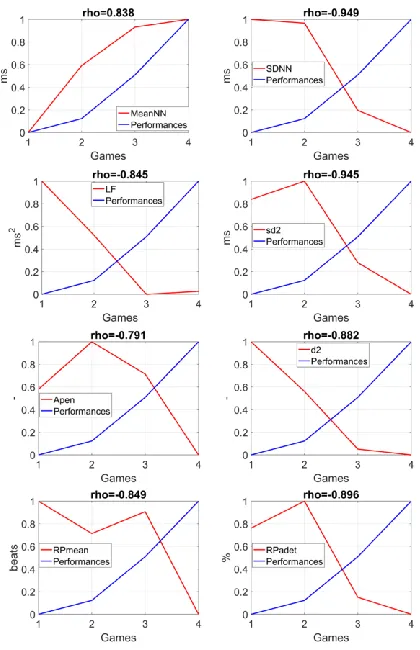
one arrow was used for non-significant variations: ↓ (or ↑) indicated a non-significant (p>.05) decrease (or increase) of a measure during the game session. Moreover, for exploratory purposes, the MD was plotted along the performance per game session (i.e., number of points) per each HRV feature. MD and performance were normalized to their maximum and the trends between HRV features and performance investigated. Spearman’s correla-tion coefficients (rho) between each HRV feature and perfor-mance over the four sessions were computed. A HRV feature and performance were considered highly correlated if rho re-sulted greater than 0.7 and significant if the associated p-value was less than 0.05.
III.
R
ESULTS AND DISCUSSIONData for 54 participants were included in the current study. ECG signals for 15 participants were discarded after quality check (i.e., NN/RR ratio < 90%).
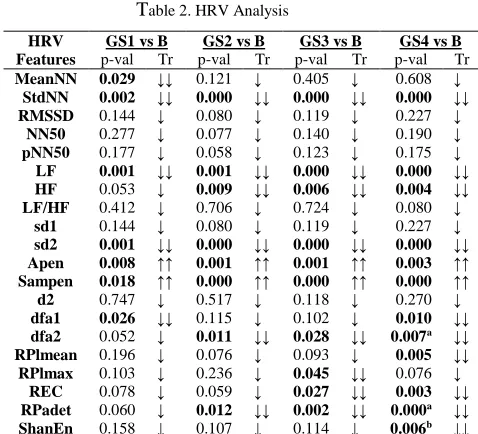
Table 2 shows the p-value and HRV trend between the re-peated video gaming sessions (i.e., mental workload) and the baseline (i.e., control condition). Seven HRV features changed significantly between session 1 and the baseline (see column 2: GS1 vs. B). In particular, MeanNN, SdNN, LF, sd2 and dfa1 decreased significantly, while Apen and Sampen increased significantly. As shown in the other col-umns of Table 2, in GS2-4 more HRV features changed sig-nificantly relatively to the baseline (see HRV features 8, 10, and 11 respectively).
All the HRV features maintained similar trends over the four sessions, reflecting consistency of HRV fluctuation as the task progressed. Yet, the number of non-linear HRV fea-tures showing to be significantly different increased moving from session 1 to session 4. Indeed, non-linear HRV features 4, 5, 7 and 9 changed in game 1, 2, 3 and 4 respectively. This overall reflects an increasingly depressed HRV during each repetition, suggesting an increase in stress [4]. By comparing within sessions, dfa2 and RPadet were found significantly different between session 1 and 4, while ShanEn between session 3 and 4. Previous studies [15-17], showed that as one task’s demand increases, HRV becomes more depressed. Added to this, here we found that also on repetitive tasks,
there is a depressed HRV over sessions, which is possibly due to an increase in mental workload.
Fig. 2 shows the correlation coefficients between normal-ized HRV features and performance over the four game ses-sions. Fig. 2 shows that performance increased over sessions overall. We reasoned that this occurred because players tend to perform better once become more familiar with the video game; this finding is also in agreement with previous studies showing similar rates at which people improve through prac-tice [18]. Noteworthy, eight HRV features presented high correlation with performance over the four sessions. Aside from MeanNN, all the remaining HRV features showed a negative correlation with performance over sessions. Yet, the p-value of those correlations was higher than 0.05, possibly because of the limited amount of repetitions.
IV.CONCLUSIONS
In this study, we investigated the effects of mental work-load induced by a repetitive task on HRV features. We found that over repetitions, a depressed HRV accentuates as repeti-tions progress. This is likely correlated with the increase in the mental workload. Moreover, we found a correlation be-tween task performance and key HRV features.
All in all, this study opens novel opportunities for research at the interface between HRV analysis and behavioral science
Table 2. HRV Analysis
HRV Features
GS1 vs B GS2 vs B GS3 vs B GS4 vs B
p-val Tr p-val Tr p-val Tr p-val Tr
MeanNN 0.029 ↓↓ 0.121 ↓ 0.405 ↓ 0.608 ↓
StdNN 0.002 ↓↓ 0.000 ↓↓ 0.000 ↓↓ 0.000 ↓↓ RMSSD 0.144 ↓ 0.080 ↓ 0.119 ↓ 0.227 ↓
NN50 0.277 ↓ 0.077 ↓ 0.140 ↓ 0.190 ↓
pNN50 0.177 ↓ 0.058 ↓ 0.123 ↓ 0.175 ↓
LF 0.001 ↓↓ 0.001 ↓↓ 0.000 ↓↓ 0.000 ↓↓ HF 0.053 ↓ 0.009 ↓↓ 0.006 ↓↓ 0.004 ↓↓ LF/HF 0.412 ↓ 0.706 ↓ 0.724 ↓ 0.080 ↓
sd1 0.144 ↓ 0.080 ↓ 0.119 ↓ 0.227 ↓
sd2 0.001 ↓↓ 0.000 ↓↓ 0.000 ↓↓ 0.000 ↓↓ Apen 0.008 ↑↑ 0.001 ↑↑ 0.001 ↑↑ 0.003 ↑↑ Sampen 0.018 ↑↑ 0.000 ↑↑ 0.000 ↑↑ 0.000 ↑↑ d2 0.747 ↓ 0.517 ↓ 0.118 ↓ 0.270 ↓
dfa1 0.026 ↓↓ 0.115 ↓ 0.102 ↓ 0.010 ↓↓ dfa2 0.052 ↓ 0.011 ↓↓ 0.028 ↓↓ 0.007a ↓↓
RPlmean 0.196 ↓ 0.076 ↓ 0.093 ↓ 0.005 ↓↓ RPlmax 0.103 ↓ 0.236 ↓ 0.045 ↓↓ 0.076 ↓
REC 0.078 ↓ 0.059 ↓ 0.027 ↓↓ 0.003 ↓↓ RPadet 0.060 ↓ 0.012 ↓↓ 0.002 ↓↓ 0.000a ↓↓
ShanEn 0.158 ↓ 0.107 ↓ 0.114 ↓ 0.006b ↓↓
Tr: Trend; p-val: p-value; GS1-4: Game Sessions 1-4; B: Baseline; ↓↓ (↑↑): significantly lower (higher) under mental workload (p<.05);↓(↑): lower (higher) under mental workload (p>.05);a significant different between GS1 and GS4; b
[image:4.595.316.555.254.471.2]in both lab-based and real-life settings. This also is poten-tially able to foster the autonomic neuroscience research agenda.
A
CKNOWLEDGMENTWe acknowledge funding from the Global Research Priority in Behavioural Science of the University of Warwick.
C
ONFLICT OFI
NTERESTThe authors declare no conflicts of interest.
R
EFERENCES[1] S. Massaro and L. Pecchia, "Heart Rate Variability (HRV) Analysis A Methodology for Organizational Neuroscience," Organizational Research Methods, p. 1094428116681072, 2016.
[2] G. N. Yannakakis, H. P. Martinez, and M. Garbarino, "Psychophysiology in games," in Emotion in Games, ed: Springer, 2016, pp. 119-137.
[3] J. M. Kivikangas, G. Chanel, B. Cowley, I. Ekman, M. Salminen, S. Järvelä, et al., "A review of the use of psychophysiological methods in game research," journal of gaming & virtual worlds,
vol. 3, pp. 181-199, 2011.
[4] R. Castaldo, P. Melillo, U. Bracale, M. Caserta, M. Triassi, and L. Pecchia, "Acute mental stress assessment via short term HRV analysis in healthy adults: A systematic review with meta-analysis," Biomedical Signal Processing and Control, vol. 18, pp. 370-377, 2015.
[5] P. S. Tsang and M. A. Vidulich, "Mental workload and situation awareness," Handbook of Human Factors and Ergonomics, Third Edition, pp. 243-268, 2006.
[6] S. Hébert, R. Béland, O. Dionne-Fournelle, M. Crête, and S. J. Lupien, "Physiological stress response to video-game playing: the contribution of built-in music," Life sciences, vol. 76, pp. 2371-2380, 2005.
[7] R. A. Henning, W. Boucsein, and M. C. Gil, "Social–physiological compliance as a determinant of team performance,"
International Journal of Psychophysiology, vol. 40, pp. 221-232, 2001.
[8] R. A. Henning and S. L. Sauter, "Work-physiological synchronization as a determinant of performance in repetitive computer work,"
Biological psychology, vol. 42, pp. 269-286, 1996.
[9] P. Lehrer, M. Karavidas, S.-E. Lu, E. Vaschillo, B. Vaschillo, and A. Cheng, "Cardiac data increase association between self-report and both expert ratings of task load and task performance in flight simulator tasks: An exploratory study," International Journal of Psychophysiology, vol. 76, pp. 80-87, 2010. [10] S. H. Fairclough, L. Venables, and A. Tattersall, "The influence of
task demand and learning on the psychophysiological response," International Journal of Psychophysiology, vol. 56, pp. 171-184, 2005.
[11] A. L. Goldberger, L. A. Amaral, L. Glass, J. M. Hausdorff, P. C. Ivanov, R. G. Mark, et al., "Physiobank, physiotoolkit, and physionet components of a new research resource for complex physiologic signals," Circulation, vol. 101, pp. e215-e220, 2000.
[12] M. P. Tarvainen and J.-P. Niskanen, "Kubios HRV User's Guide,"
Biosignal Analysis and Medical Imaging Group (BSAMIG), Department of Physics University of Kuopio, 2013. [13] T. Force, "Heart rate variability guidelines: Standards of
measurement, physiological interpretation, and clinical use,"
European Heart Journal, vol. 17, pp. 354-381, 1996. [14] P. Melillo, M. Bracale, and L. Pecchia, "Nonlinear Heart Rate
Variability features for real-life stress detection. Case study: students under stress due to university examination,"
BioMedical Engineering OnLine, vol. 10, pp. 1-13, 2011/11/07 2011.
[15] B. Cinaz, R. La Marca, B. Arnrich, and G. Tröster, "Monitoring of mental workload levels," in Proceedings of IADIS eHealth conference, 2010, pp. 189-193.
[16] B. Cinaz, B. Arnrich, R. La Marca, and G. Tröster, "Monitoring of mental workload levels during an everyday life office-work scenario," Personal and ubiquitous computing, vol. 17, pp. 229-239, 2013.
[17] J. Paxion, E. Galy, and C. Berthelon, "Mental workload and driving,"
Frontiers in psychology, vol. 5, 2014.
[image:5.595.69.279.109.434.2][18] F. E. Ritter and L. J. Schooler, "The learning curve," International encyclopedia of the social and behavioral sciences, vol. 13, pp. 8602-8605, 2001.