warwick.ac.uk/lib-publications
Original citation:
Grandi, Umberto and Turrini, Paolo (2016) A network-based rating system and its resistance
to bribery. In: Twenty-Fifth International Joint Conference on Artificial Intelligence, New
York, USA, 9-15 Jul 2016. Published in: Proceedings of the Twenty-Fifth International Joint
Conference on Artificial Intelligence pp. 301-307.
Permanent WRAP URL:
http://wrap.warwick.ac.uk/97682
Copyright and reuse:
The Warwick Research Archive Portal (WRAP) makes this work by researchers of the
University of Warwick available open access under the following conditions. Copyright ©
and all moral rights to the version of the paper presented here belong to the individual
author(s) and/or other copyright owners. To the extent reasonable and practicable the
material made available in WRAP has been checked for eligibility before being made
available.
Copies of full items can be used for personal research or study, educational, or not-for profit
purposes without prior permission or charge. Provided that the authors, title and full
bibliographic details are credited, a hyperlink and/or URL is given for the original metadata
page and the content is not changed in any way.
Publisher’s statement:
© ACM, 2016. This is the author's version of the work. It is posted here by permission of
ACM for your personal use. Not for redistribution. The definitive version was published in
Proceedings of the Twenty-Fifth International Joint Conference on Artificial Intelligence pp.
301-307. (2016) https://dl.acm.org/citation.cfm?id=3060664
A note on versions:
The version presented here may differ from the published version or, version of record, if
you wish to cite this item you are advised to consult the publisher’s version. Please see the
‘permanent WRAP url’ above for details on accessing the published version and note that
access may require a subscription.
A Network-Based Rating System and its Resistance to Bribery
Umberto Grandi
University of Toulouse
France
[email protected]
Paolo Turrini
Imperial College London
United Kingdom
[email protected]
Abstract
We study a rating system in which a set of individ-uals (e.g., the customers of a restaurant) evaluate a given service (e.g, the restaurant), with their ag-gregated opinion determining the probability of all individuals to use the service and thus its generated revenue. We explicitly model the influence relation by a social network, with individuals being influ-enced by the evaluation of their trusted peers. On top of that we allow a malicious service provider (e.g., the restaurant owner) to bribe some individ-uals, i.e., to invest a part of his or her expected in-come to modify their opinion, therefore influenc-ing his or her final gain. We analyse the effect of bribing strategies under various constraints, and we show under what conditions the system is bribery-proof, i.e., no bribing strategy yields a strictly pos-itive expected gain to the service provider.
1
Introduction
Imagine to be the owner of a new and still relatively unknown restaurant. The quality of food is not spectacular and the cus-tomers you have seen so far are only limited to a tiny number of friends of yours. Your account on TripadvisorR has
re-ceived no review and your financial prospects look grim at best. There is one easy solution to your problems: you ask your friends to write an enthusiastic review for you, in ex-change for a free meal. After this, TripadvisorR lists your
restaurant as excellent and the number of customers, together with your profit, suddenly florishes.
Systems such as TripadvisorR, where a small proportion
of customers writes reviews and influences a large number of potential customers, are notbribery-proof: each restaurant owner - or the owner of whichever service - is able to offer a compensation - monetary or not - in exchange for positive evaluation, having an impact on the whole set of potential customers. TripadvisorR is based on what we call “Objective
Rating”, orO-RATING: individual evaluations are aggregated
into a single figure, which is seen by, and thus influences, every potential customer.
What we study in this paper is a system in which each indi-vidualonlyreceives the evaluation given by the set of trusted peers, his or her friends, and only this aggregated opinion
influences his or her decision. This is what we call “Per-sonalised Rating”, or P-RATING, which can be seen a
gen-eralisation ofO-RATING in which influence has a complex
network-structure. So, while in the case of O-RATING the
restaurant owner knows exactly how influence flows among the customers, this might not be the case withP-RATING.
Our contributionWe analyse the effect of bribing strate-gies in the case of O-RATING and P-RATING under various
constraints, depending on the presence of customers who do not express any opinion and the knowledge of the network by the service provider: the exact network is known, the work is known but not the customers’ exact position, the net-work is completely unknown. We show under what condi-tions the system is bribery-proof, i.e., there is no bribe yield-ing a strictly positive expected gain to the service provider, and we provide algorithms for the computation of (all) opti-mal bribing strategies when they exist.
Intuitively, being able to know and bribe influential cus-tomers is crucial for guaranteeing a positive expected reward of a bribing strategy. However, while with large populations of non-voters “random” bribes can still be profitable, the ef-fect ofP-RATINGis largely different from that ofO-RATING
and, as we show, the expected profit in the former can be severely limited and drops below zero in all networks, under certain (mild) conditions on the cost of bribes.
Our study can be applied to all situations in which individu-als influence one another in the opinion they give and bribery can have a disruptive role in determining collective decisions.
Related research linesOur approach relates to several re-search lines in artificial intelligence, game theory and (com-putational) social choice [Brandtet al., 2015].
Lobbying and Bribery Our framework features an external agent trying to influence individual decisions to reach his or her private objectives. Lobbying in decision-making is an important problem in the area of social choice, from the seminal contribution of [Helpman and Pers-son, 1998] to more recent studies in multi-issue vot-ing [Christianet al., 2007]. Lobbying and bribery are also established concepts in computational social choice, with their computational complexity being analysed ex-tensively [Faliszewski et al., 2009; Baumeister et al., 2011; Brederecket al., 2014; 2016].
Reputation-based systems We study the aggregation of possibly insincere individual evaluations by agents that can influence one another through trust relations. In this sense ours can be seen as a study of reputation in Multi Agent Systems, which has been an important concern of MAS for the past decades [Conte and Paolucci, 2002; Sabater and Sierra, 2005; Garcinet al., 2009]. In partic-ular, our framework treats reputation as a manipulable piece of information, not just a static aggregate of indi-vidual opinions, coherently with the work of Conteet al. [2008] and Pinyol and Sabater-Mir [2013].
Paper structureSection 2 presents the basic setup, intro-ducingO-RATING,P-RATINGand bribing strategies. Section 3
focusses onO-RATING, studying its bribery-proofness under
various knowledge conditions. Section 4 evaluatesP-RATING
against the same knowledge conditions. In Section 5 we com-pare the two systems, taking the cost of bribery into account. We conclude by summarising the main findings and pointing at future research directions (Section 6).
2
Basic setup
In this section we provide the basic formal definitions.
2.1
Restaurant and customers
Our framework features an object r, called restaurant, be-ing evaluated by a finite non-empty set of individualsC =
{c1, . . . , cn}, calledcustomers. Customers are connected by an undirected graphE ⊆ C×C, called thecustomers net-work. Givenc ∈C we callN(c) = {x∈ C | (c, x) ∈E}
theneighbourhoodofc, always includingcitself.
Customers concurrently submit anevaluationof the restau-rant, drawn from a set of valuesVal⊆[0,1], together with a distinguished element{∗}, symbolising no opinion. Exam-ples of values are the set[0,1]itself, or a discrete assignment of 1 to 5 stars, as common in online rating systems. We make the assumption that{0,1} ⊆Valand thatValis closed under the operationmin{1, x+y}for allx, y∈Val. The vast ma-jority of known rating methods can be mapped onto the[0,1]
interval and analysed within our framework.
We represent the evaluation of the customers as a function
eval : C → Val∪ {∗} and define V ⊆ C as the subset of customers that expresses an evaluation over the restaurant, i.e.,V ={c ∈C |eval(c)6=∗}. We refer to this set as the set ofvotersand we assume it to be always non-empty, i.e., there is at least one customer that expresses an evaluation.
2.2
Two rating systems
In online rating systems such as TripadvisorR
every inter-ested customer can see - and is therefore influenced by - (the average of) what the other customers have written. We call this methodO-RATING, which stands forobjective rating.
Given an evaluation functionevalof a restaurant, the asso-ciatedO-RATINGis defined as follows:
O-RATING(eval) = avg
c∈V
eval(c)
Whereavgis the average function across real-valuedeval(c), disregarding∗. We omitevalwhen clear from the context.
O-RATINGflattens individual evaluations into a unique ob-jective aggregate, the rating that a certain restaurant is given. What we propose is a refinement of O-RATING, which takes
the network of influence into account. In this system cus-tomers are only interested in the evaluation of other cus-tomers they can trust, e.g., their friends. We call our method P-RATING, which stands forpersonalised rating. It is defined
for a pair customer-evaluation(c,eval)as follows:
P-RATING(c,eval) = avg
k∈N(c)∩V
eval(k)
So theP-RATING(c, eval)calculates what customerccomes to think of the restaurant, taking the average of the opinions of the customerscis connected to. Again we omiteval when-ever clear from the context.
Observe that in case a customer has no connection with a voter, thenP-RATINGis not defined. To facilitate the
analy-sis we make the technical assumption thateach customer is connected to at least one voter. Also observe that whenE= C×C, i.e., in case the network is complete and each individ-ual is influenced by each other individindivid-ual, then for allc∈C
andevalwe have thatP-RATING(c,eval) =O-RATING(eval).
2.3
Utilities and strategies
We interpret a customer evaluation as a measure of his or her propensityto go to the restaurant. We therefore assume that the utility that a restaurant gets is proportional to its rating. To simplify the analysis we assume a factor 1 proportionality.
The case ofO-RATING. For theO-RATING, we assume that the initial utilityu0of the restaurant is defined as:
u0O=|C|O-RATING(eval).
Intuitively, the initial utility amounts to the number of cus-tomers that actually go to the restaurant, weighted with their (average) predisposition.
At the initial stage of the game, the restaurant owner re-ceivesu0, and can then decide to invest a part of it to influence a subset of customers and improve upon the initial gain. We assume utility to be fully transferrable and, to facilitate the analysis, that such transfers translate directly into changes of customers’ predispositions.
Definition 1. A strategy is a functionσ:C→Val such that
P
c∈Cσ(c)≤u
0.
LetΣbe the set of all strategies. We denoteσ0the strategy that assigns0 to all customers and we callbribing strategy any strategy that is different fromσ0. After the execution of a bribing strategy, the evaluation is updated as follows:
Definition 2. The evaluation evalσ(c)after execution ofσis
evalσ(c) = min{1,eval(c) +σ(c)}, where∗+σ(c) =σ(c), ifσ(c)6= 0, and∗+σ(c) =∗, ifσ(c) = 0.
In this definition we are making the assumption that the effect of bribing a non-voter to vote is equivalent to that of bribing a voter that had a 0-level review, as, intuitively, the individual has no associated predisposition to go to the restaurant.
A strategy is calledefficientifσ(c) +eval(c) ≤1 for all
c∈C. LetB(σ) ={c∈C|σ(c)6= 0}be the set of bribed customers. Let Vσ be the set of voters after the execution
ofσ. Executingσinduces the following change in utility:
uσO=|C|O-RATING(evalσ)−
X
c∈C σ(c).
Intuitively, uσO is obtained by adding to the initial utility of the restaurant the rating obtained as an effect of the money in-vested on each individual minus the amount of money spent. We define the revenue of a strategyσas the marginal utility obtained by executing it:
Definition 3. Letσbe a strategy. Therevenueofσis defined asrO(σ) =uσO−u0. We say thatσisprofitableifrO(σ)>0.
Finally, we recall the standard notion of dominance:
Definition 4. A strategyσisweakly dominantifuσ
O ≥ u
σ0
O
for allσ0∈Σ. It isstrictly dominantifuσ
O> u
σ0
O for allσ∈Σ.
Hence a non-profitable strategy is never strictly dominant.
The case ofP-RATING. The previous definitions can be adapted to the case ofP-RATINGas follows:
u0P=X c∈C
P-RATING(c,eval)
which encodes the initial utility of each restaurant, and
uσP =X c∈C
P-RATING(c,evalσ)−
X
c∈C σ(c)
which encodes the utility change after the execution of aσ. Finally, let the revenue ofσberP(σ) =uσP−u0P. If clear from the context, we useP-RATINGσ(c)forP-RATING(evalσ, c).
In order to determine the dominant strategies, we need to establish how the customers vote, how they are connected, and what the restaurant owner knows. In this paper we as-sume that the restaurant knowseval, leaving the interesting case whenevalis unknown to future work. We focus instead on the following cases: the restaurant knows the network, the restaurant knows the shape of the network but not the individ-uals’ position, and the network is unknown. We analyse the effect of bribing strategies onP-RATING in each such case.
Notice how for the case of O-RATING the cases collapse to
the first. We also look at the special situation in which every customer is a voter.
Given a set of such assumptions, we say thatO-RATING(or
P-RATING) arebribery-proofunder those assumptions ifσ0is weakly dominant.
Discussion Our model is built upon a number of simpli-fying assumptions which do not play a significant role in the results and could therefore be dispensed with: (i) customers’ ratings correspond to their propensity to go to the restaurant. (ii) the restaurant utility equals the sum of all such propen-sities (iii) bribeσ(c)affects evaluationeval(c)linearly. All these assumptions could be generalised by multiplicative fac-tors, such as an average priceRpaid at the restaurant, and a “customer price”Dc, such thatevalσ(c) =eval(c) +
σ(c)
Dc.
3
Bribes under
O
-
RATINGIn this section we look at bribing strategies underO-RATING,
first focussing on the case where everyone expresses an opin-ion, then moving on to the more general case.
3.1
All vote
Let us now consider the case in whichV = C. Recall that
B(σ)is the set of customers bribed byσ. We say that two strategiesσ1andσ2aredisjointifB(σ1)∪B(σ2) =∅. By direct calculation it follows that the revenue of disjoint strate-gies exhibits the following property:
Lemma 1. IfV =Candσ1andσ2are two disjoint strate-gies, thenrO(σ1◦σ2) =rO(σ1) +rO(σ2).
We now show that bribing a single individual is not profitable.
Lemma 2. Letσbe a bribing strategy,V =Cand|B(σ)|= 1. Then,rO(σ)≤0, i.e.,σis not profitable.
Proof sketch. Let¯cbe the only individual such thatσ(¯c)6= 0. By calculation,r(σ) =uσO−u0O=O-RATINGσ−O-RATING− P
cσ(c) = min{1,eval(¯c)+σ(¯c)}−eval(¯c)−σ(¯c)≤0.
By combining the two lemmas above we are able to show that no strategy is profitable for bribing theO-RATING.
Proposition 3. IfV =C, then no strategy is profitable.
Proof sketch. Any bribing strategyσcan be decomposed into
npairwise disjoint strategies such thatσ=σc1◦ · · · ◦σcnand
|B(σcj)|= 1for all1≤j ≤n. By applying Lemma 1 and Lemma 2 we then obtain thatrO(σ)≤0.
From this it follows thatσ0 is weakly dominant and thus O-RATINGbribery-proof when all customers voted.
3.2
Non-voters
Let us now consider the case ofV ⊂C, i.e., when there is at least one customer who is not a voter. In this case Lemma 1 no longer holds, as shown in the following example.
Example 1. LetC = {A, B, C}, and let eval(A) = 0.5, eval(B) = 0.5, and eval(C) = ∗. The initial resources are
u0 =
O-RATING ×3 = 1.5. Let nowσ1(A) = 0.5 and
σ1(B) = σ1(C) = 0, and letσ2(C) = 0.5 and σ2(A) =
σ2(B) = 0. NowuσO1 = 0.75×3−0.5 = 1.75anduσO2 =
0.5×3−0.5 = 1, butuσ1◦σ2
O = 0.¯6×3−1 = 1.
The example (in particularσ1) also shows thatO-RATING
in this case is not bribery-proof.
always dominated. Let firstσbe a strategy such thatσ(¯c)6= 0
for somec∈C\V and recall thatVσis the set of voters after
execution ofσ. Let us define thec-greedy restrictionofσto be any strategyσ−c¯such that:
• Vσ−c¯=Vσ\ {c}, i.e., the greedy restriction eliminates
¯
cfrom the set of voters.
• For each c ∈ Vσ \ c, max(1, eval(c) +σ(c)) = max(1, eval(c) +σ−c¯(c)), i.e., the greedy restriction does not waste further resources.
• If there existsc∈Vσ\csuch thateval(c) +σ−¯c(c)<1
thenP c∈Cσ
−¯c(c) = P
c∈Cσ(c), i.e., the σ
−¯c
redis-tributesσ(¯c)among the remaining voters.
We now show that each strategy bribing a non-voter is strictly dominated by any of its greedy restrictions.
Proposition 4. Let V 6= C, and c¯ ∈ C\V. Then each strategyσwithσ(c)6= 0is strictly dominated byσ−¯c.
Proof. Letσbe a strategy withσ(c)6= 0for some non-voter
c, and letσ−c¯be one of its greedy restriction defined above.
uσO−c¯−uσO=
|C|(O-RATINGσ
−¯c
−O-RATINGσ)+X
c∈C
σ(c)−X
c∈C
σ−¯c(c) =
|C|( P
c∈Ceval σ−¯c(c)
|V| −
P
c∈Ceval σ(c)
|V ∪c| ) +
+(X
c∈C
σ(c)−X
c∈C σ−¯c(c))
Observe first thatσ−c¯is a redistribution, henceP
cσ(c)− P
cσ−
¯
c(c) ≥ 0, i.e., the second addendum in the above
equation is positive. Consider now the case where there ex-ists c ∈ Vσ \c such that eval(c) +σ−¯c(c) < 1. Then by the definition ofσ−¯c we have that P
c∈Vσevalσ(c) = P
c∈Vσ−c¯evalσ
−¯c
(c), i.e., the greedy restriction preserves the overall evaluation. By straightforward calculation this en-tails thatuσ−c¯
O −u
σ
O > 0. If no suchcexists, and therefore O-RATINGσ
−c¯
= 1we have that eitherO-RATINGσ < 1 or, by the efficiency requirement and the fact thatσ(c)6= 0, we have that P
c∈Cσ(c) > P
c∈Cσ
−¯c(c). In either cases we
have thatuσ−¯c
O −u
σ
O>0.
Let anO-greedy strategybe any efficient strategy that re-distributes all the initial resourcesu0
Oamong voters. Making
use of the previous result, we are able to characterise the set of all dominant strategies forO-RATING.
Proposition 5. LetV 6= C. A strategy is weakly dominant forO-RATINGif and only if it is anO-greedy strategy.
Proof sketch. For the right-to-left direction, first observe that allO-greedy strategies are payoff-equivalent, and that a non-efficient strategy is always dominated by its non-efficient counter-part. By Proposition 4 we know that strategies bribing non-voters are dominated, and by straightforward calculations we obtain that in presence of non-voters it is always profitable to bribe as much as possible. For the left-to-right direction,
observe that a non-greedy strategy is either inefficient, or it bribes a non-voter, or does not bribe as much as possible. In either circumstance it is strictly dominated.
While there may be cases in which the number of weakly dominant strategies underO-RATINGis exponential, all such
strategies are revenue equivalent, and Proposition 5 gives us a polynomial algorithm to find one of them: starting from an evaluation vectoreval, distribute all available resources u0
O
to the voters, without exceeding the maximal evaluation of 1. By either exhausting the available budget or distributing it all, we are guaranteed the maximum gain by Proposition 5.
4
Bribes under
P
-
RATINGIn this section we look at bribing strategies underP-RATING,
against various knowledge conditions on the social network. As for Section 3 we start by looking at the case where every-one votes and later on allowing non-voters. Before doing that, we introduce a useful graph-theoretic measure of influence.
Definition 5. Theinfluence weightof a customerc∈Cin a networkEand under a strategyσis defined as follows:
wc= X k∈N(c)
1
|N(k)∩Vσ|
Intuitively, each individual’s rating influences the rating of each of its connections, with a factor that is inversely pro-portional to the number of second-level connections. We for-malise this statement in the following lemma, which is re-stricted to strategies that only bribe voters:
Lemma 6. The utility obtained by playingσwithP-RATING
isuσP =P
c∈Vσwc×eval σ
(c)−P
c∈Cσ(c).
Proof. By calculation:
uσP+X c∈C
σ(c) =X c∈C
P-RATING(c) =
X
c∈C avg k∈N(c)∩Vσ
evalσ(k) =
=X c∈C
1
|N(c)∩Vσ| X
k∈N(c)∩Vσ
evalσ(k)=
= X
k∈Vσ
evalσ(k)× X
k0∈N(k)
1
|N(k0)∩Vσ|
=
= X
c∈Vσ
wc×evalσ(c)
In particular, whenV =C, we obtainwc=P k∈N(c)
1 deg(k), wheredeg(c) =|N(c)|is thedegreeofcinE.
4.1
All vote, known network
We begin by studying the simplest case in which the restau-rant knows the evaluationeval, the networkEas well as the position of each customer on the network. The following corollary is a straightforward consequence of Lemma 6:
Corollary 7. LetV =C and letσ1andσ2be two disjoint strategies, thenrP(σ1◦σ2) =rP(σ1) +rP(σ2).
Proposition 8. LetV =C, letEbe a known network, and let
σbe an efficient strategy. ThenrP(σ) =P
c∈C(wc−1)σ(c).
Proof. By calculation, where Step (2) uses Lemma 6, and Step (4) uses the fact thatσis efficient:
rP(σ) =uσP −u0P= (1)
= [X
c∈C
wcevalσc−
X
c∈C
σ(c)−X
c∈C
wceval(c)] = (2)
=X
c∈C
wc[min{1,eval(c) +σ(c)} −eval(c)]
− (3)
−X
c∈C
σ(c) =X
c∈C
(wc−1)σ(c). (4)
Proposition 8 tells us that the factorswcare crucial in de-termining the revenue of a given bribing strategy. Bribing a customercis profitable wheneverwc>1(provided its evalua-tion was not1already), while bribing a customercwithwc≤1
is at most as profitable as doing nothing, as can be seen in the example below. Most importantly, it shows thatP-RATINGis
notbribery-proof when the restaurant knows both the network and the customers’ evaluations.
Example 2. Let E be a four arms stars, and let A be the individual in the centre. Assume each individual values the restaurant 0.5. We have thatwA = 2.2 and wc = 0.7 for allcdifferent fromA. Consider now two bribing strategies:
σA which bribesAwith0.5, andσB which bribes a single
individualB 6=Awith the same amount. What we obtain is thatrP(σA) = 0.6, whiler
P(σ
B) =−0.15.
Given a networkEand an evaluation vectoreval, let Algo-rithm 1 define theP-greedy bribing strategy.
Input: Evaluation functionevaland networkE Output: A bribing strategyσG
P :C→Val
Budget=u0P σG
P(c) = 0for allc∈C
Computewcfor allc∈C
Sortc∈Cin descending orderc0, . . . , cmbased onwc
fori=0,. . . ,mdo if Budget6= 0then
if wci>1then σG
P(ci) = min{1−eval(ci),Budget}
Budget=Budget-σG
P(ci)
end end
returnσG
P
end
Algorithm 1:TheP-greedy bribing strategyσG
P
As a consequence of Proposition 8 we obtain:
Corollary 9. TheP-greedy bribing strategy defined in Algo-rithm 1 is weakly dominant.
As in the case ofO-RATING, Corollary 9 has repercussions
on the computational complexity of bribery: it shows that
computing a weakly dominant strategy can be done in poly-nomial time. Notice how the most costly operation lies in the computation of the influence weightswc, which can be
performed only once, assuming the network is static. Simi-lar problems, such as recognising whether bribing a certain individual is profitable, or estimating whether individuals on a network can be bribed above a certain threshold, are also computable in polynomial time.
4.2
All vote, unknown network
We now move to study the more complex case of an unknown network. Surprisingly, we are able to show that no bribing strategy is profitable (in expectation), and henceP-RATINGis
bribery-proof in this case. Recall that we are still assuming that the restaurant knowsevaland everybody voted.
We begin by assuming that the restaurant knows the struc-ture of the network, but not the position of each participant. Formally, the restaurant knowsE, but considers any permu-tation of the customers inCoverEas possible. Let us thus define the expected revenue of a strategyσover a given net-workEas the average over all possible permutations of cus-tomers:E[rP(σ)] =
P 1
n![u
σ
ρ−u0ρ],where we abuse notation
by writinguσ
ρ asuσP under permutationρover the networkE.
What we are able to show is that all strategies are at most as profitable asσ0in expected return:
Proposition 10. LetV =C, let the network structure ofE
be known but not the relative positions of customers onE. ThenE[rP(σ)] = 0for all strategiesσ.
Proof sketch. Let|C|=n. We show the result for any strat-egy σ that bribes a single customer ¯c. The general state-ment follows from the linearity ofE[r(σ)]. Equation (5) uses Proposition 8 to compute the revenue for each permutationρ
of customersCon the network:
E[σ] =
X
ρ
1 n! (u
σ ρ−u
0 ρ) =
X
ρ
1
n!(wρ(¯c)−1)σ(¯c) = (5)
=X
c∈C
(n−1)!
n! (wc−1)σ(¯c) =
(n−1)! n!
X
c∈C
(wc−1) = 0 (6)
The last line follows from the observation thatP
cwc=|C|
and henceP
c(wc−1) = 0, by a consequence of Definition 5
when everybody votes.
Hence, if we assume a uniform probability over all permu-tations of customers on the network, a straightforward conse-quence of Proposition 10 concludes that it is not profitable (in expectation) to bribe customers.
Corollary 11. IfV =Cand the network is unknown, then no bribing strategy forP-RATINGis profitable in expected return.
4.3
Non-voters, known network
WithP-RATINGit is possible to find a network where bribing
a non-voter is profitable:
Example 3. Consider 4 individuals{B, C, D, E}connected only to a non-voter in the middle. Leteval(j) = 0.2for allj
but the center. We haveu0P = 1. LetAbe the non-voter, and letσ1(A) = 1and 0 otherwise. The utility ofσ1is:
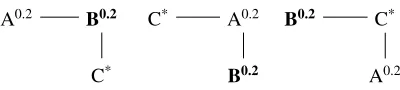
A0.2 B0.2
C*
C* A0.2
B0.2
B0.2 C*
[image:7.612.75.275.53.98.2]A0.2
Figure 1: Customers permutations in Example 4.
All other strategies can be shown to be dominated byσ1. Take for instance a strategyσ2such thatσ2(B) = 0.8,σ2(C) =
0.2and 0 otherwise. The utility ofσ2isuσP2= 1.25.
It is quite hard to obtain analytical results for strategies bribing non-voters, due to the non-linearity of theP-RATING
in this setting. We can however provide results in line with those of the previous section if we restrict tovoter-only strate-gies, i.e., strategiesσsuch thatσ(c) = 0for allc6∈V. In this case, a similar proof to Proposition 8 shows the following:
Proposition 12. LetV 6=C,E be a known network, andσ
be an efficient bribing strategy such thatB(σ) ⊆V. Then,
rP(σ) =P
c∈C(wc−1)σ(c).
The difference with the case of V = C is thatwc can be arbitrarily large in the presence of non-voters, such as in our Example 3.
4.4
Non-voters, unknown positions
Unlike the case ofV =C, in this case it is possible to define bribing strategies that are profitable (in expected return).
Example 4. LetC ={A, B, C}, and the initial evaluation eval(A) = eval(B) = 0.2 and eval(C) = ∗. Assume that the structure of the network is known, but the position of the individuals is not. Let the three possible network positions (without counting the symmetries) be depicted in Figure 1. Letσ(B) = 0.2andσ(A) =σ(C) = 0. In the first case:
r1P(σ)=P-RATING(A) +...+P-RATING(C)−0.2−u0P= = 0.3 + 0.3 + 0.4−0.2−0.6 = 0.2
In the second caser2P(σ) = 0while in the third:
r3P(σ) = 0.4 + 0.3 + 0.2−0.2−0.6 = 0.1
Therefore,P-RATINGis not bribery-proof (in expectation)
in the presence of non-voters when the network is unknown. Interesting computational problems open up in this setting, such as identifying the networks that allow for profitable brib-ing strategies, and their expected revenue.
5
Boundaries of bribery-proofness
The previous sections have shown that having a network-based rating systems, where individuals are influenced by their peers, is not bribery-proof, even when the position of in-dividuals in a given network is not known. However bribing strategies have a different effect in the overall score. While the utility ofO-RATINGis a sum of theglobalaverage of
vot-ers’ evaluation, the utility ofP-RATINGis a sum oflocal
aver-ages of voters’ evalution against the one of their peers. Therefore a strategy bribing one voter affects everyone in the case ofO-RATING, but it can be shown to have a limited
effect in the case ofP-RATING.
Proposition 13. Letσbe an efficient strategy s.t.|B(σ)|= 1, and letc¯be such thatσ(c)6= 0. ThenrP(σ)< N(¯c).
Proof. By calculation, we have that:
rP(σ) =
X
c∈C
P-RATINGσ(c)−σ(¯c)−X
c∈C
P-RATING(c) =
X
c0∈N(¯c)
P-RATINGσ(c)−σ(¯c)− X
c0∈N(¯c)
P-RATING(c)≤
≤1×N(¯c)−σ(¯c)− X
c0∈N(¯c)
P-RATING(c)< N(¯c)
The previous result shows that increasing the number of individuals that are not connected to an agent that is bribed, even if these are non-voters, does not increase the revenue of the bribing strategy. This is not true when we useO-RATING.
Proposition 14. Letσbe an efficient strategy. The revenue
rO(σ)ofσ is monotonically increasing with the number of non-voters, and is unbounded.
Proof. It follows from our definitions that:
rO(σ) = ( |C|
|Vσ|−1) X
c∈C
eval(c) +σ(c)
The above figure is unbounded and monotonically increas-ing in the number of non-voters, which can be obtained by increasingCkeepingVσfixed.
So whileP-RATINGandO-RATINGare not bribery-proof in
general, it turns out that the impact of the two in the overall network are significantly different. In particular, under realis-tic assumptions such as a very large proportion of non-voters and with participants having a few connections, bribing under O-RATINGis increasingly rewarding, while under P-RATING
this is no longer the case.
6
Conclusive remarks
We introduced P-RATING, a network-based rating system which generalises the commonly usedO-RATING, and
anal-ysed their resistance to external bribery under various condi-tions. The main take-home message of our contribution can be summarised in one point, deriving from our main results:
P-RATINGandO-RATINGare not bribery-proof in general.
However, if we assume that a service provider has a cost for bribing an individual, there are situations in whichP-RATING
is fully bribery proof, while O-RATINGis not. For instance,
if the cost of bribing an individualc is at least N(c)then P-RATINGis bribery-proof. As observed previously, this is
not necessarily true for O-RATING. In particular, if we
as-sume the presence of unreachable individuals the difference is more significant. As shown, forP-RATINGwe need to bribe
individuals withwc>1. WithO-RATINGis sufficient to find
one voter who accepts a bribe.
Acknowledgments
Umberto Grandi acknowledges the support of the Labex CIMI project “Social Choice on Networks” (ANR-11-LABX-0040-CIMI). Paolo Turrini the support of Imperial College London for the Junior Research Fellowship Design-ing negotiation spaces for collective decision-makDesign-ing (DoC-AI1048). This work has also been partly supported by COST Action IC1205 on Computational Social Choice.
References
[Abrahamet al., 2006] I. Abraham, D. Dolev, R. Gonen, and J. Halpern. Distributed computing meets game theory: ro-bust mechanisms for rational secret sharing and multiparty computation. InProceedings of the 25th ACM symposium on Principles of distributed computing (PODC’06), 2006. [Apt and Markakis, 2014] Krzysztof R. Apt and Evangelos Markakis. Social networks with competing products. Fun-damenta Informaticae, 129(3):225–250, 2014.
[Baumeisteret al., 2011] Dorothea Baumeister, G´abor Erd´elyi, and J¨org Rothe. How hard is it to bribe the judges? A study of the complexity of bribery in judgment aggregation. InProceedings of the Second International Conference on Algorithmic Decision Theory (ADT-2011), 2011.
[Brandtet al., 2015] Felix Brandt, Vincent Conitzer, Ulle Endriss, J´erˆome Lang, and Ariel Procaccia, editors. Hand-book of Computational Social Choice. Cambridge Univer-sity Press, 2015.
[Brederecket al., 2014] R. Bredereck, J. Chen, S. Hartung, S. Kratsch, R. Niedermeier, O. Such´y, and G. J. Woeg-inger. A multivariate complexity analysis of lobbying in multiple referenda. Journal of Artificial Intelligence Re-search, 50:409–446, 2014.
[Brederecket al., 2016] Robert Bredereck, Piotr Fal-iszewski, Rolf Niedermeier, and Nimrod Talmon. Large-scale election campaigns: Combinatorial shift bribery.Journal of Artificial Intelligence Research (JAIR), 55:603–652, 2016.
[Christianet al., 2007] R. Christian, M. Fellows, F. Rosa-mond, and A. Slinko. On complexity of lobbying in mul-tiple referenda. Review of Economic Design, 11(3):217– 224, 2007.
[Conitzer, 2012] Vincent Conitzer. Should social network structure be taken into account in elections? Mathemat-ical Social Sciences, 64(1):100–102, 2012.
[Conte and Paolucci, 2002] Rosaria Conte and Mario Paolucci. Reputation in Artificial Societies: Social Beliefs for Social Order. Kluwer Academic Publishers, 2002. [Conteet al., 2008] Rosaria Conte, Mario Paolucci, and
Jordi Sabater-Mir. Reputation for innovating social net-works. Advances in Complex Systems, 11(2):303–320, 2008.
[Elkind, 2014] Edith Elkind. Coalitional games on sparse so-cial networks. In 10th International Conference on Web and Internet Economics (WINE-2014), 2014.
[Faliszewskiet al., 2009] Piotr Faliszewski, Edith Hemas-paandra, and Lane A. Hemaspaandra. How hard is bribery in elections? Journal of Artificial Intelligence Research (JAIR), 35:485–532, 2009.
[Garcinet al., 2009] F. Garcin, B. Faltings, and R. Jurca. Ag-gregating reputation feedback. InProceedings of the Inter-national Conference on Reputation, 2009.
[Helpman and Persson, 1998] Elhanan Helpman and Torsten Persson. Lobbying and legislative bargaining. Working Paper 6589, National Bureau of Economic Research, June 1998.
[Kurokawaet al., 2015] David Kurokawa, Omer Lev, Jamie Morgenstern, and Ariel D. Procaccia. Impartial peer re-view. InProceedings of the Twenty-Fourth International Joint Conference on Artificial Intelligence, (IJCAI-2015), pages 582–588, 2015.
[Pinyol and Sabater-Mir, 2013] Isaac Pinyol and Jordi Sabater-Mir. Computational trust and reputation mod-els for open multi-agent systems: a review. Artificial Intelligence Review, 40(1):1–25, 2013.
[Procacciaet al., 2015] Ariel D. Procaccia, Nisarg Shah, and Eric Sodomka. Ranked voting on social networks. In Pro-ceedings of the Twenty-Fourth International Joint Confer-ence on Artificial IntelligConfer-ence, (IJCAI-2015), 2015. [Sabater and Sierra, 2005] Jordi Sabater and Carles Sierra.
Review on computational trust and reputation models. Ar-tificial Intelligence Review, 24(1):33–60, 2005.
[Salehi-Abari and Boutilier, 2014] Amirali Salehi-Abari and Craig Boutilier. Empathetic social choice on social net-works. In Proceedings of the 13th International con-ference on Autonomous Agents and Multi-Agent Systems, (AAMAS-2014), 2014.
[Simon and Apt, 2015] Sunil Simon and Krzysztof R. Apt. Social network games.Journal of Logic and Computation, 25(1):207–242, 2015.