Cross-project collaboration
in the construction sector
A 4C CONTROL TOWER FOR CONSTRUCTION SUPPLY CHAINS
2019
Master thesis Business Information Technology
Faculty of Electrical Engineering, Mathematics and Computer Science
University of Twente
Cross-project collaboration in the construction industry
Emmeloord, December 2019
Author
Name: Robin Staring
Email: [email protected] / [email protected]
Student number: s1387995
Supervisory committee
Dr. Ir Hans Moonen University of Twente
Dr. Klaas Sikkel University of Twente
External supervisor
Maarten van Pagée Van Meijel Automatisering B.V.
Copyright © 2019 Robin Staring
Management summary
The Dutch construction industry is booming: it is the fastest growing sector in the Netherlands
and there is a high need for new and renovated buildings and infrastructure. However, the
growth of the Dutch construction sector is greatly inhibited by labor shortages, rising material
prices and delays in the construction process. There are many inefficiencies in the construction
process leading to significant failure costs and low profit margins. The bundling of resources
and capacities has been found essential, especially in inner cities where space is limited and the
livability of the city needs to be taken into account. There is a need to manage the logistics of
multiple construction projects to make the construction process more efficient.
Previous research on this topic has proposed the use of the Construction Consolidation Center
for last-mile delivery and the bundling of goods for multiple projects. In addition, an
inter-organizational data platform, the 4C (Cross Chain Control Center) control tower, has been
sug-gested to be crucial in the monitoring and planning of the various logistical flows. Although
this control tower has only been described as a vision for construction logistics, the potential
role and organization of this control tower for construction industry is not yet explored.
This study goes in-depth into the topic of 4C and attempts to understand what the implications
are of a form of a 4C for the construction industry. An abstract design of a 4C is made using a
business model framework to describe the business logic. This design is validated with industry
experts to understand what value, information and processes the control tower could be
sup-ported and to assess its applicability.
The results point to many obstacles and uncertainties with regards to the development and use
of the 4C control tower in the construction industry, including a lack of a clear governance
model, a lack of a clear business case for the involved parties, improper chain-wide use of ICT,
several (perceived) risks of data sharing, and a lack of data standardization.
Instead of a central actor orchestrating the supply chains, this study finds that an industry-wide
protocol is needed that dictates the information exchange among the parties. The implications
of this for the industry, as well as for VanMeijel Automatisering are discussed. As an IT
pro-vider, VanMeijel may benefit from the opportunities that arise when logistics data among
par-ties is shared. This includes the addition of a new package to their software product, Metacom
Table of contents
Management summary ... ii
List of Figures and Tables ... v
1. Introduction ... 1
1.1 Background ... 1
1.1.1 Organizational background ... 1
1.1.2 Dutch construction industry ... 1
1.1.3 Inefficiencies in the building process ... 2
1.1.5 The need for Supply Chain Management ... 5
1.1.6 Cross Chain Control Centers ... 7
1.2 Previous work ... 8
1.3 Problem statement ... 9
1.4 Research questions ... 10
1.5 Research Methodology ... 11
1.5.1 Research approach ... 11
1.5.2 Literature review ... 12
1.5.2 Expert interviews ... 13
1.5.3 Business model design ... 13
2. Literature review ... 15
2.1 Construction supply chain management ... 15
2.1.1 Supply chain management ... 15
2.1.2 Construction characteristics ... 16
2.1.2 Construction supply chains ... 17
2.1.3 The building life cycle ... 22
2.1.4 The logistics process ... 24
2.2 Cross Chain Control Centers ... 30
2.2.1 Control towers ... 30
2.2.2 Cross-chain collaboration ... 32
2.2.3 Defining Cross-Chain Control Centers ... 33
2.2.4 Network governance models ... 35
2.2.5 4C information architecture ... 37
2.2.6 Requirements and challenges ... 40
3. 4C business model design ... 42
3.1 Construction Cross Chain Control Center ... 42
3.2.1 Customer interface ... 44
3.2.2 Product ... 46
3.2.3 Infrastructure ... 50
3.2.4 Finances ... 52
4. Validation ... 55
4.1 Expert interviews ... 55
4.2 Stakeholder problems and needs ... 55
4.2.1 Problem definition ... 55
4.2.2 Product ... 56
4.2.3 Customer interface ... 57
4.2.4 Infrastructure management ... 58
4.2.5 Financial aspects ... 59
4.3 Obstacles ... 59
4.3.1 Governance model ... 59
4.3.2 Business case ... 63
4.3.3 ICT usage ... 64
4.3.4 Risks of data sharing ... 65
4.3.5 Data standardization ... 65
5. Implications ... 67
5.1 Implications for construction industry ... 67
5.2 Implications for VanMeijel Automatisering ... 69
6. Conclusion ... 75
6.1 Answer to the research questions ... 75
6.2 Reflection ... 79
6.3 Limitations and future research ... 80
6.4 Research relevance ... 81
6.4.1 Practical relevance ... 81
6.4.2 Academic relevance ... 82
References ... 83
List of Figures and Tables
List of Figures
Figure 1 - Construction supply chain problems ... 3
Figure 2 - BIM example in Revitt ... 6
Figure 3 - Practical knowledge problem ... 11
Figure 4 - Research approach ... 12
Figure 5 - The Osterwalder Business Model Canvas ... 14
Figure 6 - Linear supply chain ... 15
Figure 7 - Characteristics of the construction industry ... 16
Figure 8 - Simplified illustration of a construction supply chain ... 18
Figure 9 - Decoupling points throughout the supply chain ... 22
Figure 10 - Building life cycle ... 22
Figure 11 - Deliveries to the construction site, own illustration ... 24
Figure 12 - Traditional control of deliveries ... 24
Figure 13 - Primary delivery process using a CCC ... 26
Figure 14 – Control of deliveries via CCC ... 26
Figure 15 - Scope of collaboration ... 32
Figure 16 - 4C supply chain network coordination ... 34
Figure 17 - Participant-governed network ... 35
Figure 18 - Lead organization-governed network ... 36
Figure 19 - Network Administrative Organization-governed network ... 36
Figure 20 - Hybrid control model ... 38
Figure 21 - 4C integration model ... 39
Figure 22 - 4C control tower in construction ... 42
Figure 23 - Metacom platform (copied from VanMeijel) ... 69
Figure 24 - Market IT needs ... 71
List of Tables Table 1 - Construction industry branches... 2
Table 2 - Benefits CCC London and Utrecht ... 28
Table 3 - 4C business model ... 54
Table 4 - Metacom Online packages ... 70
Table 5 - Dashboard KPIs ... 73
1. Introduction
This chapter is the starting point of this thesis and provides an introduction to problem of the
research domain. The first section provides some context and elaborates on the Dutch
construc-tion industry and the concept of Cross Chain Control Centers. This is followed by the problem
statement of this research in section 1.3. Section 1.4 covers the research objective and questions.
The chapter concludes with the research methodology in section 1.5.
1.1 Background
This section provides some context for this research. An introduction is made on the issues in
the Dutch construction industry and the general concept of a Cross Chain Control Center.
1.1.1 Organizational background
This research is conducted in cooperation with Van Meijel Automatisering B.V. (hereinafter
referred to as 'VanMeijel'). VanMeijel is an IT company that provides software and services for
the construction sector as well as construction-related industrial sectors to support the digital
transformation of the building process. VanMeijel was founded in 1987 and has grown to
ap-proximately 120 employees of which most are located at the headquarters in Emmeloord.
VanMeijel is seeking out new opportunities to expand and improve their product and service
offerings for its customers.
1.1.2 Dutch construction industry
The Dutch construction industry has been performing particularly well. Construction output has
risen significantly for the fourth consecutive year. The sector saw a growth of 7.1% in 2018 and
has a projected of 4.5% in the next two years (Rabobank, 2019). This growth is one of the
highest of all sectors in the Dutch economy. This growth can be attributed to the public
invest-ments in new infrastructure. Also specialized construction companies and installers are
ex-pected to benefit greatly from this growth. Residential and non-residential building construction
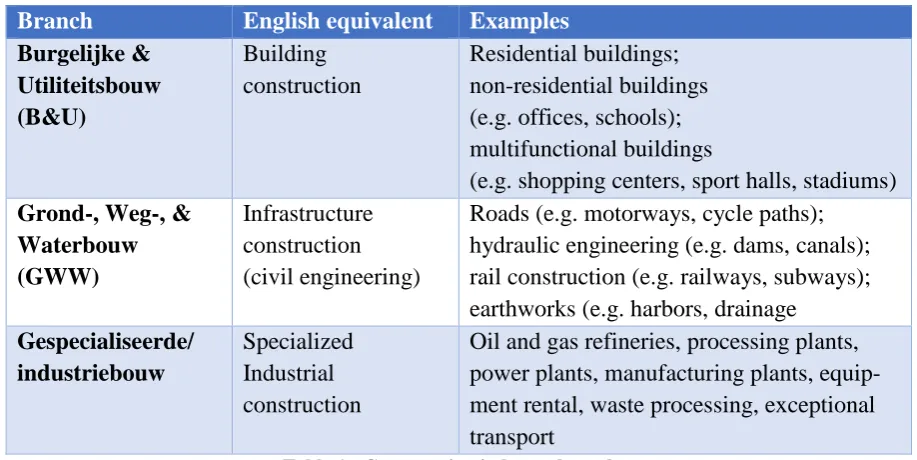
The construction sector can be divided into three branches:
Branch English equivalent Examples
Burgelijke & Utiliteitsbouw (B&U) Building construction Residential buildings; non-residential buildings (e.g. offices, schools); multifunctional buildings
(e.g. shopping centers, sport halls, stadiums) Grond-, Weg-, &
Waterbouw (GWW)
Infrastructure construction (civil engineering)
Roads (e.g. motorways, cycle paths); hydraulic engineering (e.g. dams, canals); rail construction (e.g. railways, subways); earthworks (e.g. harbors, drainage
Gespecialiseerde/ industriebouw
Specialized Industrial construction
[image:8.595.68.527.95.325.2]Oil and gas refineries, processing plants, power plants, manufacturing plants, equip-ment rental, waste processing, exceptional transport
Table 1 - Construction industry branches
There is need for new buildings and renovations to existing buildings to make them more
sus-tainable. There is currently a residential building shortage in the Netherlands. In 2019, the
short-age has built up to 300 thousand (Lissenberg, 2019). In the coming 5 years, 75.000 new
build-ings will need to be delivered each year, but in the past year only 69.109 permits have been
issued (Rabobank, 2019). Before 2030, a million new residential buildings will need to be
con-structed (Vermeeren, 2018). Despite the need for building production, it is inhibited by labor
shortages, rising material prices and delays in the building process (Rabobank, 2019).
1.1.3 Inefficiencies in the building process
The Dutch construction industry has been struggling with high failure costs (De Jong, Winkeler,
& Van Meijel, 2018). Failure costs refer to all costs that are unnecessarily incurred in the
pro-duction of the final product. They arise in every stage of the propro-duction process due to
ineffi-ciencies and the inability to meet the quality requirements of the client. Failure costs often
translate into wastage of labor and materials, and inefficient utilization of space and production
goods. The optimal use goods and labor is essential in an industry that has been struggling with
severe labor shortages. In addition, construction companies have to operate in a highly
compet-itive environment. Consequently, contractors have to settle for low profit margins as they have
to cope with the pressure of delivering high quality product within time and budget.
Several studies have been conducted to capture the scale of the failure cost problem but
esti-mating the exact costs has been difficult. Estimates of failure costs in construction vary from 8
7% of total revenue. This increased over the years to 10% in 2005 and 11% in 2009 (Busker,
2010). The inability to control the cause of the failure costs has led to this rise. Assuming failure
costs constitute 11% of the total production revenue, the waste of revenue would amount to a
total of €7.59 billion in 2019.
Failure costs are a persistent and almost accepted inefficiency in the construction sector.
Opin-ions differ as to what the causes are of failure costs in the construction sector. The causes can
be attributed to a multitude of factors and differ per company and project. A study conducted
by USP and Bouwkennis (Bouwkennis, 2013) reveals that a substantial part of the inefficiencies
can be attributed to insufficient communication and information exchange among project
part-ners. Most of the costs arise two distinct phases of a construction projects: the preparation phase
and execution phase. Failure costs in the execution phase of the project are estimated to be 43%
of total failure costs. The cause of these costs during this phase can be attributed for 26% to the
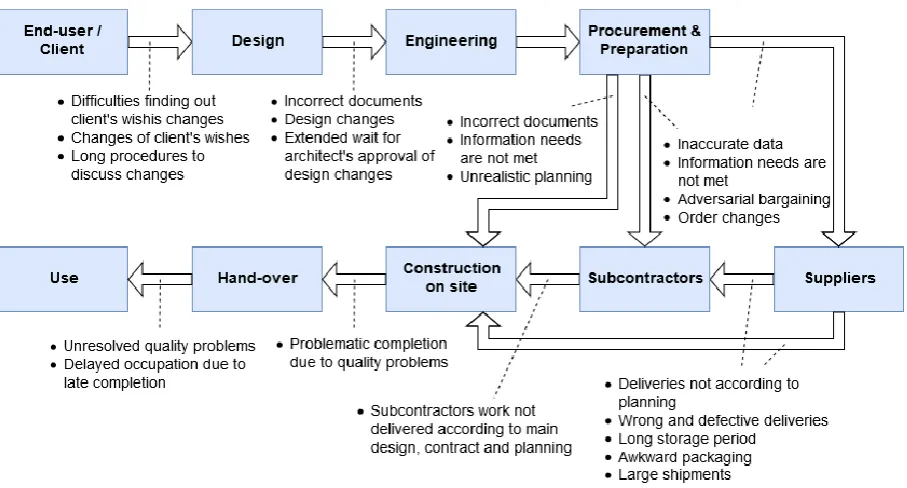
poor information exchange and communication. Figure 1 illustrates where problems may arise
[image:9.595.72.526.368.612.2]throughout the construction process.
Figure 1 - Construction supply chain problems, based on Vrijhoef & Koskela (2000)
A distinction can be made in the moment failure costs are caused and the moment they manifest.
A study conducted by USP and Bouwkennis (Bouwkennis, 2013) reveals failure costs mostly
manifest during the realization phase and to a much lesser extent during the preparation phase
and delivery of a building project. Although failure costs are almost never expressed in the
attributed to these initial phases due to errors and changes in the design. An overall trend can
be found that suggests that the vast majority of errors manifest in the execution phase, while
the causes mostly lie in the design phase. The highly phased process of construction makes the
realization phase of the project more prone to errors.
Noordhuis (2015) conducted an extensive analysis of the failure cost problems and found three
distinctive fundamental causes:
• Fragmented building process
The building process is divided into separate functional tasks which are often realized
by different actors. Building process fragmentation refers to the strict separation and
hierarchical organization of activities and has been widely described to be a major
con-tributing cause to the industry’s problems. The separation of activities and
inter-depend-encies of disciplines cause problems to build up as the construction progresses.
• Low degree of standardization
The low degree of standardization has been found to increase complexity and lower the
learning effects. It is estimated that standardized building parts make up 10 to 20% of
all parts in the residential building branch and less than 5% of parts in the non-residential
building branch (Noordhuis, 2015). For an efficient building process, there is a need for
standardization on the process level and on the product level by standardizing building
components.
• Lower price tendering
Competition between contractors is fierce resulting in prices being determined on the
basis of a product's minimum requirements. Tendering at the lowest price certainly
dis-courages the search for solutions that provide the best price/performance for the client.
As a result, a low price can ultimately result in higher (operating) costs and lower
1.1.5 The need for Supply Chain Management
The concept of supply chain management in construction has gained ground in recent years. By
applying effective management of the current construction supply chains, construction
compa-nies attempt to increase productivity and reduce failure costs of building projects. Supply chain
management (SCM) is a philosophy that describes how organizations can gain strategic
ad-vantages through effective management of their supply chains (Saad, Jones, & James, 2002). It
is the means through which improvements in flow of goods, finance, and information and
re-ductions in costs can be achieved. In the manufacturing industry, the application of SCM has
been proven to be successful in creating significant benefits throughout the supply chain. The
benefits include cost reduction, value creation and increased competitiveness (Christopher,
2016).
In a construction project, supply chain management involves the management of activities
un-dertaken by involved construction project from design to completion. Depending on the scope
of the project, the supply chain can consist of large range of participants, including the general
contractor (GC), building material suppliers, logistics providers, architects, constructors and
installers, and the client or developer.
As of yet, the application of supply chain management in construction has met many
difficul-ties. The peculiarities of construction, including unique building products, temporary supply
chain configurations, and site-specific production, prevent SCM to be applied as efficient as in
manufacturing (O’Brien, Formoso, Ruben, & London, 2008; Vrijhoef & Koskela, 2000).
Vrijhoef (2011) describes two ways of dealing with advances in building construction. First,
the elimination of the aforementioned peculiarities by means of standardization and
prefabrica-tion. It is argued that simplifying site construction techniques originating from manufacturing
can be applied in construction through the industrialization of the building method. However,
the applicability and impact of these innovations may vary greatly depending on the size and
complexity of the building projects. Overall, there has been little positive response to
perfor-mance improvement efforts in construction, largely due to the finite duration of the projects and
the project-by-project mindset of the involved companies (Tommelein, Walsh, & Hershauer,
2003).
A second approach for dealing with the unstable building production is to develop or adopt
techniques that manage to deal with the uncertainties and changes of construction (Vrijhoef,
exchange. According to Lönngren et al. (2010), there are various IT systems available to
con-struction companies to manage their business, but most are unable to aid in the information
flow and the provision of visibility across organizations. The systems used involve ERP/MRP
systems that serve to automate and provide visibility of single business unit functions, rather
than (O’Brien et al., 2008). As SCM has only begun gaining ground in construction, the
[image:12.595.70.530.196.458.2]neces-sary IT tools are needed to support the supply chain improvement practices.
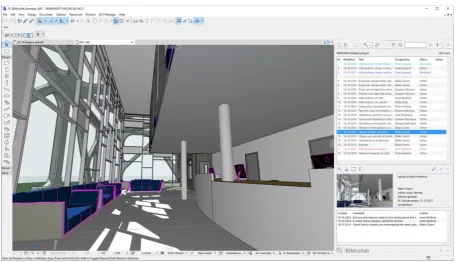
Figure 2 - BIM example in Revitt, copied from BIMcollab
In recent years, new logistical concepts and advances in ICT, such as the Building Information
Model (BIM) and sensor technology, have made their way into the construction industry.
Fig-ureFigure 2 shows an example of a BIM project in the Revitt application. BIM is mainly used
to communicate the design of a construction products, including its components, among the
client, architects, the general contractor with its subcontractors. However, it is not used for the
logistics process during the realization phase.
The logistics of a project involves a large number of suppliers that deliver goods to the
con-struction site. There is need for better communication in the logistical process throughout the
supply chain to properly coordinate the supply of goods to the construction site. is especially
needed in inner cities, where the logistics of a project are confronted with congestion, limited
space on-site, and regulations with regards to accessibility and emissions.
Several construction companies have turned to a Construction Consolidation Centers (CCC), a
logistics center is used in an attempt to make the flow of goods from the suppliers to the
con-struction site more efficient. The CCC has already proven to have significant benefits, but its
use is still in its infancy.
1.1.6 Cross Chain Control Centers
Another concept that is proposed alongside the Construction Consolidation Center is the Cross
Chain Control Center (4C). This concept is a relatively new in supply chain management and
has been gaining attention among researchers and practitioners in several industries, including
floriculture, chemical industry, e-commerce, and healthcare (De Weerd, 2018). It has been
de-scribed as a control center from which multiple supply chains can be coordinated using
state-of-the art technology and supply chain management concepts (Topsector Logistiek, 2015). As
a central actor for multiple supply chains, the 4C is able to support chain-wide activities, such
as forecasting, financial engineering, and data management, and create economies of scale. The
4C can also be used for transportation (e.g., by combining goods for transport between shippers)
and warehousing activities (e.g., merging warehouse capabilities) to achieve new efficiency
gains.
The concept of Cross Chain Collaboration Centers (4C) has been described as the next
revolu-tionary step in supply chain management (Topsector Logistiek, 2015). The potential benefits of
4C services such as collaborative planning and resource bundling have been demonstrated (De
Kok, van Dalen, & van Hillegersberg, 2015). Thus far, literature on the 4C concept has
re-mained limited to the Fast Moving Consumer Goods (FMCG) supply chain to support the
sup-ply chain activities of shippers, logistics service providers, and retailers.
There is a clear need in construction to effectively support and facilitate supply chain
manage-ment activities. As of yet, the creation and use of a 4C to support future collaborations has not
gone far beyond academic explorations and has only been described as a vision for construction
logistics. For construction, the 4C has been described a central control tower that monitors,
plans and coordinates logistics activities of one or multiple building projects by integrating the
relevant information systems and data sources. Questions remain regarding the role and
func-tions of a 4C for construction logistics. Furthermore, the implicafunc-tions of a 4C for the involved
1.2 Previous work
Topsector Logistiek and the NTO conducted an exploratory study on the possibilities of a 4C
Control Tower for construction logistics (De Bes e.a., 2018). This 4C project involves a
con-sortium of a few large Dutch construction companies, trade associations, and knowledge
insti-tutions. In this project, multiple construction logistics concepts, including the Construction
Consolidation Center (CCC, sometimes also referred to as a "logistics hub") and a 4C control
tower, were analyzed.
The report stresses the need for better ICT to support new smart logistics concepts. There is
both a need and a willingness to use smart construction logistics concepts by the large
con-tractors due to the lack of insight and control in the logistics process. However, there are a
number of challenges that prevent the adoption of these concepts. The studies conducted on
site revealed that little measurements done during the construction process. This has made it
difficult to provide insight into the effects of new concepts for improvement. Insight into the
costs and benefits is mostly theoretical, which makes the adoption of construction logistics
so-lutions difficult (De Bes e.a., 2018).
The study "4C in de bouwlogistiek" (Ludema & Van Merriënboer, 2016) found a lack of
ap-propriate ICT supporting the information exchange for the construction logistics process.
They claim a need for tactical and operational planning of the construction process. BIM does
not allow for a continuous dynamic planning for construction logistics that is linked with the
partners of the construction project. The report concludes that there are currently no examples
known of dynamic digital planning systems with a direct link between BIM and building
planning (4D BIM).
It is argued that a 4C control tower is needed to support the logistics processes across the
con-struction supply chains. This control tower would have to link the logistics processes with the
tactical and operational planning of the construction process. This vision of a control tower
came about after consultation with stakeholders involved in construction logistics. However, a
lot of questions remained unanswered. The study did not go in-depth of the inner workings
and wider implications of a 4C model in construction logistics, including the organization,
governance and ICT requirements. The 4C control tower is mainly an abstract vision for
1.3 Problem statement
This thesis describes the ways in which the 4C can support the supply chain management
ac-tivities of the parties involved for multiple construction projects. This 4C is aimed to improve
the efficiency of the logistical flows across the supply chains and to thereby minimize the failure
costs of construction projects. This thesis takes two perspectives when describing the design
and implications of the 4C: a business and a technical perspective. One way of describing how
a business creates and captures value are business models. The business functions of the 4C are
written from a managerial perspective to allow business managers to better understand and
ap-praise the business. This may help them in the formulation of a business strategy that will allow
a 4C to be implemented in the future. Similarly, the IT requirements may provide VanMeijel
Automatisering, as an IT provider, with insight into the implications of a 4C with regard to their
current product portfolio and helps them anticipate on new business opportunities. To
summa-rize, the goal of the thesis is twofold:
• To design and validate a blueprint of a 4C for construction using a business model
framework; and
1.4 Research questions
The problem statement and the goal of this study is used to formulate the main research
ques-tion.
What would a 4C look like that supports and facilitates supply chain management activities of
multiple construction projects?
The main research question is divided into several successive sub-questions:
RQ1. What is construction supply chain management?
RQ2. What are 4C control towers and how are they applied in logistics?
The answers to these two questions are provided in the literature review section. They provide
an understanding of how construction supply chains work and how 4C control towers are
ap-plied in logistics.
RQ3. What would a business model of a 4C control tower look like?
RQ4. To what extent does the designed 4C control tower fulfil the needs of the stakeholders?
In order for the business model to be viable, it will need to deliver value to the involved
stake-holders. The developed business model is validated by stakeholders and experts on the
likeli-hood of adoption and is adjusted where necessary.
RQ5. What are the IT implications of the designed 4C control tower in general, and for
VanMeijel in particular?
The validated business model is combined with the findings from literature to come to
recom-mendations to VanMeijel Automatisering on how to address the development of a 4C with
1.5 Research Methodology
1.5.1 Research approach
The main research method used for this study is Design Science Research (DSR) as it has
proven to be a useful method for information systems development (Hevner, March, Park, &
Ram, 2004) DSR is a method that helps structuring the thesis and guide the formulation of the
research question. The goal of the research is to develop a solution to a complex problem needed
in achieving in the development, use and assessment of information systems within an
organi-zation. The utility of the artefact is the main goal in this research.
Hevner et. al (2004) characterizes the problems in design science as follows:
• Unstable requirements and constraints based on ill-defined environmental contexts
• Complex interactions among subcomponents of the problem
• Inherent flexibility to change design processes as well as design artefacts (i.e., mallable
processes and artefacts)
• A critical dependence upon human cognitive abilities (e.g., creativity) to produce
effec-tive solutions
• A critical dependence upon human social abilities (e.g., teamwork) to produce effective
solutions
Looking at the specifications for wicked problems, DSR seems like a perfect fit for the problem
at hand. This approach involves both practical and knowledge problems (Wieringa, 2010), as
illustrated in Figure 3. The organizational context determines the goals of the practical problems
and is subject to change due to the implementation of an artefact. The knowledge base is used
to answer knowledge questions and can be extended when the new knowledge is gained through
[image:17.595.78.524.608.696.2]investigation.
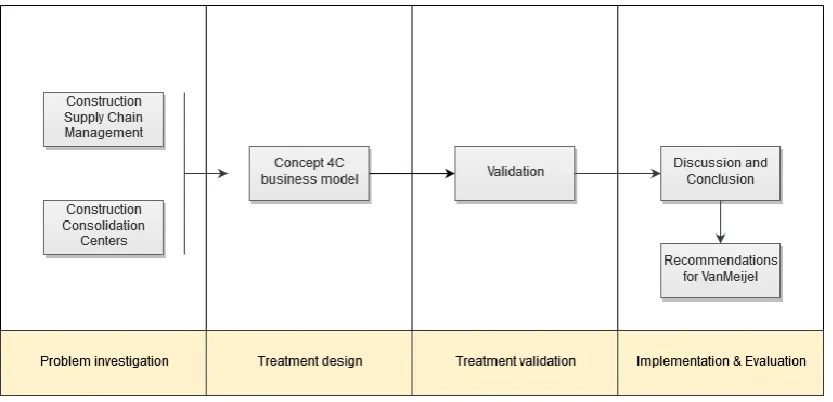
Wieringa (2010) describes a design cycle to tackle design problems. This study applies this
design cycle to structure the research approach. The cycle consists of: (1) design problem (2)
treatment design, (3) treatment validation, and (4) implementation & validation. The research
[image:18.595.91.508.184.385.2]approach of this study is made based on this cycle (Figure 4).
Figure 4 - Research approach
1.5.2 Literature review
The problem investigation and treatment design is primarily done through literature review.
Literature was selected from a broad range of sources. In addition to scholarly papers,
publica-tions of consultancy firms and research institutes where used in this research. The relevant
lit-erature is identified from the available scholarly databases. A comprehensive search is carried
out to find as many relevant literature as possible. This result of this search is a set of papers
that can be used for this study. The search strategy involves a number of databases and key
words that were determined to be relevant. The chosen journal databases include Scopus,
Sci-encedirect, Web of Science and IEEE. With help of a search operation, a list of papers where
presented on these databases. The title and abstract where used to determine the relevancy of
1.5.2 Expert interviews
This study started with an investigation into the problem statement and subsequent formulation
of the research questions. To support the exploration the research domain, several interviews
are conducted with experts both in the field of 4C and the construction industry. These
inter-views were unstructured in nature and provided a range of perspectives on the topic which is
desirable during the early stage of this research.
In the second phase of this research, several semi-structured interviews are conducted with
ex-perts in the construction industry and the field of 4C. The semi-structured character of these
interviews allow for any deviations in case new significant findings emerge during the
inter-views that need further investigation (Bryman, 2012). The explorative nature of this study calls
for a more flexible approach to how the interviews are conducted.
The aim of the expert interviews in this phase is two-folded. First of all, the interviews with
experts will result in valuable input regarding the creation of the of the research artifact. After
the design, the same experts are interviewed to validate the solution. The second aim of these
interviews is revealing the perception of the experts towards supply chain integration and 4C.
The interviews are transcribed and coded to allow for further analysis of the data. Together with
the findings of the literature study, these results are used to answer the research questions.
1.5.3 Business model design
The 4C for construction is designed through the method of business modeling, the process of
designing business models. “A business model describes how a business creates, delivers and
captures value” (Osterwalder, Pigneur, & Tucci, 2010). It demonstrates the structure of
reve-nues and costs associated with the operations of the business (Teece, 2010). A design of a
busi-ness model allows decision-makers to easily communicate and assess the inner workings of a
business (Morris, Schindehutte, & Allen, 2005; Zott & Amit, 2010).
The business model concept is used to better understand and contemplate about the possibilities
of the 4C functions. This study uses the Business Model Canvas (BMC) to understand the
busi-ness logic of the 4C. The BMC has proven to be a successful framework as it has been used in
many businesses to rethink old businesses and explore new business opportunities (Osterwalder
e.a., 2010). The BMC was proposed as a strategic management tool: “The BMC is like a
blue-print for a strategy to be implemented through organizational structures, processes and systems”
The BMC can be divided into four main areas:
• Product: to describe the products and services that the firm offers.
• Customer interface: to describe the delivery of the product and the relationships with the customers.
• Infrastructure management: to describe the infrastructure and logistical aspects of the
business.
• Financial aspects: to describe sustainability of the business through its revenue model and cost structure.
The four areas are divided into nine building blocks, including value proposition, customer
relationships, channels, customers segments, key partners, key activities, key resources,
[image:20.595.108.488.320.533.2]reve-nue model and cost structure.
Figure 5 - The Osterwalder Business Model Canvas, copied from Kleef, Noltes, & Van der Spoel (2010)
Thus far, the use of any business modeling technique for the 4C concept has been limited. There
is a need for new business models in this regard (Topsector Logistiek, 2015). In order to
com-plete the building blocks for the 4C, current business models for control towers and
intermedi-ary logistics service providers have been analyzed. A review of the academic and professional
publications on this topic was conducted and combined with the current literature on
construc-tion to get a general overview. Based on the business models described in literature, the
2. Literature review
2.1 Construction supply chain management
2.1.1 Supply chain management
Many authors have tried to capture the essence and meaning of the supply chain concept in
words. Christopher defines a supply chain as: “a network of organizations that are involved,
through upstream and downstream linkages, in the different processes and activities that
pro-duce value in the form of products and services in the hands of the ultimate consumer”
(Chris-topher, 2016).
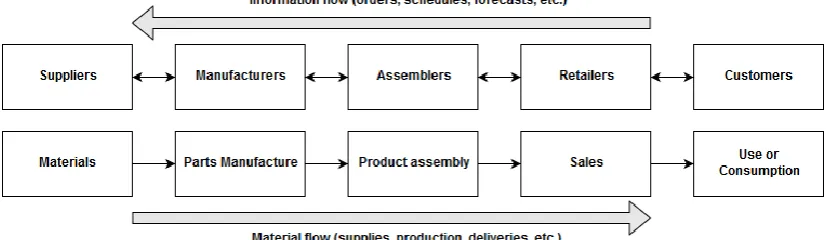
A supply chain refers to the flow of information and goods up and downstream. In its broadest
sense, a supply chain consists of a network of suppliers and customers that are involved in the
production, from the raw material to the distribution of the final product to the user. Figure 6
represents a simplified overview of the flow of materials and information across a linear supply
[image:21.595.91.508.406.526.2]chain.
Figure 6 - Linear supply chain
The concept of Supply chain management (SCM) can be traced back to the automotive industry.
The Toyota car factory was among the first to implement SCM where it was used to deliver
their product on a Just-in-Time (JIT) basis (Shingo, 1988). The goal of supply chain
manage-ment in this system was to reduce stocks and encourage better quality control. It regulated the
right amount of supplies to the Toyota motor factory in a timely manner.
Supply chain management can be defined as: “the systemic, strategic coordination of the
tradi-tional business functions and the tactics across these business functions within a particular
com-pany and across businesses within the supply chain, for the purposes of improving the
long-term performance of the individual companies and the supply chain as a whole” (Mentzer e.a.,
The concept of SCM evolved as a distinct subject of research and attained an autonomous status
in industrial management theory (Bechtel & Jayaram, 1997). With the increase in understanding
of supply chains came new approaches and concepts, such as the value chain, that further
in-fluenced the concept of SCM. Although the contemporary concept of SCM is largely dominated
by logistics, it is used to encompasses more than just logistics (Van der Veen & Robben, 1997).
2.1.2 Construction characteristics
The construction industry has been criticized by its low productivity and the slow rate of
per-formance improvement (Woudhuysen & Abley, 2004). Various studies point to the inherent
characteristics of the industry (Barbosa e.a., 2017; Changali, Mohammad, & van Nieuwland,
2015; Loera, Espinosa, Enríquez, & Rodriguez, 2013). The construction industry has certain
peculiarities that distinguishes it from other project-based industries and make the production
of a building product a relatively complex and unstable undertaking(O’Brien e.a., 2008;
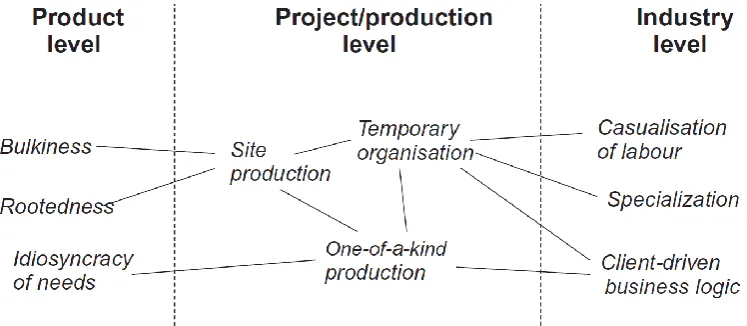
Vrijhoef & Koskela, 2005a). Vrijhoef and Koskela (2005b) categorize the peculiarities of
construction into three levels: product level, production level, and the industry as a whole (see
Figure 2) These levels are described below:
Figure 7 - Characteristics of the construction industry (Vrijhoef & Koskela, 2005b)
• Product level
There are several specific features of the construction product that greatly affect the
production level, including product lifecycle, immobility and impact on surroundings.
The products are typically unique due to the idiosyncratic needs of the client and the
socio-economic context it is constructed in. For example, construction products can be
located in a densely populated area which may affect the way the product has to be
[image:22.595.110.484.401.564.2]ascribed to the construction items (Ofori, 1990). In general, construction products are
rooted to a specific location which means that the assembling is done on-site.
• Production level
The production is dependent and bound to the aforementioned characteristics of the
building product. This means that the production is strongly aimed towards a particular
site to deliver a customized unique product to a single client. The one-off approach has
been described as the "prototype nature" of construction industry (Koskela, 2000). The
construction industry is not unique in the characteristics of its production organization
since they can be found in other industries as well, such as offshore and mining.
How-ever, the building situation is unique due to the specific combination of these
character-istics (Vrijhoef, 2011). By addressing the combined charactercharacter-istics and the independent
relationship, concept from other industries could be applied. The adaption and
transla-tion of those concepts into the constructransla-tion context may help the industry overcome the
problems in production.
• Industry level
The construction industry itself is characterized by high levels of fragmentation
involv-ing many Small and Medium-sized Enterprises (SMEs) of different specializations.
Larger construction firms often take the role as general contractor to coordinate the
building process. Due the wide variety of trades and the casualization of labor,
construc-tion projects have been regarded as the "epitome of a loosely coupled system" (Dubois
& Gadde, 2002). The different firms work on different construction project in constantly
changing coalitions. The interaction between the different parties is relatively informal
compared to process-driven industries. The industry is a typical demand driven industry
where the product is seldom predefined and the client initiates the construction.
2.1.2 Construction supply chains
The construction supply chain (CSC) refers to all parties that exchange goods, information, and
finance related for the completion of a particular construction product (Xue Xiaolong, Shen
Qiping, & Ren Zhaomin, 2010). The flow of goods originates from the raw material producer
and ends at the client. In the opposite direction, there is a flow of funds as a function of risk
taken by each stakeholder and the added-value of their services. The flow of information is
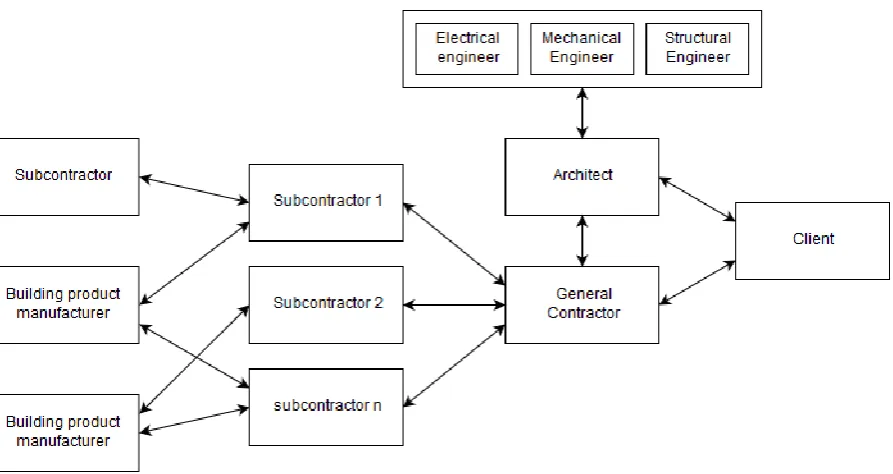
Figure 8 - Simplified illustration of a construction supply chain, own illustration
The CSC can be a network of a range of different parties, including a client/owner,
designer/ar-chitect, general contractor (GC), subcontractors, and suppliers (Xue, Wang, Shen, & Yu, 2007).
Figure 8 illustrates a simplified model of the value exchange in a typical CSC of a construction
project from the viewpoint of the GC. It is not uncommon for contractors to outsource certain
work. Ultimately, a project could have multiple tiers of subcontractors and suppliers that deliver
certain goods or services.
Supply chain stakeholders
The outcome of a project can be attributed the joint effort of all actors by contributing in the
design, construction, finance, consulting and other operation services (Narbaev & De Marco,
2011). Although some of these parties such as designers and engineers, can also be involved in
a manufacturing supply chains, they play a large role in the construction process due to unique
characteristics of the construction project (O’Brien e.a., 2008). The supply side of the supply
chain consists of the contractor and the suppliers, the demand side consists of the contractor
and the client. and the suppliers (Papadonikolaki, Verbraeck, & Wamelink, 2017). There are
nine types of stakeholders involved throughout the building lifecycle (Geraedts & Wamelink,
2010). These are described briefly below:
Client
A client of a construction project can have different degrees of expertise and experience with
the building process. The non-professional client has limited to no experience and requires the
their own expertise due to their frequent experience with the building process. Clients include
landowners, future owners, project developers, executive contractors, investors, government,
and housing corporations. The varying level of expertise involvement of the client types greatly
influences the construction process.
Architects
Architects, like the clients, have a major influence on the building process. Traditionally, the
architect advised the client from initiation phase up to the completion of a building. The
archi-tect is also the expert in the field of translating the needs of the client to a design by using both
an engineering and design approach.
Engineering consultants
Engineering consultants can be involved in various ways throughout the construction project.
They can have contractual relationships between a consultant, client, contractor, and building
manager, with each type of relationship affecting the building process in a different way. The
advisor can be selected by the architect or construction manager or have an existing relationship
with the client.
Construction management firms
Construction management firms have a wide range of tasks to the construction supply chain in
both its demand and its supply. They advise client in the specification of requirements and the
supervision of construction processes, and they support contractors in the coordination of
com-plex processes involving investors, users, advisers, and executing parties.
Contractors
There are many ways a contractor can be involved in the construction process depending on the
construction phase (early or late in the process), its role, (ranging from advisory in construction
teams to only the core business of construction on site after a successful tender procedure), and
the organizational and contractual context of the project. The contractor is responsible for the
construction of the product. There are three types of executive contractors: small contractors
for small-scale projects, and renovation or maintenance; medium-sized companies that either
merge into larger conglomerates or specialize in specific market segments; and large
construc-tion companies operating on an internaconstruc-tional scale and delivering complete construcconstruc-tion
• Secondary contractor: a secondary contractor is a contractor that operates in addition to
the main contractor on a project. This contractor operates on a separate contract with
the client. For example, two contractors may work on two separate building in one
com-plex simultaneously. In this situation, the coordination between the contractor parties is
critical.
• Subcontractor: a subcontractor is hired by the contractor and does not have a direct
con-tract with the client. Examples are: installers, road workers, plasterers, plumbers, etc.).
The trend for many large contractors is to employ less staff and allocate more work to
subcontractors.
Manufacturers and suppliers
The manufacturers and suppliers provide the materials for the construction of the building. The
materials vary from raw materials to prefabricated building components. Certain suppliers that
deliver project-specific materials (e.g. prefab concrete) are often involved early in the
construc-tion process due to their considerable lead times.
Real estate agents
Next to their role as a mediating party between buyers and sellers of houses and offices, real
estate agents are among the first parties clients contact for starting a construction project. The
agent is therefore an important partner for a construction management firm as a source of
in-formation for acquisition.
Tenants or users
The tenant or user is the stakeholder who will move into the constructed building. The user is
in many cases an anonymous party, but can also be the client. If the user is involved early in
the construction process, they can be involved in the decision-making and influence the design
of the building.
Government
Next to the role as a client, the government can also take the role of service provider,
policy-maker, and supervisor, on local, regional, and national level . The main task of government is
the protection of public interest, overseeing the construction, and adjusting the building policy
Characteristics of construction supply chains
Due the unique peculiarities of the construction industry, the construction supply chain (CSC)
typically has the following characteristics:
Fragmentation and complex
CSCs can be very complex, especially in large construction projects (O’Brien e.a., 2008). This
complexity can be attributed to need for a variety of materials and specialized parties at the
construction site, including equipment suppliers and subcontractors. The industry has wide
va-riety of disciplines, such as developers, builders, engineers and architects, with relatively high
share of Small to Medium-sized Enterpises (SMEs). Complexity increases as more people get
involved in a project with the involvement of multi-tier suppliers and subcontractors. Larger
construction projects may involve hundreds or thousands of suppliers and subcontractors which
requires a great deal of organizing, planning and collaboration between supply chain parties
(Taylor & Bjornsson, 1999).
Converging
CSCs are converging supply chains where all materials are directed to a particular construction
site to be assembled into the final project (Vrijhoef & Koskela, 2000). Unlike manufacturing
supply chains where many products can be assembled in different places and distributed to
customers, CSCs are set around a single product designated for a single client.
Make-to-order
The traditional CSC has been typified as a make-to-order (Ballard, 2005; Gosling, Purvis, &
Naim, 2010; Vrijhoef & Koskela, 2000; Winch, 2003). Figure 9 illustrates the different
decou-pling points throughout the supply chain. The construction supply chain is very rarely set up
for 'modified purchase' (assemble-to-order) and almost never for 'routine purchase'
(make-to-stock) (Noordhuis, 2015). In a make-to-order production system, production is driven by the
demand of the clients. Firms work in constantly changing coalitions on construction projects
due to the unique characteristics of the product. Issues in project management and production
can often be attributed to the disconnect between design and production. Moreover, many small
and specialized firms are involved in the construction of the unique products. The
interdepend-ence of the parties within the chain contribute to the persistinterdepend-ence of problems originating
Figure 9 - Decoupling points throughout the supply chain
The construction industry is a project-driven industry where often one-off buildings are
con-structed. Standardization is particularly low in comparison to many production industries. The
production of a construction product is done at temporary sites by actors that are only
tempo-rarily involved with the construction project. The short-term focus incentivizes supply chain
parties to try and leverage every opportunity they get within the boundaries of an existing
con-tract (Aloini e.a., 2012; Vrijhoef & Koskela, 2000).
2.1.3 The building life cycle
Literature shows several categorizations of project phases depending on different points of view
(Antunes & Gonzalez, 2015). There generally is not one process for a construction project due
to their unique characteristics. While the project phases are typically completed sequentially,
there are project situations where they can overlap. The process heavily depends on the parties
involved, the type of product, the contractual relationship among parties, and many other
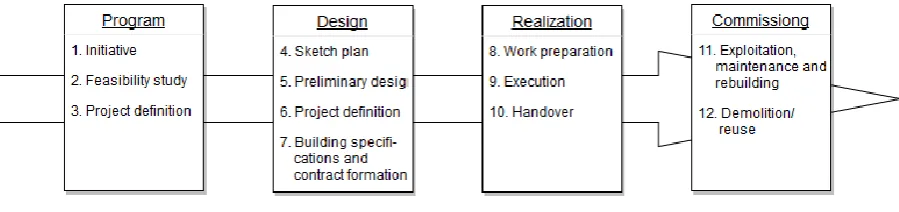
fac-tors. Geraedts and Wamelink (2010) distinguishes between four phases that can be found in a
typical construction project: initiation, preparation, execution, and commissioning.
[image:28.595.74.524.566.672.2]Program/Initiation
A project starts with a client defining the needs and conditions of the end result. In construction,
this is called “the demand”(Ashworth, 2012). Two types of demand can be identified in
con-struction: functional and technically specified demand (Vrijhoef e.a., 2013). In functional
de-mand, the client, e.g. the owner or initiator of a project, describes a certain problem and
speci-fies the functional requirements of a project. This is followed by an interactive meeting between
contractor companies and the client in which the contractors present their ideas on how to solve
the problem of the client. The client selects the contractors based on their expertise and
experi-ence, which often results the best possible solutions to clients’ problem. When a technically
specified demand is applied, the client describes the technical requirements and how these
re-quirements should be met. This is a more traditional way of construction. The client is often
supported by a specialist to work out a first Program of Requirements (PoR) and formulate
several product scenarios. The costs and benefits of the alternatives are considered in order to
decide on the most suitable design (Geraedts & Wamelink, 2010).
Design
Once a choice has been made for a certain product, a designer (and possibly other architectural
specialists) works out the scenario in more detail in the preparation phase. In this phase, the
feasibility of the alternative (design)solutions can be tested and reconsidered. After sketching,
the designs are worked out in more detail into a final design. The construction documents
con-tains the drawings, descriptions, specifications calculations, time-plan, and other information
which will be provided to the contractor as a basis for the construction. When the specifications
are known and authorizations are granted, the project is tendered with aid of STABU or
RAW-specifications. In general, the contractor with the lowest bid wins the tender.
Realization
This phase is divided into three steps: work preparation, execution, and hand-over. The
reali-zation of the project starts with the preparation of the construction of the contractor. The
divi-sion of activities are defined in one or several contract documents between the contractor and
the involved clients. This document lays out the scope and the possible risks of the project.
client or the contractor selects one or more advisers to coordinate the preparation, execution
and hand-over. The contractor is usually responsible for the execution until completion of the
Commissioning
This phase is also called operation or post-construction in other life cycle models. After
reali-zation, the constructed building is commissioned and managed. Maintenance is covered
de-pending on the type of contract. This phase covers the longest period of building life cycle.
After a certain amount of time, the construction may no longer meet the technical or functional
requirements and could be declared unusable. In that case, preparations are made to demolish
the building. After demolition, the land is available for new construction projects.
2.1.4 The logistics process
A construction project often involves a large variety of contractors that are responsible for
de-livering certain goods to the construction site. Deliveries are often done by different suppliers,
including building material wholesalers, manufacturers, subcontractors and raw material
[image:30.595.72.519.338.410.2]sup-pliers. Figure 11 illustrates a general outline of deliveries to the construction site.
Figure 11 - Deliveries to the construction site, based on Ludema (2011)
The decoupling the supply chain can take place the use of transfer points or logistical hubs.
There hubs are currently partially used in construction for interim storage on or nearly the
construction site. Goods are unloaded and stored until further processing or assembly. As a
result of the limited available space at or near the construction site, this form of hub is not
al-ways possible. In addition, a transfer point often causes considerable hindrance to the
environ-ment.
[image:30.595.192.406.577.706.2]Orders are placed based on the project schedule. Figure 12 shows the traditional way for
con-tractors to order deliveries from their suppliers. The deliveries of suppliers may take place
us-ing the suppliers’ own transport or that of a logistics service provider. The information of the order includes item code, name, the component, the contractor’s weekly planning, etc. For the
information exchange about the delivery of products to the construction site building tickets
can be used. The building ticket is a form with which the supplier reports deliveries to the
construction site in advance. The logistical coordinator can schedule the deliveries on-site. On
the construction ticket information stated about the supplier, the carrier, the products,
infor-mation about the goods and any handling requirements.
Construction Consolidation center
The typical construction consolidation center that is generally seen as the solution for most
problems takes the form of a city distribution center to which suppliers deliver their goods. A
construction consolidation center is a transshipment point that is conveniently located for
sup-pliers at the edge of a city (Vries & Ludema, 2012). The goods are unloaded at the hub, are
transferred to another means of transport or temporarily stored and after call-off delivered to
the (sub)contractor at the construction site. The construction logistics hub thus acts as a
de-coupling point where deliveries from goods originating from multiple suppliers are “pushed” to the hub and “pulled” from the construction site. This makes deliveries to the consolidation
center less time dependent than deliveries directly to the construction site. In addition,
de-pending on the nature of the goods and the method of processing, the truck load of the
deliv-eries to the construction site can be increased. However, this only work to a limited extent.
Certain goods are not suitable for consolidation and need direct delivery, such as concrete
mixers with liquid concrete, full load wagons or deliveries that requires special handling.
In addition to outflow to the construction site, it is possible to use the center for return flows
as well. Figure 13 shows a schematic illustration of the primary delivery processes to the
Figure 13 - Primary delivery process using a CCC, based on Ludema (2013)
Goods are ordered from the supplier by the (sub)contractor based on project planning. During
the construction, a six week project planning is usually used in which each activity is clear per
week. Insights about the activities performed on a specific day is usually provided in a more
detailed week planning. The latter is leading for the call-off of goods at suppliers.
Conse-quently, the suppliers deliver the ordered goods to the construction site.
With the use of a consolidation center, the goods are ordered by the contractor at the supplier,
based on the project schedule. The supplier delivers goods in bulk to the construction
consoli-dation center to be temporarily stored. The contractor can call goods daily from the
consolida-tion center so that the goods can be delivered into a combined freight when they are needed at
the site. The latter happens on the basis of detailed (day) planning. The orders are assembled
and delivered within 24 hours. Figure 9 illustrates the control of delivery via a consolidation
center.
[image:32.595.176.420.513.661.2]Benefits of a CCC
The construction consolidation center provides temporary storage space for suppliers’ "push"
deliveries and allows "pull" deliveries based on the construction schedule to be transported to
the construction site. By packaging the goods in a certain way, the hub allows contractors to
increase the capacity of trucks headed to the city center and to reduce the number of
trans-ports required (Vries & Ludema, 2012). Supplies can also be transported using smaller
(elec-trical) vehicles. The benefit for the city is that it minimizes disturbances in the city center.
The LCCC (London Construction Consolidation Centre) is a successful pilot of a
consolida-tion center for the supply of multiple construcconsolida-tion sites in London. The use of a consolidaconsolida-tion
center has shown to reduce the number of transports (and therefore transport costs)
signifi-cantly. The LCCC has a achieved a transport movement reduction of 65% which results in
re-duction of CO2 emissions by approximately 75%.
Vrijhoef et al. (2015) compared the performance of two pilot projects (De Trip in Utrecht and
the Amtelkwartier in Amsterdam) using pre-defined KPIs. By using a construction
consolida-tion center in combinaconsolida-tion with a logistics coordinator, deliveries could be scheduled in
ac-cordance to the needs on the construction site. Based on the analysis of the construction
logis-tics concepts, the construction hub appears to offer great benefits to the construction process.
As a distribution center on the outskirt of the city, it is easily accessible for carriers which can
supply the construction site more efficiently. The advantages have been demonstrated on
sev-eral occasions. Moreover, such a hub facilitates the use of other smart concepts. The
establish-ment of a construction logistics hub has been described as a necessity in cases where
con-struction takes place at busy locations with limited space, a high number of visitors and a need
for ongoing accessibility. Despite some early setbacks, the De Trip project ran three months
ahead of schedule once the hub was running at full capacity (Merrienboer, S.A. van &
Table 2 shows the benefits that have been achieved by the London Consolidation and Utrecht
CCC and the Utrecht CCC.
KPI London CC De Trip Voorzetgebouw
Paviljoen
Noordgebouw,
Utrecht
Percentage over hub 100% 100% 15% 60-80%
Reduction in
transport miles
68% 69% 47% 72%
Average load factor - 90% 75% 81%
Time savings 2 hours 1 hour and
21 min
1 hour and 26
min
1 hour and 25
min
[image:34.595.71.529.138.325.2]CO2 reduction 75% 68% 40% 87%
Table 2 - Benefits CCC London and Utrecht (VolkerWessels Bouwmaterieel)
The transport of goods via a construction hub results in a different cost structure. The
transport costs can now be divided into a long haul to the hub and a short haul into the city.
The hub is typically more accessible for trucks and remains open for deliveries longer than the
construction site. Naturally, the hub itself gives rise to additional costs, consisting of
over-heads and operational costs. However, there are significant cost savings to be achieved, so the
main challenge is in distributing these costs and benefits among stakeholders. The hub
pro-vided space for prefabrication, which meant the work on the construction site could proceed
faster. Furthermore, the shuttle bus for workers ensured that the inner city construction sites
were not overflowing with parked cars.
Requirements and disadvantages
Next to the aforementioned benefits, there are several disadvantages that need to be accounted
for when establishing a consolidation center. The use of a consolidation centers has proven to
have significant benefits. However, one also needs to take the drawbacks into account. First of
all, the benefits of the CCC difficult to quantify in advance. The benefits will only gradually
become apparent as the construction progresses. Opinions differ on when the use of the CCC
is beneficial and how to fairly distribute the costs and benefits among the stakeholders (Vries
& Ludema, 2012).
To successfully implement a construction consolidation center, collaboration between the
sufficient trust between participants and clear agreements have been made in advance about
the role of the consolidation center. The parties that are typically involved in this are the
con-tractors, suppliers, possible logistics service provider and the client. An important basis for
achieving this is a workable underlying business model. A clear business model is needed to
align the interests of the different parties involved. It is also important to involve and manage
partners early in the process.
It must be clear who contributes to what during which phase in the construction process and
what every party gains. Enough space must be available where the center can be realized. The
terrain must be secured and have the appropriate equipment to handle the goods. Also, an
in-formation system must be available to control the flow of goods and logistics employees need
to be appointed. The terrain can be open 24 hours a day for the delivery of goods and the
scheduling of deliveries to the construction site(s). The operation of the construction
2.2 Cross Chain Control Centers
The aim of this study is to make a blueprint of a Cross Chain Collaboration Center (4C) for the
construction industry. In order to come to a definition of what a 4C is, we have to go into the
concept of control towers and supply chain collaborations first.
2.2.1 Control towers
Supply chain visibility is regarded as an important organization capability to improve
decision-making and reduce negative impacts of supply chain disruptions (Barratt & Oke, 2007;
Bran-don-Jones, Squire, Autry, & Petersen, 2014; Dubey e.a., 2018). Supply chain visibility is
de-scribed as “the extent to which actors within a supply chain have access to or share information
which they consider as key or useful to their operations, and which they consider will be of
mutual benefit” (Barratt & Oke, 2007). To create supply chain visibility, it is key that the
infor-mation is timely, trustworthy, accurate and useful (Zhou & Benton Jr, 2007).
By introducing new supply chain management concepts, companies have sought to create this
visibility and maintain a sustainable competitive edge. A new concept “Supply Chain Control
Tower” has been proposed not only create supply chain visibility, but also to exercise certain
control over the logistics flows.
Literature review reveals little academic research regarding the concept of “Control Tower” for
supply chain visibility. The concept has mainly been used in non-academic publications by
software vendors and consultancy firms (see for example: Bleda, Martin, Narsana, & Jones,
2014; Bosle e.a., 2011; Samelson, 2017). They often have their own definition of a control
tower and load it with marketing hype which often leads to confusion and misinterpretation in
the marketplace (Pradhan, Payne, & Titze, 2018). There are dozens of vendors solutions that
are marketed as control towers with each their own capabilities, but here is no uniform
descrip-tion of a control tower listing standard capabilities.
Research and advisory firm Gartner (Pradhan e.a., 2018) takes a more critical approach and
attempts to define the term “control tower” by describing three capabilities:
• End-to-end visibility
Data is essential for end-to-end (E2E) supply chain visibility. Having access to accurate,
timely and relevant data across organizations supports effective planning and execution
of supply chain activities. Ultimately, the data should provide the supply chain with a
single and accurate source of truth that can be used to support decisions. This data will
involves a network of interconnected systems (internal systems and external partner
ecosystems) that is able to ingest and push data.
• Information hubs
At heart of the control tower is the “information hub”. The integrates, gathers, stores
and normalizes the data from a variety of sources and uses the appropriate logic and
analytics to simulate impacts and measures across the supply chain. This information is
distributed in a consistent format for further utilization by the supply chain parties.
• Digital twin
The “digital twin” refers to a virtual supply chain that is updated in (near) real-time to
reflect the physical supply chain. This digital twin provides a single source of truth for
all partners to support decision-making and coordination and enables supply chain
plan-ning and execution functionalities.
The control tower supports end-to-end decision making of various levels of granularity through
data driven insights from the supply chain. Companies can use a control tower for levels of
control: operationally, tactically, and strategically.
• Operational level: this level concerns real-time planning and control activities. This
includes order management, and issue and event management.
• Tactical level: this levels means that three months till three years. This enables
pro-active planning of procurement, operations and distribution. Carrier management,
in-voicing control, and transport optimization.
• Strategic: the control tower is used for the design of the overall business network.
Ultimately, the control tower is a digital supply chain platform that provides supply chain
par-ties with relevant and accurate supply chain insights. This includes the use a range of
intercon-nected computing devices (i.e., Internet of Things) and, to a certain degree, some intelligence
(e.g. predictive analytics), to continuously learn, generate insights and provide
recommenda-tions. The control tower can be used in numerous ways to support the supply chain. Control
towers are can be used to monitor and plan:
The control tower could provide supply chain parties new insights through interactive
dash-boards, geo maps, production workflows to visualize data (Pradhan e.a., 2018). Also, supplier
performance can be monitored. The data could be used to plan, book and track the delivery of
goods throughout the supply chain (Bosle e.a., 2011). The control tower could be embedded