http://go.warwick.ac.uk/lib-publications
Original citation:Aaij, R. et al. (2012). Determination of the Sign of the Decay Width Difference in the Bs0 System. Physical Review Letters, 108(24), pp. 241801
Permanent WRAP url:
http://wrap.warwick.ac.uk/48471
Copyright and reuse:
The Warwick Research Archive Portal (WRAP) makes the work of researchers of the University of Warwick available open access under the following conditions.
This article is made available under the Creative Commons Attribution-NonCommercial-NoDerivs 3.0 Unported (CC BY-NC-ND 3.0) license and may be reused according to the conditions of the license. For more details see: http://creativecommons.org/licenses/by-nc-nd/3.0/
A note on versions:
The version presented in WRAP is the published version, or, version of record, and may be cited as it appears here.
Determination of the Sign of the Decay Width Difference in the
B
0sSystem
R. Aaijet al.* (LHCb Collaboration)
(Received 22 February 2012; published 11 June 2012)
The interference between theKþKS-wave andP-wave amplitudes inB0
s !J=cKþKdecays with
theKþK pairs in the region around theð1020Þresonance is used to determine the variation of the difference of the strong phase between these amplitudes as a function ofKþKinvariant mass. Combined with the results from ourCPasymmetry measurement inB0
s !J=cdecays, we conclude that theB0s
mass eigenstate that is almostCP¼ þ1is lighter and decays faster than the mass eigenstate that is almost
CP¼ 1. This determines the sign of the decay width differencesLHto be positive. Our result also resolves the ambiguity in the past measurements of theCPviolating phasesto be close to zero rather than. These conclusions are in agreement with the standard model expectations.
DOI:10.1103/PhysRevLett.108.241801 PACS numbers: 14.40.Nd, 11.30.Er, 13.25.Hw
The decay time distributions ofB0
smesons decaying into
the J=c final state have been used to measure the pa-rameterssandsLH of theB0
s system [1–3].
Here, s is the CP violating phase equal to the phase difference between the amplitude for the direct decay and the amplitude for the decay after oscillation.LandHare the decay widths of the light and heavy B0
s mass
eigen-states, respectively. The most precise results, presented recently by the LHCb experiment [3],
s¼0:150:18ðstatÞ 0:06ðsystÞ rad;
s¼0:1230:029ðstatÞ 0:011ðsystÞps1; (1)
show no evidence ofCPviolation yet, indicating thatCP violation is rather small in the B0
s system. There is clear
evidence for the decay width difference s being non-zero. It must be noted that there exists another solution,
s¼2:990:18ðstatÞ 0:06ðsystÞ rad;
s¼ 0:1230:029ðstatÞ 0:011ðsystÞps1; (2)
arising from the fact that the time-dependent differential decay rates are invariant under the transformation ðs;sÞ $ ðs;sÞ, together with an
appropri-ate transformation for the strong phases. In the absence of
CPviolation,sins¼0, i.e.,s¼0ors¼, the two mass eigenstates also becomeCP eigenstates withCP¼ þ1andCP¼ 1, according to the relationship between
B0
s mass eigenstates andCPeigenstates given in Ref. [4].
They can be identified by the decays into final states which areCPeigenstates. InB0
s!J=cKþK decays, the final
state is a superposition ofCP¼ þ1andCP¼ 1for the
KþKpair in theP-wave configuration andCP¼ 1for
theKþKpair in theS-wave configuration. Higher-order partial waves are neglected. These decays have different angular distributions of the final-state particles and are distinguishable.
Solution I is close to the cases¼0and leads to the light (heavy) mass eigenstate being almost aligned with the
CP¼ þ1(CP¼ 1) state. Similarly, solution II is close to the case s¼ and leads to the heavy (light) mass eigenstate being almost aligned with the CP¼ þ1 (CP¼ 1) state. In Fig. 2 of Ref. [3], a fit to the observed decay time distribution shows that it can be well described by a superposition of two exponential functions corre-sponding to CP¼ þ1 and CP¼ 1, compatible with no CPviolation [3]. In this fit, the lifetime of the decay to theCP¼ þ1final state is found to be smaller than that of the decay toCP¼ 1. Thus, the mass eigenstate that is predominantly CP even decays faster than the CP odd state. For solution I, we finds>0, i.e.,L>H, and, for solution II,s<0, i.e., L<H. In order to deter-mine if the decay width difference s is positive or negative, it is necessary to resolve the ambiguity between the two solutions.
Since each solution corresponds to a different set of strong phases, one may attempt to resolve the ambiguity by using the strong phases either as predicted by factori-zation or as measured in B0!J=cK0 decays. Unfortunately, these two possibilities lead to opposite answers [5]. A direct experimental resolution of the am-biguity is therefore desirable.
In this Letter, we resolve this ambiguity using the decay
B0
s!J=cKþK with J=c !þ. The total decay
amplitude is a coherent sum of S-wave andP-wave con-tributions. The phase of theP-wave amplitude, which can be described by a spin-1 Breit-Wigner function of the invariant mass of the KþK pair, denoted by mKK, rises rapidly through the ð1020Þ mass region. On the other hand, the phase of the S-wave amplitude should vary
*Full author list given at the end of the article.
relatively slowly for either an f0ð980Þ contribution or a nonresonant contribution. As a result, the phase difference between theS-wave andP-wave amplitudes falls rapidly with increasingmKK. By measuring this phase difference as a function of mKK and taking the solution with a decreasing trend around theð1020Þmass as the physical solution, the sign ofsis determined and the ambiguity insis resolved [6]. This is similar to the way theBABAR Collaboration measured the sign ofcos2using the decay
B0 !J=cK0
S0 [7], where2is the weak phase
charac-terizing mixing-inducedCPasymmetry in this decay. The analysis is based on the same data sample as used in Ref. [3], which corresponds to an integrated luminosity of 0:37 fb1 ofppcollisions collected by the LHCb
experi-ment at the Large Hadron Collider at the center-of-mass energy of pffiffiffis¼7 TeV. The LHCb detector is a forward spectrometer and is described in detail in Ref. [8]. The trigger, event selection criteria, and analysis method are very similar to those in Ref. [3], and here we discuss only the differences. The fraction of KþK S-wave contribu-tion measured within12 MeV of the nominal ð1020Þ mass is0:0420:0150:018[3]. (We adopt units such thatc¼1and@¼1.) TheS-wave fraction depends on the mass range taken around the ð1020Þ. The result of Ref. [3] is consistent with the CDF limit on theS-wave fraction of less than6%at95%C.L. (in the range 1009– 1028 MeV) [2], smaller than the D0 result of ð123Þ% (in 1010–1030 MeV) [9] and consistent with phenomeno-logical expectations [10]. In order to apply the ambiguity resolution method described above, the range of mKK is extended to 988–1050 MeV. Figure 1 shows the
þKþK mass distribution where the mass of the
þ pair is constrained to the nominal J=c mass. We
perform an unbinned maximum likelihood fit to the invariant mass distribution of the selectedB0
s candidates. The
proba-bility density function (PDF) for the signal B0
s invariant
massmJ=cKKis modeled by two Gaussian functions with a common mean. The fraction of the wide Gaussian and its width relative to that of the narrow Gaussian is fixed to values obtained from simulated events. A linear function describes themJ=cKK distribution of the background, which is domi-nated by combinatorial background.
This analysis uses the sWeight technique [11] for back-ground subtraction. The signal weight, denoted by
WsðmJ=cKKÞ, is obtained usingmJ=cKK as the
discriminat-ing variable. The correlations between mJ=cKK and other variables used in the analysis, includingmKK, decay timet, and the angular variablesdefined in Ref. [3], are found to be negligible for both the signal and background com-ponents in the data. Figure 2shows the mKK distribution where the background is subtracted statistically using the sWeight technique. The range of mKK is divided into four intervals: 988–1008, 1008–1020, 1020–1032, and 1032–1050 MeV. Table I gives the number of B0
s signal
and background candidates in each interval.
In this analysis, we perform an unbinned maximum likelihood fit to the data using the sFit method [12], an extension of the sWeight technique, that simplifies fitting in the presence of background. In this method, it is only necessary to model the signal PDF, as background is canceled statistically using the signal weights.
The parameters of the B0
s!J=cKþK decay time
distribution are estimated from a simultaneous fit to the four intervals of mKK by maximizing the log-likelihood function
lnLðP;SÞ ¼X
4
k¼1
Wp;k
XNk
i¼1
WsðmJ=cKK;iÞ
lnPsigðti;i; qi; !i;P;SÞ;
whereNk ¼Nsig;kþNbkg;k is the number of candidates in
themJ=cKK range of 5200–5550 MeV for thekth interval.
Prepresents the physics parameters independent ofmKK,
(MeV) J/ψKK m
5200 5250 5300 5350 5400 5450 5500 5550
Events / 2 MeV
2 10 3 10 data total fit signal background LHCb
FIG. 1 (color online). Invariant mass distribution for B0 s ! þKþK candidates, with the mass of the þ pair constrained to the nominal J=c mass. The result of the fit is shown with signal (dashed curve) and combinatorial background (dotted curve) components and their sum (solid curve).
(MeV) KK m
990 1000 1010 1020 1030 1040 1050
Events / 2 MeV
10
2
10
3
10 LHCb
FIG. 2 (color online). Background subtractedKþKinvariant mass distribution forB0
s!J=cKþK candidates. The vertical
dash-dotted lines separate the four intervals.
[image:3.612.56.293.496.654.2] [image:3.612.320.556.515.676.2]includings,s, and the magnitudes and phases of the
P-wave amplitudes. Note that theP-wave amplitudes for different polarizations share the same dependence onmKK.
S denotes the values of the mKK-dependent parameters
averaged over each interval, namely, the average fraction of S-wave contribution for the kth interval,FS;k, and the
average phase difference between the S-wave amplitude and the perpendicularP-wave amplitude for thekth inter-val, S?;k. Psig is the signal PDF of the decay time t,
angular variables , initial flavor tag q, and the mistag probability !. It is based on the theoretical differential decay rates [6] and includes experimental effects such as decay time resolution and acceptance, angular acceptance, and imperfect identification of the initial flavor of theB0 s
particle, as described in Ref. [3]. The factorsWp;k account
for loss of statistical precision in parameter estimation due to background dilution and are necessary to obtain the correct error coverage. Their values are given in TableI.
The fit results fors,s,FS;k, andS?;k are given in
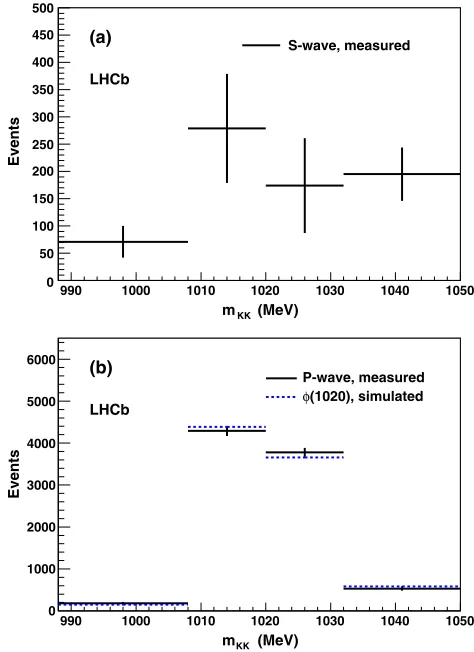
TableII. Figure3shows the estimatedKþK S-wave and
P-wave contributions in the fourmKKintervals. The shape of the measuredP-wavemKKdistribution is in good agree-ment with that of B0
s!J=c events simulated using a
spin-1 relativistic Breit-Wigner function for the ð1020Þ amplitude. In Fig. 4, the phase difference between the
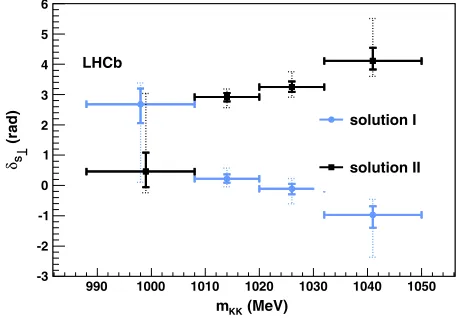
S-wave and the perpendicularP-wave amplitude is plotted in fourmKKintervals for solution I and solution II.
Figure 4 shows a clear decreasing trend of the phase difference between theS-wave andP-wave amplitudes in theð1020Þmass region for solution I, as expected for the physical solution. To estimate the significance of the result, we perform an unbinned maximum likelihood fit to the data by parametrizing the phase differenceS?;k as
a linear function of the average mKK value in the kth interval. This leads to a slope of 0:050þ0:013
0:020 rad=MeV
[image:4.612.51.297.85.154.2]for solution I and the opposite sign for solution II, where the uncertainties are statistical only. The difference of the lnLvalue between this fit and a fit in which the slope is fixed to be zero is 11.0. Hence, the negative trend of solution I has a significance of 4.7 standard deviations. Therefore, we conclude that solution I, which has s> 0, is the physical solution. The trend of solution I is also qualitatively consistent with that of the phase difference between the KþK S-wave and P-wave amplitudes versus mKK measured in the decay Dþs !KþKþ by the BABAR Collaboration [13].
TABLE I. Numbers of signal and background events in the
mJ=cKK range of 5200–5550 MeV and statistical power per
signal event in four intervals ofmKK.
k mKKinterval (MeV) Nsig;k Nbkg;k Wp;k
1 988–1008 25121 167543 0.700
2 1008–1020 456970 200249 0.952
3 1020–1032 395266 224451 0.938
4 1032–1050 72634 344262 0.764
TABLE II. Results from a simultaneous fit of the four intervals of mKK, where the uncertainties are statistical only. Only pa-rameters which are needed for the ambiguity resolution are shown.
Parameter Solution I Solution II
s (rad) 0:1670:175 2:9750:175
(ps1) 0:1200:028 0:1200:028 FS;1 0:2830:113 0:2830:113 FS;2 0:0610:022 0:0610:022 FS;3 0:0440:022 0:0440:022 FS;4 0:2690:067 0:2690:067 S?;1(rad) 2:68þ00::3542 0:46þ00::4235 S?;2(rad) 0:22þ00::1513 2:92þ00::1315 S?;3(rad) 0:11þ00::1618 3:25þ00::1816 S?;4(rad) 0:97þ00::2843 4:11þ00::4328
(MeV) KK m
990 1000 1010 1020 1030 1040 1050
Events 0 50 100 150 200 250 300 350 400 450 500 S-wave, measured LHCb (a) (MeV) KK m
990 1000 1010 1020 1030 1040 1050
Events 0 1000 2000 3000 4000 5000 6000 P-wave, measured
φ(1020), simulated LHCb
(b)
FIG. 3 (color online). Distribution of (a)KþKS-wave signal events and (b) KþK P-wave signal events, both in four invariant mass intervals. In (b), the distribution of simulated
B0
s!J=cevents in the four intervals assuming the same total
[image:4.612.317.554.295.621.2] [image:4.612.52.298.562.716.2]Several possible sources of systematic uncertainty on the phase variation versusmKK have been considered. A pos-sible background from decays with similar final states such asB0!J=cK0 could have a small effect. From
simula-tion, the contamination to the signal from such decays is estimated to be1:1%in themKKrange of 988–1050 MeV. We add a 2:2%contribution of simulated B0 !J=cK0 events to the data and repeat the analysis. The largest observed change is a shift of S?;4 by 0.06 rad, which is
only20%of its statistical uncertainty and has a negligible effect on the slope of S? versus mKK. The effect of neglecting the variation of the values of FS and S? in eachmKKinterval is determined to change the significance of the negative trend of solution I by less than 0.1 standard deviations. We also repeat the analysis for differentmKK ranges, different ways of dividing themKKrange, or differ-ent shapes of the signal and backgroundmJ=cKK distribu-tions. The significance of the negative trend of solution I is not affected. To measure precisely the S-wave line shape and determine its resonance structure, more data are needed. However, the results presented here do not depend on such detailed knowledge.
In conclusion, the analysis of the strong interaction phase shift resolves the ambiguity between solution I and solution II. Values ofsclose to zero and positivesare preferred. It follows that, in the B0
s system, the mass
eigenstate that is almost CP even is lighter and decays faster than the state that is almost CP odd. This is in agreement with the standard model expectations (e.g., [14]). It is also interesting to note that this situation is similar to that in the neutral kaon system.
We express our gratitude to our colleagues in the CERN accelerator departments for the excellent performance of the LHC. We thank the technical and administrative staff at CERN and at the LHCb institutes and acknowledge sup-port from the National Agencies: CAPES, CNPq, FAPERJ, and FINEP (Brazil); CERN; NSFC (China); CNRS/IN2P3 (France); BMBF, DFG, HGF, and MPG (Germany); SFI (Ireland); INFN (Italy); FOM and NWO (The Netherlands); SCSR (Poland); ANCS (Romania); MinES of Russia and Rosatom (Russia); MICINN, XuntaGal, and GENCAT (Spain); SNSF and SER (Switzerland); NAS Ukraine (Ukraine); STFC (United Kingdom); and NSF (USA). We also acknowledge the support received from the ERC under FP7 and the Region Auvergne.
[1] V. M. Abazovet al.(D0 Collaboration),Phys. Rev. D85, 032006 (2012).
[2] T. Aaltonenet al.(CDF Collaboration),arXiv:1112.1726. [3] R. Aaijet al.(LHCb Collaboration),Phys. Rev. Lett.108,
101803 (2012).
[4] I. Dunietz, R. Fleischer, and U. Nierste,Phys. Rev. D63, 114015 (2001).
[5] S. Nandi and U. Nierste,Phys. Rev. D77, 054010 (2008). [6] Y. Xie, P. Clarke, G. Cowan, and F. Muheim, J. High
Energy Phys. 09 (2009) 074.
[7] B. Aubertet al.(BABARCollaboration),Phys. Rev. D71, 032005 (2005).
[8] A. A. Alveset al.(LHCb Collaboration),JINST3, S08005 (2008).
[9] V. M. Abazovet al.(D0 Collaboration),Phys. Rev. D85, 011103 (2012).
[10] S. Stone and L. Zhang,Phys. Rev. D79, 074024 (2009). [11] M. Pivk and F. R. Le Diberder, Nucl. Instrum. Methods
Phys. Res., Sect. A555, 356 (2005). [12] Y. Xie,arXiv:0905.0724.
[13] P. del Amo Sanchezet al.(BABARCollaboration),Phys. Rev. D83, 052001 (2011).
[14] A. Lenz, U. Nierste, J. Charles, S. Descotes-Genon, A. Jantsch, C. Kaufhold, H. Lacker, S. Monteil, V. Niess, and S. T’Jampens,Phys. Rev. D83, 036004 (2011).
R. Aaij,38C. Abellan Beteta,33,nB. Adeva,34M. Adinolfi,43C. Adrover,6A. Affolder,49Z. Ajaltouni,5J. Albrecht,35 F. Alessio,35M. Alexander,48G. Alkhazov,27P. Alvarez Cartelle,34A. A. Alves, Jr.,22S. Amato,2Y. Amhis,36
J. Anderson,37R. B. Appleby,51O. Aquines Gutierrez,10F. Archilli,18,35L. Arrabito,55A. Artamonov,32 M. Artuso,53,35E. Aslanides,6G. Auriemma,22,mS. Bachmann,11J. J. Back,45D. S. Bailey,51V. Balagura,28,35 W. Baldini,16R. J. Barlow,51C. Barschel,35S. Barsuk,7W. Barter,44A. Bates,48C. Bauer,10Th. Bauer,38A. Bay,36 I. Bediaga,1S. Belogurov,28K. Belous,32I. Belyaev,28E. Ben-Haim,8M. Benayoun,8G. Bencivenni,18S. Benson,47 J. Benton,43R. Bernet,37M.-O. Bettler,17M. van Beuzekom,38A. Bien,11S. Bifani,12T. Bird,51A. Bizzeti,17,h
(MeV) KK m
990 1000 1010 1020 1030 1040 1050
(rad)
S
δ
-3 -2 -1 0 1 2 3 4 5 6
solution I
solution II LHCb
FIG. 4 (color online). Measured phase differences between
S-wave and perpendicularP-wave amplitudes in four intervals ofmKKfor solution I (full blue circles) and solution II (full black squares). The asymmetric error bars correspond to lnL¼
0:5(solid lines) and lnL¼ 2(dash-dotted lines).
[image:5.612.59.290.48.207.2]P. M. Bjørnstad,51T. Blake,35F. Blanc,36C. Blanks,50J. Blouw,11S. Blusk,53A. Bobrov,31V. Bocci,22A. Bondar,31 N. Bondar,27W. Bonivento,15S. Borghi,48,51A. Borgia,53T. J. V. Bowcock,49C. Bozzi,16T. Brambach,9 J. van den Brand,39J. Bressieux,36D. Brett,51M. Britsch,10T. Britton,53N. H. Brook,43H. Brown,49K. de Bruyn,38
A. Bu¨chler-Germann,37I. Burducea,26A. Bursche,37J. Buytaert,35S. Cadeddu,15O. Callot,7M. Calvi,20,j M. Calvo Gomez,33,nA. Camboni,33P. Campana,18,35A. Carbone,14G. Carboni,21,kR. Cardinale,19,35,iA. Cardini,15
L. Carson,50K. Carvalho Akiba,2G. Casse,49M. Cattaneo,35Ch. Cauet,9M. Charles,52Ph. Charpentier,35 N. Chiapolini,37K. Ciba,35X. Cid Vidal,34G. Ciezarek,50P. E. L. Clarke,47,35M. Clemencic,35H. V. Cliff,44 J. Closier,35C. Coca,26V. Coco,38J. Cogan,6P. Collins,35A. Comerma-Montells,33F. Constantin,26A. Contu,52
A. Cook,43M. Coombes,43G. Corti,35B. Couturier,35G. A. Cowan,36R. Currie,47C. D’Ambrosio,35P. David,8 P. N. Y. David,38I. De Bonis,4S. De Capua,21,kM. De Cian,37F. De Lorenzi,12J. M. De Miranda,1L. De Paula,2 P. De Simone,18D. Decamp,4M. Deckenhoff,9H. Degaudenzi,36,35L. Del Buono,8C. Deplano,15D. Derkach,14,35
O. Deschamps,5F. Dettori,39J. Dickens,44H. Dijkstra,35P. Diniz Batista,1F. Domingo Bonal,33,nS. Donleavy,49 F. Dordei,11A. Dosil Sua´rez,34D. Dossett,45A. Dovbnya,40F. Dupertuis,36R. Dzhelyadin,32A. Dziurda,23S. Easo,46
U. Egede,50V. Egorychev,28S. Eidelman,31D. van Eijk,38F. Eisele,11S. Eisenhardt,47R. Ekelhof,9L. Eklund,48 Ch. Elsasser,37D. Elsby,42D. Esperante Pereira,34A. Falabella,16,14,eE. Fanchini,20,jC. Fa¨rber,11G. Fardell,47
C. Farinelli,38S. Farry,12V. Fave,36V. Fernandez Albor,34M. Ferro-Luzzi,35S. Filippov,30C. Fitzpatrick,47 M. Fontana,10F. Fontanelli,19,iR. Forty,35O. Francisco,2M. Frank,35C. Frei,35M. Frosini,17,fS. Furcas,20
A. Gallas Torreira,34D. Galli,14,cM. Gandelman,2P. Gandini,52Y. Gao,3J-C. Garnier,35J. Garofoli,53 J. Garra Tico,44L. Garrido,33D. Gascon,33C. Gaspar,35R. Gauld,52N. Gauvin,36M. Gersabeck,35T. Gershon,45,35 Ph. Ghez,4V. Gibson,44V. V. Gligorov,35C. Go¨bel,54D. Golubkov,28A. Golutvin,50,28,35A. Gomes,2H. Gordon,52 M. Grabalosa Ga´ndara,33R. Graciani Diaz,33L. A. Granado Cardoso,35E. Grauge´s,33G. Graziani,17A. Grecu,26
E. Greening,52S. Gregson,44B. Gui,53E. Gushchin,30Yu. Guz,32T. Gys,35C. Hadjivasiliou,53G. Haefeli,36 C. Haen,35S. C. Haines,44T. Hampson,43S. Hansmann-Menzemer,11R. Harji,50N. Harnew,52J. Harrison,51 P. F. Harrison,45T. Hartmann,56J. He,7V. Heijne,38K. Hennessy,49P. Henrard,5J. A. Hernando Morata,34 E. van Herwijnen,35E. Hicks,49K. Holubyev,11P. Hopchev,4W. Hulsbergen,38P. Hunt,52T. Huse,49R. S. Huston,12 D. Hutchcroft,49D. Hynds,48V. Iakovenko,41P. Ilten,12J. Imong,43R. Jacobsson,35A. Jaeger,11M. Jahjah Hussein,5
E. Jans,38F. Jansen,38P. Jaton,36B. Jean-Marie,7F. Jing,3M. John,52D. Johnson,52C. R. Jones,44B. Jost,35 M. Kaballo,9S. Kandybei,40M. Karacson,35T. M. Karbach,9J. Keaveney,12I. R. Kenyon,42U. Kerzel,35T. Ketel,39
A. Keune,36B. Khanji,6Y. M. Kim,47M. Knecht,36R. F. Koopman,39P. Koppenburg,38M. Korolev,29 A. Kozlinskiy,38L. Kravchuk,30K. Kreplin,11M. Kreps,45G. Krocker,11P. Krokovny,11F. Kruse,9K. Kruzelecki,35 M. Kucharczyk,20,23,35,jT. Kvaratskheliya,28,35V. N. La Thi,36D. Lacarrere,35G. Lafferty,51A. Lai,15D. Lambert,47 R. W. Lambert,39E. Lanciotti,35G. Lanfranchi,18C. Langenbruch,11T. Latham,45C. Lazzeroni,42R. Le Gac,6 J. van Leerdam,38J.-P. Lees,4R. Lefe`vre,5A. Leflat,29,35J. Lefranc¸ois,7O. Leroy,6T. Lesiak,23L. Li,3L. Li Gioi,5 M. Lieng,9M. Liles,49R. Lindner,35C. Linn,11B. Liu,3G. Liu,35J. von Loeben,20J. H. Lopes,2E. Lopez Asamar,33 N. Lopez-March,36H. Lu,3J. Luisier,36A. Mac Raighne,48F. Machefert,7I. V. Machikhiliyan,4,28F. Maciuc,10
O. Maev,27,35J. Magnin,1S. Malde,52R. M. D. Mamunur,35G. Manca,15,dG. Mancinelli,6N. Mangiafave,44 U. Marconi,14R. Ma¨rki,36J. Marks,11G. Martellotti,22A. Martens,8L. Martin,52A. Martı´n Sa´nchez,7 D. Martinez Santos,35A. Massafferri,1Z. Mathe,12C. Matteuzzi,20M. Matveev,27E. Maurice,6B. Maynard,53
A. Mazurov,16,30,35G. McGregor,51R. McNulty,12M. Meissner,11M. Merk,38J. Merkel,9R. Messi,21,k S. Miglioranzi,35D. A. Milanes,13M.-N. Minard,4J. Molina Rodriguez,54S. Monteil,5D. Moran,12P. Morawski,23
R. Mountain,53I. Mous,38F. Muheim,47K. Mu¨ller,37R. Muresan,26B. Muryn,24B. Muster,36M. Musy,33 J. Mylroie-Smith,49P. Naik,43T. Nakada,36R. Nandakumar,46I. Nasteva,1M. Nedos,9M. Needham,47N. Neufeld,35
A. D. Nguyen,36C. Nguyen-Mau,36,oM. Nicol,7V. Niess,5N. Nikitin,29A. Nomerotski,52,35A. Novoselov,32 A. Oblakowska-Mucha,24V. Obraztsov,32S. Oggero,38S. Ogilvy,48O. Okhrimenko,41R. Oldeman,15,35,d M. Orlandea,26J. M. Otalora Goicochea,2P. Owen,50K. Pal,53J. Palacios,37A. Palano,13,bM. Palutan,18 J. Panman,35A. Papanestis,46M. Pappagallo,48C. Parkes,51C. J. Parkinson,50G. Passaleva,17G. D. Patel,49
M. Patel,50S. K. Paterson,50G. N. Patrick,46C. Patrignani,19,iC. Pavel-Nicorescu,26A. Pazos Alvarez,34 A. Pellegrino,38G. Penso,22,lM. Pepe Altarelli,35S. Perazzini,14,cD. L. Perego,20,jE. Perez Trigo,34 A. Pe´rez-Calero Yzquierdo,33P. Perret,5M. Perrin-Terrin,6G. Pessina,20A. Petrella,16,35A. Petrolini,19,iA. Phan,53
J. Prisciandaro,36V. Pugatch,41A. Puig Navarro,33W. Qian,53J. H. Rademacker,43B. Rakotomiaramanana,36 M. S. Rangel,2I. Raniuk,40G. Raven,39S. Redford,52M. M. Reid,45A. C. dos Reis,1S. Ricciardi,46A. Richards,50 K. Rinnert,49D. A. Roa Romero,5P. Robbe,7E. Rodrigues,48,51F. Rodrigues,2P. Rodriguez Perez,34G. J. Rogers,44
S. Roiser,35V. Romanovsky,32M. Rosello,33,nJ. Rouvinet,36T. Ruf,35H. Ruiz,33G. Sabatino,21,k J. J. Saborido Silva,34N. Sagidova,27P. Sail,48B. Saitta,15,dC. Salzmann,37M. Sannino,19,iR. Santacesaria,22 C. Santamarina Rios,34R. Santinelli,35E. Santovetti,21,kM. Sapunov,6A. Sarti,18,lC. Satriano,22,mA. Satta,21 M. Savrie,16,eD. Savrina,28P. Schaack,50M. Schiller,39S. Schleich,9M. Schlupp,9M. Schmelling,10B. Schmidt,35
O. Schneider,36A. Schopper,35M.-H. Schune,7R. Schwemmer,35B. Sciascia,18A. Sciubba,18,lM. Seco,34 A. Semennikov,28K. Senderowska,24I. Sepp,50N. Serra,37J. Serrano,6P. Seyfert,11M. Shapkin,32I. Shapoval,40,35
P. Shatalov,28Y. Shcheglov,27T. Shears,49L. Shekhtman,31O. Shevchenko,40V. Shevchenko,28A. Shires,50 R. Silva Coutinho,45T. Skwarnicki,53N. A. Smith,49E. Smith,52,46K. Sobczak,5F. J. P. Soler,48A. Solomin,43 F. Soomro,18,35B. Souza De Paula,2B. Spaan,9A. Sparkes,47P. Spradlin,48F. Stagni,35S. Stahl,11O. Steinkamp,37
S. Stoica,26S. Stone,53,35B. Storaci,38M. Straticiuc,26U. Straumann,37V. K. Subbiah,35S. Swientek,9 M. Szczekowski,25P. Szczypka,36T. Szumlak,24S. T’Jampens,4E. Teodorescu,26F. Teubert,35C. Thomas,52
E. Thomas,35J. van Tilburg,11V. Tisserand,4M. Tobin,37S. Topp-Joergensen,52N. Torr,52E. Tournefier,4,50 S. Tourneur,36M. T. Tran,36A. Tsaregorodtsev,6N. Tuning,38M. Ubeda Garcia,35A. Ukleja,25P. Urquijo,53 U. Uwer,11V. Vagnoni,14G. Valenti,14R. Vazquez Gomez,33P. Vazquez Regueiro,34S. Vecchi,16J. J. Velthuis,43
M. Veltri,17,gB. Viaud,7I. Videau,7D. Vieira,2X. Vilasis-Cardona,33,nJ. Visniakov,34A. Vollhardt,37 D. Volyanskyy,10D. Voong,43A. Vorobyev,27H. Voss,10S. Wandernoth,11J. Wang,53D. R. Ward,44N. K. Watson,42 A. D. Webber,51D. Websdale,50M. Whitehead,45D. Wiedner,11L. Wiggers,38G. Wilkinson,52M. P. Williams,45,46
M. Williams,50F. F. Wilson,46J. Wishahi,9M. Witek,23W. Witzeling,35S. A. Wotton,44K. Wyllie,35Y. Xie,47 F. Xing,52Z. Xing,53Z. Yang,3R. Young,47O. Yushchenko,32M. Zangoli,14M. Zavertyaev,10,aF. Zhang,3
L. Zhang,53W. C. Zhang,12Y. Zhang,3A. Zhelezov,11L. Zhong,3and A. Zvyagin35
(LHCb Collaboration)
1Centro Brasileiro de Pesquisas Fı´sicas (CBPF), Rio de Janeiro, Brazil 2Universidade Federal do Rio de Janeiro (UFRJ), Rio de Janeiro, Brazil
3Center for High Energy Physics, Tsinghua University, Beijing, China 4LAPP, Universite´ de Savoie, CNRS/IN2P3, Annecy-Le-Vieux, France
5Clermont Universite´, Universite´ Blaise Pascal, CNRS/IN2P3, LPC, Clermont-Ferrand, France 6CPPM, Aix-Marseille Universite´, CNRS/IN2P3, Marseille, France
7LAL, Universite´ Paris-Sud, CNRS/IN2P3, Orsay, France
8LPNHE, Universite´ Pierre et Marie Curie, Universite´ Paris Diderot, CNRS/IN2P3, Paris, France 9
Fakulta¨t Physik, Technische Universita¨t Dortmund, Dortmund, Germany
10Max-Planck-Institut fu¨r Kernphysik (MPIK), Heidelberg, Germany
11Physikalisches Institut, Ruprecht-Karls-Universita¨t Heidelberg, Heidelberg, Germany 12School of Physics, University College Dublin, Dublin, Ireland
13Sezione INFN di Bari, Bari, Italy 14Sezione INFN di Bologna, Bologna, Italy 15Sezione INFN di Cagliari, Cagliari, Italy 16Sezione INFN di Ferrara, Ferrara, Italy
17Sezione INFN di Firenze, Firenze, Italy
18Laboratori Nazionali dell’INFN di Frascati, Frascati, Italy 19Sezione INFN di Genova, Genova, Italy
20Sezione INFN di Milano Bicocca, Milano, Italy 21Sezione INFN di Roma Tor Vergata, Roma, Italy 22Sezione INFN di Roma La Sapienza, Roma, Italy
23Henryk Niewodniczanski Institute of Nuclear Physics, Polish Academy of Sciences, Krako´w, Poland 24AGH University of Science and Technology, Krako´w, Poland
25
Soltan Institute for Nuclear Studies, Warsaw, Poland
26Horia Hulubei National Institute of Physics and Nuclear Engineering, Bucharest-Magurele, Romania 27Petersburg Nuclear Physics Institute (PNPI), Gatchina, Russia
28Institute of Theoretical and Experimental Physics (ITEP), Moscow, Russia 29Institute of Nuclear Physics, Moscow State University (SINP MSU), Moscow, Russia 30Institute for Nuclear Research of the Russian Academy of Sciences (INR RAS), Moscow, Russia
31Budker Institute of Nuclear Physics (SB RAS) and Novosibirsk State University, Novosibirsk, Russia 32Institute for High Energy Physics (IHEP), Protvino, Russia
33Universitat de Barcelona, Barcelona, Spain
34Universidad de Santiago de Compostela, Santiago de Compostela, Spain 35European Organization for Nuclear Research (CERN), Geneva, Switzerland
36Ecole Polytechnique Fe´de´rale de Lausanne (EPFL), Lausanne, Switzerland 37Physik-Institut, Universita¨t Zu¨rich, Zu¨rich, Switzerland
38Nikhef National Institute for Subatomic Physics, Amsterdam, The Netherlands 39
Nikhef National Institute for Subatomic Physics and Vrije Universiteit, Amsterdam, The Netherlands
40NSC Kharkiv Institute of Physics and Technology (NSC KIPT), Kharkiv, Ukraine 41Institute for Nuclear Research of the National Academy of Sciences (KINR), Kyiv, Ukraine
42University of Birmingham, Birmingham, United Kingdom
43H. H. Wills Physics Laboratory, University of Bristol, Bristol, United Kingdom 44Cavendish Laboratory, University of Cambridge, Cambridge, United Kingdom 45Department of Physics, University of Warwick, Coventry, United Kingdom
46STFC Rutherford Appleton Laboratory, Didcot, United Kingdom
47School of Physics and Astronomy, University of Edinburgh, Edinburgh, United Kingdom 48School of Physics and Astronomy, University of Glasgow, Glasgow, United Kingdom
49Oliver Lodge Laboratory, University of Liverpool, Liverpool, United Kingdom 50Imperial College London, London, United Kingdom
51School of Physics and Astronomy, University of Manchester, Manchester, United Kingdom 52Department of Physics, University of Oxford, Oxford, United Kingdom
53Syracuse University, Syracuse, New York, USA
54Pontifı´cia Universidade Cato´lica do Rio de Janeiro (PUC-Rio), Rio de Janeiro, Brazil 55
CC-IN2P3, CNRS/IN2P3, Lyon-Villeurbanne, France
56Physikalisches Institut, Universita¨t Rostock, Rostock, Germany
aAlso at P. N. Lebedev Physical Institute, Russian Academy of Sciences (LPI RAS), Moscow, Russia. bAlso at Universita` di Bari, Bari, Italy.
cAlso at Universita` di Bologna, Bologna, Italy. dAlso at Universita` di Cagliari, Cagliari, Italy. e
Also at Universita` di Ferrara, Ferrara, Italy.
fAlso at Universita` di Firenze, Firenze, Italy. gAlso at Universita` di Urbino, Urbino, Italy.
hAlso at Universita` di Modena e Reggio Emilia, Modena, Italy. iAlso at Universita` di Genova, Genova, Italy.
jAlso at Universita` di Milano Bicocca, Milano, Italy. kAlso at Universita` di Roma Tor Vergata, Roma, Italy.
lAlso at Universita` di Roma La Sapienza, Roma, Italy. mAlso at Universita` della Basilicata, Potenza, Italy.