warwick.ac.uk/lib-publications
Original citation:Rahnama, Alireza and Qin, R. S.. (2015) Effect of electric current pulses on the
microstructure and niobium carbide precipitates in a ferritic-pearlitic steel at an elevated temperature. Journal of Materials Research, 30 (20). pp. 3049-3055.
Permanent WRAP URL:
http://wrap.warwick.ac.uk/83833
Copyright and reuse:
The Warwick Research Archive Portal (WRAP) makes this work by researchers of the University of Warwick available open access under the following conditions. Copyright © and all moral rights to the version of the paper presented here belong to the individual author(s) and/or other copyright owners. To the extent reasonable and practicable the material made available in WRAP has been checked for eligibility before being made available.
Copies of full items can be used for personal research or study, educational, or not-for profit purposes without prior permission or charge. Provided that the authors, title and full bibliographic details are credited, a hyperlink and/or URL is given for the original metadata page and the content is not changed in any way.
Publisher’s statement:
© Cambridge University Press.
http://dx.doi.org/10.1557/jmr.2015.268
A note on versions:
The version presented here may differ from the published version or, version of record, if you wish to cite this item you are advised to consult the publisher’s version. Please see the ‘permanent WRAP url’ above for details on accessing the published version and note that access may require a subscription
1
Effect of electric current pulses on the microstructure and niobium carbide
precipitate in a ferritic-pearlitic steel at an elevated temperature
Alireza Rahnama, Email: [email protected] Research Fellow
WMG, IDL Building, University of Warwick, Gibbet Hill road, Coventry, CV4 7Al, United Kingdom, Telephone number: +44(0)24 7657 5219
R.S. Qin, email: [email protected], Professor in Advanced Materials Engineering
Department of Engineering and Innovation, The Open University, Walton Hall, Milton Keynes, MK7 6AA, United Kingdom
Corresponding author’s email: [email protected], Telephone number: +44(0)24 7657 5219
Abstract
Niobium is an important alloying element in steels. In the present work an effort has been made to investigate the effect of electropulsing on the niobium carbide (NbC) at an elevated temperature (800 ºC). The results show that the electropulsing treatment can generate an evenly distributed NbC by decreasing the kinetics barriers for precipitation. It has been also found that a semi-transformed pearlite structure forms in such a way that the grains are oriented towards a direction parallel to that of the electric current flow. Furthermore, the electropulsed sample benefits from refined grain size. This is thought to be due to the electropulse-enhanced nucleation rate. Tensile testing has been carried out in order to compare the properties of electropulsed sample with that of without electropulsing. The results show that the sample with treatment has greater yield strength and ultimate tensile stress (UTS) while its elongation is only 1% less that of the unelectropulsed samples. The improved mechanical properties of the sample with pulsing are attributed to its finer grain sizes as well as the elimination of precipitation free zones (PFZs) caused by the electropulsing treatment.
Keywords: Electromigration, Phase transformation, Steel.
Introduction
The application of electropulsing to metallic materials and its effects on the microstructure and mechanical properties have been studied extensively in past decade. It has been reported that electropulsing can improve the corrosion behaviour [1] and remove detrimental inclusion such as MnS and Al2O3 from metal matrix [2]. The treatment has also been applied to various aspects of
materials processing, e.g. to generate plasticity [3], to refine microstructure [4] and to expedite structural relaxation [5, 6].
Studies have shown that the effect of electropulsing on both substitutional and interstitial precipitations is complex and depends on various factors such as the alloy system, the solutionizing time and temperature, the aging time and temperature, the magnitude of the current density and its frequency [5]. Since precipitation is a diffusion-controlled phase transformation, it is expected that electromigration may play a significant role when considering the effect of electric current pulses. The atomic drift flux due to the application of electropulsing to a metal can be expressed by the modified Nernst-Einstein equation as [5]:
𝜙𝑖 =𝑛𝑖𝐷𝑖 𝑘𝑇 (𝑘𝑇
𝜕𝑙𝑛𝑁𝑖 2𝑥 − Ω
𝜕𝜎
2
where N is the atomic density, D the pertinent diffusion coefficient, 𝑍∗ an effective valance, e the charge on an electron, ρ the resistivity and j the current density. The second term in the right hand side of the equality is related to the back force due to an opposing chemical potential gradient generated by
the application of electropulsing in which Ω is the atomic volume and −𝜕𝜎𝜕𝑥 the stress gradient. The
first term in the right-hand-side is added because there usually is a composition gradient in diffusion-controlled phase transformation.
The generally observed linear effect of current density on the precipitation rate in previous researches [7] indicates that electron wind force 𝑍∗𝑒𝜌𝑗 has a profound influence on the diffusion-controlled transformation. Furthermore, it is well known that electropulsing enhances the vacancies mobility and thus reduces the amount of nucleation sites for carbide precipitates [8]. The electric field generated by the passing current pulses may also affect the energy barriers which require to be surpassed for a solute atom moving from the matrix and attaching to the precipitates.
Niobium is an important alloying element in production of modern steels. Being a strong carbide forming element, niobium is used in steel industry to control the austenite grain size through the formation of grain boundary pinning precipitates during thermomechanical processing [9]. Moreover, dissolved niobium plays a key role in retarding recrystallization, recovery during thermomechanical rolling as well as in affecting the hardenability of the steel [10].
It has been reported previously that electropulsing treatment induces microstructure evolution in a ferritic-pearlitic 0.14 % carbon steel at room temperature. Experimental observation in this study has shown that the lamellar structure forms in a direction parallel to that of the electric current flow [11]. In a separated study, the authors have reported that electropulsing treatment affects the distribution of niobium carbide and hence the formation of precipitation free zones (PFZs) [12]. In the present work, the experiments have been carried out at an elevated temperature (800 ºC) in order to explore the effect of electric current pulses on the microstructure evolution at a higher temperature by which the diffusion is much easier for both substitutional and interstitial atoms. In contrast to the experiment at ambient temperature, the observations for the results at the elevated temperature reveal that the sample underwent electropulsing possesses a smaller degree of PFZs compared to that of the sample without undergoing electropulsing. Tensile test shows that the electropulsed sample benefits from higher yield strength and ultimate tensile stress (UTS).
Experiment
Materials
The composition of the steel is demonstrated in Table 1. The steel was produced by a conventional ingot metallurgical routine and then hot rolled at 800 C to a sheet with a thickness of 2.64 mm. Flat samples were cut to 20 mm long, 3.5 mm wide and 2.64 mm thick in order to be electropulsed.
3
Table 1: Chemical composition of the steel
Electropulsing device
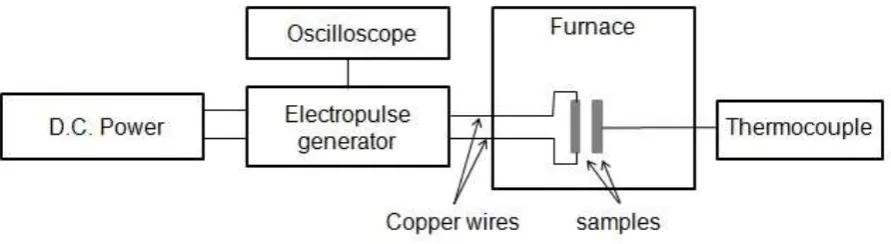
[image:4.595.77.523.389.511.2]The electropulsing is provided by an electropulse-generator linked to a direct current power. The direct current power source has standard output power of 80 W and standard output electric potential of 20 V. The pulse width, peak current intensity, pulse frequency and pulse trigger mode are programmable. Copper wires were used to connect the sample and electropulse-generator. An oscilloscope was used to monitor the shape of the current pulses. The temperature is measured by a K-type thermocouple (0.08 mm) attached to a sample. The embedded electrical feed-back system in the pulse generator enables to fix either the electric current or the electric potential. The pulse duration, pulse frequency and current density are adjustable in a wide range of values. A furnace is connected to the devise so that the temperature can be chosen to various values. The setting of the experimental facilities is schematically demonstrated in Fig. 1. All the pulses applied in this work were chosen to have 20μs pulse width and 1.018 ×10⁷𝐴/𝑚2 peak current density. The frequency of electropulse was 1 Hz.
Figure 1: Schematic diagram of experimental setting
Microstructure characterization
The microstructure of all the samples with and without electropulsing treatment were characterised by optical microscope and a LEO Gemini 1525 high resolution field emission gun scanning electron microscope (FEGSEM) operated at 5kV fitted with Oxford instruments INCA energy dispersive and wavelength dispersive x-ray spectrometers. The samples for scattering electron microscopy (SEM) observations were prepared by the conventional method using diamond pastes and etched in 2% nital etching solution.
Results and discussion
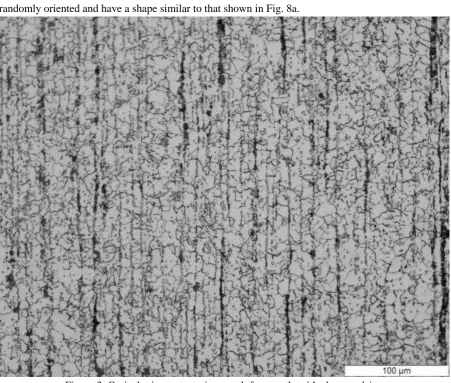
Fig. 2 shows optical microscope images of the unelectropulsed sample. The microstructure consists of ferrite and semi-transformed plates of cementite (darker grains). EDX analysis shows that the darker grains are richer in carbon. These grains are randomly distributed into the ferrite matrix and
Element C Mn Si Al Nb
4
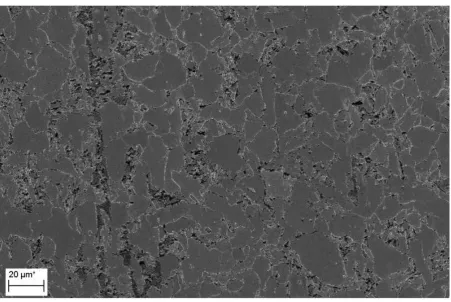
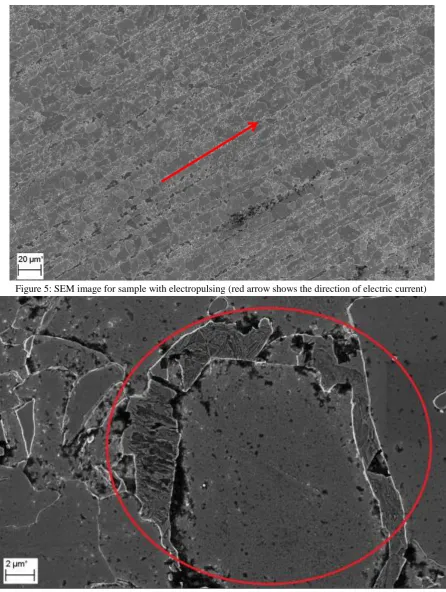
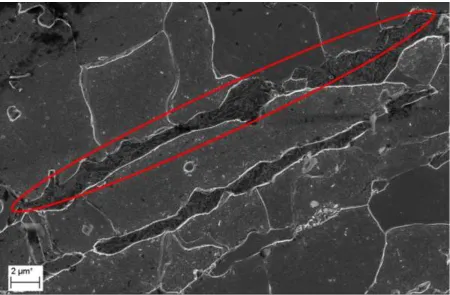
the direction of plates does not show any preference. The ferrite grain size was measured to be in average 35 μm. Fig. 3 demonstrates the optical microscope micrograph for electropulsed sample. As it is clear from this image, electropulsing has caused a remarkable change in the microstructure that produces ferrite matrix with smaller grain size and semi-transformed pearlite aligned with the current direction. This is in line with the observation identified in room temperature application of the electropulsing [11]. The average grain size of ferrite has reduced to 13 μm after electropulsing. Fig. 4 and 5 illustrates the SEM micrographs of unelectropulsed and electropulsed samples, respectively. From these figure, it is evident that grains are oriented towards the direction of electric current flow for the sample underwent the treatment during annealing. In addition, the grains in the electropulsed sample are elongated towards the current direction. These differences in the microstructures of unelectropulsed and electropulsed samples are shown in Fig. 6 and 7, respectively.
In elegant thermodynamics calculations, Dolinsky and Elperin showed that electropulsing tends to re-configure the structure towards a state that electrical conductivity of material can be increased. Basically, the application of electropulsing to a material adds a free energy due to the electric current pulses to the total free energy of the system. The total bulk free energy of the steel includes two terms which are the chemical free energy of the bulk phases (∆𝐺𝑐ℎ𝑒𝑚), and the free energy associated with the passing electric current pulses (∆𝐺𝐸𝑃 ). The free energy change due to electric current pulse can be determined by [11, 13, 14]:
∆𝐺𝐸𝑃= 𝜇 8𝜋∬
𝑗1
⃗⃗ (𝑟)𝑗⃗⃗ (𝑟1 ′) − 𝑗 2
⃗⃗⃗ (𝑟)𝑗⃗⃗⃗ (𝑟2 ′)
5
Figure 2: Optical microscope micrograph for sample without electropulsing
where r and 𝑟′ are two different positions in space, 𝑗 (𝑟) and 𝑗 (𝑟′) are the current densities at position
r and 𝑟′, respectively. μ is the magnetic permeability. Eq. 2 has been used to explain the significant
[image:6.595.73.525.269.652.2]role that ∆𝐺𝐸𝑃 plays in inclusion segregation [15]. In that study, the authors show that the effect of electropulsing treatment could significantly reduce the diffusion activation energy of lead in brass, while remarkably accelerate the lead diffusion in the matrix. The same theory can also be employed to explain the electripulse-induced microstructural evolution in the steel under study. According to Eq. 2, the configuration of the microstructure will, therefore, have a profound influence on the distribution of electric current and subsequently on the free energy change because of electropulsing. For the unelectropulsed sample we have ∆𝐺𝐸𝑃= 0. The evolution in microstructure occurred by passing electric current is schematically shown in Fig. 8a and Fig. 8b. The streamline of electric current distribution is different in these two figures since the semi-transformed pearlite grains are richer in carbon than the bulk material and therefore have higher resistivity. Before the treatment, the grains are randomly oriented and have a shape similar to that shown in Fig. 8a.
Figure 3: Optical microscope micrograph for sample with electropulsing
6
[image:7.595.73.525.110.412.2]the electric current distribution, therefore, decreases the free energy associated with electropulsing. Thus, the free energy of the system in Fig. 8a is remarkably different from that in Fig. 8b.
Figure 4: SEM image for sample without electropulsing
7
Figure 5: SEM image for sample with electropulsing (red arrow shows the direction of electric current)
8
Figure 7: SEM image for sample with electropulsing
(a)
9
Figure 8: Schematic representation of the streamline of electric current distribution a) before electropulsing b) after electropulsing
𝐼𝑒= 𝐼0(𝐷
𝜆2) exp (−
𝛥𝐺0+ 𝛥𝐺𝐸𝑃
𝑅𝑇 ) (3) where 𝐼0 is a constant. 𝜆, D, R, and T denote the jump distance, diffusivity, Boltzman constant and absolute temperature, respectively. Eq. 3 can be rewritten as:
𝐼𝑒= 𝐼𝑟exp (−𝛥𝐺 𝐸𝑃
𝑅𝑇 ) (4) where 𝐼𝑟 refers to the nucleation rate when there is no electropulsing performed. According to Eq.4, it can be understood that the nucleation rate is increased by the electropulsing treatment.
Furthermore, nucleation rate of this process is mainly controlled by the movement of dislocations. During electropulsing, the drift electrons impose an extra pushing force on dislocations (electron wind force) [19]. This is sometimes referred to as athermal effect of electropulsing. Such a force is proportional to the current density. This force can considerably promote the gliding and climbing rate of dislocations toward certain areas. The nucleation rate is, thus, enhanced by the treatment. From a mathematical point of view, the athermal effect of electropulsing can be expressed as [20]:
𝐹𝑒𝑤 = (𝜌𝐷
𝑁𝐷) 𝑒𝑛𝑒𝑗 (5)
where 𝐹𝑒𝑤 is the electron-wind force per unit dislocation length. (𝜌𝑁𝐷
𝐷) is the specific resistivity per unit dislocation length and 𝑁𝐷 is the dislocation density. e is the charge on an electron, respectively 𝑛𝑒 and 𝑗 are electron density and the current density, respectively. This equation clearly demonstrates that the athermal effect of electropulsing can remarkably increases the atomic diffusion flux, and the activity of vacancies as well as altering the sliding behaviour of dislocations. This equation clearly demonstrates that the athermal effect of electropulsing can remarkably increases the atomic diffusion flux, and the activity of vacancies as well as altering the sliding behaviour of dislocations. In the work reported by Xiao et al [20], the current-induced stress (e.g. the magnetic pinch) was found to play a more important role than that of the electron wind force. It is worth to point out that stress is proportional to j2
m while electron wind force is proportional to jm. The electric
current density implemented in Xiao et al’s work is around 106 A/cm2 (1010 A/m2) but that of in the
present work is around 107 A/m2. The difference is 3 orders of magnitude. It is obviously that electron
wind force plays more significant role than stress in the current work.
10
Generally, electric current enhances solute diffusion, dislocation migration and interface kinetics [5, 21, 22]. The NbC precipitate has a different electrical conductivity from the steel matrix under the study. As mentioned earlier, the various configurations of the precipitates can also affect the electric current distribution in the whole system.
It is believed that different current distribution corresponds to different system free energies [13]. It is now known for sometimes that electropulsing has a profound influence on the formation of any object within the microstructure with different electrical conductivity from that of the matrix. Electric current pulse is a high energy input method can greatly affect the precipitation process, grain boundary migration and phase transformation in various steels [11, 21]. It is well-known that the drift electrons induced by the electrical potential are scattered unevenly around defects [23]. This generates an uneven distribution of electrons resulting in anisotropic shielding effect against the electromagnetic forces between any atom and its neighbours. This phenomenon causes the kinetic barrier of transformation to reduce. In general, the mobility of a substitutional atom can be written as:
𝑀 = 𝑀𝑎exp (−𝛥𝐸𝑘
11
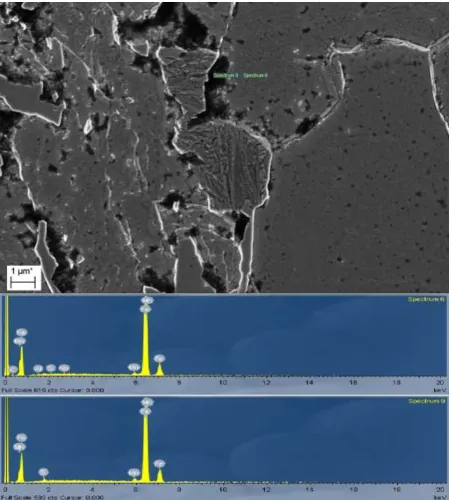
Figure 9: EDX analysis for unelectropulsed sample showing the existence of precipitation free zones in the microstructure (the dark areas around grain boundaries)
previous experiment at room temperature [12] had showed that the electropulsing might results in the formation of PFZs.
12
Table 2: Mechanical properties of unelectropulsed and electropulsed samples
Sample Yield strength (MPa) UTS (MPa) Elongation (%)
Unelectropulsed sample 510 675 25%
Electropulsed sample 560 655 24%
Conclusion
Electropulsing treatment has resulted in the production of finer grain sizes and therefore enhanced the mechanical properties. This is thought to be because of increase in nucleation rate for the electropulsed sample. The semi-transformed pearlite structure has been observed to be parallel to the direction of the electric current flow. The tendency of electric current pulses towards the re-configuration of the structure with lower electrical resistivity is anticipated to play a key role in this phenomenon. This observation is in agreement with the previous experiment performed at room temperature. A relatively even distribution of precipitation produced after electropulsing which is believed to be due to the enhanced mobility due to decrease in the kinetics barrier.
Acknowledgement
The authors wish to acknowledge the financial support from POSCO and the Royal Academy of Engineering at United Kingdom.
References
[1] X. Ye, W. Lingsheng, Z.T.H. Tse, G. Tang, G. Song, Effects of high-energy electro-pulsing treatment on microstructure, mechanical properties and corrosion behaviour of Ti-6Al4V alloy, Mater Sci. Eng. C, 49, 851-860 (2015)
[2] X.F. Zhang, R.S. Qin, Controlled motion of electrically neutral microparticles by pulsed direct current, Sci. Rep., 5, 10162 (2015)
[3] L. Guan, G. Y. Tang, P. K. Chu, Recent advances and challenges in electroplastic manufacturing processing of metals, J Mater Res, 25, 1215-1224 (2010)
[4] J. P. Barnak, A.F. Sprecher, H. Conrad, Colony (grain) size reduction in eutectic Pb-Sn castings by electropulsing, Scr Metall Mater, 32, 879-884 (1995)
[5] H. Conrad, Effects of electric current on solid state phase transformations in metals, Mater Sci Eng A, 287, 227-237 (2000)
[6] Y. Z. Zhou, R. S. Qin, S. H. Xiao, G. He, B. Zhou, Reversing effect of electropulsing on damage of 1045 steel, J Mater Res, 15, 1056-1061
[7] Y. Onodora, A. Sakuma, K. I. Hirano, Current dependence of the retardation of precipitation by direct-current stress in AI-3.3 at % Mg, J Mater Sci, 28, 3835-3838 (1993)
[8] Y. Onodora, J. I. Maruyama, K. I. Hirano, Retardation of the precipitation reaction by d.c. stress in an A1-12.5 wt. % Zn alloy, J Mater Sci, 12, 1109-1114
[9] N. Fujita, H. K. D. H. Bhadeshia, Modelling precipitation of niobium carbide in austenite: multicomponent diffusion, capillarity, and coarsening, Mater Sci Tech, 17, 403-408 (2001)
[10] P. Yan, H. K. D. H. Bhadeshia, Austeniteferrite transformation in enhanced niobium, low carbon steel, Mater Sci Tech, DOI:10.1179/1743284714Y.0000000673.
[11] A. Rahnama, R. S. Qin, Electropulse-induced microstructural evolution in a ferriticpearlitic 0.14% C steel, Scripta Mater., 96, 17-20 (2015)
[12] A. Rahnama, R. S. Qin, The effect of electropulsing on the interlamellar spacing and mechanical properties o fa hot-rolled 14 wt.% carbon steel, Mater Sci Eng A, 627, 145-152 (2015)
13
[14] W. J. Lu, X. F. Zhang, R. S. Qin, Stability of precipitates under electropulsing in 316L stainless steel, Mater Sci Tech, DOI 10.1179/1743284714Y.0000000743
[15] X. L. Wang, X. L. Wang, J. D. Guo, Y. M. Wang, X. Y. Wu, and B. Q. Wang, Segregation of lead in Cu–Zn alloy under electric current pulses, Appl. Phys. Lett. 89, 061910, (2006)
[16] Y. Liu, J. Fan, H. Zhang, W. Jin, H. Dong, B. Xu, Recrystallization and microstructure evolution of the rolled Mg-3Al-1Zn alloy strips under electropulsing treatment, J Alloys and Compounds, 622, 229-235 (2015)
[17] Y. S. Zheng, G. Y. Tang, J. Kuang, X. P. Zheng, Effect of electropulsing on solid solution treatment of 6061 aluminium alloy, J alloys and Compounds, 615, 849-853 (2014)
[18] R. S. Qin, B. L.Zhou, Exploration on the fabrication of bulk nanocrystalline material by direct nanocrystallizing method II Theoritical calculation of grain size of metals solidified under electropulsing, Chinese J Mater Res, 11, 69-72 (1997)
[19] H. Conrad, N. Karam, S. Mannan, Effect of electric current pulses on the recrystallization of copper, Scripta Mater, 17, 411-416 (1983)
[20] S.H. Xiao, Y.Z. Zhou, J.D. Guo, S.D. Wu, G. Yao, S.X. Li, G.H. He, B.L. Zhou, The effect of high current pulsing on persistent slip bands in fatigued copper single crystals Mater. Sci. Eng. A332 351–355, (2002).
[21] R. S. Qin, I. Samuel, A. Bhowmik, Electropulse-induced cementite nanoparticle formation in deformed pearlitic steels, J Mater Sci, 46, 2838-2842 (2011)
[22] Y. B. Jiang, G. Y. Tang, C. H. Shek, Y. H. Zhu, Z. H. Xu, On the thermodynamics and kinetics of electropulsing induced dissolution of 𝛽-𝑀𝑔17𝐴𝑙12 phase in an aged Mg-9Al-1Zn alloy, Acta Mater, 57, 4797-4808 (2009)