http://wrap.warwick.ac.uk
Original citation:
Shen, S., Rodrigo, G., Prakash, S., Majer, E., Landrain, T. E., Kirov, B., Daros, J.-A. and
Jaramillo, Alfonso. (2015) Dynamic signal processing by ribozyme-mediated RNA
circuits to control gene expression. Nucleic Acids Research .
Permanent WRAP url:
http://wrap.warwick.ac.uk/67559
Copyright and reuse:
The Warwick Research Archive Portal (WRAP) makes this work of researchers of the
University of Warwick available open access under the following conditions.
This article is made available under the Creative Commons Attribution 4.0 International
license (CC BY 4.0) and may be reused according to the conditions of the license. For
more details see:
http://creativecommons.org/licenses/by/4.0/
A note on versions:
The version presented in WRAP is the published version, or, version of record, and may
be cited as it appears here.
doi: 10.1093/nar/gkv287
Dynamic signal processing by ribozyme-mediated
RNA circuits to control gene expression
Shensi Shen
1,†, Guillermo Rodrigo
1,†, Satya Prakash
3, Eszter Majer
2, Thomas E. Landrain
1,
Boris Kirov
1, Jos ´e-Antonio Dar `
os
2and Alfonso Jaramillo
1,3,*1Institute of Systems and Synthetic Biology, Universit ´e d’ ´Evry-Val-d’Essonne, CNRS, F-91000 ´Evry, France,2Instituto
de Biolog´ıa Molecular y Celular de Plantas, CSIC – Universidad Polit ´ecnica de Valencia, 46022 Valencia, Spain and
3School of Life Sciences, University of Warwick, Coventry CV4 7AL, UK
Received June 19, 2014; Revised March 23, 2015; Accepted March 24, 2015
ABSTRACT
Organisms have different circuitries that allow con-verting signal molecule levels to changes in gene expression. An important challenge in synthetic bi-ology involves the de novo design of RNA mod-ules enabling dynamic signal processing in live cells. This requires a scalable methodology for sensing, transmission, and actuation, which could be assembled into larger signaling networks. Here, we present a biochemical strategy to design RNA-mediated signal transduction cascades able to sense small molecules and small RNAs. We design switch-able functional RNA domains by using strand-displacement techniques. We experimentally charac-terize the molecular mechanism underlying our syn-thetic RNA signaling cascades, show the ability to regulate gene expression with transduced RNA sig-nals, and describe the signal processing response of our systems to periodic forcing in single live cells. The engineered systems integrate RNA–RNA interac-tion with available ribozyme and aptamer elements, providing new ways to engineer arbitrary complex gene circuits.
INTRODUCTION
Natural signal transduction systems allow organisms to adapt to fluctuating environments, often by exploiting sub-cellular localization, molecular cascades and protein al-lostericity (1,2). A major challenge in synthetic biology in-volves the engineering of novel signaling systems that sense, process and transmit information. Most engineering efforts have relied on the translational fusion of known protein domains with specific interaction or catalytic functionali-ties (2). However, this approach is limited by the availabil-ity of known natural interaction domains that are specific
enough to avoid cross-talk with other molecules in the cellu-lar context. Alternatively, the use of RNA as programmable molecules would allow engineering an unlimited number of interaction partners (3,4). This way, we propose to engineer synthetic signal transduction systems relying on RNA by using a transcriptional fusion strategy, exploiting sequence fragments with definite interaction and catalytic properties. In protein-based signaling, localized folding domains facil-itate the engineering (or re-engineering) of multiple func-tions (5,6). Similarly, there are well-known RNA folding structures that are stable and capable to interact specifically with signaling molecules (aptamers) or to catalyze reactions (ribozymes) (4). In addition, the use of computational tools allows the prediction of conformational changes in many cases, opening the door to the engineering of signal trans-duction systems based on RNA (7). As a proof of concept, we here develop a system (to control gene expression with a molecular signal) that consists in the fusion of an aptazyme, acting as a molecular sensing element, with a riboregula-tor, acting as a signal mediator. To simplify the terminol-ogy, in the following we refer to this multifunctional RNA molecule as regazyme.
In this direction, pioneering work in synthetic biology inserted known aptamer domains into 5 untranslated re-gions (UTRs) of messenger RNAs (mRNAs) to sense small molecules (10), and also exploited riboregulation in com-bination with small-molecule-responsive promoters to con-trol gene networks and metabolic pathways (8,9). More re-cently, important steps towards RNA-based sensing have been carried out by engineering aptazymes in the 5 or 3 UTRs to sense both small molecules (11,12) and small RNAs (sRNAs) (13). Moreover, previous work has com-bined aptamers with riboregulators to create novel sens-ing devices (13–15). Those works exploit the programma-bility of RNA function through strand-displacement re-actions and induced conformational changes. Here, our strategy allows engineering a one-to-two-component sig-nal transduction system, where emerging RNA function is
*To whom correspondence should be addressed. Tel: +44 24 765 73432; Email: [email protected] †These authors contributed equally to the paper as first authors.
C
The Author(s) 2015. Published by Oxford University Press on behalf of Nucleic Acids Research.
achieved by incorporating self-cleavage ability into atrans -acting riboregulator. This corresponds to a four-molecule system, where the first one is the signal molecule, either a small molecule or sRNA, and the last one is acis-regulated mRNA as system’s readout. The other two molecules (two components) correspond to the sensor and mediator, which can be switched ON/OFF in presence/absence of the signal molecule, respectively.
The devised system shares properties with natural signal-ing systems (1). On the one hand, it is a one-component sys-tem from the input viewpoint. Thus, it has the advantage of subcellular localization independence. On the other hand, it is a two-component system from the output perspective (the sensor and mediator are different molecules after cleavage). Thanks to the modularity offered by the independence of the sensor and mediator domains, we could have a palette of domains with alternative functionalities. Compared to endogenous sensors (e.g. receptors), our sensor is not lim-ited to the cell membrane, meanwhile the mediator (i.e., ri-boregulator) works like a phosphorylated transcription fac-tor but at post-transcriptional level (interacting with a 5 UTR rather than with a promoter). Our approach to en-gineer a signal transduction system combines the fusion of functional RNA elements together with the computational prediction of each conformational state. This is also possi-ble with a protein-based system (16,17), although it could become much harder, requiring experimental screening to-wards appropriate transduction properties (5).
In this work, we show that RNA structure is predictable enough to allow a computational design strategy. In gen-eral, the tremendous size of the system’s sequence space pre-vents thede novodesign without automation. We have previ-ously demonstrated that an automated design methodology is able to generatede novoriboregulation in live cells (18). Therefore, we here propose to generalize such methodology to design RNA-mediated signal transduction systems. For that, we assume that any interaction between two RNAs is triggered by a seed (or toehold) sequence (18). In the case of a regazyme, the signal molecule induces a catalytic pro-cess that releases a riboregulator, which in turn induces a conformational change in the 5UTR that initiates interac-tion with the 16S ribosomal unit (18,19) inEscherichia coli. This way, we enforce a hierarchical mode of action consist-ing in switchconsist-ing ON each functional module, which is ini-tially OFF.
In the following, we will provide a detailed description of the computational methodology to design a hierarchical system with functional RNA modules that couples molec-ular signals in the cell (either from the environment or from upstream biological systems) with gene expression. We will first describe the development of a methodology for nu-cleotide sequence design, and then we will present a mech-anistic characterization to assess the self-cleavage activity of the regazyme. Subsequently, we will show results assess-ing signal transduction with time-dependent induction in bacterial cells, allowing the characterization of the dynamic regulatory properties at both population and single cell lev-els.
MATERIALS AND METHODS
Sequence design
We developed a Monte Carlo Simulated Annealing (20) op-timization algorithm to design the transducer modules of regazymes provided the sequences of given aptazymes (or sRNA-induced ribozymes) and riboregulators (Supplemen-tary Figure S6). For that, we constructed a basic energy model that involved three variables (to be minimized): the energy of activation corresponding to the catalytic activity of the aptazyme, the degree of accessibility of the riboregu-lator seed before cleavage, and the degree of obstruction of the seed after cleavage. The exposure or obstruction of the riboregulator seed is governed by secondary structure, but the aptazyme involves tertiary contacts. We here simplified the problem by only considering the secondary structure of the aptamer to calculate the energy of activation for cleav-age. Rounds of random mutations (replacements, additions or deletions) were applied and selected with the energy-based objective function. We used the Vienna RNA package (21) for energy and structure calculation (see further details in Supplementary Materials and Methods). The sequences of the engineered regazymes in this work are shown in Sup-plementary Tables S1–S3.
Plasmid construction
The different RNA devices were chemically synthesized and cloned in plasmid pSynth (pUC replication origin, ampi-cillin resistance) and then subcloned into plasmids pSTC1 or pSTC2. These two plasmids contain a pSC101m repli-cation origin (a mutated pSC101 ori giving a high copy number) and a kanamycin resistance marker (Supplemen-tary Figures S1 and S2). The pSTC2 vector is based on our previously reported vector pSTC1 (18) by removing the mRFP coding sequence and tagging the carboxyl terminus of the superfolder GFP (sfGFP) (22) with thessrA degra-dation tag (23). Dysfunctional regazymes were constructed by PCR-based site-directed mutagenesis (see Supplemen-tary Materials and Methods). Strains and plasmids used in this study are listed in Supplementary Table S6.
Intracellular catalytic activity
Processing extent of regazyme at different time points (0, 2, 4, 8, 16 and 32 min) was analyzed by northern blot hybridization using a complementary [32P]-labeled RNA
probe after separating the different RNA samples by de-naturing polyacrylamide gel electrophoresis (PAGE). RNA preparations were mixed with formamide loading buffer for denaturation, followed by PAGE separation in 5% poly-acrylamide gels including 8 M urea and TBE buffer. Gels were stained with ethidium bromide. Membranes were hy-bridized overnight, imaged by autoradiography, and then hybridization signals quantified by phosphorimetry (Fuji-film FLA-5100). See more details in Supplementary Mate-rials and Methods.
Fluorescence quantification
stationary phase. Cells were then diluted 1:200 in 200 l of M9 minimal medium in each well of the plate (Custom Corning Costar). The plate was incubated in an Infinite F500 multi-well fluorometer (TECAN) at 37◦C with shak-ing. It was assayed with an automatic repeating protocol of absorbance measurements (600 nm absorbance filter) and fluorescence measurements (480/20 nm excitation filter – 530/25 nm emission filter for sfGFP) every 15 min. All sam-ples were present in triplicate on the plate (see further details in Supplementary Materials and Methods).
Single cell microfluidics analysis
The design of our microfluidics device (Supplementary Fig-ure S16) (24), which was performed in AUTOCAD (AU-TODESK), was adapted from the previous one reported by Hastyet al.(25). All images were acquired using Zeiss Axio Observer Z1 microscopy (Zeiss). The microscope resolution was 0.24m with Optovariation 1.6×, resulting total mag-nification 1600×for both bright field and fluorescent im-ages. Images were analyzed with MATLAB (MathWorks). Cells were tracked by defining a cell-to-cell distance matrix and the cell lineages were reconstructed. Finally, the fluo-rescence level of each cell in each fluofluo-rescence frame was ex-tracted (see further details in Supplementary Materials and Methods).
RESULTS
Computational design of RNA-mediated signal transduction systems to control gene expression
Our modular strategy consists in designing switchable func-tional RNA domains, which is implemented by exploiting strand-displacement principles together with the engineer-ing of allosteric conformational states. This way, we can de-sign chains of several domains that are activated in cascade. Without loss of generality, we considered a system com-posed of two transcriptional units: regazyme and mRNA of a reporter gene (e.g. a gene coding for a green fluores-cent protein−GFP), but our methodology could be gener-alized to an arbitrary number of transcriptional units con-taining switchable functional elements. To engineer such a synthetic RNA system implementing the transduction of molecular signals into changes in gene expression, we took advantage of a standard physicochemical model (based on Watson-Crick and wobble pairing) predicting RNA sec-ondary structure and free energy (26) to be used in an opti-mization algorithm to select for the hierarchical activation of functional RNA modules in the cascade (7).
In particular, our system corresponds to a cascade of three modules: sensor (aptazyme designed to specifically re-spond to a given ligand), mediator (riboregulator designed to specifically activate acis-repressed ribosome-binding site
− RBS), and actuator (mRNA with cis-repressed RBS) (Figure1a). To create the regazyme, we fused an aptazyme element, acting as a molecular sensing device, with a ri-boregulator, acting as a signal mediator, into the same tran-scriptional unit. This fusion is performed with flanking se-quences that form a stem and function as a transducer mod-ule, in the same way as when designing allosteric aptamers (27). The sensor domain (aptazyme) is initially in a state
OFF (catalytically inactive) and is switched to ON (catalyt-ically active) only when it acquires its functional conforma-tion, which is induced by the signal molecule. The mediator domain (riboregulator) will be in a state ON when its seed sequence is exposed to the solvent. We designed the trans-ducer module to ensure that the sensor and mediator were ON/OFF in presence/absence of the signal molecule. This prevents any premature release of the mediator or any direct activation of gene expression by the regazyme. Afterward, the input signal produces a stabilization of an alternative conformation where the aptazyme is active. Once the ap-tazyme is active, it will self-cleave releasing the mediator do-main, which is then switched on (i.e. the riboregulator seed sequence becomes exposed). Once the mediator domain is active, it will diffuse towards its target genes (in particular, to interact with 5UTRs), similarly to phosphorylated tran-scription factors in the conventional two-component sys-tems (1). To be noted, the independence between the sen-sor and mediator domains favors expanding the functional repertoire, which allows them to be exchanged with alterna-tive domains.
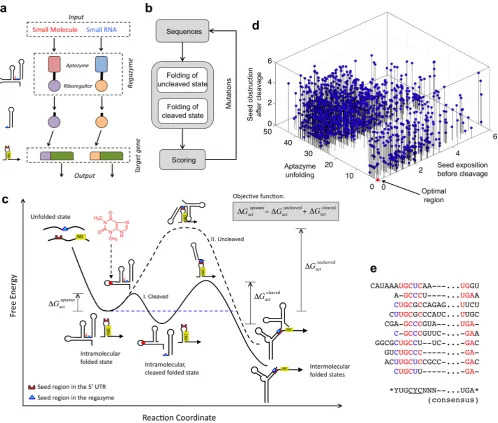
We here propose a new methodology to engineer one-to-two-component signal transduction, which combines the advantages of subcellular independence of one-component systems and of modularity of two-component systems. We constructed a combinatorial optimization problem to ex-plore the sequence space of the transducer module (Fig-ure 1b), where a nucleotide-level energy model consider-ing the conformational states (uncleaved and cleaved) of the regazyme was used to evaluate the performance of the generated sequences. For each state, the model accounts for its free energy and its secondary structure. As objectives to be optimized (computed as Hamming distances), the algo-rithm considers the energy of activation corresponding to the catalytic activity of the aptazyme (which we assume de-pends on the correct formation of the aptamer in the un-cleaved state), and the degree of exposure to the solvent of the riboregulator seed before and after cleavage (28). Figure1c illustrates the energy landscape associated to the molecular mechanism of the regazyme, reporting the differ-ent conformational states and their corresponding free en-ergy levels (see also Supplementary Figure S4). The reaction coordinate was defined here as the number of intermolecu-lar hydrogen bonds, on one side, between the ligand and the aptazyme and, on the other side, between the riboregulator and the 5UTR (in terms of base-pairs). In absence of sig-nal molecule, the progression of the reaction is limited by the presence of a high-energy intermediate that prevents the interaction between the regazyme and the 5 UTR. How-ever, when the signal molecule is at sufficient concentration, a cleavage is produced and then the activation energy for the resulting riboregulatory element is lowered, which speeds up the reaction (29).
dis-Figure 1. Computational design of the regazyme signaling pathway. (a) Scheme of the modular system, where a signal molecule (either a small molecule or a sRNA) induces a catalytic reaction that releases a riboregulator able to activate gene expression. Each signaling pathway is viewed as a wire carrying information. (b) Scheme of the optimization loop, where a regazyme sequence is iteratively mutated and evaluated according to an objective function. (c) Energy landscape of the signaling pathway showing the different conformational states (intra- and intermolecular), together with the three free energy terms of the objective function, in terms of a reaction coordinate. Solid line illustrates the trajectory corresponding to the ligand-induced cleavage of the regazyme and subsequent binding of the riboregulator to the mRNA. Dashed line corresponds to the trajectory where the uncleaved regazyme binds to the mRNA. (d) Computation of the free energy terms of the objective function for 1,000 random sequences to evaluate their distribution. (e) Alignment of different optimized sequences with aptazyme theoHHAz and riboregulator RAJ12. Highly conserved nucleotides are highlighted in red or blue, and the consensus sequence is shown.
tinct solutions can be equally good computationally (i.e., according to the objective function), experiments could dis-till differences in performance among them. We observed, for the sampled sequences, that the aptamer (in the un-cleaved state) is correctly formed only for a small subset of sequences (Supplementary Figure S5). Moreover, the result-ing distribution is apparently bimodal (Sarle’s bimodality coefficient BC=0.630>5/9) (30), which may be explained by an all-or-none formation of the functional structure of the aptazyme. Such pre-organized conformations will fa-vor ligand binding and subsequent cleavage, whereas struc-tures requiring considerable rearrangements will be offside
due to a given free energy barrier (29). The distribution of score values along the axis representing the seed exposure in the uncleaved state is more homogeneous (BC=0.467
<5/9), whereas the distribution in the cleaved state shows substantial heterogeneity (BC=0.639>5/9). This may be explained by an interaction of the seed region with part of the 5end after cleavage (see, for example, Supplementary Figure S8).
Modularity in the design of regazymes
[image:5.612.52.551.66.489.2]and thiamine pyrophosphate−TPP, Figure2and Supple-mentary Figure S7), and another sensing a specific sRNA (Break1, Figure3). This sRNA is induced with anhydrote-tracycline (aTc) in our system. More specifically, each sen-sor is composed of a binding domain (e.g., an aptamer) and a catalytic domain (e.g. a hammerhead ribozyme). Our ligand-induced ribozymes (aptazymes) are theoHHAz and tppHHAz for sensing small molecules (11,31), and breakHHRz for sensing sRNA (32) (Supplementary Fig-ure S3). For the mediator domain, we considered three synthetic riboregulators known to activate the initiation of translation, two engineered in Rodrigo et al. (RAJ11 and RAJ12) (18) and one in Isaacs et al. (RR12) (19) (Supplementary Figure S8). We then designed the rest of the regazyme sequence according to the specifications re-quired to generate the RNA signaling cascade. Exploiting the modularity of this system, we engineered the following regazymes: theoHHAzRAJ11, theoHHAzRAJ12, theoH-HAzRR12, tppHHAzRAJ12 and breakHHAzRAJ12. The regazyme produces a mediator molecule (riboregulator) that is independent of the signal and sensor molecules. In the following, we investigate, on the one hand, how different signal molecules (Theo, TPP and Break1) activate a com-mon mediator (RAJ12), and, on the other hand, how differ-ent implemdiffer-entations of the wire (RAJ11, RAJ12 and RR12) transduce the information from a common signal molecule (Theo).
Our computational approach allowed us to investigate the designability (defined as the number of sequences that have the desired biochemical function) of the solution space for a particular couple of aptazyme and riboregulator. We expect, nevertheless, a higher designability when sequences are allowed to vary in length, as it is the case for our algo-rithm. It is instructive to align multiple solutions to reveal conserved nucleotide positions. Figure1e shows, for differ-ent designs, the consensus sequence for a given choice (ap-tazyme theoHHAz and riboregulator RAJ12). Sequences (corresponding to the 5and 3regions of the aptazyme, see Supplementary Figure S6a) were aligned by using the anti-seed consensus sequence (CYC in this case; note that the seed sequence is GGG) as reference. In addition, this mod-ularity would allow a hierarchical design of the regazyme molecule. To create a suitable pipeline, we can exploit com-putational algorithms to: (i) design the binding domain (ap-tamer in particular) for a specific signal molecule (33), (ii) design the riboregulator and cognate 5UTR (18), and (iii) apply the methodology developed in this work to design the appropriate transducer module. Experimental screenings or directed evolution techniques (34) could also be applied, es-pecially to link the binding and catalytic domains (see ’Dis-cussion’ section).
Molecular characterization of RNA-mediated signal trans-duction
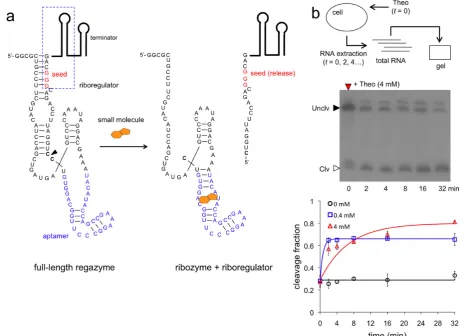
To analyze the mechanism of the signaling pathway, we first carried out a kinetic and dose-dependent study of the catalytic activity. The predicted secondary structure of the small-molecule-sensing regazyme theoHHAzRAJ12 in the uncleaved state (Figure2a) shows, as designed, that the ap-tamer is already arranged for Theo sensing, and that the
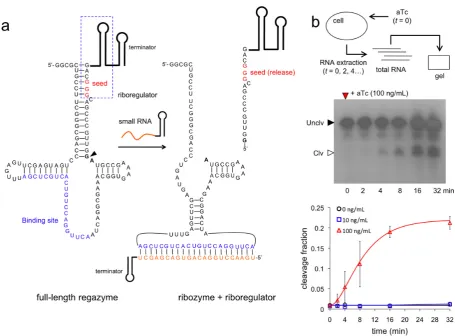
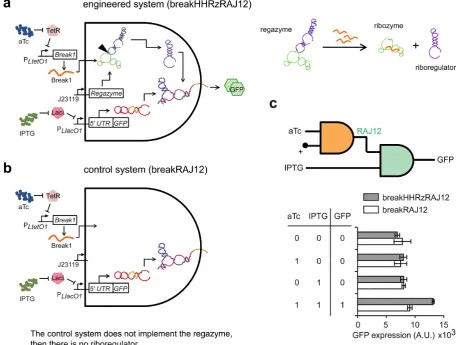
seed region of the riboregulator is blocked by the transducer module. After cleavage at the CC dinucleotide site between the transducer module and the ribozyme core (Figure2a, marked by an arrow), the seed region is released, which al-lows the riboregulator to interact downstream with the cog-nate 5UTR of the reporter gene. An analogous seed-based structural mechanism is illustrated for the sRNA-sensing regazyme breakHHRzRAJ12 (Figure3a). In this case, the binding domain is only partially paired to allow an efficient interaction with the signal sRNA (Break1), and the cleav-age is done at the GA dinucleotide site (Figure3a, marked by an arrow). Indeed, there is a seed-mediated interaction between Break1 and the regazyme, similar to the interac-tion between the riboregulator and the 5UTR. Of note, our regazyme breakHHRzRAJ12 implements for the first time an RNA cascade in live cells (independent of any protein-based machinery).
To monitor the dynamic RNA processing of the sys-tem, we performed a gel assay from cellular RNA ex-tracts. Cells expressing regazyme theoHHAzRAJ12 or breakHHRzRAJ12 were induced with different concentra-tions of Theo or aTc and lysed at several time points. The gel assays in both cases showed fast dynamic RNA process-ing, reaching steady states in almost 16 min. The observed cleavage rate (fitted with a model of exponential decay with production) is 0.15 min−1for theoHHAzRAJ12 with 4 mM
Theo, although the model does not capture finely the exper-imental trend (Figure2b and Supplementary Figure S9a). In this case, the band corresponding to the released riboreg-ulator (of 114 nt, accounting for the terminator) migrates faster than expected. This band was not observed without Theo, indicating that indeed it is a product of the cleav-age reaction. Moreover, we note that our probe did not de-tect the 5fragment after cleavage, suggesting a fast degra-dation of this new species. In those conditions, the maxi-mal cleavage fraction is∼80%, which is>2.5-fold increase with respect to the basal state (∼30%). With 0.4 mM Theo, the observed cleavage rate is 1.5 min−1 with a more
accu-rate fitting (note that the discrepancy between the accu-rates at 4 and 0.4 mM is indeed due to the model fitting; at 4 min the fraction cleaved is∼60% in both cases). According to previous experimental results in vitro without RNA pro-duction and degradation (11), the observed cleavage rates of theoHHAz in absence and presence (4 mM) of Theo are 1.3 and 3.6 min−1, respectively, with a maximal
cleav-age fraction of 90%. Certainly, the dynamic responsein vivo
faces additional challenges due to the balance between pro-duction and degradation. For breakHHRzRAJ12, the ob-served cleavage rate is 0.17 min−1with 100 ng/ml aTc, but
Figure 2. Molecular characterization of small-molecule-sensing regazyme. (a) Sequence and structure of the regazyme theoHHAzRAJ12. A small molecule (Theo) binds to the regazyme to reconstitute the active conformation of the ribozyme and then produce the cleavage. An arrow marks the cleavage site, between the transducer module and the ribozyme core. The seed of the riboregulator is paired in the uncleaved state. (b) Time-dependent electrophoretic analysis of cellular RNA extracts taken at different time points; gel shown for 4 mM Theo. Quantification of dynamic RNA processing for different concentrations of the signal molecule (Theo). Data fitted with a generalized exponential decay model with production, where the temporal factor is (1− exp(−λt))m, withm≈1. Error bars represent standard deviations over replicates.
assaysin vitro(32) revealed a rate of 0.11 min−1with
single-stranded DNA as ligand (3 M). The maximal cleavage fraction reported here is almost 25% (∼1% for the basal state), which shows a big discrepancy with those previous
in vitroresults (∼75%). One possible explanation is that the expression of the sRNA with 100 ng/ml aTc does not sat-urate the system, because the regazyme is expressed from a strong constitutive promoter, and also because of a high effective dissociation constant. Of relevance, this regazyme has much lower leakage (1% versus 30%, although main-taining similar fold-changes), which could be important in case of sensitive systems. Moreover, we observed higher het-erogeneity in the dynamic response (from cell to cell) for this sRNA-sensing regazyme, which could be a result of a heterogeneous expression of the sRNA or even of a certain heterogeneous sRNA–regazyme interaction. As a result, by predicting RNA structures and quantifying cellular RNA extracts, we have shown the precise signal sensing and sub-sequent cleavage to release a functional riboregulator.
To further confirm that our devices behave as ex-pected, we performedin vitrotranscription of systems theo-HHAzRAJ12 and breakHHRzRAJ12. The experiments
Figure 3. Molecular characterization of sRNA-sensing regazyme. (a) Sequence and structure of the regazyme breakHHRzRAJ12. A sRNA binds to the regazyme to reconstitute the active conformation of the ribozyme and then produce the cleavage. An arrow marks the cleavage site, between the transducer module and the ribozyme core. The seed of the riboregulator is paired in the uncleaved state. (b) Time-dependent electrophoretic analysis of cellular RNA extracts taken at different time points; gel shown for 100 ng/ml aTc. Quantification of dynamic RNA processing for different concentrations of the signal molecule (aTc). Data fitted with a generalized exponential decay model with production, where the temporal factor is (1−exp(-λt))m, withm≈2. Error bars represent standard deviations over replicates.
vitrothanin vivo. For example,in vitrothe regazyme might exist in thermodynamic equilibrium with its ligand, result-ing in a different effective dissociation rate, or differ slightly in length from the strandsin vivo. In addition,in vitrowe used T3 polymerase for transcription (without terminators) instead ofEscherichia colipolymerase and a higher Mg2+ concentration thanin vivo, which might result in differences in folding and cleavage kinetics of the regazyme. In the fol-lowing, we present the net effect of regazyme cleavage and riboregulator release on GFP expressionin vivo(both at the population and single cell levels) with and without the lig-and, showing a regulatory behavior as designed.
Regulation of gene expression in live cells with transduced RNA signal
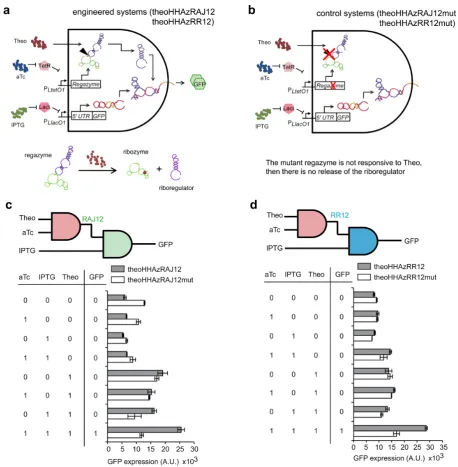
To characterize the dynamic range of our engineered sys-tems, we placed the transcriptional units corresponding to the regazyme and mRNA of the GFP reporter gene un-der the control of tunable promoters (35). These promoters can be induced with isopropyl--D-thiogalactopyranoside
(IPTG) and aTc in E. coli cells expressing constitutively the repressors LacI and TetR. Thus, our systems
Figure 4. Functional characterization of small-molecule-sensing regazymes. (a,b) Schemes of the engineered RNA-based circuit to sense a small molecule and its corresponding control. (c,d) Digital scheme, associated Truth table, and fluorescence results of regazymes theoHHAzRAJ12 and theoHHAzRR12 (gray bars), and of their dysfunctional mutants (white bars) for all possible combinations of inducers. Error bars represent standard deviations over replicates.
in Supplementary Figure S7a) (11) also revealed decreased GFP expression with respect to the native sequence (Sup-plementary Figure S11a,b). We also engineered and charac-terized systems based on riboregulators RR12 (Figure4d) and RAJ11 (Supplementary Figure S11d), although the ri-boregulatory activity of theoHHAzRAJ11 with respect to its dysfunctional mutant was more moderate. Furthermore, these three regazymes for Theo-signaling have responsive-ness in a dose-dependent manner (Supplementary Figure S14) with an effective dissociation constant of about 1 mM. Another engineered system for TPP signaling (regazyme
tp-pHHAzRAJ12) showed no significant riboregulatory activ-ity (Supplementary Figure S15).
Figure 5. Functional characterization of sRNA-sensing regazyme. (a,b) Schemes of the engineered RNA-based circuit to sense a sRNA and its corre-sponding control. (c) Digital scheme, associated Truth table, and fluorescence results of regazyme breakHHRzRAJ12 (gray bars), and of its dysfunctional mutant (white bars) for all possible combinations of inducers. Error bars represent standard deviations over replicates.
other tunable promoter. To exclude the possibility that the sRNA Break1 could directly activate the cis-repressed re-porter gene, we generated a control system (breakRAJ12) by using a dysfunctional mutant removing the regazyme el-ement (Figure5b and Supplementary Figure S13), reveal-ing no significant riboregulatory activity in this case (Figure
5c).
All together, these results demonstrate the modularity of our designs: (i) the same sensor module can transduce the signal to different mediators (riboregulators), and (ii) the same riboregulator (RAJ12 in this case) can be coupled with different sensor modules. We also analyzed experimentally the orthogonality between regazymes. To this end, we con-structed new genetic systems based on non-cognate pairs (between riboregulators and 5 UTRs), in order to testin vivo the eventual cross-talk in regulation of gene expres-sion (36). Computational predictions showed no interfer-ence between the riboregulators RAJ11, RAJ12 and RR12 (Supplementary Figure S22a), and previous experimental work revealed no apparent activation of sRNA of system RAJ11 on the 5UTR of system RAJ12 (18). However, as shown in Supplementary Figure S22b, signaling cross-talk through regazymes can appear (e.g. between RAJ12 and RR12 riboregulatory systems), probably, as a consequence
of non-Watson-Crick pairing not covered in the physico-chemical model. A further computational design method-ology will account for RNA 3D models to better predict RNA-RNA interaction (7) and then engineer RNA circuits with multiple wires. For N different sensor modules and
Morthogonal riboregulators, we could generate, in theory,
NMregazymes. Importantly, as the output of one regazyme can be the input of another regazyme, we could have at most (NM)P different implementations of circuits with P
regazymes, including cascades and feedback loops (Supple-mentary Figure S23).
Time-dependent RNA-mediated signal transduction in single cells
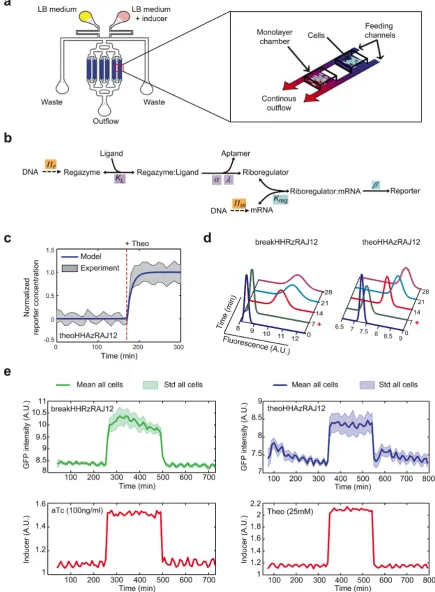
tion of the medium was able to incorporate the appropri-ate time-dependent, small-molecule concentration (25 mM Theo or 100 ng/ml aTc). This way, we can create step func-tions, pulses or even square waves to force the system. The resulting time series of GFP served to calibrate a mathemat-ical model to further understand the dynamics of the sig-naling pathway. At this point, we constructed a simplified model, based on first-order kinetics and quasi-steady states assumptions, able to simulate changes in gene expression upon variations in the concentration of the signal molecule (Figure6b). In essence, the dynamics is modulated by the rates of regazyme cleavage and protein degradation. Ac-cording to our model, the dynamics can be reduced to an ex-ponential decay with production when the time scale of pro-tein degradation is dominant (Supplementary Figure S21). However, it follows a linear trend in the opposite case. Other parameters such as the cleaved fraction upon signal induc-tion, the effective dissociation constant between the riboreg-ulator and the 5UTR, or the gene copy number only affect the stationary level, but not the dynamics. Even though the model can capture small changes in gene expression, the ac-tivity could be not discernable in a cellular context when these parameters are suboptimal. Based on our own data, the characteristic times of HHAz (and also HHRz) cleav-age and GFP degradation are about 6 and 12 min, respec-tively (GFP has a degradation tag for riboregulatory devices RAJ12 and RR12). Moreover, the RNA species must also be short lived (about 2 min of half-life) to not exert a sig-nificant effect on the dynamics of the systems. In turn, we observed that the response of the system is very fast and without delay, reaching the steady state (criterion of 95%) after 26 min in the case of theoHHAzRAJ12 (Figure6c). In addition, there is no significant difference in dynamics when inducing with small molecule or sRNA (Figure6e, see also Supplementary Figures S17 and S18). We also analyzed the dynamic response of regazymes theoHHAzRAJ11 (Supple-mentary Figure S19) and theoHHAzRR12 (Supple(Supple-mentary Figure S20), showing higher dynamic range in these cases and also higher cell-to-cell variability.
By collecting all single cell measurements, we can ana-lyze the response of the population and its heterogeneity (quantified as the coefficient of variation−CV−in the state ON). The fluorescence is significantly shifted in all cases af-ter addition of the inducers (Figure 6d). Then, we calcu-lated CV=0.15 for theoHHAzRAJ12 and CV=0.17 for breakHHRzRAJ12, revealing a similar heterogeneity in the dynamic response in both cases. However, regazyme theo-HHAzRR12 has the wider distribution of the fluorescence (with CV=0.49), which might be a consequence of a higher dynamic range. Indeed, as the enzymatic degradation ma-chinery limits noise in gene expression (and then cell-to-cell variability) (38), high expression levels can saturate this ma-chinery and then expose the system to noise sources related to growth rate (in the case of theoHHAzRR12, such a sat-uration is indicated by a slow dynamic response, Supple-mentary Figure S20). Of importance for further develop-ments, the engineered RNA-mediated signaling pathways are highly responsive to multiple variations in the signal molecule.
DISCUSSION
We have developed a new kind of synthetic RNA molecules (here termed regazymes) able to transduce sig-nals in a modular way in live cells, introducing the one-to-two-component signal transduction paradigm (Fig-ure 1). The design strategy relies on the hierarchical activation/inactivation of RNA elements with specific func-tion. The design of these cascades of interactions requires, in general, automated design algorithms, which we have im-plemented thanks to an effective energy model. We have exemplified the strategy by designing several regazymes, engaging different sensor modules responsive to small molecules or sRNAs, and also different mediator modules that work as independent regulatory wires. In turn, each me-diator regulates a given reporter gene (here a given 5UTR of a common mRNA). The sensor and mediator modules are fused with a transducer module (computationally de-signed) to form the regazyme molecule. Upon sensing the signal molecule, the aptazyme undergoes a conformational change that activates its self-cleavage activity to release the riboregulator, which is fused in the 3 end (Figures2 and
3). This riboregulator is then emitted to the cellular context to further activate a downstreamcis-repressed gene, which may allow the sensing and regulation in different subcellu-lar localizations.
ac-tivities of the aptazyme and riboregulator, besides allowing the straightforward creation of novel systems in a combina-torial way, can enhance the predictability of the dynamic response and the quality of the transmitted information. Similarly, a cleavage-based decoupling of the 5 UTR se-quence from upstream regulatory elements (mainly a pro-moter) was recently proposed for a protein expression con-text (40).
Nucleotide-level energy models, such as the one pre-sented in this work, can provide the underlying explana-tions for molecular interacexplana-tions, which can then be used in the construction of higher-level biological systems (7). Our study has shown the capability of RNA to mediate in signaling pathways in a cellular context similar to pro-teins. However, engineering signal transduction with RNA bypasses the challenges related to membrane localization, complex assembly, competition, and limitation of interac-tion modules regular to protein-based two-component sys-tems (2). Then, the use of regazymes, as pre-engineered modules, may allow devising more complex RNA circuits, at the same time they illustrate new ways to engineer ar-bitrary complexity. We have shown that a regazyme can be used to engineer multi-input AND logic gates, through the combination of transcriptional and post-transcriptional regulations (Figures 4 and 5). Yet, nothing prevents, in theory, using complementary riboregulatory elements such as RNA-binding/processing proteins (41) or translation-transcription control adaptors (42) to generate feedback or feedforward loops. Therefore, a regazyme could serve as an information transmission platform to control over network connections in live cells, which promises future synthetic bi-ology developments, such as metabolic control and rewiring (9).
In addition, we have measured the dynamic response of the catalytic activity of our designed regazymes in cellular RNA extracts (Figures2and3), obtaining comparable val-ues than those previously measuredin vitrowith the same ribozyme core (11,32). These results have revealed a fast cleavage rate, which is within the same time-scale as pro-tein modifications in synthetic systems (5). Moreover, we have observed higher heterogeneity of the dynamic response (from cell to cell) for the sRNA-sensing regazyme, point-ing out an effect of heterogeneous gene expression or even RNA-RNA interaction across cells. Using a mathematical model, we have also analyzed the impact on the dynam-ics of key parameters governing this RNA-mediated signal-ing pathway. We have further characterized in detail the dy-namic response of the riboregulated gene by monitoring a single cell expressing a regazyme using a microfluidics plat-form (Figure6). Systems with higher dynamic range also ex-hibit higher heterogeneity in their dynamic response (from cell to cell). Our results have shown, in agreement with the catalytic assays, a fast activation of protein expression.
The modularity of our approach, where the sensing and mediator modules can be designed independently through computational design of a proper interface, would allow us to replace the mediator module to control eukaryotic gene expression. Perhaps the best strategy would consist in ex-pressing the regazyme only in the nucleus, using a suitable promoter (e.g. a promoter transcribed by RNA polymerase III). One example would consist in exploiting as mediator
module a sRNA able to guide the CRISPR-associated cat-alytically inactive dCas9 protein to block transcription ini-tiation or elongation (recently proposed as CRISPR inter-ference in both prokaryotes and eukaryotes (43,44)). This RNA-guided DNA targeting would allow the addition of a transcription regulation layer into the RNA-mediated sig-nal transduction. Another example of application in eu-karyotic cells would consist in fusing micro RNAs (miR-NAs) rather than bacterial riboregulators with sensor do-mains. There, an aptazyme engineered in the 3UTR of the primary miRNA controlling the poly(A) tail could serve to link the mediator to the signal molecule (12). In conclu-sion, we envision our computationally designed regazymes as a start point for engineering more sophisticated RNA-mediated signaling with particular applications. This would allow the synthetic biology community to use RNA devices to incorporate new signaling functions into cells or rewire natural protein signaling pathways (45).
SUPPLEMENTARY DATA
Supplementary Dataare available at NAR Online.
ACKNOWLEDGEMENTS
We thank Mr. W. Rostain for proofreading the manuscript.
FUNDING
EVOPROG [FP7-ICT-610730]; PROMYS [FP7-KBBE-613745 to A.J.]; Ministerio de Econom´ıa y Competitivi-dad, Spain [BIO2011-26741 to J.-A.D.]; PRES Paris Sud grant (S.S.); EMBO long-term fellowship co-funded by Marie Curie actions [ALTF-1177-2011 A.J., G.R.]; AXA research fund; Ministerio de Educaci ´on, Cultura y De-porte, Spain [AP2012-3751 to E.M.]. Funding for open access charge: EVOPROG [FP7-ICT-610730]; PROMYS [FP7-KBBE-613745].
Conflict of interest statement.None declared.
REFERENCES
1. Ulrich,L.E., Koonin,E.V. and Zhulin,I.B. (2005) One-component systems dominate signal transduction in prokaryotes.Trends Microbiol.,13, 52–56.
2. Kiel,C., Yus,E. and Serrano,L. (2010) Engineering signal transduction pathways.Cell,140, 33–47.
3. Isaacs,F.J., Dwyer,D.J. and Collins,J.J. (2006) RNA synthetic biology.
Nat. Biotechnol.,24, 545–554.
4. Liang,J.C., Bloom,R.J. and Smolke,C.D. (2011) Engineering biological systems with synthetic RNA molecules.Mol. Cell,43, 915–926.
5. Dueber,J.E., Yeh,B.J., Chak,K. and Lim,W.A. (2003) Reprogramming control of an allosteric signaling switch through modular
recombination.Science,301, 1904–1908.
6. Sallee,N.A., Yeh,B.J. and Lim,W.A. (2007) Engineering modular protein interaction switches by sequence overlap.J. Am. Chem. Soc.,
129, 4606–4611.
7. Rodrigo,G., Landrain,T.E., Shen,S. and Jaramillo,A. (2013) A new frontier in synthetic biology: automated design of small RNA devices in bacteria.Trends Genet.,29, 529–536.
9. Callura,J.M., Cantor,C.R. and Collins,J.J. (2012) Genetic
switchboard for synthetic biology applications.Proc. Natl. Acad. Sci. U.S.A.,109, 5850–5855.
10. Werstuck,G. and Green,M.R. (1998) Controlling gene expression in living cells through small molecule-RNA interactions.Science,282, 296–298.
11. Wieland,M. and Hartig,J.S. (2008) Improved aptazyme design and in vivo screening enable riboswitching in bacteria.Angew. Chem. Int. Ed. Engl.,47, 2604–2607.
12. Win,M.N. and Smolke,C.D. (2007) A modular and extensible RNA-based gene-regulatory platform for engineering cellular function.Proc. Natl. Acad. Sci. U.S.A.,104, 14283–14288. 13. Klauser,B. and Hartig,J.S. (2013) An engineered small
RNA-mediated genetic switch based on a ribozyme expression platform.Nucleic Acids Res.,41, 5542–5552.
14. Bayer,T.S. and Smolke,C.D. (2005) Programmable ligand-controlled riboregulators of eukaryotic gene expression.Nat. Biotechnol.,23, 337–343.
15. Qi,L., Lucks,J.B., Liu,C.C., Mutalik,V.K. and Arkin,A.P. (2012) Engineering naturally occurring trans-acting non-coding RNAs to sense molecular signals.Nucleic Acids Res.,40, 5775–5786. 16. Looger,L.L., Dwyer,M.A., Smith,J.J. and Hellinga,H.W. (2003)
Computational design of receptor and sensor proteins with novel functions.Nature,423, 185–190.
17. Kortemme,T. and Baker,D. (2004) Computational design of protein-protein interactions.Curr. Opin. Chem. Biol.,8, 91–97. 18. Rodrigo,G., Landrain,T.E. and Jaramillo,A. (2012) De novo
automated design of small RNA circuits for engineering synthetic riboregulation in living cells.Proc. Natl. Acad. Sci. U.S.A.,109, 15271–15276.
19. Isaacs,F.J., Dwyer,D.J., Ding,C., Pervouchine,D.D., Cantor,C.R. and Collins,J.J. (2004) Engineered riboregulators enable
post-transcriptional control of gene expression.Nat. Biotechnol.,22, 841–847.
20. Kirkpatrick,S., Gelatt,C.D. Jr and Vecchi,M.P. (1983) Optimization by simulated annealing.Science,220, 671–680.
21. Hofacker,I.L., Fontana,W., Stadler,P.F., Bonhoeffer,L.S., Tacker,M.S. and Schuster,P. (1994) Fast folding and comparison of RNA secondary structures.Monatsh. Chem.,125, 167–188. 22. Pedelacq,J.D., Cabantous,S., Tran,T., Terwilliger,T.C. and
Waldo,G.S. (2006) Engineering and characterization of a superfolder green fluorescent protein.Nat. Biotechnol.,24, 79–88.
23. Hersch,G.L., Baker,T.A. and Sauer,R.T. (2004) SspB delivery of substrates for ClpXP proteolysis probed by the design of improved degradation tags.Proc. Natl. Acad. Sci. U.S.A.,101, 12136–12141. 24. Rodrigo,G., Kirov,B., Shen,S. and Jaramillo,A. (2013) Theoretical and experimental analysis of the forced LacI-AraC oscillator with a minimal gene regulatory model.Chaos,23, 025109.
25. Danino,T., Mondragon-Palomino,O., Tsimring,L. and Hasty,J. (2010) A synchronized quorum of genetic clocks.Nature,463, 326–330.
26. Mathews,D.H., Sabina,J., Zuker,M. and Turner,D.H. (1999) Expanded sequence dependence of thermodynamic parameters improves prediction of RNA secondary structure.J. Mol. Biol.,288, 911–940.
27. Paige,J.S., Nguyen-Duc,T., Song,W. and Jaffrey,S.R. (2012)
Fluorescence imaging of cellular metabolites with RNA.Science,335, 1194.
28. Chen,X. and Ellington,A.D. (2009) Design principles for ligand-sensing, conformation-switching ribozymes.PLoS Comput. Biol.,5, e1000620.
29. Quarta,G., Sin,K. and Schlick,T. (2012) Dynamic energy landscapes of riboswitches help interpret conformational rearrangements and function.PLoS Comput. Biol.,8, e1002368.
30. Freeman,J.B. and Dale,R. (2013) Assessing bimodality to detect the presence of a dual cognitive process.Behav. Res. Methods,45, 83–97. 31. Wieland,M., Benz,A., Klauser,B. and Hartig,J.S. (2009) Artificial
ribozyme switches containing natural riboswitch aptamer domains.
Angew. Chem. Int. Ed. Engl.,48, 2715–2718.
32. Penchovsky,R. and Breaker,R.R. (2005) Computational design and experimental validation of oligonucleotide-sensing allosteric ribozymes.Nat. Biotechnol.,23, 1424–1433.
33. Chushak,Y. and Stone,M.O. (2009) In silico selection of RNA aptamers.Nucleic Acids Res.,37, e87.
34. Bartel,D.P. and Szostak,J.W. (1993) Isolation of new ribozymes from a large pool of random sequences.Science,261, 1411–1418. 35. Lutz,R. and Bujard,H. (1997) Independent and tight regulation of
transcriptional units in Escherichia coli via the LacR/O, the TetR/O and AraC/I1-I2 regulatory elements.Nucleic Acids Res.,25, 1203–1210.
36. Mutalik,V.K., Qi,L., Guimaraes,J.C., Lucks,J.B. and Arkin,A.P. (2012) Rationally designed families of orthogonal RNA regulators of translation.Nat. Chem. Biol.,8, 447–454.
37. Bennett,M.R. and Hasty,J. (2009) Microfluidic devices for measuring gene network dynamics in single cells.Nat. Rev. Genet.,10, 628–638. 38. Cookson,N.A., Mather,W.H., Danino,T., Mondragon-Palomino,O.,
Williams,R.J., Tsimring,L.S. and Hasty,J. (2011) Queueing up for enzymatic processing: correlated signaling through coupled degradation.Mol. Syst. Biol.,7, 561.
39. Hermann,T. and Patel,D.J. (2000) Adaptive recognition by nucleic acid aptamers.Science,287, 820–825.
40. Lou,C., Stanton,B., Chen,Y.J., Munsky,B. and Voigt,C.A. (2012) Ribozyme-based insulator parts buffer synthetic circuits from genetic context.Nat. Biotechnol.,30, 1137–1142.
41. Qi,L., Haurwitz,R.E., Shao,W., Doudna,J.A. and Arkin,A.P. (2012) RNA processing enables predictable programming of gene expression.Nat. Biotechnol.,30, 1002–1006.
42. Liu,C.C., Qi,L., Lucks,J.B., Segall-Shapiro,T.H., Wang,D.,
Mutalik,V.K. and Arkin,A.P. (2012) An adaptor from translational to transcriptional control enables predictable assembly of complex regulation.Nat. Methods,9, 1088–1094.
43. Qi,L.S., Larson,M.H., Gilbert,L.A., Doudna,J.A., Weissman,J.S., Arkin,A.P. and Lim,W.A. (2013) Repurposing CRISPR as an RNA-guided platform for sequence-specific control of gene expression.Cell,152, 1173–1183.
44. Gilbert,L.A., Larson,M.H., Morsut,L., Liu,Z., Brar,G.A., Torres,S.E., Stern-Ginossar,N., Brandman,O., Whitehead,E.H., Doudna,J.A.et al.(2013) CRISPR-mediated modular RNA-guided regulation of transcription in eukaryotes.Cell,154, 442–451. 45. Bashor,C.J., Horwitz,A.A., Peisajovich,S.G. and Lim,W.A. (2010)
Rewiring cells: synthetic biology as a tool to interrogate the organizational principles of living systems.Annu. Rev. Biophys.,39, 515–537.