University of Warwick institutional repository: http://go.warwick.ac.uk/wrap
A Thesis Submitted for the Degree of PhD at the University of Warwick
http://go.warwick.ac.uk/wrap/58321
This thesis is made available online and is protected by original copyright.
Please scroll down to view the document itself.
Library Declaration and Deposit Agreement
1. STUDENT DETAILS
Please complete the following:
Full name: ………. University ID number: ………
2. THESIS DEPOSIT
2.1 I understand that under my registration at the University, I am required to deposit my thesis with the University in BOTH hard copy and in digital format. The digital version should normally be saved as a single pdf file.
2.2 The hard copy will be housed in the University Library. The digital version will be deposited in the University’s Institutional Repository (WRAP). Unless otherwise indicated (see 2.3 below) this will be made openly accessible on the Internet and will be supplied to the British Library to be made available online via its Electronic Theses Online Service (EThOS) service.
[At present, theses submitted for a Master’s degree by Research (MA, MSc, LLM, MS or MMedSci) are not being deposited in WRAP and not being made available via EthOS. This may change in future.]
2.3 In exceptional circumstances, the Chair of the Board of Graduate Studies may grant permission for an embargo to be placed on public access to the hard copy thesis for a limited period. It is also possible to apply separately for an embargo on the digital version. (Further information is available in the Guide to Examinations for Higher Degrees by Research.)
2.4 If you are depositing a thesis for a Master’s degree by Research, please complete section (a) below. For all other research degrees, please complete both sections (a) and (b) below:
(a) Hard Copy
I hereby deposit a hard copy of my thesis in the University Library to be made publicly available to readers (please delete as appropriate) EITHER immediately OR after an embargo period of ………... months/years as agreed by the Chair of the Board of Graduate Studies.
I agree that my thesis may be photocopied. YES / NO (Please delete as appropriate)
(b) Digital Copy
I hereby deposit a digital copy of my thesis to be held in WRAP and made available via EThOS.
Please choose one of the following options:
EITHER My thesis can be made publicly available online. YES / NO(Please delete as appropriate)
OR My thesis can be made publicly available only after…..[date] (Please give date)
YES / NO(Please delete as appropriate)
OR My full thesis cannot be made publicly available online but I am submitting a separately identified additional, abridged version that can be made available online.
YES / NO (Please delete as appropriate)
OR My thesis cannot be made publicly available online. YES / NO(Please delete as appropriate)
Giorgos Minas
0852199
5
3. GRANTING OF NON-EXCLUSIVE RIGHTS
Whether I deposit my Work personally or through an assistant or other agent, I agree to the following:
Rights granted to the University of Warwick and the British Library and the user of the thesis through this agreement are non-exclusive. I retain all rights in the thesis in its present version or future versions. I agree that the institutional repository administrators and the British Library or their agents may, without changing content, digitise and migrate the thesis to any medium or format for the purpose of future preservation and accessibility.
4. DECLARATIONS
(a) I DECLARE THAT:
I am the author and owner of the copyright in the thesis and/or I have the authority of the authors and owners of the copyright in the thesis to make this agreement. Reproduction of any part of this thesis for teaching or in academic or other forms of publication is subject to the normal limitations on the use of copyrighted materials and to the proper and full acknowledgement of its source.
The digital version of the thesis I am supplying is the same version as the final, hard-bound copy submitted in completion of my degree, once any minor corrections have been completed.
I have exercised reasonable care to ensure that the thesis is original, and does not to the best of my knowledge break any UK law or other Intellectual Property Right, or contain any confidential material.
I understand that, through the medium of the Internet, files will be available to automated agents, and may be searched and copied by, for example, text mining and plagiarism detection software.
(b) IF I HAVE AGREED (in Section 2 above) TO MAKE MY THESIS PUBLICLY AVAILABLE DIGITALLY, I ALSO DECLARE THAT:
I grant the University of Warwick and the British Library a licence to make available on the Internet the thesis in digitised format through the Institutional Repository and through the British Library via the EThOS service.
If my thesis does include any substantial subsidiary material owned by third-party copyright holders, I have sought and obtained permission to include it in any version of my thesis available in digital format and that this permission encompasses the rights that I have granted to the University of Warwick and to the British Library.
5. LEGAL INFRINGEMENTS
I understand that neither the University of Warwick nor the British Library have any obligation to take legal action on behalf of myself, or other rights holders, in the event of infringement of intellectual property rights, breach of contract or of any other right, in the thesis.
Please sign this agreement and return it to the Graduate School Office when you submit your thesis.
Multivariate Global Testing and Adaptive Designs
by
Giorgos Minas
Thesis
Submitted to the University of Warwick
in partial fulfilment of the requirements
for admission to the degree of
Doctor of Philosophy
Department of Statistics
Contents
List of Tables v
List of Figures vii
Acknowledgments ix
Declarations xi
Abstract xiii
Abbreviations xiv
Notation xv
Chapter 1 Introduction 1
1.1 Outline of the thesis . . . 4
Chapter 2 Neuroimaging studies 8 2.1 Introduction . . . 8
2.2 Neuroimaging . . . 8
2.3 fMRI . . . 11
2.3.1 FMRI data analysis . . . 12
2.3.2 Example: fMRI drug development study . . . 15
2.4.1 EEG data analysis . . . 18
2.4.2 Example: EEG depression study . . . 20
2.5 Conclusions . . . 21
Chapter 3 Global testing 23 3.1 Introduction . . . 23
3.2 P−value adjustment methods . . . 26
3.3 Multivariate tests . . . 29
3.3.1 Fully multivariate tests . . . 31
3.3.2 One-sided tests . . . 36
3.3.3 Linear Combination Tests . . . 37
3.4 Conclusions . . . 44
Chapter 4 Optimal linear combination tests 46 4.1 Introduction . . . 46
4.2 Formulation . . . 49
4.3 The power-optimalz∗ and t∗ tests . . . . 51
4.4 Thez+ and t+ tests . . . . 56
4.5 Bayesian multivariate tests . . . 61
4.6 Discussion . . . 64
Chapter 5 Adaptive designs 66 5.1 Introduction . . . 66
5.2 Early stopping and design adaptation . . . 67
5.2.1 Early stopping . . . 67
5.2.2 Design modifications . . . 68
5.3 Group-sequential testing . . . 72
5.3.1 Group-sequential global tests . . . 72
5.4.1 Combination tests . . . 74
5.4.2 Conditional error approach . . . 77
5.5 Types of design modifications . . . 79
5.5.1 Stage-wise statistic adaptation . . . 80
5.6 Discussion: potential and challenges . . . 81
Chapter 6 Adaptive linear combination tests 84 6.1 Introduction . . . 84
6.2 Formulation ofJ−stage linear combination tests . . . 85
6.3 OptimalJ−stage linear combination tests . . . 89
6.4 The adaptive zAD+ and t+AD tests . . . 97
6.5 Conclusions . . . 103
Chapter 7 Power characterisation for linear combination tests 104 7.1 Introduction . . . 104
7.2 J−stage z and ttests . . . 106
7.3 J−stage z+AD test . . . 108
7.4 J−stage t+AD test . . . 111
7.5 Conclusions . . . 116
Chapter 8 Power analysis 118 8.1 Introduction . . . 118
8.2 Design and model parameters . . . 121
8.2.1 Impact of Σunknown . . . 131
8.3 Comparisons . . . 134
8.4 Application to neuroimaging studies . . . 140
8.4.1 Application to the fMRI study . . . 141
8.4.2 Application to the EEG study . . . 145
Chapter 9 Conclusions and future work 149
9.1 Future work . . . 154
List of Tables
2.1 Properties of various neuroimaging modalities . . . 11
2.2 Means, standard deviations and correlations of ROI data . . . 17
2.3 Means, standard deviations and correlations of the EEG data . . . . 21
3.1 The localt−andp−values for the observations collected at each ROI
used in the fMRI study. . . 27
3.2 The local t− and p−values for the observations collected at each
channel used in the EEG depression study. . . 28
4.1 Power ofz+ and Bayes Factor test . . . . 64
7.1 Model parameters, weighting vector and their dimension for the linear
combination z,t,zGS and tGS tests . . . 108
7.2 Model and prior parameters of thez+andz+ADtests and their dimension111
7.3 Model and prior parameters of thet+andt+AD tests and their dimension115
8.1 Power and RSSR versus the first-stage rejection critical valueα1,1 . 126
8.2 Power and RSSR versus the first-stage futility critical valueα1,0 . . 127
8.3 Power and RSSR versus the sample allocation ratio for the GS tests 129
8.4 Power and RSSR versus the sample allocation ratio for the z+ and
zAD+ tests . . . 130
8.6 Power versus total sample sizenT for single-stage tests . . . 138
8.7 Power versus total sample sizenT for GS and AD tests . . . 139
8.8 RSSR versus total sample size nT for various tests . . . 140
8.9 Locations of ROI centroids of the fMRI study. . . 144
List of Figures
2.1 Schematic representation of a subject in a fMRI scan . . . 12
2.2 Typical steps of ROI data analysis . . . 15
2.3 Approximate locations of ROI used in the fMRI study example . . . 16
2.4 Schematic representation of the EEG electrodes placed on the scalp 18 2.5 Schematic presentation of the position of the channels used in the EEG depression study . . . 20
3.1 The ellipsoids χ2 =χ2 K,α of the two-dimensional (K = 2)χ2 test for variousΣ. . . 32
3.2 The critical values of theχ2andT2 tests versus the dimensionK and sample sizen . . . 34
3.3 Schematic representation of the observation vector, the weighting vec-tor and the projection vecvec-tor . . . 38
4.1 The power ofT2 and t∗ tests versus the sample size n . . . . 56
8.1 Power versus Mahalanobis distance ∆ for various tests . . . 122
8.2 Power versus the total sample sizenT for various tests . . . 123
8.3 RSSR versus Mahalanobis distance ∆ and the total sample size nT for various tests . . . 123
8.5 Power versus Mahalanobis distance for t+AD test with various prior
estimates . . . 133
8.6 Power versus Mahalanobis distance for t+AD test with various prior
estimates . . . 134
8.7 Power versus Mahalanobis distance for various single-stage tests . . . 135
8.8 Power versus Mahalanobis distance forz+ and z+AD tests . . . 136
8.9 Power versus Mahalanobis distance for various GS and AD tests . . 137
8.10 Box-plots of the angle φt+
Acknowledgments
This thesis would not have come true without all those who have supported me in
many different ways over the last three and a half years.
First, I would like to thank my supervisors Professor John A.D. Aston and
Professor Nigel Stallard for the time and energy that they have spent with me these
years to provide guidance and support in so many different ways. I could not imagine
a better supervision. I would also like to thank Dr Fabio Rigat for the supervision
during the first period of my PhD, and Tom E. Nichols for providing the fMRI data
and his advice at various instances regarding fMRI applications.
Throughout these years I have had the opportunity to discuss my research
with various members of the department. I would like to thank the people of the
statistical inference and neuroimaging reading groups for many fruitful discussions.
Special thanks go to the members of my review panels, Dr Elke Thonnes, Dr Sach
Mukherjee and Professor Jane L. Hutton for providing useful feedback at various
instances during my PhD.
I also feel grateful to the Department of Statistics at the University of
War-wick for providing the facilities, the funding for attending various conferences, but
most importantly the stimulating environment for research. I would also like to
thank the Engineering and Physical Sciences Research Council that has funded my
studies through the Warwick Centre for Analytical Science (EP/F034210/1).
During my PhD I have had the chance to make some new friends that I would
like to thank for making my time more pleasant during these years. To name very
younger ones, Helen Ogden, Pantelis Samartsidis, Panayiota Touloupou, thank you.
I would also like to thank Chris for proofreading this thesis and Pantelis, Habib
Ganjgahi for helping me to produce an fMRI figure.
Lastly, I could not forget my friends, all my family members - my
grand-parents, my brothers-, sisters- and parents-in-law, my siblings, Giannis, Eleni and
her family, and my parents, Kostas and Loukia - and especially my wife Kyriaki for
Declarations
I hereby declare that this thesis is based on my own research, except when stated
otherwise, in accordance with the regulations of the University of Warwick, and has
not been submitted elsewhere.
The methodology in chapter 4 and part of the results in chapter 8 are
incor-porated in a paper [Minas et al., 2012] published in Statistics in Medicine (2012,
31) with the title: “A hybrid procedure for detecting Global Treatment Effects in
Multivariate Clinical Trials: Theory and Applications to fMRI Studies”. This is
joint work with F. Rigat, T.E. Nichols, J.A.D. Aston and N. Stallard.
The methods and results contained in chapters 6, 7 and 8 are joint work
with J.A.D. Aston and N. Stallard. The methodological part of this work is
sub-mitted for publication in a paper entitled: “Adaptive multivariate global testing”. A
draft of this paper [Minas et al., 2013] is published inCRISM research papers. The
application of this methodology to fMRI studies is incorporated in the conference
paper entitled: “ROI analysis of pharmafMRI data: an adaptive approach for global
testing” published in the “Proceedings of 46th Scientific meeting of the Italian
Sta-tistical Society, 2012”. T.E. Nichols also participated in this work. A paper that
considers wider application of this methodology to neuroimaging studies is to be
submitted for publication.
In all of these publications I have taken the leading role both in terms of
preparation of the material and conceptual work. In addition, all results presented in
In addition to the work presented in this thesis, a contribution to the
discus-sion of the paper: “Group sequential tests for delayed responses”, by L.V. Hampson
and C. Jennison, is published in theJournal of the Royal Statistical Society Series
Abstract
Global tests are a key research endpoint in multivariate studies. They provide an
omnibus assessment of the overall effects across the multivariate outcomes. This
global evaluation is clearly of high practical value in the field of neuroimaging,
which has become increasingly important in recent years. Existing global testing
methodologies, however, fail to accommodate the demands of neuroimaging studies
that have typically small sample sizes and highly correlated local outcomes.
In this thesis a novel class of multivariate global tests is developed. The
proposed tests are based on a formal framework for using prior information and
accumulated data to learn the effect direction. This framework is used to construct
test statistics that target the estimated effect direction, rather than the whole
multi-variate space, for detecting global effects. Adaptive designs are employed to allow for
sequential modifications of the test statistics, based on accumulated data, without
inflating the type I error.
A major focus in our methodology is power performance. The proposed tests
are shown to be optimal in terms of predictive power. Furthermore, a power
charac-terisation allowing us to explain the behaviour of our tests and perform simple power
analysis is derived. An extensive power analysis, including comparisons to
alterna-tive global tests, is performed. Applications to neuroimaging studies are illustrated
through two real examples. Our results show that the developed methodology can
be particularly useful in cases where the sample sizes are small and prior information
Abbreviations
MRI Magnetic Resonance Imaging
fMRI functional MRI
EEG Electroencephalography
MEG Magnetoencephalography
PET Positron Emission Tomography
BOLD Blood Oxygenation Level Dependent
CNS Central Nervous System
GLM General Linear Model
SPM Statistical Parametric Mapping
ROI Region(s) Of Interest
DFT Discrete Fourier Transformation
OLS Ordinary Least Squares
GLS Generalised Least Squares
SS Standardised Sum
PC Principal Component
SSD Single-Stage Design
GS Group Sequential (design or test)
GSD Group Sequential Design
AD Adaptive design (or test)
CIP Conditional Invariance Principle
CEF Conditional Error Function
Notation
The following notation is used throughout this thesis, unless otherwise stated. In
addition to their statement here, they are usually described at their first occurrence.
Unless otherwise stated, we use: (i) lower case, normal font type to represent scalars,
(ii) lower case,bold font type to represent vectors and (iii) upper case, bold font type for matrices. No distinction is made between random variables and observed
values in terms of notation, but, if not obvious by the context, this is made clear by
appropriate descriptions.
R the set of real numbers
RK the set ofK−dimensional vectors with real entries
zT,AT transpose of a vector z, matrixA
cK K−dimensional vector with all entries equal to the scalarc
ang(a,b) angle, in measured degrees at the origin, between a and b
Diag(a1, a2, . . . , aK) K×K diagonal matrix with diagonal entries a1, a2, . . . , aK
Diag(a) diagonal matrix with diagonal the vector a
IK K×K identity matrix
E(·) expectation function
P r(A) probability of eventA
N(µ, σ2) Normal distribution with mean µand variance σ
NK(µ,Σ) K−dimensional normal distribution with mean vectorµand
covariance matrixΣ
tν Student’st distribution withν degrees of freedom
tν(θ) Non-central t distribution with ν degrees of freedom and
location/non-centrality parameterθ
tK(ν,θ,S) K−dimensional non-centralt distribution withν degrees of
freedom, location/non-centrality parameterθand scale
ma-trixS
IWK×K ν,S−1
Inverse Wishart distribution with ν degrees of freedom and
scale matrixS
χ2K χ2 distribution withK degrees of freedom
χ2
K(D) Non-central χ2 distribution with K degrees of freedom and
non-centrality parameterD
T2
K,n Hotelling’sT2 distribution with (K, n) degrees of freedom
TK,n2 (D) Non-central Hotelling’s T2 distribution with (K, n) degrees
of freedom and non-centrality parameter D
φ(·) The standard normal probability density function
Φ(·) The standard normal cumulative density function
Ψθ,ν The cumulative distribution function of tν(θ)
ψθ,ν The probability density function oftν(θ)
∆ Mahalanobis distance
k dimension index
K dimension of observations
i subject index
n sample size
j stage index
H0 null hypothesis
H1 alternative hypothesis
α nominal type I error
β power
1−β type II error
χ2 test single stage multivariateχ2 test
T2 test single stage multivariate Hotelling’sT2 test
χ2
GS test group sequential test with test statistic the multivariate χ2
TGS2 test group sequential test with test statistic the multivariate
Hotelling’sT2 test
z test single stage test with test statistic the linear combination
z−statistics with fixed weighting vector
t test single stage test with test statistic the linear combination
t−statistics with fixed weighting vector
zGS test group sequential test with test statistics the linear
combina-tionz−statistics with fixed weighting vectors
tGS test group sequential test with test statistics linear combination
z−statistics with fixed weighting vectors
z+ test single stage linear combinationz−test with weighting vector
selected using prior information and/or pilot data
t+ test single stage linear combinationt−test with weighting vector
selected using prior information and/or pilot data
zAD+ test adaptive linear combination z−test with weighting vector
initially selected using prior information and sequentially
adapted to accumulating data at interim analyses
t+AD test adaptive linear combination t−test with weighting vector
initially selected using prior information and sequentially
Chapter 1
Introduction
Multiple outcomes emerge in almost every area of scientific investigation.
Natu-rally, when performing a scientific study, researchers wish to monitor a number of
measures for each experimental unit. With more measures recorded and explored,
one can develop greater knowledge about the problem. This multiplicity, however,
does not solely arise from scientific curiosity and luxury to collect more information,
but often because of the nature of the problem which implies that a single isolated
measure is not sufficient to answer key experimental questions. Particularly, in
med-ical studies, to evaluate the effects of a treatment on subjects, multiple symptoms
and bodily functions need to be monitored. This situation occurs in many other
fields of statistical application including industry, economics, ecology, biology and
psychology, in cases where multiple events or phenomena are essential to evaluate
an effect of interest.
A fundamental question arising in experimental studies, regardless of whether
single or multiple outcomes are evaluated, is whether the results provide significant
evidence for the existence of the effect of interest or not. This is most often a
key question. In the presence of multiple outcomes, it is translated as whether the
results provide significant evidence for an overall effect. An omnibus assessment
no treatment effect in any of the multiple outcomes is formed and suitable testing
procedures are constructed. These global tests, as opposed to being interested in
detecting “local” effects, as in effects on specific outcomes, simultaneously evaluate
multiple outcomes to provide a global statement for the presence of the treatment
effect.
Global testing is a classical field of statistical inference with several different
approaches being available. Multiple testing methods, such as Bonferroni correction,
can be used to evaluate global hypotheses. These are typically simple procedures,
usually constructed under weak modeling assumptions, but they become
conserva-tive if the multiple outcomes are highly correlated. In the latter case, it is often
useful to consider the multiple outcomes as multivariate observations and to
incor-porate correlations into the modeling assumptions. This multivariate approach is
especially appropriate when the multiple outcomes are biologically (or in some other
context) related. The classical multivariate global test, Hotelling’sT2, can efficiently
detect effects in every direction of the multivariate space, when the sample size of
the study, n, is sufficiently large. However, in settings where n approaches or
be-comes smaller than the observation dimensionK, theT2 test becomes respectively
inefficient and inapplicable. This cost in efficiency, paid because of searching in
ev-ery direction of the alternative space, seems particularly wasteful if prior knowledge
about the direction of the effect is available.
The present thesis investigates global testing procedures in the presence of
multivariate observations. This work is motivated by an area which introduces new
challenges in global testing, highlighting some deficiencies of existing methodology
and necessitating the demand for novel methodology. This is the very exciting, and
rich in statistical applications, field of neuroimaging.
Neuroimaging uses powerful techniques, such as Magnetic Resonance
Imag-ing (MRI), to explore the anatomy, function and pharmacology of the normal and
of neural activity at various brain locations suggest a significant overall treatment
effect is fundamental. These local neural measures, even after substantial
sum-marisation, can have relatively large dimension. Furthermore, these measures are
typically highly correlated and the effects across them are often dispersed in the
sense that they are locally small, but, if combined, globally large. Another property
of neuroimaging studies is that the great amount of research in the area and the
spatial characterization of neural measures typically provide the researchers prior
information about various aspects of their investigation. Finally, the high cost of
neuroimaging equipment and expertise typically restricts sample size of
neuroimag-ing studies to small levels.
These properties are taken into consideration in the present thesis to develop
novel methodology for global testing. Multivariate assumptions are imposed on the
observation vectors enabling us to incorporate correlations and combine dispersed
local effects for a single global evaluation. The proposed tests are based on linear
combinations of the observation vectors. The crucial element in this approach is
the weighting vector reducing the observation vectors to scalar linear combinations.
This defines the direction in which we decide to search for effects, and it can
sub-stantially affect both type I and type II error rates of the tests. A formal framework
for selecting the weighting vector using prior information and pilot data without
inflating the type I error is developed. This enables the proposed tests to attain
high power levels for large sample sizes, but can be efficient even in situations where
the sample size is limited to relatively low values.
In a major development of our methodology, global testing procedures are
implemented within an adaptive design framework. Adaptive designs allow for
in-terim design modifications, based on the observed data, without inflating the type
I error rate. The use of adaptive design methodology increases the possible actions
of the proposed procedures and can potentially improve efficiency. The global test
based on accumulated data at subsequent interim analyses. Early termination of
the study, due to early acceptance or rejection of the null hypothesis at interim
analyses, is also possible within the adaptive design framework.
While the developed tests are analytically proved to control type I error, a
major focus of our methodology is power performance. The test statistics of the
constructed procedures are derived to be optimal, within the class of linear
com-bination tests, with respect to predictive power given the information available at
interim analyses. Furthermore, a framework for performing power analysis of
lin-ear combination tests is derived. In this, we reduce the complexities in performing
power analysis of linear combination tests, by re-expressing the possibly high
dimen-sional design space as a lower dimendimen-sional easily interpretable space, that is, still
sufficient to determine power. These results provide wide understanding of the
be-haviour of linear combination tests and allow us to perform relatively simple power
analysis. The main results of an extensive power analysis, including comparisons to
alternative tests and application to neuroimaging studies, is provided in this thesis.
Finally, it is useful to note here that the methodology developed in this thesis
is motivated by neuroimaging studies, but our framework is rather more generic
and can be applied for multivariate global testing in many other fields. Biomedical
studies and particularly clinical trials would likely provide an area of application.
Clinical trials are studies undertaken to examine the effects of different medical
interventions on human subjects [Friedman et al., 2010]. The issues of multiple
outcomes, global testing, error rates control are often crucial in clinical trials and
this is addressed by the present thesis.
1.1
Outline of the thesis
The remainder of this thesis is structured as follows.
intro-duced. I briefly summarize the current state of the field, focusing on the two
neu-roimaging modalities, functional MRI (fMRI) and Electroencephalography (EEG),
which I target in this work. fMRI and EEG data analysis is then discussed with
special attention given to the types of preparatory analysis that generated the two
datasets used throughout this thesis to illustrate applications of various global tests.
In chapter 3, we discuss the problem of testing global hypotheses. Various
global tests available in the literature are discussed, with special attention given
to their strengths and weaknesses. We first briefly discuss p−value adjustment
methods, such as the Bonferroni global test. We then proceed to multivariate global
tests which are the broad focus of this thesis. We discuss the fully multivariateχ2
and Hotelling’s T2 tests and briefly introduce one-sided multivariate tests. Finally,
we proceed to the class of linear combination tests which is the specific area of
focus in this thesis. Here, we describe the available approaches in the literature
and address the weaknesses which we attempt to mitigate using the methodology
developed in later chapters.
In chapter 4, we develop novel methodology for performing linear
combi-nation tests. The class of linear combicombi-nation tests is first formally introduced.
Then, power-optimal linear combination tests are derived. Using this result, links
to O’Brien linear combination and Hotelling’s T2 test are derived. The
power-optimal linear combination tests use weighting vectors which depend on unknown
model parameters. The weighting vectors which maximise predictive power given
prior information and preliminary data obtained from a pilot study are then derived.
The proposedz+ and t+ tests are discussed, while a comparison to the alternative
approach of a fully Bayesian test is also provided.
Adaptive designs provide the possibility of substantially improving the tests
developed in chapter 4. In chapter 5, the framework of adaptive design
methodol-ogy is introduced. Here sequential designs are also discussed as they are strongly
pro-vide the framework for various alternative global tests considered for comparison to
the developed methodology. The concepts that give rise to sequential and adaptive
designs are first discussed. Group sequential and adaptive testing is next developed
with the main attention given to the combination tests used in our methodology.
Finally, we briefly describe various types of applications of these designs available
in the literature, while the chapter is closed with a discussion for the current state,
challenges and potentials of the field.
In chapter 6, we develop a methodology for performing adaptive linear
com-bination tests. First, we formulate the J−stage tests with stage-wise statistics
obtained via linear combinations. The power-optimal J−stage linear combination
tests are then derived. The latter tests use weighting vectors which depend on
the unknown modelling parameters. For practical implementation, a framework for
sequentially updating the weighting vector, initially constructed based on prior
in-formation, using the data observed at interim analyses is constructed. Adaptation
rules maximising the predictive power given the interim results are derived. These
tests are analytically proved to control type I error.
The problem of performing power analysis of multivariate global tests and
particularly linear combination tests is discussed in chapter 7. We derive a power
characterisation of linear combination tests in terms of low-dimensional easily
inter-pretable parameter summaries. The implications of these results, with respect to
our understanding for linear combination tests and for performing power analysis,
are discussed.
In chapter 8, the main results of an extensive power analysis are presented.
We start by describing the effect of various design and model parameters on power
performance. Comparisons between various global tests, including the constructed
procedures, are next provided. Finally, application of various global tests on our
real examples of an fMRI and an EEG study are considered.
future developments and extensions of the proposed methodology.
Chapter 2
Neuroimaging studies
2.1
Introduction
In this chapter, we attempt to outline the enormously exciting field of neuroimaging
which has motivated the methodology developed in this thesis. Our target is to
establish our motivations and to provide the necessary background to understand
the examples to which we apply our methods.
We first briefly provide some background about neuroimaging and its current
state. We then provide some more details on the neuroimaging modalities, fMRI and
EEG, in which we are most interested. Here, we discuss fMRI and EEG data analysis
and particularly Regions of Interest (ROI) analysis of fMRI data and frequency
analysis of EEG data from which our real datasets are derived. We also introduce our
real examples arising from a fMRI drug development study and an EEG depression
study.
2.2
Neuroimaging
The study of the human brain has a long history tracing back at least to the father
in-different aspects of the nervous system. In the late 1960s, scientists of all these
disciplines decided to merge their knowledge under an interdisciplinary field coined
neuroscience. The Society of Neuroscience, formed in 1971, set a common principal
target for neuroscientists: to understand the structure and function of the normal
and abnormal brain. This initiated an era of revolutionary achievements and great
public interest with neuroscience being one of the leading areas of science today
and the Society of Neuroscience being, according to Bear et al. [2007], the “largest
and fastest-growing association of professional scientists in all experimental biology”
[Bear et al., 2007; Squire et al., 2008].
Neuroimaging is the branch of neuroscience that uses various techniques to
create images of the structure, function and/or pharmacology of the brain.
Struc-tural neuroimaging targets the description of brain anatomy, while functional
neu-roimaging attempts to describe the functional organization of the brain [Squire et al.,
2008]. Technological development enabled the invention of various neuroimaging
techniques over the 20th century [Raichle, 2000]. The consecutive discoveries of
Positron Emission Tomography (PET) in 1980s and especially fMRI [Ogawa et al.,
1992] in early 1990s led to an explosion of interest in functional neuroimaging over
the last decades (see for example Friston [2009]).
Neuroimaging is now the predominant technique in behavioral and
cogni-tive neuroscience [Cabeza et al., 2001; Friston, 2009] and it has a fast-growing role
in psychiatry [Phillips, 2012], evidence-based neurology [Burneo et al., 2011] and
image-guided neurosurgery [Aquilina et al., 2005]. An emerging application of
neu-roimaging is in the discovery and development of drugs for the treatment of disorders
of the Central Nervous System (CNS). This is regarded by many authors as a great
opportunity to respond to the increasing burden of CNS disorders by improving
the efficiency of current practice in CNS drug development [Matthews et al., 2011;
Wong et al., 2008].
acqui-sition. Using the various modalities of neuroimaging, the living human brain can be
studied with great spatio-temporal resolution while activated and possibly engaged
to symptom-related tasks. Many authors have argued that neuroimaging can play
an important role in early stages of drug development by providing objective
mark-ers of brain activity. Imaging biomarkmark-ers can replace subjective behavioral measures
especially to support proof-of-concept studies and go/no-go decision making. At the
current time, neuroimaging techniques are (strictly) not validated for drug
develop-ment, but most major pharmaceutical companies are embracing this technology by
establishing it in-house or via academic collaborations [Borsook et al., 2011; Wise
and Tracey, 2006].
Nevertheless, there are several challenges to be overcome before these
tech-niques become further established. The signal of various important neuroimaging
modalities needs to be better understood and neuroimaging traits of CNS diseases
need to be established. The high cost of the equipment and the need for trained
individuals to run the experiments most often limits the sample size of the studies,
while the pressure for efficiency remains high. Hence, there is a need for
standard-ized statistical methodologies specialstandard-ized to neuroimaging data analysis [Borsook
et al., 2011; Whitcher and Matthews, 2006]. We respond to the latter problems,
as we explain later, by providing methodology which uses the special properties of
neuroimaging to achieve high efficiency even in settings with small sample sizes.
The modalities of functional neuroimaging can be broadly separated into two
categories. The first, which mainly consists of Electroencephalography (EEG) and
Magnetoencephalography (MEG), directly measures brain activity by capturing the
electrical or magnetic signals produced by neurons during activation. The second,
which is currently dominated by functional Magnetic Resonance Imaging (fMRI)
and Positron Emission Tomography (PET), indirectly measures brain activity by
capturing changes in local blood flow linked with neuronal activation. The nature
which along with their invasiveness and their cost are important properties in terms
[image:32.595.126.536.201.423.2]of application (see table 2.1).
Table 2.1: Properties of various neuroimaging modalities. Source: Lystad and Pol-lard [2009]
PET fMRI EEG MEG
Measure indirect indirect direct direct
Response haemodynamic haemodynamic neuroelectrical neuromagnetic
Invasive yes no no no
- confined yes yes no yes
- radiation yes none none none
Device cost $8,000,000 $2,000,000 $100,000 $2,000,000
Operating cost $1,500 $800 $150 $600
Temporal res 1-2 min 4-5 s <1 ms <1 ms
Spatial res 4 mm 2 mm 10 mm 5 mm
In the following, we discuss further two important neuroimaging techniques, fMRI
and EEG, which motivate the methodology developed in this thesis.
2.3
fMRI
The most prominent form of fMRI is based on the so-called Blood Oxygenation
Level Dependent (BOLD) contrast. BOLD fMRI (often simply called fMRI) uses
the strong magnetic fields generated by MRI scanners to capture the local changes
in blood oxygenation level that accompany neural activation. These local
haemo-dynamic responses of the brain are recorded in 3−dimensional images with great
seconds) of the scanner is restricted by various issues including the delay of the
haemodynamic response to neural activation [Huettel et al., 2008].
Figure 2.1: Schematic representation of a subject in a fMRI scan. Image by Duff Hendrickson, U.W., Copyright Hunter Hoffman, U.W.
The key properties of fMRI are the non-invasive, unharmful nature of the
technique and the very high spatial resolution allowing for a study of the brain
at the systems level. fMRI is currently one of the main drivers in understanding
brain function. The potential of further application to drug development studies is
discussed in a number of review publications (see Iannetti and Wise [2007]; Matthews
et al. [2011]; Whitcher and Matthews [2006]; Wise and Tracey [2006] for overviews).
fMRI is currently used to study the function and pharmacology of the brain under
several pathologies, such as Alzheimer’s disease [Pihlajam¨aki and Sperling, 2008] and
drug addiction [Smith et al., 2010]). Honey and Bullmore [2004] report more than
50 published articles on psychopharmacological studies using fMRI while Schwarz
et al. [2011a,b] provide guidelines for good imaging practice in pharmacological fMRI
studies.
2.3.1 FMRI data analysis
The typical fMRI dataset produced by a single scanning session consists of BOLD
recordings acquired from a small number of subjects (often around 15) during a
relatively short period of time (few hundreds time points) at around 104 −105
voxels1 throughout the brain.
The raw fMRI data is preprocessed using several techniques of signal
process-ing, image processing and statistics. This typically involves realignment and spatial
normalization using suitable transformations to register the raw data to a
com-mon reference image. Spatial smoothing and temporal filtering are also employed
to eliminate the most common experimental artifacts (such as motion and scanner
artifacts) and increase the signal-to-noise ratio [Poldrack et al., 2011]. The typical
approach to model the preprocessed fMRI data is to apply mass-univariate
Gen-eral Linear Models (GLMs) to the time-series of each voxel separately. Normality
is a common and generally acceptable assumption for the preprocessed fMRI data
[Friston et al., 2007; Lindquist, 2008; Poldrack et al., 2011]. The default approach
for statistical inference is based on maps of the brain, called Statistical Parametric
Maps (SPMs), depicting the value of thet-statistics for each voxel. Parametric (for
example random field theory) or non-parametric (for example permutation tests)
approaches are then widely used to handle the huge multiple-testing problem of
detecting activated voxels throughout the brain while controlling for false positives
[Friston et al., 2007; Poldrack et al., 2011].
The burden of this multiple-testing problem can be alleviated by restricting
the search for activated voxels only to specific brain areas. In the following, we
briefly describe one method of data reduction. This is the ROI analysis applied to
the fMRI study of the example in section 2.3.2.
ROI analysis
In fMRI data analysis, investigators often primarily target selected brain locations
called regions of interest (ROI). ROI analysis is also very often reported as
supple-mentary to the standard mass-univariate voxel-by-voxel analysis in fMRI studies.
Compared with the voxel-by-voxel approach, ROI analysis provides a number of key
benefits. First, in data exploration, it enables the investigator to take advantage of
regarding the anatomy and function of a great number of brain ROI. For similar
rea-sons, ROI analysis is more suitable than voxel-by-voxel analysis for studying specific
regional hypotheses about the drug action [Wise and Tracey, 2006]. Such
hypothe-ses are more strict and therefore potentially more conformable to the regulations of
drug authorities. Finally, ROI analysis results in a drastic reduction of data
dimen-sion and this is expected to substantially increase statistical power [Mitsis et al.,
2007; Poldrack et al., 2011].
The first step in ROI analysis is to define the exact location of the ROI
to be analyzed. This can be performed based on structural or functional features.
Structural or anatomical ROI can be defined based on anatomical landmarks of
the brain. These are described by standard brain atlases, such as the Talairach
atlas [Talairach and Tournoux, 1988], which are widely available. In some cases,
brain atlases can even be specific to the area of investigation. For example, Mitsis
et al. [2007] use a “pain-atlas” for a pain treatment study. Based on such atlases,
investigators define the detailed location of ROI in each subject either in terms of
the subject’s brain anatomy, derived using high-resolution structural MRI, or using
“probabilistic atlases” reflecting the anatomical variability between subjects. On
the other hand, functional ROI are often derived using an independent “localizer”
scan to identify voxels in particular brain areas that show a characteristic response
of interest. Finally, ROI can be defined based on previous studies, preferably from
a meta-analysis on the domain of interest. It is important to note that to control
the type I error, the ROI locations need to be defined prior to analyzing the data
of the main study [Poldrack et al., 2011].
The next step in ROI analysis is to quantify the measure to be extracted
from each ROI. One method is to count the activated voxels within the defined
ROI. However, this approach, used mainly in early fMRI studies, is very
sensi-tive to the specified activation threshold. More commonly, voxel-wise estimates, ˆβ,
mass-univariate GLM. These ˆβ-values are often standardized to the design of the
experiment by appropriate scaling. Summaries of the ˆβ-values across the voxels of
each ROI of each subject are then derived using either weighted (for example first
Principal Component [Friston et al., 2007]) or un-weighted averages. These averages
of the estimated effects constitute the ROI data which are used to derive statistical
inference for the brain action at, between or across the selected ROI [Poldrack et al.,
[image:36.595.130.510.276.356.2]2011]. The main steps for deriving ROI data are also described in figure 2.2.
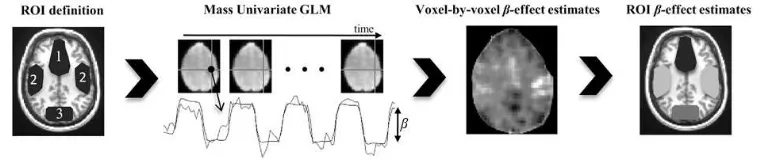
Figure 2.2: Typical steps of ROI analysis producing the multivariate outcome used in our real example in section 2.3.2. The preprocessed series of fMRI images are modelled at voxel-by-voxel resolution using mass univariate General Linear Models (GLMs). Suitable estimates of parameter values (β) expressing the treatment effect in each voxel are first extracted from the GLM and then averaged across the pre-defined ROI to produce a multivariate outcome where each component corresponds to a measure of the treatment effect in a specific ROI.
2.3.2 Example: fMRI drug development study
For the purposes of drug development, a fMRI study was conducted by
Glaxo-SmithKline plc. A total of 13 subjects participated in the study. At the planning
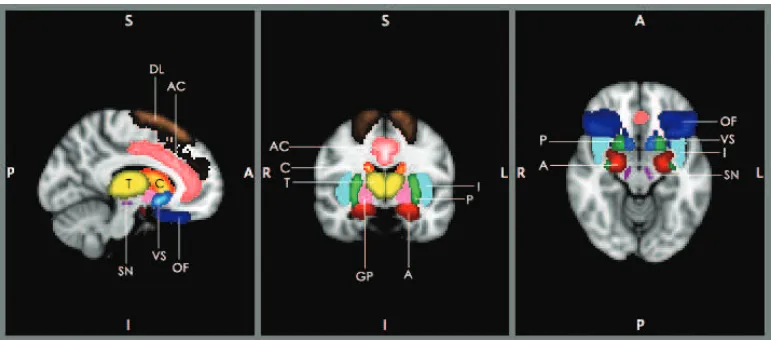
stage, the following anatomical ROI (see figure 2.3) were defined: 1. Anterior
Cin-gulate (AC), 2. Atlas Amygdala (A), 3. Caudate (C), 4. Dorsolateral Prefrontal
Cortex (DL), 5. Globus Pallidus (GP), 6. Insula (I), 7. Orbitofrontal cortex (OF),
8. Putamen (P), 9. Substantia Nigra (SN), 10. Thalamus (T), 11. Ventral Striatum
(VS).
ROI summary data was extracted from the mass-univariate GLM applied to
aver-aged across the voxels of each ROI for each subject. The available data represents
the difference between paired treatment-placebo observations across ROI for each
[image:37.595.128.515.176.346.2]subject.
Figure 2.3: Approximate locations of ROI used in the fMRI study example. Each of the following ROI are indicated by a different colour and abbreviation: Anterior Cin-gulate (AC-pink), Atlas Amygdala (A-red), Caudate (C-red/yellow), Dorsolateral Prefrontal Cortex (DL-copper), Globus Pallidus (GP-magenta), Insula (I-purple), Orbitofrontal cortex (OF-blue), Putamen (P-green), Substantia Nigra (SN-cyan), Thalamus (T-yellow), Ventral Striatum (VS-blue/lightblue)
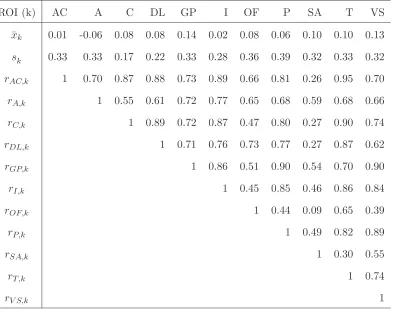
The means, standard deviations and correlations matrix of this ROI dataset
are presented in table 2.2. As we can see, effect sizes differ across ROI, the standard
deviations are relatively large and generally high correlations are observed.
Using this data, the investigators wished to address a fundamental question
arising in neuroimaging studies. This concerns the existence of global treatment
effects across ROI. The term global is used here to stress the difference to being
interested in local effects, as in effects at specific ROI. The null hypothesis to be
evaluated is then whether the treatment-placebo differences provide no statistically
significant evidence for treatment effects across the selected ROI. To answer this
global question, within this setting but also more generally, we employ various
test-ing procedures introduced in the next chapters. We now turn our interest to another
Table 2.2: Means, standard deviations and correlations of ROI data (nT = 13) of
the fMRI study.
ROI (k) AC A C DL GP I OF P SA T VS
¯
xk 0.01 -0.06 0.08 0.08 0.14 0.02 0.08 0.06 0.10 0.10 0.13
sk 0.33 0.33 0.17 0.22 0.33 0.28 0.36 0.39 0.32 0.33 0.32
rAC,k 1 0.70 0.87 0.88 0.73 0.89 0.66 0.81 0.26 0.95 0.70
rA,k 1 0.55 0.61 0.72 0.77 0.65 0.68 0.59 0.68 0.66
rC,k 1 0.89 0.72 0.87 0.47 0.80 0.27 0.90 0.74
rDL,k 1 0.71 0.76 0.73 0.77 0.27 0.87 0.62
rGP,k 1 0.86 0.51 0.90 0.54 0.70 0.90
rI,k 1 0.45 0.85 0.46 0.86 0.84
rOF,k 1 0.44 0.09 0.65 0.39
rP,k 1 0.49 0.82 0.89
rSA,k 1 0.30 0.55
rT,k 1 0.74
rV S,k 1
2.4
EEG
EEG records the electrical activity of the brain. Specifically, EEG captures the
summed electrical potential generated by synchronously activated neurons (tens
of thousands). This activity is captured by electrodes typically placed at various
locations of the scalp. EEG has unrivalled temporal resolution (around 1-10
mil-liseconds) with recordings regarded as “real-time” measures. On the other hand,
spatial resolution has fundamental physical limits with up to a number of sites,
often called channels, sampled in routine studies. For clinical studies, typically 19
used [Gevins, 2002].
The high temporal resolution, the relatively low cost compared to other
neu-roimaging techniques, as well as the non-invasive, safe, portable equipment are the
main advantages of EEG. During the last decade, neuroscientists have shown great
interest in combining EEG with fMRI to achieve high spatial and temporal
resolu-tion [Mulert and Lemieux, 2010]. There is also interest in the so-called event-related
potentials (ERPs) which employ EEG to record brain response to specific stimuli
[Handy, 2005]. EEG has made great contribution in studying the effects and
phar-macology of various CNS-related disorders (see [Bauer and Bauer, 2005]),
particu-larly epilepsy [Thompson and Ebersole, 1999] and depression [Steiger and Kimura,
[image:39.595.252.391.368.526.2]2010]. An example of the latter application is described in section 2.4.2.
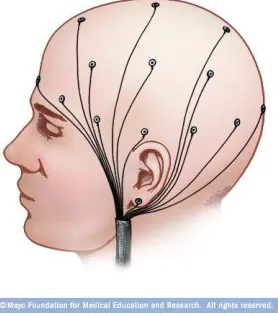
Figure 2.4: Schematic representation of the EEG electrodes placed on the scalp. Image source: www.riversideonline.com
2.4.1 EEG data analysis
EEG raw data of a single subject consists of multiple time-series recorded at a
num-ber of different location or channels. They are typically preprocessed by applying
high- and low-pass filters to eliminate experimental artifacts and possibly signals of
no interest for the study. Baseline correction is also applied by subtracting a “mean
artifacts such as sweating and muscle tension [Hauk, 2013; Sanei and Chambers,
2007].
EEG data can be analyzed as observed in the time-domain, but they are
of-ten transformed to the frequency-domain to perform data analysis. Frequency data
analysis is particularly important in EEG. The rhythms that characterize normal
and abnormal brain activity in EEG are categorized in four major frequency ranges.
These are (from low to high frequency): delta (0.5−4 Hertz), theta (4−8 Hertz),
alpha (8−13 Hertz) and beta (13−30 Hertz). In terms of cognition states, delta is
associated with deep sleep and theta with creative inspiration and deep meditation.
Alpha frequency is associated with relaxed awareness and beta is observed during
active thinking, focus and creation. Abnormal EEG signal in alpha and beta
fre-quency ranges is associated with various CNS related disorders (for example epilepsy
[Sanei and Chambers, 2007]).
The Discrete Fourier Transformation (DFT) is typically used to transform
the time-series of each channel to the frequency domain. Formally, the DFT is
defined as
y(f) =
N
X
t=1
x(t) exp−i2πf t,
where x(t) the response at time t and y(f) the amplitude of the spectrum at
fre-quency f. The square of the amplitude, (y(f))2, named the power spectrum, or
more commonly its logarithm, log y(f)2
, is then used in data analysis [Rao, 2010].
In practice, EEG data is typically segmented into short time intervals before
ap-plying the DFT. These epochs are defined by the clinicians, by taking into account
the experimental design, to ensure that they have similar characteristics. To avoid
discontinuities at the epoch edges, overlapping between them and suitable window
functions (such as the Hanning or Gaussian window) are often used. DFT is then
applied to the time-series of each epoch (after windowing and overlapping) to derive
data, the power spectra are typically averaged across these epochs to derive a
sum-mary aggregate power spectrum (stationarity assumptions are made here) for each
subject. This average power spectrum function, or the average power spectrum at
specific frequencies, are then often used for data analysis [Kropotov, 2009; Sanei
and Chambers, 2007]. Gaussianity is the typical assumption for the logarithms and
other transformations of the average power spectra [Collura et al., 2009; Lopes da
Silva, 2005; Sanei and Chambers, 2007].
2.4.2 Example: EEG depression study
L¨auter et al. [1996] published frequency data from an EEG study. As they describe,
the data is collected fromn= 19 depressive patients at the beginning and at the end
of a six week therapy. The published data represent the changes on the absolute2
theta power of channels 3,4,5,6,7,8,17,19 (K = 9 locations, see figure 2.5) during
[image:41.595.259.373.423.549.2]the therapy of each patient.
Figure 2.5: Schematic presentation of the position of the channels used in the EEG depression study
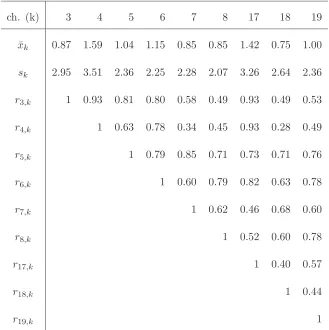
In table 2.3 we present the means, standard deviations and correlation matrix
of the data. Note that the correlations especially of nearby locations are high.
Furthermore, an increase in theta power is indicated in all channels, but the standard
deviations are generally high.
2The term absolute is used in EEG data analysis to distinguish from the relative power where,
Similarly to the fMRI study in section 2.3.2, the investigators were
primar-ily interested in the global treatment effects. That is, they wished to investigate
whether the differences in the absolute theta power suggest a statistically
signifi-cant treatment effect across the selected channels. This question can be expressed
[image:42.595.156.485.258.588.2]in terms of a global hypothesis.
Table 2.3: Means, standard deviations and correlations for the EEG depression study presented in L¨auter et al. [1996].
ch. (k) 3 4 5 6 7 8 17 18 19
¯
xk 0.87 1.59 1.04 1.15 0.85 0.85 1.42 0.75 1.00
sk 2.95 3.51 2.36 2.25 2.28 2.07 3.26 2.64 2.36
r3,k 1 0.93 0.81 0.80 0.58 0.49 0.93 0.49 0.53
r4,k 1 0.63 0.78 0.34 0.45 0.93 0.28 0.49
r5,k 1 0.79 0.85 0.71 0.73 0.71 0.76
r6,k 1 0.60 0.79 0.82 0.63 0.78
r7,k 1 0.62 0.46 0.68 0.60
r8,k 1 0.52 0.60 0.78
r17,k 1 0.40 0.57
r18,k 1 0.44
r19,k 1
2.5
Conclusions
Neuroimaging is a very important and exciting field of neuroscience. Neuroimaging
studies can provide great insight into the normal and abnormal brain anatomy and
clinical trials setting, a number of challenges remain outstanding and some of them
regard statistical methodology.
Some of these challenges are illustrated by the real examples of the fMRI and
EEG study. These studies share common properties which are typical in
neuroimag-ing studies. Firstly, high correlations are observed especially but not exclusively
be-tween nearby locations. Secondly, the observed effects are dispersed across different
locations, in the sense that they are locally small but, as we show in section 3.3.1,
globally large. This suggests combining the local outcomes, rather than treating
them separately, to detect global effects. In addition, due to the high cost of these
studies, the sample size is small and even after the reduction in data dimensionality
(for example using ROI or frequency analysis) remains close to the observations’
dimension. Furthermore, for these studies but also more generally in neuroimaging,
there are opportunities to elicit prior information from earlier results. In section
8.4 we provide some examples of such prior information which may arise from the
spatial characterization of the signal and from the nature of the study. Lastly, as
our examples illustrate, effects are often expressed in different directions between
brain locations with hyperactivation simultaneously occurring with deactivation.
These properties of neuroimaging studies are taken into consideration in the
methods introduced in later chapters. The deficiencies of existing global tests in
Chapter 3
Global testing
3.1
Introduction
As we discussed in the previous chapter, in neuroimaging studies the neural
ac-tivity is simultaneously investigated at multiple brain locations. More generally,
in biomedical studies but also in experiments performed in many other fields (for
example industry, ecology and psychology), investigators are often interested in a
number of outcomes and only rarely focus on a single measure. This situation often
becomes necessary due to the nature of the research questions. For example, in order
to evaluate the treatment effect on patients, multiple symptoms and relevant body
functions need to be monitored and hence multiple outcomes need to be evaluated
[D’Agostino and Russell, 2005; Dmitrienko et al., 2010].
In this chapter, we consider methods that can be used to evaluate
treat-ment effects in settings where multiple outcomes are studied. Specifically, we are
interested in testing procedures which can be used to evaluate global effects
ob-served across these outcomes. That is, as opposed to focusing on local effects on
specific outcomes, we consider methodology which evaluates multiple outcomes
si-multaneously to provide an omnibus assessment of the effects over all the outcomes.
observed outcomes suggest a significant treatment effect. [D’Agostino and Russell,
2005; O’Brien, 1984; Pocock, 1997; Sankoh et al., 1997]. This methodology can be
used to evaluate the question posed by the examples of neuroimaging studies, as
seen in sections 2.3.2 and 2.4.2, regarding global treatment effects across multiple
brain locations.
In the following, we consider various testing procedures, focusing mainly on
the essence of their methodology and discussing when they are appropriate. We
discussp−value adjustment methods and multivariate tests, including “fully”
mul-tivariate tests and the class of linear combination tests which is the main
method-ological focus in this thesis. We begin with a general formulation of the global
testing problem.
Formulation
The K−dimensional observation vectors, xi = (xi1, xi2, . . . , xiK)T, of subjects i =
1,2, . . . , n, are assumed to be independent with common mean vector E(x) =
µ = (µ1, . . . , µK)T and covariance matrix (the symmetric positive definite) Σ =
(σkk′)Kk,k′=1. The mean vector µ is often interpreted as the effect of interest or the
treatment effect. We wish to test the global null hypothesis of no treatment effect
against the two-sided alternative. That is,
H0 :µ=0K = (0,0, . . . ,0)T versus H1 :µ6=0K. (3.1)
In global testing, and more generally in statistical hypothesis testing, we are
inter-ested in controlling or minimising the potential incorrect decisions, called errors, of
the test. Specifically, we focus on controlling the type I error rate as in ensuring
that
and minimising the type II error rate
1−β =P r( not reject H0 |µ=µ1), (µ1 6=0K) (3.3)
or, equivalently, maximising the power of the test
β=P r( reject H0|µ=µ1). (3.4)
If the type I error is equal to the significance level α, that is, the equality in (3.2)
is satisfied, we say that the test controls/maintains the type I error exactly or,
simply, the test is exact. The target of maximising power is sometimes replaced by
minimising the sample size of the test (or other design parameters) while controlling
power at a fixed level. We stress that in this thesis power is denoted by the letter β
rather than the (more common) expression 1−β, to simplify notation.
Note that the testing procedures which follow equally apply to the
two-sample setting with common covariance matrix. This can be formulated in terms
of two independent samples, xAi, xBi, i = 1,2, . . . , n from groups A and B, with
E(xAi) = µA, E(xBi) = µB, var(xAi) = var(xBi) = Σ which are used to test
the null hypothesis H0 : µA−µB = 0K against the two-sided alternative H0 :
µA−µB6=0K. Furthermore, the setting of paired multivariate observations (as in
observations before and after a treatment), where the multivariate outcomes are set
equal todi =xAi−xBi,i= 1,2, . . . , n, can also be accommodated by the methods
which follow. Finally, with a few trivial changes in the procedures to follow, the
situation where the hypotheses of interest are H′
0 :µ=µ0 and H1′ :µ6=µ0, with
µ0 6= 0K can also be accommodated. However, to simplify notation we continue
3.2
P
−
value adjustment methods
The above global hypotheses can be evaluated usingp−value adjustment methods,
such as the Bonferroni test. In the well-known Bonferroni correction test, the local
outcomes, x1, x2, . . . , xK, are used to construct the statistics t1, t2, . . . , tK, with
correspondingp−valuesp1, p2, . . . , pK, to test the local null hypotheses
H0k : µk= 0, k= 1,2, . . . , K.
The Bonferroni test rejects the k−th local null hypothesis H0k if and only if pk ≤
α/K. Note that the global null hypothesis H0 in (3.1) can be written as the
inter-section of the local null hypotheses, formally
H0 =
K
\
k=1
H0k, (3.5)
and thus rejection of a local null hypothesis implies rejection of the global null
hypothesis.
Thus, by ordering thep−values as p(1)≤p(2)≤ · · · ≤p(K), we can write the
global Bonferroni test as
reject H0 iff p(1) ≤α/K. (3.6)
Due to the first-order Bonferroni inequality (Boole’s inequality) this procedure
con-trols the type I error at the nominalα level [D’Agostino and Russell, 2005].
The global Bonferroni test is easy and convenient to apply and it does not
require any distributional assumption to control the type I error. It can even be
used if the observations of each dimension are measured at a different scale. On
the other hand, the Bonferroni method relies entirely on the smallest p−value and
nominalα level) and inefficient (that is, power at unexpectedly low levels). This is
the case when, as in our motivating example, high correlations exist between the
local outcomes. The problem becomes worse as the dimension,K, of the observation
vectors increases. Pocock et al. [1987] and Dmitrienko et al. [2010] found, through
simulation studies, that for large positive correlations, especially when these are
higher than 0.5, the type I error rate of the Bonferroni method is substantially
lower than the nominal level. The results in Dmitrienko et al. [2010] show that the
conservatism is considerably larger if the observation dimension is increased even
from K = 2 to K = 5. We next consider the application of the global Bonferroni
test to the examples in sections 2.3.2 and 2.4.2.
Example: Global Bonferroni test for fMRI and EEG study data
We compute the values of the t test statistics and the corresponding two-sided
p−values (12 degrees of freedom) at each of the 11 ROI.
Table 3.1: The local t− and p−values for the observations collected at each ROI used in the fMRI study.
ROI AC A C DL GP I OFC P SA T VS
tk 0.03 -0.72 1.80 1.28 1.55 0.21 0.76 0.59 1.14 1.10 1.46
pk 0.98 0.48 0.10 0.23 0.15 0.84 0.46 0.57 0.28 0.29 0.17
The smallest p−value p(1) = p3 = 0.10 is clearly larger than α/K ≈ 0.0045 for
α= 0.05,K = 11 and thus the Bonferroni method fails to reject H0.
Similarly, in the next table, we present the t− and p−values of the theta
Table 3.2: The localt−and p−values for the observations collected at each channel used in the EEG depression study.
ch. 3 4 5 6 7 8 17 18 19
tk 1.29 1.97 1.92 2.22 1.63 1.80 1.90 1.24 1.84
pk 0.22 0.06 0.07 0.04 0.12 0.09 0.07 0.23 0.08
The smallestp−value is p(1) =p4 = 0.04> α/K ∼= 0.0055 forα = 0.05,K = 9 and
thus the Bonferroni method fails to rejectH0.
A number of modifications of the Bonferroni method exist in the literature.
Simes [1986] global test rejects H0 if and only if p(k) ≤ kα/K, for at least one k,
k= 1,2, . . . , K. This test does not rely heavily on the smallestp−value and it is less
conservative and more efficient than the Bonferroni method. Further, despite the
slight increase in computation, it is still very easy and convenient to apply. However,
Simes’ global test does not always control the type I error. Simes [1986] analytically
proved that his test controls type I error for independent outcomes, while, through
simulations, he showed that the type I error is also controlled for specific correlation
structures under various distributions including the multivariate normal. Hommel
[1988] also proposed two p−value adjustment methods, which control the type I
error and are less conservative than Bonferroni method but more conservative than
Simes global test [D’Agostino and Russell, 2005].
The above methods completely ignore correlations and thus they all become
conservative when correlations are high. Some p−value adjustment methods
ac-counting for correlations exist in the literature (for example James [1991], random
field theory [Friston et al., 2007] and non-parametric [Westfall and Young, 1993]
methods), but these tend to require complex calculations and they often rely on
![Table 2.1: Properties of various neuroimaging modalities. Source: Lystad and Pol-lard [2009]](https://thumb-us.123doks.com/thumbv2/123dok_us/9609142.463862/32.595.126.536.201.423/table-properties-various-neuroimaging-modalities-source-lystad-pol.webp)