1471
Predicting Annotation Difficulty to Improve Task Routing and Model
Performance for Biomedical Information Extraction
Yinfei Yang
Google AI
Oshin Agarwal
University of Pennsylvania [email protected]
Chris Tar
Google AI [email protected]
Byron C. Wallace
Northeastern University
Ani Nenkova
University of Pennsylvania [email protected]
Abstract
Modern NLP systems require high-quality an-notated data. In specialized domains, expert annotations may be prohibitively expensive. An alternative is to rely on crowdsourcing to reduce costs at the risk of introducing noise. In this paper we demonstrate that directly model-ing instance difficulty can be used to improve model performance, and to route instances to appropriate annotators. Our difficulty predic-tion model combines two learned representa-tions: a ‘universal’ encoder trained on out-of-domain data, and a task-specific encoder. Ex-periments on a complex biomedical informa-tion extracinforma-tion task using expert and lay anno-tators show that: (i) simply excluding from the training data instances predicted to be difficult yields a small boost in performance; (ii) us-ing difficulty scores to weight instances durus-ing training provides further, consistent gains; (iii) assigning instances predicted to be difficult to domain experts is an effective strategy for task routing. Our experiments confirm the expec-tation that for specialized tasks expert annota-tions are higher quality than crowd labels, and hence preferable to obtain if practical. More-over, augmenting small amounts of expert data with a larger set of lay annotations leads to fur-ther improvements in model performance.
1 Introduction
Assembling training corpora of annotated natural language examples in specialized domains such as biomedicine poses considerable challenges. Ex-perts with the requisite domain knowledge to per-form high-quality annotation tend to be expen-sive, while lay annotators may not have the nec-essary knowledge to provide high-quality annota-tions. A practical approach for collecting a
suf-ficiently large corpus would be to use crowd-sourcing platforms like Amazon Mechanical Turk (MTurk). However, crowd workers in general are likely to provide noisy annotations (Abad and Moschitti,2016;Plank et al.,2014;Alonso et al., 2015), an issue exacerbated by the technical na-ture of specialized content. Some of this noise may reflect worker quality and can be modeled (Abad and Moschitti,2016;Plank et al.,2014;Cohn and Specia,2013;Nguyen et al.,2017), but for some instances lay people may simply lack the domain knowledge to provide useful annotation.
In this paper we report experiments on the EBM-NLP corpus comprising crowdsourced an-notations of medical literature (Nye et al.,2018). We operationalize the concept of annotation dif-ficulty and show how it can be exploited during training to improve information extraction mod-els. We then obtain expert annotations for the ab-stracts predicted to be most difficult, as well as for a similar number of randomly selected abstracts. The annotation of highly specialized data and the use of lay and expert annotators allow us to exam-ine the following key questions related to lay and expert annotations in specialized domains:
Can we predict item difficulty? We define a
training instance as difficult if a lay annotator or an automated model disagree on its labeling. We show that difficulty can be predicted, and that it is distinct from inter-annotator agreement. Further, such predictions can be used during training to im-prove information extraction models.
annota-tions in the new data that we collected. More gen-erally, we expect lay annotations to be lower qual-ity, which may translate to lower precision, recall, or both, compared to expert annotations.
Can one rely solely on lay annotations? Rea-sonable models can be trained using lay anno-tations alone, but similar performance can be achieved using markedly less expert data. This suggests that the optimal ratio of expert to crowd annotations for specialized tasks will depend on the cost and availability of domain experts. Expert annotations are preferable whenever its collection is practical. But in real-world settings, a combi-nation of expert and lay annotations is better than using lay data alone.
Does it matter what data is annotated by ex-perts? We demonstrate that a system trained on combined data achieves better predictive perfor-mance when experts annotate difficult examples rather than instances selected at i.i.d. random.
Our contributions in this work are summarized as follows. We define a task difficulty prediction task and show how this is related to, but distinct from, inter-worker agreement. We introduce a new model for difficulty prediction combining learned representations induced via a pre-trained ‘univer-sal’ sentence encoder (Cer et al.,2018), and a sen-tence encoder learned from scratch for this task. We show that predicting annotation difficulty can be used to improve the task routing and model per-formance for a biomedical information extraction task. Our results open up a new direction for en-suring corpus quality. We believe that item diffi-culty prediction will likely be useful in other, non-specialized tasks as well, and that the most ef-fective data collection in specialized domains re-quires research addressing the fundamental ques-tions we examine here.
2 Related Work
Crowdsourcing annotation is now a well-studied problem (Snow et al.,2008;Abad and Moschitti, 2016;Plank et al.,2014;Alonso et al.,2015). Due to the noise inherent in such annotations, there have also been considerable efforts to develop ag-gregation models that minimize noise (Abad and Moschitti,2016;Plank et al.,2014;Cohn and Spe-cia,2013;Nguyen et al.,2017).
There are also several surveys of crowdsourcing in biomedicine specifically (Good and Su, 2013; Khare et al.,2015;Lee et al.,2017). Some work
in this space has contrasted model performance achieved using expert vs. crowd annotated training data (Zhai et al.,2013;Cocos et al.,2017; Dumi-trache et al.,2018). Dumitracheet al.(2018) con-cluded that performance is similar under these su-pervision types, finding no clear advantage from using expert annotators. This differs from our find-ings, perhaps owing to differences in design. The experts we used already hold advanced medical degrees, for instance, while those in prior work were medical students. Furthermore, the task con-sidered here would appear to be of greater diffi-culty: even a system trained on∼5k instances per-forms reasonably, but far from perfect. By con-trast, in some of the prior work where experts and crowd annotations were deemed equivalent, a clas-sifier trained on 300 examples can achieve very high accuracy (Cocos et al.,2017).
More relevant to this paper, prior work has in-vestigated methods for ‘task routing’ in active learning scenarios in which supervision is pro-vided by heterogeneous labelers with varying lev-els of expertise (Yan et al.,2011;Donmez and Car-bonell,2008;Nguyen et al.,2015;Wallace et al., 2011; Yan et al., 2011). The related question of whether effort is better spent collecting additional annotations for already labeled (but potentially noisily so) examples or novel instances has also been addressed (Sheng et al.,2008). What distin-guishes the work here is our focus on providing an operational definition of instancedifficulty, show-ing that this can be predicted, and then usshow-ing this to inform task routing.
3 Application Domain
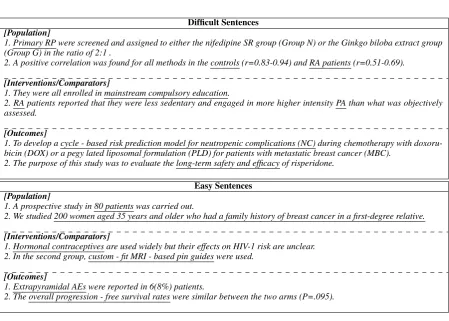
Difficult Sentences
[Population]
1. Primary RP were screened and assigned to either the nifedipine SR group (Group N) or the Ginkgo biloba extract group (Group G) in the ratio of 2:1 .
2. A positive correlation was found for all methods in the controls (r=0.83-0.94) and RA patients (r=0.51-0.69).
[Interventions/Comparators]
1. They were all enrolled in mainstream compulsory education.
2. RA patients reported that they were less sedentary and engaged in more higher intensity PA than what was objectively assessed.
[Outcomes]
1. To develop a cycle - based risk prediction model for neutropenic complications (NC) during chemotherapy with doxoru-bicin (DOX) or a pegy lated liposomal formulation (PLD) for patients with metastatic breast cancer (MBC).
2. The purpose of this study was to evaluate the long-term safety and efficacy of risperidone.
Easy Sentences
[Population]
1. A prospective study in 80 patients was carried out.
2. We studied 200 women aged 35 years and older who had a family history of breast cancer in a first-degree relative.
[Interventions/Comparators]
1. Hormonal contraceptives are used widely but their effects on HIV-1 risk are unclear. 2. In the second group, custom - fit MRI - based pin guides were used.
[Outcomes]
1. Extrapyramidal AEs were reported in 6(8%) patients.
2. The overall progression - free survival rates were similar between the two arms (P=.095).
Table 1: Example sentences are difficult or easy to annotate for crowd workers. The underlined text are reference annotations from domain experts.
Table1shows an example of difficult and easy examples according to our definition of difficulty. The underlined text demarcates the (consensus) reference label provided by domain experts. In the difficult examples, crowd workers marked text dis-tinct from these reference annotations; whereas in the easy cases they reproduced them with reason-able fidelity. The difficult sentences usually exhibit complicated structure and feature jargon.
An abstract may contain some ‘easy’ and some ‘difficult’ sentences. We thus perform our analysis at the sentence level. We split abstracts into sen-tences using spaCy.1 We excluded sentences that comprise fewer than two tokens, as these are likely an artifact of errors in sentence splitting. In total, this resulted in 57,505 and 2,428 sentences in the train and test set abstracts, respectively.
4 Quantifying Task Difficulty
The test set includes annotations from both crowd workers and domain experts. We treat the latter as ground truth and then define the difficulty of sen-tences in terms of the observed agreement between expert and lay annotators. Formally, for annotation
1https://spacy.io/
tasktand instancei:
Difficultyti= Pn
j=1f(labelij, yi)
n (1)
where f is a scoring function that measures the quality of the label from workerj for sentencei, as compared to a ground truth annotation,yi. The
diffi-0 1 2 3
4 Probability Density of Difficulty Scores
Participants Mean: 0.500; Std: 0.296
0 1 2 3 4
Intervention Mean: 0.562; Std: 0.279
0.0 0.2 0.4 0.6 0.8 1.0
Scores
0 1 2 3 4
[image:4.595.328.503.62.106.2]Outcome Mean: 0.576; Std: 0.279
Figure 1: Distributions of difficulty scores over all sen-tences that contain any span annotations
culty score of sentences as described above; we normalize these to the [0,1] interval. We validate this approximation by comparing the proxy scores against reference scores over the test set, the Pear-son’s correlation coefficients are 0.57 for Popula-tion, 0.71 for Intervention and 0.68 for Outcome.
There exist many sentences that contain nei-ther manual nor predicted annotations. We treat these as maximally easy sentences (with difficulty scores of 0). Such sentences comprise 51%, 42% and 36% for Population, Interventions and Out-comes data respectively, indicating that it is eas-ier to identify sentences that have no Population spans, but harder to identify sentences that have no Interventions or Outcomes spans. This is intuitive as descriptions of the latter two tend to be more technical and dense with medical jargon.
We show the distribution of the automatically labeled scores for sentences that do contain spans in Figure1. The mean of the Population (P) sen-tence scores is significantly lower than that for other types of sentences (I and O), again indicat-ing that they are easier on average to annotate. This aligns with a previous finding that annotat-ing Interventions and Outcomes is more difficult than annotating Participants (Nye et al.,2018).
Many sentences contain spans tagged by the LSTM-CRF-Pattern model, but missed by all crowd workers, resulting in a maximally difficult score (1). Inspection of such sentences revealed that some are truly difficult examples, but others are tagging model errors. In either case, such sen-tences have confused workers and/or the model, and so we retain them all as ‘difficult’ sentences.
Content describing theP, IandO, respectively, is quite different. As such, one sentence usually contains (at most) only one of these three content types. We thus treat difficulty prediction for the
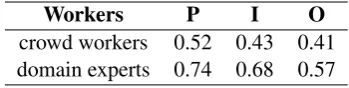
re-Workers P I O
[image:4.595.81.284.63.202.2]crowd workers 0.52 0.43 0.41 domain experts 0.74 0.68 0.57
Table 2: Average inter-worker agreement.
spective label types as separate tasks.
5 Difficulty is not Worker Agreement
Our definition of difficulty is derived from agree-ment between expert and crowd annotations for the test data, and agreement between a predictive model and crowd annotations in the training data. It is reasonable to ask if these measures are re-lated to inter-annotator agreement, a metric often used in language technology research to identify ambiguous or difficult items. Here we explicitly verify that our definition of difficulty only weakly correlates with inter-annotator agreement.
We calculate inter-worker agreement between crowd and expert annotators using Spearman’s correlation coefficient. As shown in Table 2, av-erage agreement between domain experts are con-siderably higher than agreements between crowd workers for all three label types. This is a clear in-dication that the crowd annotations are noisier.
Furthermore, we compare the correlation be-tween inter-annotator agreement and difficulty scores in the training data. Given that the major-ity of sentences do not contain a PICO span, we only include in these calculations those that con-tain a reference label. Pearson’s r are 0.34, 0.30 and 0.31 for P, I and O, respectively, confirming that inter-worker agreement and our proposed dif-ficulty score are quite distinct.
6 Predicting Annotation Difficulty
We treat difficulty prediction as a regression prob-lem, and propose and evaluate neural model vari-ants for the task. We first train RNN (Chung et al., 2014) and CNN (Kim,2014) models.
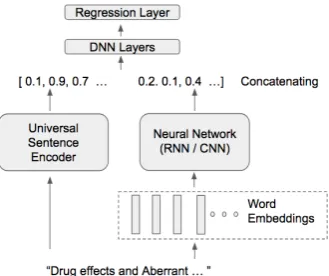
de-Figure 2: Model architecture.
picts the model architecture. Sentences are fed into both the universal sentence encoder and, sepa-rately, a task specific neural encoder, yielding two representations. We concatenate these and pass the combined vector to the regression layer.
6.1 Experimental Setup and Results
We trained models for each label type separately. Word embeddings were initialized to 300d GloVe vectors (Pennington et al.,2014) trained on com-mon crawl data;2these are fine-tuned during train-ing. We used the Adam optimizer (Kingma and Ba,2014) with learning rate and decay set to 0.001 and 0.99, respectively. We used batch sizes of 16.
We used the large version of the universal sen-tence encoder3with a transformer (Vaswani et al., 2017). We did not update the pretrained sentence encoder parameters during training. All hyper-paramaters for all models (including hidden lay-ers, hidden sizes, and dropout) were tuned using Vizier (Golovin et al.,2017) via 10-fold cross val-idation on the training set maximizing for F1.4
As a baseline, we also trained a linear Support-Vector Regression (Fan et al.,2008) model on n-gram features (nranges from 1 to 3).5
Table3reports Pearson correlation coefficients between the predictions with each of the neu-ral models and the ground truth difficulty scores. Rows 1-4 correspond to individual models, and row 5 reports the ensemble performance. Columns correspond to label type. Results from all mod-els outperform the baseline SVR model: Pearson’s
2http://nlp.stanford.edu/data/glove.
840B.300d.zip
3
https://tfhub.dev/google/
universal-sentence-encoder-large/3
4
This performs random search over the number of hidden layers (1-5), hidden sizes (128-1024), and dropout (0.1- 0.5).
5We perform gridsearch over the hyperparameterC.
P I O
NGRAM+SVR 0.455 0.311 0.541
RNN 0.521 0.555 0.601
CNN 0.470 0.522 0.550
USE 0.492 0.518 0.580
[image:5.595.319.513.61.146.2]USE+RNN 0.550 0.604 0.622
Table 3: Pearson correlation coefficients of sentence difficulty predictions.
correlation coefficients range from 0.550 to 0.622. The regression correlations are the lowest.
The RNN model realizes the strongest per-formance among the stand-alone (non-ensemble) models, outperforming variants that exploit CNN and USE representations. Combining the RNN and USE further improves results. We hypothesize that this is due to complementary sentence infor-mation encoded in universal representations.
For all models, correlations for Intervention and Outcomes are higher than for Population, which is expected given the difficulty distributions in Fig-ure1. In these, the sentences are more uniformly distributed, with a fair number of difficult and eas-ier sentences. By contrast, in Population there are a greater number of easy sentences and consid-erably fewer difficult sentences, which makes the difficulty ranking task particularly challenging.
7 Better IE with Difficulty Prediction
We next present experiments in which we attempt to use the predicted difficulty during training to improve models for information extraction of de-scriptions of Population, Interventions and Out-comes from medical article abstracts. We investi-gate two uses: (1) simply removing the most dif-ficult sentences from the training set, and, (2) re-weighting the most difficult sentences.
We again use LSTM-CRF-Pattern as the base model and experimenting on the EBM-NLP cor-pus (Nye et al.,2018). This is trained on either (1) the training set with difficult sentences removed, or (2) the full training set but with instances re-weighted in proportion to their predicted difficulty score. Following (Nye et al., 2018), we use the Adam optimizer with learning rate of 0.001, de-cay 0.9, batch size 20 and dropout 0.5. We use pretrained 200d GloVe vectors (Pennington et al., 2014)6 to initialize word embeddings, and use
6http://nlp.stanford.edu/data/glove.
[image:5.595.99.264.63.201.2]Model Precision Recall F1
P I O P I O P I O
Base model 81.54 81.99 78.01 64.22 54.19 54.84 71.85 65.25 64.40
[image:6.595.77.522.62.131.2]Re-weight by agreement 78.63 82.24 82.19 66.47 54.45 55.22 72.04 65.53 66.06 Re-weight by difficulty 79.57 74.69 73.92 70.31 63.71 64.96 74.65 68.76 69.15
Table 4: Medical IE performance by re-weighting sentences according to predicted agreement or difficulty scores.
100d hidden char representations. Each word is thus represented with 300 dimensions in total. The hidden size is 100 for the LSTM in the character representation component, and 200 for the LSTM in the information extraction component. We train for 15 epochs, saving parameters that achieve the best F1 score on a nested development set.
7.1 Removing Difficult Examples
We first evaluate changes in performance induced by training the sequence labeling model using less data by removing difficult sentences prior to traing. The hypothesis here is that these difficult in-stances are likely to introduce more noise than signal. We used a cross-fold approach to predict sentence difficulties, training on 9/10ths of the data and scoring the remaining 1/10th at a time. We then sorted sentences by predicted difficulty scores, and experimented with removing increas-ing numbers of these (in order of difficulty) prior to training the LSTM-CRF-Pattern model.
Figure 3 shows the results achieved by the LSTM-CRF-Pattern model after discarding in-creasing amounts of the training data: the x and y axes correspond to the the percentage of data removed and F1 scores, respectively. We contrast removing sentences predicted to be difficult with removing them (a) randomly (i.i.d.), and, (b) in inverse order of predicted inter-annotator agree-ment. The agreement prediction model is trained exactly the same like difficult prediction model, with simply changing the difficult score to an-notation agreement. F1 scores actually improve (marginally) when we remove the most difficult sentences, up until we drop 4% of the data for Pop-ulation and Interventions, and 6% for Outcomes. Removing training points at i.i.d. random degrades performance, as expected. Removing sentences in order of disagreement seems to have similar effect as removing them by difficulty score when remov-ing small amount of the data, but the F1 scores drop much faster when removing more data. These findings indicate that sentences predicted to be
dif-70.0 70.5 71.0 71.5 72.0 72.5 73.0 73.5 74.0
0 2 4 6 8 10
62.0 62.5 63.0 63.5 64.0 64.5 65.0 65.5
Percent of data dropped
F1 score
Biomedical IE performance (F1)
P Difficulty P Agreement P Random
I Difficulty I Agreement I Random
O Difficulty O Agreement O Random
Figure 3: F1 scores achieved when removing increas-ingly large fractions of the training data.
ficult are indeed noisy, to the extent that they do not seem to provide the model useful signal.
7.2 Re-weighting by Difficulty
We showed above that removing a small number of the most difficult sentences does not harm, and in fact modestly improves, medical IE model per-formance. However, using the available data we are unable to test if this will be useful in practice, as we would need additional data to determine how many difficult sentences should be dropped.
We instead explore an alternative, practical means of exploiting difficulty predictions: we re-weight sentences during training inversely to their predicteddifficulty. Formally, we weight sentence iwith difficulty scores aboveτ according to:1−a·
(di−τ)/(1−τ), wherediis the difficulty score for
sentencei, andais a parameter codifying the min-imum weight value. We setτ to 0.8 so as to only re-weight sentences with difficulty in the top 20th percentile, and we setato 0.5. The re-weighting is equivalent to down-sampling the difficult sen-tences. LSTM-CRF-Pattern is our base model.
[image:6.595.318.506.183.343.2]modestly but consistently. All F1 differences are statistically significant under a sign test (p <
0.01). The model with best precision is differ-ent for Patidiffer-ent, Intervdiffer-ention and Outcome labels. However re-weighting by difficulty does consis-tently yield the best recall for all three extraction types, with the most notable improvement for I and O, where recall improved by 10 percentage points. This performance increase translated to im-provements in F1 across all types, as compared to the base model and to re-weighting by agreement.
8 Involving Expert Annotators
The preceding experiments demonstrate that re-weighting difficult sentences annotated by the crowd generally improves the extraction models. Presumably the performance is influenced by the annotation quality.
We now examine the possibility that the higher quality and more consistent annotations of do-main experts on the difficult instances will bene-fit the extraction model. This simulates an annota-tion strategy in which we route difficult instances to domain experts and easier ones to crowd anno-tators. We also contrast the value of difficult data to that of an i.i.d. random sample of the same size, both annotated by experts.
8.1 Expert annotations of Random and
Difficult Instances
We re-annotate by experts a subset of most dif-ficult instances and the same number of random instances. As collecting annotations from experts is slow and expensive, we only re-annotate the difficult instances for the interventions extraction task. We re-annotate the abstracts which cover the sentences with predicted difficulty scores in the top 5 percentile. We rank the abstracts from the training set by the count of difficult sen-tences, and re-annotate the abstracts that con-tain the most difficult sentences. Constrained by time and budget, we select only 2000 ab-stracts for re-annotation; 1000 of these are top-ranked, and 1000 are randomly sampled. This re-annotation cost $3,000. We have released the new annotation data at: https://github.com/ bepnye/EBM-NLP.
Following (Nye et al.,2018), we recruited five medical experts via Up-work7with advanced med-ical training and strong technmed-ical reading/writing
7https://www.upwork.com
skills. The expert annotator were asked to read the entire abstract and highlight, using the BRAT toolkit (Stenetorp et al., 2012), all spans describ-ing medical Interventions. Each abstract is only annotated by one expert. We examined 30 re-annotated abstracts to ensure the annotation qual-ity before hiring the annotator.
Table 5 presents the results of LSTM-CRF-Pattern model trained on the reannotated difficult subset and the random subset. The first two rows show the results for models trained with expert an-notations. The model trained on random data has a slightly better F1 than that trained on the same amount of difficult data. The model trained on ran-dom data has higher precision but lower recall.
Rows 3 and 4 list the results for models trained on the same data but with crowd annotation. Mod-els trained with expert-annotated data are clearly superior to those trained with crowd labels with respect to F1, indicating that the experts produced higher quality annotations. For crowdsourced an-notations, training the model with data sampled at i.i.d. random achieves 2% higher F1 than when difficult instances are used. When expert annota-tions are used, this difference is less than 1%. This trend in performance may be explained by differ-ences in annotation quality: the randomly sampled set was more consistently annotated by both ex-perts and crowd because the difficult set is harder. However, in both cases expert annotations are bet-ter, with a bigger difference between the expert and crowd models on the difficult set.
The last row is the model trained on all 5k abstracts with crowd annotations. Its F1 score is lower than either expert model trained on only 20% of data, suggesting that expert annotations should be collected whenever possible. Again the crowd model on complete data has higher pre-cision than expert models but its recall is much lower.
8.2 Routing To Experts or Crowd
Precision Recall F1
Difficult-Expert 68.46 65.06 66.72
Random-Expert 70.84 63.46 67.04
Difficult-Crowd 83.68 44.63 58.45
Random-Crowd 78.55 49.23 60.52
[image:8.595.70.296.62.147.2]Base (All-Crowd) 81.99 54.19 65.25
Table 5: Interventions IE model performance trained crowd or expert. The first four models are trained with a subset of 1k abstracts and the base model is trained with all 5k abstracts.
Precision Recall F1
(D)ifficult-Expert 68.46 65.06 66.72
(R)andom-Expert 70.84 63.46 67.04
D+R 68.57 67.54 69.62
D+Other 83.55 60.73 70.33
R+Other 85.10 57.08 68.34
D+R+Other 82.19 61.88 70.60
Table 6: Interventions IE model performance trained by mixing annotations from experts and crowd workers. [D]: Difficult-Expert; [R]: Random-Expert; [Other]: the rest of the abstracts with crowd annotation only.
annotations. The results are presented in Table6. Rows 1 and 2 repeat the performance of the models trained on difficult subset and random sub-set with expert annotations only respectively. The third row is the model trained by combining diffi-cult and random subsets with expert annotations. There are around 250 abstracts in the overlap of these two sets, so there are total 1.75k abstracts used for training the D+R model. Rows 4 to 6 are the models trained on all 5k abstracts with mixed annotations, whereOthermeans the rest of the ab-stracts with crowd annotation only.
The results show adding more training data with crowd annotation still improves at least 1 point F1 score in all three extraction tasks. The improve-ment when the difficult subset with expert tations is mixed with the remaining crowd anno-tation is 3.5 F1 score, much larger than when a random set of expert annotations are added. The model trained with re-annotating the difficult sub-set (D+Other) also outperforms the model with re-annotating the random subset (R+Other) by 2 points in F1. The model trained with re-annotating both of difficult and random subsets (D+R+Other), however, achieves only marginally higher F1 than the model trained with the re-annotated difficult subset (D+Other).
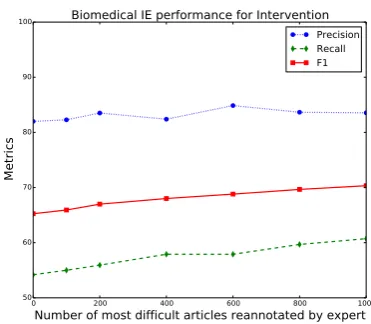
0 200 400 600 800 1000
Number of most difficult articles reannotated by expert
50 60 70 80 90 100
Metrics
Biomedical IE performance for Intervention
Precision Recall F1
Figure 4: Precision/Recall/F1 as a function of the num-ber of articles re-annotated by expert, in decreasing or-der of difficulty.
In sum, the results clearly indicate that mixing expert and crowd annotations leads to better mod-els than using solely crowd data, and better than using expert data alone. More importantly, there is greater gain in performance when instances are routed according to difficulty, as compared to ran-domly selecting the data for expert annotators. These findings align with our motivating hypothe-sis that annotation quality for difficult instances is important for final model performance. They also indicate that mixing annotations from expert and crowd could be an effective way to achieve accept-able model performance given a limited budget.
8.3 How Many Expert Annotations?
We established that crowd annotation are still use-ful in supplementing expert annotations for med-ical IE. Obtaining expert annotations for the one thousand most difficult instances greatly improved the model performance. However the choice of how many difficult instances to annotate was an uninformed choice. Here we check if less ex-pert data would have yielded similar gains. Future work will need to address how best to choose this parameter for a routing system.
[image:8.595.319.505.69.231.2]with higher quality annotation. This observation implies that crowd workers often fail to mark tar-get tokens, but do not tend to produce large num-bers of false positives. We suspect such failures to identify relevant spans/tokens are due to in-sufficient domain knowledge possessed by crowd workers.
The F1 score achieved after re-annotating the 600 most-difficult articles reaches 68.1%, which is close to the performance when re-annotating 1000 random articles. This demonstrates the effective-ness of recognizing difficult instances. The trend when we use up all expert data is still upward, so adding even more expert data is likely to fur-ther improve performance. Unfortunately we ex-hausted our budget and were not able to obtain ad-ditional expert annotations. It is likely that as the size of the expert annotations increases, the value of crowd annotations will diminish. This investi-gation is left for future work.
9 Conclusions
We have introduced the task of predicting annota-tion difficulty for biomedical informaannota-tion extrac-tion (IE). We trained neural models using dif-ferent learned representations to score texts in terms of their difficulty. Results from all models were strong with Pearsons correlation coefficients higher than 0.45 in almost all evaluations, indicat-ing the feasibility of this task. An ensemble model combining universal and task specific feature sen-tence vectors yielded the best results.
Experiments on biomedical IE tasks show that removing up to∼10% of the sentences predicted to be most difficult did not decrease model perfor-mance, and that re-weighting sentences inversely to their difficulty score during training improves predictive performance. Simulations in which dif-ficult examples are routed to experts and other in-stances to crowd annotators yields the best results, outperforming the strategy of randomly select-ing data for expert annotation, and substantially improving upon the approach of relying exclu-sively on crowd annotations. In future work, rout-ing strategies based on instance difficulty could be further investigated for budget-quality trade-off.
Acknowledgements
This work has been partially supported by NSF1748771 grant. Wallace was support in part by NIH/NLM R01LM012086.
References
Azad Abad and Alessandro Moschitti. 2016. Taking the best from the crowd: Learning question passage classification from noisy data. In Proceedings of the Fifth Joint Conference on Lexical and Compu-tational Semantics, *SEM@ACL 2016, Berlin, Ger-many, 11-12 August 2016.
H´ector Mart´ınez Alonso, Anders Johannsen, Oier Lopez de Lacalle, and Eneko Agirre. 2015. Predicting word sense annotation agreement. In
Proceedings of the First Workshop on Linking Computational Models of Lexical, Sentential and
Discourse-level Semantics, LSDSem@EMNLP
2015, Lisbon, Portugal, September 18, 2015, pages 89–94.
Daniel Cer, Yinfei Yang, Sheng-yi Kong, Nan Hua, Nicole Limtiaco, Rhomni St John, Noah Constant, Mario Guajardo-Cespedes, Steve Yuan, Chris Tar, et al. 2018. Universal sentence encoder for english. In Proceedings of the 2018 Conference on Empiri-cal Methods in Natural Language Processing: Sys-tem Demonstrations, pages 169–174.
Junyoung Chung, Caglar Gulcehre, KyungHyun Cho, and Yoshua Bengio. 2014. Empirical evaluation of gated recurrent neural networks on sequence model-ing.arXiv preprint arXiv:1412.3555.
Anne Cocos, Ting Qian, Chris Callison-Burch, and Aaron J. Masino. 2017. Crowd control: Effectively utilizing unscreened crowd workers for biomedical data annotation.Journal of Biomedical Informatics, 69:86–92.
Trevor Cohn and Lucia Specia. 2013. Modelling anno-tator bias with multi-task gaussian processes: An ap-plication to machine translation quality estimation. InProceedings of the 51st Annual Meeting of the As-sociation for Computational Linguistics, ACL 2013, 4-9 August 2013, Sofia, Bulgaria, Volume 1: Long Papers, pages 32–42.
Pinar Donmez and Jaime G Carbonell. 2008. Proactive learning: cost-sensitive active learning with multiple imperfect oracles. InProceedings of the 17th ACM conference on Information and knowledge manage-ment, pages 619–628. ACM.
Anca Dumitrache, Lora Aroyo, and Chris Welty. 2018. Crowdsourcing ground truth for medical relation extraction. ACM Trans. Interact. Intell. Syst., 8(2):11:1–11:20.
Rong-En Fan, Kai-Wei Chang, Cho-Jui Hsieh, Xiang-Rui Wang, and Chih-Jen Lin. 2008. LIBLINEAR: A library for large linear classification. Journal of Machine Learning Research, 9:1871–1874.
Benjamin M Good and Andrew I Su. 2013. Crowd-sourcing for bioinformatics. Bioinformatics, 29(16):1925–1933.
Ritu Khare, Benjamin M Good, Robert Leaman, An-drew I Su, and Zhiyong Lu. 2015. Crowdsourcing in biomedicine: challenges and opportunities. Brief-ings in bioinformatics, 17(1):23–32.
Yoon Kim. 2014. Convolutional neural networks for sentence classification. In Proceedings of the 2014 Conference on Empirical Methods in Natu-ral Language Processing (EMNLP), pages 1746– 1751, Doha, Qatar. Association for Computational Linguistics.
Diederik P Kingma and Jimmy Ba. 2014. Adam: A method for stochastic optimization. arXiv preprint arXiv:1412.6980.
Young Ji Lee, Janet A Arida, and Heidi S Donovan. 2017. The application of crowdsourcing approaches to cancer research: a systematic review. Cancer medicine, 6(11):2595–2605.
An T Nguyen, Byron C Wallace, Junyi Jessy Li, Ani Nenkova, and Matthew Lease. 2017. Aggregating and predicting sequence labels from crowd anno-tations. In Proceedings of the conference. Associ-ation for ComputAssoci-ational Linguistics. Meeting, vol-ume 2017, page 299. NIH Public Access.
An Thanh Nguyen, Byron C Wallace, and Matthew Lease. 2015. Combining crowd and expert labels us-ing decision theoretic active learnus-ing. InThird AAAI conference on human computation and crowdsourc-ing.
Benjamin Nye, Jessy Li, Roma Patel, Yinfei Yang, Iain Marshall, Ani Nenkova, and Byron C. Wal-lace. 2018. A Corpus with Multi-Level Annotations of Patients, Interventions and Outcomes to Support Language Processing for Medical Literature. In
Proceedings of the Conference of the Association for Computational Linguistics (ACL).
Roma Patel, Yinfei Yang, Iain Marshall, Ani Nenkova, and Byron Wallace. 2018. Syntactic patterns im-prove information extraction for medical search. In
Proceedings of the Conference of the North Amer-ican Chapter of the Association for Computational Linguistics (NAACL).
Jeffrey Pennington, Richard Socher, and Christo-pher D. Manning. 2014. Glove: Global vectors for word representation. InEmpirical Methods in Nat-ural Language Processing (EMNLP), pages 1532– 1543.
Barbara Plank, Dirk Hovy, and Anders Søgaard. 2014. Learning part-of-speech taggers with inter-annotator agreement loss. InProceedings of the 14th Confer-ence of the European Chapter of the Association for Computational Linguistics, EACL 2014, April 26-30, 2014, Gothenburg, Sweden, pages 742–751.
Victor S Sheng, Foster Provost, and Panagiotis G Ipeirotis. 2008. Get another label? improving data quality and data mining using multiple, noisy label-ers. InProceedings of the 14th ACM SIGKDD in-ternational conference on Knowledge discovery and data mining, pages 614–622. ACM.
Rion Snow, Brendan O’Connor, Daniel Jurafsky, and Andrew Y Ng. 2008. Cheap and fast—but is it good?: evaluating non-expert annotations for natu-ral language tasks. InProceedings of the conference on empirical methods in natural language process-ing, pages 254–263. Association for Computational Linguistics.
Pontus Stenetorp, Sampo Pyysalo, Goran Topi´c, Tomoko Ohta, Sophia Ananiadou, and Jun’ichi Tsu-jii. 2012. Brat: A web-based tool for nlp-assisted text annotation. InProceedings of the Demonstra-tions at the 13th Conference of the European Chap-ter of the Association for Computational Linguistics, EACL ’12, pages 102–107, Stroudsburg, PA, USA. Association for Computational Linguistics.
Ashish Vaswani, Noam Shazeer, Niki Parmar, Jakob Uszkoreit, Llion Jones, Aidan N Gomez, Ł ukasz Kaiser, and Illia Polosukhin. 2017. Attention is all you need. In Proceedings of NIPS. Curran Asso-ciates, Inc.
Byron C Wallace, Kevin Small, Carla E Brodley, and Thomas A Trikalinos. 2011. Who should label what? instance allocation in multiple expert active learning. InProceedings of the 2011 SIAM Interna-tional Conference on Data Mining, pages 176–187. SIAM.
Yan Yan, Romer Rosales, Glenn Fung, and Jennifer G Dy. 2011. Active learning from crowds. InICML, volume 11, pages 1161–1168.