Proceedings of NAACL-HLT 2019, pages 785–795 785
Improving Event Coreference Resolution by Learning Argument
Compatibility from Unlabeled Data
Yin Jou Huang1, Jing Lu2, Sadao Kurohashi1, Vincent Ng2 1Graduate School of Informatics, Kyoto University
2Human Language Technology Research Institute, University of Texas at Dallas
[email protected], [email protected]
{ljwinnie,vince}@hlt.utdallas.edu
Abstract
Argument compatibility is a linguistic condi-tion that is frequently incorporated into mod-ern event coreference resolution systems. If two event mentions have incompatible argu-ments in any of the argument roles, they can-not be coreferent. On the other hand, if these mentions have compatible arguments, then this may be used as information toward deciding their coreferent status. One of the key chal-lenges in leveraging argument compatibility lies in the paucity of labeled data. In this work, we propose a transfer learning framework for event coreference resolution that utilizes a large amount of unlabeled data to learn the ar-gument compatibility between two event men-tions. In addition, we adopt an interactive in-ference network based model to better capture the (in)compatible relations between the con-text words of two event mentions. Our exper-iments on the KBP 2017 English dataset con-firm the effectiveness of our model in learn-ing argument compatibility, which in turn im-proves the performance of the overall event coreference model.
1 Introduction
Events are essential building blocks of all kinds of natural language text. An event can be described several times from different aspects in the same document, resulting in multiple surface forms of event mentions. The goal of event coreference resolution is to identify event mentions that cor-respond to the same real-world event. This task is critical for natural language processing applica-tions that require deep text understanding, such as storyline extraction/generation, text summariza-tion, question answering, and information extrac-tion.
[image:1.595.312.518.220.383.2]Figure1shows a document consisting of three events described by six different event mentions. Among these event mentions,m1,m2andm4are
Figure 1: A document with three events described in six event mentions. Coreferent event mentions are highlighted with the same color.
coreferent, since they all correspond to the event of the KMT party electing a new party chief. Sim-ilarly,m3andm5are also coreferent, whilem6is
not coreferent with any other event mentions. An event mention consists of a trigger and zero or more arguments. The trigger of an event men-tion is the word/phrase that is considered the most representative of the event, such as the word meet-ingform3or the wordelectedform6. Triggers of
coreferent event mentions must be related, that is, they should describe the same type of events. For example, m1 andm3 cannot be coreferent, since
their trigger words —elect andmeeting — are not related.
Arguments are the participants of an event, each having its role. For example,KMTis the AGENT-argument and new party chief is the PATIENT-argument of m1. Argument compatibility is an
Figure 2: System overview.
otherwise, they are compatible. For example, a pair of TIME-arguments —Wednesdayand2005
— which are expressed in different level of speci-ficity, are considered compatible. If two event mentions have incompatible arguments in some specific argument roles, they cannot be coreferent. For example,m2 andm6 are not coreferent since
their TIME-arguments —January 2012and2005
— and their PATIENT-arguments —a new chair-personandMa— are incompatible. On the other hand, coreferent event mentions can only have compatible arguments. For example, m3 andm5
both haveWednesdayas TIME-arguments. In this example, argument compatibility in the TIME ar-gument role is a strong hint suggesting their coref-erence.
Despite its importance, incorporating argument compatibility into event coreference systems is challenging due to the lack of sufficient labeled data. Many existing works have relied on imple-menting argument extractors as upstream compo-nents and designing argument features that cap-ture argument compatibility in event coreference resolvers. However, the error introduced in each of the steps propagates through these resolvers and hinders their performance considerably.
In light of the aforementioned challenge, we propose a framework for transferring argument (in)compatibility knowledge to the event coref-erence resolution system, specifically by adopt-ing the interactive inference network (Gong et al.,
2018) as our model structure. The idea is as follows. First, we train a network to determine whether the corresponding arguments of an event mention pair are compatible on automatically la-beled training instances collected from a large unlabeled news corpus. Second, to transfer the knowledge of argument (in)compatibility to an
event coreference resolver, we employ the net-work (pre)trained in the previous step as a starting point and train it to determine whether two event mentions are coreferent on manually labeled event coreference corpora. Third, we iteratively repeat the above two steps, where we use the learned coreference model to relabel the argument com-patibility instances, retrain the network to deter-mine argument compatibility, and use the result-ing pretrained network to learn an event corefer-ence resolver. In esscorefer-ence, we mutually bootstrap the argument (in)compatibility determination task and the event coreference resolution task.
Our contributions are three-fold. First, we uti-lize and leverage the argument (in)compatibility knowledge acquired from a large unlabeled cor-pus for event coreference resolution. Second, we employ the interactive inference network as our model structure to iteratively learn argument com-patibility and event coreference resolution. Ini-tially proposed for the task of natural language in-ference, the interactive inference network is suit-able for capturing the semantic relations between word pairs. Experimental results on the KBP coreference dataset show that this network archi-tecture is also suitable for capturing the argument compatibility between event mentions. Third, our model achieves state-of-the-art results on the KBP 2017 English dataset (Ellis et al.,2015,2016; Get-man et al.,2017), which confirms the effectiveness of our method.
2 Related Work
Ablation experiments conducted byChen and Ng
event mention DATE-compatibility withma
ma The result of theelectionlast October surprised everyone.
-m1 He waselectedas president in 2005. no
m2 The presidentialelectiontook place on October 20th. yes
[image:3.595.68.527.60.135.2]m3 The opposition party won theelection. yes
Table 1: Examples of NER-based sample filtering. The phrases tagged as DATE are underlined, and the trigger words are boldfaced.
Arock(2012);Araki and Mitamura(2015);Lu and Ng (2017)), argument features have been exten-sively exploited in event coreference systems to capture the argument compatibility between two event mentions. Basic features such as the num-ber of overlapping arguments and the numnum-ber of unique arguments, and a binary feature encoding whether arguments are conflicting have been pro-posed (Chen et al.,2009;Chen and Ji,2009;Chen and Ng,2016). More sophisticated features based on different kinds of similarity measures have also been considered, such as the surface similar-ity based on Dice coefficient and the WuPalmer WordNet similarity between argument heads ( Mc-Conky et al., 2012; Cybulska and Vossen, 2013;
Araki et al.,2014;Liu et al., 2014;Krause et al.,
2016). However, these features are computed us-ing either the outputs of event argument extrac-tors and entity coreference resolvers (Ahn,2006;
Chen and Ng,2014,2015;Lu and Ng,2016) or se-mantic parsers (Bejan and Harabagiu,2014;Yang et al.,2015;Peng et al.,2016) and therefore suf-fer from serious error propagation issues (seeLu and Ng(2018)). Several previous works proposed joint models to address this problem (Lee et al.,
2012;Lu et al., 2016), while others utilized iter-ative methods to propagate argument information (Liu et al., 2014; Choubey and Huang, 2017) in order to alleviate this issue. However, all of these methods still rely on argument extractors to iden-tify arguments and their roles.
3 Method
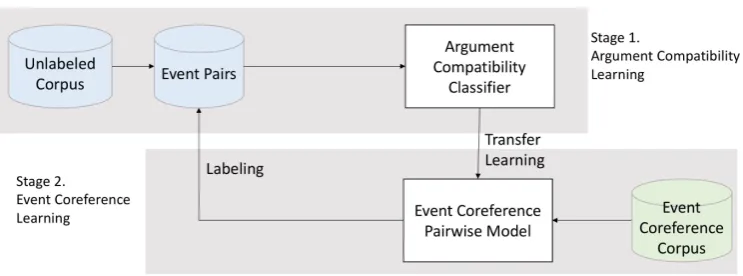
Our proposed transfer learning framework con-sists of two learning stages, the pretraining stage of an argument compatibility classifier and the fine-tuning stage of an event coreference resolver (Figure2). We provide the details of both stages in sections3.1 and3.2, and describe the iterative strategy combining the two training stages in sec-tion 3.3. Details on the model structure are cov-ered in section3.4.
3.1 Argument Compatibility Learning
In the pretraining stage, we train the model as an argument compatibility classifier with event men-tions extracted from a large unlabeled news cor-pus.
Task definition Given a pair of event mentions (ma, mb) with related triggers, predict whether their arguments are compatible or not.
Here, an event mention is represented by a trig-ger word and the context words within ann-word window around the trigger.
Related trigger extraction We analyze the event coreference resolution corpus and extract trigger pairs that are coreferent more thanktimes in the training data. We define these trigger pairs to be related triggers in our experiment. In this work, we setkto 10. Table2shows some exam-ples of related triggers with high counts.
trigger pair count
kill - death 86
shoot - shooting 35
retire - retire 34
demonstration - protest 30
Table 2: Examples of related triggers.
If the triggers of an event mention pair are re-lated, their coreferent status cannot be determined by looking at the triggers alone, and this is the case in which argument compatibility affects the coreferent status most directly. Thus, we focus on the event mention pairs with related triggers in the pretraining stage of argument compatibility learn-ing.
Compatible samples extraction From each document, we extract event mention pairs with related triggers and check whether the following conditions are satisfied:
1. DATE-compatibility (Table1):
(NER) on the context words. If both event mentions have phrases tagged as DATE in the context, these two phrases must contain at least one overlapping word. If there are mul-tiple phrases tagged as DATE in the context, only the phrase closest to the trigger word is considered.
2. PERSON-compatibility: Similar to 1.
3. NUMBER-compatibility: Similar to 1.
4. LOCATION-compatibility: Similar to 1.
5. Apart from function words, the ratio of over-lapping words in their contexts must be un-der 0.3 for both event mentions. We add this constraint in order to remove trivial samples of nearly identical sentences.
Conditions 1–4 are heuristic filtering rules based on NER tags, which aim to remove samples with apparent incompatibilities. Here, we consider four NER types — DATE, PERSON, NUMBER, and LOCATION — because these types of words are the most salient types of incompatibility that can be observed between event mentions. Condi-tion 5 aims to remove event menCondi-tion pairs that are “too similar”. We add this condition because we do not want our model to base its decisions on the number of overlapping words between the event mentions.
We collect event mention pairs satisfying all the above conditions as our initial set of compatible samples.
Incompatible sample extraction From differ-ent documdiffer-ents in the corpus, we extract evdiffer-ent mentions with related triggers and check whether the following conditions are satisfied:
1. The creation date of the two documents must be at least one month apart.
2. Apart from the trigger words and the function words, the context of the event mentions must contain at least one overlapping word.
In the unlabeled news corpus, articles describ-ing similar news events are sometimes present. Thus, we use condition 1 to roughly assure that the event mention pairs extracted are not coreferent. Mention pairs extracted from the same document tend to contain overlapping content words, so to prevent our model to make decisions based on the
existence of overlapping words, we add condition 2 as a constraint.
We collect event mention pairs satisfying all the above conditions as our initial set of incompatible samples.
Argument compatibility classifier With the initial set of compatible and incompatible samples acquired above, we train a binary classier to dis-tinguish between samples of the two sets.
3.2 Event Coreference Learning
In the fine-tuning stage, we adapt the argument compatibility classifier on the labeled event coref-erence data to a mention-pair event corefcoref-erence model.
3.2.1 Event Mention Detection
Before proceeding to the task of event coreference resolution, we have to identify the event mentions in the documents. We train a separate event men-tion detecmen-tion model to identify event menmen-tions along with their subtypes.
We model event mention detection as a multi-class multi-classification problem. Given a candidate word along with its context, we predict the subtype of the event mention triggered by the word. If the given candidate word is not a trigger, we label it as NULL. We select the words that have appeared as a trigger at least once in the training data as candi-date trigger words. We do not consider multi-word triggers in this work.
Given an input sentence, we first represent each of its comprising words by the concatenation of the word embedding and the character embedding of the word. These representation vectors are fed into a bidirectional LSTM (biLSTM) layer to ob-tain the hidden representation of each word.
For each candidate word in the sentence, its hid-den representation is fed into the inference layer to predict the class label. Since the class distribution is highly unbalanced, with the NULL label signif-icantly outnumbering all the other labels, we use a weighted softmax at the inference layer to obtain the probability of each class. In this work, we set the weight to 0.1 for the NULL class label and 1 for all the other class labels.
con-sistency across sentences by the following post-processing step: If a candidate word is assigned the NULL label but more than half of the candi-dates sharing the same surface form is detected as triggers of a specific subtype, then we change the label to this given subtype. Also, we disre-gard event mentions with typescontact,movement
andtransactionin this post-processing step, since the subtypes under these three types do not have a good consistency across different sentences in the same document.
3.2.2 Mention-Pair Event Coreference Model
With the argument compatibility classifier trained in the previous stage, we use the labeled event coreference corpus to fine-tune the model into an event coreference resolver. We design the event coreference resolver to be a mention-pair model (Soon et al., 2001), which takes a pair of event mentions as the input and outputs the likelihood of them being coreferent.
With the pairwise event coreference predictions, we further conduct best-first clustering (Ng and Cardie, 2002) on the pairwise results to build the event coreference clusters of each document. Best-first clustering is an agglomerative clustering algorithm that links each event mention to the an-tecedent event mention with the highest corefer-ence likelihood given the likelihood is above an empirically determined threshold.
3.3 Iterative Relabeling Strategy
Previously, we collected a set of compatible event mentions from the same document with simple heuristic filtering. Despite this filtering step, the initial compatible set is noisy. Here, we intro-duce an iterative relabeling strategy to improve the quality of the compatible set of event mentions.
First, we calculate the coreference likelihood of the event mentions in the initial compatible set. Mention pairs with a coreference likelihood above thresholdθM are added to the new compatible set. On the other hand, mention pairs with a corefer-ence likelihood below θm are added to the initial incompatible set to form the new incompatible set. With the new compatible and incompatible sets, we can start another iteration of transfer learning to train a coreference resolver with improved qual-ity. In this work, we setθM to0.8andθmto0.2.
3.4 Model Structure
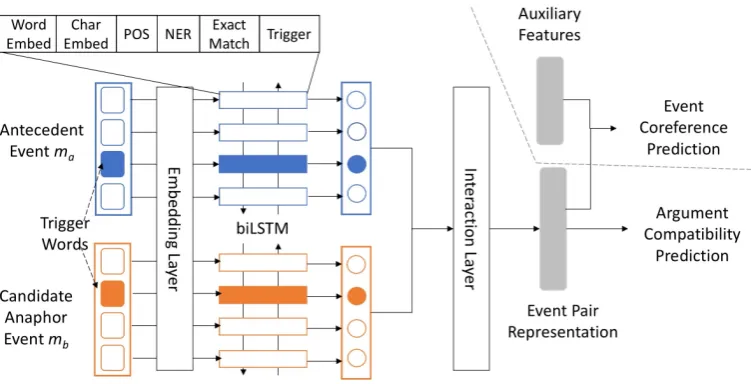
We adopt an interactive inference network as the model structure of our proposed method (Figure
3). A qualitative analysis of an interactive in-ference network shows that it is good at captur-ing word overlaps, antonyms and paraphrases be-tween sentence pairs (Gong et al.,2018). Thus, we believe this network is suitable for capturing the argument compatibility between two event men-tions. The model consists of the following com-ponents:
Model inputs The input to the model is a pair of event mentions (ma, mb), with ma being the antecedent mention ofmb:
ma={w1a, w2a, ..., wNa }
mb ={w1b, w2b, ..., wNb }
(1)
Each event mention is represented by a sequence ofN tokens consisting of one trigger word and its context. Here, we take the context to be the words within ann-word window around the trigger. In this work,nis set to 10.
Embedding layer We represent each input to-ken by the concatenation of the following compo-nents:
Word embedding The word representation of the given token. We use pretrained word vectors to initialize the word embedding layer.
Character embedding To identify (in)compatibilities regarding person, orga-nization or location names, the handling of out-of-vocabulary (OOV) words is critical.
Adding character-level embeddings can allevi-ate the OOV problem (Yang et al., 2017). Thus, we apply a convolutional neural network over the comprising characters of each token to acquire the corresponding character embedding.
POS and NER one-hot vectors One-hot vec-tors of the part-of-speech (POS) tag and NER tag.
Exact match A binary feature indicating whether a given token appears in the context of both event mentions. This feature is proved useful for several NLP tasks operating on pairs of texts (Chen et al., 2017; Gong et al., 2018;Pan et al.,
2018).
Figure 3: Model structure.
Encoding layer We pass the sequence of em-bedding vectors into a biLSTM layer (Hochreiter and Schmidhuber, 1997), resulting in a sequence of hidden vectors of size|h|:
hia=biLST M(emb(wia), hia−1)
hib =biLST M(emb(wib), hib−1) (2)
where emb(w) is the embedding vector of token w.
Interaction layer The interaction layer captures the relations between two event mentions based on the hidden vectorshaandhb. The interaction ten-sorI, a 3-D tensor of shape (N,N,|h|), is calcu-lated by taking the pairwise multiplication of the corresponding hidden vectors:
Iij =hia◦h j
b (3)
Finally, we apply a multi-layer convolutional neu-ral network to extract the event pair representation vectorfev.
Inference layer In the pretraining stage, we feed fev to a fully-connected inference layer to make a binary prediction of argument compatibility.
As for the fine-tuning stage, we concatenate an auxiliary feature vectorfauxtofevbefore feeding it into the inference layer.fauxconsists of two fea-tures, a one-hot vector that encodes the sentence distance between the two event mentions and the difference of the word embedding vectors of the two triggers.
4 Evaluation
4.1 Experimental Setup
4.1.1 Corpora
We use English Gigaword (Parker et al.,2009) as the unlabeled corpus for argument compatibility learning. This corpus consists of the news arti-cles from five news sources, each annotated with its creation date.
As for event coreference resolution, we use the English portion of the KBP 2015 and 2016 datasets (Ellis et al.,2015,2016) for training, and the KBP 2017 dataset (Getman et al., 2017) for evaluation. The KBP datasets comprise news arti-cles and discussion forum threads. The KBP 2015, 2016, and 2017 corpora contain 648, 169, and 167 documents, respectively. Each document is anno-tated with event mentions of 9 types and 18 sub-types, along with the coreference clusters of these event mentions.
4.1.2 Implementation Details
Preprocessing We use the Stanford CoreNLP toolkit (Manning et al.,2014) to perform prepro-cessing on the input data.
MUC B3 CEAFe BLANC AVG-F biLSTM (standard) 29.49 43.15 39.91 24.15 34.18 biLSTM (transfer) 33.84 42.91 38.39 26.59 35.43 Interact (standard) 31.12 42.84 39.01 24.99 34.49 Interact (transfer) 34.28 42.93 39.95 32.12 36.24 Interact (transfer, 2nditer) 35.66 43.20 40.02 32.43 36.75
[image:7.595.152.447.61.162.2]Interact (transfer, 3rditer) 36.05 43.07 39.69 28.06 36.72 Jiang et al. (2017) 30.63 43.84 39.86 26.97 35.33
Table 3: Event coreference resolution results of our proposed system, compared with the biLSTM baseline model and the current state-of-the-art system.
words are cropped. For the interaction layer, we use convolution layers with a kernel size of 3 in combination with max-pooling layers. The size of the inference layer is 128. Sigmoid activation is used for the inference layer, and all other layers use ReLU as the activation function.
Event mention detection model For word em-beddings, we use the concatenation of a 300-dimensional pretrained GloVe embedding and the 50-dimensional embedding proposed by Turian et al.(2010). The character embedding layer is a combination of an 8-dimensional embedding layer and three 1D convolution layers with kernel sizes of 3, 4, 5 with 50 filters.
4.1.3 Evaluation Metrics
We follow the standard evaluation setup adopted in the official evaluation of the KBP event nugget detection and coreference task. This evaluation setup is based on four distinct scoring measures — MUC (Vilain et al.,1995) , B3 (Bagga and Bald-win,1998), CEAFe(Luo,2005) and BLANC (
Re-casens and Hovy,2011) — and the unweighted av-erage of their F-scores (AVG-F). We use AVG-F as the main evaluation measure when comparing system performances.
4.2 Results
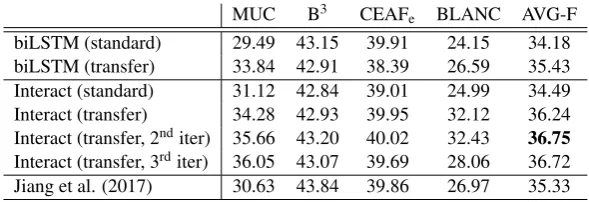
We present the experimental results on the KBP 2017 corpus in Table3. In the following, we com-pare the performance of methods with different network architectures and experimental settings.
Comparison of network architectures We compare the results of the interactive inference network (Interact) with the biLSTM baseline model (biLSTM).
The biLSTM baseline model does not have the interaction layer. Instead, the last hidden vectors of the biLSTM layer are concatenated and fed into the inference layer directly.
When trained solely on the event coreference corpus (standard), the model with the interactive inference network performs slightly better than the biLSTM baseline model, as shown in rows 1 and 3. However, with an additional pretraining step of argument compatibility learning (transfer), the interact inference network outperforms the biL-STM baseline model by a considerable margin, as shown in rows 2 and 4. We conclude that the in-teractive inference network can better capture the complex interactions between two event mentions, accounting for the difference in performance.
Effect of transfer learning Regardless of the network structure, we observe a considerable improvement in performance by pretraining the model as an argument compatibility classifier. The biLSTM baseline model achieves an improvement of 1.25 points in AVG-F by doing transfer learn-ing, as can be seen in rows 1 and 2. As for the interactive inference network, an improvement of 1.75 points in AVG-F is achieved, as can be seen in rows 3 and 4. These results provide sugges-tive evidence that our proposed transfer learning framework, which utilizes a large unlabeled cor-pus to perform argument compatibility learning, is effective.
Type Event Mention Pair Gold System
Explicit m1: ... the building where13people werekilledwill be razed, and a memorial ...
m2: In that case, George Hennardkilled23people at a Luby ’s restaurant, ... non-coref non-coref
Explicit m1: Ten relatives of the victims arrived at the airport Sunday beforetravelingtothe city of Jiangshan.
m2: On Monday , the victims’ relativeswenttothe Jiangshan Municipal Funeral Parlor. non-coref non-coref
Implicit m1: ... ayoungwomanprotesterwas brutally slapped while she was demonstrating ...
m2: ... explain why a womenprotesterin her 60swas beaten up by policemen ...
non-coref coref
Implicit m1: She died from abrain hemorrhageon July 10, 2003, ...
m2: ... has denied killing his second wife, whom he saysdiedin acar accident.
non-coref non-coref
Implicit m1: Nationwide demonstrations held in France toprotestgay marriage.
m2: ... toprotestagainst the country’s plan to legalizesame-sex marriage. coref coref
General m1: ... Connecticut elementary schoolshootinghas reignited the debate over gun control.
m2: Gun supporters hold that people, not guns, are to blame for theshootings. non-coref coref
General m1: Industrial accidents have injured andkilledFoxconn workers, and the company also experienced ...
[image:8.595.73.529.61.219.2]m2: ... explosion in May 2011 at Foxconn ’s Chengdu factorykilledthree workers ... non-coref non-coref
Table 4: Examples of event pairs with related triggers. Trigger words are boldfaced, and words with (in)compatibility information are colored in blue.
Comparison with the state of the art Com-paring row 5 and 7, we can see that our method outperforms the previous state-of-the-art model (Jiang et al.,2017) by 1.42 points in AVG-F.
5 Discussion
In this section, we conduct a qualitative analysis of the outputs of our best-performing system (the Interact (transfer, 2nd iter) system in Table 3) on the event coreference dataset and the unseen event mention pairs extracted from the unlabeled corpus.
5.1 Compatibility Classification
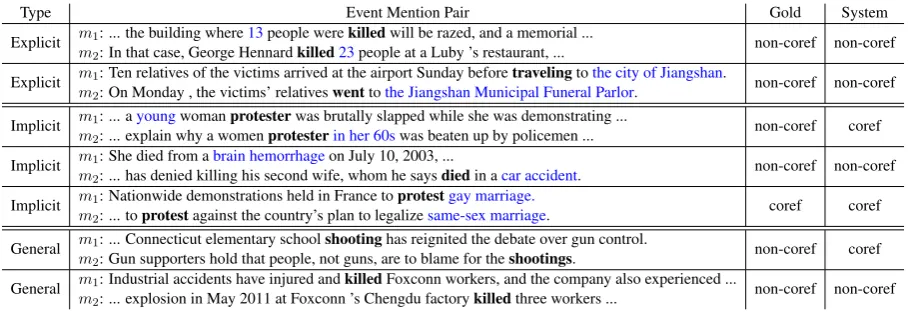
We focus on the samples with related triggers hav-ing either compatible or incompatible arguments (Table4). These samples can be roughly classified into the following categories:
Explicit argument compatibility The existence of identical/distinct time phrases, numbers, loca-tion names or person names in the context is the most explicit form of (in)compatibility.
For these event pairs, the existence of identi-cal/distinct phrases with the same NER type is a direct clue toward deciding their coreferent status. Making use of this nature, we perform filtering on the set of compatible samples acquired from the unlabeled corpus in order to remove samples with explicit incompatibility.
Our model can recognize this type of
(in)compatibility with a relatively high
accu-racy. Both examples shown in Table 4 are
predicted correctly.
Implicit argument compatibility Event pairs with implicit (in)compatible arguments require ex-ternal knowledge to resolve.
We present three examples in Table 4. In the first example, the knowledge that a womanin her 60sis generally not referred to as beingyoungis required to determine the incompatibility. Simi-larly, the knowledge that both brain hemorrhage
andcar accidentare causes of people’s death are required to classify the second example correctly.
While the performance on samples with implicit (in)compatibility is not as good as that on samples with explicit (in)compatibility, our system is able to capture implicit (in)compatibility to some ex-tent. We believe that this type of (in)compatibility is difficult to be captured with the argument fea-tures that are designed based on the outputs of argument extractors and entity coreference re-solvers, and that the ability to resolve implicit (in)compatibility contributes largely to our sys-tem’s performance improvements.
General-specific incompatibilities Event men-tions describing general events pose special chal-lenges to the task of event coreference resolution.
In Table 4, we present two typical examples of this category. In the first example, the second event mention does not refer to any specific shoot-ing event in the real world, in contrast to the first event mention, which describes a specific school shooting event. Similarly for the second exam-ple, where the first event mention depicts a gen-eral event and the second event mention depicts a specific one.
Event Mention Pair Type System
I
m1: What would have happened ifSteve Jobshad neverleftApple ... -
-ma
2: ...in the state that is today ifJohnhadn’tleft. Explicit non-coref
mb
2: ...in the state that is today ifshehadn’tleft. Implicit non-coref
mc
2: ...in the state that is today ifhehadn’tleft. Implicit coref
II
m1: Police arrest 6 men forgangrapinghousewifein northern India. -
-ma
2: Indian police have arrested six men for allegedlygangrapinga29-year-old housewife... Explicit coref
mb
2: Indian police have arrested six men for allegedlygangrapingawoman... Implicit coref
mc2: Indian police have arrested six men for allegedlygangrapingamedical student... Implicit non-coref
III
m1: Nationwide demonstrations in France toprotestgay marriage. -
-ma
2: ...took to the streets across the country toprotestagainst thecountry’s plan to legalize same-sex marriage. Implicit coref
mb
[image:9.595.76.525.64.190.2]2: ...took to the streets across the country toprotestagainst thecontentious citizenship amendment bill. Implicit non-coref
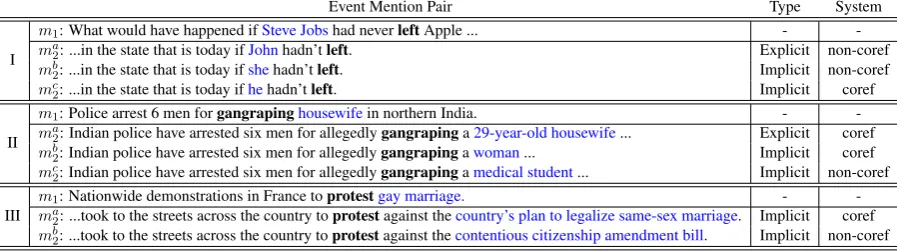
Table 5: Case study on manually-generated event mention pairs. Trigger words are boldfaced, and the target arguments are colored in blue.
event mentions account for a considerable fraction of our system’s error, since they are quite perva-sive in both news articles and discussion forum threads.
5.2 Case Study
To better understand the behavior of our system, we perform a case study on manually-generated event pairs. Specifically, for a given pair of event mentions, we first alter only one of the arguments and keep the rest of the content fixed. We then observe the behavior of the system across different variations of the altered argument (Table5).
Example I In this example, we pick the AGENT-argument as the target and alter the AGENT-argument of the second event mention. The event pair (m1, ma2) is non-coreferent due
to the explicit incompatibility betweenSteve Jobs
andJohn, and the system’s prediction is also non-coreferent. Further, we alter the target argument to the pronounshe (mb2), resulting in an implicit incompatibility in the AGENT argument since the
Steve Jobsis generally not considered a feminine name. As expected, the system classifies the event pair (m1,mb2) as non-coreferent. Finally, when we
alter the target argument to he (mc2), the system correctly classifies the resulting pair as coreferent.
Example II In this example, we pick the PATIENT-argument as the target and alter the PATIENT-argument of the second event mention. The system classifies the event pair (m1, ma2)
as coreferent, which is reasonable considering the presence of the explicit compatible arguments
housewife and 29-year-old housewife. Further, when we alter the target argument towoman(mb2), the system output is still coreferent. This is con-sistent with our prediction: the event mentions are likely to be coreferent judging only from the
con-text of the two event mentions. However, when we alter the target argument tomedical student(mc2), the event pair would become non-coreferent due to the incompatibility between medical student and
housewife. The system classifies the event pair correctly.
Example III In this example, we pick the REASON-argument as the target and alter the REASON-argument of the second event mention. The event pair (m1, ma2) has a pair of implicit
compatible arguments in the REASON-argument role and is likely to be coreferent. In contrast, al-tering the target argument to contentious citizen-ship amendment bill(mb2) would yield an pair of implicit incompatible arguments, and the resulting event pair would become non-coreferent. Our sys-tem classifies both event pairs correctly.
6 Conclusion
We proposed an iterative transfer learning frame-work for event coreference resolution. Our method exploited a large unlabeled corpus to learn a wide range of (in)compatibilities between argu-ments, which contributes to the improvement in performance on the event coreference resolution task. We achieved state-of-the-art results on the KBP 2017 English event coreference dataset, out-performing the previous state-of-the-art system. In addition, a qualitative analysis of the system out-put confirmed the ability of our system to capture (in)compatibilities between two event mentions.
Acknowledgments
References
David Ahn. 2006. The stages of event extraction. In Proceedings of the COLING/ACL Workshop on Annotating and Reasoning about Time and Events, pages 1–8.
Jun Araki, Zhengzhong Liu, Eduard Hovy, and Teruko Mitamura. 2014. Detecting subevent structure for event coreference resolution. In Proceedings of the 9th International Conference on Language Re-sources and Evaluation, pages 4553 – 4558.
Jun Araki and Teruko Mitamura. 2015. Joint event trig-ger identification and event coreference resolution with structured perceptron. In Proceedings of the 2015 Conference on Empirical Methods in Natural Language Processing, pages 2074–2080.
Amit Bagga and Breck Baldwin. 1998.Algorithms for scoring coreference chains. In Proceedings of the LREC Workshop on Linguistics Coreference, pages 563–566.
Cosmin Adrian Bejan and Sanda Harabagiu. 2014. Un-supervised event coreference resolution. Computa-tional Linguistics, 40(2):311–347.
Chen Chen and Vincent Ng. 2013. Chinese event coreference resolution: Understanding the state of the art. InProceedings of the 6th International Joint Conference on Natural Language Processing, pages 822–828.
Chen Chen and Vincent Ng. 2014. SinoCoreferencer: An end-to-end Chinese event coreference resolver. In Proceedings of the 9th International Confer-ence on Language Resources and Evaluation, pages 4532–4538.
Chen Chen and Vincent Ng. 2015. Chinese event coreference resolution: An unsupervised probabilis-tic model rivaling supervised resolvers. In Proceed-ings of Human Language Technologies: The 2015 Conference of the North American Chapter of the Association for Computational Linguistics, pages 1097–1107.
Chen Chen and Vincent Ng. 2016. Joint inference over a lightly supervised information extraction pipeline: Towards event coreference resolution for resource-scarce languages. InProceedings of the 30th AAAI Conference on Artificial Intelligence, pages 2913– 2920.
Danqi Chen, Adam Fisch, Jason Weston, and Antoine Bordes. 2017. Reading Wikipedia to answer open-domain questions. InProceedings of the 55th An-nual Meeting of the Association for Computational Linguistics (Volume 1: Long Papers), pages 1870– 1879.
Zheng Chen and Heng Ji. 2009. Graph-based event coreference resolution. In Proceedings of the ACL-IJCNLP Workshop on Graph-based Methods for Natural Language Processing (TextGraphs-4), pages 54–57.
Zheng Chen, Heng Ji, and Robert Haralick. 2009. A pairwise event coreference model, feature impact and evaluation for event coreference resolution. In
Proceedings of the RANLP Workshop on Events in Emerging Text Types, 3, pages 17–22.
Prafulla Kumar Choubey and Ruihong Huang. 2017.
Event coreference resolution by iteratively unfold-ing inter-dependencies among events. In Proceed-ings of the 2017 Conference on Empirical Methods in Natural Language Processing, pages 2124–2133.
Agata Cybulska and Piek Vossen. 2013. Semantic relations between events and their time, locations and participants for event coreference resolution. In
Proceedings of the 9th International Conference on Recent Advances in Natural Language Processing, pages 156–163.
Joe Ellis, Jeremy Getman, Dana Fore, Neil Kuster, Zhiyi Song, Ann Bies, and Stephanie Strassel. 2015.
Overview of linguistic resources for the TAC KBP 2015 evaluations: Methodologies and results. In
Proceedings of the TAC KBP 2015 Workshop.
Joe Ellis, Jeremy Getman, Neil Kuster, Zhiyi Song, Ann Bies, and Stephanie Strassel. 2016. Overview of linguistic resources for the TAC KBP 2016 eval-uations: Methodologies and results. InProceedings of the TAC KBP 2016 Workshop.
Jeremy Getman, Joe Ellis, Zhiyi Song, Jennifer Tracey, and Stephanie Strassel. 2017. Overview of linguis-tic resources for the TAC KBP 2017 evaluations: Methodologies and results. In Proceedings of the TAC KBP 2017 Workshop.
Yichen Gong, Heng Luo, and Jian Zhang. 2018. Nat-ural language inference over interaction space. In
Proceedings of the 6th International Conference on Learning Representations.
Sepp Hochreiter and J¨ungen Schmidhuber. 1997.
Long short-term memory. Neural Computation, 9(8):1735–1780.
Shanshan Jiang, Yihan Li, Tianyi Qin, Qian Meng, and Bin Dong. 2017.SRCB entity discovery and linking (EDL) and event nugget systems for TAC 2017. In
Proceedings of the TAC KBP 2017 Workshop.
Sebastian Krause, Feiyu Xu, Hans Uszkoreit, and Dirk Weissenborn. 2016. Event Linking with Sentential Features from Convolutional Neural Networks. In
Proceedings of the 20th Conference on Computa-tional Natural Language Learning, pages 239–249.
Heeyoung Lee, Marta Recasens, Angel Chang, Mihai Surdeanu, and Dan Jurafsky. 2012. Joint entity and event coreference resolution across documents. In
Zhengzhong Liu, Jun Araki, Eduard Hovy, and Teruko Mitamura. 2014. Supervised within-document event coreference using information propagation. In Pro-ceedings of the 9th International Conference on Language Resources and Evaluation, pages 4539– 4544.
Jing Lu and Vincent Ng. 2016. Event coreference res-olution with multi-pass sieves. In Proceedings of the 10th International Conference on Language Re-sources and Evaluation, pages 3996–4003.
Jing Lu and Vincent Ng. 2017.Joint learning for event coreference resolution. InProceedings of 55th An-nual Meeting of the Association for Computational Linguistics (Volume 1: Long Papers), pages 90–101.
Jing Lu and Vincent Ng. 2018. Event coreference res-olution: A survey of two decades of research. In
Proceedings of the 27th International Joint Confer-ence on Artificial IntelligConfer-ence, pages 5479–5486.
Jing Lu, Deepak Venugopal, Vibhav Gogate, and Vin-cent Ng. 2016.Joint inference for event coreference resolution. InProceedings of the 26th International Conference on Computational Linguistics: Techni-cal Papers, pages 3264–3275.
Xiaoqiang Luo. 2005. On coreference resolution per-formance metrics. In Proceedings of the Confer-ence on Human Language Technology and Empiri-cal Methods in Natural Language Processing, pages 25–32.
Christopher D. Manning, Mihai Surdeanu, John Bauer, Jenny Finkel, Steven J. Bethard, and David Mc-Closky. 2014. The Stanford CoreNLP natural lan-guage processing toolkit. In Proceedings of the 52nd Annual Meeting of the Association for Compu-tational Linguistics: System Demonstrations, pages 55–60.
Katie McConky, Rakesh Nagi, Moises Sudit, and William Hughes. 2012. Improving event co-reference by context extraction and dynamic feature weighting. InProceedings of the 2012 IEEE Inter-national Multi-Disciplinary Conference on Cogni-tive Methods in Situation Awareness and Decision Support, pages 38–43.
Vincent Ng and Claire Cardie. 2002. Improving ma-chine learning approaches to coreference resolution. InProceedings of the 40th Annual Meeting of the As-sociation for Computational Linguistics, pages 104– 111.
Boyuan Pan, Yazheng Yang, Zhou Zhao, Yueting Zhuang, Deng Cai, and Xiaofei He. 2018. Dis-course marker augmented network with reinforce-ment learning for natural language inference. In
Proceedings of the 56th Annual Meeting of the As-sociation for Computational Linguistics (Volume 1: Long Papers), pages 989–999.
Robert Parker, David Graff, Junbo Kong, Ke Chen, and Kazuaki Maeda. 2009. English Gigaword fourth edition. InLinguistic Data Consortium.
Haoruo Peng, Yangqi Song, and Dan Roth. 2016.
Event detection and co-reference with minimal su-pervision. InProceedings of the 2016 Conference on Empirical Methods in Natural Language Pro-cessing, pages 392–402.
Jeffrey Pennington, Richard Socher, and Christopher Manning. 2014. GloVe: Global vectors for word representation. In Proceedings of the 2014 Con-ference on Empirical Methods in Natural Language Processing, pages 1532–1543.
Marta Recasens and Eduard Hovy. 2011. BLANC: Im-plementing the Rand Index for coreference evalu-ation. Natural Language Engineering, 17(4):485– 510.
Satyan Sangeetha and Michael Arock. 2012. Event coreference resolution using mincut based graph clustering. In Proceedings of the 4th International Workshop on Computer Networks & Communica-tions, pages 253–260.
Wee Meng Soon, Hwee Tou Ng, and Daniel Chung Yong Lim. 2001. A machine learning ap-proach to coreference resolution of noun phrases.
Computational Linguistics, 27(4):521–544.
Joseph Turian, Lev Ratinov, and Yoshua Bengio. 2010.
Word representations: A simple and general method for semi-supervised learning. InProceedings of the 48th Annual Meeting of the Association for Compu-tational Linguistics, pages 384–394.
Marc Vilain, John Burger, John Aberdeen, Dennis Con-nolly, and Lynette Hirschman. 1995. A model-theoretic coreference scoring scheme. In Proceed-ings of the Sixth Message Understanding Confer-ence, pages 45–52.
Bishan Yang, Claire Cardie, and Peter Frazier. 2015. A hierarchical distance-dependent bayesian model for event coreference resolution. Transactions of the Association for Computational Linguistics, 3:517– 528.
Zhilin Yang, Bhuwan Dhingra, Ye Yuan, Junjie Hu, William W. Cohen, and Ruslan Salakhutdinov. 2017.