In:
Proceedings of CoNLL-2000 and LLL-2000,
pages 127-132, Lisbon, Portugal, 2000.I n t r o d u c t i o n to the CoNLL-2000 Shared Task: C h u n k i n g
Erik F. Tjong Kim Sang
C N T S - L a n g u a g e T e c h n o l o g y G r o u pUniversity of A n t w e r p e r i k t O u i a , u a . a c . be
Sabine
B u c h h o l zILK, C o m p u t a t i o n a l Linguistics T i l b u r g U n i v e r s i t y
s. b u c h h o l z @ k u b , nl
A b s t r a c t
We describe the CoNLL-2000 shared task: dividing text into syntactically related non- overlapping groups of words, so-called text chunking. We give background information on the data sets, present a general overview of the systems that have taken part in the shared task and briefly discuss their performance.
1 I n t r o d u c t i o n
Text chunking is a useful preprocessing step for parsing. There has been a large inter- est in recognizing non-overlapping noun phrases (Ramshaw and Marcus (1995) and follow-up pa- pers) but relatively little has been written about identifying phrases of other syntactic categories. The CoNLL-2000 shared task a t t e m p t s to fill this gap.
2 T a s k d e s c r i p t i o n
Text chunking consists of dividing a text into phrases in such a way that syntactically re- lated words become member of the same phrase. These phrases are non-overlapping which means that one word can only be a member of one chunk. Here is an example sentence:
[NP He ] [vP reckons ] [NP the current account deficit ] [vP will narrow ] [pp to ] [NP only £ 1.8 billion ] [pp in ][NP September ] .
Chunks have been represented as groups of words between square brackets. A tag next to the open bracket denotes the type of the chunk. As far as we know, there are no annotated cor- pora available which contain specific informa- tion about dividing sentences into chunks of words of arbitrary types. We have chosen to work with a corpus with parse information, the
Wall Street Journal W S J part of the P e n n Tree- b a n k II corpus (Marcus et al., 1993), a n d to ex- tract c h u n k information f r o m the parse trees in this corpus. W e will give a global description of the various c h u n k types in the next section.
3 C h u n k T y p e s
T h e c h u n k types are based on the syntactic cat- egory part (i.e. without function tag) of the bracket label in the T r e e b a n k (cf. Bies (1995) p.35). Roughly, a c h u n k contains everything to the left of a n d including the syntactic head of the constituent of the s a m e name. S o m e Tree- b a n k constituents do not have related chunks. T h e head of S (simple declarative clause) for ex- a m p l e is normally thought to be the verb, but as the verb is already part of the V P chunk, no S c h u n k exists in our e x a m p l e sentence.
Besides the head, a c h u n k also contains pre- modifiers (like determiners a n d adjectives in NPs), but no postmodifiers or arguments. This is w h y the P P c h u n k only contains the preposi- tion, a n d not the a r g u m e n t N P , a n d the S B A R c h u n k consists of only the complementizer.
There are several difficulties w h e n converting trees into chunks. In the m o s t simple case, a c h u n k is just a syntactic constituent without any further e m b e d d e d constituents, like the N P s in our examples. In s o m e cases, the chunk con- tains only w h a t is left after other chunks have been r e m o v e d f r o m the constituent, cf. " ( V P loves ( N P Mary))" above, or A D J P s a n d P P s below. W e will discuss s o m e special cases dur- ing the following description of the individual c h u n k types.
3.1 N P
ordinated NPs follows the Treebank annotators. However, as R a m s h a w and Marcus do not de- scribe the details of their conversion algorithm, results m a y differ in difficult cases, e.g. involv- ing NAC a n d NX. 1
An A D J P constituent inside an N P con- stituent becomes part of the N P chunk:
(NP T h e ( A D J P most volatile) form)
[NP
the most volatile form ] 3.2 V PIn the Treebank, verb phrases are highly embed- ded; see e.g. the following sentence which con- tains four V P constituents. Following R a m s h a w and Marcus' V-type chunks, this sentence will only contain one V P chunk:
((S (NP-SBJ-3 Mr. Icahn) (VP m a y not (VP want (S (NP-SBJ *-3) (VP to (VP sell ...))))) . ))
[NP
Mr. Icahn ] [vP m a y not want to sell ] ...It is still possible however to have one V P chunk directly follow another:
[NP
T h e impression ] [NP I ] [VP h a v e g o t ] [vP is ] [NP t h e y ] [vP 'd love to do ] [PRT away ] [pp with ] [NP it ]. In this case the two V P constituents did not overlap in the Treebank.A d v e r b s / a d v e r b i a l phrases becorae part of the V P chunk (as long as they are in front of the m a i n verb):
(VP could ( A D V P very well) (VP show ... ) )
"-+ [ve could very well show ] ...
In contrast to R a m s h a w a n d Marcus (1995), predicative adjectives of the verb are not part of the V P chunk, e.g. in "[NP t h e y ] [vP are ] [ADJP u n h a p p y ]'.
In inverted sentences, the auxiliary verb is not part of any verb phrase in the Treebank. Con- sequently it does not belong to any V P chunk:
((S (SINV ( C O N J P Not only) does (NP-SBJ-1 your p r o d u c t ) (VP have (S IE.g. (NP-SBJ (NP Robin Leigh-Pemberton) , (NP (NAC Bank (PP of (NP England))) governor) ,) which we convert to [NP Robin Leigh-Pemberton ] , Bank [pp of ] [NP England ] [NP governor ] whereas Ramshaw and Marcus state that ' "governor" is not included in any baseNP chunk'.
(NP-SBJ *-1) (VP to (VP be (ADJP- P R D excellent)))))) , b u t ...
[CONJP
Not only ] does[NP your
p r o d u c t ] [vP have to be ] [ADJP ex- cellent ] , b u t ...3.3 A D V P a n d A D J P
A D V P chunks mostly correspond to A D V P con- stituents in t h e Treebank. However, A D V P s in- side A D J P s or inside V P s if in front of the main verb are assimilated into the A D J P respectively V P chunk. O n the o t h e r h a n d , A D V P s t h a t contain an N P make two chunks:
( A D V P - T M P (NP a year) earlier) -+ [NP a year ] [ADVP earlier ]
A D J P s inside N P s are assimilated into the NP. A n d parallel to A D V P s , A D J P s t h a t contain an N P make two chunks:
( A D J P - P R D (NP 68 years) old)
[NP
68 years ][ADJP
old ]It would be interesting to see how chang- ing t h e s e decisions (as can be done in the T r e e b a n k - t o - c h u n k conversion script 2) infiu- ences the c h u n k i n g task.
3.4 P P a n d S B A R
Most P P chunks j u s t consist of one word (the preposition) w i t h the part-of-speech tag IN. This does not mean, t h o u g h , t h a t finding P P chunks is completely trivial. INs can also con- s t i t u t e an S B A R chunk (see below) a n d some P P chunks contain more t h a n one word. This is the case w i t h fixed multi-word prepositions such as such as, because of, due to, with prepo- sitions preceded by a modifier: well above, just after, even in, particularly among or with coor- d i n a t e d prepositions: inside and outside. We t h i n k t h a t P P s behave sufficiently differently from N P s in a sentence for not wanting to group t h e m into one class (as R a m s h a w and Marcus did in their N-type chunks), a n d t h a t on the other h a n d tagging all N P chunks inside a P P as I - P P would only confuse the chunker. We therefore chose not to handle the recognition of true P P s ( p r e p . + N P ) d u r i n g this first chunking step.
SBAR Chunks mostly consist of one word (the complementizer) with the part-of-speech tag IN, but like multi-word prepositions, there are also multi-word complementizers: even though, so that, just as, even if, as if, only if.
3.5 C O N J P , P R T , I N T J , L S T , U C P Conjunctions can consist of more than one word as well: as well as, instead of, rather than, not only, but also. One-word conjunctions (like and, or) are not annotated as CONJP in the Tree- bank, and are consequently no CONJP chunks in our data.
The Treebank uses the PRT constituent to annotate verb particles, and our PRT chunk does the same. The only multi-word particle is on and off. This chunk type should be easy to recognize as it should coincide with the part- of-speech tag RP, but through tagging errors it is sometimes also assigned IN (preposition) or RB (adverb).
INTJ is an interjection phrase/chunk like no, oh, hello, alas, good grief!. It is quite rare.
The list marker LST is even rarer. Examples are 1., 2 , 3., .first, second, a, b, c. It might con- sist of two words: the number and the period.
The UCP chunk is reminiscent of the UCP (unlike coordinated phrase) constituent in the Treebank. Arguably, the conjunction is the head of the UCP, so most UCP chunks consist of conjunctions like and and or. UCPs are the rarest chunks and are probably not very useful for other NLP tasks.
3.6 T o k e n s o u t s i d e
Tokens outside any chunk are mostly punctua- tion signs and the conjunctions in ordinary coor- dinated phrases. The word not may also be out- side of any chunk. This happens in two cases: Either not is not inside the VP constituent in the Treebank annotation e.g. in
... (VP have (VP told (NP-1 clients) (S (NP-SBJ *-1) not (VP to (VP ship (NP anything))))))
or not is not followed by another verb (because the main verb is a form of to be). As the right chunk boundary is defined by the chunk's head, i.e. the main verb in this case, not is t h e n i n fact a postmodifier and as such not included in the chunk: "... [SBAR that ] [NP there ] [vP were ] n't [NP any major problems ] ."
3.7 P r o b l e m s
All chunks were automatically extracted from the parsed version of the Treebank, guided by the tree structure, the syntactic constituent la- bels, the part-of-speech tags and by knowledge about which tags can be heads of which con- stituents. However, some trees are very complex and some annotations are inconsistent. What to think about a VP in which the main verb is tagged as NN (common noun)? Either we al- low NNs as heads of VPs (not very elegant but which is what we did) or we have a VP without a head. The first solution might also introduce errors elsewhere... As Ramshaw and Marcus (1995) already noted: "While this automatic derivation process introduced a small percent- age of errors on its own, it was the only practi- cal way both to provide the amount of training data required and to allow for fully-automatic testing."
4 D a t a a n d E v a l u a t i o n
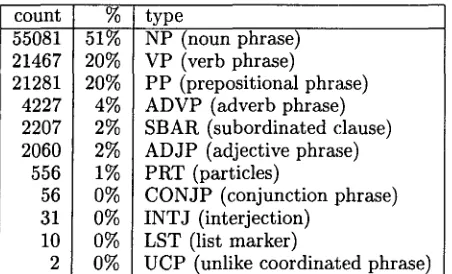
For the CoNLL shared task, we have chosen to work with the same sections of the Penn Treebank as the widely used data set for base noun phrase recognition (Ramshaw and Mar- cus, 1995): WSJ sections 15-18 of the Penn Treebank as training material and section 20 as test material 3. The chunks in the data were selected to match the descriptions in the previous section. An overview of the chunk types in the training data can be found in ta- ble 1. De data sets contain tokens (words and punctuation marks), information about the lo- cation of sentence boundaries and information about chunk boundaries. Additionally, a part- of-speech (POS) tag was assigned to each token by a standard POS tagger (Brill (1994) trained on the Penn Treebank). We used these POS tags rather than the Treebank ones in order to make sure that the performance rates obtained for this data are realistic estimates for data for which no treebank POS tags are available.
In our example sentence in section 2, we have used brackets for encoding text chunks. In the data sets we have represented chunks with three types of tags:
count % 55081 51% 21467 20% 21281 20% 4227 4% 2207 2% 2060 2% 556 1% 56 O% 31 0% 10 O% 2 0%
type
NP (noun phrase) VP (verb phrase)
PP (prepositional phrase) ADVP (adverb phrase) SBAR (subordinated clause) ADJP (adjective phrase) PRT (particles)
CONJP (conjunction phrase INTJ (interjection)
LST (list marker)
UCP (unlike coordinated phrase)
Table 1: Number of chunks per phrase type in the training data (211727 tokens, 106978 chunks).
B-X I-X 0
first word of a chunk of type X non-initial word in an X chunk word outside of any chunk
This representation type is based on a repre- sentation proposed by Ramshaw and Marcus (1995) for noun phrase chunks. The three tag groups are sufficient for encoding the chunks in the data since these are non-overlapping. Using these chunk tags makes it possible to approach the chunking task as a word classification task. We can use chunk tags for representing our ex- ample sentence in the following way:
He/B-NP reckons/B-VP t h e / B - N P current/I-NP account/I-NP
deficit/I-NP will/B-VP narrow/I-VP t o / B - P P o n l y / B - N P # / I - N P
1.8/I-NP billion/B-NP i n / B - P P September/B-NP ./O
The o u t p u t of a chunk recognizer may contain inconsistencies in the chunk tags in case a word tagged I-X follows a word tagged O or I-Y, with X and Y being different. These inconsistencies can be resolved by assuming that such I-X tags start a new chunk.
The performance on this task is measured with three rates. First, the percentage of detected phrases that are correct (precision). Second, the percentage of phrases in the data that were found by the chunker (recall). And third, the FZ=i rate which is equal to (f12 + 1)*precision*recall / (~2,precision+recall)
with ~ = 1 (van Rijsbergen, 1975). The lat- ter rate has been used as the target for optimization 4.
5 R e s u l t s
The eleven systems that have been applied to the CoNLL-2000 shared task can be divided in four groups:
1. Rule-based systems: Villain and Day; Jo- hansson; D6jean.
2. Memory-based systems: Veenstra and Van den Bosch.
3. Statistical systems: Pla, Molina and Pri- eto; Osborne; Koeling; Zhou, Tey and Su. 4. Combined systems: Tjong Kim Sang; Van
Halteren; K u d o h and Matsumoto.
Vilain and Day (2000) approached the shared task in three different ways. T h e most success- ful was an application of the Alembic parser which uses transformation-based rules. Johans- son (2000) uses context-sensitive and context- free rules for transforming part-of-speech (POS) tag sequences to chunk tag sequences. D6jean (2000) has applied the theory refinement sys- t e m ALLiS to the shared task. In order to ob- tain a system which could process XML format- ted data while using context information, he has used three extra tools. Veenstra and Van den Bosch (2000) examined different parame- ter settings of a memory-based learning algo- rithm. T h e y found that modified value differ- ence metric applied to POS information only worked best.
[image:4.596.81.307.90.227.2]test data
Kudoh and Matsumoto Van Halteren
Tjong Kim Sang Zhou, Tey and Su D@jean
Koeling Osborne
Veenstra and Van den Bosch Pla, Molina and Prieto Johansson
Vilain and Day baseline
precision 93.45% 93.13% 94.04% 91.99% 91.87% 92.08% 91.65% 91.05% 90.63% 86.24%
88.82%
72.58%recall 93.51% 93.51%
91.00%
92.25% 91.31% 91.86% 92.23% 92.03% 89.65% 88.25% 82.91% 82.14%F ~ = i
93.48 93.32 92.50 92.12 92.09 91.97 91.94 91.54 90.14 87.23 85.76 77.07
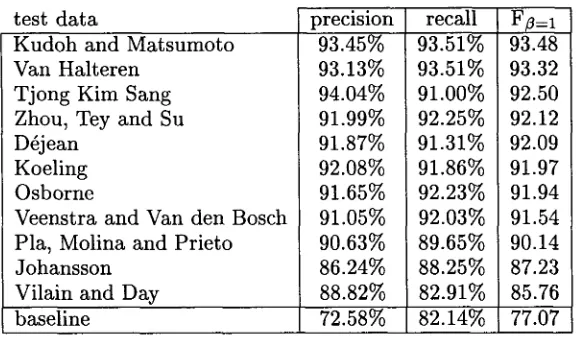
Table 2: Performance of the eleven systems on the test data. The baseline results have been obtained by selecting the most frequent chunk tag for each part-of-speech tag.
incorporating chunk probabilities generated by a memory-based learning process. The two other statistical systems use maximum-entropy based methods. Osborne (2000) trained Ratna- parkhi's maximum-entropy POS tagger to out- put chunk tags. Koeling (2000) used a stan- dard maximum-entropy learner for generating chunk tags from words and POS tags. Both have tested different feature combinations be- fore finding an optimal one and their final re- sults are close to each other.
Three systems use system combination. Tjong Kim Sang (2000) trained and tested five memory-based learning systems to produce dif- ferent representations of the chunk tags. A combination of the five by majority voting per- formed better than the individual parts. Van Halteren (2000) used Weighted Probability Dis- tribution Voting (WPDV) for combining the results of four WPDV chunk taggers and a memory-based chunk tagger. Again the com- bination outperformed the individual systems. Kudoh and Matsumoto (2000) created 231 sup- port vector machine classifiers to predict the unique pairs of chunk tags. The results of the classifiers were combined by a dynamic pro- gramming algorithm.
The performance of the systems can be found in Table 2. A baseline performance was ob- tained by selecting the chunk tag most fre- quently associated with a POS tag. All systems outperform the baseline. The majority of the
systems reached an F~=i score between 91.50 and 92.50. Two approaches performed a lot better: the combination system WPDV used by Van Halteren and the Support Vector Machines used by Kudoh and Matsumoto.
6 R e l a t e d W o r k
In the early nineties, Abney (1991) proposed to approach parsing by starting with finding related chunks of words. By then, Church (1988) had already reported on recognition of base noun phrases with statistical meth- ods. Ramshaw and Marcus (1995) approached chunking by using a machine learning method. Their work has inspired many others to study the application of learning methods to noun phrase chunking 5. Other chunk types have not received the same attention as NP chunks. The most complete work is Buchholz et al. (1999), which presents results for NP, VP, PP, ADJP and ADVP chunks. Veenstra (1999) works with NP, VP and P P chunks. Both he and Buchholz et al. use data generated by the script that pro- duced the CoNLL-2000 shared task data sets. Ratnaparkhi (1998) has recognized arbitrary chunks as part of a parsing task but did not re- port on the chunking performance. Part of the Sparkle project has concentrated on finding var- ious sorts of chunks for the different languages
[image:5.596.141.430.91.261.2](Carroll et al., 1997).
'7 C o n c l u d i n g R e m a r k s
We have presented an introduction to the CoNLL-2000 shared task: dividing text into syntactically related non-overlapping groups of words, so-called text chunking. For this task we have generated training and test d a t a from the P e n n Treebank. This d a t a has been processed by eleven systems. T h e best performing system was a combination of Support Vector Machines s u b m i t t e d by Taku K u d o h and Yuji Matsumoto. It obtained an FZ=i score of 93.48 on this task. A c k n o w l e d g e m e n t s
We would like to t h a n k the m e m b e r s of the CNTS - Language Technology Group in Antwerp, Belgium and the m e m b e r s of the ILK group in Tilburg, T h e Netherlands for valuable discussions and comments. Tjong Kim Sang is funded by the E u r o p e a n T M R network Learn- ing C o m p u t a t i o n a l G r a m m a r s . Buchholz is sup- ported by the Netherlands Organization for Sci- entific Research (NWO).
R e f e r e n c e s
Steven Abney. 1991. Parsing by chunks. In
Principle-Based Parsing. Kluwer Academic Pub- lishers.
Ann Bies, Mark Ferguson, Karen Katz, and Robert MacIntyre. 1995. Bracket Guidelines /or Tree- bank H Style Penn Treebank Project. Penn Tree- bank II cdrom.
Eric Brill. 1994. Some advances in rule-based part of speech tagging. In Proceedings o] the Twelfth National Con/erence on Artificial Intel- ligence (AAAI-9~). Seattle, Washington.
Sabine Buchholz, Jorn Veenstra, and Walter Daele- mans. 1999. Cascaded grammatical :relation as- signment. In Proceedings o] EMNLP/VLC-99.
Association for Computational Linguistics. John Carroll, Ted Briscoe, Glenn Carroll, Marc
Light, Dethleff Prescher, Mats Rooth, Stefano Federici, Simonetta Montemagni, Vito Pirrelli, Irina Prodanof, and Massimo Vanocchi. 1997.
Phrasal Parsing Software. Sparkle Work Package 3, Deliverable D3.2.
Kenneth Ward Church. 1988. A stochastic parts program and noun phrase parser for unrestricted text. In Second Con]erence on Applied Natural Language Processing. Austin, Texas.
H@rve D@jean. 2000. Learning syntactic structures with xml. In Proceedings o/ CoN~LL-2000 and LLL-2000. Lisbon, Portugal.
Christer Johansson. 2000. A context sensitive max- imum likelihood approach to chunking. In Pro- ceedings o] CoNLL-2000 and LLL-2000. Lisbon, Portugal.
Rob Koeling. 2000. Chunking with maximum en- tropy models. In Proceedings o/ CoNLL-2000 and LLL-2000. Lisbon, Portugal.
Taku Kudoh and Yuji Matsumoto. 2000. Use of sup- port vector learning for chunk identification. In
Proceedings o~ CoNLL-2000 and LLL-2000. Lis- bon, Portugal.
Mitchell P. Marcus, Beatrice Santorini, and Mary Ann Marcinkiewicz. 1993. Building a large annotated corpus of english: the penn treebank.
Computational Linguistics, 19(2).
Miles Osborne. 2000. Shallow parsing as part-of- speech tagging. In Proceedings o] CoNLL-2000 and LLL-2000. Lisbon, Portugal.
Ferran Pla, Antonio Molina, and Natividad Pri- eto. 2000. Improving chunking by means of lexical-contextual information in statistical lan- guage models. In Proceedings o] CoNLL-2000 and LLL-2000. Lisbon, Portugal.
Lance A. Ramshaw and Mitchell P. Marcus. 1995. Text chunking using transformation-based learn- ing. In Proceedings o] the Third A CL Workshop on Very Large Corpora. Association for Compu- tational Linguistics.
Adwait Ratnaparkhi. 1998. Maximum Entropy Models ]or Natural Language Ambiguity Resolu- tion. PhD thesis Computer and Information Sci- ence, University of Pennsylvania.
Erik F. Tjong Kim Sang. 2000. Text chunking by system combination. In Proceedings of CoNLL- 2000 and LLL-2000. Lisbon, Portugal.
Hans van Halteren. 2000. Chunking with wpdv models. In Proceedings o/ CoNLL-2000 and LLL- 2000. Lisbon, Portugal.
C.J. van Rijsbergen. 1975. In/ormation Retrieval.
Buttersworth.
Jorn Veenstra and Antal van den Bosch. 2000. Single-classifier memory-based phrase chunking. In Proceedings o] CoNLL-2000 and LLL-2000.
Lisbon, Portugal.
Jorn Veenstra. 1999. Memory-based text chunking. In Nikos Fakotakis, editor, Machine learning in human language technology, workshop at ACAI 99.
Marc Vilain and David Day. 2000. Phrase parsing with rule sequence processors: an application to the shared conll task. In Proceedings o/CoNLL- 2000 and LLL-2000. Lisbon, Portugal.