J
In:
Proceedings of CoNLL-2000 and LLL-2000,
pages 199-208, Lisbon, Portugal, 2000.Inductive Logic Programming for
Corpus-Based Acquisition of Semantic Lexicons
P a s c a l e S 4 b i l l o t
IRISA - C a m p u s de Beaulieu - 35042 R e n n e s cedex - F r a n c e
sebillot@irisa, fr
P i e r r e t t e B o u i l l o n
T I M / I S S C O - E T I - Universit4 de Gen~ve - 40 Bvd du P o n t - d ' A r v e - CH-1205 G e n e v a - Switzerland
Pierrette. Bouillon@issco. unige, ch
C 4 c i l e F a b r e
ERSS - Universit@ de Toulouse II - 5 all@es A. M a c h a d o - 31058 Toulouse cedex - France
cfabre@univ-tlse2, fr
A b s t r a c t
In this paper, we propose an Inductive Logic Programming learning method which aims at automatically extracting special Noun-Verb (N- V) pairs from a corpus in order to build up semantic lexicons based on Pustejovsky's Gen- erative Lexicon (GL) principles (Pustejovsky, 1995). In one of the components of this lex- ical model, called the
qualia structure,
words are described in terms of semantic roles. For example, therelic
role indicates the purpose or function of an item(cut
forknife),
the agen- tive role its creation mode(build
forhouse),
etc. The qualia structure of a noun is mainly made up of verbal associations, encoding rela- tional information. The Inductive Logic Pro- gramming learning method that we have devel- oped enables us to automatically extract from a corpus N-V pairs whose elements axe linked by one of the semantic relations defined in the qualia structure in GL, and to distinguish them, in terms of surrounding categorial context from N-V pairs also present in sentences of the corpus but not relevant. This method has been theoret- ically and empirically validated, on a technical corpus. The N-V pairs that have been extracted will further be used in information retrieval ap- plications for index expansion 1.1This works is funded by the Agence universi- taire de la Francophonie (AUF) (Action de recherche partag4e "Acquisition automatique d'dldments du Lex-
K e y w o r d s : Lexicon learning, Generative Lexicon, Inductive Logic Programming, Infor- mation indexing.
1 I n t r o d u c t i o n
Information retrieval (IR) systems aim at pro- viding a user who asks a query to a database of documents with the most relevant texts. The quality of these systems is usually measured with the help of two criteria: the
recall
rate, which corresponds to the proportion of relevant answers that have been given by the system compared to the total number of relevant an- swers in the database, and theprecision
rate, which denotes the proportion of relevant an- swers that are present among the given answers. In these IR systems, texts and queries are usually represented by indexes, that is, a col- lection of some of the words that they contain. The quality of the systems therefore highly de- pends on the type of indexing language that has been chosen. Two kinds of indexes exist: sim- ple indexes, which correspond to simple nouns (N), verbs (V) a n d / o r adjectives (A) that oc- cur in a text or a query 2, and complex indexes, which correspond to the compounds (for exam- ple, NN compounds) present in the document orique Gdndratif pour amdliorer les performances de
syst~mes de recherche d'information", r@seau F R A N - CIL).
the question. The solutions that are given for a user query are the texts whose indexes better match the query index.
In order to obtain the hightest performances, IR systems usually offer some possibilities to expand both query and text indexes. Tra- ditional index expansion concerns morpho- syntactic similarities; for example, the same in- dex words in plural and singular forms can be matched. Some other systems deal with a kind of semantic similarities: if they possess a lin- guistic knowledge database, they can, for ex- ample, expand a nominal index by following synonymy or hyperonymy links. These systems are however usually limited to intra-categorial expansion, especially N-to-N one. Here we deal with a new kind of expansion that has been proven particularly useful (Grefenstette, 1997; Fabre and S~billot, 1999) for document database questioning. It concerns N-V links and aims at allowing matching between nominal and verbal formulations that are semantically close. For example, our objective is to permit a matching between a query index
disk
store and the text formulation tosell disks,
related by the typical function of a store.N-V index expansion however has to be con- trolled in order to ensure that the same con- cept is involved in the two formulations. We have chosen Pustejovsky's Generative Lexicon (GL) framework (Pustejovsky, 1995; Bouillon and Busa, 2000) to define what a relevant N- V link is, that is, what is a N-V pair in which the N and the V are related by a semantic link which is close, and which can therefore be used to expand indexes.
In GL formalism, lexical entries consist in structured sets of predicates that define a word. In one of the components of this lexical model, called the
qualia structure,
words are described in terms of semantic roles. Thetelic
role in- dicates the purpose or function of an item (for example, cut forknife),
the agentive role its cre- ation mode(build
forhouse),
the constitutive role its constitutive parts(handle
forhandcup)
and the formal role its semantic category(con-
tain (information)
forbook).
The qualia struc- ture of a noun is mainly made up of verbal as- sociations, encoding relational information. We assert that these N-V links are especially rele- vant for index expansion in IR systems (Fabreand S~billot, 1999), and what we call a relevant N-V pair afterwards in the paper is a pair com- posed of a N and a V which are related by one of the four semantic relations defined in the qualia structure in GL.
GL is however currently just a formalism; no generative lexicons exist that are precise enough for every domain and every application (for eg. IR), and the cost of a manual construction of a lexicon based on GL principles is prohibitive. Moreover the real N-V links that are the key- point of this formalism cannot be defined a pri-
ori
and have to be acquired from corpora of the studied domain. The aim of this paper is therefore to present a machine learning method, developed in the Inductive Logic Programming framework, that enables us to automatically ex- tract from a corpus N-V pairs whose elements are linked by one of the semantic relations de- fined in the qualia structure in GL, and to dis- tinguish them, in terms of surrounding cate- gorial (Part-of-Speech, POS) context from N- V pairs also present in sentences of the corpus but not relevant. It will be divided in three parts. Section 2 focusses on the motivation of this project regarding the use of GL. Section 3 explains the machine learning method that we have developed. Section 4 is dedicated to its theoretical and empirical validations, and to the results of its application to a technical corpus.2 M o t i v a t i o n
As stated in the introduction, our work makes two strong claims: firstly N-V associations de- fined in GL are relevant for IR and secondly this information can be acquired from a corpus on the basis of surrounding POS context. These presuppositions have to be motivated before ex- plaining the learning method:
is therefore a t h e o r y of words in context. It can also be seen as a way to structure information in corpora and, in t h a t sense, the relations it defines are therefore privileged information for IR. In this perspective, GL has been preferred to existing lexical resources such as WordNet (Fellbaum, 1998) for two m a i n reasons: lexical relations t h a t we want to exhibit - n a m e l y N-V links - are unavailable in WordNet, which fo- cuses on paradigmatic lexical relations; Word- Net is a domain-independent, static resource, which can not be used as such to describe lexi- cal associations in specific texts, considering the great variability of semantic associations from one domain to another.
2. In GL, the qualia structures are not arbi- t r a r y repository of information. T h e y contain the information necessary to explain the syn- tactic behaviour of the item. We would there- fore expect t h a t there are strong connections between some specific syntactic p h e n o m e n a and some specific qualia relations. For example, the middle construction seems to be only possible if a telic relation holds between the N and V (Bas- sac and Bouillon, 2000) (for example: ??this book writes well vs this book reads well). Sim- ilarly, imperative constructions (e.g. open the door, follow the links) or adjectival sentences (a
book difficult to write/read) m a y also indicate a qualia relation. These are some of the con- structions t h a t we want to identify primilarly in corpora by the learning m e t h o d .
3 T h e m a c h i n e l e a r n i n g m e t h o d
Trying to infer lexical semantic information from corpora is not new: lots of works have already been conducted on this subject, espe- cially in the statistical learning domain (see (Grefenstette, 1994b), for e.g., or (Habert et al., 1997) and (Pichon and S~billot, 1997) for surveys of this field). Following Harris's frame- work (Harris et al., 1989), such research tries to extract b o t h s y n t a g m a t i c and paradigmatic in- formation, respectively studying the words t h a t appear in the same window-based or syntactic contexts as a considered lexical unit (first or- der word affinities (Grefenstette, 1994a)), or the words t h a t generate the same contexts as the key word (second order word affinities). For ex- ample, (Briscoe and Carroll, 1997) and (Faure and N~dellec, 1999) t r y to automatically learn
verbal a r g u m e n t structures and selectional re- strictions; (Agarwal, 1995) and (Bouaud et al., 1997) build semantic classes; (Hearst, 1992) and (Morin, 1997) focus on particular lexi- cal relations, like hyperonymy. Some of these works are concerned with automatically ob- taining more complete lexical semantic repre- sentations ((Grefenstette, 1994b; Pichon and S~billot, 1999). A m o n g these studies, (Puste- jovsky et al., 1993) presents a research whose aim is to acquire GL nominal qualia structures from a corpus; this work is however quite dif- ferent from ours because it supposes t h a t the qualia s t r u c t u r e contents are initialized and are only refined with the help of the corpus by using the type coercion 3 mechanism.
In order to automatically acquire N-V pairs whose elements are linked by one of the seman- tic relations defined in the qualia structure in GL, we have decided to use a machine learning method. This section is devoted to the expla- nation of this choice and to the description of the m e t h o d t h a t we have developed.
Machine learning aims at automatically building programs from examples t h a t are known to be positive or negative examples of their runnings. According to Mitchell (Mitchell, 1997), "a computer program is said to learn from experience E with respect to some class of tasks T and performance measure P, i f its
performance at tasks in T, as m e a s u r e d by P, improve with experience E".
A m o n g different machine learning techniques, we have chosen the Inductive Logic Program- ming framework (ILP) (Muggleton and De- Raedt, 1994) to learn from a textual corpus N-V pairs t h a t are related in terms of one of the re- lations defined in the qualia structure in GL. P r o g r a m s t h a t are infered from a set of facts and a background knowledge are here logic pro- grams, t h a t is, sets of Horn clauses. In the ILP framework, the m a i n idea is to obtain a set of generalized clauses t h a t is sufficiently generic to cover the m a j o r i t y of the positive examples ( E + ) , and sufficiently specific to rightly corre- spond to the concept we want to learn and to cover no (or a few - some noise can be allowed) negative example(s) ( E - ) . For our experiment,
we furnish a set of N-V pairs related by one of the qualia relations within a POS context (E+), and a set of N-V pairs that are not semantically linked ( E - ) , and the method infers general rules (clauses) that explain these E +. This particular explanatory characteristic of ILP has motivated our choice: ILP does not just provide a predic- tor (this N-V pair is relevant, this one is not) but also a data-based theory. Contrary to some statistical methods, it does not just give raw results but explains the concept that is learnt 4. We use Progol (Muggleton, 19915) for our project, Muggleton's ILP implementation that has already been proven well suited to deal with a big amount of data in multiple domains, and to lead to results comparable to other ILP im- plementations (Roberts et al., 1998).
In this section we briefly describe the corpus on which our experiment has been conducted. We then explain the elaboration of E + and E - for Progol. We finally present the generalized clauses that we obtain. The validation of the method is detailed in section 4.
3.1 T h e c o r p u s
The French corpus used in this project is a 700 kBytes handbook of helicopter main- tenance, given to us by MATRA CCR A@rospatiale, which contains more than 104000 word occurrences 5. The MATRA CCR corpus has some special characteristics that are espe- cially well suited for our task: it is coherent; it contains lots of concrete terms
(screw, door,
etc.)
that are frequently used in sentences to- gether with verbs indicating their telic(screws
must be tightened,
etc.) or agentive roles.This corpus has been POS-tagged with the help of annotation tools developed in the M U L -
T E X T project (Armstrong, 1996); sentences and
words are first segmented with
MtSeg;
words are analyzed and lemmatized with Mmorph (Pe- titpierre and Russell, 1998; Bouillon et al., 1998), and finally disambiguated by theTatoo
tool, a Hidden Markov Model tagger (Arm- strong et al., 1995). Each word therefore only receive one POS-tag, with less than 2% of er-4Learning with ILP has already been successfully used in natural language processing, for example in cor- pus POS-tagging (Cussens, 1996) or semantic interpre- tation (Mooney, 1999).
5104212 word occurrences.
rors.
3.2 E x a m p l e c o n s t r u c t i o n
The first task consists in building up E + and E - for Progol, in order for it to infer gener- alized clauses that explain what, in the POS context of N-V pairs, distinguishes the relevant pairs from the not relevant ones. Work has to be done to determine what is the most appro- priate context for this task. We just present here the solution we have finally chosen. Sec- tion 4 describes methods and measures to eval- uate the "quality" of the learning that enable us to choose between the different contextual possibilities. Here is our methodology for the construction of the examples.
We first consider all the nouns of the MA- TRA CCR corpus. More precisely, we only deal with a 81314 word occurrence subcorpus of the MATRA CCR corpus, which is formed by all the sentences that contain at least one N and one V. This subcorpus contains 1489 different N (29633 noun occurrences) and 567 different V (9522 verb occurrences). For each N of this subcorpus, the 10 most strongly associated V, in terms of Chi-square, are selected. This first step both produces pairs that are really bound by one qualia relation
((dcrou,
serrer)) 6 and pairs that are fully irrelevant((roue, prescrire)) 7.
Each pair is manually annotated as relevant or irrelevant according to Pustejovsky's qualia structure principles. A Perl program is then used to find the occurrences of these N-V pairs in the sentences of the corpus.
For each occurrence of each pair that is sup- posed to be used to build one E +, that is for each of the previous pairs that has been glob- ally annotated as relevant, a manual control has to be done to ensure that the N and the V really are in the expected relation within the studied sentence. After this control, a second Perl pro- gram automatically produces the E +. Here is the form of the positive examples:
POSITiVE(category_before_N, category_after.N,
category_before_V, V_type, distance, position).
where
V_type
indicates if the V is an infinitive form, etc.,distance
corresponds to the numberof verbs between the N and the V, and
position
is POS (for positive) if the V appears before the N in the sentence, NEG if the N appears before the V.For example,
POSITIVE(VRBINF, P_DE, VID, VRBINF~ 0, POS).
means t h a t a N-V pair, in which the N is surrounded with an infinitive verb on its left
(VRBINF)
and a preposition de s (P.DE) on its right, in which the V is preceded by nothing 9 (VID) 1° and is an infinitive one (VRBINF), in which no verb exists between the N and the V (0), and in which the V appears before the N in the sentence (POS), is a relevant pair (for ex- ample, inouvrir la porte de ...).
T h e E - are elaborated in the same way t h a n the E +, with the same Perl program. E - and E + forms are identical, except the presence of a sign :- before the predicate POSITIVE to denote a E - :
:-POSITIVE (category_before.N,
category_after_N, category_before_V, V_type,
distance, position).
These E - are automatically built from the previous highly correlated N-V pairs t h a t have been m a n u a l l y a n n o t a t e d as irrelevant. For ex- ample,
:-POSITIVE(VID, P_PAR, NC, VRBPP, 0, NEG).
means t h a t a N-V pair, in which the N has noth- ing on its left
(VID)
and a preposition p a r n (P_PAR) on its right, in which the V is preceded by a n o u n (NC) and is a past participle (VRBPP), in which no verb exists between the N and the V (0), and in which the V appears after the N in the sentence(NEG),
is an irrelevant pair (for example, infreinage
p a rgoupilles fendues).
4031 E + and about 7000 E - are automati- cally p r o d u c e d this way from the corpus.
sOl.
9Or by one of the three categories that we do not consider for example elaboration, that is, determiners, adverbs and adjectives.
1°Empty. nBy.
3.3 L e a r n i n g w i t h t h e h e l p o f P r o g o l
These E + and E - are t h e n furnish to Progol in order for it to t r y to infer generalized clauses t h a t explain the concept "qualia pair" versus "not qualia pair". We do not discuss here ei- ther p a r a m e t e r setting t h a t concerns the choice of the example POS context, or evaluation cri- teria; this discussion is p o s t p o n e d to next sec- tion; we simply present t h e learning m e t h o d and the type of generalized clauses t h a t we have ob- tained.
Some information have to be given to Progol for it to know what are the categories t h a t can undergo a generalization. For example, if two E + are identical but possess different locative prepositions as second arguments (for eg. sur 12 and sous13), must Progol p r o d u c e a generaliza- tion corresponding to the same clause except t h a t the second a r g u m e n t is replaced by the general one:
locative-preposition,
or by a still more general one:preposition?
T h e
background knowledge
used by Progol is knowledge on t h e domain. For example here, it contains t h e fact t h a t a verb can be found in the corpus in an infinitive or a conjugated form, etc.verbe( V ) :- infinitif( V ). verbe( V ) :- conjugue( V ).
and t h a t an infinitive form is denoted by the tag VERBINF, and a conjugated form by the tags VERB-PL a n d VER.B-SG, etc.
infinitif( verbinf ). conjugue( verb-pl ). conjugue( verb-sg ).
W h e n Progol is provided with all this knowl- edge, learning can begun. T h e o u t p u t of Progol is of two kinds: some clauses t h a t have not at all been generalized (that is, some of the E + ) , and some generalized clauses; we call the set of these generalized clauses G, and it is this set G t h a t interests us here. Here is an example of one of the generalized clauses t h a t we have obtained in our experiment:
POSITIVE(A, C, C, D, E, F) :- PREPOSITIONLIEU(A), VIDE(C), VERBINF(D),
PRES(E).
(1)
which means that N-V pairs (i) in which the category before the N is a locative preposition
(PREPOSITIONLIEU(A)), (ii) in which there is
nothing after the N and before the V (VIDE(C) for the second and third arguments), (iii) in which the V is an infinitive one (VERBINF(D)), and (iv) in which there is no verb between the N and the V (proximity denoted by P:aEs(E)14), are relevant. No constraint is set on N/V order in the sentences.
This generalized clause covers, for example, the following E+:
POSITIVE(P_SUR, VID, VID, VERBINF, 0, POS).
which corresponds to the relevant pair (prise, brancher) 15 that is detected in the corpus in the sentence "Brancher les connecteurs sur les prises ~lectriques.".
Some of the generalized clauses in G cover lots of E +, others far less. We now present a method to detect what the "good" c, lauses are, that is, the clauses that explain the concept that we want to learn, and a measure of the "quality" of the learning that has been conducted.
4 L e a r n i n g v a l i d a t i o n a n d r e s u l t s
This section is dedicated to two aspects of the validation of our machine learning method. First we define the theoretical validation of the learning, that is, we focus on the determination of a means to detect what are the "good" gen- eralized clauses, and of a measure of the quality of the concept learning; this parameter setting and evaluation criterion phase explains how we have chosen the precise POS context for N-V pairs in the E + and E - (as described in subsec- tion 3.2): the six contextual elements in exam- ples are the combination that leads to the best results in terms of the learning quality measure that we have chosen. The second step of the validation is the empirical one. We have applied the generalized clauses that have been selected
to the M a t r a C C R corpus a n d haw~ evaluated
the quality of the results in t e r m s of pairs that are indicated relevant or not. H e r e are these t w o phases.
14Close(E).
l~(plug, to plug in).
4.1 T h e o r e t i c a l v a l i d a t i o n
As we have previously noticed, among the gen- eralized clauses produced from our E + and E - by Progol (set G), some of them cover a lot of E +, others only a few of them. What we want is to get a way to automatically find what are the generalized clauses that have to be kept in order to explain the concept we want to learn.
We have first defined a measure of the theo- retical generality of the clauses 16. The theoreti- cal generality of a generalized clause is the num- ber of not generalized clauses (E +) that this clause can cover. For example, both
POSITIVE(P_AUTOURDE, VID, VID, VERBINF, 0, NEG).
and
POSITIVE(P_CHEZ, VID, VID, VERBINF, 0, POS).
can be covered by clause (1) (cf. subsec- tion 3.3). During the study of, for example, the distribution of the number of clauses in G on these different theoretical generality values, our "hope" is to obtain a gaussian-like graph in order to automatically select all the clauses present under the gaussian plot, or to calculate two thresholds that cover 95% of these clauses and to reject the other 5%. This distribution is however not a gaussian one.
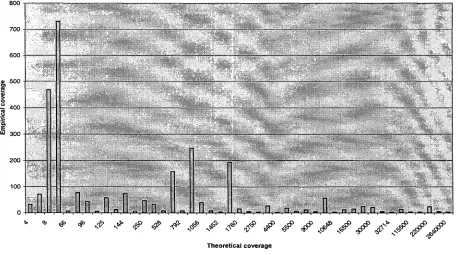
Our second try has not only concerned the theoretical coverage of G clauses but also their empirical coverage. This second measure that we have defined is the number of E + that are really covered by each clause of G. We then con- sider the distribution of the empirical coverage of G clauses on the theoretical coverages of these clauses, that is, we consider the graph in which, for each different theoretical measure value for G clauses, we draw a line whose length corre- sponds to the total number of E + covered by the G clauses that have this theoretical cover- age value. Here two gaussians clearly appear (cf. figure 1), one for rather specific clauses and the other for more general ones. We have there- fore decided to keep all the generalized clauses produced by Progol.
8 0 0
7 0 0
6 0 0
5OO
4 0 0
u l 3 0 0
200
100
!!iiii~i~ii!ii!i!iiii!iiii!iiii~iiiii!iil
Theoretical coverage
Figure 1: Distribution of
The second point concerns the determination of a measure of the quality of the learning for the parameter setting. We are especially interested in the percentage of E + that are covered by the generalized clauses, and if we permit some noise in Progol parameter adjustment to allow more generalizations, by the percentage of E - that are rejected by these generalized clauses. The measure of the recall and the precision rates of the learning method can be summarized in a Pearson coefficient:
Pearson = ( T P , T N ) - ( F P , F N ) x / P r P * P r N * A P * A N
where A = actual, Pr = predicated, P -- pos- itive, N = negative, T = true, F = false; the more close to 1 this value is, the better the learning is.
The results for our learning method with a rate of Progol noise equal to 0 are the following: from the 4031 initial E + and the 6922 initial E - , the 109 generalized clauses produced by Progol cover 2485 E + and 0 E - ; 1546 E + and 6922 E -
positive examples on clauses
are therefore uncovered; the value of the Pear- son coefficient is 0.71. (NB: Figure 1 illustrates these results).
We have developed a Perl program whose role is to find which Progol noise rate leads to the best results. This Progol noise rate is equal to 37. With this rate, the results are the following: from the 4031 initial E + and the 6922 initial E - , the 66 generalized clauses produced by Progol cover 3547 E + and 348 E - ; 484 E + and 6574 E - are therefore uncovered; the value of the Pear- son coefficient is 0.84. The stability of the set of learnt generalized clauses has been tested.
4.2 E m p i r i c a l v a l i d a t i o n
[image:7.596.62.520.129.384.2]icant nouns of the domain.
A Perl p r o g r a m presents to one expert all the N-V pairs t h a t appear in one sentence in a part of the corpus and include one of the studied nouns. T h e expert m a n u a l l y tags each pair as relevant or not. This tagging is t h e n compared to the results obtained for these N-V pairs of the same part of the corpus by the application of the generalized clauses learnt wit]h Progol.
T h e results for seven significant nouns (vis, @crou, porte, voyant, prise, capot, bouchon) 17
are presented in table 1. In the left column, one N-V pair is considered as tagged "relevant" by the generalized clauses if at least one of t h e m covers this pair; in the right one, at least six different clauses of G must cover a pair for it to be said correctly d e t e c t e d by the generalized clauses; the aim of this second test is to reduce noise in the results.
1 occurrence 6 occurrences correctly found: 49 correctly found: 23 incorrectly found: 54 incorrectly found: 4 not found: 10 not found: 36 Pearson = 0.5138 Pearson = 0.5209
Table 1: Empirical validation on M a t r a C C R corpus
T h e results are quite promising, especially if we compare t h e m to those obtain by Chi-square correlation (cf. table 2). This comparison is interesting because Chi-square is the first step of our selection of N-V couples in the corpus (cf. subsection 3.2).
correctly found: 38 incorrectly found: 124 not found: 21
Pearson = 0.1206
Table 2: Chi-square results on M a t r a C C R cor- pus
5 C o n c l u s i o n
T h e Inductive Logic P r o g r a m m i n g learning m e t h o d t h a t we have proposed in order to de- fine what is a N-V pair whose elements are
17(screw, nut, door, indicator signal, plug, cowl, cap).
b o u n d by one of the qualia relations in Puste- jovsky's Generative Lexicon formalism leads to very promising results: 83.05% of relevant pairs (after one occurrence) are d e t e c t e d for seven sig- nificant nouns; these results have to be com- pared with the 64% results of Chi-square. It is worth noticing t h a t b e y o n d this simple com- parison with one of the possible pure statis- tics based m e t h o d is, t h e interest of using ILP learning is its e x p l a n a t o r y characteristic; and it is this characteristic t h a t have motivated our choice: c o n t r a r y to statistical methods, our ILP m e t h o d does not just e x t r a c t statistically corre- lated pairs b u t it p e r m i t s to a u t o m a t i c a l l y learn rules t h a t distinguish relevant pairs from others. T h e fact t h a t noise has to be used in Progol to obtain these results however means t h a t some- thing is missing in our E + to fully define the concept "qualia pair" versus "not qualia pair"; some E - have to be covered to define it better. A piece of information, m a y b e syntactic a n d / o r semantic is missing in our E + to fully character- ize it. This fact can be easily illustrated by the following example: 'Verbinf det N' structures are generally relevant (ouvrir la p o r t e 19, etc.), except w h e n t h e N indicates a collection of ob- jects (nettoyer l'ensemble du rdservoir 2°) or a part of an object (vider le fond du rdservoir21).
A simple POS-tagging of t h e sentences offers no difference between them. We are currently working on a semantic tagging of the M a t r a C C R corpus in order to improve the results.
A n o t h e r f u t u r e work concerns the a u t o m a t i c distinction between t h e various qualia roles dur- ing learning. T h e last phase of the project will deal with the real use of t h e N-V pairs obtained by the machine learning m e t h o d within one in- formation retrieval s y s t e m and the evaluation of the improvement of its performances.
R e f e r e n c e s
Rajeev Agarwal. 1995. Semantic Feature Extraction from Technical Texts with Limited Human Inter- vention. Ph.D. thesis, Mississippi State Univer- sity, USA.
Susan Armstrong, Pierrette Bouillon, and Gilbert Robert. 1 9 9 5 . Tagger Overview.
lSThis comparison could be extended to other corpus frequency based technics (mutual information, etc.).
Technical report, ISSCO, (http://issco- www.unige.ch/staff/robert/tatoo/tagger.html). Susan Armstrong. 1996. Multext: Multilingual
Text Tools and Corpora. In H. Feldweg and W. Hinrichs, editors, Lexikon und Text, pages 107-119. Tiibingen: Niemeyer.
Christian Bassac and Pierrette Bouillon. 2000. The Polymorphism of Verbs Exhibiting Middle Tran- sitive Alternations in English. Technical report, ISSCO.
Jacques Bouaud, Beno~t Habert, Adeline Nazarenko, and Pierre Zweigenbaum. 1997. Regroupe- ments issus de d@pendances syntaxiques en cor- pus : cat@gorisation et confrontation avec deux mod@lisations conceptuelles. In Proceedings of Ingdnierie de la Connaissance, Roscoff, France. Pierrette Bouillon and Federica Busa. 2000. Gener-
ativity in the Lexicon. CUP:Cambridge, In Press. Pierrette Bouillon, Sabine Lehmann, Sandra Manzi, and Dominique Petitpierre. 1998. DSveloppement de lexiques ~ grande @chelle. In Proceedings of colloque de Tunis 1997 "La mgmoire des mots', Tunis, Tunisie.
Ted Briscoe and John Carroll. 1997. Automatic Ex- traction of Subcategorisation from Corpora. In
Proceedings of 5th ACL conference on Applied Natural Language Processing, Washington, USA. James Cussens. 1996. Part-of-Speech Disambigua- tion using ILP. Technical report, Oxford Univer- sity Computing Laboratory.
C@cile Fabre and Pascale S~billot. 1999. Seman- tic Interpretation of Binominal Sequences and In- formation Retrieval. In Proceedings of Interna- tional ICSC Congress on Computational Intelli- gence: Methods and Applications, CIMA '99, Sym- posium on Advances in Intelligent Data Analysis AIDA '99, Rochester, N.Y., USA.
David Faure and Claire N@dellec. 1999. Knowledge Acquisition of Predicate Argument Structures from Technical Texts using Machine Learning: the System ASIUM. In Dieter Fensel Rudi Studer, editor, Proceedings of 11th European Workshop EKAW'99, Dagstuhl, Germany. Springer-Verlag. Christiane Fellbaum, editor. 1998. WordNet: An
Electronic Lexical Database. MIT Press, Cam- bridge, MA.
Gregory Grefenstette. 1994a. Corpus-Derived First, Second and Third-Order Word Affinities. In
Proceedings of EURALEX'9~, Amsterdam, The Netherlands.
Gregory Grefenstette. 1994b. Explorations in Auto- matic Thesaurus Discovery. Dordrecht: Kluwer Academic Publishers.
Gregory Grefenstette. 1997. SQLET: Short Query Linguistic Expansion Techniques, Palliating One- Word Queries by Providing Intermediate Struc-
ture to Text. In McGill-University, editor, Pro- ceedings of Recherche d'Informations Assistde par Ordinateur, RIAO'g7, Montr@al, Qu@bec, Canada.
Beno~t Habert, Adeline Nazarenko, and Andr@ Salem. 1997. Les linguistiques de corpus. Ar- mand Collin/Masson, Paris.
Zelig Harris, Michael Gottfried, Thomas Ryckman, Paul Mattick(Jr), Anne Daladier, Tzvee N. Har- ris, and Suzanna Harris. 1989. The Form of Information in Science, Analysis of Immunology Sublanguage. Kluwer Academic Publisher, Dor- drecht.
Marti A. Hearst. 1992. Automatic Acquisition of Hyponyms from Large Text Corpora. In
Proceedings of 15th International Conference on Computational Linguistics, COLING-92, Nantes, France.
Tom M. Mitchell. 1997. Machine Learning.
McGraw-Hill.
Raymond Mooney. 1999. Learning for Semantic In- terpretation: Scaling Up without Dumbing Down. In Proceedings of Learning Language in Logic, LLL99, Bled, Slovenia.
Emmanuel Morin. 1997: Extraction de liens s@mantiques entre termes dans des corpus de textes techniques : application ~ l'hyponymie. In Proceedings of Traitement Automatique des Langues Naturelles, TALN'97, Grenoble, France. Stephen Muggleton and Luc De-Raedt. 1994. In-
ductive Logic Programming: Theory and Meth- ods. Journal of Logic Programming, 19-20:629- 679.
Stephen Muggleton. 1995. Inverse Entailment and Progol. New Generation Computing, 13(3-4):245- 286.
Dominique Petitpierre and Graham Russell. 1998. Mmorph - the Multext Morphology Program. Technical report, ISSCO.
Ronan Pichon and Pascale S~billot. 1997. Acquisi- tion automatique d'informations lexicales ~ partir de corpus : un brian. Research report n°3321, IN- RIA, Rennes.
Ronan Pichon and Pascale S@billot. 1999. From Corpus to Lexicon: from Contexts to Semantic Features. In Proceedings of Practical Applications in Language Corpora, PALC'99, to appear, Lodz, Poland.
James Pustejovsky, Peter Anick, and Sabine Bergler. 1993. Lexical Semantic Techniques for Corpus Analysis. Computational Linguistics, 19(2). James Pustejovsky. 1995. The Generative Lexicon.
Cambridge:MIT Press.
Propositional Data. In Springer-Verlag, editor,