Probabilistic Head-Driven Parsing for Discourse Structure
Jason Baldridge and Alex Lascarides
School of Informatics University of Edinburgh
2 Buccleuch Place Edinburgh, EH8 9LW
Scotland, UK
{jbaldrid,alex}@inf.ed.ac.uk
Abstract
We describe a data-driven approach to building interpretable discourse structures for appointment scheduling dialogues. We represent discourse structures as headed trees and model them with probabilis-tic head-driven parsing techniques. We show that dialogue-based features regard-ing turn-takregard-ing and domain specific goals have a large positive impact on perfor-mance. Our best model achieves an f -score of 43.2% for labelled discourse rela-tions and 67.9% for unlabelled ones, sig-nificantly beating a right-branching base-line that uses the most frequent relations.
1 Introduction
Achieving a model of discourse interpretation that is both robust and deep is a major challenge. Consider the dialogue in Figure 1 (the sentence numbers are from the Redwoods treebank (Oepen et al., 2002)). A robust and deep interpretation of it should resolve the anaphoric temporal description in utterance 154 to the twenty sixth ofJulyin the afternoon. It should identify that time and before 3pm on the twenty-seventh as potential times to meet, while ruling out July thirtieth to August third. It should gracefully handle incomplete or ungrammatical utterances like 152 and recognise that utterances 151 and 152 have no overall effect on the time and place to meet.
According to Hobbs et al. (1993) and Asher and Lascarides (2003), a discourse structure consisting of hierarchical rhetorical connections between utter-ances is vital for providing aunified modelof a wide
149 PAM:maybe we can get together, and, discuss, the planning, say, two hours, in the next, couple weeks,
150 PAM:let me know what your schedule is like.
151 CAE:okay, let me see.
152 CAE:twenty,
153 CAE:actually, July twenty sixth and twenty seventh looks good,
154 CAE:the twenty sixth afternoon,
155 CAE:or the twenty seventh, before three p.m., geez.
156 CAE:I am out of town the thirtieth through the,
157 CAE:the third, I am in San Francisco.
Figure 1: A dialogue extract from Redwoods.
range of anaphoric and intentional discourse phe-nomena, contributing to the interpretations of pro-nouns, temporal expressions, presuppositions and ellipses (among others), as well as influencing com-municative goals. This suggests that a robust model of discourse structure could complement current ro-bust interpretation systems, which tend to focus on onlyoneaspect of the semantically ambiguous ma-terial, such as pronouns (e.g., Str¨ube and M¨uller (2003)), definite descriptions (e.g., Vieira and Poe-sio (2000)), or temporal expresPoe-sions (e.g., Wiebe et al. (1998)). This specialization makes it hard to assess how they would perform in the context of a more comprehensive set of interpretation tasks.
to create classifiers for discourse segmentation and for identifying rhetorical relations. Together, these amount to a model of discourse parsing. However, the results are trees of Rhetorical Structure Theory (RST) (Mann and Thompson, 1986), and the
clas-sifiers rely on well-formedness constraints on RST
trees which are too restrictive (Moore and Pollack, 1992). Furthermore, RSTdoes not offer an account
of how compositional semantics gets augmented, nor does it model anaphora. It is also designed for monologue rather than dialogue, so it does not of-fer a precise semantics of questions or non-sentential utterances which convey propositional content (e.g., 154 and 155 in Figure 1). Another main approach to robust dialogue processing has been statistical mod-els for identifying dialogue acts (e.g., Stolcke et al. (2000)). However, dialogue acts are properties of utterances rather than hierarchically arranged rela-tionsbetweenthem, so they do not provide a basis for resolving semantic underspecification generated by the grammar (Asher and Lascarides, 2003).
Here, we present the first probabilistic approach to parsing the discourse structure of dialogue. We use dialogues from Redwoods’ appointment scheduling domain and adapt head-driven genera-tive parsing strategies from sentential parsing (e.g., Collins (2003)) for discourse parsing. The discourse structures we build conform to Segmented Dis-course Representation Theory (SDRT) (Asher and
Lascarides, 2003).SDRTprovides a precise dynamic
semantic interpretation for its discourse structures which augments the conventional semantic repre-sentations that are built by most grammars. We thus view the task of learning a model ofSDRT-style
dis-course structures as one step towards achieving the goal of robust and precise semantic interpretations.
We describe SDRT in the context of our domain
in Section 2. Section 3 discusses how we encode and annotate discourse structures as headed trees for our domain. Section 4 provides background on probabilistic head-driven parsing models, and Sec-tion 5 describes how we adapt the approach for dis-course and gives four models for disdis-course parsing. We report results in Section 6, which show the im-portance of dialogue-based features on performance. Our best model performs far better than a baseline that uses the most frequent rhetorical relations and right-branching segmentation.
h0 : Request-Elab(149,150)∧
Plan-Elab(150, h1)
h1 : Elaboration(153, h2)∧
Continuation(153,156)∧
Continuation(156,157)
h2 : Alternation(154,155)
Figure 2: TheSDRSfor the dialogue in Figure 1.
2 Segmented Discourse Representation Theory
SDRTextends prior work in dynamic semantics (e.g.,
van Eijk and Kamp (1997)) via logical forms that feature rhetorical relations. The logical forms con-sist of speech act discourse referents which la-bel content (either of a clause or of text seg-ments). Rhetorical relations such as Explanation
relate these referents. The resulting structures are called segmented discourse representation struc-tures or SDRSs. An SDRS for the dialogue in
Fig-ure 1 is given in FigFig-ure 2; we have used the numbers of the elementary utterances from Redwoods as the speech act discourse referents but have omitted their labelled logical forms. Note that utterances 151 and 152, which do not contribute to the truth conditions of the dialogue, are absent – we return to this shortly. There are several things to note about thisSDRS.
First, SDRT’s dynamic semantics of rhetorical
rela-tions imposes constraints on the contents of its argu-ments. For example,Plan-Elab(150, h1)(standing
forPlan-Elaboration) means thath1provides
infor-mation from which the speaker of 150 can elaborate a plan to achieve their communicative goal (to meet for two hours in the next couple of weeks). The relation Plan-Elab contrasts with Plan-Correction, which would relate the utterances in dialogue (1):
(1) a. A:Can we meet at the weekend?
b. B:I’m afraid I’m busy then.
Pair): this means that (1b) provides sufficient infor-mation for the questionerAto infer a direct answer to his question (Asher and Lascarides, 2003).
The relation Elaboration(153, h2) in Figure 2
means that the segment 154 to 155 resolves to a proposition which elaborates part of the content of the proposition 153. Therefore the twenty sixth in 154 resolves to the twenty sixth ofJuly—any other interpretation contradicts the truth conditional con-sequences of Elaboration. Alternation(154,155)
has truth conditions similar to (dynamic) disjunc-tion. Continuation(156,157) means that 156 and
157 have a common topic (here, this amounts to a proposition about whenCAEis unavailable to meet).
The second thing to note about Figure 2 is how one rhetorical relation can outscope another: this creates a hierarchical segmentation of the discourse. For example, the second argument to the Elabo-ration relation is the label h2 of the Alternation
-segment relating 154 to 155. Due to the semantics ofElaborationandAlternation, this ensures that the dialogue entails that one of 154 or 155 is true, but it does not entail 154, nor 155.
Finally, observe that SDRT allows for a
situ-ation where an utterance connects to more than one subsequent utterance, as shown here with
Elaboration(153, h2)∧Continuation(153,156). In
fact, SDRTalso allows two utterances to be related
by multiple relations (see (1)) and it allows an utter-ance to rhetorically connect to multiple utterutter-ances in the context. These three features ofSDRTcapture the
fact that an utterance can make more than one illo-cutionary contribution to the discourse. An example of the latter kind of structure is given in (2):
(2) a. A:Shall we meet on Wednesday?
b. A:How about one pm?
c. B:Would one thirty be OK with you?
The SDRS for this dialogue would feature the
re-lations Plan-Correction(2b,2c), IQAP(2b,2c) and Q-Elab(2a,2c). Q-Elab, orQuestion-Elaboration,
always takes a question as its second argument; any answers to the question must elaborate a plan to achieve the communicative goal underlying the first argument to the relation. From a logical per-spective, recognising Plan-Correction(2b,2c) and Q-Elab(2a,2c)are co-dependent.
Segment/h0
ind
149
Request-Elab imp
150
Plan-Elab Segment/h1
Pass pause
151
irr
152
ind
153
Elaboration/h2
ind
154
Alternation ind
155
Continuation ind
156
Continuation ind
[image:3.612.313.564.54.203.2]157
Figure 3: The discourse structure for the dialogue from Figure 1 in tree form.
3 Augmenting the Redwoods treebank with discourse structures
Our starting point is to create training material for probabilistic discourse parsers. For this, we have augmented dialogues from the Redwoods Treebank (Oepen et al., 2002) with their analyses within a fragment ofSDRT(Baldridge and Lascarides, 2005).
This is a very different effort from that being pur-sued for the Penn Discourse Treebank (Miltsakaki et al., 2004), which uses discourse connectives rather than abstract rhetorical relations like those in
SDRTin order to provide theory neutral annotations.
Our goal is instead to leverage the power of the se-mantics provided bySDRT’s relations, and in
partic-ular to do so for dialogue as opposed to monologue. Because the SDRS-representation scheme, as
shown in Figure 2, uses graph structures that do not conform to tree constraints, it cannot be combined directly with statistical techniques from sentential parsing. We have therefore designed a headed tree encoding ofSDRSs, which can be straightforwardly
modeled with standard parsing techniques and from whichSDRSs can be recovered.
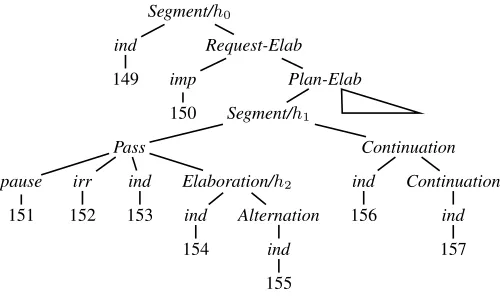
For instance, the tree for the dialogue in Figure 1 is given in Figure 3. TheSDRSin Figure 2 is
recov-ered automatically from it. In this tree, utterances are leaves which are immediately dominated by their tag, indicating either the sentence mood (indicative,
interrogative orimperative) or that it isirrelevant, a
leaf utterance tagged with its sentence mood. Non-terminal nodes may in addition have any number of daughterirr,pauseandplsnodes, and an additional daughter labelled with a rhetorical relation.
The notion of headedness has no status in the se-mantics of SDRSs themselves. The heads of these
discourse trees are not like verbal heads with sub-categorization requirements in syntax; here, they are nothing more than the left argument of a rhetor-ical relation, like 154 in Alternation(154,155). Nonetheless, defining one of the arguments of rhetorical relations as a head serves two main pur-poses. First, it enables a fully deterministic algo-rithm for recovering SDRSs from these trees.
Sec-ond, it is also crucial for creating probabilistic head-driven parsing models for discourse structure.
Segment andPassare non-rhetorical node types. The former explicitly groups multiple utterances. The latter allows its head daughter to enter into re-lations with segments higher in the tree. This allows us to represent situations where an utterance attaches to more than one subsequent utterance, such as 153 in dialogue (1). Annotators manually annotate the rhetorical relation,SegmentandPassnodes and de-termine their daughters. They also tag the individual utterances with one of the three sentence moods or
irr, pauseorpls. The labels for segments (e.g.,h0
andh1 in Figure 3) are added automatically.
Non-veridical relations such asAlternationalso introduce segment labels on their parents; e.g.,h2 in Figure 3.
The SDRS is automatically recovered from this
tree representation as follows. First, each rela-tion node generates a rhetorical connecrela-tion in the
SDRS: its first argument is the discourse referent
of its parent’s head daughter, and the second is the discourse referent of the node itself (which unless stated otherwise is its head daughter’s discourse ref-erent). For example, the structure in Figure 3 yields
Request-Elab(149,150), Alternation(154,155)and Elaboration(153, h2). The labels for the relations
in theSDRS—which determine segmentation—must
also be recovered. This is easily done: any node which has a segment label introduces anoutscopes
relation between that and the discourse referents of the node’s daughters. This produces, for ex-ample, outscopes(h0,149), outscopes(h1,153) and
outscopes(h2,154). It is straightforward to
deter-mine the labels of all the rhetorical relations from
these conditions. Utterances such as 151 and 152, which are attached withpauseandirrto indicate that they have no overall truth conditional effect on the dialogue, are ignored when constructing the SDRS,
soSDRTdoes not assign these terms any semantics.
Overall, this algorithm generates the SDRS in
Fig-ure 2 from the tree in FigFig-ure 3.
Thus far, 70 dialogues have been annotated and reviewed to create our gold-standard corpus. On av-erage, these dialogues have 237.5 words, 31.5 ut-terances, and 8.9 speaker turns. In all, there are 30 different rhetorical relations in the inventory for this annotation task, and 6 types of tags for the utterances themselves:ind,int,imp,pause,irrandpls.
Finally, we annotated all 6,000 utterances in the Verbmobil portion of Redwoods with the following: whether the time mentioned (if there is one) is a good time to meet (e.g., I’m free then or Shall we meet at 2pm?) or a bad time to meet (e.g.,I’m busy thenorLet’s avoid meeting at the weekend). These are used as features in our model of discourse struc-ture (see Section 5). We use these so as to minimise using directly detailed features from the utterances themselves (e.g. the fact that the utterance contains the wordfreeorbusy, or that it contains a negation), which would lead to sparse data problems given the size of our training corpus. We ultimately aim to
learn good-time and bad-time from sentence-level features extracted from the 6,000 Redwoods analy-ses, but we leave this to future work.
4 Generative parsing models
the utterances/segments which are being considered, and lexicalisation allows the model to probabilisti-cally relate such utterances/segments very directly.
Probabilistic Context Free Grammars (PCFGs) determine the conditional probability of a right-hand side of a rule given the left-right-hand side, P(RHS|LHS). Collins instead decomposes the
calculation of such probabilities by first generating a head and then generating its left and right modifiers independently. In a supervised setting, doing this gathers a much larger set of rules from a set of la-belled data than a standard PCFG, which learns only rules that are directly observed.1
The decomposition of a rule begins by noting that rules in a lexicalised PCFG have the form:
P(h)→Ln(ln). . . L1(l1)H(h)R1(r1). . . Rm(rm)
whereh is the head word,H(h) is the label of the
head constituent,P(h)is its parent, andLi(li) and Ri(ri) are thenleft andmright modifiers, respec-tively. It is also necessary to includeST OP sym-bols Ln+1 and Rm+1 on either side to allow the
Markov process to properly model the sequences of modifiers. By assuming these modifiers are gener-ated independently of each other but are dependent on the head and its parent, the probability of such expansions can be calculated as follows (wherePh, Pl and Pr are the probabilities for the head, left-modifiers and right-left-modifiers respectively):
P(Ln(ln). . . L1(l1)H(h)R1(r1). . . Rm(rm)|P(h)) = Ph(H|P(h))
× Y
i=1...n+1
Pl(Li(li)|P(h), H)
× Y
i=1...m+1
Pr(Ri(ri)|P(h), H)
This provides the simplest of models. More con-ditioning information can of course be added from any structure which has already been generated. For example, Collins’ model 1 adds a distance feature that indicates whether the head and modifier it is generating are adjacent and whether a verb is in the string between the head and the modifier.
1A similar effect can be achieved by converting n-ary trees
to binary form.
5 Discourse parsing models
In Section 3, we outlined howSDRSs can be
repre-sented as headed trees. This allows us to create pars-ing models for discourse that are directly inspired by those described in the previous section. These mod-els are well suited for our discourse parsing task. They are lexicalised, so there is a clear place in the discourse model for incorporating features from ut-terances: simply replace lexical heads with whole utterances, and exploit features from those utter-ances in discourse parsing in the same manner as lexical features are used in sentential parsing.
Discourse trees contain a much wider variety of kinds of information than syntactic trees. The leaves of these trees are sentences with full syntactic and semantic analyses, rather than words. Furthermore, each dialogue has two speakers, and speaker style can change dramatically from dialogue to dialogue. Nonetheless, the task is also more constrained in that there are fewer overall constituent labels, there are only a few labels which can act as heads, and trees are essentially binary branching apart from constituents containing ignorable utterances.
The basic features we use are very similar to those for the syntactic parsing model given in the previous section. The featureP is the parent label that is the starting point for generating the head and its modi-fiers.H is the label of the head constituent. The tag tis also used, except that rather than being a part-of-speech, it is either a sentence mood label (ind,int, or
imp) or an ignorable label (irr, pls, orpause). The word featurewin our model is the first discourse cue phrase present in the utterance.2 In the absence of a
cue phrase,wis the empty string. The distance fea-ture∆is true if the modifier being generated is
adja-cent to the head and false otherwise. To incorporate a larger context into the conditioning information, we also utilize a featureHCR, which encodes the child relation of a node’s head.
We have two features that are particular to dia-logue. The firstST, indicates whether the head ut-terance of a segment starts a turn or not. The other, T C, encodes the number of turn changes within a segment with one of the values0,1, or≥2.
Finally, we use the good/bad-time annotations discussed in Section 3 for a featureT M indicating
Head features Modifier features
P t w HCR ST TC TM P t w H ∆ HCR ST TC TM
Model 1 X X X X X X X X
Model 2 X X X X X X X X X X X X
Model 3 X X X X X X X X X X X X X X
[image:6.612.74.528.55.140.2]Model 4 X X X X X X X X X X X X X X X X
Figure 4: The features active for determining the head and modifier probabilities in each of the four models.
one of the following values for the head utterance of a segment:good time,bad time,neither, orboth.
With these features, we create the four models given in Figure 4. As example feature values, con-sider theSegmentnode labelledh1in Figure 3. Here,
the features have as values: P=Segment, H=Pass, t=ind (the tag of utterance 153), w=Actually (see 153 in Figure 1), HCR=Elaboration, ST=false, T C=0, andT M=good time.
As is standard, linear interpolation with back-off levels of decreasing specificity is used for smooth-ing. Weights for the levels are determined as in Collins (2003).
6 Results
For our experiments, we use a standard chart parsing algorithm with beam search that allows a maximum of 500 edges per cell. The figure of merit for the cut-off combines the probability of an edge with the prior probability of its label, head and head tag. Hy-pothesized trees that do not conform to some simple discourse tree constraints are also pruned.3
The parser is given the elementary discourse units as defined in the corpus. These units correspond di-rectly to the utterances already defined in Redwoods and we can thus easily access their complete syntac-tic analyses directly from the treebank.
The parser is also given the correct utterance moods to start with. This is akin to getting the cor-rect part-of-speech tags in syntactic parsing. We do this since we are using the parser for semi-automated annotation. Tagging moods for a new discourse is a very quick and reliable task for the human. With them the parser can produce the more complex hierarchical structure more accurately than if it had to guess them – with the potential to dra-matically reduce the time to annotate the discourse 3E.g., nodes can have at most one child with a relation label.
structures of further dialogues. Later, we will create a sentence mood tagger that presents an n-best list for the parser to start with, from the tag setind, int, imp, irr, pause,andpls.
Models are evaluated by using a leave-one-out strategy, in which each dialogue is parsed after train-ing on all the others. We measure labelled and un-labelled performance with both the standard PAR -SEVAL metric for comparing spans in trees and a
relation-based metric that compares theSDRS’s
pro-duced by the trees. The latter gives a more direct in-dication of the accuracy of the actual discourse log-ical form, but we include the former to show perfor-mance using a more standard measure. Scores are globally determined rather than averaged over all in-dividual dialogues.
For the relations metric, the relations from the derived discourse tree for the test dialogue are ex-tracted; then, the overlap with relations from the corresponding gold standard tree is measured. For labelled performance, the model is awarded a point for a span or relation which has the correct discourse relation label and both arguments are correct. For unlabelled, only the arguments need to be correct.4
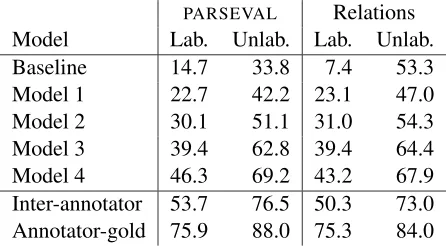
Figure 5 provides the f-scores5 of the various models and compares them against those of a base-line model and annotators. All differences between models are significant, using a pair-wise t-test at 99.5% confidence, except that between the baseline and Model 2 for unlabelled relations.
The baseline model is based on the most frequent way of attaching the current utterance to its
dia-4This is a much stricter measure than one which measures
relations between a head and its dependents in syntax because it requires twosegmentsrather than two heads to be related cor-rectly. For example, Model 4’s labelled and unlabelled relation f-scores using segments are 43.2% and 67.9%, respectively; on a head-to-head basis, they rise to 50.4% and 81.8%.
PARSEVAL Relations
[image:7.612.72.295.56.179.2]Model Lab. Unlab. Lab. Unlab. Baseline 14.7 33.8 7.4 53.3 Model 1 22.7 42.2 23.1 47.0 Model 2 30.1 51.1 31.0 54.3 Model 3 39.4 62.8 39.4 64.4 Model 4 46.3 69.2 43.2 67.9 Inter-annotator 53.7 76.5 50.3 73.0 Annotator-gold 75.9 88.0 75.3 84.0
Figure 5: Model performance.
logue context. The baseline is informed by the gold-standard utterance moods. For this corpus, this re-sults in a baseline which is a right-branching struc-ture, where the relationPlan-Elaborationis used if the utterance is indicative, Question-Elaboration if it is interrogative, and Request-Elaboration if it is imperative. The baseline also appropriately handles ignorable utterances (i.e, those with the mood labels irrelevant, pause, or pleasantry).
The baseline performs poorly on labelled rela-tions (7.4%), but is more competitive on unlabelled ones (53.3%). The main reason for this is that it takes no segmentation risks. It simply relates every non-ignorable utterance to the previous one, which is indeed a typical configuration with com-mon content-level relations likeContinuation. The generative models take risks that allow them to cor-rectly identify more complex segments – at the cost of missing some of these easier cases.
Considering instead thePARSEVALscores for the
baseline, the labelled performance is much higher (14.7%) and the unlabelled is much lower (33.8%) than for relations. The difference in labelled per-formance is due to the fact that the intentional-level relations used in the baseline often have arguments that are multi-utterance segments in the gold stan-dard. These are penalized in the relations compar-ison, but the spans used in PARSEVAL are blind to
them. On the other hand, the unlabelled score drops considerably – this is due to poor performance on dialogues whose gold standard analyses do not have a primarily right-branching structure.
Model 1 performs most poorly of all the models. It is significantly better than the baseline on labelled relations, but significantly worse on unlabelled
rela-tions. All its features are derived from the structure of the trees, so it gets no clues from speaker turns or the semantic content of utterances.
Model 2 brings turns and larger context via the ST andHCRfeatures, respectively. This improves segmentation over Model 1 considerably, so that the model matches the baseline on unlabelled relations and beats it significantly on labelled relations.
The inclusion of theT Cfeature in Model 3 brings large (and significant) improvements over Model 2. Essentially, this feature has the effect of penalizing hypothesized content-level segments that span sev-eral turns. This leads to better ovsev-erall segmentation. Finally, Model 4 incorporates the domain-based T M feature that summarizes some of the semantic content of utterances. This extra information im-proves the determination of labelled relations. For example, it is especially useful in distinguishing a
Plan-Correctionfrom aPlan-Elaboration.
The overall trend of differences betweenPARSE -VAL and relations scoring show that PARSEVAL is
tougher on overall segmentation and relations scor-ing is tougher on whether a model got the right ar-guments for each labelled relation. It is the latter that ultimately matters for the discourse structures produced by the parser to be useful; nonetheless, the
PARSEVALscores do show that each model
progres-sively improves on capturing the trees themselves, and that even Model 1 – as a syntactic model – is far superior to the baseline for capturing the overall form of the trees.
We also compare our best model against two up-perbounds: (1) inter-annotator agreement on ten dialogues that were annotated independently and (2) the best annotator against the gold standard agreed upon after the independent annotation phase. For the first, the labelled/unlabelled relations f -scores are 50.3%/73.0% and for the latter, they are 75.3%/84.0%—this is similar to the performance on other discourse annotation projects, e.g., Carlson et al. (2001). On the same ten dialogues, Model 4 achieves 42.3%/64.9%.
from the Redwoods annotations rather than estimat-ing them. Even so, it is interestestimat-ing that the scores reported in Marcu (1999) for labelled and unlabelled relations are similar to our scores for Model 4.
7 Conclusion
In this paper, we have shown how the complex task of creating structures for SDRTcan be adapted to a
standard probabilistic parsing task. This is achieved via a headed tree representation from which SDRSs
can be recovered. This enables us to directly ap-ply well-known probabilistic parsing algorithms and use features inspired by them. Our results show that using dialogue-based features are a major factor in improving the performance of the models, both in terms of determining segmentation appropriately and choosing the right relations to connect them.
There is clearly a great deal of room for improve-ment, even with our best model. Even so, that model performed sufficiently well for use in semi-automated annotation: when correcting the model’s output on ten dialogues, one annotator took 30 sec-onds per utterance, compared to 39 for another an-notator working on the same dialogues with no aid.
In future work, we intend to exploit an exist-ing implementation ofSDRT’s semantics (Schlangen
and Lascarides, 2002), which adopts theorem prov-ing to infer resolutions of temporal anaphora and communicative goals fromSDRSs for scheduling
di-alogues. This additional semantic content can in turn be added (semi-automatically) to a training cor-pus. This will provide further features for ing discourse structure and opportunities for learn-ing anaphora and goal information directly.
Acknowledgments
This work was supported by Edinburgh-Stanford Link R36763, ROSIE project. Thanks to Mirella La-pata and Miles Osborne for comments.
References
N. Asher and A. Lascarides. Logics of Conversation. Cam-bridge University Press, 2003.
J. Baldridge and A. Lascarides. Annotating discourse struc-tures for robust semantic interpretation. InProceedings of the 6th International Workshop on Computational Seman-tics, Tilburg, The Netherlands, 2005.
L. Carlson, D. Marcu, and M. Okurowski. Building a discourse-tagged corpus in the framework of rhetorical structure the-ory. InProceedings of the 2nd SIGDIAL Workshop on Dis-course and Dialogue, Eurospeech, 2001.
M. Collins. Head-driven statistical models for natural language parsing.Computational Linguistics, 29(4):589–638, 2003. J. R. Hobbs, M. Stickel, D. Appelt, and P. Martin. Interpretation
as abduction.Artificial Intelligence, 63(1–2):69–142, 1993. W. C. Mann and S. A. Thompson. Rhetorical structure theory:
Description and construction of text structures. In G. Kem-pen, editor,Natural Language Generation: New Results in Artificial Intelligence, pages 279–300. 1986.
D. Marcu. The rhetorical parsing of unrestricted natural lan-guage texts. InProceedings of ACL/EACL, pages 96–103, Somerset, New Jersey, 1997.
D. Marcu. A decision-based approach to rhetorical parsing. InProceedings of the 37th Annual Meeting of the Associa-tion for ComputaAssocia-tional Linguistics (ACL99), pages 365–372, Maryland, 1999.
E. Miltsakaki, R. Prasad, A. Joshi, and B. Webber. The Penn Discourse TreeBank. InProceedings of the Language Re-sources and Evaluation Conference, Lisbon, Portugal, 2004. J. D. Moore and M. E. Pollack. A problem for RST: The need for multi-level discourse analysis. Computational Linguis-tics, 18(4):537–544, 1992.
S. Oates. Generating multiple discourse markers in text. Mas-ter’s thesis, ITRI, University of Brighton, 2001.
S. Oepen, E. Callahan, C. Manning, and K. Toutanova. LinGO Redwoods—a rich and dynamic treebank forHPSG. In
Pro-ceedings of theLRECparsing workshop: BeyondPARSEVAL,
towards improved evaluation measures for parsing systems, pages 17–22, Las Palmas, 2002.
D. Schlangen and A. Lascarides. Resolving fragments using discourse information. InProceedings of the 6th Interna-tional Workshop on the Semantics and Pragmatics of Dia-logue (Edilog), Edinburgh, 2002.
R. Soricut and D. Marcu. Sentence level discourse parsing using syntactic and lexical information. InProceedings of Human Language Technology and North American Association for Computational Linguistics, Edmonton, Canada, 2003. A. Stolcke, K. Ries, N. Coccaro, E. Shriberg, D. Jurafsky
R. Bates, P. Taylor, R. Martin, C. van Ess-Dykema, and M. Meteer. Dialogue act modeling for automatic tagging and recognition of conversational speech. Computational Lin-guistics, 26(3):339–374, 2000.
M. Str¨ube and C. M¨uller. A machine learning approach to pro-noun resolution in spoken dialogue. InProceedings of the 41st Annual Meeting of the Association for Computational Linguistics (ACL2003), pages 168–175, 2003.
J. van Eijk and H. Kamp. Representing discourse in context. In J. van Benthem and A. ter Meulen, editors,Handbook of Logic and Linguistics, pages 179–237. Elsevier, 1997. R. Vieira and M. Poesio. Processing definite descriptions in
corpora. InCorpus-based and computational approaches to anaphora. UCL Press, 2000.