A Comparative Evaluation of Deep and Shallow Approaches to the
Automatic Detection of Common Grammatical Errors
Joachim Wagner, Jennifer Foster, and Josef van Genabith∗ National Centre for Language Technology
School of Computing, Dublin City University, Dublin 9, Ireland
{jwagner, jfoster, josef}@computing.dcu.ie
Abstract
This paper compares a deep and a shallow processing approach to the problem of clas-sifying a sentence as grammatically well-formed or ill-well-formed. The deep processing approach uses the XLE LFG parser and En-glish grammar: two versions are presented, one which uses the XLE directly to perform the classification, and another one which uses a decision tree trained on features con-sisting of the XLE’s output statistics. The shallow processing approach predicts gram-maticality based on n-gram frequency statis-tics: we present two versions, one which uses frequency thresholds and one which uses a decision tree trained on the frequen-cies of the rarest n-grams in the input sen-tence. We find that the use of a decision tree improves on the basic approach only for the deep parser-based approach. We also show that combining both the shallow and deep decision tree features is effective. Our eval-uation is carried out using a large test set of grammatical and ungrammatical sentences. The ungrammatical test set is generated au-tomatically by inserting grammatical errors into well-formed BNC sentences.
1 Introduction
This paper is concerned with the task of predict-ing whether a sentence contains a grammatical er-ror. An accurate method for carrying out automatic
∗Also affiliated to IBM CAS, Dublin.
grammaticality judgements has uses in the areas of computer-assisted language learning and grammar checking. Comparative evaluation of existing error detection approaches has been hampered by a lack of large and commonly used evaluation error cor-pora. We attempt to overcome this by automatically creating a large error corpus, containing four dif-ferent types of frequently occurring grammatical er-rors. We use this corpus to evaluate the performance of two approaches to the task of automatic error de-tection. One approach uses low-level detection tech-niques based on POS n-grams. The other approach is a novel parser-based method which employs deep linguistic processing to discriminate grammatical in-put from ungrammatical. For both approaches, we implement a basic solution, and then attempt to im-prove upon this solution using a decision tree clas-sifier. We show that combining both methods im-proves upon the individual methods.
N-gram-based approaches to the problem of error detection have been proposed and implemented in various forms by Atwell(1987), Bigert and Knutsson (2002), and Chodorow and Leacock (2000) amongst others. Existing approaches are hard to compare since they are evaluated on different test sets which vary in size and error density. Furthermore, most of these approaches concentrate on one type of gram-matical error only, namely, context-sensitive or real-word spelling errors. We implement a vanilla n-gram-based approach which is tested on a very large test set containing four different types of error.
The idea behind the parsbased approach to er-ror detection is to use a broad-coverage hand-crafted precision grammar to detect ungrammatical
tences. This approach exploits the fact that a pre-cision grammar is designed, in the traditional gen-erative grammar sense (Chomsky, 1957), to dis-tinguish grammatical sentences from ungrammati-cal sentences. This is in contrast to treebank-based grammars which tend to massively overgenerate and do not generally aim to discriminate between the two. In order for our approach to work, the coverage of the precision grammars must be broad enough to parse a large corpus of grammatical sentences, and for this reason, we choose the XLE (Maxwell and Kaplan, 1996), an efficient and robust parsing sys-tem for Lexical Functional Grammar (LFG) (Kaplan and Bresnan, 1982) and the ParGram English gram-mar (Butt et al., 2002) for our experiments. This sys-tem employs robustness techniques, some borrowed from Optimality Theory (OT) (Prince and Smolen-sky, 1993), to parse extra-grammatical input (Frank et al., 1998), but crucially still distinguishes between optimal and suboptimal solutions.
The evaluation corpus is a subset of an un-grammatical version of the British National Cor-pus (BNC), a 100 million word balanced corCor-pus of British English (Burnard, 2000). This corpus is ob-tained by automatically inserting grammatical errors into the original BNC sentences based on an analysis of a manually compiled “real” error corpus.
This paper makes the following contributions to the task of automatic error detection:
1. A novel deep processing XLE-based approach
2. An effective and novel application of decision tree machine learning to both shallow and deep approaches
3. A novel combination of deep and shallow pro-cessing
4. An evaluation of an n-gram-based approach on a wider variety of errors than has previously been carried out
5. A large evaluation error corpus
The paper is organised as follows: in Section 2, we describe previous approaches to the problem of error detection; in Section 3, a description of the error corpus used in our evaluation experiments is presented, and in Section 4, the two approaches to error detection are presented, evaluated, combined
and compared. Section 5 provides a summary and suggestions for future work.
2 Background
2.1 Precision Grammars
A precision grammar is a formal grammar designed to distinguish ungrammatical from grammatical sen-tences. This is in contrast to large treebank-induced grammars which often accept ungrammatical input (Charniak, 1996). While high coverage is required, it is difficult to increase coverage without also in-creasing the amount of ungrammatical sentences that are accepted as grammatical by the grammar. Most publications in grammar-based automatic error detection focus on locating and categorising errors and giving feedback. Existing grammars are re-used (Vandeventer Faltin, 2003), or grammars of limited size are developed from scratch (Reuer, 2003).
The ParGram English LFG is a hand-crafted broad-coverage grammar developed over several years with the XLE platform (Butt et al., 2002). The XLE parser uses OT to resolve ambiguities (Prince and Smolensky, 1993). Grammar constraints re-sulting in rare constructions can be marked as “dis-preferred” and constraints resulting in common un-grammatical constructions can be marked as “un-grammatical”. The use of constraint ordering and marking increases the robustness of the grammar, while maintaining the grammatical / ungrammati-cal distinction (Frank et al., 1998). The English Resource Grammar (ERG) is a precision Head-Driven Phrase Structure Grammar (HPSG) of En-glish (Copestake and Flickinger, 2000; Pollard and Sag, 1994). Its coverage is not as broad as the XLE English grammar. Baldwin et al. (2004) propose a method to identify gaps in the grammar. Blunsom and Baldwin (2006) report ongoing development.
adding additional OT marks for ungrammatical con-structions observed in a learner corpus. However, the evaluation is preliminary, on only 50 test items.
2.2 N-gram Methods
Most shallow approaches to grammar error detection originate from the area of real-word spelling error correction. A real-word spelling error is a spelling or typing error which results in a token which is an-other valid word of the language in question.
The (to our knowledge) oldest work in this area is that of Atwell (1987) who uses a POS tagger to flag POS bigrams that are unlikely according to a reference corpus. While he speculates that the bi-gram frequency should be compared to how often the same POS bigram is involved in errors in an error corpus, the proposed system uses the raw frequency with an empirically established threshold to decide whether a bigram indicates an error. In the same paper, a completely different approach is presented that uses the same POS tagger to consider spelling variants that have a different POS. In the example sentence I am very hit the POS of the spelling vari-ant hot/JJ is added to the list NN-VB-VBD-VBN of possible POS tags of hit. If the POS tagger chooses hit/JJ, the word is flagged and the correction hot is proposed to the user. Unlike most n-gram-based ap-proaches, Atwell’s work aims to detect grammar er-rors in general and not just real-word spelling erer-rors. However, a complete evaluation is missing.
The idea of disambiguating between the elements of confusion sets is related to word sense disam-biguation. Golding (1995) builds a classifier based on a rich set of context features. Mays et al. (1991) apply the noisy channel model to the disambiguation problem. For each candidate correction S′ of the
inputSthe probabilityP(S′)P(S|S′)is calculated
and the most likely correction selected. This method is re-evaluated by Wilcox-O’Hearn et al. (2006) on WSJ data with artificial real-word spelling errors.
Bigert and Knutsson (2002) extend upon a basic n-gram approach by attempting to match n-grams of low frequency with similar n-grams in order to re-duce overflagging. Furthermore, n-grams crossing clause boundaries are not flagged and the similarity measure is adapted in the case of phrase boundaries that usually result in low frequency n-grams.
Chodorow and Leacock (2000) use a mutual
iformation measure in addition to raw frequency of n-grams. Apart from this, their ALEK system employs other extensions to the basic approach, for exam-ple frequency counts from both generic and word-specific corpora are used in the measures. It is not reported how much each of these contribute to the overall performance.
Rather than trying to implement all of the pre-vious n-gram approaches, we implement the basic approach which uses rare n-grams to predict gram-maticality. This property is shared by all previous shallow approaches. We also test our approach on a wider class of grammatical errors.
3 Ungrammatical Data
In this section, we discuss the notion of an artifi-cial error corpus (Section 3.1), define the type of ungrammatical language we are dealing with (Sec-tion 3.2), and describe our procedure for creating a large artificial error corpus derived from the BNC (Section 3.3).
3.1 An Artificial Error Corpus
In order to meaningfully evaluate a shallow ver-sus deep approach to automatic error detection, a large test set of ungrammatical sentences is needed. A corpus of ungrammatical sentences can take the form of a learner corpus (Granger, 1993; Emi et al., 2004), i. e. a corpus of sentences produced by lan-guage learners, or it can take the form of a more gen-eral error corpus comprising sentences which are not necessarily produced in a language-learning context and which contain competence and performance er-rors produced by native and non-native speakers of the language (Becker et al., 1999; Foster and Vogel, 2004; Foster, 2005). For both types of error corpus, it is not enough to collect a large set of sentences which are likely to contain an error - it is also neces-sary to examine each sentence in order to determine whether an error has actually occurred, and, if it has, to note the nature of the error. Thus, like the cre-ation of a treebank, the crecre-ation of a corpus of un-grammatical sentences requires time and linguistic knowledge, and is by no means a trivial task.
in grammatical sentences. These transformations should be linguistically realistic and should, there-fore, be based on an analysis of naturally produced grammatical errors. Automatically generated error corpora have been used before in natural language processing. Bigert (2004) and Wilcox-O’Hearn et al. (2006), for example, automatically introduce spelling errors into texts. Here, we generate a large error corpus by automatically inserting four different kinds of grammatical errors into BNC sentences.
3.2 Commonly Produced Grammatical Errors
Following Foster (2005), we define a sentence to be ungrammatical if all the words in the sentence are well-formed words of the language in question, but the sentence contains one or more error. This er-ror can take the form of a performance slip which can occur due to carelessness or tiredness, or a com-petence error which occurs due to a lack of knowl-edge of a particular construction. This definition in-cludes real-word spelling errors and exin-cludes non-word spelling errors. It also excludes the abbrevi-ated informal language used in electronic communi-cation. Using the above definition as a guideline, a 20,000 word corpus of ungrammatical English sen-tences was collected from a variety of written texts including newspapers, academic papers, emails and website forums (Foster and Vogel, 2004; Foster, 2005). The errors in the corpus were carefully anal-ysed and classified in terms of how they might be corrected using the three word-level correction op-erators: insert, delete and substitute. The following frequency ordering of the three word-level correc-tion operators was found:
substitute (48%)>insert (24%) >delete (17%)>
combination (11%)
Stemberger (1982) reports the same ordering of the substitution, deletion and insertion correction oper-ators in a study of native speaker spoken language slips. Among the grammatical errors which can be corrected by substituting one word for another, the most common errors are real-word spelling errors and agreement errors. In fact, 72% of all errors fall into one of the following four classes:
1. missing word errors:
What are the subjects?>What the subjects?
2. extra word errors:
Was that in the summer?>Was that in the sum-mer in?
3. real-word spelling errors:
She could not comprehend. > She could no comprehend.
4. agreement errors:
She steered Melissa round a corner. > She steered Melissa round a corners.
A similar classification was adopted by Nicholls (1999), having analysed the errors in a learner cor-pus. Our research is currently limited to the four er-ror types given above, i. e. missing word erer-rors, ex-tra word errors, real-word spelling errors and agree-ments errors. However, it is possible for it to be ex-tended to handle a wider class of errors.
3.3 Automatic Error Creation
The error creation procedure takes as input a part-of-speech-tagged corpus of sentences which are as-sumed to be well-formed, and outputs a corpus of ungrammatical sentences. The automatically intro-duced errors take the form of the four most com-mon error types found in the manually created cor-pus, i. e. missing word errors, extra word errors, real-word spelling errors and agreement errors. For each sentence in the original tagged corpus, an attempt is made to automatically produce four ungrammatical sentences, one for each of the four error types. Thus, the output of the error creation procedure is, in fact, four error corpora.
3.3.1 Missing Word Errors
In the manually created error corpus of Foster (2005), missing word errors are classified based on the part-of-speech (POS) of the missing word. 98% of the missing parts-of-speech come from the fol-lowing list (the frequency distribution in the error corpus is given in brackets):
det (28%)>verb (23%)>prep (21%)>pro (10%)
>noun (7%)>“to” (7%)>conj (2%)
sentence is produced if the original sentence con-tains just one word or if the sentence concon-tains no words with parts-of-speech in the above list.
3.3.2 Extra Word Errors
We introduce extra word errors in the following three ways:
1. Random duplication of any token within a sen-tence: That’s the way we we learn here.
2. Random duplication of any POS within a sen-tence: There it he was.
3. Random insertion of an arbitrary token into the sentence: Joanna drew as a long breadth.
Apart from the case of duplicate tokens, the extra words are selected from a list of tagged words com-piled from a random subset of the BNC. Again, our procedure for inserting extra words is based on the analysis of extra word errors in the 20,000 word er-ror corpus of Foster (2005).
3.3.3 Real-Word Spelling Errors
We classify an error as a real-word spelling er-ror if it can be corrected by replacing the erroneous word with another word with a Levenshtein distance of one from the erroneous word, e.g. the and they. Based on the analysis of the manually created er-ror corpus (Foster, 2005), we compile a list of com-mon English real-word spelling error word pairs. For each BNC sentence, the error creation proce-dure records all tokens in the sentence which appear as one half of one of these word pairs. One token is selected at random and replaced by the other half of the pair. The list of common real-word spelling error pairs contains such frequently occurring words as is and a, and the procedure therefore produces an ill-formed sentence for most input sentences.
3.3.4 Agreement Errors
We introduce subject-verb and determiner-noun number agreement errors into the BNC sentences. We consider both types of agreement error equally likely and introduce the error by replacing a singular determiner, noun or verb with its plural counterpart, or vice versa. For English, subject-verb agreement errors can only be introduced for present tense verbs, and determiner-noun agreement errors can only be introduced for determiners which are marked for
number, e.g. demonstratives and the indefinite ar-ticle. The procedure would be more productive if applied to a morphologically richer language.
3.3.5 Covert Errors
James (1998) uses the term covert error to de-scribe a genuine language error which results in a sentence which is syntactically well-formed under some interpretation different from the intended one. The prominence of covert errors in our automati-cally created error corpus is estimated by manually inspecting 100 sentences of each error type. The per-centage of grammatical structures that are inadver-tently produced for each error type and an example of each one are shown below:
• Agreement Errors, 7%
Mary’s staff include Jones,Smith and Murphy
>Mary’s staff includes Jones,Smith and Mur-phy
• Real-Word Spelling Errors, 10% And then?>And them?
• Extra Word Errors, 5%
in defiance of the free rider prediction>in de-fiance of the free rider near prediction
• Missing Word Errors, 13%
She steered Melissa round a corner > She steered round a corner
The occurrence of these covert errors can be re-duced by fine-tuning the error creation procedure but they can never be completely eliminated. Indeed, they should not be eliminated from the test data, because, ideally, an optimal error detection system should be sophisticated enough to flag syntactically well-formed sentences containing covert errors as potentially ill-formed.1
4 Error Detection Evaluation
In this section we present the error detection eval-uation experiments. The experimental setup is ex-plained in Section 4.1, the results are presented in Section 4.2 and they are analysed in Section 4.3.
1
4.1 Experimental Setup
4.1.1 Test Data and Evaluation Procedure The following steps are carried out to produce training and test data for this experiment:
1. Speech material, poems, captions and list items are removed from the BNC. 4.2 million sen-tences remain. The order of sensen-tences is ran-domised.
2. For the purpose of cross-validation, the corpus is split into 10 parts.
3. Each part is passed to the 4 automatic error in-sertion modules described in Section 3.3, re-sulting in 40 additional sets of varying size.
4. The first 60,000 sentences of each of the 50 sets, i. e. 3 million sentences, are parsed with XLE.2
5. N-gram frequency information is extracted for the first 60,000 sentences of each set. An addi-tional 20,000 is extracted as held-out data.
6. 10 sets with mixed error types are produced by joining a quarter of each respective error set.
7. For each error type (including mixed errors) and cross-validation set, the 60,000 grammat-ical and 60,000 ungrammatgrammat-ical sentences are joined.
8. Each cross-validation run uses one set out of the 10 as test data (120,000 sentences) and the remaining 9 sets for training (1,080,000 sen-tences).
The experiment is a standard binary classification task. The methods classify the sentences of the test sets as grammatical or ungrammatical. We use the standard measures of precision, recall, f-score and accuracy (Figure 1). True positives are understood to be ungrammatical sentences that are identified as such. The baseline precision and accuracy is 50% as half of the test data is ungrammatical. If 100% of the test data is classified as ungrammatical, re-call will be 100% and f-score 2/3. Recall shows the accuracy we would get if the grammatical half of the test data was removed. Parametrised methods
2
We use the XLE command testfile with
parse-literally set to 1, max xle scratch storage set to 1,000 MB, time-out to 60 seconds, and the XLE English LFG. Skimming is not
switched on and fragments are.
Measure Formula
precision tp/(tp+f p)
recall tp/(tp+f n)
f-score 2pr∗re/(pr+re)
[image:6.612.325.532.59.130.2]accuracy (tp+tn)/(tp+tn+f p+f n)
Figure 1: Evaluation measures: tp = true positives, fp = false positives, tn = true negatives, fn = false negatives, pr = precision, re = recall
are first optimised for accuracy and then the other measures are taken. Therefore, f-scores below the artificial2/3baseline are meaningful.
4.1.2 Method 1: Precision Grammar
According to the XLE documentation, a sentence is marked with a star (*) if its optimal solution uses a constraint marked as ungrammatical. We use this star feature, parser exceptions and zero number of parses to classify a sentence as ungrammatical.
4.1.3 Method 2: POS N-grams
In each cross-validation run, the full data of the remaining 9 sets of step 2 of the data generation (see Section 4.1.1) is used as a reference corpus of
0.9×4,200,000 = 3,800,000assumedly grammat-ical sentences. The reference corpora and data sets are POS tagged with the IMS TreeTagger (Schmidt, 1994). Frequencies of POS n-grams (n = 2, . . . ,7) are counted in the reference corpora. A test sentence is flagged as ungrammatical if it contains an n-gram below a fixed frequency threshold. Method 2 has two parameters:nand the frequency threshold.
4.1.4 Method 3: Decision Trees on XLE Output
The XLE parser outputs additional statistics for each sentence that we encode in six features:
• An integer indicating starredness (0 or 1) and various parser exceptions (-1 for time out, -2 for exceeded memory, etc.)
• The number of optimal parses3 • The number of unoptimal parses • The duration of parsing
• The number of subtrees • The number of words
3
Training data for the decision tree learner is com-posed of9×60,000 = 540,000feature vectors from grammatical sentences and9×15,000 = 135,000
feature vectors from ungrammatical sentences of each error type, resulting in equal amounts of gram-matical and ungramgram-matical training data.
We choose the weka implementation of machine learning algorithms for the experiments (Witten and Frank, 2000). We use a J48 decision tree learner with the default model.
4.1.5 Method 4: Decision Trees on N-grams
Method 4 follows the setup of Method 3. How-ever, the features are the frequencies of the rarest n-grams (n= 2, . . . ,7) in the sentence. Therefore, the feature vector of one sentence contains 6 num-bers.
4.1.6 Method 5: Decision Trees on Combined Feature Sets
This method combines the features of Methods 3 and 4 for training a decision tree.
4.2 Results
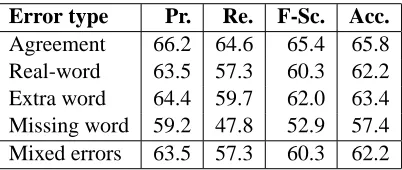
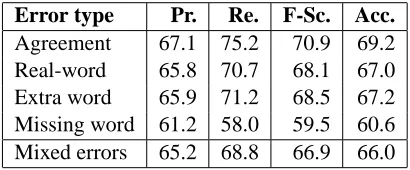
Table 1 shows the results for Method 1, which uses XLE starredness, parser exceptions4and zero parses to classify grammaticality. Table 2 shows the re-sults for Method 2, the basic n-gram approach. Ta-ble 3 shows the results for Method 3, which classi-fies based on a decision tree of XLE features. The results for Method 4, the n-gram-based decision tree approach, are shown in Table 4. Finally, Table 5 shows the results for Method 5 which combines n-gram and XLE features in decision trees.
In the case of Method 2, we first have to find opti-mal parameters. As only very limited integer values fornand the threshold are reasonable, an exhaustive search is feasible. We consideredn = 2, . . . ,7and frequency thresholds below 20,000. Separate held-out data (400,000 sentences) is used in order to avoid overfitting. Best accuracy is achieved with 5-grams and a threshold of 4. Table 2 reports results with these parameters.
4
XLE parsing (see footnote 2 for configuration) runs out of time for 0.7 % and out of memory for 2.5 % of sentences, measured on training data of the first cross-validation run, i. e. 540,000 grammatical sentence and 135,000 of each error type. 14 sentences of 3 million caused the parser to terminate abnor-mally.
Error type Pr. Re. F-Sc. Acc.
Agreement 66.2 64.6 65.4 65.8
Real-word 63.5 57.3 60.3 62.2
Extra word 64.4 59.7 62.0 63.4
Missing word 59.2 47.8 52.9 57.4
[image:7.612.327.528.59.144.2]Mixed errors 63.5 57.3 60.3 62.2
Table 1: Classification results with XLE starredness, parser exceptions and zero parses (Method 1)
Error type Pr. Re. F-Sc. Acc.
Agreement 58.6 51.7 55.0 57.6
Real-word 64.0 64.9 64.5 64.2
Extra word 64.8 67.3 66.0 65.4
Missing word 57.2 48.8 52.7 56.1
Mixed errors 61.5 58.2 59.8 60.8
Table 2: Classification results with 5-gram and fre-quency threshold 4 (Method 2)
The standard deviation of results across cross-validation runs is below 0.006 on all measures, ex-cept for Method 4. Therefore we only report average percentages. The highest observed standard devia-tion is 0.0257 for recall of Method 4 on agreement errors.
For Methods 3, 4 and 5, the decision tree learner optimises accuracy and, in doing so, chooses a trade-off between precision and recall.
4.3 Analysis
Both Method 1 (Table 1) and Method 2 (Table 2) achieve above baseline accuracy for all error types. However, Method 1, which uses the XLE starred feature, parser exceptions and zero parses to de-termine whether or not a sentence is grammatical, slightly outperforms Method 2, which uses the
fre-Error type Pr. Re. F-Sc. Acc.
Agreement 67.0 79.3 72.6 70.1
Real-word 63.4 67.6 65.4 64.3
Extra word 63.0 66.4 64.7 63.7
Missing word 59.7 57.8 58.7 59.4
[image:7.612.324.529.585.672.2]Mixed errors 63.4 67.8 65.6 64.4
Error type Pr. Re. F-Sc. Acc.
Agreement 61.2 53.8 57.3 59.9
Real-word 65.3 64.3 64.8 65.1
Extra word 66.4 67.4 66.9 66.7
Missing word 59.1 49.2 53.7 57.5
[image:8.612.87.289.61.144.2]Mixed errors 63.3 58.7 60.9 62.3
Table 4: Classification results with decision tree on vectors of frequency of rarest n-grams (Method 4)
Error type Pr. Re. F-Sc. Acc.
Agreement 67.1 75.2 70.9 69.2
Real-word 65.8 70.7 68.1 67.0
Extra word 65.9 71.2 68.5 67.2
Missing word 61.2 58.0 59.5 60.6
Mixed errors 65.2 68.8 66.9 66.0
Table 5: Classification results with decision tree on joined feature set (Method 5)
quency of POS 5-grams to detect an error. The XLE deep-processing approach is better than the n-gram-based approach for agreement errors (f-score +10.4). Examining the various types of agree-ment errors, we can see that this is especially the case for singular subjects followed by plural cop-ula verbs (recall +37.7) and determiner-noun num-ber mismatches (recall +23.6 for singular nouns and +18.0 for plural nouns), but not for plural subjects followed by singular verbs (recall -24.0). The rela-tively poor performance of Method 2 on agreement errors involving determiners could be due to the lack of agreement marking on the Penn Treebank deter-miner tag used by TreeTagger.
Method 1 is outperformed by Method 2 for real-word spelling and extra real-word errors (f-score -4.2, -4.0). Unsurprisingly, Method 2 has an advantage on those real-word spelling errors that change the POS (recall -8.8 for Method 1). Both methods per-form poorly on missing word errors. For both meth-ods there are only very small differences in perfor-mance between the various missing word error sub-types (identified by the POS of the deleted word).
Method 3, which uses machine learning to exploit all the information returned by the XLE parser, im-proves performance from Method 1, the basic XLE
method, for all error types.5 The general improve-ment comes from an improveimprove-ment in recall, mean-ing that more ungrammatical sentences are actu-ally flagged as such without compromising preci-sion. The improvement is highest for agreement errors (f-score +7.2). Singular subject with plural copula errors (e. g. The man are) peak at a recall of 91.0. The Method 3 results indicate that information on the number of solutions (optimal and unoptimal), the number of subtrees, the time taken to parse the sentence and the number of words can be used to predict grammaticality. It would be interesting to investigate this approach with other parsers.
Method 4, which uses a decision tree with n-gram-based features, confirms the results of Method 2. The decision trees’ root nodes are similar or even identical (depending on cross-validation run) to the decision rule of Method 2 (5-gram frequency below 4). However, the 10 decision trees have between 1,111 and 1,905 nodes and draw from all features, even bigrams and 7-grams that perform poorly on their own. The improvements are very small though and they are not significant according the criterion of non-overlapping cross-validation results. The main reason for the evaluation of Method 4 is to provide another reference point for comparison of the final method.
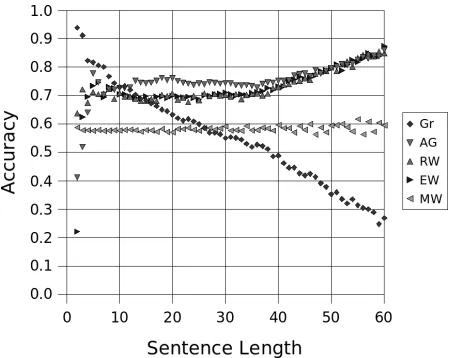
The overall best results are those for Method 5, the combined XLE, n-gram and machine-learning-based method, which outperforms the next best method, Method 3, on all error types apart from agreement errors (f-score -1.7, +2.7, +3.8, +0.8). For agreement errors, it seems that the relatively poor results for n-grams have a negative effect on the relatively good results for the XLE. Figure 2 shows that the performance is almost constant on ungram-matical data in the important sentence length range from 5 to 40. However, there is a negative correla-tion of accuracy and sentence length for grammati-cal sentences. Very long sentences of any kind tend to be classified as ungrammatical, except for missing word errors which remain close to the 50% baseline of coin-flipping.
For all methods, missing word errors are the worst-performing, particularly in recall (i. e. the
ac-5
[image:8.612.83.288.201.286.2]Figure 2: Accuracy by sentence length for Method 5 measured on separate grammatical and ungrammat-ical data: Gr = Grammatungrammat-ical, AG = Agreement, RW = Real-Word, EW = Extra Word, MW = Missing Word
curacy on ungrammatical data alone). This means that the omission of a word is less likely to result in the sentence being flagged as erroneous. In contrast, extra word errors perform consistently and relatively well for all methods.
5 Conclusion and Future Work
We evaluated a deep processing approach and a POS n-gram-based approach to the automatic detection of common grammatical errors in a BNC-derived arti-ficial error corpus. The results are broken down by error type. Together with the deep approach, a deci-sion tree machine learning algorithm can be used ef-fectively. However, extending the shallow approach with the same learning algorithm gives only small improvements. Combining the deep and shallow ap-proaches gives an additional improvement on all but one error type.
Our plan is to investigate why all methods per-form poorly on missing word errors, to extend the error creation procedure so that it includes a wider range of errors, to try the deep approach with other parsers, to integrate additional features from state-of-the-art shallow techniques and to repeat the ex-periments for languages other than English.
Acknowledgements
This work is supported by the IRCSET Embark Ini-tiative (basic research grant SC/02/298 and postdoc-toral fellowship P/04/232). The training and test data used in this reseach is based on the British Na-tional Corpus (BNC), distributed by Oxford Univer-sity Computing Services on behalf of the BNC Con-sortium. We thank Djam´e Seddah for helping us to run the XLE parsing on the SFI/HEA Irish Centre for High-End Computing (ICHEC) and the authors wish to acknowledge ICHEC for the provision of computational facilities and support.
References
Eric Atwell. 1987. How to detect grammatical errors in a text without parsing it. In Proceedings of the 3rd
EACL, pages 38–45, Morristown, NJ.
Timothy Baldwin, John Beavers, Emily M. Bender, Dan Flickinger, Ara Kim, and Stephan Oepen. 2004. Beauty and the beast: What running a broad-coverage precision grammar over the BNC taught us about the grammar - and the corpus. In Pre-Proceedings of the
International Conference on Linguistic Evidence: Em-pirical, Theoretical and Computational Perspectives,
pages 21–26.
Markus Becker, Andrew Bredenkamp, Berthold Crys-mann, and Judith Klein. 1999. Annotation of error types for German news corpus. In Proceedings of the
ATALA Workshop on Treebanks, Paris, France.
Emily M. Bender, Dan Flickinger, Stephan Oepen, and Timothy Baldwin. 2004. Arboretum: Using a preci-sion grammar for grammar checking in CALL. In
Pro-ceedings of the InSTIL/ICALL Symposium: NLP and Speech Technologies in Advanced Language Learning Systems, Venice, Italy.
Johnny Bigert and Ola Knutsson. 2002. Robust error detection: a hybrid approach combining unsupervised error detection and linguistic knowledge. In
Proceed-ings RO-MAND-02, Frascati, Italy.
Johnny Bigert. 2004. Probabilistic detection of context-sensitive spelling errors. In Proceedings of LREC-04, volume Five, pages 1633–1636, Lisbon, Portugal.
Phil Blunsom and Timothy Baldwin. 2006. Multilingual deep lexical acquisition for HPSGs via supertagging. In Proceedings of EMNLP-06, pages 164–171, Syd-ney.
Miriam Butt, Helge Dyvik, Tracy Holloway King, Hi-roshi Masuichi, and Christian Rohrer. 2002. The par-allel grammar project. In Proceedings of
COLING-2002 Workshop on Grammar Engineering and Evalu-ation, pages 1–7, Morristown, NJ, USA.
Eugene Charniak. 1996. Tree-bank grammars. Tech-nical Report CS-96-02, Department of Computer Sci-ence, Brown University.
Martin Chodorow and Claudia Leacock. 2000. An unsu-pervised method for detecting grammatical errors. In
Proceedings of NAACL-00, pages 140–147, San
Fran-cisco, CA.
Noam Chomsky. 1957. Syntactic Structures. Mouton.
Ann Copestake and Dan Flickinger. 2000. An open-source grammar development environment and broad-coverage English grammar using HPSG. In
Proceed-ings of LREC-02, Athens, Greece.
Izumi Emi, Kiyotaka Uchimoto, and Hitoshi Isahara. 2004. The overview of the SST speech corpus of Japanese learner English and evaluation through the experiment on automatic detection of learners’ er-rors. In Proceedings of LREC-04, volume Four, pages 1435–1439, Lisbon, Portugal.
Jennifer Foster and Carl Vogel. 2004. Good reasons for noting bad grammar: Constructing a corpus of un-grammatical language. In Stephan Kepser and Marga Reis, editors, Pre-Proceedings of the International
Conference on Linguistic Evidence: Empirical, The-oretical and Computational Perspectives, pages 151–
152, T¨ubingen, Germany.
Jennifer Foster. 2005. Good Reasons for Noting Bad
Grammar: Empirical Investigations into the Parsing of Ungrammatical Written English. Ph.D. thesis,
Uni-versity of Dublin, Trinity College, Dublin, Ireland.
Anette Frank, Tracy Holloway King, Jonas Kuhn, and John Maxwell. 1998. Optimality theory style con-straint ranking in large-scale LFG grammars. In
Pro-ceedings of LFG-98, Brisbane, Australia.
Andrew R. Golding. 1995. A Bayesian hybrid method for context-sensitive spelling correction. In
Proceed-ings of the Third Workshop on Very Large Corpora,
pages 39–53, Boston, MA.
Sylviane Granger. 1993. International corpus of learner English. In J. Aarts, P. de Haan, and N.Oostdijk, ed-itors, English Language Corpora: Design, Analysis
and Exploitation, pages 57–71. Rodopi, Amsterdam.
Carl James. 1998. Errors in Language Learning and
Use: Exploring Error Analysis. Addison Wesley Longman.
Ron Kaplan and Joan Bresnan. 1982. Lexical Functional Grammar: a formal system for grammatical represen-tation. In Joan Bresnan, editor, The Mental
Represen-tation of Grammatical Relations, pages 173–281. MIT
Press.
Rafiq Abdul Khader, Tracy Holloway King, and Miriam
Butt. 2004. Deep CALL grammars: The
LFG-OT experiment. http://ling.uni-konstanz.de/pages/ home/butt/dgfs04call.pdf.
John Maxwell and Ron Kaplan. 1996. An Efficient Parser for LFG. In Proceedings of LFG-96, Grenoble.
Eric Mays, Fred J. Damerau, and Robert L. Mercer. 1991. Context based spelling correction. Information
Processing and Management, 23(5):517–522.
D. Nicholls. 1999. The Cambridge learner corpus – error coding and analysis. In Summer Workshop on Learner
Corpora, Tokyo, Japan.
Carl Pollard and Ivan A. Sag. 1994. Head-Driven Phrase
Structure Grammar. University of Chicago Press and
CSLI Publications.
Alan Prince and Paul Smolensky. 1993. Optimality
The-ory. MIT Press, Cambridge, Massachusetts.
Veit Reuer. 2003. PromisD - Ein Analyseverfahren zur antizipationsfreien Erkennung und Erkl¨arung von grammatischen Fehlern in Sprachlehrsystemen. Ph.D.
thesis, Humboldt-Universit¨at zu Berlin, Berlin, Ger-many.
Helmut Schmidt. 1994. Probabilistic part-of-speech tag-ging using decision trees. In Proceedings of the
In-ternational Conference on New Methods in Language Processing, pages 44–49, Manchester, England.
J.P. Stemberger. 1982. Syntactic errors in speech.
Jour-nal of Psycholinguistic Research, 11(4):313–45.
Anne Vandeventer Faltin. 2003. Syntactic Error
Diag-nosis in the context of Computer Assisted Language Learning. Ph.D. thesis, Universit´e de Gen`eve.
L. Amber Wilcox-O’Hearn, Graeme Hirst, and Alexan-der Budanitsky. 2006. Real-word spelling correc-tion with trigrams: A reconsideracorrec-tion of the Mays, Damerau, and Mercer model. http://ftp.cs.toronto.edu/ pub/gh/WilcoxOHearn-etal-2006.pdf.
Ian H. Witten and Eibe Frank. 2000. Data Mining: