Multilingual Dependency Parsing using Global Features
Tetsuji Nakagawa Oki Electric Industry Co., Ltd.
2−5−7 Honmachi, Chuo-ku, Osaka 541−0053, Japan [email protected]
Abstract
In this paper, we describe a two-stage multi-lingual dependency parser used for the mul-tilingual track of the CoNLL 2007 shared task. The system consists of two compo-nents: an unlabeled dependency parser us-ing Gibbs samplus-ing which can incorporate sentence-level (global) features as well as token-level (local) features, and a depen-dency relation labeling module based on Support Vector Machines. Experimental re-sults show that the global features are useful in all the languages.
1 Introduction
Making use of as many informative features as pos-sible is crucial to obtain high performance in ma-chine learning based NLP. Recently, several meth-ods for incorporating non-local features have been investigated, though such features often make mod-els complex and thus complicate inference. Collins and Koo (2005) proposed a reranking method for phrase structure parsing with which any type of global features in a parse tree can be used. For dependency parsing, McDonald and Pereira (2006) proposed a method which can incorporate some types of global features, and Riedel and Clarke (2006) studied a method using integer linear pro-gramming which can incorporate global linguistic constraints. In this paper, we study dependency parsing using Gibbs sampling which can incorpo-rate any type of global feature in a sentence. The parser determines unlabeled dependency structures only, and we attach dependency relation labels us-ing Support Vector Machines afterwards.
We participated in the multilingual track of the CoNLL 2007 shared task (Nivre et al., 2007), and evaluated the system on data sets of 10 languages (Hajiˇc et al., 2004; Aduriz et al., 2003; Mart´ı et al., 2007; Chen et al., 2003; B¨ohmov´a et al., 2003; Marcus et al., 1993; Johansson and Nugues, 2007; Prokopidis et al., 2005; Csendes et al., 2005; Mon-temagni et al., 2003; Oflazer et al., 2003).
The rest of the paper describes the specification of the system and the evaluation results.
2 Unlabeled Dependency Parsing using Global Features
2.1 Probabilistic Model
Rosenfeld et al. (2001) proposed whole-sentence ex-ponential language models which can incorporate arbitrary features in a sentence, and we consider here a similar probabilistic model for dependency pars-ing which can incorporate any sentence-level fea-ture. Letw=w1· · ·w|w|denote an input sentence
consisting of|w|tokens, andh=h1· · ·h|w|denote
the sequence of the indices of each token’s head. Root nodes of a sentence do not have heads, and we regard the index of a root node’s head as zero, i.e.,
hi ∈ {0,1,· · ·,|w|} \ {i}. We define the
probabil-ity distribution of the dependency structurehgiven a sentencewusing exponential models as follows:
PΛ,M(h|w)= 1
ZΛ,M(w)QM(h|w)exp (K
X
k=1
λkfk(w,h) )
,(1)
ZΛ,M(w)=X h0∈H(w)
QM(h0|w) exp ( K
X
k=1
λkfk(w,h0) )
, (2)
whereQM(h|w)is an initial distribution,fk(w,h)
is thek-th feature function,Kis the number of fea-ture functions, andλkis the weight of thek-th
fea-ture. H(w) is the set of possible configurations of heads for a given sentence w. Although it is ap-propriate thatH(w)is the set of projective trees for projective languages, and is the set of non-projective trees (which is a superset of the set of projective trees) for non-projective languages, in this study, we defineH(w)to be the set of all the possible graphs, which contains |w||w| elements. PΛ,M(h|w) and
QM(h|w) are defined overH(w)1. The probabil-ity distributionPΛ,M(h|w) is a joint distribution of
all the heads conditioned by a sentence, therefore we call this model sentence-level model. The fea-ture function fk(w,h) is defined on a sentencew
with headsh, and we can use any information in the sentence without the independence assumption for the heads of the tokens, therefore we callfk(w,h)
1H(w)is a superset of the set of non-projective trees, and is an unnecessarily large set which contains ill-formed depen-dency trees such as trees with cycles. This issue may cause reduction of parsing performance, but we adopt this approach for computational efficiency.
sentence-level (global) feature. We define initial distributionQM(h|w)as the product ofqM(h|w, t)
which is the probability distribution of the headhof each t-th token calculated with maximum entropy models:
QM(h|w)=
|w| Y
t=1
qM(ht|w, t), (3)
qM(h|w, t)= 1
YM(w, t)exp ( L
X
l=1
µlgl(w, t, h) )
, (4)
YM(w, t)=
|w| X
h0=0
h06=t
exp ( L
X
l=1
µlgl(w, t, h0) )
, (5)
wheregl(w, t, h)is thel-th feature function,Lis the
number of feature functions, andµlis the weight of
thel-th feature. qM(h|w, t)is a model of the head
of a single token, calculated independently from other tokens, therefore we call qM(h|w, t) token-level model, and gl(w, t, h) token-level (local)
fea-ture.
2.2 Decoding and Parameter Estimation
Let us consider how to find the optimal solution ˆ
h, given a sentencew, parameters of the sentence-level model Λ = {λ1,· · ·, λK}, and parameters of
the token-level model M = {µ1,· · ·, µL}. Since
the probabilistic model contains global features and efficient algorithms such as dynamic programming cannot be used, we use Gibbs sampling to obtain an approximated solution. Gibbs sampling can ef-ficiently generate samples from high-dimensional probability distributions with complex dependencies among variables (Andrieu et al., 2003), and we as-sume thatRsamples{h(1),· · ·,h(R)}are generated fromPΛ,M(h|w)using Gibbs sampling. Then, the
marginal distribution of the head of the t-th token given w, Pt(h|w), is approximately calculated as
follows:
Pt(h|w) = X
h1,···,ht−1,ht+1,···,h|w| ht=h
PΛ,M(h|w),
=X h
PΛ,M(h|w)δ(h, ht)' 1 R
R X
r=1
δ(h, h(r)t ), (6)
where δ(i, j) is the Kronecker delta. In order to find a solution using the marginal distribution, we adopt the maximum spanning tree (MST) frame-work proposed by McDonald et al. (2005a). In this framework, scores for possible edges in dependency graphs are defined, and the optimal dependency tree is found as the MST in which the summation of the edge scores is maximized. Let s(i, j) denote the score of the edge from a parent node (head)i to a child node (dependent) j. We defines(i, j) as fol-lows:
s(i, j)=logPj(i|w). (7)
We use the logarithm of the marginal distribution be-cause the summation of edge scores is maximized by the MST search algorithms but the product of the marginal distributions should be maximized. The best projective parse tree is obtained using the Eis-ner algorithm (EisEis-ner, 1996) with the scores, and the best non-projective one is obtained using the Chu-Liu-Edmonds (CLE) algorithm (McDonald et al., 2005b).
Although in this method, the factored scores(i, j) is used to measure likelihood of dependency trees, the score is calculated taking a whole sentence into consideration using Gibbs sampling.
Next, we explain how to estimate the parame-ters of our models, given training data consisting of
N examples {hw1,h1i,· · ·,hwN,hNi}. In order to estimate the parameters of the token-level model M = {µ1,· · ·, µL}, we use maximum a posteriori estimation with Gaussian priors. We define the fol-lowing objective functionM:
M=log N Y
n=1
QM(hn|wn)− 1 2σ2
L X
l=1
µ2l, (8)
where σ is a hyper parameter of Gaussian priors. The optimal parametersMwhich maximizeMcan be obtained by quasi-Newton methods such as the L-BFGS algorithm with above M and its partial derivatives. The parameters of the sentence-level modelΛ = {λ1,· · ·, λK}can also be estimated in
a similar way with the following objective function Lafter the parameters of the token-level model are estimated.
L=log N Y
n=1
PΛ,M(hn|wn)− 1 2σ02
K X
k=1
λ2k. (9)
This objective function and its partial derivative con-tain summations over all the possible configura-tions which are difficult to calculate. We approx-imately calculate these values using static Monte Carlo (not MCMC) methods with fixed S samples {hn(1),· · ·,hn(S)}generated fromQ
M(h|wn)2:
logZΛ,M(wn)'log1
S S X s=1 exp ( K X k=1
λkfk(wn,hn(s)) )
,(10)
X
h0∈H(wn)
PΛ,M(h0|wn)fk(wn,h0)
'1 S
S X
s=1
fk(wn,hn(s))
ZΛ,M(wn) exp ( K
X
k0=1
λk0fk0(wn,hn(s))
)
.(11)
2
2.3 Local Features
The token-level features used in the system are the same as those used in MSTParser version 0.4.23. The features include lexical forms and (coarse and fine) POS tags of parent tokens, child tokens, their surrounding tokens, and tokens between the child and the parent. The direction and the distance from a parent to its child, and the FEATS fields of the parent and the child which are split into elements and then combined are also included. Features that appeared less than 5 times in training data are ignored.
2.4 Global Features
Global features can capture any information in de-pendency trees, and the following nine types of global features are used (In the following, parent
node means a head token, and child node means a
dependent token):
Child Unigram+Parent+Grandparent This
fea-ture template is a 4-tuple consisting of (1) a child node, (2) its parent node, (3) the direc-tion from the parent node to the child node, and (4) the grandparent node.
Each node in the feature template is expanded to its lexical form and coarse POS tag in or-der to obtain actual features. Features that ap-peared in four or less sentences are ignored. The same procedure is applied to the following other features.
Child Bigram+Parent This feature template is a
4-tuple consisting of (1) a child node, (2) its par-ent node, (3) the direction from the parpar-ent node to the child node, and (4) the nearest outer sib-ling node (the nearest sibsib-ling node which exists on the opposite side of the parent node) of the child node. This feature template is almost the same as the one used by McDonald and Pereira (2006).
Child Bigram+Parent+Grandparent This feature
template is a 5-tuple. The first four ele-ments (1)–(4) are the same as the Child
Bi-gram+Parent feature template, and the
addi-tional element (5) is the grandparent node.
Child Trigram+Parent This feature template is a
5-tuple. The first four elements (1)–(4) are the same as the Child Bigram+Parent feature tem-plate, and the additional element (5) is the next nearest outer sibling node of the child node.
3
http://sourceforge.net/projects/mstparser
Parent+All Children This feature template is a
tu-ple with more than one element. The first ele-ment is a parent node, and the other eleele-ments are all of its child nodes.
Parent+All Children+Grandparent This feature
template is a tuple with more than two ele-ments. The elements other than the last one are the same as the Parent+All Children feature template, and the last element is the grandpar-ent node.
Child+Ancestor This feature template is a 2-tuple
consisting of (1) a child node, and (2) one of its ancestor nodes.
Acyclic This feature type has one of two values,
true if the dependency tree is acyclic, or false
otherwise.
Projective This feature type has one of two
val-ues, true if the dependency tree is projective, or false otherwise.
3 Dependency Relation Labeling
3.1 Model
Dependency relation labeling can be handled as a multi-class classification problem, and we use Sup-port Vector Machines (SVMs) which have been suc-cessfully applied to many NLP tasks. Solving large-scale multi-class classification problem with SVMs requires substantial computational resources, so we use the revision learning method (Nakagawa et al., 2002). The revision learning method combines a probabilistic model which has smaller computa-tional cost with a binary classifier which has higher generalization capacity. In the method, the latter classifier revises the output of the former model to conduct multi-class classification with higher ac-curacy and reasonable computational cost. In this study, we use maximum entropy (ME) models as the probabilistic model and SVMs with the second order polynomial kernel as the binary classifier. The dependency label of each node is determined inde-pendently of the labeling of other nodes.
3.2 Features
As the features for SVMs to predict the dependency relation label of the i-th token, we use the lexical forms, coarse and fine POS tags, and FEATS fields of thei-th and the hi-th tokens. We also use
lex-ical forms and POS tags of the tokens surround-ing and in between them (i.e. thej-th token where
j ∈ {j|min{i, hi} −1 ≤ j ≤ max{i, hi}+ 1}),
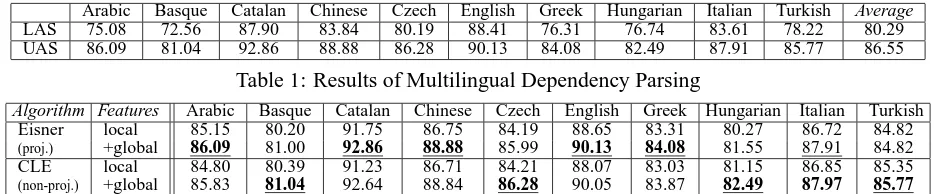
Arabic Basque Catalan Chinese Czech English Greek Hungarian Italian Turkish Average
LAS 75.08 72.56 87.90 83.84 80.19 88.41 76.31 76.74 83.61 78.22 80.29
[image:4.612.72.539.62.159.2]UAS 86.09 81.04 92.86 88.88 86.28 90.13 84.08 82.49 87.91 85.77 86.55
Table 1: Results of Multilingual Dependency Parsing
Algorithm Features Arabic Basque Catalan Chinese Czech English Greek Hungarian Italian Turkish
Eisner local 85.15 80.20 91.75 86.75 84.19 88.65 83.31 80.27 86.72 84.82
(proj.) +global 86.09 81.00 92.86 88.88 85.99 90.13 84.08 81.55 87.91 84.82
CLE local 84.80 80.39 91.23 86.71 84.21 88.07 83.03 81.15 86.85 85.35
(non-proj.) +global 85.83 81.04 92.64 88.84 86.28 90.05 83.87 82.49 87.97 85.77
Table 2: Unlabeled Attachment Scores in Different Settings (underlined values indicate submitted results, and bold values indicate the highest scores)
and the child tokens of i (the j00-th token where
j00 ∈ {j00|h
j00 =i})4. As the features for ME
mod-els, a subset of them is used since ME models are used just for reducing the search space, and do not need so many features.
4 Results and Analysis
In order to tune the system, we split each training data set into two parts, and used the first half for training and the remaining half for testing in devel-opment. The CLE algorithm was used for Basque, Czech, Hungarian and Turkish, and the Eisner algo-rithm was used for the others. We used lemmas for Catalan, Czech, Greek and Italian, and word forms for all others. The values of the parameters to be fixed were chosen asR = 500,S = 200,σ= 0.25, andσ0 = 0.25. With these parameter settings, train-ing took 247 hours, and testtrain-ing took 343 minutes on an Opteron 250 processor.
Table 1 shows the evaluation results on the test sets. Accuracy was measured with the labeled at-tachment score (LAS) and the unlabeled atat-tachment score (UAS). Among the participating systems in the shared task, we obtained the second best average accuracy in the labeled attachment score, and the best average accuracy in the unlabeled attachment score. Compared with other systems, the gap be-tween our labeled and unlabeled scores is relatively big. In this study, labeling of dependency relations was performed in a separate post-processing step, and each label was predicted independently. The la-beled scores may be improved if the parsing process and the labeling process are performed at the same time, and dependencies among labels are taken into account.
We conducted experiments with different settings. Table 2 shows the results measured with the unla-beled attachment score. In the table, Eisner and
4
Although polynomial kernels of SVMs can implicitly han-dle combined features, some of combined features were also in-cluded explicitly because using unnecessarily high order poly-nomial kernels decreases performance.
CLE indicate that the Eisner algorithm and the
CLE algorithm are used in decoding, and local and
+global indicate that local features alone, and local
and global features together are used. The CLE al-gorithm performed better than the Eisner alal-gorithm for Basque, Czech, Hungarian, Italian and Turkish. All of these data sets except Italian contain relatively a large number of non-projective sentences (the per-centage of sentences with at least one non-projective relation in the training data is over 20% (Nivre et al., 2007)), though the Greek data set, on which the Eis-ner algorithm performed better, also contains many non-projective sentences (20.3%).
By using the global features, the accuracy was improved in all the cases except for Turkish with the Eisner algorithm (Table 2). The increase was rather large in Chinese and Czech. When the global features were used in these languages, the depen-dency accuracy for tokens whose heads had con-junctions as parts-of-speech was notably improved; from 80.5% to 86.0% in Chinese (Eisner), and from 73.2% to 77.6% in Czech (CLE). We investigated the trained global models, and found that Parent+All
Children features, whose parents were conjunctions
and whose children had compatible classes, had large positive weights, and those whose children had incompatible classes had large negative weights. A feature with a larger weight is generally more influ-ential. Riedel and Clarke (2006) suggested to use linguistic constraints such as “arguments of a coor-dination must have compatible word classes,” and such constraint seemed to be represented by the fea-tures in our models.
5 Conclusion
References
A. Abeill´e, editor. 2003. Treebanks: Building and Using
Parsed Corpora. Kluwer.
I. Aduriz, M. J. Aranzabe, J. M. Arriola, A. Atutxa, A. Diaz de Ilarraza, A. Garmendia, and M. Oronoz. 2003. Construction of a Basque Dependency Tree-bank. In Proc. of the 2nd Workshop on Treebanks and
Linguistic Theories (TLT), pages 201–204.
C. Andrieu, N. de Freitas, A. Doucet, and M. I. Jordan. 2003. An Introduction to MCMC for Machine Learn-ing. Machine Learning, 50:5–43.
A. B¨ohmov´a, J. Hajiˇc, E. Hajiˇcov´a, and B. Hladk´a. 2003. The PDT: a 3-level annotation scenario. In Abeill´e (Abeill´e, 2003), chapter 7, pages 103–127.
K. Chen, C. Luo, M. Chang, F. Chen, C. Chen, C. Huang, and Z. Gao. 2003. Sinica Treebank: Design Crite-ria, Representational Issues and Implementation. In Abeill´e (Abeill´e, 2003), chapter 13, pages 231–248.
M. Collins and T. Koo. 2005. Discriminative Rerank-ing for Natural Language ParsRerank-ing. Computational
Lin-guistics, 31(1):25–69.
D. Csendes, J. Csirik, T. Gyim´othy, and A. Kocsor. 2005.
The Szeged Treebank. Springer.
J. Eisner. 1996. Three New Probabilistic Models for De-pendency Parsing: An Exploration. In Proc. of
COL-ING ’96, pages 340–345.
J. Hajiˇc, O. Smrˇz, P. Zem´anek, J. ˇSnaidauf, and E. Beˇska. 2004. Prague Arabic Dependency Treebank: Develop-ment in Data and Tools. In Proc. of the NEMLAR
In-tern. Conf. on Arabic Language Resources and Tools,
pages 110–117.
R. Johansson and P. Nugues. 2007. Extended Constituent-to-Dependency Conversion for English. In Proc. of the 16th Nordic Conference on
Computa-tional Linguistics (NODALIDA).
M. Marcus, B. Santorini, and M. Marcinkiewicz. 1993. Building a Large Annotated Corpus of English: the Penn Treebank. Computational Linguistics,
19(2):313–330.
M. A. Mart´ı, M. Taul´e, L. M`arquez, and M. Bertran. 2007. CESS-ECE: A Multilingual and Multilevel Annotated Corpus. Available for download from: http://www.lsi.upc.edu/∼mbertran/cess-ece/.
R. McDonald and F. Pereira. 2006. Online Learning of Approximate Dependency Parsing Algorithms. In
Proc. of EACL 2006, pages 81–88.
R. McDonald, K. Crammer, and F. Pereira. 2005a. On-line Large-Margin Training of Dependency Parsers. In
Proc. of ACL 2005, pages 91–98.
R. McDonald, F. Pereira, K. Ribarow, and J. Hajic. 2005b. Non-projective dependency parsing using Spanning Tree Algorithms. In Proc. of HLT/EMNLP
2005, pages 523–530.
S. Montemagni, F. Barsotti, M. Battista, N. Calzolari, O. Corazzari, A. Lenci, A. Zampolli, F. Fanciulli, M. Massetani, R. Raffaelli, R. Basili, M. T. Pazienza, D. Saracino, F. Zanzotto, N. Nana, F. Pianesi, and R. Delmonte. 2003. Building the Italian Syntactic-Semantic Treebank. In Abeill´e (Abeill´e, 2003), chap-ter 11, pages 189–210.
T. Nakagawa, T. Kudo, and Y. Matsumoto. 2002. Re-vision Learning and its Application to Part-of-speech Tagging. In Proc. of ACL 2002, pages 497–504.
J. Nivre, J. Hall, S. K¨ubler, R. McDonald, J. Nilsson, S. Riedel, and D. Yuret. 2007. The CoNLL 2007 Shared Task on Dependency Parsing. In Proc. of
the CoNLL 2007 Shared Task. Joint Conf. on Em-pirical Methods in Natural Language Processing and Computational Natural Language Learning (EMNLP-CoNLL).
K. Oflazer, B. Say, D. Zeynep Hakkani-T¨ur, and G. T¨ur. 2003. Building a Turkish Treebank. In Abeill´e (Abeill´e, 2003), chapter 15, pages 261–277.
P. Prokopidis, E. Desypri, M. Koutsombogera, H. Papa-georgiou, and S. Piperidis. 2005. Theoretical and Practical Issues in the Construction of a Greek Depen-dency Treebank. In Proc. of the 4th Workshop on
Tree-banks and Linguistic Theories (TLT), pages 149–160.
S. Riedel and J. Clarke. 2006. Incremental Integer Linear Programming for Non-projective Dependency Parsing. In Proc. of EMNLP 2006, pages 129–137.
R. Rosenfeld, S. F. Chen, and X. Zhu. 2001. Whole-Sentence Exponential Language Models: A Vehi-cle For Linguistic-Statistical Integration. Computers