Proceedings of the 2019 Conference on Empirical Methods in Natural Language Processing 389
Self-Attention Enhanced CNNs and Collaborative Curriculum Learning
for Distantly Supervised Relation Extraction
Yuyun Huang† Jinhua Du‡§ †University College Dublin, Ireland
‡Investments AI, AIG (American International Group, Inc.)
§ADAPT Centre, School of Computing, Dublin City University, Ireland
{yuyun.huang}@ucd.ie
{jinhua.du}@aig.com
Abstract
Distance supervision is widely used in relation extraction tasks, particularly when large-scale manual annotations are virtually impossible to conduct. Although Distantly Supervised Re-lation Extraction (DSRE) benefits from auto-matic labelling, it suffers from serious mis-labelling issues, i.e. some or all of the in-stances for an entity pair (head and tail enti-ties) do not express the labelled relation. In this paper, we propose a novel model that employs a collaborative curriculum learning framework to reduce the effects of mislabelled data. Specifically, we firstly propose an in-ternal self-attention mechanism between the convolution operations in convolutional neu-ral networks (CNNs) to learn a better sentence representation from the noisy inputs. Then we define two sentence selection models as two relation extractors in order to collaboratively learn and regularise each other under a curricu-lum scheme to alleviate noisy effects, where the curriculum could be constructed by con-flicts or small loss. Finally, experiments are conducted on a widely-used public dataset and the results indicate that the proposed model significantly outperforms baselines including the state-of-the-art in terms of P@N and PR curve metrics, thus evidencing its capability of reducing noisy effects for DSRE.
1 Introduction
Relation Extraction (RE) is vital for NLP tasks such as information extraction, question answer-ing and knowledge base completion. RE aims to identify the relationship between an entity pair (e1, e2) in a sentence. For example, in the
sen-tence “[Bill Gatese1]is the principal founder of
[M icrosof te2]”, the relation extractor decodes the
relation of founder for the entity pair Bill Gates
(the person) andMicrosoft(the company). Recent supervised relation extraction research can be roughly categorised into two areas: fully
supervised and distantly supervised relation ex-traction. Fully supervised relation extraction mainly depends on manually annotated training dataset (Zeng et al., 2014; dos Santos et al., 2015). Ordinarily, human annotation on large-scale datasets is costly and often practicably im-possible. Distance supervision addresses this problem by using an existing knowledge base (e.g. DBpedia) to automatically annotating large-scale datasets, thus reducing the burden of manual anno-tation (Mintz et al.,2009;Hoffmann et al.,2011; Surdeanu et al.,2012). However, distance super-vision often suffers from mislabelling problems.
Figure 1 illustrates this incorrect labelling is-sue, which shows that not all sentences in a bag with the same entity pair express the labelled rela-tion ofperson/company/founder. The worst case is that all sentences in a bag are mislabelled. Thus, one primary challenge in DSRE is to minimize the noisy labelling effects, which in turn, would let model learn from incorrect labelled datasets.
person / company / founder Bill_Gates Microsoft
founder
existing knowledge
Bill Gates is the principal founder of Microsoft Bill Gates founded Microsoft in 1975
Bill Gates speaking at a Microsoft held Conference
Figure 1: Mislabeling issue example in DSRE: the en-tity pairs bag containing three sentences is labeled as person/company/founder. However, the last sentence marked in red has no extractable pre-defined relation.
other and improving their final grades. We call this process of two students learning together with a curriculum asCollaborative Curriculum Learning
(CCL), where each student represents a network. Inspired by the above intuition, we propose to use a bag-level selective sentence attention model (NetAtt) (Lin et al.,2016) and a maximum proba-bility sentence model (NetMax) (Zeng et al.,2015) as two students learning collaboratively. Mean-while, highly organised human education methods using a multilevel curriculum, from easy to hard, is an analogy for curriculum learning training, which advocates the adoption of similar multi-stage strategies (Bengio et al.,2009). The curricu-lum learning training method for DSRE is used with the assumption that entity pair bags contain corrupted labelled sentences, which are difficult components to learn in the curriculum. By disre-garding the effects of noisy samples (meaningless knowledge) during the training, the expectation is to boost the model’s learning capability. More-over, in order to accurately obtain the semantic representation of each sentence for our curriculum learning approach, we propose an internal CNNs self-attention mechanism to learn a better sentence representation in the DSRE setting.
The main contributions are summarised as: (1) We make the first attempt to use the concept of curriculum learning for denoising DSRE and present a novel collaborative curriculum learning model to alleviate the effects of noisy sentences in an entity pair bag. In this model, we define two collaborative relation extractors to regularize each other and boost the model’s learning capability.
(2) We propose conflicts and small loss tricks for our collaborative curriculum learning. Instead of using a separated complex noisy sentence fil-ter and two-step training in baseline models, our model can alleviate noise effects during a single training and is easy to implement.
(3) We are the first to apply an internal CNNs self-attention mechanism to enhance a multilayer CNNs model for DSRE.
(4) We conduct thorough experiments on the widely-used NYT dataset, and achieve significant improvements over state-of-the-art models.
2 Related Work
Most DSRE approaches fall under the framework of Multi-Instance Learning (MIL) (Riedel et al., 2010;Surdeanu et al.,2012;Zeng et al.,2015;Lin
et al.,2016;Ji et al.,2017;Qin et al.,2018;Feng et al.,2018). At the encoding step, a sentence rep-resentation is learned using handcrafted features or neural network models. Afterwards, in the sen-tence selection step, one or several sensen-tences from an entity pair bag are chosen for further bag rep-resentation learning. Previously, statistical models (Mintz et al., 2009; Hoffmann et al., 2011; Sur-deanu et al., 2012) have used designed features, such as syntactic and lexical features, and have then been trained by logistic regression or expec-tation maximization.
When adopting deep learning approaches, a sin-gle layer CNNs based model (Zeng et al.,2014) was exploited to extract sentence level features to attain fully supervised relation classification. For DSRE, Zeng et al. (2015) proposed an extended Piece-wise CNN (PCNN) approach and selected the most probable valid sentence to represent an entity pair bag, while the remaining sentences in the bag were ignored. Lin et al. (2016) and Ji et al.(2017) used all the sentences in a bag by as-signing higher weights to valid labeled sentences and lower weights to noisy sentences. The selec-tive sentence attention mechanism combined all weighted sentences as a bag representation. In ad-dition,Ji et al.(2017) made use of entity descrip-tion background knowledge and fused the external information into their PCNN-based model.
The self-attention mechanism (Cheng et al., 2016;Parikh et al., 2016; Vaswani et al., 2017), also called intra-attention, relates to different po-sitions of a single sequence to learn the sequence representation. An internal CNNs states self-attention approach was proposed by Zhang et al. (2018) to improve Generative Adversarial Net-works (GANs) (Goodfellow et al., 2014) perfor-mance in generating high-quality images.Alt et al. (2019) extended Generative Pre-trained Trans-former (GPT) to learn semantic and syntactic fea-tures for DSRE. Wang et al. (2019) used pre-trained Transformer for multiple entity-relations extraction task. Du et al. (2018) utilized self-attention mechanisms for better MIL sentence-level and bag-sentence-level representations. However, pre-vious work has not considered to use self-attention over the internal CNNs model states for DSRE.
To better address issues relating to mislabelling, e.g., when some or all sentence labels in a bag are falsely positive, schemes to filter out noisy in-stances have been developed. Takamatsu et al. (2012) proposed a wrong label sentence filter method using linguistic features. Feng et al. (2018) proposed a model comprising of a rela-tion classifier and an instance selector based on reinforcement learning (RL). The instance selector was designed to select possible correctly labelled sentences and was regularised by the rewards from the relation classifier. Qin et al.(2018) used the idea of GANs to develop a separated correct la-bel indicator, which filters high confidence scor-ing instances for trainscor-ing on existscor-ing PCNN/CNN-based relation extractors (DSGAN). Unlike pre-vious work, which filters out incorrectly labelled
sentencesto generate an approximate clean train-ing dataset and then retrains on the filtered data to improve models, we instead train our model to actively and purposefully forget noisy entity pair
bags, based on a collaborative curriculum learning strategy in a single training process. In doing so, we develop an approach to building the curricu-lum – the identified disagreements and losses of two collaborative student networks in our model.
3 Methodology
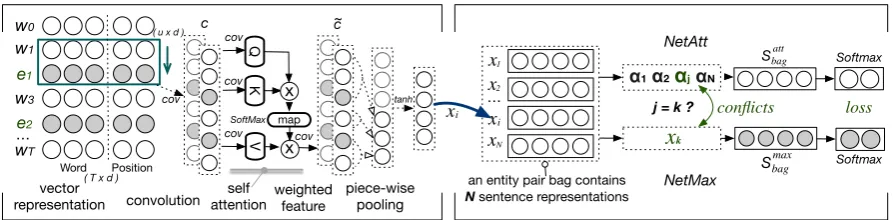
The mislabelled sentences from the distance su-pervision method are normally regarded as un-wanted noise that can reduce the performance of relation extraction. To alleviate noisy effects, we propose a collaborative curriculum learning framework for DSRE. Thearchitecture is shown in Figure3, consisting of three main components: (1) input representation; (2) CNNs that are com-posed of convolution, self-attention and pooling; and (3) collaborative curriculum learning module.
3.1 Inputs: Word and Position Embeddings
To represent each input token, we use word2vec1 (Mikolov et al., 2013) to obtain its embedding. Each word embedding (wt)
contains syntactic and semantic information.
Bill Gates is the principal founder of Microsoft
4 -2
Figure 2: relative distances from ‘founder’ to entities Similar to (Zeng et al.,2015), we use position
1https://code.google.com/p/word2vec/
embedding to assist the CNNs in measuring dis-tances from the current word to the head and tail entities. As illustrated in Figure2, in the sentence, the distance of the wordfounderto the head entity is4and−2to the tail entity.
Figure 3(a) further illustrates the use of these embeddings as input representation in CNNs, i.e. the input representation is a concatenation ofword
embedding and position embedding. In Figure 3(a), it is assumed that the dimensions of word em-beddingdw and position embeddingdp are 3 and
1 (as a simplified example for the sake of the fig-ure), respectively. The total vector representation dimensiondisdw+ 2×dp.
3.2 Contextualised Representation:
Self-attention for CNNs
The sentence embedding matrix is formed by con-catenating every vector representation horizon-tally (left panel Figure 3) and is represented as sn = [w1 : · · · : wt : · · · : wT], where sn is
the input that feeds CNNs to learn a sentence rep-resentation. For an input sentence, we use a con-volution filterWp to slide alongsn as[wt : · · · :
wt+u−1]∗Wp+b, where∗is the convolution
sym-bol,b∈ Ris a bias andprepresents thepthfilter in a filter set. Wp ⊂ Ru×d, whereuis the length
of the filter anddis the dimension of a word vector consisting of word and position embeddings.
In order to learn a better sentence represen-tation, we propose a self-attention mechanism which is performed directly over internal CNNs states as shown in Figure3(a). The self-attention function maps queries (Q) and corresponding keys (K) to compute a weight map. The output is a multiplication of the values (V) and the weight vector. We place this internal CNNs self-attention module after the first convolution state (C). Val-ues, queries, and keys are computed by applying convolution again on C, where V = C ∗ WV, Q = C∗WQandK = C∗WK. The attention map, is calculated using the softmax function, as shown in Equation (1), whereQT is the transpose ofQand⊗is the matrix multiplication operator.
map= exp(Q
T ⊗K)
P
exp(QT ⊗K) (1)
…
(b) Collaborative Learning with Conflicts and Loss an entity pair bag contains
N sentence representations NetMax NetAtt
α1α2αjαN
Softmax
j = k ?
Softmax
(a) Self-Attention Piece-wise pooling CNN
( u x d )
( T x d ) Word Position
w0
w1
e1
w3
e2
wT
convolution vector
representation
self attention
Q
K
V
x
map SoftMax
x
weighted feature …
cov cov
cov
cov cov
c
piece-wise pooling
tanh
conflicts loss x1
xi x2
xN
xi
Satt bag
Sbagmax
xk ~
[image:4.595.76.524.66.176.2]c
Figure 3:(a)A sentence embedding matrix with the entity pair (e1,e2) consists of a word vector set of dimension
(T×d). T is the length of the given sentence anddis the length of the word and position vector. A convolution filter with a dimension of(u×d)is sliding along the sentence representation. covrepresents a convolution op-eration. The internal CNNs states (C) from the first convolution operation are fed into the self-attention module. A piece-wise max-pooling is employed at outputs (C˜) from last convolution layer. A sentence representationxi is learned after a nonlinear function. (b)For an entity pair bagB containingN sentence representations, thejth sentence with maximum weight scoreαjis selected by NetAtt, whilexk is thekthsentence selected by NetMax. Conflicts between the two subnets are used to form a conflict lossLjk. Each network uses the same sentence representation and generates different bag representations to feed a softmax layer separately. Theconflictsandloss from collaborative training are used as cues for curriculum building in section3.5.2.
3.3 Entity Position-aware Sentence
Representation: Piece-wise Max Pooling
Following the self-attention operations, we use a piece-wise max pooling operation to form the final sentence representation. The max pool-ing is a variant of poolpool-ing in standard CNNs, which applies the pooling to three convolution segments separated by head and tail entities (Zeng et al.,2015). As shown in the column of “piece-wise pooling” in Figure 3(a), the grey dots in ˜
c, representing head and tail entities, split each vector into three pieces, which are denoted as
˜
C1,C˜2,C˜3, respectively. Thus, the piece-wise
max pooling is expressed as {x1i, x2i, x3i} = max-pooling( ˜C1,C˜2,C˜3). These three pooled
vectors are then concatenated together to form a vectorxiand a nonlinear function is applied to the
output vector, such thatxi=tanh(xi)is the final
representation of a sentence.
3.4 Bag Representation for Entity Pairs
After learning representations of all sentences in an entity pair bag, we then use two approaches to form the entity pair bag representation, as illus-trated in Figure3(b), i.e., we employ a mechanism of averaging all sentences using attention scores (NetAtt) (Lin et al.,2016), and a maximum prob-ability sentence selection method (NetMax) (Zeng et al., 2015), respectively, to learn the bag rep-resentation. Specifically, NetAtt assigns weight scores{α1, . . . , αN}to all sentences in an entity
pair bag, while NetMax will select the most rea-sonable sentence that has the highest probability.
Ideal student networks are equipped with SOTA MIL selection mechanisms and could empirically generate conflicts during the selection, based on this criterion we use NetAtt and NetMax. NetAtt works by considering all sentences in a bag, but it also introduces noisy sentences while learning a bag representation. NetMax works by selecting the sentence with the highest probability in a bag as the bag representation, but it overlooks other valid sentences. Moreover, the two networks use different bag representations to feed classifiers and eventually generatedisagreements. Therefore, we are motivated by the idea of combining their ad-vantages and disagreements over sentence selec-tion in a single framework to learn better bag rep-resentations and to reduce the noise effects.
Before introducing the proposed single frame-work, we first describe below how NetAtt and Net-Max work in bag representation learning. The sentence bag of an entity pair is denoted as B, which consists of representations ofN sentences
{x1, x2, . . . , xN}, where each sentence
represen-tation is learned from our self-attention based PCNN. The entity pair is expressed as(e1, e2)and
the bag’s relation isr.
3.4.1 NetAtt: Sentence-Level Attention
Subse-quently, the bag representationSbagatt for the entity pair’s bagBis computed as:Sbagatt =PN
i=1αixi.
We can see that the purpose of the weighted factorαi is to give higher weights to correctly
beled instances and lower weights to wrongly la-beled ones. Given the score βi of a given
sen-tence representation xi with a relation r, which
is measured as: βi(xi|r) = xiAr (where A is a
weighted diagonal matrix), the attention scores in a given bagBcan be calculated as:αi(xi|r, B) =
softmax(γβi(xi|r)), whereγis set empirically and
borrowed from the work by (Sutton and Barto, 1998). Smallerγ will lead to equalisation in all sentences and larger γ will increase bias of the high scored sentence.
3.4.2 NetMax: Maximum Probability
NetMax assumes that at least one sentence in an entity pair bag reflects the bag’s relation, and only one sentence with the maximum probability is se-lected to represent the bag, which is denoted as Sbagmax = xk, where xk is the kth sentence
rep-resentation with maximum probability. As only one sentence is selected, the input ofor the soft-maxclassifier can be expressed aso= Kxk+b,
whereKis the transformation matrix andbis the bias. For a bag with relation r, the conditional probability isp(r|xk;θ) = sof tmax(or). For all
sentences in a bag, the index k is computed by k=argmaxkp(r|xk;θ).
3.5 Collaborative Curriculum Learning
As mentioned above, we consider the advantages and disagreements of sentence selection of Ne-tAtt and NetMax in a single framework so that they can learn to regularise each other so as to reduce the effects of noisy sentences. We pro-pose a collaborative curriculum learning frame-work where NetAtt and NetMax are defined as two student networks and they learn together under a curriculum scheme. For DSRE, we assume that entity pair bags with wrongly labeled sentences are hard samples to be learned, while bags with correctly labeled sentences areeasy samples. Fig-ure 3(b) shows the architecture of our collabora-tive curriculum learning framework, where NetAtt and NetMax are trained collaboratively and reg-ularised by each other. The curriculum vectorvi
for collaborative learning could be built by various schemes, for example, theconflicts(vc
i) of
select-ing the valid sentence in a bag between the two student networks, which will be detailed later.
3.5.1 Objective Function
The objective function is defined as J(Si;θ) = 1
m
Pm
i=1j(Si;θ), wheremis the total number of
entity pair’s bags in a mini-batch. Si is a set of
{Sbag iatt , Sbag imax}. j(Si;θ) is the objective function
of one entity pair’s bag defined in Equation (2):
j(Si;θ) =ηlogp(ri|Sbag iatt ;θ)+
(1−η) logp(ri|Sbag imax;θ)
(2)
where, 0 < η < 1 is an empirical value to as-sign weights to NetAtt and NetMax. With a cur-riculum, the model’s minimisation problem can be formulated as in Equation (3):
min
θ,v E(θ, v, λ) =
1 m
m
X
i=1
vili+Ljk (3)
where,li = l(ri, j(Si;θ))is the loss of each bag;
ri is the relation of a bag; vi is the curriculum
weight variable; Ljk is the cross entropy loss of
conflicts between the highest probability sentence indexes from NetAtt and NetMax, which aims to let them regularise each other during sentence se-lection;θandλare the optimisation parameters of relation extractor and curriculum. The weighted loss is minimised by stochastic gradient descent.
Algorithm 1Update using conflicts
inputs: mini batch size m; jatti and kimax; two students:patt(NetAtt),pmax(NetMax); bag
repre-sentation:Siatt,Simax
fori in{1,2,3, . . . ,m}do ifjatti =kmaxi then
#no conflictsvic= 1 addSiattto set{Satt}
addSmax
i to set{Smax}
end end
updatepattwith{Satt}&pmaxwith{Smax}
3.5.2 Curriculum Construction for
Collaborative Learning
Conflicts trickof two students are utlised to build a curriculum (vic): In a mini-batch of size m, where the ith entity pair’s bag contains N sen-tences,ji
att, kimax ∈ [0to N) are the indexes of
highest probably sentence selected by NetAtt and NetMax, respectively. For each entity pair bag in the batch, ifji
attis not equal tokmaxi , thenvic= 0,
conflicts that occur during the collaborative train-ing between NetAtt and NetMax are shown in Fig-ure 3(b). There is no extra curriculum network (f(vc;λ)) required to learn avc
i.
Whenvicis assigned to 0, the training procedure will forget the effects of ‘hard’ sample (ith bag) by multiplying 0 and its loss li as shown in Eq.
(3). Algorithm 1 illustrates the logic to update the training using the conflicts curriculum. In a mini-batch, entity pair bags with conflicts in sentence selection are dropped, the remaining bags are used to update the network parameters.
Furthermore, various curriculum types could be used in CCL to alleviate the noise in DSRE. We utilize thesmall loss trickto build a curriculum which inspired by Jiang et al. (2018). Specifi-cally, to build a curriculum (vil), the loss (li) is used
as an input constant feature to learn a curriculum vector. We use the MentorNet framework2(Jiang et al., 2018) as the curriculum network to learn an approximate predefined curriculum f(vl;λ).
The approximation process is to train a curriculum model using synthetic data generated according to the predefined curriculum. The trained model is then used as the curriculum to guide the further model training. We use the predefined curriculum f(vl;λ) = vl
ili +12λ2(vil)2−(λ1+λ2)vil(Jiang
et al.,2015) to guide our training.
4 Experiments
4.1 Dataset
We evaluate our model on the widely used New York Times (NYT) DSRE dataset3, which aligns Freebase entity relation with NYT corpus (Riedel et al.,2010). The dataset uses the data from 2005 to 2006 as the training set and the remaining data, taken from 2007, as the test set. The processed dataset4 was released by Lin et al. (2016). We use the cleaned version of the processed dataset, which has removed duplicated sentences in train-ing and test sets. In total, the traintrain-ing set con-sists of 522,611 sentences, 281,270 entity pairs and 18,252 relation facts. The testing set contains 172,448 sentences, 96,678 entity pairs, and 1,950 relation facts. The dataset contains 39,528 unique entities and 53 relations in total including an NA
relation which represents no existing relation for given entity pairs in sentences.
2https://github.com/google/mentornet
3
http://iesl.cs.umass.edu/riedel/ecml/
4https://github.com/thunlp/NRE
4.2 Evaluation Metrics
Instead of obtaining a costly human annotated test data, we conduct a held-out evaluation (Riedel et al., 2010) in the experiments, as in previous work (Riedel et al., 2010;Surdeanu et al., 2012; Zeng et al.,2015;Lin et al.,2016). Held-out evalu-ation compares relevalu-ation facts predicted in test data with those relations identified in Freebase. It gives an approximate evaluation of the proposed model. As with the evaluation metrics used in the litera-ture, we report our results using Precision-Recall curve (PR-curve) and Precision at N (P@N) met-rics. PR-curveis used to understand the trade-off between precision and recall. Using all the test data, the plotted curve expresses the precision as a function of recall. P@Nconsiders the cutoff top-mostN precision values as a set. Each entity pair bag contains one or more instances and P@N con-sidersallthe multiple instances.
4.3 Baseline Models
We compare our model with both statistical and deep learning baseline models. These baselines were evaluated on the same cleaned dataset. We exclude some recent models due to the dataset and reproducibility issues. Namely, recent mod-els that were trained on a dataset, which was re-leased by mistake, obtained higher results. These results in fact may be inaccurate. From the Github repository commit history and comments5:
“It has not deleted the mix part of testing data. The training sentence is 570000+, but in the pa-per is 520000+.“. The incorrect training dataset was replaced with the corrected one in March 2018, which might be the main reason as to why some MIL DSRE papers in 2018 reported non-reproducible results on the corrected training data. In all probability these works had commenced prior to March 2018 and were likely relying on the erroneous dataset.
(1) Statistical Models: Mintz (Mintz et al., 2009) extracted sentence syntactic and lexical fea-tures and trained a multiclass logistic regression classifier. Hoffmann(Hoffmann et al.,2011) is a probabilistic, graphic model with MIL. MIMLRE
(Surdeanu et al.,2012) is a MIL model that uses expectation maximization for classification.
(2) Deep Learning Models: both CNN (Zeng et al.,2014) and PCNN (Zeng et al.,2015) based
5https://github.com/thunlp/NRE/commit/
a b c
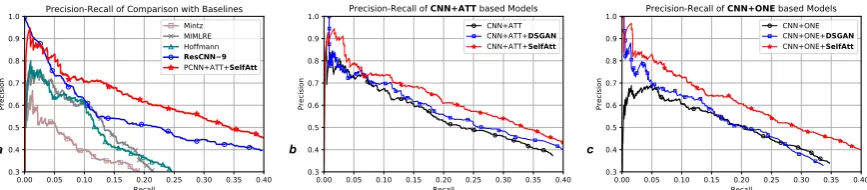
Figure 4: PR curves comparison of CNN/PCNN based models with SelfAtt module and baselines
relation extraction models with bag level selective attention mechanism (PCNN+ATT, CNN+ATT) (Lin et al., 2016) and multi-instance learning (PCNN+ONE,CNN+ONE) (Zeng et al.,2015).
(3) ResCNN-9 (Huang and Wang, 2017): 9-layers CNN model with residual identity shortcuts and three fully connected layers. The model out-performs CNN+ATT/ONE models.
(4) State-of-the-art DSRE Noise Filter Systems: DSGAN (Qin et al.,2018) is a model to filter out noise instances. It unitizes GANs to remove po-tentially inaccurate sentences from original train-ing data and further trains PCNN/CNN models on the filtered data to improve performance.
Number of CNN filters 128, 230, 256
Batch sizeB 120
Learning rate 0.1, 0.4
Weight decay 0.00001
Burn-in epoch 5
Dropout probability 0.3
Table 1: Parameters setting for best results
We fine-tune our models by validating and se-lecting the best model parameters. To accom-plish this we set the gradient descent learning rate among{0.4,0.2,0.1,0.01,0.001}. Batch sizeB is set to{60,120,160}. The amount of CNN fil-ter is set among {64,128,230,256}. A dropout rate is in the set {0.1,0.3}. All the parame-ters fine-tuned in our experiments are shown in Table 1. Specifically, the best performance of [CNN+ATT/ONE+SelfAtt] with training parame-ters of learning rate:0.4 and CNN filparame-ters:230; the best performance of [PCNN+ATT/ONE+SelfAtt] with training parameters of learning rate:0.4 and CNN filters:128; and the best performance of [PCNN+ATT/ONE+SelfAtt+CCL] with training parameters of learning rate:0.1 and CNN fil-ters:256. For other parameters, we follow the set-tings in the work of (Lin et al.,2016), e.g. the max-imum sentence length is limited to 70, the word and position embedding size is fixed to 50 and 5
respectively, and the CNNs filter window size is 3.
4.4 Effects of Internal CNNs Self-Attention
Armed by the internal multilayer CNNs self-attention mechanism (named as SelfAtt), our model can learn a better representation from noisy data compared with the conventional CNN en-coder used in PCNN/CNN. Each model has more than one convolution operation, as illustrated in Figure 3(a). Prior to feeding these outputs from the first convolution operation into the self-attention module, we add a batch normalisation followed by an ReLU activation function.
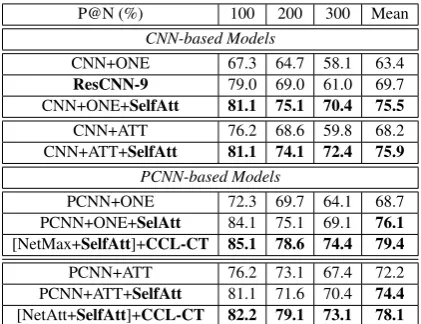
Figures 4 & 5 show the PR-curve results attained by applying SelfAtt to CNN/PCNN based models. We also report the results of P@100, P@200, P@300 and the Mean for CNN/PCNN+ONE and CNN/PCNN+ATT with SelfAtt in the held-out evaluation. Table3shows the P@N values with test settings where all sen-tences in an entity pair’s bag are taken into ac-count. PR-curve and P@N results demonstrate that CNN/PCNN based approaches achieve im-proved results with the SelfAtt. PCNN/CNN mod-els with SelfAtt also outperform ResCNN-9 in terms of P@N and PR-curve, which indicates that the proposed SelfAtt is beneficial for boost-ing the performance of the models learnboost-ing from noisy inputs. The state-of-the-art DSGAN system demonstrates its ability to improve PCNN/CNN + ATT/ONE by filtering out noisy data. By com-paring our SelfAtt with DSGAN, Figure4shows that SelfAtt significantly outperforms the DSGAN system in terms of CNN-based models.
The intuition of adding an internal CNN states self-attention module to help DSRE task is that, 1/ a deeper CNN has positive effects on noisy NLP tasks (Conneau et al.,2017), 2/ attention enhanced PCNN/CNN is expected to assign various weight scores to different sentence portions and will form a better representation in the DSRE setting.
convolution layers into a model, as the internal self-attention used is placed between two con-volution operations. Huang and Wang (2017) demonstrated that multi-layer ResCNNs network does achieve performance improvement by adding residual identity shortcuts, which aligns with the study that deeper CNN has positive effects on noisy NLP tasks (Conneau et al., 2017). How-ever, previous DSRE researches overlooked multi-layer CNN/PCNN with ONE/ATT. To investigate multilayer effects of DSRE, we present multilayer CNN with ATT results in Table 2, we observe that with ATT several multilayer models (e.g., 2 layers CNN+ATT) have improvements compared with single layer models, and overfitting occurs when larger convolution layers are employed.
P@N(%) 100 200 300 Mean AUC CNN-1+ATT 76.2 68.6 59.8 68.2 0.327
CNN-2+ATT 76.2 72.1 68.4 72.2 0.348
CNN-5+ATT 74.2 72.6 66.1 71.0 0.338
[image:8.595.311.522.61.223.2]CNN-9+ATT 66.3 64.2 63.7 64.7 0.315
Table 2: Multilayer CNNs+ATT
Thus, our SelfAtt design is expected to boost a sentence encoder with attention scores and al-leviate noise effects by benefiting from a multi-layer CNN network. From empirical testing, to ap-ply attention more subtly, placing self-attention af-ter the second convolution operation and followed by one convolution operation works well for all PCNN/CNN + ONE/ATT based models generally. We report results with this setting.
avaya , which was once a division of lucent technologies and att before that , is one of the nation ’s top makers of phone equipment , rivaling cisco , nortel and alcatel-lucent in providing internet-based communications to corporations .
By looking at the weight scores from SeftAtt, we observe that different parts of a sentence obtain different attentions. For example, as the heat-map illustrates using attention scores, entities avaya
andciscoobtain more attention than others.
4.5 Effects of Collaborative Curriculum
Learning
We refer to the Collaborative Curriculum Learn-ing usLearn-ing Conflicts Trick as CCL-CT, and us-ing the Small Loss trick as CCL-SL. For the fol-lowing experiments, we expect that by applying our CCL strategies, it will result in further im-provements by reducing the undesirable effects of noise. In our framework of integrating col-laborative curriculum learning, both NetAtt and
P@N (%) 100 200 300 Mean
CNN-based Models
CNN+ONE 67.3 64.7 58.1 63.4
ResCNN-9 79.0 69.0 61.0 69.7
CNN+ONE+SelfAtt 81.1 75.1 70.4 75.5
CNN+ATT 76.2 68.6 59.8 68.2 CNN+ATT+SelfAtt 81.1 74.1 72.4 75.9
PCNN-based Models
PCNN+ONE 72.3 69.7 64.1 68.7 PCNN+ONE+SelAtt 84.1 75.1 69.1 76.1
[NetMax+SelfAtt]+CCL-CT 85.1 78.6 74.4 79.4
PCNN+ATT 76.2 73.1 67.4 72.2 PCNN+ATT+SelfAtt 81.1 71.6 70.4 74.4
[NetAtt+SelfAtt]+CCL-CT 82.2 79.1 73.1 78.1
Table 3: P@N results for models with internal CNNs self-attention and curriculum learning
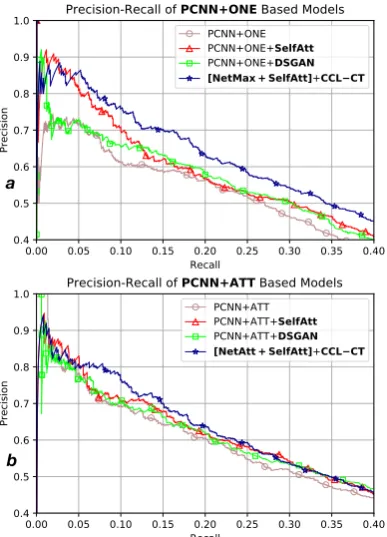
NetMax could be used for testing. We report a comparison of NetAtt/NetMax+SelfAtt+CCL, PCNN+ONE/ATT and state-of-the-art DSGAN noise reduction as shown in Table3and Figure5.
CCL-CT utilises the conflicts from the collab-orative training of NetMax and NetAtt to form a curriculum to guide the training. The two students form different bag representations to feed to Soft-max layer separately, and they generate disagree-ments on the bag-level selection during training. In our experiment, each epoch reveals less than 10.9% disagreement, thus we drop less than 10.9% of the total entity pair bags during each epoch and the drop ratios work well in our experiments.
Model +SelfAtt CCL-CT
PCNN+ATT 0.341 0.368 0.381
PCNN+ONE 0.325 0.352 0.380
Table 4: Comparison of AUC Results
[image:8.595.87.275.290.351.2]b a
Figure 5: PR curves comparison of PCNN based noise removal models
training. When compared with the state-of-the-art DSGAN system, our models outperform both DS-GAN based ONE and ATT models.
We examine the small loss trick based curricu-lum using MentorNet (Jiang et al., 2018). CCL-SLuses the loss from the collaborative training to build the curriculum vector, which commences by guiding the collaborative training from the burn-in epoch (5th) and the optimal epoch result of
(AUC:0.382, P@N mean:77.3%), which is re-ported for held-out evaluation starting at the burn-in epoch. The results also demonstrate that vari-ous curriculum types (the conflict and loss tricks) could help to alleviate the noise in DSRE.
Overall, our experimental results demonstrate that the proposed SelfAtt and CCL strategies for PCNN/CNN models significantly outperform baselines in terms of PR-curve and P@N.
5 Conclusion
To deal with the mislabelling issue in distantly su-pervised relation extraction, this paper details the development of a novel model based on a multi-layer self-attention mechanism for CNNs and col-laborative curriculum learning strategies with two students (NetAtt and NetMax). The internal
self-attention model can learn a better sentence rep-resentation by taking advantage of deeper CNNs in terms of positive effects on noisy inputs. The CCL strategies can perform a collaborative train-ing on NetAtt and NetMax by allowtrain-ing them to regularize each other, in tandem with the removal of noisy sample effects. Two different tricks, namely conflicts tricks and small loss tricks, are utilized in the CCL framework. Experimental re-sults on the commonly-used NYT dataset indicate that our proposed approaches significantly outper-form state-of-the-art baseline models in terms of P@N and PR-curve evaluation metrics.
6 Acknowledgement
We thank co-authors Jingguang Han and Sha Liu ({jingguang.han, sha.liu}@ucd.ie) and anony-mous reviewers for these insightful comments and suggestions. We would like to thank Emer Gilmartin ([email protected]) for helpful comments and presentation improvements. This research is funded by the Enterprise-Ireland Innovation Part-nership Programme (Grant IP2017626).
References
Christoph Alt, Marc H¨ubner, and Leonhard Hennig. 2019. Fine-tuning pre-trained transformer language models to distantly supervised relation extraction. In Proceedings of the 57th Annual Meeting of the Association for Computational Linguistics, pages 1388–1398, Florence, Italy. ACL.
Yoshua Bengio, J´erˆome Louradour, Ronan Collobert, and Jason Weston. 2009. Curriculum learning. In Proceedings of the 26th annual international con-ference on machine learning, pages 41–48. ACM.
Jianpeng Cheng, Li Dong, and Mirella Lapata. 2016. Long short-term memory-networks for machine reading. InProceedings of the 2016 Conference on Empirical Methods in Natural Language Process-ing, pages 551–561.
Alexis Conneau, Holger Schwenk, Lo¨ıc Barrault, and Yann Lecun. 2017. Very deep convolutional net-works for text classification. In European Chap-ter of the Association for Computational Linguistics EACL’17.
Jun Feng, Minlie Huang, Li Zhao, Yang Yang, and Xi-aoyan Zhu. 2018. Reinforcement learning for rela-tion classificarela-tion from noisy data. InProceedings of AAAI.
Ian Goodfellow, Jean Pouget-Abadie, Mehdi Mirza, Bing Xu, David Warde-Farley, Sherjil Ozair, Aaron Courville, and Yoshua Bengio. 2014. Generative
ad-versarial nets. In Advances in Neural Information
Processing Systems 27, pages 2672–2680.
Raphael Hoffmann, Congle Zhang, Xiao Ling, Luke Zettlemoyer, and Daniel S Weld. 2011. Knowledge-based weak supervision for information extraction of overlapping relations. InProceedings of the 49th Annual Meeting of the Association for Computa-tional Linguistics: Human Language Technologies-Volume 1, pages 541–550. ACL.
YiYao Huang and William Yang Wang. 2017. Deep residual learning for weakly-supervised relation ex-traction. InProceedings of the 2017 Conference on Empirical Methods in Natural Language Process-ing, pages 1803–1807.
Guoliang Ji, Kang Liu, Shizhu He, and Jun Zhao. 2017. Distant supervision for relation extraction with sentence-level attention and entity descriptions. InProceedings of the Thirty-First AAAI Conference on Artificial Intelligence, February 4-9, 2017, San Francisco, California, USA., pages 3060–3066.
Lu Jiang, Deyu Meng, Qian Zhao, Shiguang Shan, and Alexander Hauptmann. 2015. Self-paced curricu-lum learning. InAAAI.
Lu Jiang, Zhengyuan Zhou, Thomas Leung, Li-Jia Li, and Li Fei-Fei. 2018. Mentornet: Learning data-driven curriculum for very deep neural networks on corrupted labels. InICML.
Yankai Lin, Shiqi Shen, Zhiyuan Liu, Huanbo Luan, and Maosong Sun. 2016. Neural relation extraction with selective attention over instances. In Proceed-ings of the 54th Annual Meeting of the Association for Computational Linguistics (Volume 1: Long Pa-pers), volume 1, pages 2124–2133.
Tomas Mikolov, Ilya Sutskever, Kai Chen, Greg S Cor-rado, and Jeff Dean. 2013. Distributed representa-tions of words and phrases and their
composition-ality. In C. J. C. Burges, L. Bottou, M. Welling,
Z. Ghahramani, and K. Q. Weinberger, editors, Ad-vances in Neural Information Processing Systems 26, pages 3111–3119. Curran Associates, Inc.
Mike Mintz, Steven Bills, Rion Snow, and Dan Juraf-sky. 2009. Distant supervision for relation extrac-tion without labeled data. In Proceedings of the Joint Conference of the 47th ACL and the 4th IJC-NLP of the AFIJC-NLP, pages 1003–1011. Association for Computational Linguistics.
Ankur Parikh, Oscar T¨ackstr¨om, Dipanjan Das, and Jakob Uszkoreit. 2016. A decomposable attention
model for natural language inference. In Proceed-ings of the 2016 Conference on Empirical Methods in Natural Language Processing, pages 2249–2255.
Pengda Qin, Weiran Xu, and William Yang Wang. 2018. Dsgan: Generative adversarial training for distant supervision relation extraction. arXiv preprint arXiv:1805.09929.
Sebastian Riedel, Limin Yao, and Andrew McCallum. 2010. Modeling relations and their mentions with-out labeled text. In Joint European Conference on Machine Learning and Knowledge Discovery in Databases, pages 148–163. Springer.
C´ıcero Nogueira dos Santos, Bing Xiang, and Bowen Zhou. 2015. Classifying relations by ranking with convolutional neural networks. InACL. Association for Computational Linguistics.
Mihai Surdeanu, Julie Tibshirani, Ramesh Nallapati, and Christopher D Manning. 2012. Multi-instance multi-label learning for relation extraction. In Pro-ceedings of the 2012 joint conference on empirical methods in natural language processing and compu-tational natural language learning, pages 455–465. Association for Computational Linguistics.
Richard S Sutton and Andrew G Barto. 1998. Rein-forcement learning: An introduction.
Shingo Takamatsu, Issei Sato, and Hiroshi Nakagawa. 2012. Reducing wrong labels in distant supervi-sion for relation extraction. In Proceedings of the 50th Annual Meeting of the Association for Compu-tational Linguistics: Long Papers-Volume 1, pages 721–729. ACL.
Ashish Vaswani, Noam Shazeer, Niki Parmar, Jakob Uszkoreit, Llion Jones, Aidan N Gomez, Łukasz Kaiser, and Illia Polosukhin. 2017. Attention is all you need. InAdvances in Neural Information Pro-cessing Systems, pages 5998–6008.
Haoyu Wang, Ming Tan, Mo Yu, Shiyu Chang, Dakuo Wang, Kun Xu, Xiaoxiao Guo, and Saloni Pot-dar. 2019. Extracting multiple-relations in one-pass with pre-trained transformers. arXiv preprint arXiv:1902.01030.
Daojian Zeng, Kang Liu, Yubo Chen, and Jun Zhao. 2015. Distant supervision for relation extraction via piecewise convolutional neural networks. In Pro-ceedings of the 2015 Conference on EMNLP, pages 1753–1762.
Daojian Zeng, Kang Liu, Siwei Lai, Guangyou Zhou, and Jun Zhao. 2014. Relation classification via con-volutional deep neural network. In Proceedings of COLING 2014, the 25th International Conference on Computational Linguistics: Technical Papers, pages 2335–2344.
Han Zhang, Ian Goodfellow, Dimitris Metaxas,