Proceedings of the 2019 Conference on Empirical Methods in Natural Language Processing 5022
Subword Language Model for Query Auto-Completion
Gyuwan Kim
Clova AI, NAVER Corp. [email protected]
Abstract
Current neural query auto-completion (QAC) systems rely on character-level language mod-els, but they slow down when queries are long. We present how to utilize subword language models for the fast and accurate generation of query completion candidates. Represent-ing queries with subwords shorten a decod-ing length significantly. To deal with issues coming from introducing subword language model, we develop a retrace algorithm and a reranking method by approximate marginal-ization. As a result, our model achieves up to 2.5 times faster while maintaining a sim-ilar quality of generated results compared to the character-level baseline. Also, we pro-pose a new evaluation metric, mean recover-able length (MRL), measuring how many up-coming characters the model could complete correctly. It provides more explicit meaning and eliminates the need for prefix length sam-pling for existing rank-based metrics. More-over, we performed a comprehensive analysis with ablation study to figure out the impor-tance of each component1.
1 Introduction
Query auto-completion (QAC) is one of the es-sential features for search engines. When a user types a query in the search box, QAC systems sug-gest most likely completion candidates (Cai et al.,
2016). It not only saves time for users to enter search terms but also provides new information more than what was initially expected.
Recent neural QAC models in the literature em-ploy character-level language models (Park and Chiba, 2017). It is a natural choice in that QAC systems need to respond whenever a user enters a query as input character-by-character. In addition to the accuracy, speed in terms of latency is also an
1Code is available at https://github.com/ clovaai/subword-qac.
indispensable prerequisite for practical QAC sys-tems. The generation process is auto-regressive, and the size of the search space is exponential to the sequence length. Long character sequences make prediction slow and inaccurate in the con-straints of limited computation. Also, character-level models are prone to errors due to long-range dependency (Sennrich, 2016). Therefore, these limitations arouse to consider alternatives to rep-resent a query in a shorter sequence.
In this paper, we apply a subword language model for query auto-completion. Compared to character language models, subword language models reduce sequence length and the number of decoding steps significantly, thus resulting in much faster decoding. For subword-level model-ing, a segmentation algorithm is necessary. Byte pair encoding (BPE) (Sennrich et al., 2015) is widely used, but noise in the data makes segmen-tation ambiguous and degrades BPE output. To address this issue, as well as BPE, we use subword regularization (SR) algorithm proposed by Kudo
(2018) that stochastically samples multiple seg-mentations by utilizing a unigram language model. To our knowledge, we are the first to apply SR to language modeling.
is unlikely to generate ground truth query. To con-sider every possible segmentation of target com-pletion, we propose retrace algorithm that is going a few characters back from the end and generat-ing candidates with the restriction that they should match with retraced characters. For the case of SR models, due to the stochasticity of segmenta-tion, we should marginalize over all possible seg-mentations to calculate the likelihood of a query. For better approximation than just argmax, we perform reranking with approximated marginal-ization using the output of beam search. Experi-mental results show that these techniques improve the robustness of the decoding process of the sub-word language model to achieve close generation quality compared to the character baseline.
We propose a novel metric for query auto-completion evaluation, called mean recoverable length (MRL). This metric remedies shortcom-ings of common QAC evaluation metrics, mean reciprocal rank (MRR) and partial-matching MRR (PMRR), which require sampling of a prefix length and are favorable to short queries. We con-duct comprehensive ablation study and analysis of our models on these three metrics.
2 Related Work
One of the successful traditional QAC approaches is most popular completion (MPC) (Bar-Yossef and Kraus,2011), which returns the most frequent candidates among all previously observed queries that match the prefix. After extracting candi-dates, reranking algorithms (e.g., LambdaMART (Burges,2010)) with additional features are used to align final candidates. These methods can-not generate previously unseen queries by nature. Contrary to traditional approaches based on infor-mation retrieval, neural approaches can generalize to unseen prefixes.
Choosing an appropriate granularity level for text segmentation has been long studied over the variety of natural language processing problems. It can be a character, subword, word, phrase, sen-tence, and even paragraph. A trade-off between them exists, and the best performing granular-ity often varies depending on tasks and datasets. Character models are widely used to address nat-ural language processing tasks including text clas-sification (Kim, 2014; Zhang et al., 2015; Con-neau et al.,2016), language modeling (Hwang and Sung,2017;Al-Rfou et al.,2018), machine
trans-lation (Chung et al.,2016;Lee et al.,2017), etc. Currently, neural machine translation systems widely use subword segmentation as de facto.
Mikolov et al.(2012) observed that a subword lan-guage model is advantageous in that it achieves better performance compared to character-level models with zero out-of-vocabulary rate and smaller model size. BERT (Devlin et al., 2018) uses a subword as the unit token for their (masked) language models.
Word-level segmentation can easily shorten se-quence length compared to character-level. How-ever, word-level models require larger vocabulary size and the number of parameters to learn. Also, it causes data sparsity issue. Because the vocab-ulary of words is usually fixed before training, it cannot generate out-of-vocabulary words by itself. Search systems are especially in an open vocab-ulary setting. For word-level models, it is hard to deal with the last incomplete token because it may not be in the vocabulary, unlike character-level naturally handle it. Even if the vocabulary contains this token, the decoding process may be somewhat different from expected.
Word-character hybrid models were proposed to overcome the out-of-vocabulary problem ( Lu-ong and Manning, 2016; Wu et al., 2016). A word-level decoder generates a word sequence, and when it generates a special <UNK> token, a character-level decoder generates a character se-quence on top of it. These two decoders are connected hierarchically. Word models assume whitespace as the boundary of words. In some languages including Japanese and Chinese, seg-mentation of sentences into words is unknown in advance and sometimes vague. Moreover, input queries usually include much noise such as typos, grammatical errors and spacing errors. The prob-lems mentioned above hinder word-level process-ing for QAC.
Park and Chiba (2017) and Fiorini and Lu
2016). Even though they use word information to the input, the decoding process of their models is still in the character-level.
We can interpret generating a subword which is a concatenation of characters as parallel de-coding of characters (Stern et al., 2018). In this sense, non-autoregressive neural machine transla-tion (Gu et al., 2017; Lee et al., 2018) is related to our work. They also aim to improve decoding speed with minimal performance degradation. Our model and decoding method can be used for non-autoregressive NMT in place of a character-level decoder, and in the opposite direction, we can ap-ply their approaches to QAC vice versa.
3 Subword Language Model
LetΣbe the set of all possible characters andV
be the vocabulary of tokens. Each token is a char-acter or a concatenation of charchar-acters, and it is a subword in our case. A language model estimates the probability of a token sequence t where the probability distribution of tokentiat each stepiis
conditioned on the previous tokenst<i:
p(t;θ) = |t| Y
i=1
p(ti|t<i;θ)
where ti ∈ V and θ is a set of model
parame-ters. For a token sequencet, we can map it to a queryq = concat(t)(= t1 ⊕t2⊕ · · · ⊕t|t|)by concatenating itself sequentially. Then, the prob-ability of a given queryqis the sum of the prob-ability over the set of all possible segmentationt,
S(q) ={t:concat(t) =q}:
p(q;θ) = X t∈S(q)
p(t;θ).
Similar to (Chan et al.,2016), segmentationtcan be interpretable as a latent decomposition of the queryq.
3.1 Segmentation
In character-level language modeling, token vo-cabularyV is equal toΣ, and segmentation is per-formed by merely splitting every character. We ex-clude word-level language modeling which splits a sentence by whitespace from consideration due to its limitations mentioned in Section2.
In the case of subword language modeling, we use two widely used segmentation algorithms: (1)
byte pair encoding (BPE) and (2) subword regular-ization (SR). Formally, a segmentation algorithm defines a probability distribution over a token se-quencetconditioned on given queryq:pseg(t|q).
The BPE algorithm is deterministic because it segments greedily from left to right. On the other hand, SR can sample multiple segmentations stochastically. The number of possible segmenta-tions is exponentially large. It is hard to calculate the likelihood of a given sentence using dynamic programming because even with the same prefix, hidden states vary upon different previous tok-enization. Marginalization over all possible seg-mentations of very long sequences is intractable. In sum, we compare character-level and subword-level (BPE, SR) language modeling.
3.2 Training
We can derive an unbiased gradient estima-tor of the log-likelihood of a query by using Bayes’ theorem and the identity of∇θf(x;θ) =
f(x;θ)∇θlogf(x;θ) assuming f(x;θ) 6= 0 for
allx(Williams,1992):
∇θlogp(q;θ) = E
t∼p(t|q;θ)∇θlogp(t;θ).
However, since sampling t from p(t|q;θ) is computationally expensive, we heuristically use
pseg(t|q) instead. Regardless of the language
model parameters θ, segmentation model pseg is learned before the language model training and can be used to sample t easily. The better way to approximate the distribution p(t|q;θ) will be explored in the future.
Our training objective becomes equivalent to maximizing the average log-likelihood of the seg-mentation of sentences:
L(θ) = 1
|Q|
X
q∈Q
logp(t;θ)
= 1
|Q|
X
q∈Q
X
i
logp(ti|t<i;θ),
where Q is the training set of all queries, and t
is the segmentation of a query q sampled from
pseg(t|q) which depends on the segmentation
4 Decoding
Given prefix p, let the set of its completions be Q+(p) and the set of their tokenizations be
S+(p) = {t : concat(t) ∈ Q+(p)}. We want to find the most likely completionqˆ:
ˆ
q= argmax q
logp(q|p)
= argmax q∈Q+(p)
logp(q)
= argmax q∈Q+(p)
log X
t∈S(q)
p(t) (1)
however, this is obviously intractable to search in the infinitely large token sequence space. We approximate this by decoding for the best token sequence ˆt and then returning its corresponding queryq˜by concatenating its token sequentially:
ˆ
t= argmax t∈S+(p)
logp(t)
˜
q=concat(ˆt)
Basic practice is segmentingp, feeding it into language model to encode p, and using it for the decoding. Since findingˆtis also intractable, beam search decoding is used but only results in subop-timal predictions. We will improve this incremen-tally with techniques following.
4.1 Retrace Algorithm
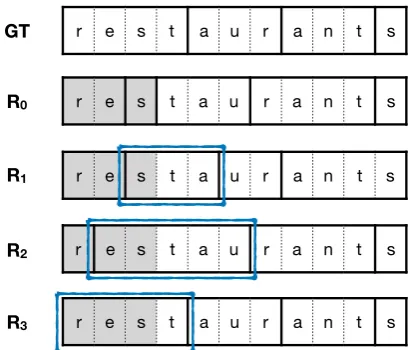
There is no guarantee that the end of given pre-fix matches the tokenization boundary of the com-pleted query. To address this possibility of the in-completeness at the end of a prefix, we can retrace a few characters and generate from there. For the case (call itRr) where the last token that overlaps with the prefix finishesrcharacters before the end of the prefix, first starting from a token sequence ofp1:|p|−r, we can perform beam search decoding
on the restriction that the next token should cover the remaining part of the prefix and the next new character. Figure1illustrates this algorithm.
This process is unnecessary for a character-level model since every token is a single character. On the other hand, the retrace algorithm is helpful for subword models, especially BPE models which have deterministic segmentation algorithm.
We can limit the maximum step of retrace byL
to only consider Rr where 0 ≤ r ≤ L because of the computational issue. We will denote this limitation asRL. R0 is the usual case without the retrace algorithm, and R∞ counts every possible retrace steps.
r e s t a u r a n t s
r e s t a u r a n t s
r e s t a u r a n t s
r e s t a u r a n t s
r e s t a u r a n t s
GT
R0
R1
R2
[image:4.595.313.519.61.236.2]R3
Figure 1: Illustration of retrace algorithm with the ex-ample of “restaurants.” The gray area means given pre-fix (“res”) of the query. The solid line indicates the boundary of the segmentation. GT is the segmentation of ground truth query. Possible examples of the gener-ated sequence of tokens belonging to the caseRr are visualized. Blue boxes indicate a fixed segmentation with retrace algorithm at the end of the prefix.
4.2 Reranking Method by Approximate Marginalization
QAC system has to suggest N completion can-didates sorted in order of likelihood rather than finding only the best completion candidate. We can extract a set of top B(≥ N) candidates us-ing beam search with beam sizeB, namelyTB =
{t1,· · ·,tB} in the descending order of likeli-hood. In the case of deterministic segmentation,
qi = concat(ti) are mutually different. i.e. |QB| = B forQB = {q1,· · · ,qB}. Then,
triv-ially our prediction would be(q1,· · · ,qN). On the other hand, in the case of stochastic seg-mentation, same queryqi,qj(i 6= j) with differ-ent token sequenceti,tj may exist. The obvious way is merely removing duplicates.
On the assumption thatlogp(t)logp(t0)for all t ∈ TB and t0 ∈/ TB, Equation (1) implies
that marginalization over the final beam outputs can provide better approximation:
ˆ
q≈argmax q∈Q+(p)
log X
t∈TB
p(t)
= argmax q∈QB
log X
t∈TB
p(t)
5 Evaluation Metric 5.1 MRR and PMRR
One of the most standard QAC evaluation metrics is the mean reciprocal rank (MRR). The MRR for the QAC systemmis calculated with test dataset
Qtestas follows:
M RR(m) = 1
|Qtest|
X
q∈Qtest
RR(q, m(p)),
wherep is a prefix of a queryqandm(p)is the ranked list of candidate completions ofpfromm. RRis reciprocal rank ofqifqis inm(p), other-wise 0.
Since it is hard to get a pair of the desired query and its prefix in a real situation, we should synthet-ically select a prefix by cutting off a given query for the evaluation. Common practice is to uni-formly sample from all possible prefixes within minimal length constraint in characters (or words) However, real distribution of the prefix length may differ to the uniform distribution. For example, users tend to engage with QAC at the position close to the boundary of words, and after typ-ing half of query characters (Mitra et al., 2014). Due to the stochastic characteristic of prefix sam-pling processes or their difference among distinct QAC systems, evaluation results are inconsistent even with the same test dataset. To prevent this problem, a sampling function should be concretely specified.
Park and Chiba(2017) introduced a new metric, partial-matching MRR (PMRR):
P M RR(m) = 1
|Qtest|
X
q∈Qtest
PRR(q, m(p)),
where partial-matching reciprocal rank PRR is the reciprocal of the index of the first candidate such that the original query is the same as it or starts with it plus whitespace. If there is no such candidate,PRRequals to 0.
PMRR also requires sampling of the prefix length. PMRR values are often omitted in the liter-ature because of the similar tendency to MRR. In other words, PMRR does not give much additional information about the quality of the generated re-sults.
5.2 Recoverable Length
To avoid the synthetic sampling process and length dependency, we propose a new evaluation metric
for query auto-completion, namely mean recover-able length (MRL). We define recoverrecover-able length RL as the number of characters right before the first position where candidates do not have the query. When all characters of a query are known, we can readily suggest itself. If we delete chars from right to left one-by-one, the ground truth query will disappear in the list of candidate com-pletions. For example, if q ∈ m(q1:|q|−l) for l = 1,2,3 but not 4, recoverable length of this query with respect to the QAC system m is 3. MRL is mean of recoverable length:
M RL(m) = 1
|Qtest|
X
q∈Qtest
RLm(q)
MRL is a useful metric for additive QAC which suggests one word at a time instead of a whole-query completion (Vargas et al., 2016) in that it measures how many characters the system can pre-dict correctly at once. MRL does not care about the order of candidates and check whether they contain the target query or not. Lastly, it elimi-nates the need to choose a prefix length in the test data.
6 Experiments 6.1 Data
We use the public AOL query log dataset (Pass et al., 2006) for the experiments. We split data based on time. Among three months of the entire span, we use last one week as test data and one week right before the test data as validation data. It is close to a real scenario where future queries are unseen during the training.
We perform Unicode NFKC normalization and remove non-ASCII characters. For simplicity, we change uppercase alphabets to lowercase. Af-ter normalization and changing to lowercase, only 43 unique characters including special symbols <BOS>, <EOS> and<UNK> remain. We substi-tuted multiple adjacent spaces to a single one and removed leading or trailing spaces. We merged duplicates which appear adjacently by the same user and the same query. Queries of a length shorter than three characters are filtered out.
Model MRR PMRR MRL
Execution Speed
(QPS) Decode
Length
Seen Unseen All Seen Unseen All Seen Unseen All CPU GPU
MPC .570 .000 .290 .616 .095 .360 8.06 0.00 4.10 >100 N/A
Char .458 .160 .311 .552 .372 .464 5.77 4.24 5.02 11.0(1.0x) 16.5(1.0x) 14.5
BPE .242 .085 .164 .305 .232 .269 0.49 0.54 0.51 24.2(2.2x) 37.4(2.3x) 7.1
BPE+R1 .427 .156 .294 .517 .368 .444 5.28 3.98 4.64 15.8(1.4x) 27.3(1.7x) 11.8 BPE+R2 .430 .157 .296 .520 .369 .446 5.44 4.01 4.74 15.5(1.4x) 27.2(1.6x) 12.2 BPE+R∞ .431 .157 .296 .520 .369 .446 5.50 4.01 4.7615.3(1.4x) 26.9(1.6x) 12.2
SR .422 .148 .288 .541 .379 .461 5.11 3.82 4.48 20.8(1.9x) 40.1(2.4x) 6.8
[image:6.595.70.525.60.267.2]SR+M .424 .149 .289 .535 .373 .455 5.14 3.85 4.50 19.6(1.8x) 40.0(2.4x) 6.8 SR+R∞ .423 .148 .289 .541 .378 .461 5.14 3.83 4.50 16.3(1.5x) 29.6(1.8x) 7.4 SR+R∞+M .427 .150 .291 .538 .375 .458 5.19 3.88 4.5416.2(1.5x) 28.7(1.7x) 7.4
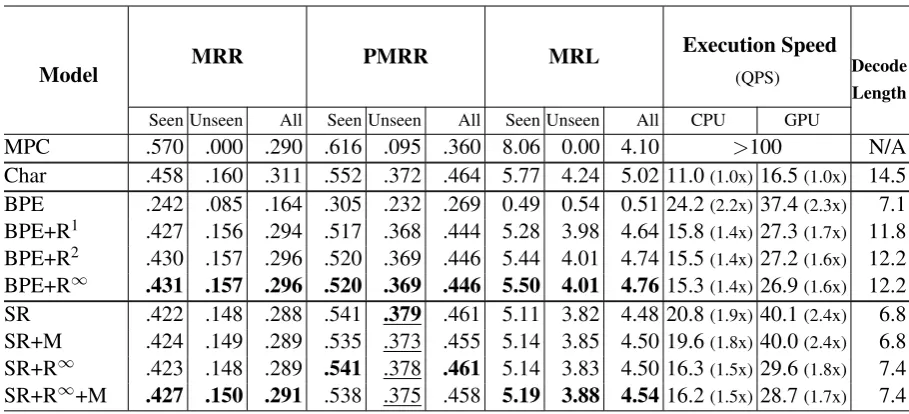
Table 1: Results of completion generation. We group MPC, character language model baseline, and two subword language models separately. +R implies the retrace algorithm. +M implies reranking with approximate marginal-ization. QPS stands for query per seconds. The higher the QPS, the better. The best results for each column related to accuracy are shown inboldfor each segmentation algorithm (BPE and SR). SR model shows higher unseen PMRR scores (underlined). Our models are faster than the character baseline.
6.2 Implementation Details
The language model used in the experiments con-sists of an input layer, a single LSTM layer, a pro-jection layer, and an output layer. For the LSTM layer, followingMelis et al.(2017) andJaech and Ostendorf (2018), we apply layer normalization (Ba et al.,2016) to each gate and couple input and forget gates. We tie input and output embeddings for better generalization (Press and Wolf, 2016;
Inan et al.,2016). We set the LSTM hidden size to 600 and the input embedding size to 100.
We train three individual language models: namely Char, BPE, SR. The only difference among models is how to segment a given sentence into tokens. We believe that increasing model size (number of LSTM layers, input size, and hidden size) would improve the performance. Also, the best set of a combination may differ depending on models. However, we use the same model size for the character baseline and our variants for the fair-ness since our goal is proposing a new method and comparing between baseline and ours rather than achieving the best performance with the restriction of having a similar number of parameters.
We use the off-the-shelf SentencePiece (Kudo and Richardson, 2018) library for vocabulary learning and segmentation of the vocabulary size 256 using BPE, SR algorithms. For the subword regularization, we use sampling parameters l =
∞,α = 0.2for the training. We choose this value by the generation accuracy on the validation data. Increase of model size and computation due to larger vocabulary size are not substantial. By set-ting a manageable amount of vocabulary size, we can balance performance and computational cost.
For the computational efficiency, we truncated queries in the training data to a length of 40. Only less than 3% of queries in the training data are longer than 40 characters. We train models for thirty epochs by the Adam (Kingma and Ba,2014) optimizer with a learning rate 5e-3 and batch size 1024. Following Smith (2018), we use a large learning rate and batch size. We use recurrent dropout (Semeniuta et al.,2016) with probability of 0.25 for regularization. The best model is cho-sen using validation data.
Using QAC models, we generateN = 10 com-pletion candidates using beam search decoding of a beam widthB = 30.
For the SR models, the segmentation of p (or retracedp1:|p|−r) is not deterministic and
gener-ated completions may differ depending on its seg-mented token sequences with their different en-coded representation. By following (Kudo,2018), we can find the most likely segmentation sequence
possi-ble reason is that segmentations which are not the best have a smaller probability as itself and so less likely to appear in training and less competitive in the process of beam search. For this reason, we set
nto 1.
We used a trie (Fredkin,1960) data structure to implement most popular completion baseline.
All experiments were performed on NAVER Smart Machine Learning (NSML) platform (Sung et al.,2017;Kim et al.,2018).
6.3 Decoding Results
We performed comprehensive experiments to an-alyze the performance of query auto-completion. Table 1shows the generation result of MPC, the character baseline, and our model variants. For BPE models, we varied the maximum retrace step to 0 (without retrace algorithm), 1, 2, and∞ (no limitation on retracing step size). For SR models, we compare decoding results without any tech-niques, with marginalization only, with retrace al-gorithm only, and with both.
MPC is a very fast and remarkably strong base-line. It is worse than language models in the over-all score (MRR, PMRR, and MRL), but better for previously seen queries. However, it is un-able to predict unseen queries. Even with effi-cient data structures, MPC requires huge memory to keep statistics of all previous queries. As a prac-tical view, combining frequency-based traditional method and neural language model approach can boost the accuracy and meet trade-off between the performance and computational costs.
MRRs and PMRRs of our best methods are close to that of the character model with less than 0.02 point drop. Notably, the SR model has bet-ter generalization ability in that their PMRR for unseen queries is higher than that of the character model. In a real scenario, it is more critical be-cause unseen queries come in increasingly as time goes by.
We measure execution time with Tesla P40 GPU and Xeon CPU. Subword-level models are up to 2.5 times faster than the character baseline with minimal loss in performance both in CPU and GPU. Decoding length which is maximum suf-fix length until beam search ends correlates with the number of floating-point operations. Subword models significantly reduce the decoding length from the character baseline more than two times shorter by generating multiple characters at once.
re nat
Char SR Char SR
[image:7.595.313.520.61.135.2]realtor.com recipes national city bank national bank recipes rentals nationalcity.com national city real estate real estate national city nationwide remax restaurants national geographic national parks realtor resources national car rental national park
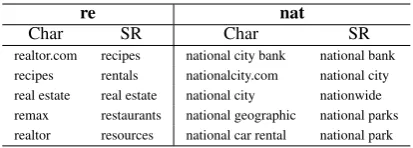
Table 2: Examples of top 5 candidates of completions given ”re” and ”nat” as prefixes generaed by the char-acter baseline and SR model.
Models with additional techniques perform bet-ter than without them. Especially, retrace al-gorithm gives huge improvement for BPE case. Without retrace algorithm, BPE models do not work well. On the other hand, SR models only obtain small improvement. Because retrace algo-rithm goes back, it increases the decoding length and slows down the speed. Although current re-trace algorithm is implemented straightforwardly, it can be improved by merging beams efficiently. Most of the subword lengths are equal or shorter than 3, so retrace of step 2 is quite enough, and R2 get a close result with R∞.
The reranking method by approximate
marginalization gives a small amount of im-provement and is orthogonal to retrace algorithm. Marginalization method increases MRR but decreases PMRR. It is plausible in that it changes the order of candidates by reranking. The effect of marginalization would be better if we use a bigger beam size. Because the reranking process is done after beam search decoding which takes most of the decoding time and only consists of summation and sorting the final beam outputs, it does not take a long time.
5 10 15 20 25 30 35 40 Query Length
(in characters) 0.1
0.2 0.3 0.4 0.5 0.6
MRR
5 10 15 20 25 30 35 40 Query Length
(in characters) 0.400
0.425 0.450 0.475 0.500 0.525 0.550 0.575 0.600
PMRR
5 10 15 20 25 30 35 40 Prefix Length
(in characters) 0.20
0.25 0.30 0.35 0.40
MRR
5 10 15 20 25 30 35 40 Prefix Length
(in characters) 0.30
0.35 0.40 0.45 0.50 0.55 0.60
PMRR
Char BPE + R SR + R SR + R + M
5 10 15 20 25 30 35 40 Query Length
(in characters) 1
2 3 4 5 6
[image:8.595.79.521.64.340.2]MRL
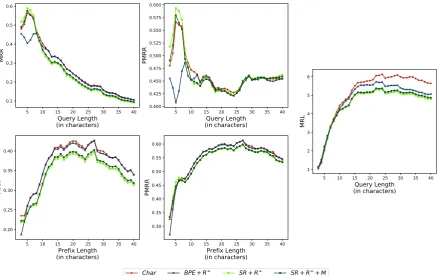
Figure 2: Comparison of the character-level baseline model and our best models by changing query length and prefix length in terms of three evaluation metrics: MRR, PMRR, and MRL. MRL is only varied by query length because it does not require prefix length sampling.
Table 2 shows examples of decoding results. Our model generates more concise and realistic examples.
6.4 Analysis on Evaluation Metrics
As shown in Figure2, we compared our best mod-els on three evaluation metrics (MRR, PMRR, and MRL) by changing the query length and prefix length. MRR and PMRR are more favorable to shorter queries. They drop very fast as the query becomes longer. For a longer query, the suffix length after sampling prefix has more chance to be longer. The search space increases exponentially with its suffix length. Even though QAC systems could generate realistic candidates, it is quite hard to match a long sequence with the ground truth. As the prefix length becomes longer which means that much information for determining the query has been given, the completion performance im-proves.
Interestingly, MRR and MRL of BPE are higher than those of SR, although BPE is worse in terms of PMRR than SR. For short queries, SR outper-forms the character baseline. On the other hand, BPE is poor when the query length (or prefix length) is short. However, for a longer case, its
MRR is almost close to that of the character base-line.
MRR and PMRR are highly dependent on the length distribution of test data. In contrast, MRL keeps the order between different methods as the query length changes. MRL is more reliable in the respect that it could provide consistent order be-tween methods regardless of query length distri-bution. For long queries lengths, MRL stays in the flat area. Normalizing recoverable length based on the query length might be necessary.
7 Future Work
Approximation in training (Section 3.2) and de-coding (Section4) deteriorate the accuracy of sub-word language modeling. One possible solution to reduce the accuracy gap between the character lan-guage model baseline and the subword lanlan-guage model is knowledge distillation (Hinton et al.,
2015;Kim and Rush,2016;Liu et al.,2018) from character-level language models. A student model can learn to match an estimation of query proba-bility with that of a teacher model.
(Kawakami et al.,2019;Grave et al.,2019) rather than using fixed pretrained segmentation algo-rithms. A conditional semi-Markov assumption allows exact marginalization using dynamic pro-gramming (Ling et al., 2016;Wang et al.,2017). Nevertheless, beam search decoding on those lan-guage models, especially faster decoding, is non-trivial.
Proposed method can be extended to wide range of tasks. Query suggestion (Sordoni et al.,2015;
Dehghani et al., 2017) and query reformulation (Nogueira and Cho,2017) are related to QAC and well-established problems. They both are also possible applications of the subword-level model-ing. (Drexler and Glass,2019) used subword reg-ularization and beam search decoding for end-to-end automatic speech recognition.
Lastly, implementation with more advanced data structure (Hsu and Ottaviano,2013) and par-allel algorithms to speed up and meet memory limitation are necessary for the real deployment (Wang et al., 2018). It would be helpful if the computation is adaptively controllable on-the-fly (Graves,2016) at the runtime depending on the sit-uation.
8 Conclusion
In this paper, we propose subword language mod-els for query auto-completion with additional techniques, retrace algorithm and reranking with approximate marginalization. We observed sub-word language models significant speedup com-pared to the character-level baseline while main-taining the generation quality. Our best models achieve up to 2.5 times faster decoding speed with less than 0.02 point drop of MRR and PMRR.
Using a subword language model, we build an accurate and much faster QAC system compared to the character-level language model baseline. Although there is still much room for improve-ment on hyperparameter optimization, decoding search, and neural architectures like Transformer (Vaswani et al., 2017; Dai et al., 2019), the goal of this work is to prove that the subword language model is an attractive choice for QAC as an alter-native to the character-level language model, espe-cially if latency is considered.
We believe that our newly proposed metric, mean recoverable length (MRL), provides fruitful information for the QAC research in addition to conventional evaluation metric based on ranks.
Acknowledgments
The author would like to thank Clova AI mem-bers and the anonymous reviewers for their helpful comments.
References
Rami Al-Rfou, Dokook Choe, Noah Constant, Mandy Guo, and Llion Jones. 2018. Character-level lan-guage modeling with deeper self-attention. arXiv preprint arXiv:1808.04444.
Jimmy Lei Ba, Jamie Ryan Kiros, and Geoffrey E Hin-ton. 2016. Layer normalization. arXiv preprint arXiv:1607.06450.
Ziv Bar-Yossef and Naama Kraus. 2011. Context-sensitive query auto-completion. In Proceedings of the 20th international conference on World wide web, pages 107–116. ACM.
Christopher JC Burges. 2010. From ranknet to lamb-darank to lambdamart: An overview. Learning, 11(23-581):81.
Fei Cai, Maarten De Rijke, et al. 2016. A survey of query auto completion in information retrieval. Foundations and TrendsR in Information Retrieval, 10(4):273–363.
William Chan, Yu Zhang, Quoc Le, and Navdeep Jaitly. 2016. Latent sequence decompositions. arXiv preprint arXiv:1610.03035.
Junyoung Chung, Kyunghyun Cho, and Yoshua Ben-gio. 2016. A character-level decoder without ex-plicit segmentation for neural machine translation. arXiv preprint arXiv:1603.06147.
Alexis Conneau, Holger Schwenk, Lo¨ıc Barrault, and Yann Lecun. 2016. Very deep convolutional networks for text classification. arXiv preprint arXiv:1606.01781.
Zihang Dai, Zhilin Yang, Yiming Yang, William W Cohen, Jaime Carbonell, Quoc V Le, and Ruslan Salakhutdinov. 2019. Transformer-xl: Attentive lan-guage models beyond a fixed-length context. arXiv preprint arXiv:1901.02860.
Mostafa Dehghani, Sascha Rothe, Enrique Alfonseca, and Pascal Fleury. 2017. Learning to attend, copy, and generate for session-based query suggestion. In Proceedings of the 2017 ACM on Conference on Information and Knowledge Management, pages 1747–1756. ACM.
Jennifer Drexler and James Glass. 2019. Subword reg-ularization and beam search decoding for end-to-end automatic speech recognition. InICASSP 2019-2019 IEEE International Conference on Acous-tics, Speech and Signal Processing (ICASSP), pages 6266–6270. IEEE.
Nicolas Fiorini and Zhiyong Lu. 2018. Personalized neural language models for real-world query auto completion. arXiv preprint arXiv:1804.06439.
Edward Fredkin. 1960. Trie memory. Communica-tions of the ACM, 3(9):490–499.
´
Edouard Grave, Sainbayar Sukhbaatar, Piotr Bo-janowski, and Armand Joulin. 2019. Training hy-brid language models by marginalizing over seg-mentations. InProceedings of the 57th Conference of the Association for Computational Linguistics, pages 1477–1482.
Alex Graves. 2016. Adaptive computation time for recurrent neural networks. arXiv preprint arXiv:1603.08983.
Jiatao Gu, James Bradbury, Caiming Xiong, Vic-tor OK Li, and Richard Socher. 2017. Non-autoregressive neural machine translation. arXiv preprint arXiv:1711.02281.
Geoffrey Hinton, Oriol Vinyals, and Jeff Dean. 2015. Distilling the knowledge in a neural network. arXiv preprint arXiv:1503.02531.
Bo-June Paul Hsu and Giuseppe Ottaviano. 2013. Space-efficient data structures for top-k completion. InProceedings of the 22nd international conference on World Wide Web, pages 583–594. ACM.
Kyuyeon Hwang and Wonyong Sung. 2017. Character-level language modeling with hierarchical recurrent neural networks. In Acoustics, Speech and Sig-nal Processing (ICASSP), 2017 IEEE InternatioSig-nal Conference on, pages 5720–5724. IEEE.
Hakan Inan, Khashayar Khosravi, and Richard Socher. 2016. Tying word vectors and word classifiers: A loss framework for language modeling. arXiv preprint arXiv:1611.01462.
Aaron Jaech and Mari Ostendorf. 2018. Personalized language model for query auto-completion. arXiv preprint arXiv:1804.09661.
Kazuya Kawakami, Chris Dyer, and Phil Blunsom. 2019. Learning to discover, ground and use words with segmental neural language models. In Pro-ceedings of the 57th Conference of the Association for Computational Linguistics, pages 6429–6441.
Hanjoo Kim, Minkyu Kim, Dongjoo Seo, Jinwoong Kim, Heungseok Park, Soeun Park, Hyunwoo Jo, KyungHyun Kim, Youngil Yang, Youngkwan Kim, et al. 2018. Nsml: Meet the mlaas platform with a real-world case study. arXiv preprint arXiv:1810.09957.
Yoon Kim. 2014. Convolutional neural net-works for sentence classification. arXiv preprint arXiv:1408.5882.
Yoon Kim, Yacine Jernite, David Sontag, and Alexan-der M Rush. 2016. Character-aware neural language models. InAAAI, pages 2741–2749.
Yoon Kim and Alexander M Rush. 2016. Sequence-level knowledge distillation. arXiv preprint arXiv:1606.07947.
Diederik P Kingma and Jimmy Ba. 2014. Adam: A method for stochastic optimization. arXiv preprint arXiv:1412.6980.
Taku Kudo. 2018. Subword regularization: Improv-ing neural network translation models with multiple subword candidates. ACL.
Taku Kudo and John Richardson. 2018. Sentencepiece: A simple and language independent subword tok-enizer and detoktok-enizer for neural text processing. arXiv preprint arXiv:1808.06226.
Jason Lee, Kyunghyun Cho, and Thomas Hofmann. 2017. Fully character-level neural machine trans-lation without explicit segmentation. Transactions of the Association for Computational Linguistics, 5:365–378.
Jason Lee, Elman Mansimov, and Kyunghyun Cho. 2018. Deterministic non-autoregressive neural se-quence modeling by iterative refinement. arXiv preprint arXiv:1802.06901.
Wang Ling, Edward Grefenstette, Karl Moritz Her-mann, Tom´aˇs Koˇcisk`y, Andrew Senior, Fumin Wang, and Phil Blunsom. 2016. Latent predic-tor networks for code generation. arXiv preprint arXiv:1603.06744.
Yijia Liu, Wanxiang Che, Huaipeng Zhao, Bing Qin, and Ting Liu. 2018. Distilling knowledge for search-based structured prediction. arXiv preprint arXiv:1805.11224.
Minh-Thang Luong and Christopher D Manning. 2016. Achieving open vocabulary neural machine trans-lation with hybrid word-character models. arXiv preprint arXiv:1604.00788.
G´abor Melis, Chris Dyer, and Phil Blunsom. 2017. On the state of the art of evaluation in neural language models. arXiv preprint arXiv:1707.05589.
Tom´aˇs Mikolov, Ilya Sutskever, Anoop Deoras, Hai-Son Le, Stefan Kombrink, and Jan Cernocky. 2012. Subword language modeling with neu-ral networks. preprint (http://www. fit. vutbr. cz/imikolov/rnnlm/char. pdf), 8.
Yasumasa Miyamoto and Kyunghyun Cho. 2016. Gated word-character recurrent language model. arXiv preprint arXiv:1606.01700.
Rodrigo Nogueira and Kyunghyun Cho. 2017. Task-oriented query reformulation with reinforcement learning.arXiv preprint arXiv:1704.04572.
Dae Hoon Park and Rikio Chiba. 2017. A neural lan-guage model for query auto-completion. In Pro-ceedings of the 40th International ACM SIGIR Con-ference on Research and Development in Informa-tion Retrieval, pages 1189–1192. ACM.
Greg Pass, Abdur Chowdhury, and Cayley Torgeson. 2006. A picture of search. In InfoScale, volume 152, page 1.
Ofir Press and Lior Wolf. 2016. Using the output embedding to improve language models. arXiv preprint arXiv:1608.05859.
David E Rumelhart, Geoffrey E Hinton, and Ronald J Williams. 1986. Learning representations by back-propagating errors.nature, 323(6088):533.
Stanislau Semeniuta, Aliaksei Severyn, and Erhardt Barth. 2016. Recurrent dropout without memory loss. arXiv preprint arXiv:1603.05118.
Rico Sennrich. 2016. How grammatical is character-level neural machine translation? assessing mt qual-ity with contrastive translation pairs. arXiv preprint arXiv:1612.04629.
Rico Sennrich, Barry Haddow, and Alexandra Birch. 2015. Neural machine translation of rare words with subword units. arXiv preprint arXiv:1508.07909.
Leslie N Smith. 2018. A disciplined approach to neu-ral network hyper-parameters: Part 1–learning rate, batch size, momentum, and weight decay. arXiv preprint arXiv:1803.09820.
Alessandro Sordoni, Yoshua Bengio, Hossein Vahabi, Christina Lioma, Jakob Grue Simonsen, and Jian-Yun Nie. 2015. A hierarchical recurrent encoder-decoder for generative context-aware query sugges-tion. InProceedings of the 24th ACM International on Conference on Information and Knowledge Man-agement, pages 553–562. ACM.
Mitchell Stern, Noam Shazeer, and Jakob Uszkoreit. 2018. Blockwise parallel decoding for deep autore-gressive models. InAdvances in Neural Information Processing Systems, pages 10106–10115.
Nako Sung, Minkyu Kim, Hyunwoo Jo, Youngil Yang, Jingwoong Kim, Leonard Lausen, Youngkwan Kim, Gayoung Lee, Donghyun Kwak, Jung-Woo Ha, et al. 2017. Nsml: A machine learning platform that enables you to focus on your models.arXiv preprint arXiv:1712.05902.
Sa´ul Vargas, Roi Blanco, and Peter Mika. 2016. Term-by-term query auto-completion for mobile search. InProceedings of the Ninth ACM International Con-ference on Web Search and Data Mining, pages 143– 152. ACM.
Ashish Vaswani, Noam Shazeer, Niki Parmar, Jakob Uszkoreit, Llion Jones, Aidan N Gomez, Łukasz Kaiser, and Illia Polosukhin. 2017. Attention is all you need. InAdvances in neural information pro-cessing systems, pages 5998–6008.
Chong Wang, Yining Wang, Po-Sen Huang, Abdel-rahman Mohamed, Dengyong Zhou, and Li Deng. 2017. Sequence modeling via segmentations. In Proceedings of the 34th International Conference on Machine Learning-Volume 70, pages 3674–3683. JMLR. org.
Po-Wei Wang, J Zico Kolter, Vijai Mohan, and Inder-jit S Dhillon. 2018. Realtime query completion via deep language models.SIGIR eCom.
Ronald J Williams. 1992. Simple statistical gradient-following algorithms for connectionist reinforce-ment learning. Machine learning, 8(3-4):229–256.
Yonghui Wu, Mike Schuster, Zhifeng Chen, Quoc V Le, Mohammad Norouzi, Wolfgang Macherey, Maxim Krikun, Yuan Cao, Qin Gao, Klaus Macherey, et al. 2016. Google’s neural ma-chine translation system: Bridging the gap between human and machine translation. arXiv preprint arXiv:1609.08144.