Proceedings of the 2019 Conference on Empirical Methods in Natural Language Processing 3924
A Logic-Driven Framework for Consistency of Neural Models
Tao Li, Vivek Gupta, Maitrey Mehta, Vivek Srikumar
School of Computing, University of Utah
{tli,vgupta,maitrey,svivek}@cs.utah.edu
Abstract
While neural models show remarkable accu-racy on individual predictions, their internal beliefs can be inconsistent across examples. In this paper, we formalize such inconsistency as a generalization of prediction error. We propose a learning framework for constrain-ing models usconstrain-ing logic rules to regularize them away from inconsistency. Our framework can leverage both labeled and unlabeled examples and is directly compatible with off-the-shelf learning schemes without model redesign. We instantiate our framework on natural language inference, where experiments show that en-forcing invariants stated in logic can help make the predictions of neural models both accurate and consistent.
1 Introduction
Recent NLP advances have been powered by im-proved representations (e.g., ELMo, BERT— Pe-ters et al.,2018;Devlin et al.,2019), novel neu-ral architectures (e.g., Cheng et al., 2016; Seo et al., 2017; Parikh et al., 2016; Vaswani et al., 2017), and large labeled corpora (e.g., Bowman et al.,2015;Rajpurkar et al.,2016;Williams et al., 2018). Consequently, we have seen progressively improving performances on benchmarks such as GLUE (Wang et al.,2018). But, are models really becoming better? We take the position that, while tracking performance on a leaderboard is neces-sary to characterize model quality, it is not suffi-cient. Reasoning about language requires that a system has the ability not only to draw correct in-ferences about textual inputs, but also to be con-sistent its beliefs across various inputs.
To illustrate this notion of consistency, let us consider the task of natural language inference (NLI) which seeks to identify whether a premise entails, contradicts or is unrelated to a hypothe-sis (Dagan et al., 2013). Suppose we have three
sentencesP,H andZ, whereP entailsHandH contradictsZ. Using these two facts, we can infer thatP contradictsZ. In other words, these three decisions are not independent of each other. Any model for textual inference should not violate this invariant defined over any three sentences,even if they are not labeled.
Neither are today’s models trained to be consis-tent in this fashion, nor is consistency evaluated. The decomposable attention model ofParikh et al. (2016) updated with ELMo violates the above constraint for the following sentences:1
P: John is on a train to Berlin. H: John is traveling to Berlin.
Z: John is having lunch in Berlin.
Highly accurate models can be inconsistent in their beliefs over groups of examples. For exam-ple, using a BERT-based NLI model that achieves about 90% F-score on the SNLI test set (Bowman et al., 2015), we found that in about 46% of un-labeledsentence triples whereP entailsHandH contradictsZ, the first sentence does not contra-dict the third. Observations of a similar spirit were also made byMinervini and Riedel(2018), Glock-ner et al.(2018) andNie et al.(2018).
To characterize and eliminate such errors, first, we define a method to measure the inconsistency of models with respect to invariants stated as first-order logic formulas over model predictions. We show that our definition of inconsistency strictly generalizes the standard definition of model error. Second, we develop a systematic framework for mitigating inconsistency in models by compil-ing the invariants into a differentiable loss func-tions using t-norms (Klement et al., 2013;Gupta and Qi, 1991) to soften logic. This allows us
1We used the model available through the Allen NLP
to take advantage of unlabeled examples and en-force consistency of model predictions over them. We show that the commonly used cross-entropy loss emerges as a specific instance of our frame-work. Our framework can be easily instantiated with modern neural network architectures.
To show the effectiveness of our approach, we instantiate it on the NLI task. We show that even state-of-the-art models can be highly inconsistent in their predictions, but our approach significantly reduces inconsistency.
In summary, our contributions are:
1. We define a mechanism to measure model inconsistency with respect to declaratively specified invariants.
2. We present a framework that compiles knowledge stated in first-order logic to loss functions that mitigate inconsistency.
3. We show that our learning framework can reduce prediction inconsistencies even with small amount of annotated examples without sacrificing predictive accuracy.2
2 A Framework for (In)consistency
In this section, we will present a systematic ap-proach for measuring and mitigating inconsistent predictions. A prediction is incorrect if it dis-agrees with what is known to be true. Similarly, predictions areinconsistentif they do not follow a known rule. Therefore, a model’s errors can be de-fined by their concordance with declarative knowl-edge. We will formalize this intuition by first developing a uniform representation for both la-beled examples and consistency constraints (§2.1). Then, we will present a general definition of er-rors in the context of such a representation (§2.2). Finally, we will show a logic-driven approach for designing training losses (§2.3).
As a running example, we will use the NLI task whose goal is to predict one of three labels: En-tailment(E),Contradiction(C), orNeutral(N).
2.1 Representing Knowledge
Supposexis acollectionof examples (perhaps la-beled). We write constraints about them as a con-junction of statements in logic:
^
(L,R)
L(x)→R(x) (1)
2Our code to replay our experiments is archived athttps:
//github.com/utahnlp/consistency.
Here, L and R are Boolean formulas, i.e. antecedents and consequents, constructed from model predictions on examples inx.
One example of such an invariant is the con-straint from §1, which can be written asE(P, H)∧
C(H, Z) → C(P, Z), where, e.g., predicate E(P, H) denotes that model predicted label E. We can also represent labeled examples as con-straints: “If an example is annotated with la-bel Y?, then model should predict so.” In logic, we write > → Y?(x).3 Seen this way, the expression (1) could represent labeled data, un-labeled groups of examples with constraints be-tween them, or a combination.
2.2 Generalizing Errors as Inconsistencies
Using the representation defined above, we can de-fine how to evaluate predictors. We seek two prop-erties of an evaluation metric: It should 1) quantify the inconsistency of predictions, and 2) also gen-eralize classification error. To this end, we define two types of errors: globalandconditional viola-tion. Both are defined for a dataset Dconsisting of example collectionsxas described above.
Global Violation (ρ) The global violation is the fraction of examples in a datasetDwhere any con-straint is violated. We have:
ρ=
P
x∈D
"
W
(L,R)
¬(L(x)→R(x))
#
|D| (2)
Here,[·]is the indicator function.
Conditional Violation (τ) For a conditional statement, if the antecedent is not satisfied, the statement becomes trivially true. Thus, with com-plex antecedents, the number of examples where the constraint is true can be trivially large. To only consider those examples where the antecedent holds, we define the conditional violation as:
τ =
P
x∈D
"
W
(L,R)
¬(L(x)→R(x))
#
P
x∈D
"
W
(L,R)
L(x)
# (3)
Discussion The two metrics are complementary to each other. On one hand, to lower the global metric ρ, a model could avoid satisfying the an-tecedents. In this case, the conditional metricτ is
more informative. On the other hand, the global metric reflects the impact of domain knowledge in a given dataset, while the conditional one does not. Ideally, both should be low.
Both violations strictly generalize classification error. If all the knowledge we have takes the form of labeled examples, as exemplified at the end of §2.1, both violation metrics are identical to model error. The appendix formally shows this.
2.3 Learning by Minimizing Inconsistencies
With the notion of errors, we can now focus on how to train models to minimize them. A key technical challenge involves the unification of discrete declarative constraints with the standard loss-driven learning paradigm.
To address this, we will use relaxations of logic in the form of t-norms to deterministically compile rules into differentiable loss functions.4 We treat predicted label probabilities as soft surrogates for Boolean decisions. In the rest of the paper, we will use lower case for model probabilities— e.g., e(P, H), and upper case—e.g., E(P, H)— for Boolean predicates.
Different t-norms map the standard Boolean operations into different continuous functions. Table 1 summarizes this mapping for three t-norms: product, Gödel, and Łukasiewicz. Com-plex Boolean expressions can be constructed from these four operations. Thus, with t-norms to relax logic, we can systematically convert rules as in (1) into differentiable functions, which in turn serve as learning objectives to minimize constraint viola-tions. We can use any off-the-shelf optimizer (e.g., ADAMKingma and Ba,2015). We will see con-crete examples in the NLI case study in §3.
Picking a t-norm is both a design choice and an algorithmic one. Different t-norms have different numerical characteristics and their comparison is a question for future research.5 Here, we will fo-cus on the product t-norm to allow comparisons to previous work: as we will see in the next section, the product t-norm strictly generalizes the widely used cross entropy loss.
4A full description of t-norms is beyond the scope of this
paper; we refer the interested reader toKlement et al.(2013).
5For example, the Gödel t-norm, used byMinervini and
Riedel(2018), has a discountinuous but semi-differentiable residuum. The Łukasiewicz t-norm can lead to zero gradients for large disjunctions, rendering learning difficult.
3 Case Study: NLI
We study our framework using the NLI task as a case study. First, in §3.1, we will show how to represent a training set as in (1). We will also in-troduce two classes of domain constraints that ap-ply to groups of premise-hypothesis pairs. Next, we will show how to compile these declaratively stated learning objectives to loss functions (§3.2). Finally, we will end this case study with a discus-sion about practical issues (§3.3).
3.1 Learning Objectives in Logic
Our goal is to build models that minimize incon-sistency with domain knowledge stated in logic. Let us look at three such consistency requirements.
Annotation Consistency For labeled examples, we expect that a model should predict what an an-notator specifies. That is, we require
∀(P, H), Y?∈D, > →Y?(P, H) (4)
where Y? represents the ground truth label for the example (P, H). As mentioned at the end of §2.2, for the annotation consistency, both global and conditional violation rates are the same, and minimizing them is maximizing accuracy. In our experiments, we will report accuracy instead of violation rate for annotation consistency (to align with the literature).
Symmetry Consistency Given any premise-hypothesis pair, the grounds for a model to pre-dictContradictionis that the events in the premise and the hypothesis cannot coexist simultaneously. That is, a(P, H)pair is a contradiction if, and only if, the(H, P)pair is also a contradiction:
∀(P, H)∈D, C(P, H)↔C(H, P) (5)
Transitivity Consistency This constraint is ap-plicable to any three related sentences P, H and Z. If we group the sentences into three pairs, namely(P, H),(H, Z)and(P, Z), the label defi-nitions mandate that not all of the33= 27
assign-ments to these three pairs are allowed. The exam-ple in §1is an allowed label assignment. We can enumerate all such valid labels as the conjunction:
∀(P, H, Z)∈D,
(E(P, H)∧E(H, Z) → E(P, Z))
∧(E(P, H)∧C(H, Z) → C(P, Z))
∧(N(P, H)∧E(H, Z) → ¬C(P, Z))
∧(N(P, H)∧C(H, Z) → ¬E(P, Z))
Name Boolean Logic Product Gödel Łukasiewicz
Negation ¬A 1−a 1−a 1−a
T-norm A∧B ab min (a, b) max (0, a+b−1)
T-conorm A∨B a+b−ab max(a, b) min (1, a+b)
Residuum A→B min 1,ba (
1, if b≥a,
b, else min (1,1−a+b)
Table 1: Mapping discrete statements to differentiable functions using t-norms. Literals are upper-cased (e.g. A) while real-valued probabilities are lower-cased (e.g.a). In this paper, we focus on the product t-norm.
3.2 Inconsistency Losses
Using the consistency constraints stated in §3.1, we can now derive the inconsistency losses to min-imize. For brevity, we will focus on the annotation and symmetry consistencies.
First, let us examine annotation consistency. We can write the universal quantifier in (4) as a con-junction to get:
^
(P,H),Y?∈D
> →Y?(P, H) (7)
Using the product t-norm from Table1, we get the learning objective of maximizing the probability of the true labels:
Y
(P,H),Y?∈D
y(?P,H) (8)
Or equivalently, by transforming to the negative log space, we get the annotation loss:
Lann =
X
(P,H),Y?∈D
−logy?(P,H). (9)
We see that we get the familiar cross-entropy loss function using the definition of inconsistency with the product t-norm!
Next, let us look at symmetry consistency:
^
(P,H)∈D
C(P, H)↔C(H, P). (10)
Using the product t-norm, we get:
Y
(P,H)∈D min
1,c(H,P) c(P,H)
min
1,c(P,H) c(H,P)
(11)
Transforming to the negative log space as before, we get the symmetry loss:
Lsym=
X
(P,H)∈D
|logc(P,H)−logc(H,P)| (12)
The loss for transitivityLtrancan also be
simi-larly derived. We refer the reader to the appendix for details.
The important point is that we can systemati-cally convert logical statements to loss functions and cross-entropy is only one of such losses. To enforce some or all of these constraints, we add their corresponding losses. In our case study, with all constraints, the goal of learning is to minimize:
L=Lann+λsymLsym+λtranLtran (13)
Here, the λ’s are hyperparameters to control the influence of each loss term.
3.3 Training Constrained Models
The derived loss functions are directly compatible with off-the-shelf optimizers. The symmetry/tran-sitivity consistencies admit using unlabeled ex-amples, while annotation consistency requires la-beled examples. Thus, in §4, we will use both la-beled and unlala-beled data to power training.
Ideally, we want the unlabeled dataset to be ab-solutely informative, meaning a model learns from every example. Unfortunately, obtaining such a dataset remains an open question since new exam-ples are required to be both linguistically mean-ingful and difficult enough for the model. Min-ervini and Riedel(2018) used a language model to generate unlabeled adversarial examples. An-other way is via pivoting through a different lan-guage, which has a long history in machine trans-lation (e.g.,Kay,1997;Mallinson et al.,2017).
5% 100%
Config ρS τS ρT τT ρS τS ρT τT
[image:5.595.131.470.67.164.2]BERT w/ SNLI 26.3 64.4 4.9 14.8 18.6 60.3 4.7 14.9 BERT w/ MultiNLI 28.4 69.3 7.0 18.5 20.6 58.9 5.6 17.5 BERT w/ SNLI+MultiNLI 25.3 62.4 4.8 14.8 18.1 59.6 4.5 14.8 BERT w/ SNLI+MultiNLI2 22.1 67.1 4.1 13.7 19.3 59.7 4.5 15.2 LSTM w/ SNLI+MultiNLI 25.8 69.5 9.9 21.0 16.8 53.6 5.3 16.0
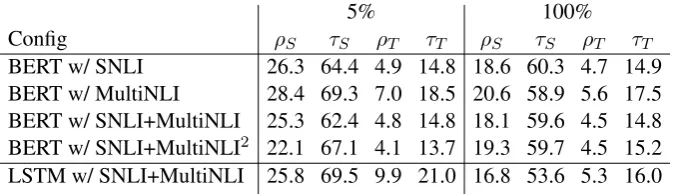
Table 2: Inconsistencies (%) of models on our100k evaluation dataset. Each number represents the average of three random runs. Models are trained using5% and100% of the train sets. SNLI+MultiNLI2: finetuned twice.
ρSandτS: symmetry consistency violations.ρT andτT: transitivity consistency violations.
4 Experiments
In this section, we evaluate our framework using (near) state-of-the-art approaches for NLI, primar-ily based on BERT, and also compare to an LSTM model. We use the SNLI and MultiNLI (Wang et al., 2018) datasets to define annotation con-sistency. Our LSTM model is based on the de-composable attention model with a BiLSTM en-coder and GloVe embeddings (Pennington et al., 2014). Our BERT model is based on the pretrained BERTbase, finetuned on SNLI/MultiNLI. The
con-strained models are initialized with the finetuned BERTbaseand finetuned again with inconsistency
losses.6 For fair comparison, we also show results of BERTbasemodels finetuned twice.
Our constrained models are trained on both la-beled and unlala-beled examples. We expect that the different inconsistencies do not conflict with each other. Hence, we select hyperparameters (e.g., the λ’s) using development accuracy only (i.e., anno-tation consistency). We refer the reader to the ap-pendix for details of our experimental setup.
4.1 Datasets
To be comprehensive, we will use both of the SNLI and MultiNLI to train our models, but we also show individual results.
We study the impact of the amount of label su-pervision by randomly sampling different percent-ages of labeled examples. For each case, we also sample the same percentages from the correspond-ing development sets for model selection. For the MultiNLI dataset, we use the matched dev for validation andmismatcheddev for evaluation.
Mirrored Instances (M) Given a labeled exam-ple, we construct its mirrored version by swapping the premise and the hypothesis. This results in the
6This is critical when label supervision is limited.
same number of unlabeled sentence pairs as the annotated dataset. When sampling by percentage, we will only use the sampled examples to con-struct mirrored examples. We use this dataset for symmetry consistency.
Unlabeled Instance Triples (T) For the transi-tivity constraint, we sample100k sentence triples from MS COCO (Lin et al.,2014) captions. From these, we construct three examples as in §3.1: sen-tences (P, H, Z) gives the pairs (P, H), (H, Z), and(P, Z). In all, we have100k example unla-beledtriples for the transitivity constraint.
Unlabeled Instance Pairs (U) For each sen-tence triple in the dataset T, we take the first exam-ple (P, H) and construct mirrored examples, i.e.
(H, P). This yields100kunlabeledinstance pairs for training with the symmetry loss.
Evaluation Dataset We sample a different set of100k example triples for measuring transitivity consistency. For symmetry consistency, we follow the above procedure for the dataset U to construct evaluation instance pairs. Recall that the definition of inconsistency allows measuring model quality with unlabeled data.
4.2 Inconsistency of Neural Models
In Table2, we report the impact of the amount of annotated data on symmetry/transitivity consisten-cies by using different percentages of labeled ex-amples. We see that both LSTM and BERT mod-els have symmetry consistency violations, while the transitivity consistency has lower violations. Surprisingly, the LSTM model performed on par with BERT in terms of symmetry/transitivity con-sistency; stronger representations does not neces-sarily mean more consistent models.
0 10 20 30 40
ρ
(%)
SNLI+MultiNLI w/ M w/ M,U w/ M,U,T
1 5 20 100
0 20 40 60
Percentage of train set(%)
τ
[image:6.595.73.292.58.298.2](%)
Figure 1: Symmetry inconsistencies on the100k evalu-ation example pairs. Each point represents the average of three random runs. M, U, and T are our unlabeled datasets with corresponding losses.
Contradiction on one, it has about 60% chance (τS) to make an inconsistent judgement on the
other. Further, we see that the inconsistencies are not affected much by different datasets. Models trained on the SNLI are as inconsistent as ones trained on MultiNLI. Combining them only gives slight improvements. Also, finetuning twice does not improve much over models finetuned once.
Finally, with more annotation, a model has fewer symmetry consistency violations. However, the same observation does not apply to the tran-sitivity consistency. In the following sections, we will show that we can almost annihilate these in-consistencies using the losses from §3.2.
4.3 Reducing Inconsistencies
We will study the effect of symmetry and transi-tivity consistency losses in turn using the BERT models. To the baseline models, we incrementally include the M, U, and T datasets. We expect that the constrained models should have accuracies at least on par with the baseline (though one of the key points of this paper is that accuracy by itself is not a comprehensive metric).
In Fig.1, we present both of the global and ditional violation rates of baselines and the con-strained models. We see that mirrored examples (i.e., the w/ M curve) greatly reduced the
sym-0 2 4 6
ρ
(%)
SNLI+MultiNLI w/ M w/ M,U w/ M,U,T
1 5 20 100
0 2 4 6 8 10 12 14 16
Percentage of train set(%)
τ
[image:6.595.315.528.60.302.2](%)
Figure 2: Transitivity inconsistencies on the100k eval-uation example pairs. Each point represents the average of three random runs. M, U, and T are our unlabeled datasets with corresponding losses.
metry inconsistency. Further, with100k unlabeled example pairs (the w/ M,U curve), we can further reduce the error rate. The same observation also applies when combining symmetry with transitiv-ity constraint.
Fig. 2 shows the results for transitivity incon-sistency. The transitivity loss is, again, greatly re-duced both for the global and conditional viola-tions. We refer the reader to the appendix for exact numbers.
We see that with our augmented losses, even a model using 1% label supervision can be much more consistent than the baselines trained on
100% training set! This suggests that label su-pervision does not explicitly encode the notion of consistency, and consequently models do not get this information from the training data.
With the simultaneous decline in global and conditional violation rate, the constrained models learn to agree with the consistency requirements specified declaratively. We will see in the next sec-tion, doing so does not sacrifice model accuracies.
4.4 Interaction of Losses
1% 5% 20% 100% Config SNLI MultiNLI SNLI MultiNLI SNLI MultiNLI SNLI MultiNLI
SNLI+MultiNLI 79.7 70.1 84.6 77.2 87.8 80.6 90.1 83.5
SNLI+MultiNLI2 80.3 71.0 85.3 77.4 87.9 80.7 90.3 84.0
w/ M 80.1 71.0 85.3 77.8 88.1 80.6 90.3 84.1
w/ M,U 80.2 71.0 85.4 77.2 88.1 80.9 90.5 84.3
[image:7.595.90.508.64.166.2]w/ M,U,T 80.6 71.1 85.4 77.2 88.1 80.9 90.2 84.2
Table 3: Impact of symmetry/transitivity consistencies on test set accuracies. Each number represents the average of three random runs of BERTbase. Columns are accuracies on our SNLI/MultiNLI test sets. SNLI+MultiNLI2:
finetuned twice. M, U, and T are unlabeled datasets with respective inconsistency losses.
Our goal is to minimize all inconsistencies with-out sacrificing one for another. In Table 3, we see that lower symmetry/transitivity inconsistency generally does not reduce test accuracy, but we do not observe substantial improvement either. In conjunction with the observations from above, this suggests that test sets do not explicitly measure symmetry/transitivity consistency.
From Fig 1 and 2, we see that models con-strained by both symmetry and transitivity losses are generally more consistent than models using symmetry loss alone. Further, we see that in Fig.2, using mirrored dataset alone can even mitigate the transitivity errors. With dataset P, the transitivity inconsistency is strongly reduced by the symme-try inconsistency loss. These observations suggest that the compositionality of constraints does not pose internal conflict to the model. They are in fact beneficial to each other.
Interestingly, in Fig2, the models trained with mirrored dataset (w/ M) become more inconsis-tent in transitivity measurement when using more training data. We believe there are two factors causing this. Firstly, there is a vocabulary gap between SNLI/MultiNLI data and our unlabeled datasets (U and T). Secondly, the w/ M models are trained with symmetry consistency but eval-uated with transitivity consistency. The slightly rising inconsistency implies that, without vocabu-lary coverage, training with one consistency might not always benefit another consistency, even using more training data.
When label supervision is limited (i.e.1%), the models can easily overfit via the transitivity loss. As a result, models trained on the combined losses (i.e. w/ M,U,T) have slightly larger transitivity inconsistency than models trained with mirrored data (i.e. w/ M) alone. In fact, if we use no la-bel supervision at all, the symmetry and
transi-Data M U T
5% w/ M,U,T 99.8 99.4 12.0 100% w/ M,U,T 98.7 97.6 6.8
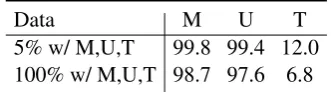
Table 4: Coverage (%) of unlabeled training sentences during the first epoch of training. Percentages are cal-culated from models with random seed 1.
tivity losses can push every prediction towards la-belNeutral. But such predictions sacrifice annota-tion consistency. Therefore, we believe that some amount of label supervision is necessary.
5 Analysis
In this section, we present an analysis of how the different losses affect model prediction and how informative they are during training.
5.1 Coverage of Unlabeled Dataset
Table4shows thecoverageof the three unlabeled datasets during the first training epoch. Specifi-cally, we count the percentage of unlabeled exam-ples where the symmetry/transitivity loss is posi-tive. The coverage decreases in subsequent epochs as the model learns to minimize constraint viola-tions. We see that both datasets M and U have high coverage. This is because that, as mentioned in §2, our loss function works in real-valued space instead of discrete decisions. The coverage of the dataset T is much lower because the compositional antecedent in transitivity statements holds less of-ten, which naturally leads to smaller coverage, un-like the unary antecedent for symmetry.
5.2 Distribution of Predictions
[image:7.595.333.499.231.277.2]BERT w/ M,U,T
(H, P) (H, P)
E C N E C N
(
P
,H
) E 4649 1491 14708 2036 29 9580 C 1508 10712 6459 33 4025 627
[image:8.595.329.503.63.150.2]N 14609 6633 39231 9632 613 73425
Table 5: Distribution of predictions on the 100k evaluation data using BERT trained on 100%
SNLI+MultiNLI data with random seed 1. Bold entries are symmetrically inconsistent.
Model Example E C N
BERT
(P, H) 20848 18679 60473
(H, Z) 20919 18768 60313
(P, Z) 20779 18721 60500
w/ M,U,T
(P, H) 11645 4685 83670
(H, Z) 11671 4703 83626
(P, Z) 11585 4597 83818
Table 6: Distribution of predictions on the100k eval-uation example triples. BERT: trained on the full SNLI+MultiNLI data. Predictions are from random run with seed 1.
constraint-violating (off-diagonal) predictions sig-nificantly dropped. Also note that the number of Neutralnearly doubled in our constrained model. This meets our expectation because the example pairs are constructed from randomly sampled sen-tences under the same topic.
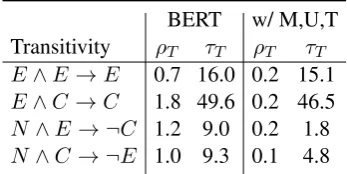
We also present the distribution of predictions on example triples for the transitivity consistency in Table6. As expected, with our transitivity con-sistency, the distribution of the labelNeutralgets significantly higher as well. Further, in Table 7, we show the error rates of each individual transi-tivity consistencies. Clearly our framework miti-gated the violation rates on all four statements.
While the logic-derived regularization pushes model prediction on unlabeled datasets towards Neutral, the accuracies on labeled test sets are not compromised. We believe this relates to the design of current NLI datasets where the three labels are balanced. But in the real world, neutrality repre-sents potentially infinite negative space while en-tailments and contradictions are rarer. The total number of neutral examples across both the SNLI and MultiNLI test sets is about 7k. Can we use these 7k examples to evaluate the nearly infinite negative space?We believe not.
BERT w/ M,U,T Transitivity ρT τT ρT τT
E∧E→E 0.7 16.0 0.2 15.1 E∧C→C 1.8 49.6 0.2 46.5
N ∧E → ¬C 1.2 9.0 0.2 1.8
[image:8.595.73.288.63.150.2]N ∧C → ¬E 1.0 9.3 0.1 4.8
Table 7: Individual transitivity inconsistency (%) on the100k evaluation example triples. BERT: trained on the full SNLI+MultiNLI data. Predictions are from ran-dom run with seed 1.
6 Related Works and Discussion
Logic, Knowledge and Statistical Models Us-ing soft relaxations of Boolean formulas as loss functions has rich history in AI. The Łukasiewicz t-norm drives knowledge-driven learning and in-ference in probabilistic soft logic (Kimmig et al., 2012). Li and Srikumar(2019) show how to aug-ment existing neural network architectures with domain knowledge using the Łukasiewicz t-norm. Xu et al.(2018) proposed a general framework for designing a semantically informed loss, without t-norms, for constraining a complex output space. In the same vein, Fischer et al. (2019) also pro-posed a framework for designing losses with logic, but using a bespoke mapping of the Boolean oper-ators.
Our work is also conceptually related to poste-rior regularization (Ganchev et al.,2010) and con-strained conditional models (Chang et al.,2012), which integrate knowledge with statistical mod-els. Using posterior regularization with imitation learning, Hu et al. (2016) transferred knowledge from rules into neural parameters. Rocktäschel et al.(2015) embedded logic into distributed rep-resentations for entity relation extraction. Alberti et al. (2019) imposed answer consistency over generated questions for machine comprehension. Ad-hoc regularizers have been proposed for pro-cess comprehension (Du et al., 2019), semantic role labeling (Mehta et al.,2018), and summariza-tion (Hsu et al.,2018).
large-scale stress tests to measure stability of models to semantic, lexical and random perturbations (Naik et al.,2018). Moreover, adversarial training exam-ples produced by paraphrasing training data (Iyyer et al.,2018) or inserting additional seemingly im-portant, yet unrelated, information to training in-stances (Jia and Liang, 2017) have been used to show model inconsistency. Finally, adversarially labeled examples have been shown to improve pre-diction accuracy (Kang et al.,2018) . Also related in this vein is the idea of dataset inoculation (Liu et al., 2019), where models are finetuned by ex-posing them to a challenging dataset.
The closest related work to this paper is prob-ably that of Minervini and Riedel(2018), which uses the Gödel t-norm to discover adversarial ex-amples that violate constraints. There are three major differences compared to this paper: 1) our definition of inconsistency is a strict generaliza-tion of errors of model predicgeneraliza-tions, giving us a uni-fied framework for that includes cross-entropy as a special case, 2) our framework does not rely on the construction of adversarial datasets, and 3) we studied the interaction of annotated examples vs. unlabeled examples via constraint, showing that our constraints can yield strongly consistent model with even a small amount of label supervision.
7 Conclusion
In this paper, we proposed a general framework to measure and mitigate model inconsistencies. Our framework systematically derives loss func-tions from domain knowledge stated in logic rules to constrain model training. As a case study, we instantiated the framework on a state-of-the-art model for the NLI task, showing that models can be highly accurate and consistent at the same time. Our framework is easily extensible to other do-mains with rich output structure, e.g., entity rela-tion extracrela-tion, and multilabel classificarela-tion.
Acknowledgements
We thank members of the NLP group at the Uni-versity of Utah for their valuable insights and suggestions; and reviewers for pointers to re-lated works, corrections, and helpful comments. We also acknowledge the support of NSF SaTC-1801446, and gifts from Google and NVIDIA.
References
Chris Alberti, Daniel Andor, Emily Pitler, Jacob De-vlin, and Michael Collins. 2019. Synthetic QA Cor-pora Generation with Roundtrip Consistency.
Samuel R Bowman, Gabor Angeli, Christopher Potts, and Christopher D Manning. 2015. A Large Anno-tated Corpus for Learning Natural Language Infer-ence. InProceedings of the 2015 Conference on Em-pirical Methods in Natural Language Processing.
Ming-Wei Chang, Lev Ratinov, and Dan Roth. 2012. Structured Learning with Constrained Conditional Models.Machine learning, 88(3):399–431.
Jianpeng Cheng, Li Dong, and Mirella Lapata. 2016. Long Short-Term Memory-Networks for Machine Reading. InProceedings of the 2016 Conference on Empirical Methods in Natural Language Process-ing.
Ido Dagan, Dan Roth, Mark Sammons, and Fabio Mas-simo Zanzotto. 2013. Recognizing Textual Entail-ment: Models and Applications. Synthesis Lectures on Human Language Technologies, 6(4):1–220.
Jacob Devlin, Ming-Wei Chang, Kenton Lee, and Kristina Toutanova. 2019. BERT: Pre-training of Deep Bidirectional Transformers for Language Un-derstanding. InProceedings of the 2019 Conference of the North American Chapter of the Association for Computational Linguistics: Human Language Technologies.
Xinya Du, Bhavana Dalvi, Niket Tandon, Antoine Bosselut, Wen tau Yih, Peter Clark, and Claire Cardie. 2019. Be Consistent! Improving Procedu-ral Text Comprehension using Label Consistency. InProceedings of the 2019 Conference of the North American Chapter of the Association for Computa-tional Linguistics: Human Language Technologies.
Marc Fischer, Mislav Balunovic, Dana Drachsler-Cohen, Timon Gehr, Ce Zhang, and Martin Vechev. 2019. DL2: Training and Querying Neural Net-works with Logic. InInternational Conference on Learning Representations.
Kuzman Ganchev, Jennifer Gillenwater, Ben Taskar, et al. 2010. Posterior Regularization for Structured Latent Variable Models. Journal of Machine Learn-ing Research.
Max Glockner, Vered Shwartz, and Yoav Goldberg. 2018. Breaking NLI Systems with Sentences that Require Simple Lexical Inferences. In Proceed-ings of the 56th Annual Meeting of the Association for Computational Linguistics (Volume 2: Short Pa-pers).
Wan-Ting Hsu, Chieh-Kai Lin, Ming-Ying Lee, Kerui Min, Jing Tang, and Min Sun. 2018. A Unified Model for Extractive and Abstractive Summariza-tion using Inconsistency Loss. InProceedings of the 56th Annual Meeting of the Association for Compu-tational Linguistics.
Zhiting Hu, Xuezhe Ma, Zhengzhong Liu, Eduard Hovy, and Eric Xing. 2016. Harnessing Deep Neu-ral Networks with Logic Rules. In Proceedings of the 54th Annual Meeting of the Association for Com-putational Linguistics.
Mohit Iyyer, John Wieting, Kevin Gimpel, and Luke Zettlemoyer. 2018. Adversarial Example Genera-tion with Syntactically Controlled Paraphrase Net-works. In Proceedings of the 2018 Conference of the North American Chapter of the Association for Computational Linguistics: Human Language Tech-nologies.
Robin Jia and Percy Liang. 2017. Adversarial exam-ples for evaluating reading comprehension systems. InProceedings of the 2017 Conference on Empirical Methods in Natural Language Processing.
Dongyeop Kang, Tushar Khot, Ashish Sabharwal, and Eduard Hovy. 2018. AdvEntuRe: Adversarial Training for Textual Entailment with Knowledge-Guided Examples. InProceedings of the 56th An-nual Meeting of the Association for Computational Linguistics.
Martin Kay. 1997. The Proper Place of Men and Ma-chines in Language Translation. Machine Transla-tion, 12.
Angelika Kimmig, Stephen Bach, Matthias Broecheler, Bert Huang, and Lise Getoor. 2012. A short Intro-duction to Probabilistic Soft Logic. InProceedings of the NIPS Workshop on Probabilistic Program-ming: Foundations and Applications.
Diederik P Kingma and Jimmy Ba. 2015. Adam: A Method for Stochastic Optimization. International Conference on Learning Representations.
Erich Peter Klement, Radko Mesiar, and Endre Pap. 2013. Triangular Norms. Springer Science & Busi-ness Media.
Tao Li and Vivek Srikumar. 2019. Augmenting Neural Networks with First-order Logic. InProceedings of the 57th Annual Meeting of the Association for Com-putational Linguistics.
Tsung-Yi Lin, Michael Maire, Serge Belongie, James Hays, Pietro Perona, Deva Ramanan, Piotr Dollár, and C Lawrence Zitnick. 2014. Microsoft COCO: Common Objects in Context. In 13th European Conference on Computer Vision. Springer.
Nelson F Liu, Roy Schwartz, and Noah A Smith. 2019. Inoculation by Fine-Tuning: A Method for Analyz-ing Challenge Datasets. InProceedings of the 2019 Conference of the North American Chapter of the
Association for Computational Linguistics: Human Language Technologies.
Jonathan Mallinson, Rico Sennrich, and Mirella Lap-ata. 2017. Paraphrasing Revisited with Neural Ma-chine Translation. InProceedings of the 15th Con-ference of the European Chapter of the Association for Computational Linguistics.
Sanket Vaibhav Mehta, Jay Yoon Lee, and Jaime Car-bonell. 2018. Towards Semi-Supervised Learning for Deep Semantic Role Labeling. InProceedings of the 2018 Conference on Empirical Methods in Nat-ural Language Processing.
Pasquale Minervini and Sebastian Riedel. 2018. Ad-versarially Regularising Neural NLI Models to Inte-grate Logical Background Knowledge. In Proceed-ings of the 22nd Conference on Computational Nat-ural Language Learning.
Aakanksha Naik, Abhilasha Ravichander, Norman Sadeh, Carolyn Rose, and Graham Neubig. 2018. Stress Test Evaluation for Natural Language Infer-ence. InProceedings of the 27th International Con-ference on Computational Linguistics.
Yixin Nie, Yicheng Wang, and Mohit Bansal. 2018. Analyzing Compositionality-Sensitivity of NLI Models. The Thirty-Second AAAI Conference on Artificial Intelligence.
Ankur Parikh, Oscar Täckström, Dipanjan Das, and Jakob Uszkoreit. 2016. A Decomposable Attention Model for Natural Language Inference. In Proceed-ings of the 2016 Conference on Empirical Methods in Natural Language Processing.
Jeffrey Pennington, Richard Socher, and Christopher Manning. 2014. Glove: Global vectors for word representation. In Proceedings of the 2014 Con-ference on Empirical Methods in Natural Language Processing.
Matthew Peters, Mark Neumann, Mohit Iyyer, Matt Gardner, Christopher Clark, Kenton Lee, and Luke Zettlemoyer. 2018. Deep Contextualized Word Rep-resentations. InProceedings of the 2018 Conference of the North American Chapter of the Association for Computational Linguistics: Human Language Technologies.
Pranav Rajpurkar, Jian Zhang, Konstantin Lopyrev, and Percy Liang. 2016. Squad: 100,000+ questions for machine comprehension of text. InProceedings of the 2016 Conference on Empirical Methods in Nat-ural Language Processing.
Minjoon Seo, Aniruddha Kembhavi, Ali Farhadi, and Hannaneh Hajishirzi. 2017. Bidirectional Attention Flow for Machine Comprehension. International Conference on Learning Representations.
Nitish Srivastava, Geoffrey Hinton, Alex Krizhevsky, Ilya Sutskever, and Ruslan Salakhutdinov. 2014. Dropout: A simple way to prevent neural networks from overfitting. Journal of Machine Learning Re-search.
Ashish Vaswani, Noam Shazeer, Niki Parmar, Jakob Uszkoreit, Llion Jones, Aidan N Gomez, Łukasz Kaiser, and Illia Polosukhin. 2017. Attention is All You Need. InAdvances in Neural Information Pro-cessing Systems.
Alex Wang, Amanpreet Singh, Julian Michael, Felix Hill, Omer Levy, and Samuel R Bowman. 2018. GLUE: A Multi-task Benchmark and Analysis Plat-form for Natural Language Understanding. Pro-ceedings of the 2018 Conference on Empirical Meth-ods in Natural Language Processing.
Haohan Wang, Da Sun, and Eric P Xing. 2019. What If We Simply Swap the Two Text Fragments? A Straightforward yet Effective Way to Test the Ro-bustness of Methods to Confounding Signals in Na-ture Language Inference Tasks. The Thirty-Third AAAI Conference on Artificial Intelligence.
Adina Williams, Nikita Nangia, and Samuel Bowman. 2018. A Broad-Coverage Challenge Corpus for Sen-tence Understanding through Inference. In Proceed-ings of the 2018 Conference of the North American Chapter of the Association for Computational Lin-guistics: Human Language Technologies.
Jingyi Xu, Zilu Zhang, Tal Friedman, Yitao Liang, and Guy Van den Broeck. 2018. A Semantic Loss Func-tion for Deep Learning with Symbolic Knowledge. InInternational Conference on Machine Learning.
A Appendices
A.1 Violations as Generalizing Errors
Both global and conditional violations defined in the body of the paper generalize classifier error. In this section, we will show that for a dataset with only labeled examples, and no additional con-straints, both are identical to error.
Recall that an example x annotated with label Y? can be written as > → Y?(x). If we have a datasetDof such examples and no constraints, in our unified representation of examples, we can write this as the following conjunction:
∀x∈D, > →Y?(x).
We can now evaluate the two definitions of viola-tion for this dataset.
First, note that the denominator in the definition of the conditional violationτ counts the number of examples because the antecedent for all exam-ples is always true. This makes ρ and τ equal. Moreover, the numerator is the number of exam-ples where the label for an example is notY?. In other words, the value of ρ andτ represents the fraction of examples inDthat are mislabeled.
The strength of the unified representation and the definition of violation comes from the fact that they apply to arbitrary constraints.
A.2 Loss for Transitivity Consistency
This section shows the loss associated with the transitivity consistency in the NLI case study. For an individual example (P, H, Z), applying the product t-norm to the definition of the transitivity consistency constraint, we get the loss
ReLU(loge(P, H)+ loge(H, Z)−loge(P, Z)) +ReLU(loge(P, H)+ logc(H, Z)−logc(P, Z)) +ReLU(logn(P, H)+ loge(H, Z)−log (1−c(P, Z))) +ReLU(logn(P, H)+ logc(H, Z)−log (1−e(P, Z)))
(14)
That is, the total transitivity lossLtran is the sum
of this expression over the entire dataset.
A.3 Details of Experiments A.3.1 Setup
For BERTbase baselines, we finetune them for 3
epochs with learning rate 3×10⁻⁵, warmed up
for all gradient updates. For constrained models, we further finetune them for another3epochs with lowered learning rate1×10−5. When datasetU
is present, we further lower the learning rate to
5 × 10⁻⁶. Optimizer is Adam across all runs. During training, we adopt Dropout rate ( Srivas-tava et al.,2014)0.1inside of BERT transformer encoder while0at the final linear layer of classifi-cation.
1% 5%
Train SNLI MultiNLI ρS τS ρT τT SNLI MultiNLI ρS τS ρT τT
SNLI 79.3 na 36.7 70.6 6.1 17.1 84.5 na 26.3 64.4 4.9 14.8
MultiNLI na 69.0 29.1 83.1 8.2 18.4 na 76.1 28.4 69.3 7.0 18.5 SNLI+MultiNLI 79.7 70.1 38.6 71.7 4.3 13.4 84.6 77.2 25.3 62.4 4.8 14.8 SNLI+MultiNLI2 80.3 71.0 32.4 75.0 3.9 12.8 85.3 77.4 22.1 67.1 4.1 13.7
w/ M 80.1 71.0 7.5 39.2 2.1 9.1 85.3 76.8 7.1 34.8 2.8 10.5
w/ M,U 80.2 71.0 6.1 38.2 2.5 9.8 85.4 77.2 4.6 32.5 2.0 8.3
w/ M,U,T 80.6 71.1 7.8 34.0 2.6 10.4 85.4 77.2 3.2 31.0 1.8 7.9
20% 100%
Train SNLI MultiNLI ρS τS ρT τT SNLI MultiNLI ρS τS ρT τT
SNLI 87.5 na 21.2 63.0 4.1 13.6 90.1 na 18.6 60.3 4.7 14.9
MultiNLI na 80.4 25.8 58.1 5.1 16.5 na 83.7 20.6 58.9 5.6 17.5 SNLI+MultiNLI 87.8 80.6 18.6 64.3 4.4 14.4 90.1 83.5 18.1 59.6 4.5 14.8 SNLI+MultiNLI2 87.9 80.7 19.0 64.0 4.3 14.5 90.3 84.0 19.3 59.7 4.5 15.2
w/ M 88.1 80.6 7.3 34.0 3.2 11.7 90.3 84.1 6.2 28.1 3.0 11.6
w/ M,U 88.1 80.9 1.4 31.2 1.3 5.8 90.5 84.3 1.4 26.8 1.3 6.3
[image:12.595.75.530.64.317.2]w/ M,U,T 88.1 80.9 1.3 29.6 1.2 5.7 90.2 84.2 1.1 25.5 0.6 4.2
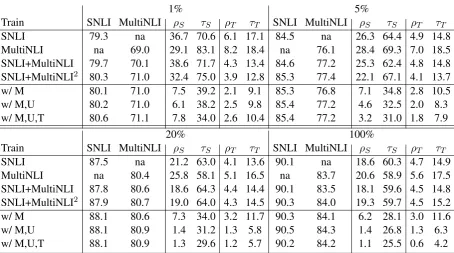
Table 8: Symmetry/Transitivity inconsistencies (%) for models using1%, 5%, 20%, and 100% training data. Each number represents the average of three random runs. SNLI+MultiNLI2: BERTbasefinetuned twice for fair
comparison. SNLI/MultiNLI column: accuracies on corresponding text sets. M: mirrored labeled examples. U: unlabeled instance pairs. T: unlabeled instance triples.
Data 1% 5% 20% 100%
M 1 1 1 1
U 10−5 10−4 10−3 10−1
T 10−6 10−5 10−4 10−3
Table 9: Choice of λ‘s for different consistency and corresponding unlabeled datasets. For different sizes of annotation and different types of data, we adopt dif-ferentλ‘s.
Having largerλleads to significantly worse ac-curacy on the development set, especially that of SNLI. Therefore we did not select such models for evaluation. We hypothesize that it is because the SNLI and MultiNLI are crowdsourced from differ-ent domains while the MS COCO shares the same domain as the SNLI. Larger scaling factor could push unlabeled examples towards Neutral, thus sacrificing the annotation consistency on SNLI ex-amples.
A.3.2 Results
We present the full experiment results on the nat-ural language inference task in Table 8. Note that the accuracies of baselines finetuned twice are slightly better than models only finetuned once, while their symmetry/transitivity consistencies are
[image:12.595.103.261.397.456.2]