Proceedings of the 2019 Conference on Empirical Methods in Natural Language Processing and the 9th International Joint Conference on Natural Language Processing, pages 3065–3075,
3065
Clickbait? Sensational Headline Generation with Auto-tuned
Reinforcement Learning
Peng Xu, Chien-Sheng Wu, Andrea MadottoandPascale Fung
Center for Artificial Intelligence Research (CAiRE) Department of Electronic and Computer Engineering
The Hong Kong University of Science and Technology, Clear Water Bay
[pxuab,cwuak,amadotto]@connect.ust.hk, [email protected]
Abstract
Sensational headlines are headlines that cap-ture people’s attention and generate reader in-terest. Conventional abstractive headline gen-eration methods, unlike human writers, do not optimize for maximal reader attention. In this paper, we propose a model that generates sen-sational headlines without labeled data. We first train a sensationalism scorer by classi-fying online headlines with many comments (“clickbait”) against a baseline of headlines generated from a summarization model. The score from the sensationalism scorer is used as the reward for a reinforcement learner. How-ever, maximizing the noisy sensationalism re-ward will generate unnatural phrases instead of sensational headlines. To effectively lever-age this noisy reward, we propose a novel loss function, Auto-tuned Reinforcement Learning (ARL), to dynamically balance reinforcement learning (RL) with maximum likelihood esti-mation (MLE). Human evaluation shows that 60.8% of samples generated by our model are sensational, which is significantly better than the Pointer-Gen baseline (See et al.,2017) and other RL models.
1 Introduction
Headline generation is the process of creating a headline-style sentence given an input article. The research community has been regarding the task of headline generation as a summarization task (Shen et al.,2017a), ignoring the fundamental dif-ferences between headlines and summaries. While summaries aim to contain most of the important information from the articles, headlines do not necessarily need to. Instead, a good headline needs to capture people’s attention and serve as an irresistible invitation for users to read through the article. For example, the headline “$2 Bil-lion Worth of Free Media for Trump”, which gives only an intriguing hint, is considered
bet-ter than the summarization style headline “Mea-suring Trump’s Media Dominance”1, as the
for-mer gets almost three times the readers as the lat-ter. Generating headlines with many clicks is espe-cially important in this digital age, because many of the revenues of journalism come from online advertisements and getting more user clicks means being more competitive in the market. However, most existing websites 2 naively generate sensa-tional headlines using only keywords or templates. Instead, this paper aims to learn a model that gen-erates sensational headlines based on an input ar-ticle without labeled data.
To generate sensational headlines, there are two main challenges. Firstly, there is a lack of sen-sationalism scorer to measure how sensational a headline is. Some researchers have tried to man-ually label headlines as clickbait or non-clickbait (Chakraborty et al., 2016; Potthast et al., 2018). However, these human-annotated datasets are usu-ally small and expensive to collect. To capture a large variety of sensationalization patterns, we need a cheap and easy way to collect a large num-ber of sensational headlines. Thus, we propose a distant supervision strategy to collect a sensation-alism dataset. We regard headlines receiving lots of comments as sensational samples and the head-lines generated by a summarization model as non-sensational samples. Experimental results show that by distinguishing these two types of head-lines, we can partially teach the model a sense of being sensational.
Secondly, after training a sensationalism scorer on our sensationalism dataset, a natural way to generate sensational headlines is to maximize the sensationalism score using reinforcement
learn-1
https://www.nytimes.com/2016/06/13/insider/which-headlines-attract-most-readers.html?module=inline
ing (RL). However, the following shows an ex-ample of a RL model maximizing the sensational-ism score by generating a very unnatural sentence, while its sensationalism scorer gave a very high score of 0.99996: 十个可穿戴产品的设计原
则这消息消息可惜说明 Ten design principles for wearable devices, this message message pity introduction. This happens because the sensa-tionalism scorer can make mistakes and RL can generate unnatural phrases which fools our sensa-tionalism scorer. Thus, how to effectively leverage RL with noisy rewards remains an open problem. To deal with the noisy reward, we introduce Auto-tuned Reinforcement Learning (ARL). Our model automatically tunes the ratio between MLE and RL based on how sensational the training headline is. In this way, we effectively take advantage of RL with a noisy reward to generate headlines that are both sensational and fluent.
The major contributions of this paper are as fol-lows: 1) To the best of our knowledge, we propose the first-ever model that tackles the sensational headline generation task with reinforcement learn-ing techniques. 2) Without human-annotated data, we propose a distant supervision strategy to train a sensationalism scorer as a reward function.3) We propose a novel loss function, Auto-tuned Rein-forcement Learning, to give dynamic weights to balance between MLE and RL. Our code will be released .3
2 Sensationalism Scorer
To evaluate the sensationalism intensity scoreαsen
of a headline, we collect a sensationalism dataset and then train a sensationalism scorer. For the sensationalism dataset collection, we choose head-lines with many comments from popular online websites as positive samples. For the negative samples, we propose to use the generated head-lines from a sentence summarization model. Intu-itively, the summarization model, which is trained to preserve the semantic meaning, will lose the sensationalization ability and thus the generated negative samples will be less sensational than the original one, similar to the obfuscation of style after back-translation (Prabhumoye et al., 2018). For example, an original headline like “一趟 挣10万?铁总增开申通、顺丰专列” (One trip to earn 100 thousand? China Railway opens new
3https://github.com/HLTCHKUST/
sensational_headline
Shentong and Shunfeng special lines) will become “中铁总将增开京广两列快递专列” (China Rail-way opens two special lines for express) from the baseline model, which loses the sensational phrases of “一趟挣10万?” (One trip to earn 100 thousand?) . We then train the sensation-alism scorer by classifying sensational and non-sensational headlines using a one-layer CNN with a binary cross entropy lossLsen. Firstly, 1-D
con-volution is used to extract word features from the input embeddings of a headline. This is followed by a ReLU activation layer and a max-pooling layer along the time dimension. All features from different channels are concatenated together and projected to the sensationalism score by adding another fully connected layer with sigmoid acti-vation. Binary cross entropy is used to compute the lossLsen.
2.1 Training Details and Dataset
For the CNN model, we choose filter sizes of 1, 3, and 5 respectively. Adam is used to optimizeLsen
with a learning rate of 0.0001. We set the embed-ding size as 300 and initialize it from Qiu et al. (2018) trained on the Weibo corpus with word and character features. We fix the embeddings during training.
For dataset collection, we utilize the headlines collected in Qin et al. (2018); Lin et al. (2019a) from Tencent News, one of the most popular Chi-nese news websites, as the positive samples. We follow the same data split as the original paper. As some of the links are not available any more, we get 170,754 training samples and 4,511 validation samples. For the negative training samples collec-tion, we randomly select generated headlines from a pointer generator (See et al.,2017) model trained on LCSTS dataset (Hu et al., 2015) and create a balanced training corpus which includes 351,508 training samples and 9,022 validation samples. To evaluate our trained classifier, we construct a test set by randomly sampling 100 headlines from the test split of LCSTS dataset and the labels are ob-tained by 11 human annotators. Annotations show that 52% headlines are labeled as positive and 48% headlines as negative by majority voting (The de-tail on the annotation can be found in Section3.6).
2.2 Results and Discussion
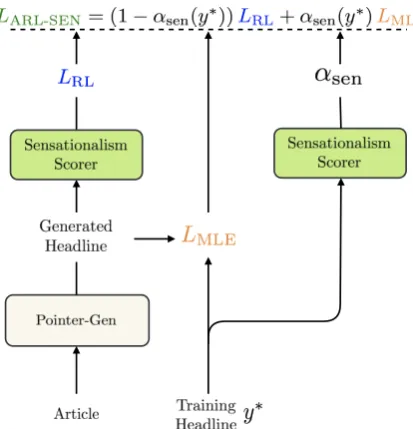
Figure 1: The loss function of Auto-tuned Reinforce-ment Learning is a weighted sum of LRL and LMLE,
where the weight is decided by our sensationalism scorer.
0.50 averaged F1 score. This confirms that the predicted sensationalism score can partially cap-ture the sensationalism of headlines. On the other hand, a more natural choice is to take headlines with few comments as negative examples. Thus, we train another baseline classifier on a crawled balanced sensationalism corpus of 84k headlines where the positive headlines have at least 28 com-ments and the negative headlines have less than 5 comments. However, the results on the test set show that the baseline classifier gets 60% accu-racy, which is worse than the proposed classifier (which achieves 65%). The reason could be that the balanced sensationalism corpus are sampled from different distributions from the test set and it is hard for the trained model to generalize. There-fore, we choose the proposed one as our sensa-tionalism scorer. Therefore, our next challenge is to show that how to leverage this noisy sensation-alism reward to generate sensational headlines.
3 Sensational Headline Generation
Our sensational headline generation model takes an article as input and output a sensational head-line. The model consists of a Pointer-Gen headline generator and is trained by ARL. The diagram of ARL can be found in Figure1.
We denote the input article as x = {x1, x2, x3,· · · , xM}, and the corresponding
headline asy∗ = {y1∗, y2∗, y3∗,· · · , yT∗}, where M
is the number of tokens in an article andT is the number of tokens in a headline.
3.1 Pointer-Gen Headline Generator
We choose Pointer Generator (Pointer-Gen) (See et al.,2017), a widely used summarization model, as our headline generator for its ability to copy words from the input article. It takes a news ar-ticle as input and generates a headline. Firstly, the tokens of each article, {x1, x2, x3,· · ·, xM}, are
fed into the encoder one-by-one and the encoder generates a sequence of hidden stateshi. For each
decoding stept, the decoder receives the embed-ding for each token of a headlineyt as input and
updates its hidden statesst. An attention
mecha-nism followingLuong et al.(2015) is used:
eti =vTtanh(Whhi+Wsst+battn) (1)
at=softmax(et) (2)
h∗t =X ia
t
ihi (3)
wherev,Wh,Ws, and battn are the trainable
pa-rameters andh∗t is the context vector. stand h∗t
are then combined to give a probability distribu-tion over the vocabulary through two linear layers:
ot=V([st, h∗t]) +b (4)
Pvoc(w) =softmax(V 0
ot+b 0
) (5)
where V, b, V0, and b0 are trainable parameters. We use a pointer generator network to enable our model to copy rare/unknown words from the input article, giving the following final word probability:
pgen=σ(wTh∗h∗t+wTsst+wTxxt+bptr) (6)
P(w) =pgenPvoc(w) + (1−pgen) X
i:xi=w ati (7)
where xt is the embedding of the input word of the decoder,wTh∗, wsT, wTx, and bptr are trainable
parameters, andσis the sigmoid function.
3.2 Training Methods
We first briefly introduce MLE and RL objective functions, and a naive way to mix these two by a hyper-parameter λ. Then we point out the chal-lenge of training with noisy reward, and propose ARL to address this issue.
3.2.1 MLE and RL
training is to minimize the negative log likelihood of the training headlines. We feedy∗into the de-coder word by word and maximize the likelihood ofy∗. The loss function for MLE becomes
LMLE=− 1 T
XT
t=1logP(y ∗
t) (8)
For RL training, we choose the REINFORCE algorithm (Williams, 1992). In the training phase, after encoding an article, a headline ys = {y1s, ys2, y3s,· · ·, ysT}is obtained by sampling from
P(w) from our generator, and then a reward of sensationalism or ROUGE(RG) is calculated.
Rrg=RG(ys, y∗) (9)
Rsen=αsen(ys) (10)
We use the baseline reward Rˆt to reduce the
variance of the reward, similar to Ranzato et al. (2016). To elaborate, a linear model is deployed to estimate the baseline reward Rˆt based on t-th
stateotfor each timestept. The parameters of the
linear model are trained by minimizing the mean square loss betweenRandRˆt:
ˆ
Rt=Wrot+br (11)
Lb = 1 T
XT
t=1|R− ˆ
Rt|2 (12)
where Wr and br are trainable parameters. To
maximize the expected reward, our loss function for RL becomes
LRL =− 1 T
XT
t=1(R− ˆ
Rt)logP(wt) (13)
A naive way to mix these two objective func-tions using a hyper-parameter λ has been suc-cessfully incorporated in the summarization task (Paulus et al., 2018). It includes the MLE train-ing as a language model to mitigate the readability and quality issues in RL. The mixed loss function is shown as follows:
LRL-* =λLRL+ (1−λ)LMLE (14)
where∗is the reward type. Usuallyλis large, and Paulus et al.(2018) used 0.9984.
3.2.2 Auto-tuned Reinforcement Learning
Applying the naive mixed training method using sensationalism score as the reward is not obvi-ous/trivial in our task. The main reason is that our sensationalism reward is notably more noisy
and more fragile than the ROUGE-L reward or abstractive reward used in the summarization task (Paulus et al., 2018; Kry´sci´nski et al., 2018). A higher ROUGE-L F1 reward in summarization in-dicates higher overlapping ratio between genera-tion and true summary statistically, but our sensa-tionalism reward is a learned score which is fragile to be fooled with unnatural samples.
To effectively train the model with RL un-der noisy sensationalism reward, our idea is to balance RL with MLE. However, we argue that
the weighted ratio between MLE and RL should be sample-dependent, instead of being fixed for all training samples as in Paulus et al. (2018); Kry´sci´nski et al. (2018). The reason is that, RL and MLE have inconsistent optimization ob-jectives. When the training headline is non-sensational, MLE training will encourage our model to imitate the training headline (thus gener-ating non-sensationalheadlines), which counter-acts the effects of RL training to generate sensa-tionalheadlines.
The sensationalism score is, therefore, used to give dynamic weight to MLE and RL. Our ARL loss function becomes:
LARL-SEN = (1−αsen(y∗))LRL+αsen(y∗)LMLE
(15)
If αsen(y∗) is high, meaning the training
head-line is sensational, our loss function encourages our model to imitate the sample more using the MLE training. Ifαsen(y∗)is low, our loss function
replies on RL training to improve the sensation-alism. Note that the weightαsen(y∗) is different from our sensationalism reward αsen(ys) and we
call the loss function Auto-tuned Reinforcement Learning, because the ratio between MLE and RL are well “tuned” towards different samples.
3.3 Dataset
We use LCSTS (Hu et al., 2015) as our dataset to train the summarization model. The dataset is collected from the Chinese microblogging website Sina Weibo. It contains over 2 million Chinese short texts with corresponding headlines given by the author of each text. The dataset is split into 2,400,591 samples for training, 10,666 samples for validation and 725 samples for testing. We tok-enize each sentence with Jieba4and a vocabulary size of 50000 is saved.
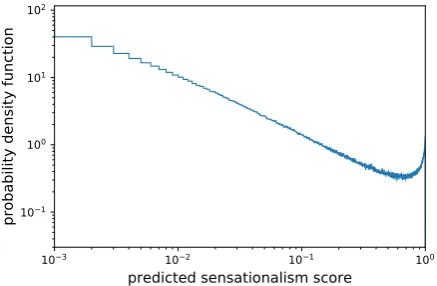
Figure 2: The probability density function (pdf) of pre-dicted sensationalism score in log scale. Low sensa-tionalism score has much higher probability density.
3.4 Baselines and Our Models
We experiment and compare with the follow-ing models. Pointer-Gen is the baseline model trained by optimizingLMLEin Equation8. Pointer-Gen+Posis the baseline model by train-ing Pointer-Gen only on positive examples whose sensationalism score is larger than 0.5
Pointer-Gen+Same-FT is the model which fine-tunes Pointer-Gen on the training samples whose sensationalism score is larger than 0.1
Pointer-Gen+Pos-FT is the model which fine-tunes Pointer-Gen on the training samples whose sensationalism score is larger than 0.5
Pointer-Gen+RL-ROUGEis the baseline model trained by optimizingLRL-ROUGE in Equation14,
with ROUGE-L (Lin,2004) as the reward.
Pointer-Gen+RL-SEN is the baseline model trained by optimizing LRL-SEN in Equation 14,
withαsenas the reward.
Pointer-Gen+ARL-SENis our model trained by optimizingLARL-SENin Equation15, withαsenas
the reward.
Test setis the headlines from the test set.
Note that we didn’t compare to Pointer-Gen+ARL-ROUGE as it is actually Pointer-GEN. Recall thatαsen(y∗)in Equation15measures how
good (based on reward function) is y∗. Then the loss function for Pointer-Gen+ARL-ROUGE will be
(1−RG(y∗, y∗))LRL+RG(y∗, y∗)LMLE =LMLE
We also tried text style transfer baseline (Shen et al., 2017b), but the generated headlines were very poor (many unknown words and irrelevant).
3.5 Training Details
MLE training: An Adam optimizer is used with the learning rate of 0.0001 to optimize LMLE.
The batch size is set as 128 and a one-layer, bi-directional Long Short-Term Memory (bi-LSTM) model with 512 hidden sizes and a 350 embedding size is utilized. Gradients with the l2 norm larger than 2.0 are clipped. We stop training when the ROUGE-L f-score stops increasing.
Hybrid training: An Adam optimizer with a learning rate of 0.0001 is used to optimizeLRL-*
(Equation14) andLARL-SEN (Equation15). When
training Pointer-Gen+RL-ROUGE, the best λ is chosen based on the ROUGE-L score on the val-idation set. In our experiment, λ is set as 0.95. An Adam optimizer with a learning rate of 0.001 is used to optimize Lb. When training
Pointer-Gen+ARL-SEN, we don’t use the full LCSTS dataset, but only headlines with a sensationalism score larger than 0.1 as we observe that Pointer-Gen+ARL-SEN will generate a few unnatural phrases when using full dataset. We believe the reason is the high ratio of RL during training. Fig-ure2shows that the probability density near 0 is very high, meaning that in each batch, many of the samples will have a very low sensationalism score. On expectation, each sample will receive 0.239 MLE training and 0.761 RL training. This leads to RL dominanting the loss. Thus, we pro-pose to filter samples with a minimum sensation-alism score with 0.1 and it works very well. For Pointer-Gen+RL-SEN, we also set the minimum sensationalism score as 0.1, andλis set as 0.5 to remove unnatural phrases, making a fair compari-son to Pointer-Gen+ARL-SEN.
We stop training Pointer-Gen+Same-FT, Pointer-Gen+Pos-FT, Pointer-Gen+RL-SEN and Pointer-Gen+ARL-SEN, when αsen stops
increasing on the validation set. Beam-search with a beam size of 5 is adopted for decoding in all models.
3.6 Evaluation Metrics
We briefly describe the evaluation metrics below.
ROUGE:ROUGE is a commonly used evaluation metric for summarization. It measures the N-gram overlap between generated and training headlines. We use it to evaluate the relevance of generated headlines. The widely used pyrouge 5 toolkit is used to calculate ROUGE-1 (RG-1), ROUGE-2
RG-1 RG-2 RG-L character-based preprocessing
RNN context (Hu et al.,2015) 29.90 17.40 27.20 COPYNET (Gu et al.,2016) 34.40 21.60 31.30 word-based preprocessing
RNN context (Hu et al.,2015) 26.80 16.10 24.10 COPYNET (Gu et al.,2016) 35.00 22.30 32.00
Pointer-Gen 34.51 22.21 31.68
[image:6.595.310.527.57.429.2]Pointer-Gen+Pos 28.51 16.53 25.56 Pointer-Gen+Same-FT 34.60 22.00 31.48 Pointer-Gen+Pos-FT 30.92 18.76 28.02 Pointer-Gen+RL-ROUGE 36.26 23.48 33.21 Pointer-Gen+RL-SEN 35.06 22.37 31.91 Pointer-Gen+ARL-SEN 34.28 21.34 30.80
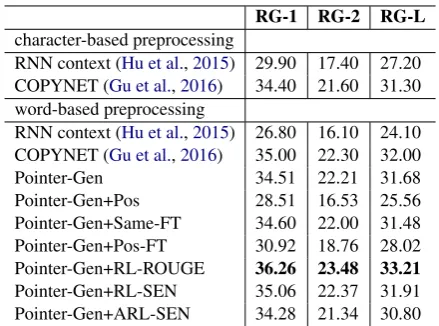
Table 1: Our implementation achieves similar perfor-mance to the RNN context and COPYNET. Pointer-Gen+ARL-SEN achieves good summarization perfor-mance even though it is optimized for the sensational reward. It shows its ability to summarize.
(RG-2), and ROUGE-L (RG-L).
Human evaluation:We randomly sample 50 arti-cles from the test set and send the generated head-lines from all models and corresponding headhead-lines in the test set to human annotators. We evaluate the sensationalism and fluency of the headlines by setting up two independent human annotation tasks. We ask 10 annotators to label each head-line for each task. For the sensationalism annota-tion, each annotator is asked one quesannota-tion, “Is the headline sensational?”, and he/she has to choose either ‘yes’ or ‘no’. The annotators were not told which system the headline is from. The process of distributing samples and recruiting annotators is managed by Crowdflower.6 After annotation, we define the sensationalism score as the proportion of annotations on all generated headlines from one model labeled as ‘yes’. For the fluency annotation, we repeat the same procedure as for the sensation-alism annotation, except that we ask each anno-tator the question “Is the headline fluent?” We define the fluency score as the proportion of an-notations on all headlines from one specific model labeled as ‘yes’. We put human annotation instruc-tions in the supplemental material.
4 Results
We first compare all four models, Pointer-Gen, Pointer-Gen-RL+ROUGE, Pointer-Gen-RL-SEN, and Pointer-Gen-ARL-SEN, to existing models with ROUGE in Table 1 to establish that our
6https://www.figure-eight.com/
Article:昨天的央视315晚会上,尼康D600相机被曝拍摄
时会出现黑色斑点,反复修理也无果,而尼康竟把责任 推给了雾霾,拒绝换机或退机。对此上海工商部门昨晚 连夜梳理了近年对尼康的投诉案,今天上午前往位于黄 浦区的尼康公司进一步调查。新民网
At the CCTV 315 party yesterday, the Nikon D600 camera is reported to have black spots when taking photos. Repeated repairs gave no results, and Nikon actually attributes the damage to the smog, refusing exchange or return. The Shanghai Industrial and Commercial Department collected the recent complaints against Nikon last night, and went to Nikon Company in Huangpu District for further investigation this morning. Xinmin Net
Pointer-Gen: 尼康D600相机被曝拍摄时会出现黑色斑点 The Nikon D600 camera is reported to have black spots when taking photos
Pointer-Gen+Same-FT: 尼康D600被曝拍出雾霾尼康已 介入调查The Nikon D600 camera is reported to have smog Nikon started investigation
Pointer-Gen+Pos-FT: 尼康投诉央视315晚会尼康投诉被 曝Nikon complains CCTV 315 night, Nikon is reported to be complained
Pointer-Gen+RL-ROUGE:尼康D600相机被曝拍摄时会 出现黑色斑点 The Nikon D600 camera is reported to have black spots when taking photos
Pointer-Gen+RL-SEN:尼康D600被曝拍出奇葩事尼康把
责任推给雾霾 The Nikon D600 camera is reported to have something strange and attributes the damage to the smog. Pointer-Gen+ARL-SEN (Ours):摊摊摊上上上大大大事了事事了了!!!尼康D600 被指拍出“黑点”In Serious Trouble!The Nikon D600 camera is reported to have black spots when taking photos Test set headline:尼康称黑点怪雾霾上海工商今上门追查 Nikon attributes black spots to the smog, and Shanghai Indus-trial and Commercial Department start investigation today.
Table 2: Generated Chinese headlines from differ-ent models. Our model (Pointer-Gen+ARL-SEN) sen-sationalized the headline with the phrase “In Serious Trouble!”.
[image:6.595.72.292.60.223.2]Model sensationalism fluency Pointer-Gen 42.6%* 80% Pointer-Gen-Pos 40.2%* 59%* Pointer-Gen+Same-FT 47.6%* 75.6% Pointer-Gen+Pos-FT 47.8%* 71.4% Pointer-Gen+RL-ROUGE 45.2%* 80%
[image:7.595.74.291.62.174.2]Pointer-Gen+RL-SEN 51.8%* 79.4% Pointer-Gen+ARL-SEN 60.8% 79.4% Test set 57.8% 80.6%
Table 3: Comparison of sensationalism score and fluency score between different models. Pointer-Gen+ARL-SEN achieves the best performance among all models in sensationalism score. * indicates Pointer-Gen+ARL-SEN is statistically significantly better than the corresponding model.
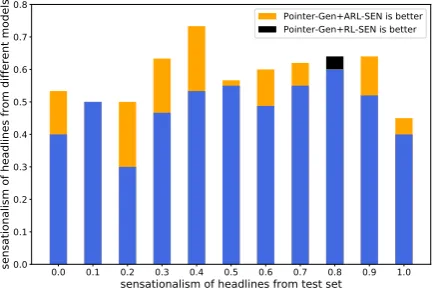
Figure 3: Comparison of sensationalism score between Pointer-Gen+ARL-SEN and Pointer-Gen+RL-SEN for different test set headlines. The blue bars denote the smaller scores between the two models. Pointer-Gen+ARL-SEN achieves better performance on most cases. Greater improvement is achieved when the test set headline is non-sensational.
makes the headline more sensational by blaming Nikon for attributing the damage to the smog. Pointer-Gen+ARL-SEN generates the most sensa-tional headline by exaggerating the result “Getting a serious trouble!” to maximize user’s attention.
We then compare different models using the sensationalism score in Table 3. The Pointer-Gen baseline model achieves a 42.6% sensation-alism score, which is the minimum that a typical summarization model achieves. By filtering out low-sensational headlines, Pointer-Gen+Same-FT and Pointer-Gen+Pos-FT achieves higher sensa-tionalism scores, which implies the effective-ness of our sensationalism scorer. Our Pointer-Gen+ARL-SEN model achieves the best perfor-mance of 60.8%. This is an absolute improvement of 18.2% over the Pointer-Gen baseline. The
Chi-square test on the results confirms that Pointer-Gen+ARL-SEN is statistically significantly more sensational than all the other baseline models, with the largest p-value less than 0.01. Also, we find that the test set headlines achieves 57.8% sen-sationalism score, much larger than Pointer-Gen baseline, which also supports our intuition that generated headlines will be less sensational than the original one. On the other hand, we found that Pointer-Gen+Pos is much worse than other base-lines. The reason is that training on sensational samples alone discards around 80% of the whole training set that is also helpful for maintaining rel-evance and a good language model. It shows the necessity of using RL.
In addition, both Pointer-Gen+RL-SEN and Pointer-Gen+ARL-SEN, which use the sensation-alism score as the reward, obtain statistically better results than Pointer-Gen+RL-ROUGE and Pointer-Gen, with a p-value less than 0.05 by a Chi-square test. This result shows the ef-fectiveness of RL to generate more sensational headlines. The reason is that even though our noisy classifier could also learn to classify do-mains, the generator during RL training is not allowed to increase the reward by shifting do-mains but encouraged to generate more sensa-tional headlines, due to the consistency constraint on the domains of the headline and the arti-cle. Furthermore, Poiner-Gen+ARL-SEN gets better performance than Pointer-Gen+RL-SEN, which confirms the superiority of the ARL loss function. We also visualize in Figure 3 a comparison between Pointer-Gen+ARL-SEN and Pointer-Gen+RL-SEN according to how sensa-tional the test set headlines are. The blue bars denote the smaller scores between the two mod-els. For example, if the blue bar is 0.6, it means that the worse model between Pointer-Gen+RL-SEN and Pointer-Gen+ARL-Pointer-Gen+RL-SEN achieves 0.6. And the color of orange/black further indi-cates the better model and its score. We find that Gen+ARL-SEN outperforms Pointer-Gen+RL-SEN for most cases. The improvement is higher when the test set headlines are not sen-sational (the sensen-sationalism score is less than 0.5), which may be attributed to the higher ratio of RL training on non-sensational headlines.
[image:7.595.73.290.271.417.2]Question
Pointer-Gen:眺望:印度经济复苏的陷阱 View: the trap of economic recovery in India
Pointer-Gen+ARL-SEN:印度或或或将将将成为下一个中国? WillIndiabecomethe next China?
Pointer-Gen:今天理论导报的主要内容有. . . . The main content of today’s theoretical report is
Pointer-Gen+ARL-SEN:如如如何何何做一名焦裕禄式的县委书记? How tobe a county party secretary like JIAO Yulu?
Creating Curiosity Gap
Pointer-Gen: 10种方法帮你避免的10个小窍门 10 tricks to help you avoid
Pointer-Gen+ARL-SEN: 10个让你意意意想想想不不不到到到的领导力法则 10 laws of leadership that youcannot think of
Pointer-Gen:王林的暴富之路 WANG Lin’s path to sudden wealth Pointer-Gen+ARL-SEN: “气功大师”王林的暴富之路:凭借5个个个生生生财财财之之之道道道
“The Qigong Master” WANG Lin’s path to sudden wealth: leveraging5 ways to make money
Highlighting Numbers
Pointer-Gen:北京市集成电路促进基金就位
The Integrated Circuit Promotion Fund in Beijing is ready Pointer-Gen+ARL-SEN:500亿亿亿巨巨巨资资资驰援国家大基金或已就位
A huge capital sum of 50 billionis ready to support the national big fund Pointer-Gen:陈光标冰桶挑战陈光标承认造假
CHEN Guangbiao admits that he cheated in the freezing water challenge Pointer-Gen+ARL-SEN:陈光标回应“造假”:有人超越我就捐款100万万万
CHEN Guangbiao responded to “cheating”: if someone can do better, I will donatea million RMB
Emotional Words
Pointer-Gen:俞永福:搜狗360还没停 YU Yongfu: Sougou and 360 have not stopped
Pointer-Gen+ARL-SEN:俞永福微博辱辱辱骂骂骂UC:太太太恶恶恶心心心了了了 YU Youfu abused UC in microblog: it is toodisgusting
Pointer-Gen:保定楼市““一天涨3000””
“3000 increase in one day” for Baoding housing market Pointer-Gen+ARL-SEN:保定楼市“一天涨3000简简简直直直疯疯疯了了了” “3000 increase in one day” for Baoding housing market,this is crazy
Empathizing
Pointer-Gen:女性购物的五大特征 Five characteristics of ladies shopping Pointer-Gen+ARL-SEN:女性购物的5个忠告:你你你中枪了吗?
5 warnings for ladies shopping: Haveyoubeen targeted? Pointer-Gen:智能手表将开始拥有智能手机功能 Smart watches will start to have smartphone features
[image:8.595.76.529.60.484.2]Pointer-Gen+ARL-SEN:关于智能手表,你你你应该知道的事! Whatyoushould know about smart watches!
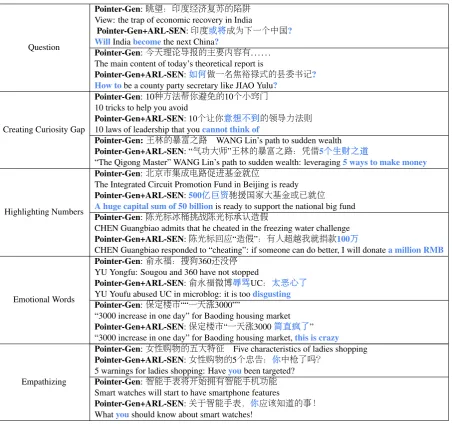
Table 4: Different sensationalization strategies Pointer-Gen+ARL-SEN learns.
3 show that Gen+RL-SEN and Pointer-Gen+ARL-SEN achieve comparable fluency per-formance to Pointer-Gen and Pointer-Gen+RL-ROUGE. Test set headlines achieve the best per-formance among all models, but the difference is not statistically significant. Also, we observe that fine-tuning on sensational headlines will hurt the performance, both in sensationalism and fluency.
After manually checking the outputs, we ob-serve that our model is able to generate sensational headlines using diverse sensationalization strate-gies. These strategies include, but are not limited to, creating a curiosity gap, asking questions, high-lighting numbers, being emotional and emphasiz-ing the user. Examples can be found in Table4.
5 Related Work
for abstractive summarization. In addition, many papers (Nallapati et al.,2017;Zhou et al.,2018b; Zhang et al.,2018a) use extractive methods to di-rectly select sentences from articles. However, none of these work considered the sensationalism of generated outputs.
RL is also gaining popularity as it can directly optimize non-differentiable metrics (Pasunuru and Bansal, 2018; Venkatraman et al., 2015; Xu and Fung, 2019). Paulus et al. (2018) proposed an intra-decoder model and combined RL and MLE to deal with summaries with bad qualities. RL has also been explored with generative adversar-ial networks (GANs) (Yu et al., 2017). Liu et al. (2018) applied GANs on summarization task and achieved better performance. Niu and Bansal (2018) tackles the problem of polite generation with politeness reward. Our work is different in that we propose a novel function to balance RL and MLE.
Our task is also related to text style trans-fer. Implicit methods (Shen et al., 2017b; Fu et al., 2018; Prabhumoye et al., 2018) transfer the styles by separating sentence representations into content and style, for example using back-translation(Prabhumoye et al., 2018). However, these methods cannot guarantee the content con-sistency between the original sentence and trans-ferred output (Xu et al., 2018a). Explicit meth-ods (Zhang et al.,2018b;Xu et al.,2018a) transfer the style by directly identifying style related key-words and modifying them. However, sensation-alism is not always restricted to keywords, but the full sentence. By leveraging small human labeled English dataset, clickbait detection has been well investigated (Chakraborty et al., 2016;Shu et al., 2018;Potthast et al., 2018). However, these hu-man labeled dataset are not available for other lan-guages, such as Chinese.
Modeling sensationalism is also related to mod-eling emotion. Emotion has been well investi-gated in both word level(Tang et al., 2016; Xu et al.,2018b) and sentence level(Felbo et al.,2017; Winata et al., 2019, 2018;Park et al., 2018;Lee et al., 2019). It has also been considered an im-portant factor in engaging interactive systems(Lin et al., 2019b; Winata et al., 2017; Zhou et al., 2018a). Although we observe that sensational headlines contain emotion, it is still not clear which emotion and how emotions will influence the sensationalism.
6 Conclusion and Future Work
In this paper, we propose a model that generates sensational headlines without labeled data using Reinforcement Learning. Firstly, we propose a distant supervision strategy to train the sensation-alism scorer. As a result, we achieve 65% accu-racy between the predicted sensationalism score and human evaluation. To effectively leverage this noisy sensationalism score as the reward for RL, we propose a novel loss function, ARL, to auto-matically balance RL with MLE. Human evalua-tion confirms the effectiveness of both our sensa-tionalism scorer and ARL to generate more sen-sational headlines. Future work can be improving the sensationalism scorer and investigating the ap-plications of dynamic balancing methods between RL and MLE in textGAN(Yu et al., 2017). Our work also raises the ethical questions about gener-ating sensational headlines, which can be further explored.
Acknowledgments
Thanks to ITS/319/16FP of Innovation Technol-ogy Commission, HKUST 16248016 of Hong Kong Research Grants Council for funding. In ad-dition, we thank Zhaojiang Lin for helpful discus-sion and Yan Xu, Zihan Liu for the data collection.
References
Asli Celikyilmaz, Antoine Bosselut, Xiaodong He, and Yejin Choi. 2018. Deep communicating agents for abstractive summarization. In Proceedings of the 2018 Conference of the North American Chapter of the Association for Computational Linguistics: Hu-man Language Technologies, Volume 1 (Long Pa-pers), volume 1, pages 1662–1675.
Abhijnan Chakraborty, Bhargavi Paranjape, Sourya Kakarla, and Niloy Ganguly. 2016. Stop clickbait: Detecting and preventing clickbaits in online news media. InProceedings of the 2016 IEEE/ACM In-ternational Conference on Advances in Social Net-works Analysis and Mining, pages 9–16. IEEE Press.
Bjarke Felbo, Alan Mislove, Anders Søgaard, Iyad Rahwan, and Sune Lehmann. 2017. Using millions of emoji occurrences to learn any-domain represen-tations for detecting sentiment, emotion and sar-casm. In Proceedings of the 2017 Conference on Empirical Methods in Natural Language Process-ing, pages 1616–1626.
Jiatao Gu, Zhengdong Lu, Hang Li, and Victor OK Li. 2016. Incorporating copying mechanism in sequence-to-sequence learning. In Proceedings of the 54th Annual Meeting of the Association for Com-putational Linguistics (Volume 1: Long Papers), volume 1, pages 1631–1640.
Baotian Hu, Qingcai Chen, and Fangze Zhu. 2015. Lc-sts: A large scale chinese short text summarization dataset. InProceedings of the 2015 Conference on Empirical Methods in Natural Language Process-ing, pages 1967–1972.
Wojciech Kry´sci´nski, Romain Paulus, Caiming Xiong, and Richard Socher. 2018. Improving abstraction in text summarization. InProceedings of the 2018 Conference on Empirical Methods in Natural Lan-guage Processing, pages 1808–1817.
Nayeon Lee, Zihan Liu, and Pascale Fung. 2019. Team yeon-zi at semeval-2019 task 4: Hyperpartisan news detection by de-noising weakly-labeled data. In
Proceedings of the 13th International Workshop on Semantic Evaluation, pages 1052–1056.
Chin-Yew Lin. 2004. Rouge: A package for auto-matic evaluation of summaries. Text Summarization Branches Out.
Zhaojiang Lin, Genta Indra Winata, and Pascale Fung. 2019a. Learning comment generation by leveraging user-generated data. In ICASSP 2019-2019 IEEE International Conference on Acoustics, Speech and Signal Processing (ICASSP), pages 7225–7229. IEEE.
Zhaojiang Lin, Peng Xu, Genta Indra Winata, Zi-han Liu, and Pascale Fung. 2019b. Caire: An end-to-end empathetic chatbot. arXiv preprint arXiv:1907.12108.
Linqing Liu, Yao Lu, Min Yang, Qiang Qu, Jia Zhu, and Hongyan Li. 2018. Generative adversarial net-work for abstractive text summarization. AAAI.
Thang Luong, Hieu Pham, and Christopher D Man-ning. 2015. Effective approaches to attention-based neural machine translation. In Proceedings of the 2015 Conference on Empirical Methods in Natural Language Processing, pages 1412–1421.
Ramesh Nallapati, Feifei Zhai, and Bowen Zhou. 2017. Summarunner: A recurrent neural network based se-quence model for extractive summarization of docu-ments. InAAAI, pages 3075–3081.
Ramesh Nallapati, Bowen Zhou, Cicero dos Santos, C¸ a glar Gulc¸ehre, and Bing Xiang. 2016. Abstrac-tive text summarization using sequence-to-sequence rnns and beyond. CoNLL 2016, page 280.
Tong Niu and Mohit Bansal. 2018. Polite dialogue gen-eration without parallel data. Transactions of the As-sociation for Computational Linguistics, 6:273–389.
Ji Ho Park, Peng Xu, and Pascale Fung. 2018. Plusemo2vec at semeval-2018 task 1: Exploiting emotion knowledge from emoji and# hashtags. In
Proceedings of The 12th International Workshop on Semantic Evaluation, pages 264–272.
Ramakanth Pasunuru and Mohit Bansal. 2018. Multi-reward reinforced summarization with saliency and entailment. InProceedings of the 2018 Conference of the North American Chapter of the Association for Computational Linguistics: Human Language Technologies, Volume 2 (Short Papers), volume 2, pages 646–653.
Romain Paulus, Caiming Xiong, and Richard Socher. 2018. A deep reinforced model for abstractive summarization. Sixth International Conference on Learning Representations.
Martin Potthast, Tim Gollub, Matthias Hagen, and Benno Stein. 2018. The clickbait challenge 2017: towards a regression model for clickbait strength.
arXiv preprint arXiv:1812.10847.
Shrimai Prabhumoye, Yulia Tsvetkov, Ruslan Salakhutdinov, and Alan W Black. 2018. Style transfer through back-translation. In Proceedings of the 56th Annual Meeting of the Association for Computational Linguistics (Volume 1: Long Papers), volume 1, pages 866–876.
Lianhui Qin, Lemao Liu, Wei Bi, Yan Wang, Xiaojiang Liu, Zhiting Hu, Hai Zhao, and Shuming Shi. 2018. Automatic article commenting: the task and dataset. In Proceedings of the 56th Annual Meeting of the Association for Computational Linguistics.
Yuanyuan Qiu, Hongzheng Li, Shen Li, Yingdi Jiang, Renfen Hu, and Lijiao Yang. 2018. Revisiting cor-relations between intrinsic and extrinsic evaluations of word embeddings. In Chinese Computational Linguistics and Natural Language Processing Based on Naturally Annotated Big Data, pages 209–221. Springer.
Marc’Aurelio Ranzato, Sumit Chopra, Michael Auli, and Wojciech Zaremba. 2016. Sequence level train-ing with recurrent neural networks. International Conference on Learning Representations.
Alexander M Rush, Sumit Chopra, and Jason Weston. 2015. A neural attention model for abstractive sen-tence summarization. In Proceedings of the 2015 Conference on Empirical Methods in Natural Lan-guage Processing, pages 379–389.
Abigail See, Peter J Liu, and Christopher D Manning. 2017. Get to the point: Summarization with pointer-generator networks. InProceedings of the 55th An-nual Meeting of the Association for Computational Linguistics (Volume 1: Long Papers), volume 1, pages 1073–1083.
Tianxiao Shen, Tao Lei, Regina Barzilay, and Tommi Jaakkola. 2017b. Style transfer from non-parallel text by cross-alignment. InAdvances in Neural In-formation Processing Systems, pages 6830–6841.
Kai Shu, Suhang Wang, Thai Le, Dongwon Lee, and Huan Liu. 2018. Deep headline generation for click-bait detection. In 2018 IEEE International Con-ference on Data Mining (ICDM), pages 467–476. IEEE.
Jiwei Tan, Xiaojun Wan, and Jianguo Xiao. 2017a. Abstractive document summarization with a graph-based attentional neural model. InProceedings of the 55th Annual Meeting of the Association for Com-putational Linguistics (Volume 1: Long Papers), volume 1, pages 1171–1181.
Jiwei Tan, Xiaojun Wan, and Jianguo Xiao. 2017b. From neural sentence summarization to headline generation: a coarse-to-fine approach. In Pro-ceedings of the 26th International Joint Conference on Artificial Intelligence, pages 4109–4115. AAAI Press.
Duyu Tang, Furu Wei, Bing Qin, Nan Yang, Ting Liu, and Ming Zhou. 2016. Sentiment embed-dings with applications to sentiment analysis. IEEE Transactions on Knowledge and Data Engineering, 28(2):496–509.
Arun Venkatraman, Martial Hebert, and J Andrew Bagnell. 2015. Improving multi-step prediction of learned time series models. In AAAI, pages 3024– 3030.
Li Wang, Junlin Yao, Yunzhe Tao, Li Zhong, Wei Liu, and Qiang Du. 2018. A reinforced topic-aware con-volutional sequence-to-sequence model for abstrac-tive text summarization. InProceedings of the 27th International Joint Conference on Artificial Intelli-gence, pages 4453–4460. AAAI Press.
Ronald J Williams. 1992. Simple statistical gradient-following algorithms for connectionist reinforce-ment learning. Machine learning, 8(3-4):229–256.
Genta Indra Winata, Onno Kampman, Yang Yang, Anik Dey, and Pascale Fung. 2017. Nora the empa-thetic psychologist. Proc. Interspeech 2017, pages 3437–3438.
Genta Indra Winata, Onno Pepijn Kampman, and Pas-cale Fung. 2018. Attention-based lstm for psycho-logical stress detection from spoken language us-ing distant supervision. In2018 IEEE International Conference on Acoustics, Speech and Signal Pro-cessing (ICASSP), pages 6204–6208. IEEE.
Genta Indra Winata, Andrea Madotto, Zhaojiang Lin, Jamin Shin, Yan Xu, Peng Xu, and Pascale Fung. 2019. Caire hkust at semeval-2019 task 3: Hierar-chical attention for dialogue emotion classification. In Proceedings of the 13th International Workshop on Semantic Evaluation, pages 142–147.
Jingjing Xu, SUN Xu, Qi Zeng, Xiaodong Zhang, Xu-ancheng Ren, Houfeng Wang, and Wenjie Li. 2018a. Unpaired sentiment-to-sentiment translation: A cy-cled reinforcement learning approach. In Proceed-ings of the 56th Annual Meeting of the Association for Computational Linguistics (Volume 1: Long Pa-pers), volume 1, pages 979–988.
Peng Xu and Pascale Fung. 2019. A novel repetition normalized adversarial reward for headline gener-ation. In ICASSP 2019-2019 IEEE International Conference on Acoustics, Speech and Signal Pro-cessing (ICASSP), pages 7325–7329. IEEE.
Peng Xu, Andrea Madotto, Chien-Sheng Wu, Ji Ho Park, and Pascale Fung. 2018b. Emo2vec: Learn-ing generalized emotion representation by multi-task training. In Proceedings of the 9th Workshop on Computational Approaches to Subjectivity, Senti-ment and Social Media Analysis, pages 292–298.
Lantao Yu, Weinan Zhang, Jun Wang, and Yong Yu. 2017. Seqgan: Sequence generative adversarial nets with policy gradient. InAAAI, pages 2852–2858.
Xingxing Zhang, Mirella Lapata, Furu Wei, and Ming Zhou. 2018a. Neural latent extractive document summarization. In Proceedings of the 2018 Con-ference on Empirical Methods in Natural Language Processing, pages 779–784.
Yi Zhang, Jingjing Xu, Pengcheng Yang, and Xu Sun. 2018b. Learning sentiment memories for sentiment modification without parallel data. InProceedings of the 2018 Conference on Empirical Methods in Natural Language Processing, pages 1103–1108.
Li Zhou, Jianfeng Gao, Di Li, and Heung-Yeung Shum. 2018a. The design and implementation of xi-aoice, an empathetic social chatbot. arXiv preprint arXiv:1812.08989.
Qingyu Zhou, Nan Yang, Furu Wei, Shaohan Huang, Ming Zhou, and Tiejun Zhao. 2018b. Neural docu-ment summarization by jointly learning to score and select sentences. InProceedings of the 56th Annual Meeting of the Association for Computational Lin-guistics (Volume 1: Long Papers), volume 1, pages 654–663.