B Britz
1Structuring place-making in a
multicultural city
Abstract
Urban designers in South Africa, as in the rest of the world, are faced with cities inhabited by people from many diverse cultures. If it is accepted that to dwell meaningfully, the inhabitants of the city should identify with their habitat and be able to understand how to appropriate it, then the structuring of the city should be an expression of many diverse cultural symbol-systems. The multicultural nature of the modern city makes it impossible to choose a particular place-making strategy. Because of their training, most urban designers tend to avoid the multicultural issue and opt for a westernised functional/technical approach. This paper first samples some of the vast variety of experiences that constitute a sense of place, not only in various cultures, but also in different periods in history. It then highlights a useful model that could serve as a paradigm for the unified multicultural city. This configuration would allow for the simultaneous expression of the symbol-systems of many cultures, yet link it with present globalising trends.
Keywords: urban designers, multiculture, modern cities, place-making. STRUKTURERING VAN DIE MAAK VAN 'PLEK' IN 'N
MULTIKULTURELE STAD
Stedelike ontwerpers in Suid-Afrika het, soos in die res van die wereld, te make met stede wat bewoon word deur mense afkomstig uit 'n wye verskeidenheid van kulture. As dit aanvaar word dat om sinvol te woon, die inwoners van 'n stad moet kan identifiseer met hul habitat en in stoat moet wees om te kan verstaan hoe om dit toe te eien, dan moet die samestelling van die multikulturele stad uitdrukking gee aan baie diverse kulturele simboolsisteme. Die aard van die moderne stad maak die keuse van 'n spesifieke plek-maak-strategie egter onmoontlik. As gevolg van hulle opleiding vermy die meeste stedelike ontwerpers die multikulturele vraagstuk en verkies 'n westerse funksioneel-tegniese benadering. Hierdie artikel verwys eerstens na 'n paar steekproewe uit 'n groot aantal belewenisse van 'n sin vir plek uit 'n verskeidenheid van kulture, maar ook uit verskillende geskiedkundige periodes. Dit plaas dan die soeklig op 'n nuttige model wat kan dien as 'n paradigma vir die verenigde-kulturele stad. Hierdie konfigurasie laat die gelyktydige uitdrukking van die simboolsisteme van baie kulture toe, terwyl dit aansluit by huidige globalisasie-tendense.
Sleutelwoorde: stedelike ontwerpers, diverse kulture, moderne stede, plek-maak-strategie.
Britz/Structuring place-making in a multicultural city
Figure 1: Zulu kraal with its semi-spherical huts around the cattle 'Kraal' (Bierman in Oliver 1971)
[image:2.393.30.353.78.677.2]1. Introduction
From birth on we try to orientate ourselves in the environment and establish a certain order. A common order is called culture. The development of culture is based on information and education and therefore depends on the existence of common symbol-systems. Participation in a culture means that one knows how to use its common symbols. The culture integrates the single personality in an ordered world based upon meaningful interactions (Norberg-Schulz, 1969: 220).
This article deals with culture, its expression in common symbol systems and the role of meaningful place-making as an expression of such symbol-systems in order to enable groups or individuals to experience the contemporary city as a sustaining environment. In order to attain such a habitat the reinforcement of specific place-making codes is proposed.
2. The current situation
Present South Africa officially recognizes eleven languages, which could be said to relate to as many ethnic groups. This does not indicate to the outside observer that a myriad of minorities such as the Portuguese, the Chinese, the Greeks, the San, the Jews, etcetera are also intertwined in the country's cultural fabric. This diversity is further complicated by vast differences in development, income and integration in a global culture. Some groups are still nomads, whereas others have been urbanized for many generations. At the moment South Africa may be considered to be largely urbanized, but the majority of the people are recent and unsettled inhabitants. The Free State, one of nine provinces, which was about 40% urban twenty years ago, is now about 73% urban. How do you order these exploding cities in a way that allows the inhabitants to feel safe and identify positively with their new context? At present it is as normal for the newly urbanized to feel threatened by their new context as it is for the older citizens, overwhelmed by the influx of rural immigrants.
Britz/Structuring place-making in a multicultural city
same could by extension be said of the city as the container of
cultural and social life.
For the professionally trained practitioner, connected to a global
culture, yet dealing with people who may still take decades to
become part of this experience, it could be salutary to take stock
of realities that still co-exist with our 'connected' world.
3. Previous connotations
Before considering spatial symbol-systems in various cultures we
should remember that place was and is not always tied to space as
an experience. According to Maria Theodorou, place (chore/chores)
was understood and depicted as 'event' or 'experience' by Homer
in both the
Iliadand the
Odyssey(Theodorou, 1997: 46-55). It is
noteworthy that Bernard Tschumi (Pelkonen, 1998: 83) one of the
most imaginative explorers of contemporary place-making,
understands the creation of buildings as 'events'. For him 'event'
becomes more important than 'space-definition'.
Turning to spatial systems, one of the best-known culturally linked
reports is that of Black Elk, a holy man of the Oglala Sioux. It
describes this"[ ... ] shaman visionary's dismay at the way the
white man had managed to destroy all his people's power by
making them live in square houses, so that they were cut off from
the harmony between their physical surroundings and their circular
world picture: '[ ... ] our tepees were round like the nests of birds
and these were always set in a circle, the nation's hoop, a nest of
many nests, where the Great Spirit meant us to hatch our children [
... ]' " (Rykwert, 1987: 3). In South Africa one immediately thinks of
the traditional huts of the Zulu people (Figure 1) . These
semi-spherical huts were arranged in a circular fashion around their
cattle 'kraal'. One could conclude that if one were to house
people of Zulu origin in round huts in a circular configuration, that
would be a way of making them feel at home. Extrapolating from
the studies of R J Martin in Zambia, it would seem that
configurations which allow continuity in social relations and in
cultural activity are more important than formal superficialities, such
as the creation of ethnic villages, preferably consisting of round
huts (Martin, 1974: 1031).
same could by extension be said of the city as the container of
cultural and social life.
For the professionally trained practitioner, connected to a global
culture, yet dealing with people who may still take decades to
become part of this experience, it could be salutary to take stock
of realities that still co-exist with our 'connected' world.
3. Previous connotations
Before considering spatial symbol-systems in various cultures we
should remember that place was and is not always tied to space as
an experience. According to Maria Theodorou, place (chore/chores)
was understood and depicted as 'event' or 'experience' by Homer
in both the
Iliadand the
Odyssey(Theodorou, 1997: 46-55). It is
noteworthy that Bernard Tschumi (Pelkonen, 1998: 83) one of the
most imaginative explorers of contemporary place-making,
understands the creation of buildings as 'events'. For him 'event'
becomes more important than 'space-definition'.
Turning to spatial systems, one of the best-known culturally linked
reports is that of Black Elk, a holy man of the Oglala Sioux. It
describes this"[ ... ] shaman visionary's dismay at the way the white
man had managed to destroy all his people's power by making
them live in square houses, so that they were cut off from the
harmony between their physical surroundings and their circular
world picture: ' [ ... ] our tepees were round like the nests of birds and
these were always set in a circle, the nation's hoop, a nest of
many nests, where the Great Spirit meant us to hatch our
children [ ... ]'" (Rykwert, 1987: 3). In South Africa one immediately
thinks of the traditional huts of the Zulu people (Figure 1). These
semi-spherical huts were arranged in a circular fashion around
their cattle 'kraal'. One could conclude that if one were to house
people of Zulu origin in round huts in a circular configuration, that
would be a way of making them feel at home. Extrapolating
from the studies of R J Martin in Zambia, it would seem that
configurations which allow continuity in social relations and in
cultural activity are more important than formal superficialities,
such as the creation of ethnic villages, preferably consisting of
round huts (Martin, 1974: 1031).
2001 Acta Structilia Vol 8 No 1
designer. In this instance a group of rural immigrants found ways of accommodating their rituals and customs in a hostile environment, thus enabling them to identify very strongly with it.
A culture, which has more or less disappeared in South Africa, is that of the San or Bushmen. Nurit Bird-David {1993: 117) points out that there is "an extensive metaphorical use of name-sake relatedness" among the members of this culture. Thus one finds a "pairing of people, dances, songs and medicine with details of the natural environment such as eland, giraffe, mantis and rain. The eland, for example, links with the people of the eland, the eland dance, the eland song and the eland medicine, while rain connects with the rain-people, the rain-dance, the rain-medicine and the rain-song". This "crossing between, and linking nature on the one hand and society and culture on the other" (Bird-David, 1993: 117) can be understood if one is aware of the Bushmen's 'key creation myth': This "myth of the double creation [ ... ] tells how people were doubly created with animals. In the Old Days, the first human beings were animals, and the first animal beings were humans. Then a reversal occurred, the first human beings turned into animals, and the first animal beings were humans. But the reversal was not complete, and today people and animals still carry within themselves residual traces of their previous state" (Guenther & Biesele in Bird-David, 1993: 119).
····"·
)
L__---�---� Figure 3: A redrawing of the incised hippopotamus at Stowlands.
The Western Free State (Ouzman, 1998: 6)
4. Identification: different scenarios
For the purposes of this article it is interesting to consider plqce ma king and place identification among the Australian Aborigines. Rapoport (1975: 41) points out that to them "dwellings do not seem to have much symbolic meaning or rules on layout and use". He states that "shelter is only one function of architecture and that other, and more important, functions are the symbolic, place-defining and socio-cultural - to any environment in which people live, whether built of not built" (Rapoport, 1975: 38).
[image:7.391.38.329.88.436.2]-2001 Acta Structilia Vol 8 No l
or 'procreated', as she puts it - into elements, such as trees and rocks, in the place they died. They are thus considered to be present as animate identities (Bird-David,1993: 116-117).
It is therefore not surprising that, whereas each group 'owns' (they actually believe that they are owned by) a specific territory where they move according to set patterns and rituals, there is a distinction between "the economic and ritual use of land with the latter more important" (Rapoport, 1975: 42) (Figure 4). As a result "boundaries seem to be more important with relation to totemic sites than food gathering areas and these boundaries are defined symbolically by means of legend, myth and ritual" (Rapoport, 1975: 43).
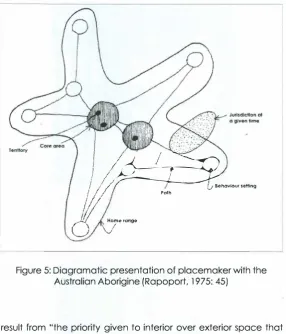
The complex way in which the landscape, and thus place, becomes meaningful to the Aborigine has only been touched on, but it is important to grasp that, for them, "an apparently featureless landscape may become full of meaning and significance, legends and happenings - that is full of places" (Figure 5) (Rapoport, 1975: 45).
Ashihara (1983: 3) compares the traditions of place-making in Japan with those in the West. He identifies "two types of ordering systems: one that is characterized by the wall and another by the floor" (Figure 6). He observes that in the West place is defined by substantial walls. "Thick, solid walls conjure up an image of interior warmth and comfort against cold wintery winds" (Ashihara, 1983: 5). Thus the vertical surfaces define and determine architectural character. In contrast the walls in traditional Japanese houses are very thin. They consist of paper in a frame and in summer they are often removed to allow breezes to cool the spaces. Roofs are carried on slender exposed timber posts. Place is primarily defined by the floor, which is raised, and covered with fresh Tatami mats made of bundled rice straw (Figure 7). Ashihara (1983: 5-7) states that the first reason for this configuration is "the sense of continuity that pervades Japanese culture". The resulting fluid space "allows a feeling of closeness rather than resistance to nature [ ... ]". Culturally it is necessary to point out that Buddhism exerted an important influence in this instance. Buddhist teachings state that "phenomenal things have no substance [ ... ]. Life is illusory, and things do not have a weight" (Ashihara, 1983: 9-1 OJ.
Figure 4: Rapoport (1975: 41) says the dwellings of the Australian Aborigines "do not seem to have much symbolical
2001 Acta Structilia Vol 8 No 1
I �I/
---I /
I
/
,
l /
/
[.;
Beho\l'lovr settmg: / / 1/ rothII/
I/;
[image:10.391.60.347.98.433.2]� Homerar,ge
�_) ,J
Figure 5: Diagramatic presentation of placemaker with the Australian Aborigine (Rapoport, 1975: 45)
Figure 6: A Japanese wood construction as seen in the Katsura Detached Palace, Kyoto (Photographer: Yukio Futa gawa) (Ashihara, 1983: 13)
[image:11.393.48.309.340.558.2]2001 Acta Structilia Vol 8 No 1
The present-day city, no longer needing the protection of a wall, and expanding haphazardly into the landscape as a result of new modes of transport, has become very much like the traditional Japanese city, filling up the entire landscape. The interchange has not necessarily been a happy one for either of the two cultures.
5.
Consequence of globalisation
The fusion of cultures could be viewed as a natural consequence of globalisation, which could lead to a dominant global culture in the near future. Such a culture could then have its own symbol systems to and with which all inhabitants of the globe could relate and identify. The question is whether the dangers of such a development would not have the same negative effect on human development as the agricultural mono-culture had on the agricultural landscape. Taken to its logical conclusion, rampant globalisation could lead to the demise of small cultural manifestations. Marriot (1955: 197-202) indicated the cross fertilisation taking place between 'little' and dominant traditions
('universalization' and 'parochialization') to the enrichment of both. "[ ... ] in the giving and receiving of cultural contents a continual exchange takes place between the two levels of culture"). This process allows the local tradition to relate to the larger world, while preventing the stagnation of the dominant tradition.
The flipside of the globalisation coin was highlighted in 1927 by the Swiss anthropologist, Henri Junod (1927: 629). He noted that the break-up of family structures, alcoholism, crime and disorientation were rampant among the Tonga working in western-type cities, and living in urban compounds. These negative effects of white cultures on the tribes among whom he worked in the North Eastern Transvaal have increased considerably in our time.
Figure 8: Definition of the eruv. The boundary is defined by way
of stretched fishing-wire
6. Eruv and the concept of place-making
2001 Acto Structilio Vol 8 No 1
Physically the eruv consists of a portion of on existing city that is demarcated by a symbolic boundary wall. The boundary is defined by linking the existing buildings by means of symbolic doorways created by stretching something transparent such as fishing-wire (Figure 8) across the openings between them. In the case of London (Figure 9), the designated perimeter is about seventeen kilometres long and is breached at thirty-one points. Weizmon and Herz (1997: 68-76) explain the traditional understanding of Jewish place consciousness as follows:
Two main models of space are implicit in the Talmud and, earlier, the Bible: the City and the Desert. They represent the two poles of existence that define the geographical matrix of Jewish history: Kingdom and Placelessness.
They also explain that
after the settlement, the temple that was built in Jerusalem became the focal point of the Jewish nation, around which their entire religious life revolved[ ... ]. It became the Jewish symbol of settlement and urban life.
It should be understood that the Torah prescribed every aspect of Jewish life accurately and that these laws were linked to the existence of the temple. When the temple was razed in AD 70 and Jews were denied access to the city in AD 135, Jewish culture was in danger of collapsing. In composing the Talmud, which is a rephrasing of Judaism under the new circumstances, a large section was devoted to the Biblical concept of 'place'. By inventing the idea of the eruv, which symbolically represents the temple, it enabled the Jews in the diaspora to practise their customs and religion in a meaningful way.
This concept of creating different readings of the city hos exciting possibilities for the structuring of the multicultural city. By creating various overlapping eruvs each representing
a specific
culture, diverse symbol-systems could co-exist and allow members of various cultures to relate to and identify with their context. These groups could then give expression to their cults and rituals and in this way contribute to the richness of their respective cities. The beauty of this system of layering is that inhabitants of the cities could plug into any or many of these patterns according to their inclination. There is also no limit to the number of layers.Physically the eruv consists of a portion of an existing city that is demarcated by a symbolic boundary wall. The boundary is defined by linking the existing buildings by means of symbolic doorways created by stretching something transparent such as fishing-wire (Figure 8) across the openings between them. In the case of London (Figure 9), the designated perimeter is about seventeen kilometres long and is breached at thirty-one points. Weizman and Herz (1997: 68-76) explain the traditional understanding of Jewish place consciousness as follows:
Two main models of space are implicit in the Talmud and, earlier, the Bible: the City and the Desert. They represent the two poles of existence that define the geographical matrix of Jewish history: Kingdom and Placelessness.
They also explain that
after the settlement, the temple that was built in Jerusalem
became the focal point of the Jewish nation, around which
their entire religious life revolved [ ... ]. It became the Jewish
symbol of settlement and urban life.
It should be understood that the Torah prescribed every aspect of Jewish life accurately and that these laws were linked to the existence of the temple. When the temple was razed in AD 70 and Jews were denied access to the city in AD 135, Jewish culture was in danger of collapsing. In composing the Talmud, which is a rephrasing of Judaism under the new circumstances, a large section was devoted to the Biblical concept of 'place'. By inventing the idea of the eruv, which symbolically represents the temple, it enabled the Jews in the diaspora to practise their customs and religion in a meaningful way.
This concept of creating different readings of the city has exciting possibilities for the structuring of the multicultural city. By creating various overlapping eruvs each representing a specific culture, diverse symbol-systems could co-exist and allow members of various cultures to relate to and identify with their context. These groups could then give expression to their cults and rituals and in this way contribute to the richness of their respective cities. The beauty of this system of layering is that inhabitants of the cities could plug into any or many of these patterns according to their inclination. There is also no limit to the number of layers.
Britz/Structuring place-making in a multicultural city
respective colours. Participants normally have no difficulty playing their games by noting the correct colour (Figure 1 OJ. The other model might have its origins in one of the most significant concepts of the 20th century: Pablo Picasso's invention of collage. Bernard Tschumi's Pare de /a Villette (Figure 11 ), one of the icons of the 20th century, is based on a collage consisting of three superimposed and easily recognizable patterns. Now may be the logical time to extend this concept to the entire city.
7. Conclusion
The idea of layering the city in this way does not require drastic restructuring or vast amounts of money, and if this is not only allowed but also encouraged, the members of the specific groups or cultures could realise this. As we all know, personal involvement in place-making leads to buying-in, identifying with
and taking responsibility for. Thus, as at /a Villette. this strategy
Britz/Structuring place-making in a multicultural city
� ·;:: co
co
..c: Cl
�
CJ)
0
-
0..c: D...
�
c
(I)() t: 0 Cl V,
0
0u
-� C 0-�
V,CJ) C
:g
0�
0
Britz/Structuring place-making in a multicultural city
References ASHIHARA, Y.
1983. The aesthetic townscape. Cambridge (Mass.): MIT Press. BIRD-DA YID, N.
1993. Tribal metaphorization of human-nature relatedness. Environmentalism. Milton, K. (Ed) London & New York: Routledge, pp. 112-25.
HERZ, M. & WEIZMAN, E.
1997. Between city and desert: constructing the North London Eruv. AA Files, 34, Autumn, pp. 68-76.
JUNOD, H.A.
1927. The Ute of a South African tribe, Vo/ 2. London: Macmillan & Co. MARRIOT, M.
1955. Uttle communities in an indigenous civilization, in India: studies in the little community. Chicago: University Press.
MARTIN, R.J.
197 4. African paradox. Architect's Journal, 197 4, October, pp. l 030-l.
MUMFORD, L.
1984. The city in history. Hammondsworth: Penguin Books.
NORBERG-SCHULZ, C.
1969. Meaning in architecture. Meaning in architecture. Jencks & Baird (Eds). London: Barrie Cresset, pp. 215-29.
NORBERG-SCHULZ, C.
1979. Kahn, Heidegger and the language of architecture. Oppositions, No 18.
OLIVER, PAUL (Ed)
1971. Shelter in Africa. London: Barrie & Jenkins.
OUZMAN, S.
1998. Stowlands. Cu/no, May, pp. 5-6.
PELKONEN, L.
1998. Bernard Tschumi's Event Space. Daida/os 67, pp. 82-5. RAPOPORT, A.
1975. Australian Aborigines and the definition of place. Shelter, Sign & Symbol. Oliver, P. (Ed). London: Barrie & Jenkins, pp. 38-51.
RYKWERT, J.
1987. The idea of town. Cambridge (Mass.): MIT Press. THEODOROU, M.
1997. Space as experience: Chore/Choros. AA. Files, 34, pp. 46-55.
TSCHUMI, B.