A Unified Framework for Grammar Error Correction
Longkai Zhang Houfeng Wang
Key Laboratory of Computational Linguistics (Peking University) Ministry of Education, China
[email protected], [email protected]
Abstract
In this paper we describe the PKU system for the CoNLL-2014 grammar error cor-rection shared task. We propose a unified framework for correcting all types of er-rors. We use unlabeled news texts instead of large amount of human annotated texts as training data. Based on these data, a tri-gram language model is used to cor-rect the replacement errors while two extra classification models are trained to correct errors related to determiners and preposi-tions. Our system achieves 25.32% inf0.5 on the original test data and 29.10% on the revised test data.
1 Introduction
The task of grammar error correction is diffi-cult yet important. An automatic grammar error correction system can help second language(L2) learners improve the quality of their writing. Pre-vious shared tasks for grammar error correction, such as the HOO shared task of 2012 (HOO-2012) and the CoNLL-2013 shared task(CoNLL-2013), focus on limited types of errors. For example, HOO-2012 only considers errors related to de-terminers and prepositions. CoNLL-2013 further considers errors that are related to noun number, verb form and subject-object agreement. In the CoNLL-2014 shared task, all systems should con-sider all the 28 kinds of errors, including errors such as spelling errors which cannot be corrected using a single classifier.
Most of the top-ranked systems in the CoNLL-2013 shared task(Ng et al., CoNLL-2013) train individ-ual classifiers or language models for each kind of errors independently. Although later systems such as Wu and Ng (2013); Rozovskaya and Roth (2013) use Integer Linear Programming (ILP) to decode a global optimized result, the input scores
for ILP still come from the individual classifica-tion confidence of each kind of errors. It is hard to adapt these methods directly into the CoNLL-2014 shared task. It will be both time-consuming and impossible to train individual classifiers for all the 28 kinds of errors.
Besides the classifier and language model based methods, some systems(Dahlmeier and Ng, 2012a; Yoshimoto et al., 2013; Yuan and Felice, 2013) also use the machine translation approach. Because there are a limited amount of training data, this kind of approaches often need to use other corpora of L2 learners, such as the Cam-bridge Learner Corpus. Because these corpora use different annotation criteria, the correction sys-tems should figure out ways to map the error types from one corpus to another. Even with these ad-ditions and transformations, there are still too few training data available to train a good translation model.
In contrast, we think the grammar error correc-tion system should 1) correct most kinds of er-rors in a unified framework and 2) use as much unlabeled data as possible instead of using large amount of human annotated data. To be specific, our system do not need to train individual clas-sifiers for each kind of errors, nor do we need to use manually corrected texts. Following the observation that a correction can either replace a wrong word or delete/insert a word, our system is divided into two parts. Firstly, we use a Lan-guage Model(LM) to correct errors with respect to the wrongly used words. The LM only uses the statistics from a large corpus. All errors related to wrongly used words can be examined in this uni-fied model instead of designing individual systems for each kind of errors. Secondly, we train extra classifiers for determiner errors and preposition er-rors. We further consider these two kinds of errors because many of the deletion and insertion errors belongs to determiner or preposition errors. The
training data of the two classification models also come from a large unlabeled news corpus there-fore no human annotation is needed.
Although we try to use a unified framework to get better performance in the grammar error cor-rection task, there are still a small portion of errors we do not consider. The insertion and deletion of words are not considered if the word is neither a determiner nor a preposition. Our system is also incapable of replacing a word sequence into an-other word sequence. We do not consider these kinds of errors because we find some of them are hard to generate correction candidates without fur-ther understanding of the context, and are not easy to be corrected even by human beings.
The paper is structured as follows. Section 1 gives the introduction. In section 2 we describe the task. In section 3 we describe our algorithm. Experiments are described in section 4. We also give a detailed analysis of the results in section 4. In section 5 related works are introduced, and the paper is concluded in the last section.
2 Task Description
The CoNLL-2014 shared task focuses on correct-ing all errors that are commonly made by L2 learn-ers of English. The training data released by the task organizers come from the NUCLE cor-pus(Dahlmeier et al., 2013). This corpus contains essays written by L2 learners of English. These essays are then corrected by English teachers. De-tails of the CoNLL-2014 shared task can be found in Ng et al. (2014).
3 System Overview
3.1 Overview
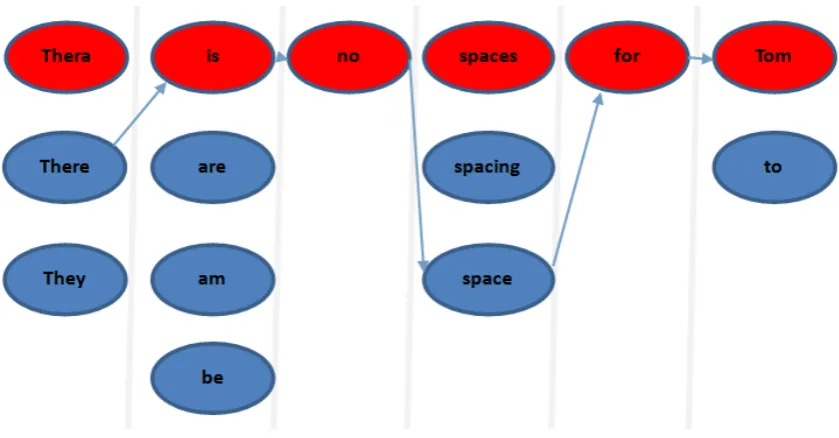
It is time-consuming to train individual models for each kind of errors. We believe a better way is to correct errors in a unified framework. We assume that each word in the sentence may be involved in some kinds of errors. We generate a list of cor-rection candidates for each word. Then a Lan-guage Model (LM) is used to find the most proba-ble word sequences based on the original sentence and the correction candidates for each word. An illustrative example is shown in figure 1.
Because the LM is designed for the replace-ment errors rather than insertion and deletion er-rors, we train two extra classifiers for determiners and prepositions. The determiner model and the
preposition model can improve the performance in our experiment.
3.2 Correction Candidate Generation
The correction candidate generation phase aims to generate a list of correction candidates for each word in the original sentence. We generate cor-rection candidates based on the following rules:
1. Words with the same stem
2. Similar words based on edit distance
The first rule includes the words with the same stem as candidates. These candidates can be used later to correct the errors re-lated to word form. For example, candidates for the word ‘time’ in the original sentence ‘This is a timely rain indeed.’ may include ‘timed’,‘time’,‘timed’,‘times’,‘timings’,‘timely’, ‘timees’ and ‘timing’, which all have the stem ’time’. The correct candidate ‘timely’ is also included in the candidate list and can be detected through further processing.
The candidate generated by the second rule are mainly used for spelling correction. For exam-ple, a such candidate for ‘beleive’ may be ‘belive’ or ‘believe’. To generate meaningful candidates while guarantee accuracy, we require that the can-didate and the original word should have the same initial character. By examining the training data we experimentally find that very few L2 learn-ers make spelling errors on the initial charactlearn-ers. For example, they may spell “believe” as “belive”. However, very few of them may spell “believe” as “pelieve” or “delieve”.
In our system, we generate 10 candidates for each word. To keep the decoding of the best word sequence controllable, we do not generate candi-dates for every word in the original sentence. We only generate the edit distance based candidates for the following words:
1. Words that never appear in the English giga-word corpus1
2. Words that appear in the gigaword corpus but with frequency below a threshold (we use 10 in the experiment)
Besides, we do not generate candidates for the words whose POS tags are “NNP” or “NNPS”.
1http://catalog.ldc.upenn.edu/
Figure 1: Correction of the original sentence “Thera is no spaces for Tom”. We use red nodes to represent the original words in the sentence, and use blue nodes below each word to represent the candidate list of each word. We use arrows to show the final corrected word sequence with the highest probability.
These words are proper nouns. The correction of this kind of words should depend on more contextual information. For the stemming tools we use the snowball stemmer2. To generate
candidates based on edit distance, we use the org.apache.lucene.search.spell.SpellChecker in Lucene3. Note that unlike other context based
spell checkers such as the one in Microsoft Office, the SpellChecker class in Lucene is actually not a spell checker. For an input wordw, it can only suggest words that are similar to w given a pre-defined dictionary. We build the dictionary using all words collected from the English Gigaword corpus.
3.3 Language Model for Candidate Selection After given each word a list of candidates, we can now find the word sequence which is most likely to be the correct sentence. The model we use is the language model. The probability P(s) of a sen-tences=w0w1...wn−1is calculated as:
P(s) =
nY−1
i=0
P(wi|w0, ..., wi−1) (1)
The transition probability P(wi|w0, ..., wi−1) is calculated based on language model. In our system we use a tri-gram language model trained on the gigaword corpus.
2http://snowball.tartarus.org/
3https://lucene.apache.org/
Therefore, P(wi|w0, ..., wi−1) is reduced to
P(wi|wi−2, wi−1). We do not use a fixed smooth-ing method. We just set the probability of an unseen string to be a positive decimal which is very close to zero.
The decoding of the word sequence that max-imize p(s) can be tackled through dynamic programming using Viterbi algorithm(Forney Jr, 1973). One useful trick is that to multiply
p(wi|wi−2, wi−1)with a coefficient (4 in our sys-tem) ifwi−2,wi−1andwiare all words in the
orig-inal sentence. This is because most of the origorig-inal word sequences are correct. If the system needs to make a correction, the corrected sequence should have a much higher score than the original one.
We do not generate candidates for determin-ers and prepositions. Firstly, they are all frequent words that are excluded by the rules we men-tioned in this section. Secondly, the determiner and preposition errors are the main kinds of errors made by L2 learners. Some of the errors are re-lated to the wrong deletions or insertions. There-fore we choose to take special care of determiners and prepositions to correct all their replacement, deletion and insertion errors instead of generating candidates for them in this stage.
3.4 Determiner Correction
forms are supposed to be corrected. As we men-tioned in the introduction, we should now handle the deletion and insertion errors. We choose to use special models for determiner and prepositions be-cause many of the deletion and insertion errors are related to determiner errors or preposition errors. Also, these two kinds of errors have been consid-ered in HOO-2012 and CoNLL2013. Therefore it’s easier to make meaningful comparison with previous works. We use Maximum Entropy (ME) classifiers to correct the determiner and preposi-tion errors. In this secpreposi-tion we consider the deter-miner errors. The preposition errors will be con-sidered in the next section. For both of the two parts, we use the open source tool MaxEnt4as the
implementation of ME.
We consider the determiner correction task as a multi-class classification task. The input instances for classification are the space between words. We consider whether the space should keep empty, or insert ‘a’ or ‘the’. Therefore, 3 labels are con-sidered to indicate ‘a’, ‘the’ and ‘NULL’. We use ‘’NULL’ to denote that the correct space does not need an article. We leave the clarification between ‘a’ and ‘an’ as a post-process by manually de-signed rules. We do not consider other determiners such as ‘this’ or ‘’these’ because further informa-tion such as the coreference resoluinforma-tion results is needed.
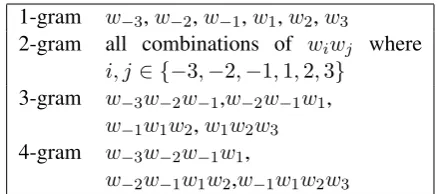
Instead of considering all spaces in a sen-tence, some previous works(AEHAN et al., 2006; Rozovskaya and Roth, 2010; Rozovskaya et al., 2013) only consider spaces at the beginning of noun phrases. Compared to these methods, our system do not need a POS tagger or a phrase chun-ker (which is sometimes not accurate enough) to filter the positions. All the operations are done on the word level. We list the features we use in ta-ble 1. Note that for 3-grams and 4-grams we do not use all combinations of characters because it will generate more sparse features while the per-formance is not improved.
Because there are limited amount of training data, we choose to use the English Gigaword cor-pus to generate training instances instead of us-ing the trainus-ing data of CoNLL-2014. Because the texts in the Gigaword corpus are all news texts, most of them are well written by native speakers and are proofread by the editors. Therefore they
4http://homepages.inf.ed.ac.uk/
lzhang10/maxent_toolkit.html
1-gram w−3,w−2,w−1,w1,w2,w3
2-gram all combinations of wiwj where
i, j∈ {−3,−2,−1,1,2,3}
3-gram w−3w−2w−1,w−2w−1w1,
w−1w1w2,w1w2w3 4-gram w−3w−2w−1w1,
[image:4.595.306.525.61.158.2]w−2w−1w1w2,w−1w1w2w3
Table 1: The features used in our system. For a given blank(space), wi means the next ith word
and w−i means the previous ith word. For the
example of “I do not play balls .”, if the current considered instance is the space between ‘play’ and ‘balls’, thenw−2 means ‘not’ andw1 means ‘balls’.
can serve as implicit gold annotations. We gener-ate the training instances from the sentences in the Gigaword corpus with the following rules:
1. for each space between words, we treat it as an instance with label ‘NULL’, which means no article is needed. We use the 3 words be-fore the space as w−3, w−2, w−1 and the 3 words after the space asw1,w2,w3to gener-ate features. We name this kind of instances ‘Space Instance’ to indicate we operate on a space. This kind of training instances can convey the information that in this context no article is needed.
2. for each word that is an article, we assume it as an instance, with the label ‘a’ or ‘the’ de-pending on itself. We use the 3 words before it as w−3, w−2, w−1 and the 3 words after is asw1,w2,w3. In this case we do not use the article itself as the context. We name this kind of instances ‘article Instance’ to indicate we operate on an article. This kind of train-ing instances can convey the information that in this context a particular article should be added.
To guarantee a certain level of precision, we re-quire the decoding should only be based on confi-dent predictions. We use the probability calculated by the classifier as the confidence score and re-quire the probability of the considered predictions should exceed a threshold.
3.5 Preposition Correction
The preposition model is similar to the article model. We use the same set of features as in ta-ble 1. The training and testing instance generation is similar except now we consider prepositions in-stead of articles. The decoding phase is also iden-tical to the determiner model.
3.6 Post Processing
The post processing in our system is listed as fol-lows:
1. Distinguish between “a” and “an”. We use rule based method for this issue.
2. Splitting words. If a word is not in the dic-tionary but one of its splitting results has a high frequency, we will split the word into two words. For example, “dailylife” is an out of vocabulary word and the splitting re-sult “daily life” is common in English. Then we split “dailylife” into “daily life”.
3. We capitalize the first character of each sen-tence.
4 Experiment and Analysis
We experiment on the CoNLL-2014 test data. We evaluate our system based on the M2 scorer which is provided by the organizers. Details of the M2 scorer can be found in Dahlmeier and Ng (2012b). We tune the additional parameters like all the thresholds on the CoNLL-2014 official training data. We use all the text in the Gigaword corpus to train the language model. We use 2.5 million sen-tences in the Gigaword corpus to train the extra two classifier.
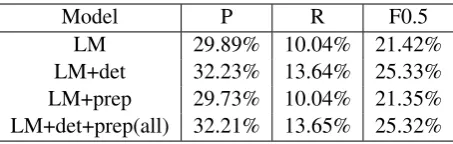
Results of our system are shown in table 2. LM refers to using language model alone. LM+det refers to using a determiner classifier after using a language model. LM+prep refers to using a preposition classifier after using a language model. LM+det+preposition refers to using a preposition classifier after LM+det, which is the method used in our final system.
Model P R F0.5
LM 29.89% 10.04% 21.42%
LM+det 32.23% 13.64% 25.33%
LM+prep 29.73% 10.04% 21.35%
[image:5.595.308.535.61.133.2]LM+det+prep(all) 32.21% 13.65% 25.32%
Table 2: The experimental results of our system in the CoNLL-2014 shared task. The threshold for determiner model and preposition model is 0.99 and 0.99. Parameters are tuned on the CoNLL-2014 training data.
Model P R F0.5
LM+det+prep(all) 36.64% 15.96% 29.10% Table 3: The experimental results of our system in the CoNLL-2014 shared task on the revised an-notations. The threshold for determiner model and preposition model is 0.99 and 0.99. Parameters are tuned on the CoNLL-2014 training data.
From the results we can see that the main con-tribution comes from the LM model and deter-miner model. The preposition model can correct part of the errors while introduce new errors. The preposition model may harm the overall perfor-mance. But considering the fact that the grammar error correction systems are always used for rec-ommending errors, we still keep the preposition model in real applications and suggest the errors predicted by the preposition model.
One limitation of our system is that we only use a tri-gram based language model as well as up to 4-gram features for limited instances. Previous works(Rozovskaya et al., 2013; Kao et al., 2013) have shown that other resources like the Google 5-gram statistics can help improve performance. For the determiner and preposition models, we exper-iment on different size of training data, from near zero to the upper bound of our server’s memory limit (about 72GB). We find that under this lim-itation, the performance is still improving when adding more training instances. We believe the performance can be further improved.
Scores based on the revised annotations is shown in table 3.
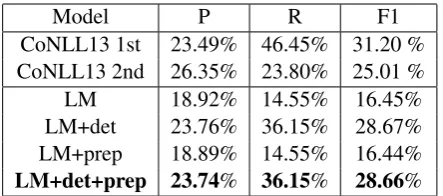
in-Model P R F1
CoNLL13 1st 23.49% 46.45% 31.20 %
CoNLL13 2nd 26.35% 23.80% 25.01 %
LM 18.92% 14.55% 16.45%
LM+det 23.76% 36.15% 28.67%
LM+prep 18.89% 14.55% 16.44%
[image:6.595.71.293.61.159.2]LM+det+prep 23.74% 36.15% 28.66% Table 4: The experimental results of our system on the CoNLL-2013 shared task data. The thresh-old for determiner model and preposition model is 0.75 and 0.99. Parameters are tuned on the CoNLL-2013 training data. CoNLL13 1st is Ro-zovskaya et al. (2013) and the 2nd is Kao et al. (2013)
stead of F0.5. Therefore some of the thresholds are different with the ones in the CoNLL-2014 sys-tem. Because the CoNLL-2013 shared task only considers 5 types of errors, it will be much easier to design components specially for each kind of errors. Therefore our system is a bit less accurate than the best system. In this system, we restrict the candidates to be either noun or verb, and omit the spell checking model. We also omit some post-processings like deciding whether a word should be split into two words, because these kinds of er-rors are not included.
5 Conclusion
In this paper we describe the PKU system for the CoNLL-2014 grammar error correction shared task. We propose a unified framework for correct-ing all types of errors. A tri-gram language model is used to correct the replacement errors while two extra classification models are trained to correct errors related to determiners and prepositions. Our system achieves 25.32% inf0.5on the original test data and 29.10% on the revised test data.
Acknowledgments
This research was partly supported by Na-tional Natural Science Foundation of China (No.61370117, No.61333018), National High Technology Research and Development Program of China (863 Program) (No.2012AA011101) and Major National Social Science Fund of China(No.12&ZD227).
References
AEHAN, N., Chodorow, M., and LEACOCK, C. L. (2006). Detecting errors in english arti-cle usage by non-native speakers.
Dahlmeier, D. and Ng, H. T. (2012a). A beam-search decoder for grammatical error correc-tion. In Proceedings of the 2012 Joint Con-ference on Empirical Methods in Natural Lan-guage Processing and Computational Natural Language Learning, pages 568–578. Associa-tion for ComputaAssocia-tional Linguistics.
Dahlmeier, D. and Ng, H. T. (2012b). Better eval-uation for grammatical error correction. In Pro-ceedings of the 2012 Conference of the North American Chapter of the Association for Com-putational Linguistics: Human Language Tech-nologies, pages 568–572. Association for Com-putational Linguistics.
Dahlmeier, D., Ng, H. T., and Wu, S. M. (2013). Building a large annotated corpus of learner en-glish: The nus corpus of learner english. In Pro-ceedings of the Eighth Workshop on Innovative Use of NLP for Building Educational Applica-tions, pages 22–31.
Forney Jr, G. D. (1973). The viterbi algorithm. Proceedings of the IEEE, 61(3):268–278. Kao, T.-h., Chang, Y.-w., Chiu, H.-w., Yen, T.-H.,
Boisson, J., Wu, J.-c., and Chang, J. S. (2013). Conll-2013 shared task: Grammatical error cor-rection nthu system description. In Proceed-ings of the Seventeenth Conference on Compu-tational Natural Language Learning: Shared Task, pages 20–25, Sofia, Bulgaria. Association for Computational Linguistics.
Ng, H. T., Wu, S. M., Briscoe, T., Hadiwinoto, C., Susanto, R. H., and Bryant, C. (2014). The conll-2014 shared task on grammatical error correction. In Proceedings of the Eighteenth Conference on Computational Natural Lan-guage Learning: Shared Task (CoNLL-2014 Shared Task), pages 1–12, Baltimore, Mary-land, USA. Association for Computational Lin-guistics.
Task, pages 1–12, Sofia, Bulgaria. Association for Computational Linguistics.
Rozovskaya, A., Chang, K.-W., Sammons, M., and Roth, D. (2013). The university of illi-nois system in the conll-2013 shared task. In Proceedings of the Seventeenth Conference on Computational Natural Language Learning: Shared Task, pages 13–19, Sofia, Bulgaria. As-sociation for Computational Linguistics. Rozovskaya, A. and Roth, D. (2010).
Train-ing paradigms for correctTrain-ing errors in grammar and usage. In Human language technologies: The 2010 annual conference of the north amer-ican chapter of the association for computa-tional linguistics, pages 154–162. Association for Computational Linguistics.
Rozovskaya, A. and Roth, D. (2013). Joint learn-ing and inference for grammatical error correc-tion. InProceedings of the 2013 Conference on Empirical Methods in Natural Language Pro-cessing, pages 791–802, Seattle, Washington, USA. Association for Computational Linguis-tics.
Wu, Y. and Ng, H. T. (2013). Grammatical error correction using integer linear programming. In Proceedings of the 51st Annual Meeting of the Association for Computational Linguistics (Vol-ume 1: Long Papers), pages 1456–1465, Sofia, Bulgaria. Association for Computational Lin-guistics.
Yoshimoto, I., Kose, T., Mitsuzawa, K., Sak-aguchi, K., Mizumoto, T., Hayashibe, Y., Ko-machi, M., and Matsumoto, Y. (2013). Naist at 2013 conll grammatical error correction shared task. CoNLL-2013, 26.