Dynamic Knowledge-Base Alignment for Coreference Resolution
Jiaping Zheng Luke Vilnis Sameer Singh Jinho D. Choi Andrew McCallum School of Computer Science
University of Massachusetts Amherst MA 01003
{jzheng,luke,sameer,jdchoi,mccallum}@cs.umass.edu
Abstract
Coreference resolution systems can benefit greatly from inclusion ofglobal context, and a number of recent approaches have demonstrated improvements when precom-puting an alignment to external knowledge sources. However, since alignment itself is a challenging task and is often noisy, ex-isting systems either align conservatively, resulting in very few links, or combine the attributes of multiple candidates, leading to a conflation of entities. Our approach instead performs joint inference between within-document coreference and entity linking, maintaining ranked lists of candi-date entities that are dynamically merged and reranked during inference. Further, we incorporate a large set of surface string vari-ations for each entity by using anchor texts from the web that link to the entity. These forms of global context enables our system to improve classifier-based coreference by
1.09 B3 F1 points, and improve over the
previous state-of-art by0.41points, thus
introducing a new state-of-art result on the ACE 2004 data.
1 Introduction
Coreference resolution is the task of identifying sets of noun phrase mentions from a document that refer to the same real-world entities. For ex-ample, in the following excerpt: “The Chicago suburb of Arlington Heights is the first stop for
hGeorge W. Bushi1today. hThe Texas governori2
stops inhGore’s home statei3ofhTennesseei4this
afternoon. . .”,(m1, m2)and(m3, m4)define the
coreferent pairs. Coreference resolution forms an important component for natural language process-ing and information extraction pipelines due to its utility in relation extraction, cross-document
coref-erence, text summarization, and question answer-ing. The task of coreference is challenging for automated systems as the local information con-tained in the document is often not enough to accu-rately disambiguate mentions, for example, corefer-encing(m1, m2)requires identifying that George
W. Bush (m1) is the governor of Texas (m2), and
similarly for(m3, m4). External knowledge-bases
such as FrameNet (Baker et al., 1998), Wikipedia, Yago (Suchanek et al., 2007), and Freebase (Bol-lacker et al., 2008), can be used to provideglobal context, and there is a strong need for coreference resolution systems to accurately use such sources for disambiguation.
Incorporating external knowledge bases into coreference has been the subject of active recent research. Ponzetto and Strube (2006) and Ratinov and Roth (2012) precompute a fixed alignment of the mentions to the knowledge base entities. The attributes of these entities are used during corefer-ence by incorporating them in the mention features. Since alignment of mentions to the external enti-ties is itself a difficult task, these systems favor high-precision linking. Unfortunately, this results in fewer alignments, and improvements are only shown on mentions that are easier to align and core-fer (such as thenon-transcript documentsin Rati-nov and Roth (2012)). Alternatively, Rahman and Ng (2011) link each mention to multiple entities in the knowledge base, improving recall at the cost of lower precision; the attributes of all the linked entities are aggregated as features. Although this approach is more robust to noise in the documents, the features of a mention merge the different as-pects of the entities, for example a “Michael Jordan” mention will contain features for both thescientist andbasketballpersonas.
Instead of fixing the alignment of the mentions to the knowledge base, our proposed approach main-tains a ranked list of candidate entities for each mention. To expand the set of surface strings that
may be used to refer to each entity, the attributes of each candidate contain anchor texts (the visible text) of the links on the web that refer to that entity candidate. When mentions are compared during inference, we use the features computed from the top ranked entity candidate of the antecedent men-tion. As mentions are merged, the ranked lists of candidate entities are also merged and reranked, of-ten changing the top-ranked entity candidate used in subsequent comparisons. The large set of sur-face string variations and constant reranking of the entity candidates during inference allows our ap-proach to correct mistakes in alignment and makes external information applicable to a wider variety of mentions.
Our paper provides the following contributions: (1) an approach that jointly reasons about both within-doc entities and their alignment to KB-entities by dynamically adjusting a ranked list of candidate alignments, during coreference, (2) Uti-lization of a larger set of surface string variations for each entity candidate by using links that appear all over the web (Spitkovsky and Chang, 2012), (3) A combination of these approaches that improves upon a competitive baseline without a knowledge base by1.09B3 F1 points on the ACE 2004 data,
and outperforms the state-of-the-art coreference system (Stoyanov and Eisner, 2012) by 0.41 B3
F1 points, and (4) Accurate predictions on docu-ments that are difficult for coreference, such as the transcriptdocuments that were omitted from the evaluation in Ratinov and Roth (2012), and docu-ments that contain a large number of mentions.
2 Baseline Pairwise System
In this section we describe a variant of a commonly-used coreference resolution system that does not utilize external knowledge sources. This widely adopted model casts the problem as a series of binary classifications (Soon et al., 2001; Ng and Cardie, 2002; Ponzetto and Strube, 2006; Bengston and Roth, 2008; Stoyanov et al., 2010). Given a document with its mentions, the system itera-tively checks each mentionmjfor coreference with
preceding mentions using a classifier. A corefer-ence link may be created betweenmj and one of
these preceding mentions using one of the follow-ing strategies. The CLOSESTLINK (Soon et al., 2001) method picks the closest mention tomjthat
is positively classified, while the BESTLINK(Ng and Cardie, 2002) method linksmj to the
preced-Types Features
String-Similarity mention string match, head string match,head substring match, head word pair, men-tion substring match,acronym
Syntax number match, gender match, apposition, relative pronoun, mention type, modifier match,head word POS tags
Semantic synonym, antonym, hypernym, modifier re-lations, both mentions are surrounded by a verb meaning “to say”,demonym match Other predicted entity type, predicted entity type
[image:2.595.309.523.59.194.2]match, both mentions in same sentence, sen-tence/token distance,capitalization
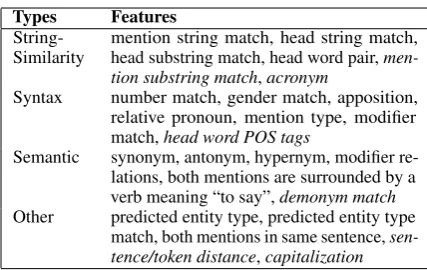
Table 1: Features of the baseline model. Extensions to Bengston and Roth (2008) areitalicized.
ing mention that was scored the highest. If none of the preceding mentions are classified as positive (for CLOSESTLINK), or are above a threshold (for BESTLINK), thenmjis left unlinked. After all the
mentions have been processed, the links are used to generate a transitive closure that corresponds to the recognized entities in the document.
2.1 Pairwise Mention Features
The features used to train our classifier are similar to those in Bengston and Roth (2008), including lexical, syntactical, semantic, predicted NER types, etc., with the exclusion of their “learned features” that require additional classifiers. Further, we in-clude features that compare the mention strings, the distance between the two mentions in terms of the number of sentences and tokens, and the POS tags of the head words. We also use the conjunctions of these features as in Bengston and Roth (2008), as well as the BESTLINKapproach. The complete set of features are listed in Table 1.
The training for our system is similar to Bengston and Roth (2008). The positive train-ing examples are generated from mentions and their immediate preceding antecedent. The neg-ative examples are generated from mentions and all their preceding non-coreferent mentions. If the mention is not a pronoun, preceding pronouns are not used to create training examples, and they are also excluded during inference. In contrast to aver-aged perceptron used in Bengston and Roth (2008), our baseline system is trained using hinge-loss,`2
-regularized SVM.
2.2 Merging Pairwise Features
When a mentionmj is compared against a
that are already coreferent withmimay be helpful
in disambiguatingmj as they may contain
infor-mation that is not available frommi. Let M be
the mentions betweenmi and mj that are
coref-erent withmi. Letmq ∈ M be the mention that
is closest to mj. All the features from the pair (mq, mj), except those that characterize one
men-tion (for example, menmen-tion type ofmj), are added
to the features between(mi, mj). This extends a
similar approach by Lee et al. (2011) that merges only the attributes of mentions (such as gender, but not all pairwise features).
2.3 Pruning Comparisons During Training
A potential drawback of including all the negative examples as in Bengston and Roth (2008) is that the negative instances far outnumber the positive ones, which is challenging for training a classifier. In their system, the positive training examples only constitute 1.6% of the total training instances. By contrast, Soon et al. (2001) reduce the number of negative instances by using only mentions between the mention and its closest coreferent pair as neg-ative examples. Instead of just using the closest coreferent mention, we extend this approach to use thekclosest of coreferent preceding mentions,
wherekis tuned using the development data.
3 Dynamic Linking to Knowledge-Base
In this section, we describe our approach to coref-erence resolution that incorporates external knowl-edge sources. The approach is an extension of the pairwise model described earlier, with the inclusion of a ranked list of entities, and using a larger set of surface string variations.
3.1 Algorithm
We describe our overall approach in Algorithm 1. The system assumes that the data is annotated with true mention boundaries and mention types. We additionally tokenize the document text and tag the tokens with their parts of speech for use as features. First, an empty entity candidate list is created for each mention in the document. For each proper noun mention, we query a knowledge base for an ordered list of Wikipedia articles that may refer to it, and add these to the mention’s candidate list. Other mentions’ candidates lists are left empty.
After this pre-processing, each mention mi
is compared against its preceding mentions
m1. . . mi−1 and their top-ranked entity
candi-Algorithm 1Dynamic Linking to Wikipedia 1: Input: Mentions{mj}
2: Initialize blank entity lists{Em} .Section 3.2 3: form∈Proper Noun Mentionsdo
4: LINKWIKIPEDIA(m,Em) .Section 3.2 5: POPULATEENTITYATTRS(Em) .Section 3.3 6: end for
7: formi∈Mentionsdo
8: Antecedents← {m1...mi−1}
9: formˆ ∈Antecedentsdo
10: t←TOPRANKEDATTRS(Emˆ) .Section 3.4
11: s←SCORE(mˆ,mi,t) .Section 3.4 12: Scoresmˆ ←s
13: end for
14: m∗←arg maxmˆ Scoresmˆ
15: ifScoresm∗>thresholdthen 16: MARKCOREFERENT(m∗,mi)
17: MERGEENTITYLISTS(Em∗,Emi).Section 3.4 18: end if
19: end for
20: returnCoreferent mention clusters
date using a classifier. Amongst antecedents
m1. . . mi−1 that score above a threshold, the
highest-scoring one mj is marked as coreferent
withmiand the two candidate lists that correspond
tomiandmj are merged. Merging two mentions
results in the merging and reranking of their respec-tive entity candidate lists, described below. If no antecedents score above a threshold, we leave the mention in its singleton cluster.
3.2 Linking to Wikipedia
To create the initial entity candidate lists for proper noun mentions, we query a knowledge base searcher (Dalton and Dietz, 2013) with the text of these mentions. These queries return scored, ranked lists of entity candidates (Wikipedia arti-cles), which we associate with each proper noun mention, leaving the rest of the candidate lists empty. Linking is often noisy, so only selecting the high-precision links as in Ratinov and Roth (2012) results in too few matches, while picking an aggre-gation of all links results in more noise due to lower precision (Rahman and Ng, 2011). Additionally, since linking is often performed in pre-processing, two mentions that are determined coreferent dur-ing inference could still be linked to different KB entities. To avoid these problems, we keep a list of candidate links for each mention, merging the lists when two mentions are determined coreferent, and rerank this list during inference.
3.3 Populating Entity Attributes
has access to external information keyed on the Wikipedia article, but this information could more generally come from any knowledge base. Given these entities, there are many possible features that may be used for disambiguation of the mentions, such asgender and fine-grained Wikipedia cate-gories as used by Ratinov and Roth (2012), how-ever most of these features may not be relevant to the task of within-document coreference. Instead, an important resource for linking non-proper men-tions of an entity is to identify the possible name variations of the entity. For example, it would be useful to know thatMassachusettsis also referred to as “The 6th State”, however this information is not readily available from Wikipedia.1
We instead use the corpus described in Spitkovsky and Chang (2012) that con-sists of anchor texts of links to Wikipedia that appear on web pages. This collection of anchor texts is sufficiently extensive to cover many common misspellings of entity names, as well as many name variations missing from Wikipedia. For example, for the entity “Massachusetts”, our anchor texts include misspellings like “Massachus-setts” and “Messuchu“Massachus-setts”, and the (debatably) affectionate nickname of “Taxachusetts”—none of which are found in Wikipedia. Using these anchor texts, each entity candidate provides a rich set of name variations that we use for disambiguation, as described in the next section.
3.4 Inference with Dynamic Linking
The input to our inference algorithm consists of a number of mentions, a list of ranked entity candi-dates for the proper noun mentions that are present in the KB, and a list of attributes (in this case, name variations) for each entity candidate.
Scoring: Our underlying model is a pairwise classification approach as described in Section 2. Similar to existing coreference systems such as Bengston and Roth (2008) and Rahman and Ng (2011), we perform coreference resolution using greedy left-to-right pairwise mention classification, clustering each mention with its highest-scoring antecedent (or leaving it as a singleton temporarily if no score is above a threshold). We add the same additional features and perform feature merging operation (Section 2.2) as in our baseline system.
1Some of this information is available asredirectsand from links within Wikipedia, however these do not accurately reflect all the variations of the name.
The top-ranked entity candidate of the an-tecedent mention is used during coreference to provide additional features for the pairwise classi-fier. Only using the top-ranked entity candidate al-lows the system to maintain a consistentone entity per clusterhypothesis, reducing the noise resulting from conflated entities. The attributes for this top-ranked entity consist of name variations. We add a binary feature, and conjunctions of this with other features, if the text of the right mention matches one of these name variations.
Entity List Merging: Once a mention pair is scored as coreferent, their corresponding entity can-didates are merged. Merging is performed by sim-ply combining the two lists of candidates. Note that there is only one candidate list for a given group of coreferent mentions at any point in inference: ifm1
andm2have been previously marked as coreferent,
andm3is marked as coreferent withm2,m1’s
en-tity candidates will then contain those fromm3for
future classification decisions.
Re-Ranking: After the two entity candidate lists are merged, we rerank the candidates to identify the top-ranked one. We sort the new list of candi-date entities by the number of times each candicandi-date occurs in the list, breaking ties by their original relevance from the KB. For example, if two men-tions disagree on the top-ranked KB search result, but agree on the second one, after being clustered they will both use the second search result when creating feature vectors for future coreference de-cisions. Even though other candidates besides the top-ranked one are ignored for a single classifica-tion decision, they may become top-ranked after merging with later candidate sets.
This approach allows our system to use the inter-mediate results of coreference resolution to re-link mentions to KB entities, reducing the noise and contradictory features from incorrect links. Addi-tionally, features from the KB are added to non-proper noun mentions once those mentions are linked with a populated entity, allowing the results of coreference to enrich non-proper noun mentions with KB-based features. The initial proper noun queries effectively seed the linking process, and KB data is then dynamically spread to the other mentions through coreference.
3.5 Example
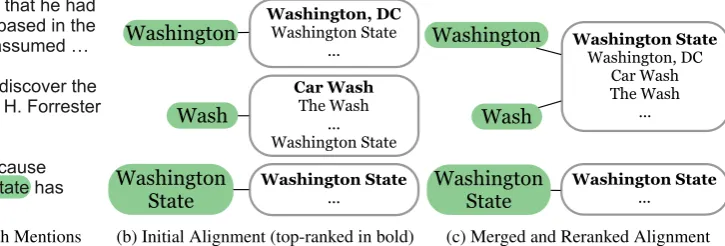
…about navigation charts that he had ordered from a company based in the state of Washington. He assumed …
…opened one of them to discover the absentee ballot of Steven H. Forrester of Bellevue, Wash….
...were not meaningful because counting in Washington State has been completed...
(a) Example Excerpts with Mentions
Washington, DC
Washington State ...
Car Wash
The Wash ... Washington State
Washington State
...
Washington
Wash
Washington State
(b) Initial Alignment (top-ranked in bold)
Washington State
Washington, DC Car Wash The Wash
...
Washington State
... Washington
Wash
Washington State
[image:5.595.176.539.77.200.2](c) Merged and Reranked Alignment
Figure 1: Example of Dynamic Alignment
paired with a top-ranked KB candidate: “Washing-ton”, “Wash”, and “Washington State”. For the first two mentions, clearly the top entity candidate is incorrect; hence approaches that rely on a fixed alignment will perform poorly. In particular, since “Washington State” mention is not compatible with the top-ranked entities of the first two mentions (Washington, D.C.andCar Washrespectively), ap-proaches that do not modify the ranking during inference may not resolve them. However, the cor-rect candidateWashington Statedoes appear in the candidate entities of the first two mentions, albeit with a lower rank. In our approach, clustering the first two mentions causes the shared candidate Washington Stateto move to the top of the list. The coreference system is now able to easily identify that the “Washington State” mention is compati-ble with theWashington Stateentity formed by the previous two mentions, providing evidence that the final mention should be clustered with either of them in subsequent comparisons.
4 Experiments
4.1 Setup
We evaluate our system on the ACE 2004 anno-tated dataset (Doddington et al., 2004). Following the setup in Bengston and Roth (2008), we split the corpus into training, development, and test sets, resulting in 268 documents in the train set, 107 documents in the test set, and 68 documents in the development set. The data is processed using stan-dard open source tools to segment the sentences and tokenize the corpus, and using the OpenNLP2 tagger to obtain the POS tags. The hyperparame-ters of our system, such as regularization, initial number of candidates, and the number of
compar-2http://opennlp.apache.org/
isons during training (kin Section 2.3) are tuned on the development data when trained on the train set. The models we use to evaluate on the test data set are trained on the training and development sets, following the standard evaluation for coreference first used by Culotta et al. (2007).
To provide the initial ranked list of entity candi-dates from Wikipedia, we query theKB Bridge sys-tem (Dalton and Dietz, 2013) with the proper name mentions. KB Bridgeis an information-retrieval-based entity linking system that connects the query mentions to Wikipedia entities using a sequential dependence model. This system has been shown to match or outperform the top performing systems in the 2012 TAC KBP entity linking task.
4.2 Methods
Our experiments investigate a number of baselines that are similar or identical to existing approaches.
Wikipedia Linking: As a simple baseline, we directly evaluate the quality of the alignment for coreference by merging all pairs of proper noun mentions that share at least one common candi-date, as perKB bridge. Further, the non-pronoun mentions are linked to these proper nouns if the mention string matches any of the entity titles or anchor texts.
Bengston and Roth (2008): A pairwise corefer-ence model containing a rich set of features, as de-scribed and evaluated in Bengston and Roth (2008).
Baseline: Our implementation of a pairwise model that is similar to the approach in Bengston and Roth (2008) with the differences described in Section 2. This is our baseline system that performs coreference without the use of external knowledge. Incidentally, it outperforms Bengston and Roth (2008).
described in Section 3, in which the list of candi-dates associated with each mention is reranked and modified during inference.
Static linking: Identical todynamic linking ex-cept that entity candidate lists are not merged dur-ing inference (i.e., Algorithm 1 without line 17). This approach is comparable to the fixed alignment model, as in the approaches of Ponzetto and Strube (2006) and Ratinov and Roth (2012).
4.3 Results
As in Bengston and Roth (2008), we evaluate our system primarily using the B3metric (Bagga and
Baldwin, 1998), but also include pairwise, MUC and CEAF(m) metrics. The performance of our systems on the test data set is shown in Table 2. These results use true mentions provided in the dataset, since, as suggested by Ng (2010), corefer-ence resolvers that use different mention detectors (extraction from parse tree, detector trained from gold boundaries, etc.) should not be compared.
Our baseline system outperforms Bengston and Roth (2008) by0.32B3F1 points on this data set.
Incorporating Wikipedia and anchor text informa-tion from the web with a fixed alignment (static linking) further improves our performance by0.54
B3 F1 points. Using dynamic linking, which
im-proves the alignment during inference, achieves another0.55F1 point improvement, which is1.09
F1 above our baseline,1.41F1 above the current
best pairwise classification system (corresponding to an error reduction of7.4%), and0.4F1 above the
current state-of-art on this dataset (Stoyanov and Eisner, 2012). The improvement of the dynamic linking approach over our baselines is consistent across the various evaluation metrics.
5 Discussion
We also explore our system’s performance on sub-sets of the ACE dataset, and on the OntoNotes dataset.
5.1 Document Length
Coreference becomes more difficult as the number of mentions is increased since the number of pair-wise comparisons increases quadratically with the number of mentions. We observe this phenomenon in our dataset: the performance on the smallest third of the documents (when sorted according to number of mentions) is8.5-10%higher than on the
largest third of the documents, as per the B3metric.
55 10 15 20 25 30 35 40 45 50
0.6 0.8 1 1.2 1.4 1.6 1.8
Top X% of Docs by Number of Mentions
Im
p
ro
ve
m
en
t
o
ve
r
Ba
se
lin
e
Dynamic Linking
[image:6.595.328.503.62.201.2]Static Linking
Figure 2: Improvements on the topX%of
docu-ments ranked by the number of mentions.
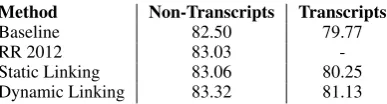
Method Non-Transcripts Transcripts
Baseline 82.50 79.77
RR 2012 83.03
-Static Linking 83.06 80.25
Dynamic Linking 83.32 81.13
Table 3: B3 F1 accuracy on transcripts and
non-transcripts from the ACE test data. RR 2012 only evaluate on non-transcripts.
However, we expect dynamic linking of entities to be more beneficial on these larger documents as our system can use the information from a larger number of mentions to improve the alignment dur-ing inference. Static linkdur-ing, on the other hand, is unlikely to obtain higher improvements with the larger number of mentions in the document as the alignment is fixed.
We perform the following experiment to analyze the performance with varying numbers of mentions. We sort all the documents in the test set according to their number of mentions, and evaluate on the top
X%of this list (whereXis10,33,40,50). As the
results demonstrate in Figure 2, the improvement of the static linking approach stays fairly even as
Xis varied. Even though the experiments suggest
that the larger documents are tougher to corefer-ence,3dynamic linking provides higher improve-ments when the docuimprove-ments contain a larger number of mentions.
5.2 Performance on Transcripts
[image:6.595.320.514.257.309.2]Method P / RPairwise F1 P / RMUC F1 P / RCEAF F1 P / RB3 F1
Culotta et al. (2007) - - - 86.7 73.2 79.3
Raghunathan et al. (2010) 71.6 46.2 56.1 80.4 71.8 75.8 - - 86.3 75.4 80.4
Stoyanov and Eisner (2012) - - - 80.1 - - - 81.8
Wiki-linking 64.15 14.99 24.30 74.41 28.39 41.10 58.54 58.4 58.47 92.89 57.21 70.81
Bengston and Roth (2008) - - 82.7 69.9 75.8 - - 88.3 74.5 80.8
[image:7.595.65.536.62.172.2]Baseline 66.56 47.07 55.14 82.84 72.02 77.05 75.58 75.40 75.49 87.02 75.97 81.12 Static Linking 82.53 40.80 54.61 88.39 66.93 76.18 75.33 75.35 75.44 93.10 72.72 81.66 Dynamic Linking 72.20 47.40 57.23 85.07 72.02 78.01 76.55 76.37 76.46 89.37 76.12 82.21
Table 2: Evaluation on the ACE test data, with the system trained on the train and development sets.
0 0.2 0.4 0.6 0.8 1 1.2 1.4
Im
p
ro
ve
m
en
t
o
ve
r
Ba
se
lin
e
non-trans
non-trans transcripts
Static Linking Dynamic Linking trans
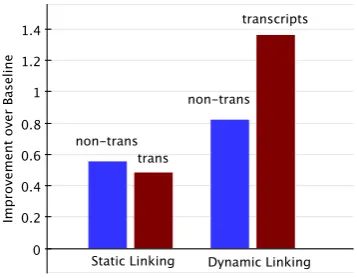
Figure 3: Comparison on the transcripts data.
ACE contains a large number of broadcast news documents, many of which consist of transcribed data containing noise in the form of incomplete sentences and disfluencies. Since these transcripts provide an additional challenge for alignment and coreference, Ratinov and Roth (2012) only use the set of non-transcripts for their evaluation.
Using dynamic linking and a large set of surface string variations, our approach may be able to pro-vide an improvement even on the transcripts. To identify the transcripts in the test set, we use the approximation from Ratinov and Roth (2012) that considers a document to be non-transcribed if it contains proper noun mentions and at least a third of those start with a capital letter. The performance is shown in Table 3, while the improvement over our baseline is shown in Figure 3.
Our static linking matches the performance of Ratinov and Roth (2012) on the non-transcripts. Further, the improvement of static linking on the transcripts over the baseline is lower than that on the non-transcript data, suggesting that noisy men-tions and text result in poor quality alignment. Dy-namic linking, on the other hand, not only outper-forms all other systems, but also shows a higher im-provement over the baseline on the transcripts than
on non-transcripts. This indicates that dynamic linking approach is robust to noise, and its wider variety of surface strings and flexible alignments are especially useful for transcripts.
5.3 OntoNotes
We also run our systems on the OntoNotes dataset, which was used for evaluation in CoNLL 2011 Shared Task (Pradhan et al., 2011). The dataset consists of2083documents from a much larger
va-riety of genres, such as conversations, magazines, web text, etc. Further, the dataset also consists of mentions that refer to events, most of which do not appear as Wikipedia pages. Since only the non-singleton mentions are annotated in the training set, we also include additional noun phrase mentions during training. We obtain B3F1 of 65.3, 67.6, and
67.7 for our baseline, static linking, and dynamic linking respectively.4 When compared to the par-ticipants of the closed task, the dynamic linking system outperforms all but two on this metric, sug-gesting that dynamic alignment is beneficial even when the features have not been engineered for events or for different genres.
6 Related Work
Within-document coreference has been well-studied for a number of years. A variety of ap-proaches incorporate linguistic knowledge as rules iteratively applied to identify the chains, such as Haghighi and Klein (2009), Raghunathan et al. (2010), Stoyanov et al. (2010). Alternatively (and similar to our approach), others represent this knowledge asfeaturesin a machine learning model. Early applications of such models include Soon et al. (2001), Ng and Cardie (2002) and (Bengston and Roth, 2008). There are also a number of tech-niques that represent entities explicitly (Culotta et
[image:7.595.93.272.221.360.2]al., 2007; Wick et al., 2009; Haghighi and Klein, 2010; Stoyanov and Eisner, 2012).
This work is an extension of recent approaches that incorporate external knowledge sources to im-prove within-document coreference. Ponzetto and Strube (2006) identify Wikipedia candidates for each mention as a preprocessing step, and incor-porate them as features in a pairwise model. Our method differs in that we draw such features from entity candidates during inference, and also main-tain and update a set of candidate entity links instead of selecting only one. Rahman and Ng (2011) introduce similar features from a more ex-tensive set of knowledge sources (such as YAGO and FrameNet) into a cluster-based model whose features change as inference proceeds. However, the features for each cluster come from a combina-tion of all entities aligned to the cluster mencombina-tions. We improve upon this approach by maintaining a list of the candidate entities for each mention clus-ter, modifying this list during the course of infer-ence, and using features from only the top-ranked candidate at any time. Further, they do not provide a comparison on a standard dataset.
Ratinov and Roth (2012) extend the multi-sieve coreference model (Raghunathan et al., 2010) by identifying at most a single candidate for each men-tion, and incorporating high-precision attributes extracted from Wikipedia. The high-precision mention-candidate pairings are precomputed and fixed; additionally, the features for an entity are based on the predictions of the previous sieves, thus fixed while a sieve is applied. With these restric-tions, they show improvements over the state-of-the-art on a subset of ACE mentions that are more easily aligned to Wikipedia, while our approach demonstrates improvements on the complete set of mentions including the tougher to link mentions from the transcripts.
There are a number of approaches that provide an alignment from mentions in a document to Wikipedia. Wikifier (Ratinov et al., 2011) analyzes the context around the mentions and the entities jointly, and was used to align mentions for corefer-ence in Ratinov and Roth (2012). Dalton and Dietz (2013) introduce an approximation to the above ap-proach, but incorporate retrieval-based supervised reranking that provides multiple candidates and scores; this approach performed competitively on previous TAC-KBP entity linking benchmarks (Di-etz and Dalton, 2012). Alignment to an external
knowledge-base has improved performance for a number of NLP and information extraction tasks, such as named-entity recognition (Cucerzan, 2007; Han and Zhao, 2009), cross-document corefer-ence (Finin et al., 2009; Singh et al., 2010), and relation-extraction (Riedel et al., 2010; Hoffmann et al., 2011).
7 Conclusions
In this paper, we incorporate external knowledge to improve within-document coreference. Instead of fixing the alignmenta priori, our approach main-tains a ranked list of candidate entities for each mention, and merges and reranks the list during inference. Further, we consider a large set of sur-face string variations for each entity by using an-chor texts from the web. These external sources allow our system to achieve a new state-of-the-art on the ACE data. We also demonstrate improve-ments on docuimprove-ments that are difficult for alignment and coreference, such as transcripts and documents containing a large number of mentions.
A number of possible avenues for future study are apparent. First, our alignment to a knowledge-base can benefit from more document-aware link-ing to entities, such as the Wikifier (Ratinov et al., 2011). Second, we would like to augment mention features with additional information available from the knowledge base, such as Wikipedia categoriza-tion and gender attributes. We also want to investi-gate a cluster ranking model, as used in (Rahman and Ng, 2011; Stoyanov and Eisner, 2012), to ag-gregate the features of all the coreferent mentions as inference progresses.
Acknowledgments
References
Amit Bagga and Breck Baldwin. 1998. Algorithms for scoring coreference chains. In International Conference on Language Resources and Evaluation
(LREC) Workshop on Linguistics Coreference, pages
563–566.
Collin F. Baker, Charles J. Fillmore, and John B. Lowe. 1998. The berkeley framenet project. In Proceed-ings of the 36th Annual Meeting of the Associa-tion for ComputaAssocia-tional Linguistics and 17th International Conference on Computational Linguistics
-Volume 1, ACL ’98, pages 86–90, Stroudsburg, PA,
USA. Association for Computational Linguistics.
Eric Bengston and Dan Roth. 2008. Understanding the value of features for coreference resolution. In
Empirical Methods in Natural Language Processing
(EMNLP).
Kurt Bollacker, Colin Evans, Praveen Paritosh, Tim Sturge, and Jamie Taylor. 2008. Freebase: a collab-oratively created graph database for structuring hu-man knowledge. In Proceedings of the 2008 ACM SIGMOD international conference on Management
of data, SIGMOD ’08, pages 1247–1250, New York,
NY, USA. ACM.
Silviu Cucerzan. 2007. Large-scale named entity dis-ambiguation based on Wikipedia data. InEmpirical
Methods in Natural Language Processing (EMNLP),
pages 708–716.
Aron Culotta, Michael Wick, and Andrew McCallum. 2007. First-order probabilistic models for corefer-ence resolution. InNorth American Chapter of the Association for Computational Linguistics - Human
Language Technologies (NAACL HLT).
Jeffrey Dalton and Laura Dietz. 2013. A neighbor-hood relevance model for entity linking. In Open Research Areas in Information Retrieval (OAIR).
Laura Dietz and Jeffrey Dalton. 2012. Across-document neighborhood expansion: UMass at TAC KBP 2012 entity linking. In Text Analysis Confer-ence (TAC).
G. Doddington, A. Mitchell, M. Przybocki, L. Ramshaw, S. Strassel, and R. Weischedel. 2004. The Automatic Content Extraction (ACE) program–tasks, data, and evaluation. In
Pro-ceedings of LREC, volume 4, pages 837–840.
Citeseer.
Tim Finin, Zareen Syed, James Mayfield, Paul Mc-Namee, and Christine Piatko. 2009. Using Wiki-tology for cross-document entity coreference resolu-tion. In AAAI Spring Symposium on Learning by
Reading and Learning to Read.
Aria Haghighi and Dan Klein. 2009. Simple corefer-ence resolution with rich syntactic and semantic fea-tures. InEmpirical Methods in Natural Language
Processing (EMNLP), pages 1152–1161.
Aria Haghighi and Dan Klein. 2010. Coreference reso-lution in a modular, entity-centered model. InNorth American Chapter of the Association for Computa-tional Linguistics - Human Language Technologies
(NAACL HLT), pages 385–393.
Xianpei Han and Jun Zhao. 2009. Named entity disam-biguation by leveraging Wikipedia semantic knowl-edge. InConference on Information and Knowledge
Management (CIKM), pages 215–224.
Raphael Hoffmann, Congle Zhang, Xiao Ling, Luke Zettlemoyer, and Daniel S. Weld. 2011. Knowledge-based weak supervision for information extraction of overlapping relations. InAnnual Meet-ing of the Association for Computational LMeet-inguis-
Linguis-tics (ACL), pages 541–550, Portland, Oregon, USA,
June. Association for Computational Linguistics. Heeyoung Lee, Yves Peirsman, Angel Chang,
Nathanael Chambers, Mihai Surdeanu, and Dan Jurafsky. 2011. Stanford’s multi-pass sieve coreference resolution system at the CoNLL-2011 shared task. In Conference on Computational
Natural Language Learning (CoNLL), pages 28–34.
Association for Computational Linguistics.
Vincent Ng and Claire Cardie. 2002. Improving ma-chine learning approaches to coreference resolution.
InAnnual Meeting of the Association for
Computa-tional Linguistics (ACL), pages 104–111.
Vincent Ng. 2010. Supervised noun phrase corefer-ence research: the first fifteen years. InProceedings of the 48th Annual Meeting of the Association for
Computational Linguistics, ACL ’10, pages 1396–
1411, Stroudsburg, PA, USA. Association for Com-putational Linguistics.
Simone Paolo Ponzetto and Michael Strube. 2006. Exploiting semantic role labeling, WordNet and Wikipedia for coreference resolution. In North American Chapter of the Association for Computa-tional Linguistics - Human Language Technologies
(NAACL HLT), pages 192–199.
Sameer Pradhan, Lance Ramshaw, Mitchell Marcus, Martha Palmer, Ralph Weischedel, and Nianwen Xue. 2011. CoNLL-2011 shared task: Modeling unrestricted coreference in ontonotes. In Confer-ence on Computational Natural Language Learning
(CoNLL), pages 1–27.
Karthik Raghunathan, Heeyoung Lee, Sudarshan Ran-garajan, Nathanael Chambers, Mihai Surdeanu, Dan Jurafsky, and Christopher Manning. 2010. A multi-pass sieve for coreference resolution. InEmpirical
Methods in Natural Language Processing (EMNLP),
pages 492–501. Association for Computational Lin-guistics.
Altaf Rahman and Vincent Ng. 2011. Coreference resolution with world knowledge. InAnnual Meet-ing of the Association for Computational LMeet-inguis-
Linguis-tics (ACL), pages 814–824, Portland, Oregon, USA,
L. Ratinov and D. Roth. 2012. Learning-based multi-sieve co-reference resolution with knowledge. In
Empirical Methods in Natural Language Processing
(EMNLP).
L. Ratinov, D. Roth, D. Downey, and M. Anderson. 2011. Local and global algorithms for disambigua-tion to wikipedia. InAnnual Meeting of the Associa-tion for ComputaAssocia-tional Linguistics (ACL).
Sebastian Riedel, Limin Yao, and Andrew McCallum. 2010. Collective cross-document relation extraction without labelled data. InEmpirical Methods in
Nat-ural Language Processing (EMNLP).
Sameer Singh, Michael L. Wick, and Andrew McCal-lum. 2010. Distantly labeling data for large scale cross-document coreference. Computing Research
Repository (CoRR), abs/1005.4298.
Wee Meng Soon, Hwee Tou Ng, and Daniel Chung Yong Lim. 2001. A machine learning ap-proach to coreference resolution of noun phrases.
Computational Linguistics, 27(4):521–544, Dec.
Valentin I. Spitkovsky and Angel X. Chang. 2012. A cross-lingual dictionary for english wikipedia con-cepts. InInternational Conference on Language
Re-sources and Evaluation (LREC).
Veselin Stoyanov and Jason Eisner. 2012. Easy-first coreference resolution. In Computational Linguis-tics (COLING).
Veselin Stoyanov, Claire Cardie, Nathan Gilbert, Ellen Riloff, David Buttler, and David Hysom. 2010. Coreference resolution with reconcile. In Annual Meeting of the Association for Computational
Lin-guistics (ACL), pages 156–161, Stroudsburg, PA,
USA. Association for Computational Linguistics.
Fabian M. Suchanek, Gjergji Kasneci, and Gerhard Weikum. 2007. Yago: a core of semantic knowl-edge. InProceedings of the 16th international
con-ference on World Wide Web, WWW ’07, pages 697–
706, New York, NY, USA. ACM.
Michael Wick, Aron Culotta, Khashayar Rohani-manesh, and Andrew McCallum. 2009. An entity-based model for coreference resolution. InSIAM