Modelling Discourse Relations for Arabic
Amal Alsaif University of Leeds
Leeds, UK LS2 9JT
Katja Markert University of Leeds
Leeds, UK LS2 9JT
Abstract
We present the first algorithms to automat-ically identify explicit discourse connectives and the relations they signal for Arabic text. First we show that, for Arabic news, most adjacent sentences are connected via explicit connectives in contrast to English, making the treatment of explicit discourse connectives for Arabic highly important. We also show that explicit Arabic discourse connectives are far more ambiguous than English ones, making their treatment challenging. In the second part of the paper, we present supervised al-gorithms to address automatic discourse con-nective identification and discourse relation recognition. Our connective identifier based on gold standard syntactic features achieves almost human performance. In addition, an identifier based solely on simple lexical and automatically derived morphological and POS features performs with high reliability, essen-tial for languages that do not have high-quality parsers yet. Our algorithm for recognizing dis-course relations performs significantly better than a baseline based on the connective sur-face string alone and therefore reduces the am-biguity in explicit connective interpretation.
1 Introduction
The automatic detection of discourse relations, such as causal, contrast or temporal relations, is useful for many applications such as automatic summarization (Marcu, 2000), question answering (Girju, 2003), sentiment analysis (Somasundaran et al., 2008) and readability assessment (Pitler and Nenkova, 2008). This task has recently seen renewed interest due to
the growing availability of large-scale corpora anno-tated for discourse relations, such as the Penn Dis-course Treebank (Prasad et al., 2008a).
In the Penn Discourse Treebank (PDTB), lo-cal discourse relations (also lo-calledsenses) such as CAUSAL or CONTRAST are annotated. They hold between two text segments (so-called arguments) that express abstract entities such as events, facts and propositions. Annotated discourse relations can be signalled explicitly by so-called discourse connec-tives(Marcu, 2000; Webber et al., 1999; Prasad et al., 2008a) or hold implicitly between adjacent sen-tences in the same paragraph, i.e. are not signalled by a specific surface string. In Ex. 1, the connec-tivewhileindicates an explicit CONTRASTbetween the attitudes of John and Richard. In Ex. 2, the con-nectivewhileindicates an explicit TEMPORAL rela-tion. In Ex. 3, an implicit CAUSALrelation between the first and second sentence holds. We indicate dis-course connectives and the two arguments they re-late via annotated square brackets.
(1) [John liked adventure,]Arg2 [ while]DC[Richard
was cautious]Arg2
(2) [The children were crying loudly]Arg1[while]DC,[their mother was
cooking]Arg2
(3) [I cannot eat any dessert.]Arg1[I have eaten far too much already.]Arg2
Although similar corpora for other languages are being developed such as for Hindi (Prasad et al., 2008b), Turkish (Zeyrek and Webber, 2008), Chi-nese (Xue, 2005) and, by ourselves, for Arabic
Saif and Markert, 2010), efforts in the automated recognition of discourse connectives, arguments and relations have so far almost exclusively centered on English.
In contrast we present the first models for dis-course relations for Arabic, focusing on explicit con-nectives. This focus is partially justified by the fact that this first study for a new language should cen-ter on the superficially more straightforward case and that no annotations for implicit relations are yet available for Arabic. More importantly, however, we make two essential claims (Section 4). Firstly, Arabic discourse connectives are more ambiguous than their English counterparts, i.e cases such as whilewhich can signal different relations dependent on context (see Example 1 and 2) are far more fre-quent. This makes their treatment morechallenging. Secondly, discourse relations between adjacent sen-tences in Arabic tend to be expressed via an explicit connective, at least for the news genre, i.e. cases such as Example 3 are rarer. This makes the treat-ment of explicit connectivesessential.
We tackle two tasks for explicit Arabic connec-tives in this paper, which are further discussed in Section 2. Discourse connective recognition needs to distinguish between discourse usage of potential connectives and non-discourse usage (such as the use ofwhile as a noun). We show in Section 5 that we can distinguish discourse- and non-discourse us-age for potential connectives in Arabic with very high reliability, even without parsed data, a fact that is important for languages with fewer high quality NLP tools available. We then present an algorithm for relation identification in Section 6 that shows small but significant gains over assigning the most frequent relation for each connective. We discuss future work and conclude in Section 7.
2 The Tasks
The handling of explicit connectives can be split into three tasks (Pitler and Nenkova, 2009). The first task of discourse connective recognition distinguishes between thediscourse usage and non-discourse us-ageof potential connectives. Whereas some poten-tial connectives such as the Arabic connective
áºË
/lkn/butalmost always have discourse usage, this isnot true for all potential connectives.1 Thus, the dis-course usage of Arabic
éJ.
«P
/r˙gbh/desire needs to be distinguished from its use as a noun. Conjunc-tions such asð
/w/and,ð@
/¯aw/orcan have discourse usage or just conjoin two non-abstract entities as inèPA ð QÔ«
/,mr w s¯arh/Omar and Sarah.The second task isdiscourse connective interpre-tationwhere a discourse connective in context is as-signed a discourse relation. Again, some connec-tives are largely unambiguous in this respect. For example,
áºË
/lkn/butsignals almost always a CON -TRAST relation. However, there are connectives where this is not the case, such asY JÓ
/mnd¯/since which has a CAUSALand a TEMPORALsense.
The third task is argument identification which identifies the arguments’ position and extent. In this paper we tackle Task 1 and Task 2 for Arabic in a supervised machine learning framework.
3 Related work
Annotated Discourse Corpora and Linguistic Background. Discourse relations are widely stud-ied in theoretical linguistics (Halliday and Hasan, 1976; Hobbs, 1985), where also different relation taxonomies have been derived (Hobbs, 1985; Knott and Sanders, 1998; Mann and Thompson, 1988; Marcu, 2000). Different inventories have been used in English corpora annotated for discourse relations (Hobbs, 1985; Prasad et al., 2008a; Carlson et al., 2002) which also differ in other respects (such as whether they prescribe a tree structure for discourse annotation). However, the annotation level of ex-isting Arabic corpora has not yet included the dis-course layer, making our work the first to address this problem for Arabic on a larger scale.
Automatic discourse parsing: explicit relations. There is no work on discourse connective recog-nition, interpretation and argument assignment for Arabic, so that we break entirely new ground here. However, the two tasks we explore (discourse con-nective recognition and discourse concon-nective disam-biguation) have been tackled for English.2 (Pitler 1Arabic examples contain in order: the Arabic right-to-left script, the transliteration (standards ISO/R 233 and DIN 31635) and the English translation (if possible).
and Nenkova, 2009) use gold standard syntactic fea-tures as well as the connective surface string in a supervised model for discourse connective recogni-tion. They achieve very high results with this ap-proach. We will (i) show that similar features work well for Arabic (ii) take into account Arabic-specific morphological properties that improve results fur-ther and (iii) present a robust version of this ap-proach that does not rely on full parsing or gold stan-dard syntactic annotations.
With regard to discourse connective interpreta-tion, (Miltsakaki et al., 2005) concentrate on disam-biguating the three connectives since, while, when only, using a very small set of features indicating tense and temporal markers in arguments. They achieve good improvements over a “most frequent relation per connective” baseline. A more compre-hensive study on all discourse connectives in the PDTB (Pitler et al., 2008; Pitler and Nenkova, 2009) reveals that most connectives are not ambiguous in English. Using syntactic features of the connec-tive, they achieve only a very small improvement over a “most frequent relation per connective base-line” for which significance tests are not given. We will show that for Arabic, discourse connectives are more highly ambiguous with regard to the relations they convey. We will present a supervised learning model that uses a wider feature set and that achieves small but significant improvements over the most frequent relation per connective baseline.
Automatic discourse parsing: implicit relations. Implicit relations have excited substantial interest for English. This includes work in the frame-work of RST (Soricut and Marcu, 2003; duVerle and Prendinger, 2009; Marcu and Echihabi, 2002), SDRT (Baldridge and Lascarides, 2005), Graph-Bank (Wellner et al., 2006), the PDTB (Blair-Goldensohn et al., 2007; Pitler et al., 2009; Lin et al., 2009; Wang et al., 2010; Zhou et al., 2010; Louis and Nenkova, 2010) or framework-independent (Sporleder and Lascarides, 2008).3 The task is challenging as implicits behave substantially differently from explicits (Sporleder and Lascarides,
but we do not discuss this work in depth here.
3Some work does not make the distinction between implicit and explicit and/or treats them in a joint framework (Soricut and Marcu, 2003; Wellner et al., 2006; Wang et al., 2010).
2008) and often need world knowledge (Lin et al., 2009). However, features/approaches that have shown improvement over a baseline are word pairs (Sporleder and Lascarides, 2008), production rules and syntactic trees (Wang et al., 2010; Lin et al., 2009) as well as language modelling (Zhou et al., 2010). As we only deal with explicit connectives this work is not directly comparable to ours, al-though we do explore some of the suggested features for improving explicit connective disambiguation.
4 An Arabic Discourse Corpus
We annotate news articles from the Arabic Penn Treebank (Part 1 v2.0) (Maamouri and Bies, 2004) for explicitly marked discourse relations. This is the first discourse-annotated corpus for Arabic, whose initial development stages we have described in (Al-Saif and Markert, 2010). We summarize this previ-ous work and extend it by including agreement stud-ies for arguments in Sections 4.1 and 4.2. In Sec-tions 4.3, 4.4 and 4.5. we then present a corpus study on the corpus which shows our major claim as to the importance and high levels of ambiguity of Arabic discourse connectives.
4.1 Annotation Principles
We overall follow the annotation principles in the Penn Discourse Treebank for explicit connectives (for example, arguments can occur at any distance from the connectives). The relation set we use is a more coarse-grained version of the PDTB rela-tions with two relarela-tions added — BACKGROUND and SIMILARITY — that we found in our Arabic news texts. The final, hierarchically organized, re-lation set of 17 discourse rere-lations is shown in Fig 1. Further adaptations necessary for Arabic are the inclusion of clitics as connectives such as
È
/l/for,H.
/b/by,withand¬
/f/then. In addition, differently to English, prepositions were included as connectives as these are frequently used to express discourse re-lations in Arabic. In these cases, normally argument 2 is the so-calledAl-Masdar.4Typical examples areÈñð
/ws.wl/arrival from the verbÉð
/ws./to ar-riveandéËðAm×
/mh.¯awlh/attemptfrom the verbÈðAg
Figure 1: Discourse relations for Arabic
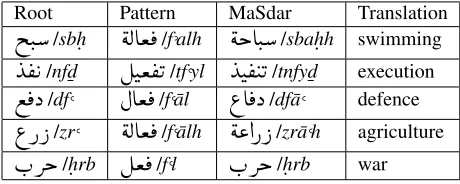
/h.¯awl/to try. Al-Masdar is formed using morpho-logical patterns well-known in the Arabic grammat-ical tradition: major Arabic grammars list around 60 patterns although some other references also claim that the patterns are many more as well as more un-predictable (Abdl al latif et al., 1997; Wright, 2008; Ryding, 2005). Al-Masdar forms do not fit into one grammatical or morphological category in English: they might correspond to a gerund, a nominalization or a noun which is not a nominalization. Some ex-amples are listed in Table 1.
Table 1: A list of Al-MaSdar patterns, examples and their English correspondence
Root Pattern MaSdar Translation
iJ.
/sbh.éËAª
¯
/f-alhékAJ.
/sbah.h swimmingY
® K
/nfd¯ÉJª
®K
/tf,ylYJ
® JK
/tnfyd¯ execution©
¯X
/df,ÈAª
¯
/f,¯al¨A
¯X
/df¯a, defence¨P P
/zr,éËAª
¯
/f,¯alhé«@P P
/zr¯a,h agricultureH.Qk
/h.rbɪ
¯
/f,lH.Qk
/h.rb warAn example of Al-MaSdar as argument of a dis-course relation is Ex. 4, where
©JÊJ.K
/tbly˙g/informing is theAl-MaSdarform of©ÊK.
/bl˙g/inform.(4)
à@Y® ¯ á« ©JÊJ.J
Ë]
DC[È]
Arg1[
é£QåË@ Q»QÓ úÍ@ A JJ.ë
X]
Arg2
[
éJÖÞ QË@
é»QåË@
KAKð
[d¯hbn¯a ’l¯a mrkz al-ˇsrt.t.]Arg1[l]DC[ltbly˙g ,n fqd¯an wt
¯¯a-iq alˇsrkh alrsmyh]Arg2
[We went to the police station]Arg1 [for]DC
[in-forming about the loss of the company’s official documents.]Arg2
4.2 Agreement Studies
The occurrences of a precompiled list of 107 po-tential discourse connectives were annotated inde-pendently by 2 native Arabic speakers on 537 news texts. Agreement was measured for the distinction of discourse vs. non-discourse usage, relation as-signment and argument asas-signment.
Agreement for the classification tasks of dis-course connective recognition and relation assign-ment was measured using kappa (Siegel and Castel-lan, 1956). Argument agreement was measured by
agr, a directional measure (Wiebe et al., 2005). It measures the word overlap between the text spans of two judges (ann1 and ann2). agr(ann1||ann2)
measures the proportion of words ann1 annotated that were also annotated by ann2.
agr(ann1||ann2) =|ann1matching ann2| |ann1|
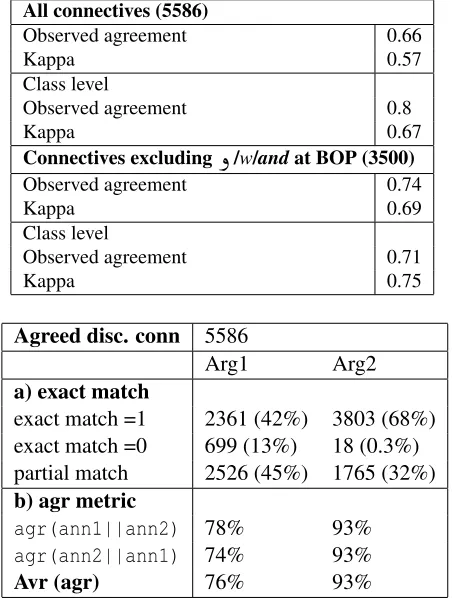
Discourse connective recognition proved to be highly reliable with percentage agreement of 0.95 and a kappa of 0.88 on the 23,331 occurrences of the 107 potential discourse connectives. 5586 of the potential connectives were agreed on by both anno-tators to have discourse usage and agreement for re-lations and argument assignment was measured on these. As shown in Table 2, kappa on all 17 relations was low with 0.57 — it turned out that this was due to the frequent, almost rhetorical use of the connec-tive
ð
/w/andat the beginning of paragraphs, which is a genre convention for Arabic news that normally does not convey a specific discourse relation. Disre-garding such occurrences ofð
/w/and, kappa rises to good agreement: 0.69 for fine-grained relations and 0.75 when measuring agreement between the 4 ma-jor relations EXPANSION, CONTINGENCY, COM -PARISONand TEMPORAL. [image:4.612.71.301.488.580.2]Table 2: Inter-annotator reliability for discourse relation assignment
All connectives (5586)
Observed agreement 0.66
Kappa 0.57
Class level
Observed agreement 0.8
Kappa 0.67
Connectives excluding
ð
/w/andat BOP (3500)Observed agreement 0.74
Kappa 0.69
Class level
Observed agreement 0.71
Kappa 0.75
Agreed disc. conn 5586
Arg1 Arg2
a) exact match
exact match =1 2361 (42%) 3803 (68%) exact match =0 699 (13%) 18 (0.3%) partial match 2526 (45%) 1765 (32%) b) agr metric
agr(ann1||ann2) 78% 93%
agr(ann2||ann1) 74% 93%
Avr (agr) 76% 93%
Table 3: Inter-annotator reliability for arguments Arg1 and Arg2, using two different measurements (a) exact match (b)agr
4.3 Gold standard
We produced a unified gold standard. First, we auto-matically corrected easily made annotator mistakes. With regard to argument extent, we automatically corrected mistakes such as the erroneous inclusion of punctuation marks at the end of clauses/sentences or not including all obligatory complements in a verb phrase argument. The latter relied on the syn-tactic annotation in the ATB. Second, with regard to discourse relation assignment, we automatically as-signed EXPANSION.CONJUNCTIONto all disagreed instances of
ð
/w/and at BOP.5 A further disam-biguation study is necessary forð
/w/and at BOP, which is beyond the scope of this paper.Finally, an adjudicator not initially involved in an-notation reconciled the remaining disagreements at
5Other instances of
ð
/w/andare not treated this way.all levels and included annotations for 5 new po-tential discourse connective types not in our initial connective list but commented on by the annotators during annotation. 3 news files were removed from the corpus — they contained no actual news reports but just a list of headlines.
The final discourse treebank we use has 6328 an-notated explicit connectives in 534 files. 68 connec-tive types were found, rising to 80 connecconnec-tive types if we include all modified forms of a connective as distinct types such as
áÓ Ñ «QËAK.
/b¯alr˙gm mn,à@ Ñ «P
/r˙gm ¯anas modified forms ofÑ
«P
/r˙gm/although.Most discourse connectives were only annotated with a single relation but 5% were annotated with two or more relations (as also allowed in the PDTB). These statistics are summarised in Table 4.
Files 534
Total tagged tokens 126,046 (125KB)
Sentences 3607
Paragraphs 3312
Discourse connectives (tokens) 6328 Distinct connective (types) 68 including modifed form
con-nectives 80
Clitic discourse connectives (to-kens)
4779 (76%) Non-clitic discourse
connec-tives (tokens) 1549(24%) Relations types (17 single, 38
combined) 55
[image:5.612.321.532.292.545.2]Single relations (tokens) 6039 (95%) Combined relations (tokens) 289 (5%)
Table 4: Statistics of the final gold standard corpus
(12%) were linked by an explicit connective.6 In contrast, out of the 3073 adjacent sentence pairs in our corpus, 2140 (70%) were linked by an explicit connective, 948 (30%) were linked via non-wa con-nectives. Thus, for our corpus, modeling of explicit connectives is primary: intrasentential relations tend to be marked by connectives anyway in both English and Arabic, and our corpus shows that this is true for most local intersentential relations as well.
4.5 Ambiguity for Arabic discourse connectives We investigate the ambiguity of Arabic connectives with regard to their sense at class level (4 relations) as well as the more fine-grained level (all 17 rela-tions). We restrict our investigation to the connec-tive occurrences that were annotated with a single relation (6039 tokens) and also exclude
ð
/w/andat the beginning of paragraph, leaving 3813 tokens.7 Of 80 connective types, 52 were unambiguous at the class level and 47 at the fine-grained level. However, many of the most frequent connectives are highly ambiguous. If we just assign the most frequent read-ing to each of the 3813 connectives, we achieve an accuracy of 82.7% at the class-level and 74.3% at the more fine-grained level for relation assignment, leaving a substantial error margin. This contrasts with the English PDTB, where at the class-level 92% can be achieved with this simple method and 85% at the second-level.85 Discourse Connective Recognition
We distinguished discourse vs. non-discourse usage for all potential connectives in the 534 gold stan-dard files. As headers and footers in the news files never contained true discourse connectives, we dis-regarded these, leaving 20,312 potential discourse connectives of which 6328 are actual connectives.
6Connections between subclauses or phrases in different, adjacent sentences were included in the count.
7We automatically assigned CONJUNCTIONto many occur-rences of
ð
/w/andat BOP (Section 4.3) so that it is not sensible to include these occurrences in a study of human-assigned am-biguity.8The second level in the PDTB with its 16 relations corre-sponds approximately to our fine-grained inventory. This com-parison can only be appropriate due to slight differences in the lower-grained relation inventory.
5.1 Features
Apart from the surface string of the potential con-nectiveConn, we use the following features. Fea-tures are either extracted from raw files tokenized by white space only (M2) or from raw files tok-enized by white space and tagged by the Stanford tagger9(Models M3, M4) or from the Arabic Tree-bank (ATB) gold standard part-of-speech and parse annotation (models M5-M9). The syntactic features (Syn) are inspired by (Pitler and Nenkova, 2009). Lexical/POS patterns of surrounding words, clitic features and Al-Masdar are novel.
Surface Features (SConn). These include the po-sition of the potential connective (sentence-initial, medial or final). Thetypeof the potential connective isSimplewhen the potential connective is a single token not attached to other tokens,PotCliticwhen it is attached. Potential connectives containing more than one token haveMoreThanTokentype.
Models where we use ATB or automated tagging (M3-M9) distinguish further between potential cli-tics that are assigned a POS and ones that are not. Models that use ATB annotation also distinguish between potential connectives that correspond to a phrase in the ATB (MorethanToken Phrase) and the ones that do not (MorethanToken NonPhrase). Lexical features of surrounding words (Lex). We encode the surface strings of the three words before and after the connective, recording posi-tion. These features are especially useful for lan-guages where no accurate parser or tagger is avail-able as lexical patterns can capture discourse and non-discourse usage. For instance, if a potential connective is followed by
à@
/¯an/ it most likely has a discourse function (see Ex. 5).(5) DC
[ ð ]
Arg1[
AëPBAK. @ñK.A
à@] áºÖß ÈA ®£B@ à@
@ñÓA JK ÕË @
X@
é@PYË@ ÈC g
Arg2[Aª JËAK. @ðQª
à@]
@YJk.
[ ¯an ¯al¯at.f¯al ymkn [¯an ys.¯abw¯ab¯al¯arh¯a-q]Arg1[w]DC[¯an yˇs,rw¯a b¯aln,¯as]Arg2 h
˘l¯al ¯aldr¯ash ¯ad
¯¯a lm yn¯amw¯a ˇgyd¯a
[Children might be tired]Arg1 [and]DC [feel
sleepy]Arg2during school time if they did not sleep
well
Part of Speech features (POS). We include the pos tag of the potential connective via the ATB/Stanford Tagger. For potential connectives that consist of more than one token, we combined its ordered POS tags. Thus, the potential connective
ÈAg ú
¯
/fy h.¯al/in case with its tags (fy PREP)(Hal NOUN)) will receive the pos PREP#NOUN. If a po-tential connective does not receive a separate POS tag in the ATB/tagger, the value ”NONE” is as-signed. This allows to distinguish clitics from let-ters at the start of a word. We also record the POS of the three words before/after the connective (ATB/Stanford Tagger). Similar to lexical patterns, these can capture discourse and non-discourse us-age. For instance, if a potential connective is soon followed by a modal, it is more likely to have a dis-course function.Syntactic category of related phrases (Syn). We record the syntactic category of the parent of the po-tential connective in ATB. For example, it is rare that cases where the parent of the potential connec-tive is an adjecconnec-tive phrase, correspond to discourse-usage. A typical example of a non-discourse usage of
ð
/w/and(éÊJÔg. ð
èQJ.»
éPYÖÏ@
/¯almdrsh kbyrh w ˇgmylh/ the school is very large and beautiful) illus-trates this. Unlike English, parents in Arabic often are noun phrases as nominalisations are frequent ar-guments of prepositional connectives. We also en-code the Left sibling category and right sibling cat-egory of the connective. For discourse connectives, the right sibling is normally S, SBAR, VP or an NP (if the connective is a preposition).Al-Masdar feature. Potential connectives fol-lowed by Al-Masdar are more likely to have dis-course usage (see Section 4.1). Especially preposi-tions with discourse usage are normally attached to Al-masdar such as in
éKXAjÖÏ
/lmh.¯adt¯h/for contacting or[email protected].
/b¯aˇgr¯a-/by processing. Al-Masdarinforma-tion is not included in the ATB so we constructed a binary Al-Masdar feature from (tagged) text by ex-amining the first noun after the potential connective. We developed an algorithm to judge such a noun as Al-Masdar or not. This algorithm uses a stemmer for Arabic and then determines whether the stem is al-Masdar by a combination of surface-based rules to check whether the stem corresponds to one of the known Al-Masdar patterns.
5.2 Results and Discussion
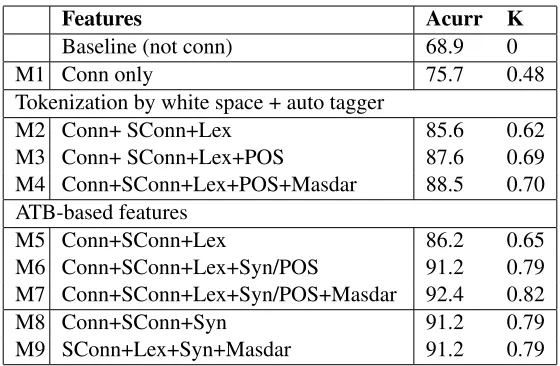
We used the implementation JRip of the rule-based classifier Ripper in the machine learning tool WEKA with its default settings. We used 10-fold cross-validation throughout. Significance tests are reported using the McNemar test at the significance level of 1%. A most frequent category baseline would assign all potential connectives asnot connec-tive, achieving an accuracy of 68.9% as only 6328 of our potential 20,312 connectives actually have dis-course usage. We built several models using differ-ent features. The results are shown in Table 5.
A simple model M1 that only uses the connective string improves significantly over the baseline with 75.7% accuracy but a kappa of only 0.48, showing that this is not a reliable strategy. Models M2-M4 do not rely on gold standard annotation or parsing (in contrast to the models for English in (Pitler and Nenkova, 2009)). Using only surface and lexical features that can be extracted from white-space to-kenized raw files in addition to the connective string (M2), gains a substantial improvement over using the connective string alone. This is further improved by using POS tags of connectives and surrounding words with an automatic tagger (M3) and by includ-ing the Al-Masdar feature (M4), thus makinclud-ing good use of the morphological properties of Arabic. All differences are statistically significant (M1<M2<
M3<M4). The final model is reliable (kappa 0.70), an encouraging result given the absence of parsing and important for resource-scarce languages.
With ATB gold standard tokenisation, tagging and parsing, our models (not surprisingly) improve fur-ther showing the same pattern of (M1<M5<M6<
M7) with all differences being significant. The final best model achieves highly reliable results (accuracy 92.4%, kappa 0.82). We also conclude that syntac-tic features are more useful than lexical patterns as model M8 (syntax with no lexical patterns) achieves equally good results as M6. Our models also man-age to generalise well over individual connectives. If we leave out the connective string (M9), we still achieve a highly reliable result.
6 Discourse Relation Recognition
Features Acurr K
Baseline (not conn) 68.9 0
M1 Conn only 75.7 0.48
Tokenization by white space + auto tagger
M2 Conn+ SConn+Lex 85.6 0.62
M3 Conn+ SConn+Lex+POS 87.6 0.69 M4 Conn+SConn+Lex+POS+Masdar 88.5 0.70 ATB-based features
M5 Conn+SConn+Lex 86.2 0.65
M6 Conn+SConn+Lex+Syn/POS 91.2 0.79 M7 Conn+SConn+Lex+Syn/POS+Masdar 92.4 0.82
M8 Conn+SConn+Syn 91.2 0.79
[image:8.612.166.446.55.238.2]M9 SConn+Lex+Syn+Masdar 91.2 0.79
Table 5: Performance of different models for identifying discourse connectives.
the connective are known. This is well-established for PDTB relation recognition (Wang et al., 2010; Lin et al., 2009; Miltsakaki et al., 2005). Our mod-els predict single relations on two datasets: (i) all instances of connectives signalling single relations (SetAll, 6039 instances) (2) all instances apart from the connective
ð
/w/andat beginning of paragraph as they are affected by the auto-correction process (Setno-wa-atBOP, 3813 instances). We use 10-fold cross-validation and JRip as well as a McNemar test at the 5% level for significance tests.6.1 Features
Whereas some of the features we use have been used for English implicit relation recognition (Lin et al., 2009; Wang et al., 2010; Pitler et al., 2009) , they are new for Arabic and not widely used for explicit connectives. All features are extracted from the ATB gold standard parses.
Connective features. This includes the connec-tive string Conn. In addition, we also use the sur-face connective features and POS of connective de-scribed in Section 5. We also use the syntactic path to the connective as a novel feature.
Words and POS of arguments. The words and pos tags of the first three words in Arg1 and Arg2 are used to catch patterns in arguments. For example, when the first word of Arg2 is
Y
¯
/qd/might/may oràA¿
/k¯an/had, the relation is likely to be EXPANSION.BACKGROUNDor EXPAN -SION.CONJUNCTION. We also measure wordover-lap between the arguments, hoping to catch relations such as COMPARISON.SIMILARITY.
Masdar. This feature states whether the first or second word in Arg 2 is an Al-Masdar. Many prepo-sitional connectives followed by an Al-Masdar indi-cate a CONTINGENCY.CAUSErelation (see Ex. 4)
Tense and Negation. Each argument is assigned its tense as one ofperfect, imperfect, future or none. We also indicate whether the tense of Arg1 or 2 are the same and whether a negation is part of Arg 1 or 2. Inspired by (Miltsakaki et al., 2005), we stip-ulate that tense is useful for recognizing temporal and causal relations. For example, the arguments of the relation TEMPORAL.SYNCHRONOUS are likely to have the same tense. In contrast, arg1 tense is more likely to be prior to arg2 tense for TEMPO -RAL.ASYNCHRONOUSand CAUSErelations.
Length, Distance and Order Features. We use the length of arguments (in words), word distance between a connective and its arguments (-1; for ar-guments in order Arg1 Conn Arg2 Arg1), tree dis-tance of connective and arguments (0 if connective and an argument are in the same tree) and a bi-nary feature of whether Arg1 and Arg2 are in dif-ferent sentences. A nominal feature encodes one of the three orders Arg1 Conn Arg2, Conn Arg2 Arg1 and Arg1 Conn Arg2 Arg1, the latter being fre-quent in Arabic for TEMPORAL.ASYNCHRONOUS relations.
argu-ment corresponds to a complete tree in the ATB — in these cases we extract the category of the parent shared by the first and last word in the argument. Production Rules. We use all non-lexical produc-tion rules that occur more than 10 times in the argu-ments as binary features. This was inspired by (Lin et al., 2009) who use production rules to good effect for implicit relations in English.
[image:9.612.317.536.55.237.2]6.2 Results
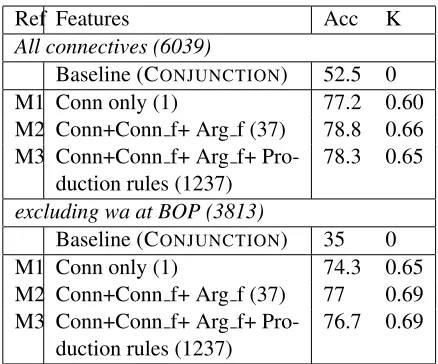
Table 6 shows the results for fine-grained (17 rela-tions) classification. The baseline of assigning the most frequent relation EXPANSION.CONJUNCTION to every connective performs with an accuracy of 52.5% on SetAlland 35% on setno-wa-atBOP. If we use a model that relies on the discourse connec-tive alone (M1) we achieve results of 77.2%/74.3%, respectively. As noted in Section 4.5 this is substan-tially lower than what the same model can achieve for English. Including connective and argument fea-tures (apart from production rules) in M2, leads to a small but significant improvement.10 Further incor-poration of production rules does not improve the results (M3). In Table 7, we show the results at the class-level (4 relations). Here using additional fea-tures over the connective string does not lead to sig-nificant improvements.
6.3 Discussion and Error Analysis
We concentrate our discussion on fine-grained clas-sification excluding wa at BOP.
Our improvements in M2 over the connective-only classifier (M1) are in two main areas. First, our model performs generalisation, i.e. outputs some rules that do not use the connective string at all. These achieve a somewhat surprising improvement of M2 over M1 forunambiguous connectives which are too rare to classify via the connective string. In those cases, they either (i) have not been seen in the training data before and are therefore not classifiable when seen first time in the test set or (ii) have been
10Our corpus includes some texts on similar topics where some sentences are (almost) repeated in different texts. To investigate whether our improvements are due to this repeti-tion, we also performed an experiment excluding all repeated instances of feature vectors from the corpus. The results are almost the same and, most importantly, M2 again improves sig-nificantly over M1.
Ref Features Acc K
All connectives (6039)
Baseline (CONJUNCTION) 52.5 0 M1 Conn only (1) 77.2 0.60 M2 Conn+Conn f+ Arg f (37) 78.8 0.66 M3 Conn+Conn f+ Arg f+
Pro-duction rules (1237) 78.3 0.65 excluding wa at BOP (3813)
Baseline (CONJUNCTION) 35 0 M1 Conn only (1) 74.3 0.65 M2 Conn+Conn f+ Arg f (37) 77 0.69 M3 Conn+Conn f+ Arg f+
Pro-duction rules (1237) 76.7 0.69
Table 6: Performance of different models for identifying fine-grained discourse relations on two datasets.
Ref Features Acc K
All connectives (6039)
Baseline (EXPANSION) 62.4 0 M1 Conn only (1) 88.7 0.78 M2 Conn+Conn f+ Arg f (37) 88.7 0.78 excluding wa at BOP (3813)
Baseline (EXPANSION) 41.8 0 M1 Conn only (1) 82.7 0.74 M2 Conn+Conn f+ Arg f (37) 83.5 0.75
Table 7: Performance of different models for identifying class-level discourse relations on two datasets.
seen in the training data too rarely for the rule-based classifier to develop a rule judged to be more re-liable than the default EXPANSION.CONJUNCTION classification. Our data includes 47 unambiguous connective types, accounting for 574 of the 3813 tokens. 30 of these 47 types are so rare that we found mistakes in the connective-only classification, including
B@
/¯al¯a/except (2),I
.
®«
/,qb(2),AÖÏA£
/t.¯a-lm¯a(2),
Ñ
«QK.
/br˙gm(1). For 14 of these 30 connec-tives, model M2 was able to use generalised rules to improve relation assignment.11 These rules in-volve mainly connective surface and POS features. Thus, sentence-start adverbials consisting of more than one token such asà@ YJK.
/byd ¯an(6) andà@ Q «
/˙gyr ¯an(6) were correctly classified as CONTRAST. [image:9.612.317.535.285.415.2]This advantage of our model over the connective-only model might disappear if in a larger corpus more instances of those connectives are found and are still unambiguous. Therefore, we are more interested in how our classifier does on truly ambiguous connectives (33 connective types accounting for 3239 tokens of 3813 overall to-kens). We conducted a separate significance test on ambiguous connectives only and found that M2 improves over M1 classification significantly at the 1% level. How well we do on individual connectives depends on their frequency and on their level of ambiguity. If connectives are ambiguous and of low frequency (
ñË
/lw,AÖ
ß@
/¯anm¯a,ÈAg
/h.¯al/) both M1 and M2 do perform badly on them. If connectives are frequent (10 or more occurrences) and have relatively low ambiguity (majority reading accounts for more than 70% of instances), the overall performance of M1 and M2 with regard to accuracy is also similar, often both using just the connective string. On the other hand, if connectives are frequent and have high ambiguity (i.e. no such clear majority reading), then M2 normally improves (often substantially) on M1. Examples of such connectives areAÒ»
/km¯a,AÒJ
¯
/fym¯aandQK@
/¯at¯r. Most of the successful rules use tense in some form, either via part of speech of verbs or via comparing the tense in the two arguments. This, for example, led to a successful recognition of all 9 instances of
Similarity in the connective kmA (whose major-ity relation is Expansion.Conjunction in 40 out of 65 occurrences). The connective
¬
/f/thenis dis-tinguished into EXPANSION.EXEMPLIFICATION, CONTINGENCY.CAUSE.RESULT and CONTIN -GENCY.CAUSE.REASON readings, depending on the lexemes around it, the parents of its arguments, and whether its argument 2 is tensed or not. Thus, nontensed arguments are most often nominalisations leading to a reason reading, whereas a verb phrase as argument 2 and a sentence as argument 1 often is a result reading. However, it is worth reporting that in cases of very high ambiguity, M2 is still far from perfect such as for connectives f¬
/fandQK@
/¯at¯r. Some improvements again come from gener-alised rules: there are some very high-coverage and high precision generalised rules that reduce dependency on the connective string. For example, clitic prepositions (such as
È
/l/for) can withoutany further information be clearly classified as
Contingency.Cause.Reason.NonPragmatic
covering 494 occurrences with only 26 mistakes. These are cases where the following argument is normally Al-Masdar.
Our analysis leads us to the following strategy for follow-on work. First of all, a larger corpus is necessary to get more examples for low frequency connectives. Secondly, experiments with different classifiers are worthwhile to conduct to see how our improvements generalise. Third, the most mileage is in further improvements on frequent, ambiguous connectives such as
¬
/f,Y JÓ
/mnd¯and
ð@
/¯aw. This can be achieved with, on the one hand, training connective-specific classifiers on larger data sets but will, on the other hand, also need a wider feature base. From our corpus study, we think that lexico-semantic features such as word pairs and seman-tic classes of verbal/nominalised arguments are the most promising.7 Conclusions and Future Work
We have presented the first study on the automatic detection and disambiguation of Arabic discourse connectives. A corpus study showed that these are highly frequent and more ambiguous than their English counterparts. Our automatic algorithms achieve very good results on discourse connective identification, using Arabic morphological proper-ties to good effect. It is particular promising that we do not need parsed data to identify discourse usage of potential connectives reliably. Our algorithm for discourse connective interpretation beats the chal-lenging baseline of assigning the most frequent re-lation per connective. In future, we will explore fur-ther features for connective disambiguation as well as connective-specific classification, combined with semi-supervised algorithms to alleviate data sparse-ness. We will also develop algorithms for argument identification.
Acknowledgments
References
M. Abdl al latif, A. Umar, and M. Zahran. 1997. Alnhw AlAsAsi. Dar Alfker Al-Arabi, Cairo, Egypt.
A. AlSaif and K. Markert. 2010. The leeds arabic dis-course treebank: Annotating disdis-course connectives for arabic. InLanguage Resources and Evaluation Con-ference (LREC).
J. Baldridge and A. Lascarides. 2005. Probabilistic head-driven parsing for discourse structure. In Proc. Of Conll 2005.
S. Blair-Goldensohn, K McKeown, and O. Rambow. 2007. Building and refining rhetorical-semantic rela-tion models. InProc. of HLT-NAACL 2007.
L. Carlson, D. Marcu, and M. Okurewski. 2002. Rst discourse treebank. Linguistic Data Consortium. D. duVerle and H. Prendinger. 2009. A novel discourse
parser based on support vector machine classification. InProc. of ACL 2009.
R. Elwell and J. Baldridge. 2008. Discourse connec-tive argument identification with connecconnec-tive specific rankers. InProc. of the International Conference on Semantic Computing.
R. Girju. 2003. Automatic detection of causal relations for questions answering. In Proc. of the ACL 2003 Workshop on Multilingual Summarisation and Ques-tion Answering, pages 76–83.
M.A.K. Halliday and R. Hasan. 1976. Cohesion in En-glish. Longman London.
J.R. Hobbs. 1985. On the coherence and structure of discourse. Center for the Study of Language and In-formation, Stanford, Calif.
A. Knott and T. Sanders. 1998. The classification of coherence relations and their linguistic markers: An exploration of two languages. Journal of Pragmatics, 30(2):135–175.
Z. Lin, M. Kan, and H.T. Ng. 2009. Recognizing implicit discourse relations in the penn discourse treebank. In
Proc. of EMNLP 2009, pages 343–351.
A. Louis and A. Nenkova. 2010. Creating local coher-ence: An empirical assessment. In Proc. of NAACL 2010.
M. Maamouri and A. Bies. 2004. Developing an Ara-bic treebank: Methods, guidelines, procedures, and tools. In Proceedings of the Workshop on Computa-tional Approaches to Arabic Script-based Languages (COLING), Geneva.
W.C. Mann and S.A. Thompson. 1988. Rhetorical struc-ture theory: Toward a functional theory of text organi-zation. Text, 8(3):243–281.
D. Marcu and A. Echihabi. 2002. An unsupervised ap-proach to recognizing discourse relations. InProc. of ACL 2002.
D. Marcu. 2000. The theory and practice of discourse parsing and summarization. MIT Press.
E. Miltsakaki, N. Dinesh, R. Prasad, A. Joshi, and B. Webber. 2005. Experiments on sense annotation and sense disambiguation of discourse connectives. In
Proc. of the Workshop on Treebanks and Linguistic Theories.
E. Pitler and A. Nenkova. 2008. Revisiting readabil-ity: A unified framework for predicting text quality. In
Proc. of EMNLP 2008, pages 186–195.
E. Pitler and A. Nenkova. 2009. Using syntax to dis-ambiguate explicit discourse connectives. InProc of ACL-IJCNLP 2009 (Short Papers), pages 13–16. E. Pitler, M. Raghupathy, H. Mehta, A. Nenkova, A. Lee,
and A. Joshi. 2008. Easily identifiable discourse relations. In Proceedings of the 22nd International Conference on Computational Linguistics (COLING 2008), Manchester, UK, August.
E. Pitler, A. Louis, and A. Nenkova. 2009. Automatic sense prediction for implicit discourse relations in text. InProc. of ACL-IJCNLP 2009, pages 683–691. R. Prasad, N. Dinesh, A. Lee, E. Miltsakaki, L. Robaldo,
A. Joshi, and B. Webber. 2008a. The Penn discourse treebank 2.0. InProceedings of the 6th International Conference on Language Resources and Evaluation (LREC 2008).
R. Prasad, S. Husain, D.M. Sharma, and A. Joshi. 2008b. Towards an Annotated Corpus of Discourse Relations in Hindi. InThe Third International Joint Conference on Natural Language Processing, pages 7–12. Cite-seer.
K.C. Ryding. 2005. A reference grammar of modern standard Arabic. Cambridge Univ Pr.
S. Siegel and N.J. Castellan. 1956. Nonparametric statistics for the behavioral sciences. McGraw-Hill New York.
S. Somasundaran, J. Wiebe, and J. Ruppenhofer. 2008. Discourse-level opinion interpretation. In Proc. of Coling 2008.
R. Soricut and D. Marcu. 2003. Sentence level dis-course parsing using syntactic and lexical information. InProc of HLT-NAACL 2003.
C. Sporleder and A. Lascarides. 2008. Using auto-matically labelled examples to classify rhetorical rela-tions: An assessment. Natural Language Engineering, 14:369–416.
W. Wang, J. Su, and C. Tan. 2010. Kernel-based dis-course relation recognition with temporal ordering in-formation. InProc. of ACL 2010, pages 710–719. B. Webber, A. Knott, M. Stone, and A. Joshi. 1999.
the 37th annual meeting of the Association for Com-putational Linguistics on ComCom-putational Linguistics, page 48. Association for Computational Linguistics. B. Wellner and J. Pustejovski. 2007. Automatically
identifying the arguments of discourse connectives. In
Proc. of EMNLP 2007, pages 92–101.
B. Wellner, J. Pustejovski, A. Havasi, A. Rumshisky, and R. Suair. 2006. Classification of discourse coherence relations: An exploratory study using multiple knowl-edge sources. InProc. of SIGDIAL2006.
Janyce Wiebe, Theresa Wilson, and Claire Cardie. 2005. Annotating expressions of opinions and emotions in language.Language Resources and Evaluation. W. Wright. 2008. A grammar of the Arabic language.
Bibliobazaar.
Nianwen Xue. 2005. Annotating discourse connectives in the chinese treebank. InCorpusAnno ’05: Proceed-ings of the Workshop on Frontiers in Corpus Annota-tions II, pages 84–91, Morristown, NJ, USA. Associa-tion for ComputaAssocia-tional Linguistics.
D. Zeyrek and B. Webber. 2008. A discourse resource for turkish: Annotating discourse connectives in the metu corpus. Proceedings of IJCNLP-2008. Hyder-abad, India.