Joint Learning and Inference for Grammatical Error Correction
Alla Rozovskaya and Dan Roth Cognitive Computation Group University of Illinois at Urbana-Champaign
201 N. Goodwin Avenue Urbana, IL 61801
{rozovska,danr}@illinois.edu
Abstract
State-of-the-art systems for grammatical er-ror correction are based on a collection of independently-trained models for specific er-rors. Such models ignore linguistic interac-tions at the sentence level and thus do poorly on mistakes that involve grammatical depen-dencies among several words. In this paper, we identify linguistic structures with interact-ing grammatical properties and propose to ad-dress such dependencies via joint inference and joint learning.
We show that it is possible to identify interac-tions well enough to facilitate a joint approach and, consequently, that joint methods correct incoherent predictions that independently-trained classifiers tend to produce. Further-more, because the joint learning model con-siders interacting phenomena during training, it is able to identify mistakes that require mak-ing multiple changes simultaneously and that standard approaches miss. Overall, our model significantly outperforms the Illinois system that placed first in the CoNLL-2013 shared task on grammatical error correction.
1 Introduction
There has recently been a lot of work addressing er-rors made by English as a Second Language (ESL) learners. In the past two years, three competitions devoted to grammatical error correction for non-native writers took place: HOO-2011 (Dale and Kil-garriff, 2011), HOO-2012 (Dale et al., 2012), and the CoNLL-2013 shared task (Ng et al., 2013).
Nowadays *phone/phones *has/have many functionalities, *included/including *∅/a camera and *∅/a Wi-Fi receiver.
Figure 1: Examples of representative ESL errors.
Most of the work in the area of ESL error cor-rection has addressed the task by building statistical models that specialize in correcting a specific type of a mistake. Figure 1 illustrates several types of errors common among non-native speakers of En-glish: article, subject-verb agreement, noun num-ber, and verb form. A significant proportion of re-search has focused on correcting mistakes in article and preposition usage (Izumi et al., 2003; Han et al., 2006; Felice and Pulman, 2008; Gamon et al., 2008; Tetreault and Chodorow, 2008; Gamon, 2010; Rozovskaya and Roth, 2010b). Several studies also consider verb-related and noun-related errors (Lee and Seneff, 2008; Gamon et al., 2008; Dahlmeier and Ng, 2012). The predictions made by individual models are then applied independently (Rozovskaya et al., 2011) or pipelined (Dahlmeier and Ng, 2012). The standard approach of training individual clas-sifiers considers each word independently and thus assumes that there are no interactions between er-rors and between grammatical phenomena. But an ESL writer may make multiple mistakes in a single sentence and these result in misleading local cues given to individual classifiers. In the example shown in Figure 1, the agreement error on the verb “have” interacts with the noun number error: a correction system that takes into account the context may in-fer, because of the word “phone”, that the verb num-ber is correct. For this reason, a system that
ers noun and agreement errors separately will fail to identify and correct the interacting errors shown in Fig. 1. Furthermore, it may also produce inconsis-tent predictions.
Even though it is quite clear that grammatical er-rors interact, for various conceptual and technical reasons, this issue has not been addressed in a sig-nificant way in the literature. We believe that the reasons for that are three-fold: (1) Data: until very recently we did not have data that jointly annotates sufficiently many errors of interacting phenomena (see Sec. 2). (2) Conceptual: Correcting errors in interacting linguistic phenomena requires that one identifies those phenomena and, more importantly, can recognize reliably the interacting components (e.g., given a verb, identify the subject to enable en-forcing agreement). The perception has been that this cannot be done reliably (Sec. 4). (3) Technical: The NLP community has started to better understand joint learning and inference and apply it to various phenomena (Roth and Yih, 2004; Punyakanok et al., 2008; Martins et al., 2011; Clarke and Lapata, 2007; Sutton and McCallum, 2007) (Sec. 5).
In this paper we present, for the first time, a suc-cessful approach to jointly resolving grammatical er-rors. Specifically:
•We identify two pairs of interacting phenomena,
subject-verb and article-NPhead agreements; we show how to reliably identify these pairs in noisy ESL data, thereby facilitating the joint correction of these phenomena.
•We propose two joint approaches: (1) ajoint infer-enceapproach implemented on top of individually learned models using an integer linear programming formulation (ILP, (Roth and Yih, 2004)), and (2) a model thatjointly learnseach pair of these phenom-ena. We show that each of these methods has its ad-vantages, and that both solve the two challenges out-lined above: the joint models exclude inconsistent predictions that violate linguistic constraints. The joint learning model exhibits superior performance, as it is also able to overcome the problem of the noisy context encountered by the individual mod-els and to identify errors in contexts, where multiple changes need to be applied at the same time.
We show that our joint models produce state-of-the-art performance and, in particular, significantly outperform the University of Illinois system that
placed first in the CoNLL-2013 shared task, increas-ing the F1 score by 2 and 4 points in different evalu-ation settings.
2 Task Description and Motivation
To illustrate the utility of jointly addressing interact-ing grammatical phenomena, we consider the cor-pus of the CoNLL-2013 shared task on grammatical error correction (Ng et al., 2013), which we found to be particularly well-suited for addressing interac-tions between grammatical phenomena. The task fo-cuses on the following five common mistakes made by ESL writers: article,preposition,noun number,
subject-verb agreement, andverb form, and we ad-dress two interactions:article-NPheadand subject-verb.
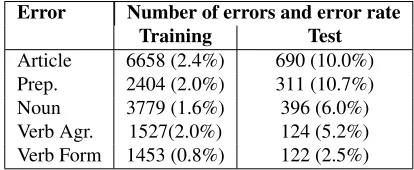
The training data for the task is from the NUCLE corpus (Dahlmeier et al., 2013), an error-tagged col-lection of essays written by non-native learners of English. The test data is an additional set of essays by learners from the same linguistic background. The training and the test data contain 1.2M and 29K words, respectively. Although the corpus contains errors of other types, the task focuses on five types of errors. Table 1 shows the number of mistakes1of each type and the error rates, i.e. the percentage of erroneous words by error type.
[image:2.612.321.528.438.523.2]Error Number of errors and error rate Training Test Article 6658 (2.4%) 690 (10.0%) Prep. 2404 (2.0%) 311 (10.7%) Noun 3779 (1.6%) 396 (6.0%) Verb Agr. 1527(2.0%) 124 (5.2%) Verb Form 1453 (0.8%) 122 (2.5%)
Table 1: Number of annotated errors in the CoNLL-2013 shared task.Percentage denotes the error rates, i.e. the number of erroneous instances with respect to the to-tal number of relevant instances in the data. For example, 10.7% of prepositions in the test data are used incorrectly. The numbers in thereviseddata set are slightly higher.
We note that the CoNLL-2013 data set is the first annotated collection that makes a study like ours feasible. The presence of a common test set that
1
contains a good number of interacting errors – ar-ticle, noun, and verb agreement mistakes – makes the data set well-suited for studying which approach works best for addressing interacting phenomena. The HOO-2011 shared task collection (Dale and Kilgarriff, 2011) contains a very small number of noun and agreement errors (41 and 11 in test, re-spectively), while the HOO-2012 competition (Dale et al., 2012) only addresses article and preposition mistakes. Indeed, in parallel to the work presented here, Wu and Ng (2013) attempted the ILP-based approach of Roth and Yih (2004) in this domain. They were not able to show any improvement, for two reasons. First, the HOO-2011 data set which they used does not contain a good number of errors in interacting structures. Second, and most impor-tantly, they applied constraints in an indiscriminate manner. In contrast, we show how to identify the interacting structures’ components in a reliable way, and this plays a key role in the joint modeling im-provements.
Lack of data hindered other earlier efforts for error correction beyond individual language phe-nomena. Brockett et al. (2006) applied machine-translation techniques to correct noun number errors on mass nouns and article usage but their application was restricted to a small set of constructions. Park and Levy (2011) proposed a language-modeling ap-proach to whole sentence error correction but their model is not competitive with individually trained models. Finally, Dahlmeier and Ng (2012) proposed a decoder model, focusing on four types of errors in the data set of the HOO-2011 competition (Dale and Kilgarriff, 2011). The decoder optimized the se-quence in which individual classifiers were to be ap-plied to the sentence. However, because the decoder still corrected mistakes in a pipeline fashion, one at a time, it is unlikely that it could deal with cases that require simultaneous changes.
3 The University of Illinois System
Below, we briefly describe the University of Illinois system (henceforthIllinois; in the overview paper of the shared task the system is referred to as UI) that achieved the best result in the CoNLL-2013 shared task and which we use as our baseline model. For a complete description, we refer the reader to
Ro-zovskaya et al. (2013).
The Illinois system implements five machine-learning independently-trained classifiers that fol-low the popular approach to ESL error correction borrowed from the context-sensitive spelling correc-tion task (Golding and Roth, 1999; Carlson et al., 2001). A confusion set is defined that specifies a list of confusable words. Each occurrence of a con-fusable word in text is represented as a vector of features derived from a context window around the target. The problem is cast as a multi-class classi-fication task and a classifier is trained on native or learner data. At prediction time, the model selects the most likely candidate from the confusion set.
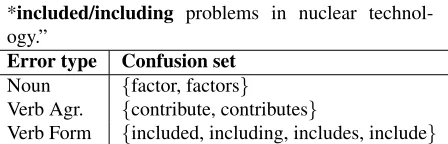
The confusion set for prepositions includes the top 12 most frequent English prepositions. The arti-cle confusion set is as follows:{a,the,∅}2. The con-fusion sets fornoun,agreement, andformmodules depend on the target word and include its morpho-logical variants (Table 2).
“Hence, the environmental *factor/factors also *contributes/contribute to various difficulties, *included/including problems in nuclear technol-ogy.”
Error type Confusion set Noun {factor, factors}
Verb Agr. {contribute, contributes}
[image:3.612.316.540.363.435.2]Verb Form {included, including, includes, include}
Table 2: Confusion sets for noun number, agreement, and form classifiers.
The article classifier is a discriminative model that draws on the state-of-the-art approach described in Rozovskaya et al. (2012). The model makes use of the Averaged Perceptron algorithm (Freund and Schapire, 1996) and is trained on the training data of the shared task with rich features.
The other models are trained on native English data, the Google Web 1T 5-gram corpus (henceforth, Google, (Brants and Franz, 2006)) with the Na¨ıve Bayes (NB) algorithm. All models use word n-gram features derived from the 4-word window around the target word. In the preposition model, priors for preposition preferences are learned from the shared task training data (Rozovskaya and Roth, 2011).
2
Example Predictions made by the Illinois system “They believe thatsuch situationmust be avoided.” such situation→such a situations “Nevertheless , electriccars isstill regarded as a great trial innovation.” cars is→car are
[image:4.612.83.292.294.345.2]“Everystudents haveappointments with the head of the department.” No change
Table 3:Examples of predictions of the Illinois system that combines independently-trained models.
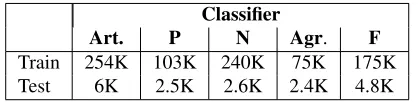
The words that are selected as input to classifiers are calledcandidates. Article and preposition can-didates are identified with a closed list of words; noun-phrase-initial contexts for the article classifier are determined using a shallow parser3(Punyakanok and Roth, 2001). Candidates for the noun, agree-ment, and form classifiers are identified with a part-of-speech tagger4, e.g. noun candidates are words that are tagged as NN or NNS. Table 4 shows the total number of candidates for each classifier.
Classifier
Art. P N Agr. F
Train 254K 103K 240K 75K 175K Test 6K 2.5K 2.6K 2.4K 4.8K
Table 4:Number of candidate words by classifier type in training and test data.
4 Interacting Mistakes
The approach of addressing each type of mistake in-dividually is problematic when multiple phenomena interact. Consider the examples in Table 3 and the predictions made by the Illinois system. In the first and second sentences, there are two possible ways to correct the structures “such situation” and “cars is”. In the former, either the article or the noun num-ber should be changed; in the latter, either the noun number or the verb agreement marker5. In these ex-amples, each of the independently-trained classifiers identifies the problem because each system makes a decision using the second error as part of its contex-tual cues, and thus the individual systems produce inconsistent predictions.
3http://cogcomp.cs.illinois.edu/page/
software view/Chunker
4http://cogcomp.cs.illinois.edu/page/
software view/POS
5Both of these solutions will result in grammatical output and the specific choice between the two depends on the wider essay context.
The second type of interaction concerns cases that require correcting more than one word at a time: the last example in Table 3 requires making changes both to the verb and the subject. Since each of the in-dependent classifiers (for nouns and for verb agree-ment) takes into account the other word as part of its features, they both infer that the verb number is correct and that the grammatical subject “student” should be plural.
We refer to the words whose grammatical prop-erties interact as structures. The independently-trained classifiers tend to fail to provide valid cor-rections in contexts where it is important to consider both words of the structure.
4.1 Structures for Joint Modeling
We address two linguistic structures that are relevant for the grammatical phenomena considered: article-NPhead and subject-verb. In the article-NPhead
structures, the interaction is between the head of the noun phrase (NP) and the article that refers to the NP (first example in Table 3). In particular, the model should take into account that the article “a” cannot be combined with a noun in plural form. For subject-verb agreement, the subject and the verb should agree in number.
We now need to identify all pairs of candidates that form the relevant structures. Article-NPhead
structures are pairs of words, such that the first word is a candidate of type article, while the second word is a noun candidate. Given an article candidate, the head of its NP is determined using the POS infor-mation (this inforinfor-mation is obtained from the article feature vector because the NP head is a feature used by the article system)6. Subject-verb structures are pairs of noun-agreement candidates. Given a verb, its subject is identified with a dependency parser (Marneffe et al., 2006).
To evaluate the accuracy of subject and NP head
6
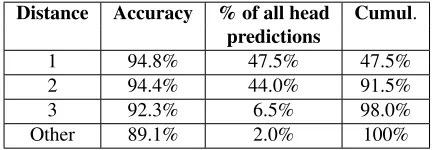
predictions, a random sample of 500 structures of each type from the training data was examined by a human annotator with formal training in Linguis-tics. The human annotations were then compared against the automatic predictions. The results of the evaluation for subject-verb and article-NPhead structures are shown in Tables 5 and 6, respectively. Although the overall accuracy is above 90% for both structures, the accuracy varies by the distance be-tween the structure components and drops signifi-cantly as the distance increases. For article-NPhead structures,distanceindicates the position of the NP head with respect to the article, e.g. distance of 1 means that the head immediately follows the arti-cle. For subject-verb structures,distance is shown with respect to the verb: a distance of -1 means that the subject immediately precedes the verb. Although in most cases the subject is located to the left of the verb, in some constructions, such as existential clauses and inversions, it occurs after the verb.
Based on the accuracy results for identifying the structure components, we select those structures where the components are reliably identified. For article-NPhead, valid structures are those where the distance is at most three words. For subject-verb, we consider as valid those structures where the identi-fied subject is located within two words to the left or three words to the right of the verb.
The valid structures are selected as input to the joint model (Sec. 5). Thejoint learningmodel con-siders only those valid structures whose components areadjacent. In adjacent structures the NP head im-mediately follows the article, and the verb immedi-ately follows the subject. Joint inferenceis not re-stricted to adjacent structures.
The last column of Table 5 shows that valid subject-verb structures account for 67.5% of all verbs whose subjects are common nouns (51.7% are cases where the words are adjacent). Verbs whose subjects are common nouns account for 57.8% of all verbs that have subjects (verbs with different types of subjects, most of which are personal pronouns, are not considered here, since these subjects are not part of the noun classifier).
Valid article-NPhead structures account for 98.0% of all articles whose NP heads are common nouns (47.5% of those are adjacent structures), as shown in the last column of Table 6. 71.0% of
arti-cles in the training data belong to an NP whose head is a common noun; NPs whose heads belong to dif-ferent parts of speech are not considered.
Note also that because a noun may belong both to an article-NPhead and a subject-verb structure, the structures contain an overlap.
Distance Accuracy % of all subj. Cumul. predictions
-1 97.6% 51.7% 51.7%
1,2,3 100.0% 8.9% 60.6%
-2 88.2% 6.9% 67.5%
[image:5.612.317.534.152.227.2]Other 80.8% 32.5% 100.0%
Table 5: Accuracy of subject identification on a random sample of subject-verb structures from the training data.
The overall accuracy is 91.52%. For each distance, the follow-ing are shown: accuracy based on comparison with human eval-uation; the percentage of all predictions that have this distance; the cumulative percentage.
Distance Accuracy % of all head Cumul. predictions
1 94.8% 47.5% 47.5%
2 94.4% 44.0% 91.5%
3 92.3% 6.5% 98.0%
Other 89.1% 2.0% 100%
Table 6: Accuracy of NP head identification on a random sample of article-NPhead structures from training data.The overall accuracy is 94.45%. For each distance, the following are shown: accuracy based on comparison with human evaluation; the percentage of all predictions that have this distance; the cu-mulative percentage.
5 The Joint Model
In this section, we present the joint inference and thejoint learningapproaches. In the joint inference approach, we use the independently-learned models from the Illinois system, and the interacting target words identified earlier are considered only at infer-ence stage. In the joint learning method, we jointly learn a model for the interacting phenomena.
The label space in the joint models corresponds to sequences of labels from the confusion sets of the individual classifiers: {a−sing, a−pl, the−
sing, the − pl,∅ −sing,∅− pl} and {sing −
sing, sing−pl, pl−sing, pl−pl}for article-NPhead and subject-verb structures, respectively7. Invalid
7
[image:5.612.317.534.322.397.2]structures, such aspl-singare excluded via hard con-straints (when we run joint inference) or via implicit soft constraints (when we use joint learning).
5.1 Joint Inference
In the individual model approach, decisions are made for each word independently, ignoring the in-teractions among linguistic phenomena. The pur-pose of joint inference is to include linguistic (i.e. structural) knowledge, such as “plural nouns do not take an indefinite article”, and “agreement consis-tency between the verb and the subject that controls it”. This knowledge should be useful for resolving inconsistencies produced by individual classifiers.
The inference approach we develop in this paper follows the one proposed by Roth and Yih (2004) of training individual models and combining them at decision time via joint inference. The advantage of this method is that it allows us to build upon any existing independently-learned models that pro-vide a distribution over their outcome, and produce a coherent global output that respects our declarative constraints. We formulate our component inference problems as integer linear program (ILP) instances as in Roth and Yih (2004).
The inference takes as input the individual clas-sifiers’ confidence scores for each prediction, along with a list of constraints. The output is the optimal solution that maximizes the linear sum of the confi-dence scores, subject to the constraints that encode the interactions. The joint model thus selects a hy-pothesis that both obtains the best score according to the individual models and satisfies the constraints that reflect the interactions among the grammatical phenomena at the level of linguistic structures, as defined in Sec. 4.
Inference The joint inference is enforced at the level of structures, and each structure corresponds to one ILP instance. All structures consist of two or three words: when an article-NPhead structure and a subject-verb structure include the same noun, the structure input to the ILP consists of an
article-noun-and verb agreement carticle-noun-andidates. The carticle-noun-andidates themselves are the surface forms of specific words that realize these grammat-ical properties. Note that a subject in subject-verb structures is always third person, since all subjects in subject-verb structures are common nouns; other subjects, including pronouns, are ex-cluded. Thus the agreement distinction is singular vs. plural.
verb triple. We formulate the inference problem as follows: Given a structuresthat consists ofnwords, letwicorrespond to theithword in the structure. Let
hdenote a hypothesis from the hypothesis spaceH
fors, andscore(wi, h, li)denote the score assigned by the appropriate error-specific model towi under
hfor labellfrom the confusion set of wordwi. We denote by ew,l the Boolean variable that indicates whether the prediction on word w is assigned the valuel(ew,l= 1) or not (ew,l= 0).
We assume that each independent classifier re-turns a score that corresponds to the likelihood of wordwiunderhbeing labeledli. The softmax func-tion (Bishop, 1995) is used to convert raw activafunc-tion scores to conditional probabilities for the discrimi-native article model. The NB scores are also normal-ized and correspond to probabilities. Then the infer-ence task is solved by maximizing the overall score of a candidate assignment of labelslto wordsw(this set of feasible assignments is denotedH here) sub-ject to the constraintsCfor the structures:
ˆ
h= arg max h∈H
score(h) =
= arg max h∈H
n X
i=1
score(wi, h, li)ewi,li
subject toC(s)
ConstraintsIn the {0,1} linear programming for-mulation described above, we can encode linguis-tic constraints that reflect the interactions among the linguistic phenomena. The inference enforces the following structural and linguistic constraints:
1. The indefinite article “a” cannot refer to an NP headed by a plural noun.
2. Subject and verb must agree in number.
In addition, we encode “legitimacy” constraints, that make sure that eachwis assigned a single label. All constraints are encoded as hard constraints.
5.2 Joint Learning
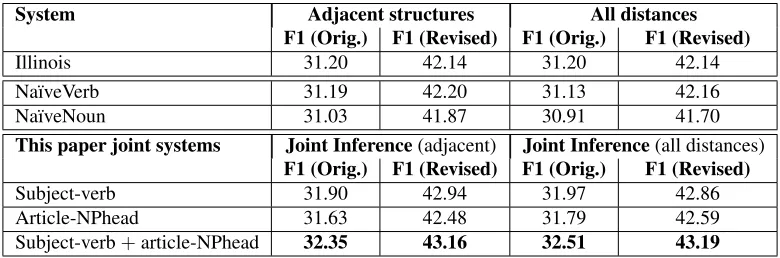
System Adjacent structures All distances F1 (Orig.) F1 (Revised) F1 (Orig.) F1 (Revised)
Illinois 31.20 42.14 31.20 42.14
Na¨ıveVerb 31.19 42.20 31.13 42.16
Na¨ıveNoun 31.03 41.87 30.91 41.70
This paper joint systems Joint Inference(adjacent) Joint Inference(all distances) F1 (Orig.) F1 (Revised) F1 (Orig.) F1 (Revised)
Subject-verb 31.90 42.94 31.97 42.86
Article-NPhead 31.63 42.48 31.79 42.59
[image:7.612.111.501.31.160.2]Subject-verb+article-NPhead 32.35 43.16 32.51 43.19
Table 7: Joint Inference Results. All results are on the CoNLL-2013 test data using the original and revised gold annotations. Adjacentdenotes a setting, where the joint inference is applied to structures with consecutive components (article-NPhead or subject-verb). All distancesdenotes a setting, where the constraints are applied to all valid structures, as described in Sec. 4.1. Illinoisdenotes the result obtained by the top CoNLL-2013 shared task system. In all cases, the candidates that are not part of the structures are handled by the respective components of the Illinois system. Na¨ıveVerbandNa¨ıveNoundenote heuristics, where a verb or subject are changed to ensure agreement. All improvements over the Illinois system are statistically significant (McNemar’s test,p <0.01).
word, here the target corresponds to two words that are part of the structure and the label space of the model is modified accordingly. Since we use fea-tures that can be computed from the small windows in the Google corpus, the joint learning model han-dles only adjacent structures (Sec. 4.1). Because the target consists of two words and the Google corpus contains counts for n-grams of length at most five, the features are collected in the three word window around the target.8
Unlike with the joint inference, here we do not explicitly encode linguistic constraints. One reason for this is that the NP head and subject predictions are not 100% accurate, so input structures will have noise. However, the joint model learns these con-straints through the evidence seen in training.
6 Experiments
In this section, we describe our experimental setup and evaluate the performance of the joint approach. In the joint approach, the joint components pre-sented in Sec. 5 handle the interacting structures de-scribed in Sec. 4. The individual classifiers of the Illinois system make predictions for the remaining words. The research question addressed by the ex-periments is the following: Given independently-trained systems for different types of errors, can we improve the performance by considering the
phe-8
Also note that when the article is∅, the surface form of the structure corresponds to the NP head alone; this does not present a problem because in the NB model the context counts are normalized with the prior counts.
nomena that interact jointly? To address this, we report the results in the following settings:
1. Joint Inference: we compare the Illinois sys-tem that is a collection of individually-trained mod-els that are applied independently with a model that uses joint inference encoded as declarative con-straints in the ILP formulation and show that using joint inference results in a strong performance gain. 2. Joint Learning: we compare the Illinois system with a model that incorporates jointly-trained com-ponents for the two linguistic structures that we de-scribed in Sec. 4. We show that joint training pro-duces an even stronger gain in performance com-pared to the Illinois model.
2. Joint Learning and Inference: we apply joint in-ference to the output of the joint learning system to account for dependencies not covered by the joint learning model.
We report F1 performance scored using the offi-cial scorer from the shared task (Dahlmeier and Ng, 2012). The task reports two types of evaluation: on the original gold data and on gold data with addi-tional corrections. We refer to the results as Origi-nalandRevised.
6.1 Joint Inference Results
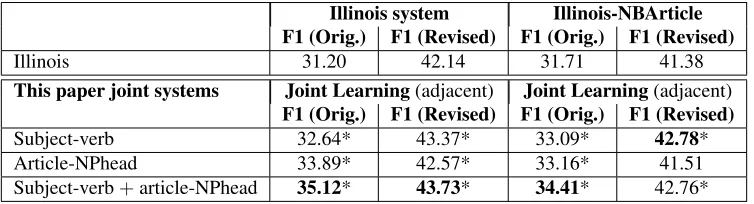
Illinois system Illinois-NBArticle F1 (Orig.) F1 (Revised) F1 (Orig.) F1 (Revised)
Illinois 31.20 42.14 31.71 41.38
[image:8.612.119.496.60.162.2]This paper joint systems Joint Learning(adjacent) Joint Learning(adjacent) F1 (Orig.) F1 (Revised) F1 (Orig.) F1 (Revised) Subject-verb 32.64* 43.37* 33.09* 42.78* Article-NPhead 33.89* 42.57* 33.16* 41.51 Subject-verb+article-NPhead 35.12* 43.73* 34.41* 42.76*
Table 8:Joint Learning Results. All results are on the CoNLL-2013 test data using the original and revised gold annotations. Illinois-NBArticledenotes the Illinois system, where the discriminative article model is replaced with a NB classifier. Adjacent denotes a setting, where the structure components are consecutive (article-NPhead or subject-verb), as described in Sec. 4.1. Illinoisdenotes the result obtained by the top CoNLL-2013 shared task system. In all cases, the candidates that are not part of the structures are handled by the respective components of the Illinois system. Statistically significant improvements (McNemar’s test, p <0.01) over the Illinois system are marked with an asterisk (*).
It is also interesting to note that the key improvement comes from considering structures whose compo-nents are adjacent. This is not surprising given that the accuracy for subject and NP head identification drops as the distance increases.
For subject-verb constraints, we also implement a na¨ıve approach that looks for contradictions and changes either the verb or the subject if they do not satisfy the number agreement. These two heuris-tics are denoted asNa¨ıveVerband Na¨ıveNoun. The heuristics differ from the joint inference in that they enforce agreement by always changing either the noun (Na¨ıveNoun) or the verb (Na¨ıveVerb), while the joint inference does this using the scores pro-duced by the independent models. In other words, the key is the objective function, while the compo-nents of the objective function are the same in the heuristics and the joint inference. The results in Ta-ble 7 show that simply enforcing agreement does not work well and that the ILP formulation is indeed ef-fective and improves over the independently-trained models in all cases.
Recall that valid structures include only those whose components can be identified in a reliable way (Sec. 4.1). To evaluate the impact of that filter-ing, we perform two experiments with subject-verb structures (long-distance dependencies are more common in those constructions than in the article-NPhead structures): first, we apply joint inference to all subject-verb structures. We obtain F1 scores of 31.61 and 42.28, on original and revised gold data, respectively, which is significantly worse than the results on subject-verb structures in Table 7 (31.97 and 42.86, respectively) and only slightly better than
the baseline performance of the Illinois system. Fur-thermore, when we apply joint inference to those structures which were excluded by filtering in Sec. 4.1, we find that the performance degrades com-pared to the Illinois system (30.85 and 41.58). These results demonstrate that the joint inference improve-ments are due to structures whose components can be identified with high accuracy and that it is essen-tial to identify these structures; bad structures, on the other hand, hurt performance.
6.2 Joint Learning Results
Now we show experimental results of the joint learn-ing (Table 8). Note that the joint learnlearn-ing component considers only those structures where the words are adjacent. Because the Illinois system presented in Sec. 3 makes use of a discriminative article model, while the joint model uses NB, we also show results, where the article model is replaced by a NB classi-fier trained on the Google corpus. In all cases, joint learning demonstrates a strong performance gain.
6.3 Joint Learning and Inference Results
Example Illinois system JL and JI “Moreover, the increasedtechnologies helppeople to overcome
different natural disasters. No change technology helps “At that time,...there are surveillancesin everyone’s heart and
criminals are more difficult to hide.” there are* surveillance* there is surveillance “Insuch situation, individuals will lose their basic privacy.” such a* situations* such a situation “In supermarketmonitor is needed because we have to track
[image:9.612.77.540.59.159.2]thieves.” No change monitors are
Table 10:Examples of mistakes that are corrected by the joint model but not by the Illinois model.Illinoisdenotes the result obtained by the top CoNLL-2013 shared task system from the University of Illinois. JLandJIstand for joint learning and joint inference, respectively. Inconsistent predictions are starred.
F1 (Orig.) F1 (Revised)
Illinois 31.20 42.14
Joint Inference 32.51 43.19 Joint Learning 35.12 43.73 Joint Learn.+Inf. 35.21 43.74
Table 9:Joint Learning and Inference.All results are on the CoNLL-2013 test data using the original and revised gold anno-tations. Results of the joint models that include the joint infer-ence component are shown for structures of all distances. Illi-noisdenotes the result obtained by the top CoNLL-2013 shared task system. All joint systems demonstrate a statistically sig-nificant improvement over the Illinois system; joint learning improvements are also statistically significant compared to the joint inference results (McNemar’s test,p <0.01).
joint learning model. Indeed, we can get a small im-provement by adding joint inference on top of the joint learning on original annotations. Since the re-vised corrections are based on the participants’ input and are most likely biased towards system predic-tions for correcpredic-tions missed by the original annota-tors (Ng et al., 2013), it is more difficult to show improvement on revised data.
7 Discussion and Error Analysis
In the previous section, we evaluated the proposed joint inference and joint learning models that han-dle interacting grammatical phenomena. We showed that the joint models produce significant improve-ments over the highest-scoring CoNLL-2013 shared task system that consists of independently-trained classifiers: the joint approaches increase the F1 score by 4 F1 points on the original gold data and almost 2 points on the revised data (Table 9).
These results are interesting from the point of view of developing a practical error correction sys-tem. However, recall that the errors in the
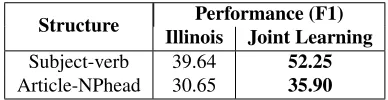
interact-ing structures are only a subset of mistakes in the CoNLL-2013 data set but the evaluation in Sec. 6 is performed with respect to all of these errors. From a scientific point of view, it is interesting to evalu-ate the impact of the joint models more precisely by considering the improvements on the relevant struc-tures only. Table 11 shows how much the joint learn-ing approach improves on the subset of relevant mis-takes.
Structure Performance (F1) Illinois Joint Learning Subject-verb 39.64 52.25 Article-NPhead 30.65 35.90
Table 11:Evaluation of the joint learning performance on the subset of the data containing interacting errors. All re-sults are on the CoNLL-2013 test data using the original anno-tations.Illinoisdenotes the result obtained by the top CoNLL-2013 shared task system. All improvements are statistically sig-nificant over the Illinois system (McNemar’s test,p <0.01).
Error AnalysisTo better understand where the joint models have an advantage over the independently-trained classifiers, we analyze the output produced by each of the approaches. In Table 10 we show examples of mistakes that the model that uses joint learning and inference is able to identify correctly, along with the original predictions made by the Illi-nois system.
[image:9.612.328.522.336.386.2]Joint inference is a less expensive model, since it uses the scores produced by the individual classifiers and thus does not require additional training. Joint learning, on the other hand, is superior to joint infer-ence, since it is better at modeling interactions where multiple errors occur simultaneously – it eliminates the noisy context present when learning the inde-pendent classifiers. Consider the first example from Table 10, where both the noun and the agreement classifiers receive noisy input: the verb “help” and the noun “technologies” act as part of input features for the noun and agreement classifiers, respectively. The noisy features prevent both modules from iden-tifying the two errors.
Finally, an important distinction of the joint learn-ing method is that it considers all possible output se-quencesin training, and thus it is able to better iden-tify errors that require multiple changes, such as the last example in Table 10, where the Illinois system proposes no changes.
7.1 Error Correction: Challenges
We finalize our discussion with a few comments on the challenges of the error correction task.
Task Difficulty As shown in Table 1 in Sec. 2, only a small percentage of words have mistakes, while over 90% (about 98% in training) are used correctly. The low error rates are the key reason the error cor-rection task is so difficult: it is quite challenging for a system to improve over a writer that already per-forms at the level of over 90%. Indeed, very few NLP tasks already have systems that perform at that level, even when the data is not as noisy as the ESL data.
Evaluation Metrics In the CoNLL-2013 competi-tion, as well as the competitions alluded to earlier, systems were compared on F1 performance, and, consequently, this is the metric we optimize in this paper. Practical error correction systems, however, should be tuned to minimize recall to guarantee that the overall quality of the text does not go down. In-deed, the error sparsity makes it very challenging to identify mistakes accurately, and no system in the shared task achieves a precision over 50%. How-ever, once the precision drops below 50%, the sys-tem introduces more mistakes than it identifies.
Clearly, optimizing the F1 measure does not en-sure that the quality of the text improves as a
re-sult of running the system. Thus, it can be argued that the F1 measure is not the right measure for er-ror correction. A different evaluation metric based on theaccuracyof the data before and after running the system was proposed in Rozovskaya and Roth (2010c). When optimizing for this metric, the noun module, for instance, at recall point 20%, achieves a precision of 63.93%. This translates into accuracy of 94.46%, while the baseline on noun errors in the test data (i.e. the accuracy of the data before running the system) is 94.0% (Table 1). This means that the system improves the quality of the data.
Annotation Lastly, we believe that it is important to provide alternative corrections, as the agreement on what constitutes a mistake even among native English speakers can be quite low (Madnani et al., 2011).
8 Conclusion
This work presented the first successful study that jointly corrects grammatical mistakes. We ad-dressed two pairs of interacting phenomena and showed that it is possible to reliably identify their components, thereby facilitating the joint approach.
We described two joint methods: a joint in-ference approach implemented via ILP and a
joint learning model. The joint inference en-forces constraints using the scores produced by the independently-trained models. The joint learning model learns the interacting phenomena as struc-tures. The joint methods produce a significant im-provement over a state-of-the-art system that com-bines independently-trained models and, impor-tantly, produce linguistically legitimate output.
Acknowledgments
References
C. Bishop. 1995. Neural Networks for Pattern Recogni-tion, chapter 6.4: Modelling conditional distributions. Oxford University Press.
T. Brants and A. Franz. 2006.Web 1T 5-gram Version 1. Linguistic Data Consortium, Philadelphia, PA. C. Brockett, D. B. William, and M. Gamon. 2006.
Correcting ESL errors using phrasal SMT techniques. In Proceedings of the 21st International Conference on Computational Linguistics and 44th Annual Meet-ing of the Association for Computational LMeet-inguistics, pages 249–256, Sydney, Australia, July. Association for Computational Linguistics.
A. J. Carlson, J. Rosen, and D. Roth. 2001. Scaling up context sensitive text correction. InIAAI.
J. Clarke and M. Lapata. 2007. Modelling compression with discourse constraints. InProceedings of the 2007 Joint Conference of EMNLP-CoNLL.
D. Dahlmeier and H.T Ng. 2012. A beam-search de-coder for grammatical error correction. In EMNLP-CoNLL, Jeju Island, Korea, July. Association for Com-putational Linguistics.
D. Dahlmeier, H.T. Ng, and S.M. Wu. 2013. Building a large annotated corpus of learner english: The nus corpus of learner english. InProc. of the NAACL HLT 2013 Eighth Workshop on Innovative Use of NLP for Building Educational Applications, Atlanta, Georgia, June. Association for Computational Linguistics. R. Dale and A. Kilgarriff. 2011. Helping Our Own: The
HOO 2011 pilot shared task. InProceedings of the 13th European Workshop on Natural Language Gen-eration.
R. Dale, I. Anisimoff, and G. Narroway. 2012. A re-port on the preposition and determiner error correction shared task. InProc. of the NAACL HLT 2012 Seventh Workshop on Innovative Use of NLP for Building Edu-cational Applications, Montreal, Canada, June. Asso-ciation for Computational Linguistics.
R. De Felice and S. Pulman. 2008. A classifier-based ap-proach to preposition and determiner error correction in L2 English. InProceedings of the 22nd Interna-tional Conference on ComputaInterna-tional Linguistics (Col-ing 2008), pages 169–176, Manchester, UK, August. Y. Freund and R. E. Schapire. 1996. Experiments with
a new boosting algorithm. InProc. 13th International Conference on Machine Learning.
M. Gamon, J. Gao, C. Brockett, A. Klementiev, W. Dolan, D. Belenko, and L. Vanderwende. 2008. Using contextual speller techniques and language modeling for ESL error correction. InProceedings of IJCNLP.
M. Gamon. 2010. Using mostly native data to correct errors in learners’ writing. InNAACL, pages 163–171, Los Angeles, California, June.
A. R. Golding and D. Roth. 1999. A Winnow based approach to context-sensitive spelling correction. Ma-chine Learning.
N. Han, M. Chodorow, and C. Leacock. 2006. Detecting errors in English article usage by non-native speakers.
Journal of Natural Language Engineering, 12(2):115– 129.
E. Izumi, K. Uchimoto, T. Saiga, T. Supnithi, and H. Isa-hara. 2003. Automatic error detection in the Japanese learners’ English spoken data. InThe Companion Vol-ume to the Proceedings of 41st Annual Meeting of the Association for Computational Linguistics, pages 145–148, Sapporo, Japan, July.
J. Lee and S. Seneff. 2008. Correcting misuse of verb forms. In ACL, pages 174–182, Columbus, Ohio, June. Association for Computational Linguistics. N. Madnani, M. Chodorow, J. Tetreault, and A.
Ro-zovskaya. 2011. They can help: Using crowdsourcing to improve the evaluation of grammatical error detec-tion systems. InProceedings of the 49th Annual Meet-ing of the Association for Computational LMeet-inguistics: Human Language Technologies, pages 508–513, Port-land, Oregon, USA, June. Association for Computa-tional Linguistics.
M. Marneffe, B. MacCartney, and Ch. Manning. 2006. Generating typed dependency parses from phrase structure parses. InLREC.
A. Martins, Noah N. Smith, M. Figueiredo, and P. Aguiar. 2011. Dual decomposition with many overlapping components. InProceedings of the 2011 Conference on Empirical Methods in Natural Language Process-ing, pages 238–249, Edinburgh, Scotland, UK., July. Association for Computational Linguistics.
H. T. Ng, S. M. Wu, Y. Wu, Ch. Hadiwinoto, and J. Tetreault. 2013. The conll-2013 shared task on grammatical error correction. In Proc. of the Sev-enteenth Conference on Computational Natural Lan-guage Learning.Association for Computational Lin-guistics.
A. Park and R. Levy. 2011. Automated whole sentence grammar correction using a noisy channel model. In
ACL, Portland, Oregon, USA, June. Association for Computational Linguistics.
V. Punyakanok and D. Roth. 2001. The use of classifiers in sequential inference. InNIPS.
V. Punyakanok, D. Roth, and W. Yih. 2008. The impor-tance of syntactic parsing and inference in semantic role labeling.Computational Linguistics, 34(2). D. Roth and W. Yih. 2004. A linear programming
formu-lation for global inference in natural language tasks. In Hwee Tou Ng and Ellen Riloff, editors,CoNLL. A. Rozovskaya and D. Roth. 2010a. Annotating ESL
NAACL Workshop on Innovative Use of NLP for Build-ing Educational Applications.
A. Rozovskaya and D. Roth. 2010b. Generating con-fusion sets for context-sensitive error correction. In
Proceedings of the Conference on Empirical Methods in Natural Language Processing (EMNLP).
A. Rozovskaya and D. Roth. 2010c. Training paradigms for correcting errors in grammar and usage. In
NAACL.
A. Rozovskaya and D. Roth. 2011. Algorithm selec-tion and model adaptaselec-tion for ESL correcselec-tion tasks. In
ACL.
A. Rozovskaya, M. Sammons, J. Gioja, and D. Roth. 2011. University of Illinois system in HOO text cor-rection shared task.
A. Rozovskaya, M. Sammons, and D. Roth. 2012. The UI system in the HOO 2012 shared task on error cor-rection.
A. Rozovskaya, K.-W. Chang, M. Sammons, and D. Roth. 2013. The University of Illinois system in the CoNLL-2013 shared task. InCoNLL Shared Task. C. Sutton and A. McCallum. 2007. Piecewise pseudo-likelihood for efficient training of conditional random fields. In Zoubin Ghahramani, editor,ICML.
J. Tetreault and M. Chodorow. 2008. The ups and downs of preposition error detection in ESL writing. InProceedings of the 22nd International Conference on Computational Linguistics (Coling 2008), pages 865–872, Manchester, UK, August.