Context-Based Morphological Disambiguation with Random Fields
∗Noah A. Smith and David A. Smith and Roy W. Tromble
Department of Computer Science / Center for Language and Speech Processing
Johns Hopkins University, Baltimore, MD 21218 USA
{
nasmith,dasmith,royt
}
@cs.jhu.edu
Abstract
Finite-state approaches have been highly successful at describ-ing the morphological processes of many languages. Such approaches have largely focused on modeling the phone- or character-level processes that generate candidate lexical types, rather than tokens in context. For the full analysis of words in context, disambiguation is also required (Hakkani-T¨ur et al., 2000; Hajiˇc et al., 2001). In this paper, we apply a novel source-channel model to the problem of morphological disam-biguation (segmentation into morphemes, lemmatization, and POS tagging) for concatenative, templatic, and inflectional lan-guages. The channel model exploits an existing morphological dictionary, constraining each word’s analysis to be linguistically valid. The source model is a factored, conditionally-estimated random field (Lafferty et al., 2001) that learns to disambiguate the full sentence by modeling local contexts. Compared with baseline state-of-the-art methods, our method achieves statisti-cally significant error rate reductions on Korean, Arabic, and Czech, for various training set sizes and accuracy measures.
1
Introduction
One of the great successes in computational linguistics has been the construction of morphological analyzers for diverse languages. Such tools take in words and enu-merate the possible morphological analyses—typically a sequence of morphemes, perhaps part-of-speech tagged. They are often encoded as finite-state transducers (Ka-plan and Kay, 1981; Koskenniemi, 1983; Beesley and Karttunen, 2003).
What such tools do not provide is a means to
dis-ambiguate a word in context. For languages with
com-plex morphological systems (inflective, agglutinative, and polysynthetic languages, for example), a word form may have many analyses. To pick the right one, we must consider the word’s context. This problem has been tackled using statistical sequence models for Turk-ish (Hakkani-T¨ur et al., 2000) and Czech (Hajiˇc et al., 2001); their approaches (and ours) are not unlike POS tagging, albeit with complex tags.
∗
This work was supported by a Fannie and John Hertz Foundation Fellowship, a NSF Fellowship, and a NDSEG Fel-lowship (sponsored by ARO and DOD). The views expressed are not necessarily endorsed by sponsors. We thank Eric Gold-lust and Markus Dreyer for Dyna language support and Jason Eisner, David Yarowsky, and three anonymous reviewers for comments that improved the paper. We also thank Jan Hajiˇc and Pavel Krbec for sharing their Czech tagger.
In this paper, we describe context-based models for morphological disambiguation that take full account of existing morphological dictionaries by estimating
condi-tionally against only dictionary-accepted analyses of a
sentence (§2). These models are an instance of condi-tional random fields (CRFs; Lafferty et al., 2001) and include overlapping features. Our applications include diverse disambiguation frameworks and we make use of linguistically-inspired features, such as local lemma de-pendencies and inflectional agreement. We apply our model to Korean and Arabic, demonstrating state-of-the-art results in both cases (§3). We then describe how our model can be expanded to complex, structured morpho-logical tagging, including an efficient estimation method, demonstrating performance on Czech (§4).
2
Modeling Framework
Our framework is a source-channel model (Jelinek, 1976). The source (modeled probabilistically byps) gen-erates a sequence of unambiguous tagged morphemes y = hy1, y2, ...i ∈ Y+ (Y is the set of unambiguous
tagged morphemes in the language).1 The precise con-tents of the tag will vary by language and corpus but will minimally include POS. y passes through a
chan-nel (modeled bypc), which outputsx = hx1, x2, ...i ∈
(X∪ {OOV})+, a sequence of surface-level words in the language and out-of-vocabulary words (OOV; X is the language’s vocabulary). Note that |x| may be smaller than|y|, since some morphemes may combine to make a word. We will denote by yi the contiguous subse-quence ofythat generatesxi;~ywill refer to a dictionary-recognized type inY+.
At test time, we decode the observedxinto the most probable sequence of tag/morpheme pairs:
ˆ
y= argmax
y
p(y|x) = argmax
y
ps(y)·pc(x|y) (1)
Training involves constructingpsandpc. We assume that there exists a training corpus of text (each wordxi annotated with its correct analysisy∗i) and a morpholog-ical dictionary. We next describe the channel model and the source model.
1The sequence also includes segmentation markings
be-tween words, not shown to preserve clarity.
a. There are many kinds of trench mortars.
b. . — 1998 1998—Sanaa accuses Riyadh of occupying border territories.
0 NUM/1998 1 PUNC/- 2 3
NOUN_PROP/SnEA’ NOUN_PROP/SanoEA’
4
IV3FS/tu IV2MS/tu
5
IV3FS/ta
IV2MS/ta 6
NOUN_PROP/tthm
IV_PASS/t~aham
IV/t~ahim 7 8
9 10 11
12 13 14
c. Klimatizovan´a j´ıdelna, svˇetl´a m´ıstnost pro sn´ıdanˇe. Air-conditioned dining room, well-lit breakfast room.
0 1
Adj {Neu Pl Acc Pos Aff}/klimatizovaný
Adj {Neu Pl Voc Pos Aff}/klimatizovaný Adj {Fem Si Voc Pos Aff}/klimatizovaný Adj {Fem Si Nom Pos Aff}/klimatizovaný
Adj {Neu Pl Nom Pos Aff}/klimatizovaný
2
Noun {Fem Si Nom Aff}/jídelna Punc/, 3 4
Adj {Neu Pl Pos Aff}/svetlý Adj {Fem Si Voc Pos Aff}/svetlý Adj {Neu Pl Acc Pos Aff}/svetlý Adj {Neu Pl Voc Pos Aff}/svetlý
Adj {Fem Si Nom Pos Aff}/svetlý
5
Noun {Fem Si Acc Aff}/místnost
[image:2.612.78.551.56.246.2]Noun {Fem Si Nom Aff}/místnost 6 7 8
Figure 1: Lattices for example sentences in Korean (a), Arabic (b), and Czech (c). Arabic lemmas are not shown, and some Arabic and Czech arcs are unlabeled, for readability. The Arabic morphemes are shown in Buckwalter’s encoding. The arcs in the correct path through each lattice are solid (incorrect arcs are dashed). Note the adjective-noun agreement in the correct path through the Czech lattice (c). The Czech lattice has no lemma-ambiguity; this is typical in Czech (see§4).
2.1 Morphological dictionaries and the channel
A great deal of research has gone into developing mor-phological analysis tools that enumerate valid analyses ~
y ∈ Y+ for a particular word x ∈ X. Typically these
tools are unweighted and therefore do not enable token disambiguation.2
They are available for many languages. We will refer to this source of categorial lexical information as a mor-phological dictionarydthat mapsX→2Y+. The setd(x)
is the set of analyses for wordx; the setd(x)is the set of whole-sentence analyses for sentencex=hx1, x2, ...i.
d(x)can be represented as an acyclic lattice with a “sausage” shape familiar from work in speech recogni-tion (Mangu et al., 1999). Note that for languages with bound morphemes,d(x)will consist of a set of sequences of tokens, so a given “link” in the sausage lattice may contain paths of different lengths. Fig. 1 shows sausage lattices for sentences in three languages.
In this paper, the dictionary defines the support set of the channel model. That is,pc(x | y) > 0if and only if y ∈ d(x). This is a clean way to incorporate do-main knowledge into the probabilistic model; this kind of constraint has been applied in previous work at decod-ing time (Hakkani-T¨ur et al., 2000; Hajiˇc et al., 2001). In such a model, each word is independent of its neighbors (because the dictionary ignores context).
Estimation. A unigram channel model defines
2Probabilistic modeling of what we call the
morphologi-cal channel was first carried out by Levinger et al. (1995), who used unlabeled data to estimatep(~y|x)for Hebrew, with the support defined by a dictionary.
pc(x|y)
def
=
|x|
Y
i=1
p(xi|yi) (2)
The simplest estimate of this model is to make p(·,·)
uniform over(x, ~y)such that~y ∈ d(x). Doing so and marginalizing to getp(x | ~y)makes the channel model encode categorial information only, leaving all learning to the source model.3
Another way to estimate this model is, of course, from data. This is troublesome, because—modulo optionality—xis expected to be known given ~y, result-ing in a huge model with mostly 1-valued probabili-ties. Our solution is to take a projectionπof~y and let p(· |~y)≈p(· |π(~y)). In this paper,πmaps the analysis to its morphological tag (or tag sequence). We will refer to this as the “tag channel.”
OOV. Morphological dictionaries typically do not have complete coverage of a language. We can augment them in two ways using the training data. If a known wordx (one for whichd(x)is non-empty) appears in the training dataset with an analysis not ind(x), we add the entry to the dictionary. Unknown words (those not recognized by the dictionary) are replaced by anOOVsymbol. d(OOV)
is taken to be the set of all analyses for anyOOVword seen in training. Rather than attempt to recover the mor-pheme sequence for anOOVword, in this paper we try only for the tag sequence, replacing all of anOOV’s mor-phemes with theOOV symbol. SinceOOV symbols ac-count for less than 2% of words in our corpora, we leave
3Note that this makes the channel term in Eq. 1 a constant.
more sophisticated channel models to future work.
2.2 The source model
The source model ps defines a probability distribution overY+, sequences of (tag, morpheme) pairs. Our source models can be viewed as weighted multi-tape finite-state automata, where the weights are associated with local, of-ten overlapping features of the path through the automa-ton.
Estimation. We estimate the source conditionally from
annotated data. That is, we maximize
X
(x,y)∈X+×Y+
˜
p(x,y) logps
y|d(x), ~θ (3)
wherep˜(·,·)is the empirical distribution defined by the training data and ~θare the model parameters. In terms of Fig. 1, our learner maximizes the weight of the correct (solid) path through each lattice, at the expense of the other incorrect (dashed) paths. Note that
logps
y|d(x), ~θ= log
ps
y|~θ
P
y0∈d(x)ps
y0|θ~ (4)
The sum in the denominator is computed using a dynamic programming algorithm (akin to the forward algorithm); it involves computing the sum of all paths through the “sausage” lattice of possible analyses for x. By doing this, we allow knowledge of the support of the channel model to enter into our estimation of the source model. It is important to note that the estimation of the model (the objective function used in training, Eq. 3) is distinct from the source-channel structure of the model (Eq. 1).
The lattice-conditional estimation approach was first used by Kudo et al. (2004) for Japanese seg-mentation and hierarchical POS-tagging and by Smith and Smith (2004) for Korean morphological disambiguation. The resulting model is an instance of a conditional random field (CRF; Lafferty et al., 2001). When training a CRF for POS tagging, IOB chunking (Sha and Pereira, 2003), or word segmentation (Peng et al., 2004), one typically structures the conditional probabilities (in the objective function) using domain knowledge: in POS tagging, the set of allowed tags for a word is used; in IOB chunking, the bigram “O I” is disallowed; and in segmentation, a lexicon is used to enumerate the possible word boundaries.4
4
This refinement is in the same vein as the move from
max-imum likelihood estimation to conditional estimation. MLE
would make the sum in the denominator of Eq. 4Y+, which for log-linear models is often intractable to compute (and for sequence models may not converge). Conditional estimation limits the sum to the subset ofY+that is consistent withx, and
our variant further stipulates consistency with the dictionary en-tries forx.
Our approach is the same, with two modifications. First, we model the relationship between labelsyi and wordsxiin a separately-estimated channel model (§2.1). Second, our labels are complex. Each wordxiis tagged with a sequence of one or more tagged morphemes; the tags may include multiple fields. This leads to models with more parameters. It also makes the dictionary es-pecially important for limiting the size of the sum in the denominator, since a complex label setYcould in prin-ciple lead to a huge hypothesis space for a given sen-tencex. Importantly, it makes training conditions more closely match testing conditions, ruling out hypotheses a dictionary-aware decoder would never consider.
Optimization. The objective function (Eq. 3) is
con-cave and known to have a unique global maximum. Be-cause log-linear models and CRFs have been widely de-scribed elsewhere (e.g., Lafferty, 2001), we note only that we apply a standard first-order numerical optimization method (L-BFGS; Liu and Nocedal, 1989). The struc-ture, features, and regularization of our models will be described in§3 and§4.
Prior work (morphological source models).
Hakkani-T¨ur et al. (2000) described a system for Turkish that was essentially a source model; Hajiˇc et al. (2001) described an HMM-based system for Czech that could be viewed as a combined source and channel. Both used dictionaries and estimated their (generative) models using maximum likelihood (with smoothing).5 Given enough data, a ML-estimated model will learn to recog-nize a good pathy, but it may not learn to discriminate a goodyfrom wrong alternatives per se. The generative framework is limiting as well, disallowing the straight-forward inclusion of arbitrary overlapping features. We present a competitive Czech model in§4.
3
Concatenative Models
The beauty of log-linear models is that estimation is straightforward given any features, even ones that are not orthogonal (i.e., “overlap”). This permits focusing on feature (or feature template) selection without worries about the mathematics of training.
We consider two languages modeled by concatenative processes with surface changes at morpheme boundaries: Korean and Arabic.
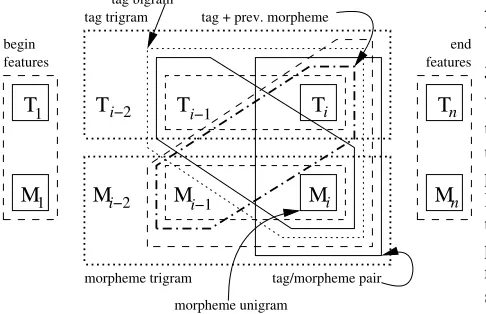
Our model includes features for tag n-grams, mor-phemen-grams, and pairs of the two (possibly of differ-ent lengths and offsets). Fig. 2 illustratesTM3, our base model. TM3 includes feature templates for some tuples of three or fewer elements, plus begin and end templates.
5Hajiˇc et al. also included a rule-based system for pruning
i−1
i−1
T
M
T
nM
n−2
i
T
−2
i
M
M
11
T
T
iM
imorpheme trigram tag trigram begin
features featuresend
tag/morpheme pair tag + prev. morpheme tag bigram
[image:4.612.71.314.59.216.2]morpheme unigram
Figure 2: The base two-level trigram source model,TM3. Each polygon corresponds to a feature template. This is a two level, second-order Markov model (weighted finite-state machine) pa-rameterized with overlapping features. Note that only some fea-tures are labeled in the diagram.
A variant, TM3H, includes all of the same templates, plus a similar set of templates that look only at head mor-phemes. For instance, a feature fires for each trigram of heads, even though there are (bound) morphemes be-tween them. This increases the domain of locality for se-mantic content-bearing morphemes. This model requires slight changes to the dynamic programming algorithms for inference and training (the previous two heads must be remembered at each state).
Every instantiation of the templates seen in any lattice d(x)built from training data is included in the model, not just those seen in correct analysesy∗.6
3.1 Experimental design
In all of our experiments, we vary the training set size and the amount of smoothing, which is enforced by a di-agonal Gaussian prior (L2regularizer) with varianceσ2.
The σ2 = ∞case is equivalent to not smoothing. We
compare performance to the expected performance of a randomized baseline that picks for each word tokenxan analysis fromd(x); this gives a measure of the amount of ambiguity and is denoted “channel only.” Performance of unigram, bigram, and trigram HMMs estimated us-ing maximum likelihood (barely smoothed, usus-ing
add-10−14) is also reported. (The unigram HMM simply
picks the most likely~yfor eachx, based on training data and is so marked.)
In the experiments in this section, we report three per-formance measures. Tagging accuracy is the fraction
of words whose tag sequence was correctly identified in entirety; morpheme accuracy is defined analogously.
6If we used only features observed to occur iny∗
, we would not be able to learn negative weights for unlikely bits of structure seen in the latticed(x)but not iny∗.
Lemma accuracy is the fraction of words whose lemma
was correctly identified.
3.2 Korean experiments
We applied TM3 and TM3Hto Korean. The dataset is the Korean Treebank (Han et al., 2002), with up to 90% used for training and 10% (5K words) for test. The mor-phological dictionary isklex(Han, 2004). There are 27 POS tags in the tag set; the corpus contains 10K word types and 3,272 morpheme types. There are 1.7 mor-phemes per word token on average (σ = 0.75). A Ko-rean word generally consists of a head morpheme with a series of enclitic suffixes. In training the head-augmented model TM3H, we assume the first morpheme of every word is the head and lemma.
Results are shown in Tab. 1.TM3Hachieved very slight gains overTM3, and the tag channel model was helpful only with the smaller training set. The oracle (last line of Tab. 1) demonstrates that the coverage of the dictio-nary remains an obstacle, particularly for recovering mor-phemes. Another limitation is the small amount of train-ing data, which may be masktrain-ing differences among esti-mation conditions. We report the performance ofTM3H with “factored” estimation. This will be discussed in detail in §4; it means that a model containing only the head features was trained on its own, then combined with the independently trainedTM3 model at test time. Fac-tored training was slightly faster and did not affect per-formance at all; accuracy scores were identical with un-factored training.
Prior work (Korean). Similar results were presented
by Smith and Smith (2004), using a similar estimation strategy with a model that included far more feature tem-plates. TM3 has about a third as many parameters and TM3Habout half; performance is roughly the same (num-bers omitted for space). Korean disambiguation results were also reported by Cha et al. (1998), who applied a deterministic morpheme pattern dictionary to segment words, then used a bigram HMM tagger. They also ap-plied transformation-based learning to fix common er-rors. Due to differences in tag set and data, we cannot compare to that model; a bigram baseline is included.
3.3 Arabic experiments
We appliedTM3 andTM3Hto Arabic. The dataset is the Arabic Treebank (Maamouri et al., 2003), with up to 90% used for training and 10% (13K words) for test. The mor-phological dictionary is Buckwalter’s analyzer (version 2), made available by the LDC (Buckwalter, 2004).7This analyzer has total coverage of the corpus; there are no
7Arabic morphological processing was also addressed by
Korean Arabic
POS tagging morpheme lemma POS tagging morpheme lemma
accuracy accuracy accuracy accuracy accuracy accuracy
σ2
32K 49K 32K 49K 32K 49K 38K 76K 114K 38K 76K 114K 38K 76K 114K
most likely~y 86.0 86.9 87.5 88.8 95.3 95.7 84.5 87.0 88.3 83.2 86.2 87.0 37.9 39.8 40.9 channel only 62.6 62.6 70.3 70.8 86.4 86.4 43.7 43.7 43.7 41.2 41.2 41.2 27.2 27.2 27.2 bigram HMM 90.7 91.2 83.2 86.1 96.9 97.2 90.3 92.0 92.8 89.2 91.4 91.6 85.7∗ 87.8∗87.9∗ trigram HMM 91.5 91.8 83.3 86.0 97.0 97.2 89.8 92.0 93.0 88.5 91.3 91.3 85.2∗ 87.8∗87.7∗
TM3 ∞ 90.7 91.3 89.3 90.5 97.1 97.4 94.6 95.4 95.9 93.4 94.3 94.9 89.7∗ 90.5∗90.7∗
uniform
channel
10 91.2 91.7 89.4 90.6 97.1 97.6 95.3 95.7 96.1 93.9 94.5 95.0 90.2∗ 90.6∗91.1∗ 1 91.5 92.2 89.4 90.6 97.1 97.5 95.2 95.7 96.0 93.9 94.5 94.7 90.0∗ 90.7∗91.0∗
TM3H ∞ 91.1 91.1 89.3 90.4 97.2 97.5 95.0 95.7 96.0 94.0 94.8 95.3 93.3 93.9 94.2 (factored) 10 91.3 91.9 89.5 90.6 97.3 97.6 95.3 95.7 96.1 94.2 94.7 95.4 93.4 93.6 94.4 1 91.4 92.2 89.5 90.7 97.3 97.6 95.4 95.8 96.1 94.4 94.8 95.1 93.3 93.8 94.2 channel only 51.4 51.3 60.6 60.4 81.2 81.7 41.4 40.6 40.1 39.9 39.1 38.6 26.7∗ 26.5∗26.4∗ bigram HMM 91.2 90.9 88.9 90.1 97.0 97.3 91.0 92.3 93.4 89.7 91.5 91.9 88.1∗ 89.9∗90.0∗ trigram HMM 91.6 91.9 88.9 90.2 97.1 97.4 91.1 92.9 93.7 89.6 92.2 92.0 88.1∗ 90.6∗90.4∗
TM3 ∞ 90.8 91.0 89.5 90.5 97.4 97.5 95.1 95.7 96.0 93.8 94.6 95.0 92.2∗ 93.1∗93.2∗
tag
channel 10 90.6 91.1 89.5 90.7 97.2 97.6 95.2 95.6 96.0 93.9 94.7 95.0 92.4 ∗
93.2∗93.5∗ 1 90.1 90.9 89.5 90.7 97.1 97.6 94.9 95.5 95.8 93.8 94.5 94.8 92.2∗ 93.0∗93.1∗
TM3H ∞ 91.0 91.0 89.4 90.5 97.2 97.6 95.1 95.8 96.0 94.0 95.1 95.4 93.3 94.3 94.4 (factored) 10 90.4 91.2 89.6 90.7 97.4 97.6 95.2 95.7 96.0 94.1 94.8 95.4 93.3 94.0 94.6 1 90.1 91.0 89.5 90.7 97.3 97.6 95.1 95.5 95.9 94.1 94.9 95.1 93.3 94.0 94.4
[image:5.612.75.537.56.299.2]oracle givend(x) 95.3 95.7 90.2 91.2 98.1 98.3 100.0 100.0 100.0 100.0 100.0 100.0 100.0 100.0 100.0
Table 1: Korean (left, 5K test-set) and Arabic (right, 13K test-set) disambiguation. A word is marked correct only if its entire tag (or morpheme) sequence (or lemma) was correctly identified. Morpheme and lemma accuracy do not includeOOVwords. The oracle is an upper bound on accuracy given the morphological dictionary. ∗These models do not explicitly predict lemmas; the lemma is chosen arbitrarily from those that match the hypothesized tag/morpheme sequence for each word. Bold scores indicate a significant improvement over the trigram HMM (binomial sign test,p <0.05).
OOVwords. There are 139 distinct POS tags; these con-tain some inflectional information which we treat atom-ically. For speed, TM3H was trained in two separate pieces:TM3 and the lemma features added byTM3H.
Arabic has a templatic morphology in which conso-nantal roots are transformed into surface words by the insertion of vowels and ancillary consonants. Our sys-tem does not model this process except through the use of Buckwalter’s dictionary to define the set of analyses for each word (cf., Daya et al., 2004, who modeled inter-digitation in Hebrew). We treat the analysis of an Ara-bic word as a sequence ~y of pairs of morphemes and POS tags, plus a lemma. The lemma, given in the dic-tionary, provides further disambiguation beyond the head morpheme. The lemma is a standalone dictionary head-word and not merely the consonantal root, as in some other work. The “heads” modeled byTM3Hcorrespond to these lemmas. There are 20K word types, and 34K morpheme types. There are 1.7 morphemes per word to-ken on average (σ= 0.77).
Results are shown in Tab. 1. Across tasks and training set sizes, our models reduce error rates by more than 36% compared to the trigram HMM source with tag channel. The TM3Hmodel and the tag channel offer slight gains over the baseTM3 model (especially on lemmatization), though the tag channel offers no help in POS tagging.
Prior work (Arabic). Both Diab et al. (2004) and
Habash and Rambow (2005) use support-vector ma-chines with local features; the former for tokenization, POS tagging, and base phrase chunking; the latter for full morphological disambiguation. Diab et al. report results for a coarsened 24-tag set, while we use the full 139 tags from the Arabic Treebank, so the systems are not directly comparable. Habash and Rambow present even better results on the same POS tag set. Our full dis-ambiguation results appear to be competitive with theirs. Khoja (2001) and Freeman (2001) describe Arabic POS taggers and many of the issues involved in developing them, but because tagged corpora did not yet exist, there are no comparable quantitative results.
4
Czech: Model and Experiments
full model (decoding) factored models (training) gender
number case POS
morphological
tags
morph. tag
num.
gen. case POS
lemma
lemmas
y
y
y
y
1
2
3
[image:6.612.82.287.53.229.2]4
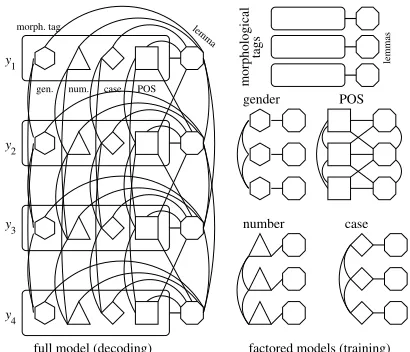
Figure 3: The Czech model, shown as an undirected graphi-cal model. The structure of the full model is on the left; fac-tored components for estimation are shown on the right. Each of these five models contains a subset of theTM3 features. The full model is only used to decode. The factored models make training faster and are used for pruning.
1,400 distinct tag types in the PDT.
Czech has been treated probabilistically before, per-haps most successfully by Hajiˇc et al. (2001).8 In con-trast, we estimate conditionally (rather than by maximum likelihood for a generative HMM) and separate the train-ing of the source and the channel. We also introduce a novel factored treatment of the morphological tags.
4.1 Factored tags and estimation
Because Czech morphological tags are not monolithic, the choice among them can be treated as several more or less orthogonal decisions. The case feature of one word, for example, is expected to be conditionally independent of the next word’s gender, given the next word’s case. Constraints in the language are expected to cause features like case, number, and gender to agree locally (on words that have such features) and somewhat independently of each other. Coarser POS tagging may be treated as an-other, roughly independent stream.
Log-linear models and the use of a morphological dic-tionary make this kind of tag factoring possible. Our approach is to separately train five log-linear models. Each model is itself an instance of some of the templates from TM3, modeling a projection of the full analysis. The model and its factored components are illustrated in Fig. 3.
POS model. The full tag is replaced by the POS tag
(the first two fields); there are 60 POS tags. The TM3
8Czech morphological processing was studied by
Petkeviˇc (2001), Hlav´acov´a (2001) (who focuses on han-dlingOOVwords), and Mr´akov´a and Sedlacek (2003) (who use partial parsing to reduce the set of possible analyses), inter alia.
feature templates are included twice: once for the full tag and once for a coarser tag (the first PDT field, for which there are 12 possible values).9
Gender, number, and case models. The full tag is
re-placed by the gender (or case or number) field. This model includes bigrams and trigrams as well as field-morpheme unigram features. These models are intended to learn to predict local agreement.
Tag-lemma model. This model contains unigram
fea-tures of full PDT tags, both alone and with lemmas. It is intended to learn to penalize morphological tags that are rare, or that are rare with a particular lemma. In our for-mulation, this is not a channel model, because it ignores the surface word forms.
Each model is estimated independently of the others. The latticed(x)against which the conditional probabili-ties are estimated contains the relevant projection of the full morphological tags (with lemmas). To decode, we run a Viterbi-like algorithm that uses the union of all models’ features to pick the best analysis (full morpho-logical tags and lemmas) allowed by the dictionary.
There are two important advantages of factored train-ing. First, each model is faster to train alone than a model with all features merged; in fact, training the fully merged model takes far too long to be practical. Second, factored models can be held out at test time to measure their effect on the system, without retraining.
Prior work (factored training). Separately training
different models that predict the same variables (e.g.,x andy) then combining them for consensus-based infer-ence (either through a mixture or a product of proba-bilities) is an old idea (Genest and Zidek, 1986). Re-cent work in learning weights for the component “ex-pert” models has turned to cooperative techniques (Hin-ton, 1999). Decoding that findsy(givenx) to maximize some weighted average of log-probabilities is known as a logarithmic opinion pool (LOP). LOPs were applied to CRFs (for named entity recognition and tagging) by Smith et al. (2005), with an eye toward regularization. Their experts (each a CRF) contained overlapping feature sets, and the combined model achieved much the same effect as training a single model with smoothing. Note that our models, unlike theirs, partition the feature space; there is only one CRF, but some parameters are ignored when estimating other parameters. We have not estimated log-domain mixing coefficients—we weight all models’ contributions equally. Sutton and McCallum (2005) have applied factored estimation to CRFs, motivated (like us) by speed; they also describe how factored estimation
9Lemma-trigram and fine POS-unigram/lemma-bigram
full morph. lemma POS OOVPOS
accuracy accuracy accuracy accuracy
σ2 376K 768K 376K 768K 376K 768K 376K 768K channel only 61.4 60.3 85.1 84.2 88.5 87.2 17.8 16.4 most likely~y 80.0 80.8 98.1 98.1 97.9 97.8 52.0 52.0 Hajiˇc et al. HMM 88.8 89.2 97.9 97.9 95.8 95.8 52.0 52.0
+OOVmodel 90.5 90.8 97.9 97.9 96.7 96.6 93.0 92.9
full ∞ 88.1 88.5 98.3 98.5 98.3 98.3 60.2 61.8
oracle given pruning 98.6 99.3 99.5 99.6 99.1 99.7 60.2 90.3
10 88.4 88.5 98.4 98.4 98.3 98.2 61.8 59.4
oracle given pruning 99.3 99.3 99.5 99.6 99.8 99.7 93.4 90.6
1 88.6 88.6 98.4 98.4 98.2 98.1 60.0 56.7
oracle given pruning 99.3 99.3 99.5 99.6 99.8 99.8 95.0 94.0
– POS ∞ 87.9 88.0† 98.2 98.2† 98.0 97.9† 55.7 51.7† 10 88.1 88.3† 98.2 98.3† 98.0 97.9† 55.4 51.6† 1 88.4 88.5† 98.2 98.2† 98.0 97.9† 55.0 51.9† – tag-lemma ∞ 87.8 88.3 98.3 98.6 98.3 98.3 60.2 59.7
10 88.0 88.1 98.4 98.5 98.3 98.2 59.1 59.1 1 88.0 88.1 98.4 98.4 98.2 98.1 59.0 58.1 POS only ∞ 65.6∗65.5∗ 98.3 98.6 98.3 98.4 60.2 63.7 10 65.7∗65.5∗ 98.5 98.6 98.5 98.5 65.2 66.4 1 65.7∗65.5∗ 98.6 98.7 98.6 98.6 67.2 67.2
POS & ∞ 81.2 82.3 98.3 98.6 98.3 98.4 60.2 63.9
tag-lemma† 10 81.9 82.3 98.5 98.6 98.4 98.5 65.8 67.2 1 82.0 82.3 98.4 98.5 98.5 98.4 67.8 66.3
[image:7.612.76.395.55.326.2]oracle givend(x) 99.8 99.8 99.5 99.6 99.9 99.9 100.0 100.0
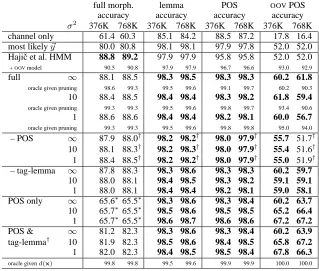
Table 2: Czech disambiguation: test-set (109K words) accuracy. A word is marked correct only if its entire morphological tag (or mor-pheme or POS tag) was correctly identified. Note that the full tag is a complex, 15-field morphologi-cal label, while “POS” is a projec-tion down to a tagset of size 60. Lemma accuracy does not include
OOVwords. ∗The POS-only model selects only POS, not full tags; these measures are expected performance if the full tag is selected randomly from those in the dictionary that match the selected POS.†Required more aggressive pruning. Bold scores were significantly better than the HMM of Hajiˇc et al. (binomial sign test,p < 0.05). Our models were slightly but significantly worse on full tagging, but showed signif-icant improvements on recovering POS tags and lemmas.
maximizes a lower bound on the unfactored objective. Smith and Smith (2004) applied factored estimation to a bilingual weighted grammar, driven by data limitations.
4.2 Experiments
Our corpus is the PDT (Hajiˇc, 1998), with up to 60% used for training and 10% (109K words) used for test.10 The morphological dictionary is the one packaged with the PDT; it covers about 98% of the tokens in the corpus. The remaining 2% have (unsurprisingly) a diverse set of 300– 400 distinct tags, depending on the training set size.11
Results are shown in Tab. 2. We compare to the HMM of (Hajiˇc et al., 2001) without itsOOVcomponent.12 We report morphological tagging accuracy on words; we also report lemma accuracy (on non-OOVwords), POS
accu-10We used less than the full corpus to keep training time
down; note that the training sets are nonetheless substantially larger than in the Korean and Arabic experiments.
11
During training, these project down to manageable num-bers of hypotheses in the factored models. At test-time, how-ever, Viterbi search is quite difficult whenOOVsymbols occur consecutively. To handle this, we pruneOOVarcs from the lat-tices using the factored POS and inflectional models. For each
OOV, every model prunes a projection of the analysis (e.g., the POS model prunes POS tags) until 90% of the posterior mass or 3 arcs remain (whichever is more conservative). Viterbi decod-ing is run on a lattice containdecod-ingOOVarcs consistent with the pruned projected lattices.
12Results with the
OOVcomponent are also reported in Tab. 2, but we cannot guarantee their experimental validity, since the
OOV component is pre-trained and may have been trained on data in our test set.
racy on all words, and POS accuracy onOOVwords. The channel model (not shown) tended to have a small, harm-ful effect on performance.
Without any explicit OOV treatment, our POS-only component model significantly reduces lemma and POS errors compared to Hajiˇc et al.’s model. On recovering
full morphological tags, our full model is close in
perfor-mance to Hajiˇc et al., but still significantly worse. It is likely that for many tasks, these performance gains are more helpful than the loss on full tagging is harmful.
Why doesn’t our full model perform as well as Hajiˇc et al.’s model? An error analysis reveals that our full model (768K,σ2= 1), compared to the HMM (768K) had 91%
as many number errors but 0.1% more gender and 31% more case errors. Taking out those three models (“POS & tag-lemma” in Fig. 2) is helpful on all measures ex-cept full tagging accuracy, due in part to substantially increased errors on gender (87% increase), case (54%), and number (35%). The net effect of these components, then, is helpful, but not quite helpful enough to match a well-smoothed HMM on complex tagging. We com-pared the models on the training set and found the same pattern, demonstrating that this is not merely a matter of over-fitting.
5
Future Work
directly modeling spelling changes. The second is to turn our factored model into a LOP. Training the mixture co-efficients should be straightforward (if time-consuming) with a development dataset.
A drawback of our system (especially for Czech) is that some components (most notably, the Czech POS model) take a great deal of time to train (up to two weeks on 2GHz Pentium systems). Speed improvements are expected to come from eliminating some of the over-lapping feature templates, generalized speedups for log-linear training, and perhaps further factoring.
6
Conclusion
We have explored morphological disambiguation of di-verse languages using log-linear sequence models. Our approach reduces error rates significantly on POS tag-ging (Arabic and Czech), morpheme sequence recovery (Korean and Arabic), and lemmatization (all three lan-guages), compared to baseline state-of-the-art methods For complex analysis tasks (e.g., Czech tagging), we have demonstrated that factoring a large model into smaller components can simplify training and achieve excel-lent results. We conclude that a conditionally-estimated source model informed by an existing morphological dic-tionary (serving as an unweighted channel) is an effective approach to morphological disambiguation.
References
K. R. Beesley and L. Karttunen. 2003. Finite State
Morphol-ogy. CSLI.
T. Buckwalter. 2004. Arabic morphological analyzer version 2.0. LDC2004L02.
J. Cha, G. Lee, and J.-H. Lee. 1998. Generalized unknown morpheme guessing for hybrid POS tagging of Korean. In
Proc. of VLC.
K. Darwish. 2002. Building a shallow Arabic morphological analyser in one day. In Proc. of ACL Workshop on
Computa-tional Approaches to Semitic Languages.
E. Daya, D. Roth, and S. Wintner. 2004. Learning Hebrew roots: Machine learning with linguistic constraints. In Proc.
of EMNLP.
M. Diab, K. Hacioglu, and D. Jurafsky. 2004. Automatic tag-ging of Arabic text: From raw text to base phrase chunks. In
Proc. of HLT-NAACL.
A. Freeman. 2001. Brill’s POS tagger and a morphology parser for Arabic. In Proc. of ACL Workshop on Arabic Language
Processing.
C. Genest and J. V. Zidek. 1986. Combining probability distri-butions: A critique and an annotated bibliography. Statistical
Science, 1:114–48.
N. Habash and O. Rambow. 2005. Arabic tokenization, part-of-speech tagging and morphological disambiguation in one fell swoop. In Proc. of ACL.
J. Hajiˇc, P. Krbec, P. Kvˇetoˇn, K. Oliva, and V. Petkeviˇc. 2001. Serial combination of rules and statistics: A case study in Czech tagging. In Proc. of ACL.
J. Hajiˇc. 1998. Building a syntactically annotated corpus: The Prague Dependency Treebank. In Issues of Valency and
Meaning.
D. Z. Hakkani-T¨ur, K. Oflazer, and G. T¨ur. 2000. Statistical morphological disambiguation for agglutinative languages. In Proc. of COLING.
C.-H. Han, N.-R. Han, E.-S. Ko, H. Yi, and M. Palmer. 2002. Penn Korean Treebank: Development and evaluation. In
Proc. Pacific Asian Conf. Language and Comp.
N.-R. Han. 2004. Klex: Finite-state lexical transducer for Ko-rean. LDC2004L01.
G. Hinton. 1999. Products of experts. In Proc. of ICANN. J. Hlav´acov´a. 2001. Morphological guesser of Czech words.
In Proc. of TSD.
F. Jelinek. 1976. Continuous speech recognition by statistical methods. Proc. of the IEEE, 64(4):532–557.
R. M. Kaplan and M. Kay. 1981. Phonological rules and finite-state transducers. Presented at Linguistic Society of Amer-ica.
S. Khoja. 2001. APT: Arabic part-of-speech tagger. In Proc.
of NAACL Student Workshop.
G. Kiraz. 2000. Multitiered nonlinear morphology using mul-titape finite automata: A case study on Syriac and Arabic.
Computational Linguistics, 26(1):77–105.
K. Koskenniemi. 1983. Two-level morphology: A general computational model of word-form recognition and produc-tion. Technical Report 11, University of Helsinki.
T. Kudo, K. Yamamoto, and Y. Matsumoto. 2004. Applying conditional random fields to Japanese morphological analy-sis. In Proc. of EMNLP.
J. Lafferty, A. McCallum, and F. Pereira. 2001. Conditional random fields: Probabilistic models for segmenting and la-beling sequence data. In Proc. of ICML.
M. Levinger, U. Ornan, and A. Itai. 1995. Learning morpho-lexical probabilities from an untagged corpus with an appli-cation to Hebrew. Computational Linguistics, 21(3):383– 404.
D. C. Liu and J. Nocedal. 1989. On the limited memory method for large scale optimization. Mathematical Programming B, 45(3):503–28.
M. Maamouri, A. Bies, H. Jin, and T. Buckwalter. 2003. Arabic Treebank part 1 version 2.0. LDC2003T06.
L. Mangu, E. Brill, and A. Stolcke. 1999. Finding consensus among words: Lattice-based word error minimization. In
Proc. of ECSCT.
E. Mr´akov´a and R. Sedlacek. 2003. From Czech morphol-ogy through partial parsing to disambiguation. In Proc. of
CLITP.
F. Peng, F. Feng, and A. McCallum. 2004. Chinese segmenta-tion and new word detecsegmenta-tion using condisegmenta-tional random fields. In Proc. of COLING.
V. Petkeviˇc. 2001. Grammatical agreement and automatic morphological disambiguation of inflectional languages. In
Proc. of TSD.
F. Sha and F. Pereira. 2003. Shallow parsing with conditional random fields. In Proc. of HLT-NAACL.
D. A. Smith and N. A. Smith. 2004. Bilingual parsing with factored estimation: Using English to parse Korean. In Proc.
of EMNLP.
A. Smith, T. Cohn, and M. Osborne. 2005. Logarithmic opin-ion pools for conditopin-ional random fields. In Proc. of ACL. C. Sutton and A. McCallum. 2005. Cliquewise training for