LOCATION AWARE INTERACTIVE GAME AUDIO
NATASA PATERSON2, KATSIARYNA NALIUKA1, TARA CARRIGY1, MADS HAAHR2, FIONNUALA CONWAY2
1 Trinity College Dublin, College Green, Dublin 2, Ireland [email protected],[email protected]
2 Trinity College Dublin, College Green, Dublin 2, Ireland
[email protected],[email protected],[email protected]
With the affordability and pervasiveness of GPS enabled smart phones, downloadable location aware applications have become increasingly popular. These applications include the overlay of local information onto physical sites to multiplayer games and tourism. However, many of these applications rely predominantly on graphical overlays and simple user interface audio. For narrative led location aware experiences, audio can play an important role in immersing the player in the story line and physical location. Coupled interactivity and adaptability of audio to player movements encourage the user to remain engaged with the physical location. This paper describes the theory and implementation of interactive audio for a location aware tourism application. The aim of the application is to create an immersive gaming experience where the audio supports the historical setting and given narrative.
INTRODUCTION
Location aware augmented reality applications refer to the overlaying of a digital world onto a real world space with physical locations providing contextual cues for narrative and gameplay elements. Currently many augmented reality applications include the use of visual and audio overlays onto physical locations in order to present local information of the site or for use in gaming or artistic installations. One installation that focuses on audio is The Tactical Sound Garden [12] by Mark Shepard. Participants download the software and travel to the specified location of the implemented soundscape within an urban place. As the user moves around the space a real-time audio mix is heard that responds to movements within the given location. As well as listening to a pre-defined soundscape, participants may also create their own ‘sound garden’ by uploading audio files to chosen physical positions. In regards to narrative led historical dramas in location aware applications, audio can play an important role in involving participants in the setting and creating empathy towards characters [11]. Correlations have been found to exist between increased immersion and the association of a physical object to audio. Visual cues are often important for sound localisation therefore adding to location involvement [5]. Hence the importance of utilising real world visual cues and an adaptive and interactive soundscape to increase the engagement in a given narrative.
Audio as yet has not been thoroughly explored for its potential in creating an immersive environment for this
medium. There are examples of rich cinematic soundtracks overlaid onto a real world space such as
SoundWalk [13]. However, most augmented reality audio walks do not include traditional gaming concepts such as non-linearity and interactive audio.
In this paper we shall overview non-linear adaptive audio in composition and gaming together with examples of historical location aware applications that use audio as part of their interface. Falkland Ghost Hunt, a location aware historical game, will then be presented together with the soundscape implementation. Results of a commercial evaluation of the overall game experience will be discussed in regards to the role of interactive audio for game immersing and involvement.
1 RELATED BACKGROUND
sound. Therefore in gaming scenarios, music acts as an accompaniment while gameplay elements and the communication of narrative information is of paramount importance.
Interactive audio in a location aware scenario describes the process where sound and music is passively triggered by a user’s movement in a given location. Audio content activated by interaction describes the process of ‘generative art’ whereby new content is created with the use of algorithmic processes [1]. The first known example of generative interactive composition goes as far back as the 18th century with Johann Philip Kirn Berger’s musical dice game Der allezeit fertige Polonoisen und Menuetten companist (Berlin, 1757). The “Minuet Composer” allowed Berger to compose by throwing a dice and consulting a table to determine which musically predefined card to use. Through mathematics the player was ensured an “original” work with most of the variation occurring in the melody and the harmonic content remaining more controlled. This random approach to music generation popularised aleatoric (according to the dice) or dice music and was popular for those new to musical composition. Many other examples of ‘dice composition’ existed with Mozart’s Musikalisches Wurfelspiel first published in 1792 in Berlin, being the most famous. More recently the technique has been used by the avant garde composers such as Henry Cowell’s String Quartet No. 3, Cage’s Winter Music
and Stockhausen’s Klavierstuck XI. In Klavierstuck X, a note sheet with nineteen separated segments are given to the performer to be played at random [2]. Information in regards to tempo and dynamics for the next segment is stated at the end of each segment and the whole piece is finished when one of the segments has been repeated twice. This is an early example of ‘mobile’ interactive music.
Due to the presence of mixers for digital audio on the mobile platform, interactive generative systems can now be developed. One example is Lasorsal and Lemordant’s [7] interactive format called AMML, (Advanced/Audio Multimedia Markup Language). This sound manager is designed for the iPhone and J2ME phones. This example uses the process of selecting short files in creating a continuous immersive soundtrack. Random file selection is used together with randomised triggering of sound effects and sleep times between file playback. DSP (Digital Signal Processing) effects and virtual 3D (three dimensional) audio is implemented in real-time. This example provides an immersive non-linear soundtrack without the use of dialogue elements and does not utilise the triggering of audio files by user movement in relation to GPS (Global Positioning System) predefined locations.
Due to the ubiquitous nature of mobile technology, tourism is one area that can greatly benefit from downloadable applications. This is especially true for historical sites where location aware technology can allow for history to ‘come alive’ for the participant. The Battel of Culloden, developed by ZolkC is an interactive visual and audio tourist guide retelling the historical events of the battle between the Jacobite and British Government in 1746 [10]. The core content is triggered automatically and delivered through a single earpiece with the visual display providing information such as maps and a menu – with the user controlling how much they want to listen to and see. However the mono audio deployment does not allow for any spatial awareness of audio and may effect engagement. Additionally, the audio presentation was linear with no use of generative audio content.
The use of interactive dramas for reliving historical sites and events is used in the location aware audio drama
Riot! 1831 [11]. Participant movements trigger a variety of sound files with audio content presenting dramatised real world historical events. In general, moving into a region would trigger one of the sound files to start playing and moving out of the region would cause it to stop. However this application was not based on the mobile phone platform and required the use of PDA (Personal Digital Assistant) and external GPS receiver.
The aim of Falkland Ghost Hunt is to combine location aware technology on the mobile phone platform with that of an interactive and generative soundscape in order to engage participants in the historical setting of Falkland palace and gaming elements.
2 GAME PROTOTYPE
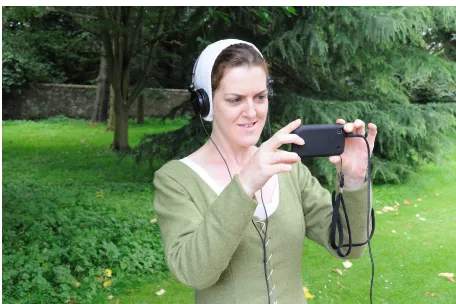
Figure 1: Capturing the ghost
Once the player has found and released all required ghosts they are able to review their evidence in a casebook where they can hear the dialogue and see the images they have captured. Therefore the aim of the sound was to reinforce the paranormal investigator role-play element within the historical setting.
3 INTERACTIVE AND GENERATIVE AUDIO According to the game composer Koji Kondo [2] game audio must be adaptive, interactive, change with each gameplay and provide tension and surprise. Keeping these principles in mind, the sound design for Falkland Ghost Hunt utilises the concept of generative stochastic background sound by the randomisation and layering of ‘wavelets’ (small audio files). Generating music by using digital audio wavelets can be used to build a soundtrack and is used for games on consoles and now is also possible on the mobile platform. The process of generating music from short audio files can be first traced back to 2001 when Kenneth Kirschner a New York based composer, used Adobe Flash (multimedia platform) to compose ever-changing pieces of digital music [4]. This process generally consists of a number of audio files that are randomly chosen and layered simultaneously and can play for as long as the player wishes. There is no inherent end and it is suited for games requiring continuously changing music, hence avoiding the problem of boredom and habituation often evident in the looping of files in console gaming. From the listeners' point of view the soundscape will always be perceived as linear even though it is non-linear in implementation.
The use of interdeterminate adaptive audio wavelets is ideal for the mobile platform due to the limited memory and CPU (Central Processing Unit) available. In the prototype, the use of wavelets forms the continuous background sound that is able to play for as long as the player remains within a given location, therefore
avoiding the looping of sound files [2]. This is implemented by using the SoundPool class in the Android operating system. The maximum audio file size was 750 KB, and of approximately 2–4 seconds in length. Playback of the wavelets was randomised within the application code so that the files overlapped to create a continuous background sound. It was found that SoundPool had a quick file loading time and hence worked well for looping and playing back smaller numerous files simultaneously. As well as randomising the file selection, sleep time between file playback was also randomised in order to avoid any perceptual pattern recognition. Hence the background was perceived as continuous and ever changing so that the player always had a different soundscape experience each time they played the game. SoundPool was also used to playback isolated sound effects. The Android MediaPlayer class presented the dialogue as it was capable of streaming larger files in a linear format [9].
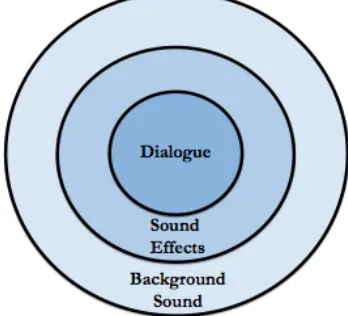
In addition to the generative background sound, interactivity of the audio to player movement was implemented by linking predefined GPS co-ordinates to the triggering of audio files. Concentric rings were created with differing radial distances from the central GPS location so when a player enters the different regions, relevant audio files are triggered, consisting of the coded generative audio files and isolated sound effects. When a ghost is encountered in the central region, the player is required to capture its image in order to listen to the historically related game dialogue.
Figure 2: Concentric rings of audio
[image:3.612.346.520.439.597.2]technology doesn’t interfere with the experience and makes the interaction pervasive and ubiquitous.
Figure 3: Falkland Ghost Hunt
Within the sound design, user interface sounds are also implemented using the SoundPool class. These sounds were designed to reinforce the concept of the handset acting as a paranormal investigative device. Hence sounds reminiscent of EVP (Electronic Voice Phenomenon) recorders and radar were used to complete the role-play aspect of the game. This represents another aspect of audio interactivity, that it provides feedback to the player of their investigative role in the game space and physical location.
As well as considering interactive and generative audio, compositional styles in creating suspense and tension reminiscent of cinema are also implemented in the sound design. The combination of these factors allow for the creation of an engaging, narrative led audio experience for the player that supports the game architecture and virtual world overlay in the given location.
4 EVALUATION
A commercial evaluation of the Falkland Ghost Hunt
was undertaken in the grounds of Falkland Castle, Scotland. The aim of the trial was to assess the commercial viability of the application and to evaluate the players’ experience of the game. The trial ran for 12 days with 319 people playing the game. Participant ages ranged from 6 to 65+ years with varying technological and cultural backgrounds. Hence player demographics were wide and diverse. After completing the game mission, participants completed a questionnaire consisting of open-ended questions and quantitative five point scale (1–5) questions. Approximately 98% of people responded that they liked the game and 71% felt they had learned something about the site. The average enjoyment rate was 4.4 out of 5 (5 stating they enjoyed it very much). Overall this
is a favourable result as one of the original aims of the application was to make history enjoyable and accessible to a wider audience, especially a younger one:
“It occupied the children with historical information…” (32 year old mom with children of 10 and 6)
“Makes history come alive.” (29 year old)
Another aim in developing the game was to encourage the participant to experience interactivity with the virtual game world and historical site. Players were asked what they liked most about this experience:
“Going around the garden, interactivity, ghosts, historical aspect.” (8 and 12 year olds)
“(The game was) easy to use, something different/modern/interactive.” (28 year old)
“Interactivity, visuals, audio.” (44 year old)
“Innovative, fun, the use of technology in a traditional setting.” (40 year old man)
Players also responded positively to the overall sound design:
“Sound effects were tremendous, very atmospheric.” (29 year old man)
“I liked the sounds.” (12 year old)
“I liked listening to the voices, fun and scary.” (13 year old)
“I liked the sound, birds, atmospheric sounds.” (60 year old woman)
Therefore the sound design contributed to participants being able to engage and interact with the historical site in a way that was immersive and enjoyable for all ages [6].
5 DISCUSSION
create a tension build up and resolution popular in linear forms, which may limit the composer’s control of musical elements. This may result in the difficulty in mapping potential player emotion progression during gameplay which would aid in sound design composition [3]. Another difficulty for location aware augmented reality sound designers and composers is the lack of standards for hardware devices that may not have the same features in memory and processing power. This results in variable playback of sound content and quality. As well as device dependency, processing constraints result in the inability of real-time DSP (Digital Signal Processing) mixing of effects on the Android platform.
Additionally GPS inaccuracies or lack of updates can interfere with the triggering of audio files in the specified locations hence interfering with the experience. However, in spite of the difficulties of game audio and current mobile platform technology, adaptive interactive game audio in location aware augmented reality gaming can result in a creative and entertaining experience.
6 CONCLUSIONS AND FUTURE WORK Location aware game audio that includes cinematic soundscapes, interactivity and non-linear generative audio together with an engaging virtual world can successfully be created on the mobile platform. Future work in this area could focus on the inclusion of variability within audio file playback. Changing the speed of audio playback would change the pitch, or the addition of real-time granulation would change audio file timbres. This would create sound variability and reusability of files hence reducing the need for additional memory in creating complex soundscapes.
REFERENCES
[1] Beilharz, K. “Interactively Determined Generative Sound Design for Sensate Environments: ExtendingCyborg Control”, Y. Pisan (eds), InteractiveEntertainment '04, pp. 11-18 (2004).
[2] Collins, K., Game Sound: An introduction to the history, theory and practice of video game music and sound design. MIT Press, USA, (2008).
[3] Glassner, A.S., Interactive storytelling: techniques for 21st century fiction. Coyote Wind, Canada, (2004).
[4] Guerraz, A., Lemordant, J. Indeterminate
Adaptive Digital Audio for Games on Mobiles: In From Pac-Man to Pop Music, editors: Karen Collins. Ashgate, (2007).
[5] Griesinger, D.H. “Concert Hall Acoustics and Audience Perception” IEEE Signal Processing Magazine March (2007)
[6] www.hauntedplanet.com
[7] Lasorsa1, Y., Lemordant, J. “An Interactive Audio System for Mobiles” Audio Engineering Society Convention Paper, Presented at the 127th Convention October 9–12 New York, NY, USA (2009).
[8] Laurel, B., Computers as theatre, New York, Addison-Wesley, (1993)
[9] Paterson, N., Naliuka, K., Jensen, S.K., Carrigy,
T., Haahr, M., Conway, F. “Spatial Audio and Reverberation in an Augmented Reality Game Sound Design,” 40th AES Conference: Spatial Audio, Tokyo, Japan, October 8-10, 2010, Audio Engineering Society, (2010).
[10] Pfeifer, T., Savage, P., Robinson, B. “Managing the Culloden Battlefield Invisible Mobile Guidance Experience”, MUCS2009, June 15, Barcelona, Spain (2009).
[11] Reid, J., Geelhoed, E., Hull, R., Cater, K., Clayton, B. “Parallel Worlds: Immersion in location-based experiences”. CHI '05 extended abstracts on Human factors in computing systems, (2005).
[12] Shepard, M. “The Tactical Sound Garden [TSG} Toolkit”. International Conference on Computer Graphics and Interactive Techniques, ACM SIGGRAPH 2007 p 219 (2007).