Learning Discourse Relations with Active D a t a Selection
T a d a s h i N o m o t o *
N a t i o n a l I n s t i t u t e of J a p a n e s e L i t e r a t u r e 1-16-10 Y u t a k a S h i n a g a w a
T o k y o 142-8585 J a p a n n o m o t o @ n i j 1. a c . j p
Y u j i M a t s u m o t o
N a r a I n s t i t u t e of Science a n d T e c h n o l o g y 8916-5 T a k a y a m a I k o m a N a r a
630-0101 J a p a n
matsu@is, aist-nara, ac.
jp
A b s t r a c t
The paper presents a new approach to identi- fying discourse relations, which makes use of a particular sampling m e t h o d called committee- based sampling (CBS). In the committee-based sampling, multiple learning models are gener- ated to measure the utility of an input example in classification; if it is judged as not useful, then the example will be ignored. The m e t h o d has the effect of reducing the a m o u n t of data required for training. In the paper, we extend CBS for decision tree classifiers. W i t h an addi- tional extension called error feedback, it is found that the m e t h o d achieves an increased accuracy as well as a substantial reduction in the a m o u n t of d a t a for training classifiers.
1 I n t r o d u c t i o n
The success of corpus-based approaches to dis- course ultimately depends on whether one is able to acquire a large volume of d a t a annotated for discourse-level information. However, to ac- quire merely a few hundred texts annotated for discourse information is often impossible due to the enormity of the h a m a n labor required.
This paper presents a novel m e t h o d for reduc- ing the amount of data for training a decision tree classifier, while not compromising the accu- racy. While there has been some work explor- ing the use of machine leaning techniques for discourse and dialogue (Marcu, 1997; Samuel et al., 1998), to our knowledge, no computational research on discourse or dialogue so far has ad- dressed the problem of reducing or minimizing the amount of data for training a learning algo- rithm.
* The work reported here was conducted while the first author was with Advanced Research Lab., Hitachi Ltd, 2520 Hatoyama Saitama 350-0395 Japan.
A particular m e t h o d proposed here is built on the committee-based sampling, initially pro- posed for probabilistic classifiers by Dagan and Engelson (1995), where an example is selected from the corpus according to its utility in im- proving statistics. We extend the m e t h o d for decision tree classifiers using a statistical tech- nique called bootstrapping (Cohen, 1995). W i t h an additional extension, which we call error .feedback, it is found that the m e t h o d achieves an increased accuracy as well as a significant reduction of training data. The m e t h o d pro- posed here should be of use in domains other t h a n discourse, where a decision tree strategy is found applicable.
2 T a g g i n g a c o r p u s w i t h d i s c o u r s e r e l a t i o n s
In tagging a corpus, we adopted Ichikawa (1990)'s scheme for organizing discourse rela- tions (Table 1). The advantage of Ichikawa (1990)'s scheme is that it directly associates dis- course relations with explicit surface cues (eg. sentential connectives), so it is possible for the coder to determine a discourse relation by figur- ing a most natural cue that goes with a sentence he/she is working on. Another feature is that, unlike Rhetorical Structure Theory (Mann and Thompson, 1987), the scheme assumes a dis- course relation to be a local one, which is de- fined strictly over two consecutive sentences. 1 We expected that these features would make a tagging task less laborious for a h u m a n coder t h a n it would be with RST. Further, our earlier study indicated a very low agreement rate with
1This does not mean to say that all of the discourse
relations are local. There could be some relations that
involve sentences separated far apart. However we did
not consider non-local relations, as our preliminary study
Table 1: Ichikawa (1990)'s taxonomy of discourse relations. The first column indicates major classes and the second subclasses. The third column lists some examples associated with each subclass. Note that the EXPANDING subclass has no examples in it. This is because no explicit cue is used to mark the relationship.
LOGICAL
SEQUENCE
ELABORATION
CONSEQUENTIAL ANTITHESIS ADDITIVE CONTRAST INITIATION APPOSITIVE COMPLEMENTARY EXPANDING
dakara therefore, shitagatte thus shikashi but, daga but
soshite and, tsuigi-ni next ipp6 in contrast, soretomo or
tokorode to change the subject, sonouchi in the meantime
tatoeba
.for example, y6suruni in other words nazenara because, chinamini incidentally NONERST (~ = 0.43; three coders); especially for a casual coder, RST turned out to be a quite dif- ficult guideline to follow.
In Ichikawa (1990), discourse relations are or- ganized into three major classes: the first class includes logical (or strongly semantic) relation- ships where one sentence is a logical conse- quence or contradiction of another; the second class consists of sequential relationships where two semantically independent sentences are jux- taposed; the third class includes elaboration- type relationships where one of the sentences is semantically subordinate to the other.
In constructing a tagged corpus, we asked coders not to identify abstract discourse rela- tions such as LOGICAL, SEQUENCE and ELAB- ORATION, but to choose from a list of pre- determined connective expressions. We ex- pected that the coder would be able to iden- tify a discourse relation with far less effort when working with eXplicit cues t h a n when working with abstract Concepts of discourse relations. Moreover, since 93% of sentences considered for labeling in the corpus did not contain pre- determined relation cues, the annotation task was in effect one of guessing a possible connec- tive cue that m'ay go with a sentence. The ad- vantage of using explicit cues to identify dis- course relations is that even if one has little or no background in linguistics, he or she may be able to assign a discourse relation to a sentence by just asking him/herself whether the associ- ated cue fits well with the sentence. In addition, in order to make the usage of cues clear and un- ambiguous, the annotation instruction carried a set of examples for each of the cues. Fur-
ther, we developed an emacs-based software aid which guides the coder to work through a cor- pus and also is capable of prohibiting the coder from making moves inconsistent with the tag- ging instruction.
As it turned out, however, Ichikawa's scheme, using subclass relation types, did not improve agreement (~ = 0.33, three coders). So, we modified the relation taxonomy so that it con- tains just two major classes, SEQUENCE and ELABORATION, (LOGICAL relationships being subsumed under the SEQUENCE class) and as- sumed that a lexical cue marks a major class to which it belongs. The modification successfully raised the ~ score to 0.70. Collapsing LOGICAL and SEQUENCE classes may be justified by not- ing that b o t h types of relationships have to do with relating two semantically independent sen- tences, a property not shared by relations of the elaboration type.
3
Learning w i t h A c t i v e D a t a
Selection
3.1
Committee-based Sampling
tributions of model parameters and measuring how much the member models disagree in clas- sifying the example. The rationale for this is: disagreement among models over the class of an example would suggest that the example af- fects some parameters sensitive to classification, and furthermore estimates of affected parame- ters are far from their true values. Since models are generated randomly from posterior distribu- tions of model parameters, their disagreement on an example's class implies a large variance in estimates of parameters, which in t u r n indi- cates that the statistics of parameters involved are insufficient and hence its inclusion in the training corpus (so as to improve the statistics of relevant parameters).
For each example it encounters, CBS goes through the following steps to decide whether to select the example for labeling.
1. Draw k models (committee members) ran- domly from the probability distribution P ( M ] S) of models M given the statistics S of a training corpus.
2. Classify an input example by each of the committee members and measure how much they disagree on classification. 3. Make a biased r a n d o m decision as to
whether or not to select the example for labeling. This would make a highly disagreed-upon example more likely to be selected.
As an illustration of how this might work, consider a problem of tagging words with parts of speech, using a Hidden Markov Model (HMM). A (bigram) HMM tagger is typically given as:
n
T(Wl . . . Wn) = argmax ~ P(wi I ti)P(ti+l I ti)
t~ ...~ ~__~
where w l . . . w n is a sequence of input words, and t l . . . t n is a sequence of tags. For a sequence of input words w l . . . w n , a sequence of corre- sponding tags T ( w l . . . w n ) is one that maxi- mizes the probability of reaching tn from tl via ti (1 < i < n) and generating W l . . . w n along with it. Probabilities P(wi I ti) and P(ti+l I ti) are called model parameters of an HMM tag- ger. In Dagan and Engelson (1995), P ( M I S)
is given as the posterior multinomial distribu- tion P ( a l = a l , . . . , a n = an J S), where ai is a model parameter and ai represents one of the possible values. P ( a l = a l , . . . , a n = an I S) represents the proportion of the times that each parameter oq takes a/, given the statistics S derived from a corpus. (Note that ~ P ( a i = ai I S) = 1.) For instance, consider a task of randomly drawing a word with replace- ment from a corpus consisting of 100 different words ( w l , . . . , Wl00). After 10 trials, you might have outcomes like wl = 3, w2 = 1 , . . . , w55 = 2 , . . . , w 7 1 = 3 , . . . , w 7 6 = 1 , . . . , w l 0 0 = 0: i.e., Wl was drawn three times, w2 was drawn once, w55 was drawn twice, etc. If you try another 10 times, you might get different results. A multi- nomial distribution tells you how likely you get a particular sequence of word occurrences. Da- gan and Engelson (1995)'s idea is to assume the distribution P ( a l = a l , . . . , a n = an I S) as a set of binomial distributions, each corre- sponding to one of its parameters. An arbitrary HMM model is then constructed by randomly drawing a value ai from a binomial distribu- tion for a parameter ai, which is approximated by a normal distribution. Given k such models (committee members) from the multinomial dis- tribution, we ask each of t h e m to classify an input example. We decide whether to select the example for labeling based on how much the committee members disagree in classifying that example. Dagan and Engelson (1995) in- troduces the notion of vote entropy to quantify disagreements among members. T h o u g h one could use the kappa statistic (Siegel and Castel- lan, 1988) or other disagreement measures such as the a statistic (Krippendorff, 1980) instead of the vote entropy, in our implementation of CBS, we decided to use the vote entropy, for the lack of reason to choose one statistic over another. A precise formulation of the vote entropy is as follows:
v(e, e) log V(c, e)
V ( e ) = - k
C
based on
V(e).
g
Pselect(e)
= logk V(e)
g here is called the
entropy gain
and is used to determine the number of times an example is selected; a grea~ter g would increase the number of examples selected for tagging. Engelson and Dagan (1996) investigated several plausible ap- proaches to the selection function but were un- able to find significant differences among them. At the beginning of the section, we mentioned some properties of 'useful' examples. A useful example is one which contributes to reducing variance in parameter values and also affects classification. By randomly generating multiple models and measuring a disagreement among them, one would be able to tell whether an ex- ample is useful in the sense above; if there were a large disagreement, then one would know that the example is relevant to classification and also is associated with parameters with a large vari- ance and thus with insufficient statistics.In the following section, we investigate how we might extend CBS for use in decision tree classifiers.
3.2 D e c i s i o n T r e e Classifiers
Since it is difficult, if not impossible, to express the model distribution of decision tree classi- fiers in terms of the multinomial distribution, we turn to the bootstrap sampling method to obtain
P(M [ S).
The bootstrap sampling method provides a way for artificially establish- ing a sampling distribution for a statistic, when the distribution is not known (Cohen, 1995). For us, a relevant statistic would be the poste- rior probability that a given decision tree may occur, given the training corpus.Bootstrap Sampling Procedure
Repeat i = 1. ,. K times:
1. Draw a bootstrap pseudosample S~ of size N from S by sampling with replacement as follows:
Repeat N times: select a member of S at random ai~d add it to S~.
2. Build a decision tree model M from S~. Add M to Ss.
S is a small Set of samples drawn from the tagged corpus. Repeating the procedure 100
times would give 100 decision tree models, each corresponding to some S~ derived from the sam- ple set S. Note that the bootstrap procedure allows a datum in the original sample to be se- lected more than once.
Given a sampling distribution of decision tree models, a committee can be formed by ran- domly selecting k models from Ss. Of course, there are some other approaches to construct- ing a committee for decision tree classifiers (Di- etterich, 1998). One such, known as
random-
ization,
is to use a single decision tree and ran- domly choose a path at each attribute test. Re- peating the process k times for each input ex- ample produces k models.3.2.1
Features
In the following, we describe a set of features used to characterize a sentence. As a conven- tion, we refer to a current sentence as 'B' and the preceding sentence as 'A'.
<LocSen> defines the location of a sentence by:
#s(x)
# S ( Last..S entence)
' # S ( X ) ' denotes an ordinal number indi- cating the position of a sentence X in a text,
i.e.,
#S(kth_sentence) = k, (k >_ 0). 'Last_Sentence' refers to the last sentence in a text. LocSen takes a continuous value between 0 and 1. A text-initial sentence takes 0, and a text-final sentence 1.<LocPar> is defined similarly to D i s t P a r . It records information on the location of a para- graph in which a sentence X occurs.
#Par(X)
#Last.Paragraph
'#Par(X)'
denotes an ordinal number indicat- ing the position of a paragraph containing X. '#Last_Paragraph' is the position of the last paragraph in a text, represented by the ordinal number.<LocWithinPax> records information on the location of a sentence X within a paragraph in which it appears.
'Par_Init_Sen' refers to the initial sentence of a p a r a g r a p h in which X occurs, ' L e n g t h ( P a r ( X ) ) ' denotes the number of sentences t h a t occur in t h a t paragraph. LocW:i.thinPar takes continu- ous values ranging from 0 to 1. A p a r a g r a p h initial sentence would have 0 and a p a r a g r a p h final sentence 1.
<LenText> the length of a text, measured in Japanese characters.
the length of A in Japanese char-
<LenSenA>
acters.
<LenSenB>
acters.
the length of B in Japanese char-
<Sire> encodes the lexical similarity b e t w e e n A and B, based on an information-retrieval measure known as
t f . idf
(Salton and McGill, 1983). 2 One i m p o r t a n t feature here is t h a t we defined similarity based on (Japanese) charac- ters rather t h a n on words: in practice, we broke up nominals from relevant sentences into simple alphabetical characters (including graphemes) and used t h e m to measure similarity b e t w e e n the sentences. (Thus in our setupxi
in foot- note 2 corresponds to one character, and not to one whole word.) We did this to deal with abbreviations and rewordings, which we found quite frequent in the corpus.<Cue> takes a discrete value 'y' or 'n'. The cue feature is intended to exploit surface cues most relevant for distinguishing between the SE- QUENCE and ELABORATION relations. The fea-
2For a w o r d j in a sentence Si (j E Si), its weight wij
is defined by:
N
w# = tf~j • log ~ -
df~
is the number of sentences in the text which have an occurrence of a word j. N is the total number of sentences in the text. Thetf.idf
metric has the property of favoring high frequency words with local distribution. For a pair of sentences .,~ = (xl .... ) and Y = (yx,...), where x and y are words, we define the lexical similarity between X and Y by:t
2 E w(xi)w(y~)
S I M ( . X , Y ) = t i=x t
E
E
i = 1 i = 1
where w(xi) represents a t~idf weight assigned to t h e
t e r m xi. T h e m e a s u r e is known as t h e Dice coefficient
(Salton a n d McGill, 1983)
ture takes 'y' if a sentence contains one or more cues relevant to distinguishing b e t w e e n the two relation types. We considered up to 5 word n-grams found in the training corpus. O u t of these, those whose
INFOx
values are below a particular threshold are included in the set ofc u e s . 3 A n d if a sentence contains one of the
cues in the set, it is marked 'y', and 'n' other- wise. T h e cutoff is determined in such a way as to minimize
INFOcue(T),
where T is a set of sentences (represented with features) in the training corpus. We had the total of 90 cue ex- pressions. Note t h a t using a single binary fea- ture for cues alleviates the d a t a sparseness prob- lem; t h o u g h some of the cues m a y have low fre- quencies, t h e y will be aggregated to form a sin- gle cue category with a sufficient n u m b e r of in- stances. In the training corpus, which contained 5221 sentences, 1914 sentences are m a r k e d 'y' and 3307 are marked 'n' with the cutoff at 0.85, which is found to minimize the e n t r o p y of the distribution of relation types. It is interesting to note t h a t the entropy s t r a t e g y was able to pick up cues which could be linguistically m o t i v a t e d (Table 2). In contrast to Samuel et al. (1998), we did not consider relation cues r e p o r t e d in the linguistics literature, since t h e y would be useless unless t h e y contribute to reducing the cue entropy. T h e y m a y b e linguistically 'right' cues, b u t their utility in the machine learning context is not known.< P r e v R e l > makes available information a b o u t a relation t y p e of the preceding sentence. It has two values, E L A for the elaboration relation, and SEQ for the sequence relation.
In the Japanese linguistics literature, there is a popular theory that sentence endings are rel- evant for identifying semantic relations among 3INFOx (T) m e a s u r e s t h e e n t r o p y of t h e d i s t r i b u t i o n of classes in a set T w i t h respect to a feature X . W e define INFOx j u s t as given in Q u i n l a n (1993):
xNFOx(T) = x xNFo(T,)
i = 1
Ti represents a p a r t i t i o n of T corresponding to one of
t h e values for X . INFO(T) is defined as follows:
k
INFO(T) = ~ freq(Cj, T) freq(Cj, T)
- ~ i . ~ ] x log s ] T I
j = l
I
Table 2: Some of the 'linguistically interesting' cues identified by the entropy strategy. mata on the other hand, dSjini at the same time, ippou in contrast, sarani in addition, mo topic marker, ni-tsuite-wa regarding, tameda the reason is that, kekka as the result ga-nerai the goal is that
sentences. Some of the sentence endings are in- flectional categories of verbs such as PAST/NON- PAST, INTERROGATIVE, and also morpholog- ical categories :like nouns and particles (eg. question-markers). Based on Ichikawa (1990), we defined six types of sentence-ending cues and marked a sentence according to whether it contains a part.icular type of cue. Included in the set are inflectional forms of the verb and the verbal adjec~tive, PAST/NON-PAST, morpho- logical categories such as COPULA, and NOUN, parentheses (quotation markers), and sentence- final particles such as -ka. We use the follow- ing two attributes to encode information about sentence-ending cues.
<EndCueh> records information about a sentence-ending form of the preceding sentence. It takes a discrete value from 0 to 6, with 0 indicating the absence in the sentence of relevant cues.
<EadCueB> Sa~me as above except that this fea- ture is concerned with a sentence-ending form of the current sentence, i.e. the 'B' sentence.
Finally, we have two classes, ELABORATION and SEQUENCE.
4 E v a l u a t i o n
To evaluate our method, we carried out ex- periments, using a corpus of news articles from a Japanese economics daily (Nihon-Keizai- Shimbun-Sha, 1995). The corpus had 477 arti- cles, randomly selected from issues that were published durilig the year. Each sentence in the articles was tagged with one of the discourse re- lations at the subclass level (i.e. CONSEQUEN- TIAL, ANTITHESIS, etc.). However, in evaluation experiments, we translated a subclass relation into a corresponding major class relation (SE- QUENCE/ELABORATION) for reasons discussed earlier. Furthermore , we explicitly asked coders not to tag a paragraph initial sentence for a dis- course relation, for we found that coders rarely agree on their :classifications. Paragraph-initial
sentences were dropped ffrom the evaluation cor- pus. This had left us with 5221 sentences, of which 56% are labeled as SEQUENCE and 44% ELABORATION.
To find out effects of the committee-based sampling m e t h o d (CBS), we ran the C4.5 (Re- lease 5) decision tree algorithm with CBS turned on and off (Quinlan, 1993) and measured the performance by the 10-fold cross validation, in which the corpus is divided evenly into 10 blocks of data and 9 blocks are used for train- ing and the remaining one block is held out for testing. On each validation fold, CBS starts with a set of about 512 samples from the set of training blocks and sequentially examines sam- ples from the rest of the training set for pos- sible labeling. If a sample is selected, then a decision tree will be trained on the sample to- gether with the data acquired so far, and tested on the held-out data. Performance scores (er- ror rates) are averaged over 10 folds to give a s u m m a r y figure for a particular learning strat- egy. T h r o u g h o u t the experiments, we assume that k = 10 and g = 1, i.e., 10 committee members and the entropy gain of 1. Figure 1 shows the result of using CBS for a decision tree. T h o u g h the performance fluctuates erratically, we see a general tendency t h a t the CBS m e t h o d fares better t h a n a decision tree classifier alone. In fact differences between C4.5/CBS and C4.5 alone proved statistically significant (t = 7.06, df = 90, p < .01).
Figure 1: Effects of CBS on the decision tree learning. Each point in the scatterplots represents a s u m m a r y figure,
i.e.
the average of figures obtained for a given x in 10-fold cross validation trials. Thex-axis
represents the amount of training data, and the y-axis the error rate. The error rate is the proportion of the misclassified instances to the total number of instances.47.5
4 7
,46.5
46
45.5
45
44.5
44
43.5
43 0
@ o
o o O @ ~ o
@ @ o o
@ @@~ @ o
@ O O O :
@ @
+ O @ 0 O
"¢+ $ O : O +
o + o
@ o o : o 0
o +%+ + % > + ~+ o
+ + +++ +~ + ~ + o ~ *+
+ + + + ++ ~ + ¢ 0 + + +
.p + + +
+ ~ + + + + O a r + +
+ + O@
4- 4-
+
I I I
200 400 600
Training Data
I
STD C4.5 CBS+C4.5 +
O @
o
o @ o o @
o o o o o
o ¢ o @ O
-I-k++ +
+ + +++ ++++
÷ +
+ I
8OO
0
1000
a drastic restructuring of a decision tree. In the face of this, we made a small change to the way CBS works. The idea, which we call a
sampling
with error feedback,
is to remove harmful exam- ples from the training data and only use those with positive effects on performance. It forces the sampling mechanism to return tostatus quo
ante
when it finds that an example selected de- grades performance. More precisely, this would be put as follows:f St U {e}, if
E(CSU{e}) < E ( C s~)
S +l
[
St otherwiseSt is a training set at time t. C s denotes a clas- sifter built from the training set S.
E ( C s)
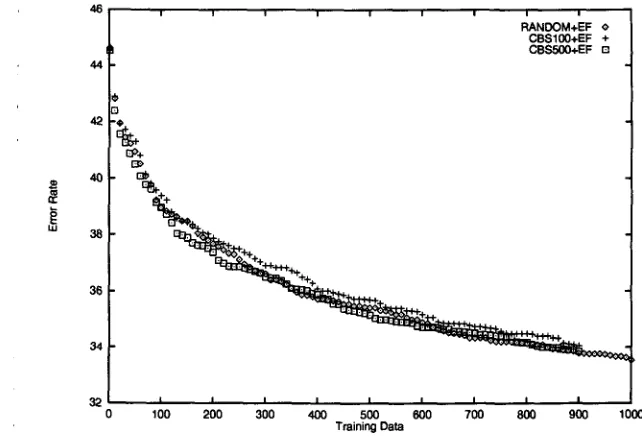
is an error rate of a classifier C s. Thus if there is an increase or no reduction in the error rate after adding an example e to the training set, a clas- sifter goes back to the state before the change.As Figure 2 shows, the error feedback pro- duced a drastic reduction in the error rate. At 900, the committee-based m e t h o d with the er- ror feedback reduced the error rate by as much as 23%. Figure 3 compares performance of three sampling methods, random sampling, the committee-based sampling with 100 bootstrap replicates
(i.e.,
K = 100) and that with 500Figure 2: The committee-based method (with 100 bootstraps) with the error feedback as compared against one without. The error rate decreases rapidly with the growth of the training data (the lower scatterplot). The upper scatterplot represents CBS with the error feedback disabled.
46
44'
42
uJ
38
36
34 0
o o C~+C4.5 o
0 4 2 0 0 CBS.~C4.5+EF +
o o ~ ° °°°oo~ o ~ : o ~ ~ o ooo o ~ % o o o
o ~oo o o o ~ o
~ ° o
\
+
\
\
++~+%+++++++++++*+-H.++++
+++'H'~'+~'++'~'+÷++++'H
~'H'+++++..H.+++.H..H.~.+
...
I I I I I I I I "J'H'4"l:+,~
100 200 300 400 500 600 700 800 900
Training Data
Figure 3: Comparing performance of three approaches, random sampling (RANDOM-EF), boot- strapped CBS with 100 replicates (CBS100-EF), and bootstrapped CBS with 500 replicates (CBS500-EF),: all with the error feedback on.
42
4 0
3 !
36
34
32
i ,'
RANDOM+EF o
CBS100+EF + CBS500+EF E]
[~÷
| I I I I I I I I
100 200 300 400 500 600 700 800 900
Training Data
1000
amount of training data without hurting perfor- mance.
5 C o n c l u s i o n s
We presented a new approach for identifying discourse relations, built upon the committee-
[image:8.612.141.454.116.336.2] [image:8.612.134.455.396.615.2]Figure 4: Differences in performance of RANDOM-EF (random sampling with the error feedback) and CBS500-EF (CBS with the error feedback, with 500 bootstrap replicates).
46
44
42
4O
38
36
34
32
i i i i i i !
random sampling+EF o
C B S + B P S O O + E F +
+o
I I I I I I I I I
100 2 0 0 3 0 0 4 0 0 5(X3 6 0 0 7 0 0 8 0 0 9 0 0
Training Data
1000
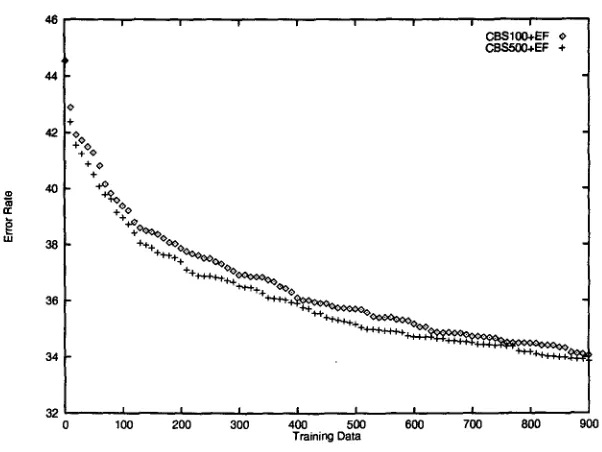
Figure 5: Differences in performance of CBS500-EF and CBS100-EF.
44
4O
38
36
34
! i
C B S l O O + E F ¢.
CBSSOO+EF +
+ o +
• ~ ~ + + ~ . : v . , , , ~
3 2 I , I I I I I | I -
0 1 O0 2 0 0 3 0 0 4 0 0 5 0 0 600 700 800 900
Training Data
ing a statistical technique called
bootstrapping.
The use of the method for learning discourse relations resulted in a drastic reduction in the amount of data required and also an increased accuracy. Further, we found that the num- ber of bootstraps has substantial effects on per- formance; CBS with 500 bootstraps performed better than that with 100 bootstraps
R e f e r e n c e s
Paul R. Cohen. 1995.
Empirical Methods in Ar-
tificial Intelligence.
The MIT Press.Ido Dagan and Sean Engelson. 1995. Committee-based sampling for training probabilistic classifiers. In
Proceedings off In-
ternational Conference on Machine Learning,
pages 150-157, July.
[image:9.612.165.467.107.328.2] [image:9.612.164.465.360.586.2]!
comparison of three methods for constructing ensembles of decision trees: Bagging, boost- ing, and randomization,
submitted to Ma-
chine Learning.
Sean P. Engelson and Ido Dagan. 1996. Mini- mizing manual annotation cost in supervised training from ,corpora. In
Proceedings off the
3~th Annual Meeting of the Association for
Computational Linguistics,
pages 319-326. ACL, June. University of California,SantaC r u z .
Takashi Ichikawa. 1990.
Bunshddron-gaisetsu.
KySiku-Shuppan, Tokyo.
Klaus Krippendorff. 1980.
Content Analysis:
An Introductiqn to Its Methodology,
volume 5 ofThe Sage
COMMTEXT
series.
The Sage Publications, Inc.W. C. Mann and S. A. Thompson. 1987. Rhetorical Structure Theory. In L. Polyani, editor,
The Structure of Discourse.
Ablex Publishing Co:rp., Norwood, NJ.Daniel Marcu. 1997. The Rhetorical Pars- ing of Natural Language Texts. In
Proceed-
ings of the 35th Annual Meetings of the As-
sociation for ,Computational Linguistics and
the 8th European Chapter of the Association
for Computational Linguistics,
pages 96-102, Madrid, Spain, July.Nihon-Keizai-Shimbun- Sha. 1 9 9 5 . Nihon Keizai Shimbun 95 hen CD-ROM ban. CD-ROM. Nihon Keizai Shimbun, Inc., Tokyo.
J. Ross Quinlani 1993.
C~.5: Programs for Ma-
chine Learning.
Morgan Kanfmann.Gerald Salton and Michael J. McGill. 1983.
Introduction t o Modern Information Re-
treival.
McGraw-Hill Computer Science Se- ries. McGraw~Hill Publishing Co.Ken Samuel, Sandra Carberry, and K. Vijay- Shanker. 1998. Diaglogue act tagging with transformation-based learning. In
Proceed-
ings of the 36th Annual Meeting off the Asso-
ciation of Computational Linguistics and the
17th International Conference on Computa-
tional Linguistics,
pages 1150-1156, August 10-14. Montreal, Canada.Sidney Siegel and N. John CasteUan. 1988.