MSMO: Multimodal Summarization with Multimodal Output
Junnan Zhu1,2, Haoran Li1,2, Tianshang Liu1,2, Yu Zhou1,2, Jiajun Zhang1,2 and Chengqing Zong1,2,3 1 National Laboratory of Pattern Recognition, Institute of Automation, CAS, Beijing, China
2University of Chinese Academy of Sciences, Beijing, China
3CAS Center for Excellence in Brain Science and Intelligence Technology, Beijing, China {junnan.zhu, yzhou, jjzhang, cqzong}@nlpr.ia.ac.cn
Abstract
Multimodal summarization has drawn much attention due to the rapid growth of multime-dia data. The output of the current multimodal summarization systems is usually represented in texts. However, we have found through ex-periments that multimodal output can signifi-cantly improve user satisfaction for informa-tiveness of summaries. In this paper, we pro-pose a novel task, multimodal summarization with multimodal output (MSMO). To handle this task, we first collect a large-scale dataset for MSMO research. We then propose a multi-modal attention model to jointly generate text and select the most relevant image from the multimodal input. Finally, to evaluate mul-timodal outputs, we construct a novel multi-modal automatic evaluation (MMAE) method which considers both intramodality salience and intermodality relevance. The experimen-tal results show the effectiveness of MMAE.
1 Introduction
Text summarization is to extract the important formation from source documents. With the in-crease of multimedia data on the internet, some
researchers (Li et al., 2016b; Shah et al., 2016;
Li et al., 2017) focus on multimodal
summariza-tion in recent years. Existing experiments (Li
et al., 2017, 2018a) have proven that, compared to text summarization, multimodal summarization can improve the quality of generated summary by using information in visual modality.
However, the output of existing multimodal summarization systems is usually represented in
a single modality, such as textual or visual (Li
et al.,2017;Evangelopoulos et al.,2013; Madem-lis et al., 2016). In this paper, we argue that
multimodal output1 is necessary for the
follow-ing three reasons: 1) It is much easier and faster
1Note that in this work, the multimodal output refers to a
pictorial summary which contains one image (for the sake of
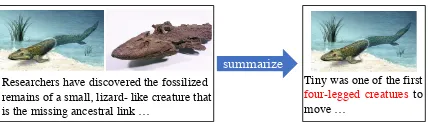
Researchers have discovered the fossilized remains of a small, lizard- like creature that is the missing ancestral link …
summarize
Tiny was one of the first
four-legged creaturesto move …
Figure 1: The illustration of our proposed task – Multimodal Summarization with Multimodal Output (MSMO). The image can help better understand the text in the red font.
for users to get critical information from the
im-ages (Li et al., 2017). 2) According to our
ex-periments, the multimodal output (text+image)
in-creases users’ satisfaction by12.4%compared to
the single-modality output (text) (more details can
be found in Sec. 4.2). 3) Images help users to
grasp events while texts provide more details
re-lated to the events. Thus the images and text
can complement each other, assisting users to gain
a more visualized understanding of events (Bian
et al.,2013). We give an example in Fig.1to il-lustrate this phenomenon. For the output with only the text summary, user will be confused about the description of “four-legged creatures”; while with a relevant image, user will have a clearer under-standing of the text.
In recent years, some researchers(Bian et al.,
2013,2015;Wang et al.,2016) focus on incorpo-rating multimedia contents into the output of sum-marization which all treat the image-text pair as a basic summarization unit. But in our work, our input comes from a document and a collection of images where there is no alignment between texts and images. So our biggest challenge is how to bridge the semantic gaps between texts and im-ages. Based on the above discussion, in this work, we propose a novel task which we refer to as Mul-timodal Summarization with MulMul-timodal Output (MSMO). To explore this task, we focus on the
[image:1.595.311.525.220.281.2]following three questions: 1) how to acquire the relevant data; 2) how to generate the multimodal output; 3) how to automatically evaluate the qual-ity of the multimodal output in MSMO.
For the first question, similar to Hermann
et al.(2015), we collect a large-scale multimodal
dataset2 from Daily Mail website and annotate
some pictorial summaries. For the second ques-tion, we propose a multimodal attention model to jointly generate text and the most relevant im-age, in which the importance of images is deter-mined by the visual coverage vector. For the last question, we construct a novel multimodal auto-matic evaluation (MMAE) which jointly considers salience of text, salience of image, and image-text relevance.
Our main contributions are as follows:
• We present a novel multimodal
summariza-tion task, which takes the news with images as input, and finally outputs a pictorial sum-mary. We construct a large-scale corpus for MSMO studying.
• We propose an abstractive multimodal
marization model to jointly generate sum-mary and the most relevant image.
• We propose a multimodal automatic
evalua-tion (MMAE) method which mainly consid-ers three aspects: salience of text, salience of image, and relevance between text and im-age.
2 Our Models
2.1 Overview
We begin by defining the MSMO task. The in-put of the task is a document and a collection of images and the output is a pictorial summary.
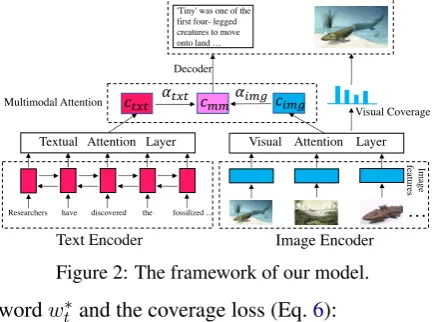
As shown in Fig. 2, our proposed model
con-sists of four modules: text encoder, image en-coder, multimodal attention layer, and summary decoder. The text encoder is a BiLSTM used to
encode text. Our image encoder is VGG193
pre-trained on ImageNet (Simonyan and Zisserman,
2015) used to extract global or local features. The
multimodal attention layer aims to fuse textual and visual information during decoding. Our summary
2Our dataset has been released to the public, which
can be found inhttp://www.nlpr.ia.ac.cn/cip/ jjzhang.htm.
3
http://www.robots.ox.ac.uk/˜vgg/ research/very_deep
decoder, which is a unidirectional LSTM, makes use of information from two modalities to gener-ate the text summary and select the most relevant image according to visual coverage vector. Our text encoder and summary decoder are based on pointer-generator network which we will describe
in Sec.2.2. We then describe image encoder and
multimodal attention layer in our multimodal
at-tention model (Sec.2.3).
2.2 Pointer-Generator Network
See et al.(2017) propose a pointer-generator net-work which allows both copying words from the source text and generating words from a fixed vocabulary, achieving the best performance on
CNN/Daily mail dataset. Their model consists
of an encoder (a single-layer bidirectional LSTM) and an attentive decoder (a unidirectional LSTM). The encoder maps the article to a sequence of
encoder hidden states hi. During decoding, the
decoder receives the embedding of the previous
word and reaches a new decoder state st. Then
the context vectorctis computed by the attention
mechanism (Bahdanau et al., 2015;Luong et al.,
2015) as calculated in Eq. 1 and 2. To alleviate
the problem of repetition, See et al.(2017)
main-tain a coverage vector covt, which is the sum of
attention distributions over all previous decoding
timesteps (initialized to zero vector at timestep0):
covt = Pt−1 ˜
t=0α ˜
t. The coverage vector is used as
an extra input to the attention vector (Eq.1) and
is also used to calculate the coverage loss (Eq.6).
Next, the attention distribution is used to calculate the context vector as follows.
eti =vTtanh(Whhi+Wsst+Wccovt) (1)
αt= softmax(et) (2)
ct=
X
i
αtihi (3)
The important part in this model is the
calcula-tion of the generacalcula-tion probabilitypg. It represents
the probability of generating a word from the
vo-cabulary distributionpv, and(1−pg) represents
the probability of copying a word from the source
by sampling from the attention distributionαt. pg
is determined byct,st, and the decoder inputxtin
Eq. 4. The final probability distribution over the
extended vocabulary, which denotes the union of the vocabulary and all words in the source, is
cal-culated in Eq.5. Finally, the loss for timesteptis
Researchers have discovered the fossilized ... Textual Attention Layer
𝑐"#"
…
Visual Attention Layer
𝑐$%&
Multimodal Attention
Decoder
'Tiny' was one of the first four- legged creatures to move onto land …
Visual Coverage
Text Encoder Image Encoder
Final Output
𝑐%%
Im
age
fe
atur
es
[image:3.595.73.291.72.233.2]𝛼"#" 𝛼$%&
Figure 2: The framework of our model.
wordwt∗and the coverage loss (Eq.6):
pg =σ(W∗hct+W∗sst+Wxxt) (4)
pw =pgpv(w) + (1−pg)
X
wi=w
αti (5)
Lt=−logpwt∗+
X
i
min(αit, covit) (6)
2.3 Multimodal Attention Model
We incorporate visual information into the pointer-generator network and propose a novel
multimodal attention model. As shown in Fig.2,
there are three main differences between our model and pointer-generator network: 1) We have an extra image encoder and a corresponding visual attention layer; 2) To achieve the fusion of textual and visual information, we introduce a multimodal attention mechanism; 3) We add a visual
cover-age (Li et al., 2018a) to both alleviate visual
rep-etition and measure the salience of image. More details are as follows.
Image Encoder. We apply the VGG19 to
ex-tract global and local image feature vectors for
all images. The global features g are
4096-dimensional activations of the pre-softmax
fully-connected layerfc7. The local featureslare the
7×7×512feature maps of the last pooling layer
(pool5). We flatten the local feature into a ma-trixA = (a1,· · ·, aL)(L = 49) whereal ∈ R512 corresponds to a patch of an image.
Visual Attention. The attention mechanism is
learned to focus on different parts of input text while decoding. Attention mechanisms have also shown to work with other modalities, like images, where they can learn to attend the salient parts of
an image (Xu et al.,2015). We then explore to use
images with a visual attention to learn text-image alignment. Concretely, we extend attention
mech-anism (Bahdanau et al.,2015;Luong et al.,2015)
to visual attention mechanisms, which attend
vi-sual signals. There are three variants of our vivi-sual attention mechanisms: 1) attention on global fea-tures (ATG), 2) attention on local feafea-tures (ATL), and 3) hierarchical visual attention on local fea-tures (HAN). We take the calculation of ATG as an example. To attend to the salient parts of a
collec-tion of images with sizeM, we flatten the global
feature setginto a matrixg0= (g1,· · · , gM). In
addition to calculating the text context vector in
Sec. 2.2, we also obtain a visual context vector.
We first project the image feature into the same dimension as the text context vector. The visual attention is calculated as follows:
g∗=W2I(W1Ig+b1I) +b2I (7)
eta=vaTtanh(Wagi∗+Uast+covta) (8)
αta= softmax(eta) (9)
where W1I ∈ R4096×4096 and W2
I ∈ R4096×dh
are the image transformation matrices,b1I ∈R4096
andb2
I ∈ Rdh are bias vectors, and covtadenotes
the visual coverage vector and is initialized to zero vector in the beginning. Then the visual attention
distributionαt
ais used to obtain the visual context
vector ctimg through ctimg = P
iαa,it g∗i. Similar
is the ATL, we flatten the local feature setAinto
a matrixA0 = (a1,· · · , aM×49). The calculation
of attention in ATL is the same as in ATG. There is a bit difference in the HAN model, which first
attend to the49image patches and get an
interme-diate visual context vector to represent the image, and then attend to the intermediate visual context vectors to get the visual context vector.
Multimodal Attention. To fuse the text and
vi-sual context information, we add a multimodal
at-tention layer (Li et al.,2018a), as shown in Fig.2.
And the attention distribution is calculated as fol-lows:
ettxt=vtxtT (Wtxtcttxt+Utxtst) (10)
etimg=vimgT (Wimgctimg+Uimgst) (11)
αttxt= softmax(ettxt) (12)
αtimg= softmax(etimg) (13)
ctmm =αttxtctxtt +αtimgctimg (14)
whereαttxtis the attention weight for text context
vector andαt
img is the attention weight for visual
context vector.
Visual Coverage. In addition to the calculation
of the text coverage vector as in Sec.2.2, we also
obtain a visual coverage vector covtimg, which is
reduce repeated attention to multimodal informa-tion, we incorporate a text coverage loss and a vi-sual coverage loss into the loss function. The final loss function is as follows:
Lt=−logpw∗
t +
X
i
min(αit, covit)
+X
j
min(αtj, covtimg,j) (15)
The attention mechanism can attend the salient parts of texts or images. Meanwhile, the coverage mechanism sums up all the historical attention dis-tributions. Therefore, we regard the coverage vec-tor as a global salience measure of the source be-ing attended. We then use the visual coverage vec-tor in the last decoding timestep to select the most relevant image. Concretely, we choose the image whose coverage score is the largest. The process is a bit different for the local features. An image
corresponds to49patches, the coverage scores of
these patches are summed up to get the salience score of the image as follows:
Sj =
X
patch
covpatch,jt∗ (16)
where Sj denotes the salience of the j-th image
andcovt∗
patch,j denotes the coverage score of each corresponding image patch in the last decoding
timestep t∗. For the HAN, we introduce an
ex-tra coverage vector for the image patches attention and calculate coverage loss for it as follows:
Lt=−logpwt∗+
X
k
min(αkt, covpatch,kt )
+X
i
min(αti, covit) +X
j
min(αtj, covimg,jt )
(17)
3 Multimodal Automatic Evaluation
To evaluate the quality of a pictorial summary, we propose the MMAE method which is defined as y = f(m1, m2, m3). In this definition, m1,
m2, andm3denote scores measured by three
met-rics which consider salience of text (Sec. 3.1),
salience of image (Sec.3.2), and image-text
rele-vance (Sec.3.3) respectively,f(·)denotes a
map-ping function, andy denotes the score of the
pic-torial summary.
In our experiments, the reference pictorial sum-mary consists of a text sumsum-mary and a reference
image set4 refimg. In MMAE,m1 is obtained by
comparing the text summary in reference with that
in model output,m2is obtained by comparing the
image set in reference with the image in model
output, andm3 considers the image-text
similar-ity in model output. To learn MMAE, we choose
three simple methods to fit y with human
judg-ment scores. These methods include Linear Re-gression (LR), and two nonlinear methods: Logis-tic Regression (Logis), and Multilayer Perceptron (MLP).
3.1 Salience of Text
ROUGE (Lin,2004b) is widely used to
automat-ically assess the quality of text summarization
systems. It has been shown that ROUGE
cor-relates well with human judgments (Lin, 2004a;
Owczarzak et al., 2012; Over and Yen, 2004). Therefore, we directly apply ROUGE to assess the salience of the text units.
3.2 Salience of Image
We propose a metric, namely, image precision
(IP), to measure the salience of image. The
im-age precision is defined as follows:
IP = |{refimg} ∩ {recimg}| |{recimg}|
(18)
whererefimg,recimgdenote reference images and
recommended images by MSMO systems respec-tively. The reasons for this metric are as follows.
A good summary should have good coverage of the events for both texts and images. The im-age in the output should be closely related to the events. So we formulate the image selection pro-cess as an image recommendation —instead of recommending items to users as in a recommen-dation system, we recommend the most salient image to an event. It can also be viewed as an image retrieval task, which retrieves the image most relevant to an event. Precision and recall are commonly used to evaluate recommendation
systems (Karypis,2001) and information retrieval
task (Zuva and Zuva, 2012). However, we only
care about whether the image appears in the ref-erence image set. Thus in our case, we are only interested in calculating precision metric.
There-fore, we adapt the precision here asIPto measure
image salience.
3.3 Image-Text Relevance
A prerequisite for a pictorial summary to help users accurately acquire information is that the im-age must be related to the text. Therefore, we re-gard the image-text relevance as one of metrics to measure the quality of the pictorial summary. We
consider using visual-semantic embedding (Faghri
et al., 2018; Wang et al., 2018) to calculate the cosine similarity between visual feature and tex-tual feature, which we use as image-text relevance. Visual-semantic embedding has been widely used
in cross-modal retrieval (Kiros et al., 2014) and
image captioning (Karpathy and Fei-Fei,2015).
We apply VSE0 model of Faghri et al.(2018),
which achieves state-of-the-art performance for image-caption retrieval task on the Flickr30K
dataset (Young et al., 2014). The difference is
that instead of training a CNN model to encode the image, we use the pretrained VGG19 to ex-tract global features. The text is encoded by a uni-directional Gated Recurrent Unit (GRU) to a se-quence of vector representations. Then we apply
the max-over-time pooling (Collobert et al.,2011)
to get a single vector representation. Next, the vi-sual features and text features are projected to a joint semantic space by two feed-forward neural networks. The whole network is trained using a max-margin loss:
L=X ˆ
c
max(β−s(i, c) +s(i,ˆc),0)
+X ˆi
max(β−s(i, c) +s(ˆi, c),0) (19)
The loss comprises two symmetric terms, with i
andcbeing images and captions repectively. The
first term is taken over negative captionscˆimage
iin a batch. The second is over negative imagesˆi
given captionc. Ifiandcare closer to each other
in the joint embedding space than to any other
neg-ative pairs, by a margin β, the loss is zero. We
choose to use image-caption pairs in our dataset to train the VSE0 model.
4 Experiments
We conduct the following five sets of experiments: 1) To verify our motivation of the multimodal out-put (pictorial summary), we design an experiment
for user satisfaction test (Sec.4.2); 2) We compare
our multimodal summarization with text summa-rization from both ROUGE score and manual
eval-uation (Sec.4.3); 3) To verify the effectiveness of
our evaluation metrics, we calculate the correla-tion between these metrics and human judgments
(Sec.4.4); 4) We conduct two experiments to show
the effectiveness of our proposed MMAE and the
generalization of MMAE respectively (Sec. 4.5);
5) Finally, we evaluate our multimodal attention
model with MMAE (Sec.4.6).
The hyperparameters in our model are similar to
See et al.(2017), except that we set the maximum
number of images to10, 7, and7for ATG, ATL,
and HAN respectively, because different articles have the image collection of different sizes. The images are sorted in the order of the position in the article.
4.1 Dataset
There is no large-scale benchmark dataset for
MSMO. We follow Hermann et al.(2015) to
con-struct a corpus fromDaily Mailwebsite5. Similar
to Hermann et al.(2015), we use the
manually-written highlights offered byDaily Mail as a
ref-erence text summary. FromDaily Mail, we
ran-domly select articles within a week and find that 2,917 out of 2,930 articles contain images. More
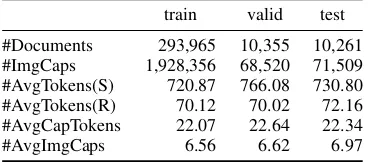
details are illustrated in Table1.
train valid test
#Documents 293,965 10,355 10,261 #ImgCaps 1,928,356 68,520 71,509 #AvgTokens(S) 720.87 766.08 730.80 #AvgTokens(R) 70.12 70.02 72.16 #AvgCapTokens 22.07 22.64 22.34
[image:5.595.325.509.413.494.2]#AvgImgCaps 6.56 6.62 6.97
Table 1: Corpus statistics. Each image on the website is paired with a caption.#ImgCapsdenotes the number of image-caption pairs.#AvgTokens(S),#AvgTokens(R)
and#AvgCapTokensdenote the average number of to-kens in articles, highlights, and captions respectively.
To get the pictorial reference, we employ 10 graduate students to select the relevant images from the article for each reference text summary. We allow annotators to select up to three images to reduce the difference between different annota-tors. If the annotators find that there is no relevant image, they will select none of them. Each
arti-cle is annotated by at least two students6. Since
we use the text reference to guide the generation of the pictorial summary, we do not use the ref-erence image during training. Therefore, we only conduct the annotation on the test set.
5
http://www.dailymail.co.uk
6A third annotator will be asked to decide the final
4.2 User Satisfaction Test
We conduct an experiment to investigate whether a pictorial summary can improve the user satis-faction for the informativeness of the summary. For a fair comparison, we propose a novel strat-egy to compare text summaries and pictorial sum-maries. We take an example to illustrate our
strat-egy. Given100source news pages, we have their
corresponding reference text summaries and picto-rial summaries. We divide them into two parts of
the same size, part1and part2. In part1, human
annotator A evaluates the text summaries accord-ing to the input news, and human annotator B
eval-uates the pictorial summaries. In part2, annotator
A evaluates the pictorial summaries and annota-tor B evaluates the text summaries. All annotaannota-tors
will give a score of1 to5. The input news is the
same for annotator A and annotator B.
Format AnnotatorA AnnotatorB Overall
Text 3.67 3.75 3.71
Pictorial 4.14 4.20 4.17
Table 2: User satisfaction test results. In total, we use the strategy mentioned in Section4.2to evaluate400
randomly selected source news pages.Overalldenotes the average score on these400samples.
Table 2 shows our results for user
satisfac-tion test. User ratings of pictorial summaries are
12.4%higher than text summaries. It shows that
users prefer this way of presenting information. It also confirms our motivation for MSMO.
4.3 Comparison with Text Summarization
Our user satisfaction test in Sec. 4.2 is done in
an ideal situation, comparing the text reference with the pictorial reference. To show the effec-tiveness of our model, we also compare our model with text summarization from ROUGE and human
judgment scores. We compare several
abstrac-tive summarization methods with our multimodal
summarization methods. PGC7(See et al.,2017)
refers to the pointer-generator network (Sec.2.2).
AED (Nallapati et al., 2016) uses an attentional encoder-decoder framework and adds some lin-guistic features such as POS, named-entities, and
TF-IDF into the encoder. We also implement
a seq2seq model with attention (S2S+attn). To
compare the multimodal output with our multi-modal model, we propose an extractive method
7https://github.com/abisee/
pointer-generator
based on GuideRank (GR) (Li et al., 2016a,
2018b). GuideRank applies LexRank (Erkan and Radev,2004) with guidance strategy. In this strat-egy, captions recommend the sentences related to them. The rankings of sentences and captions are obtained through GR; we extract sentences that satisfy the length limit as a text summary accord-ing to the rankaccord-ing of text. We select an image whose caption ranks the first in the captions. And
finally, the pictorial summary is obtained. We
evaluate different summarization models with the standard ROUGE metric, reporting the F1 scores for ROUGE-1, ROUGE-2, and ROUGE-L. Our
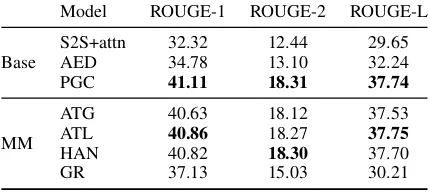
ROUGE results are given in Table 3, and human
judgment scores are given in Table4.
Model ROUGE-1 ROUGE-2 ROUGE-L
S2S+attn 32.32 12.44 29.65
Base AED 34.78 13.10 32.24
PGC 41.11 18.31 37.74
ATG 40.63 18.12 37.53
MM ATL 40.86 18.27 37.75
HAN 40.82 18.30 37.70
[image:6.595.309.524.285.381.2]GR 37.13 15.03 30.21
Table 3: ROUGE F1 scores on our test set. All our ROUGE scores are reported by official ROUGE script.
Model PGC ATG ATL HAN
HS 3.07 3.30 3.22 3.20
Table 4: Human judgment scores for our multimodal model and PGC. We randomly select400articles and use the same strategy as Sec.4.2. HS denotes the aver-age human judgment scores.
From Table 3, all multimodal models lead to
a decrease in ROUGE scores which can attribute
to the following reasons. There are 6.56 images
on average in each article and not every image is closely related to the event of the article. In other words, some images are noise. On the other hand, our text input is long text, and it contains enough
information for text generation. In Table4,
multi-modal models are better than text model in human judgments. It further illustrates our motivation, and also proves the effectiveness of our models.
4.4 Correlation Test
To illustrate the effectiveness of our evaluation metrics, we conduct an experiment on correla-tions between these metrics and human judgment
scores. Human annotators give a score which
accord-ing to the reference8. The reference consists of a text summary and up to three relevant images se-lected by humans. We randomly extract the pic-torial summaries from the output of different sys-tems. In response to the three aspects we proposed
in Section3, we propose some related metrics
re-spectively. For text salience, we applyROUGE-1,
ROUGE-2, ROUGE-L, and BLEU. For
image-text relevance of candidate pictorial summaries, we propose two ways. One is to calculate the
similarity (Img-Sum) between the image and the
whole text summary. The other is to calculate
the similarities between the image and each sen-tence in the text summary. Then we take the
maxi-mum and average values as two metrics:MAXsim
and AVGsim. For image salience, in addition to
theIPmetric mentioned in Section3.2, we try to
calculate the similarity between the candidate im-age and each reference imim-age in three ways: 1)
I-I: similarities between the global fc7 features,
2) Hist: Bhattacharyya distance9 for histogram
comparison (Bhattacharyya,1943), and 3)Temp:
Fourier Analysis template matching (Briechle and
Hanebeck,2001).
We employ annotators to evaluate600samples
(randomly selected from the outputs of each model on the validation set). Each sample is scored by two persons and we take the average score as the
final score. We use450of them as training set to
train the MMAE model in Sec.4.5, the rest is used
as test set. The scores calculated by each evalua-tion metric are then tested on the training set to see how well they correlate with human judgments. The correlation is evaluated with three metrics,
in-cluding 1) Pearson correlation coefficient (r), 2)
Spearman rank coefficient (ρ), and 3) Kendall rank
coefficient (τ). Our results of correlation test are
given in Table5.
As shown in Table5,IP(Image Precision)
cor-relates best with human assessments according to the three correlation coefficients. It illustrates that people pay more attention to images when assess-ing pictorial summaries. If we choose the right image for the summary, people are more likely to assign a high score. We also note that the
corre-lation score ofIPis significantly higher than four
8Some articles are annotated with no relevant images
(about3.9%), we directly skipped these articles without man-ual scoring
9In statistics, the Bhattacharyya distance measures the
similarity of two discrete or continuous probability distribu-tions. For a distanced, we take(1−d)as the similarity.
Metric r ρ τ
BLEU .1949 .1542 .1198
Text ROUGE-1 .3006 .2941 .2152
ROUGE-2 .2735 .2742 .2002 ROUGE-L .3144 .3087 .2272
AVGsim .2662 .2388 .1774
Image-Text MAXsim .2849 .2749 .2033 Img-Sum .2380 .2075 .1556
I-I (max) .0169 .0258 .0196 I-I (avg) -.0262 -.0140 -.0113 Histavg .4688 .5077 .3725
Image Histmax .5974 .6388 .5149
Tempavg .4913 .4944 .3631 Tempmax .5967 .6435 .5080
IP .6407 .6482 .5789
Table 5: Correlation with human judgment scores (training set), measured with Pearsonr, Spearmanρ, and Kendallτ coefficients. The max and avg denote the maximum and average value of the scores.
text metrics. Because it is easy for a person to judge the importance of images based on refer-ence, such as to see whether the image appears in reference. However, measuring the semantic sim-ilarity of two texts is difficult. The four metrics all measure the degree of n-gram overlap which can-not accurately measure semantic similarity.
For the image-text relevance,MAXsimperforms
best and is comparable to the several ROUGE met-rics. It shows that in a good pictorial summary, the image and text should be relevant. In some cases, even though the generated text is not so im-portant, the image is closely related to the text. At this time, people can also be satisfied. On the
other hand, our VSE0 (Sec.3.3) model can
cap-ture some fluency of sentences by adopting GRU.
Compare MAXsim, AVGsim, and Img-Sum, this
is very intuitive. Once people find a sentence (or a part) relevant to the image, they will think the image is related to the text. Besides, the worst
performance of Img-Sum metric is probably
be-cause the average length of captions used to train
VSE0 model is about22, far less than the length
of the summary. We find the I-I (max) and I-I
(avg)nearly do not correlate with human
assess-ments. It shows that the visual features extracted from VGG19 are not suitable for calculating the similarity between news images. The analysis of
Hist (Temp)avg andHist (Temp)max is similar to
the analysis ofMAXsimandAVGsimabove.
4.5 Effectiveness and Generalization of
MMAE
ROUGE-L,MAXsim, andIP. We apply LR, MLP,
and Logis to learn our MMAE model that com-bines the three metrics. We calculate the three co-efficients for the three metrics on the test set as a comparison. The correlation results are given in
Table6.
Metric r ρ τ
ROUGE-L .3488 .3554 .2669
MAXsim .2541 .2339 .1773
IP .5982 .5966 .5485
MMAELR .6646 .6644 .5265 MMAEMLP .6632 .6646 .5265 MMAELogis .6630 .6653 .5277
Table 6: Correlation with human judgment scores (test set).
As shown in Table 6, the MMAE learned by
three methods correlates better with human
judg-ments. Although MMAELogis gets a slightly
higher correlation score according to Spear-man and Kendall coefficients, we choose the
MMAELR10as our final MMAE model due to
Oc-cam’s Razor11.
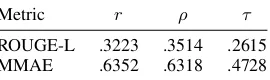
It is crucial that MMAE can generalize for a previously unseen system. To test the generaliza-tion of MMAE, we use MMAE to evaluate a new system and calculate the correlation with human judgment scores. The new system is a naive model which applies LexRank to extract sentences and randomly select an image from source. We can ob-serve that MMAE still correlates well with human
judgment scores, as shown in Table7. It illustrates
that MMAE generalize well for a new model. We give some examples of MMAE in supplementary material.
Metric r ρ τ
ROUGE-L .3223 .3514 .2615
[image:8.595.319.513.64.125.2]MMAE .6352 .6318 .4728
Table 7: Correlation results for the new model on the same150test samples as in Sec.4.4.
4.6 Model Performances
According to our analyses above, we have proved MMAE can evaluate multimodal output. In this section, we report the MMAE scores for our pro-posed multimodal attention model, as shown in
Table8.
10
The weight for ROUGE-L, MAXsim, and IP is 1.641, 0.854,0.806respectively and the intercept is1.978.
11https://en.wikipedia.org/wiki/Occam%
27s_razor
Model ROUGE-L MAXsim IP MMAE
ATG 40.76 25.82 59.28 3.35
ATL 40.80 13.26 62.44 3.26
HAN 40.82 12.22 61.83 3.25
GR 30.20 26.60 61.70 3.20
Table 8: Results evaluated by our MMAE method. We skipped the articles that are labeled as no relevant im-ages. Finally, only 9,851 of the 10,261 articles are left.
Surprisingly, the model ATG achieves the high-est MMAE score despite the mediocre
perfor-mance in three individual metrics. The MAXsim
score of ATG is much higher than ATL and HAN. It shows the global features can help to learn bet-ter image-text alignments. Since GR itself makes use of the image-caption pairs, it is natural to get a high image-text relevance score. Our pro-posed multimodal attention models all achieves higher performance than the extractive baseline GR, which further indicate the effectiveness of our models.
5 Related Work
Different from text summarization (Wan and
Yang, 2006;Rush et al., 2015; Zhu et al., 2017;
See et al.,2017;Celikyilmaz et al.,2018;Paulus et al.,2018), Multimodal Summarization is a task to generate a condensed text summary or a few keyframes to help acquire the gist of multimedia data. One of the most significant advantages of the task is that it does not rely solely on text informa-tion, but it can also utilize the rich visual content from the images.
In recent years, much work has focused on
mul-timodal summarization. Evangelopoulos et al.
(2013) detect salient events in a movie based on
the saliency of individual features for aural, visual,
and linguistic representations. Li et al. (2017)
generate the text summary from an asynchronous collection of text, image, audio, and video. There
has also been some work (Bian et al.,2013,2015;
Wang et al., 2016; Qian et al.,2016) focused on producing multimodal output for summarization.
Bian et al.(2013,2015) aim to produce a
visual-ized summary for microblogs. Wang et al.(2016)
generate a pictorial storyline for summarization.
[image:8.595.115.250.544.584.2]mi-croblog post; Wang et al.(2016) obtain the image-text pairs by using image search engine. None of the above works focuses on generating multimodal output from a collection of texts and images that are not explicitly aligned. This is one of the goals in this paper. Another difference is that they sep-arately evaluate texts and images when evaluating the final results. In our work, we propose a new automatic evaluation which jointly considers two aspects of textual and visual modalities.
6 Conclusion
In this paper, we focus on a novel task which aims to automatically generate a multimodal summary from multimodal news, where the images and the texts are not explicitly aligned. We provide a mul-timodal summarization method to jointly gener-ate text and the most relevant image, which can be referred as the baseline for further study. Our proposed metrics have been proved to be effective in evaluating the multimodal output. Moreover, the idea of constructing our MMAE can be eas-ily extended to other modalities. That is, we both consider the intramodality salience and the inter-modality relevance.
7 Acknowledgments
The research work described in this paper has been supported by the National Key Research and Development Program of China under Grant No. 2016QY02D0303. We thank the three anonymous reviewers for their careful reading of our paper and their many insightful comments and suggestions. We also thank Shaonan Wang, Xiaomian Kang, and Yang Zhao for helpful discussions.
References
Dzmitry Bahdanau, Kyunghyun Cho, and Yoshua Ben-gio. 2015. Neural machine translation by jointly learning to align and translate. In Proceedings of the International Conference on Learning Represen-tations (ICLR).
Anil Bhattacharyya. 1943. On a measure of divergence between two statistical populations defined by their probability distributions. Bull. Calcutta Math. Soc., 35:99–109.
Jingwen Bian, Yang Yang, and Tat-Seng Chua. 2013. Multimedia summarization for trending topics in mi-croblogs. InProceedings of the 22nd ACM interna-tional conference on Conference on information & knowledge management, pages 1807–1812.
Jingwen Bian, Yang Yang, Hanwang Zhang, and Tat-Seng Chua. 2015. Multimedia summarization for social events in microblog stream. IEEE Transac-tions on multimedia, 17(2):216–228.
Kai Briechle and Uwe D Hanebeck. 2001. Template matching using fast normalized cross correlation. In Optical Pattern Recognition XII, volume 4387, pages 95–103.
Asli Celikyilmaz, Antoine Bosselut, Xiaodong He, and Yejin Choi. 2018. Deep communicating agents for abstractive summarization. In Proceedings of the 2018 Conference of the North American Chapter of the Association for Computational Linguistics: Hu-man Language Technologies (NAACL-HLT), pages 1662–1675.
Ronan Collobert, Jason Weston, Michael Karlen, Ko-ray Kavukcuoglu, and Pavel Kuksa. 2011. Nat-ural language processing (almost) from scratch.
Journal of Machine Learning Research (JMLR), 12(1):2493–2537.
G¨unes Erkan and Dragomir R Radev. 2004. Lexrank: Graph-based lexical centrality as salience in text summarization. Journal of Artificial Intelligence Research, 22:457–479.
Georgios Evangelopoulos, Athanasia Zlatintsi, Alexan-dros Potamianos, Petros Maragos, Konstantinos Ra-pantzikos, Georgios Skoumas, and Yannis Avrithis. 2013. Multimodal saliency and fusion for movie summarization based on aural, visual, and tex-tual attention. IEEE Transactions on Multimedia, 15(7):1553–1568.
Fartash Faghri, David J Fleet, Jamie Ryan Kiros, and Sanja Fidler. 2018. Vse++: Improving visual-semantic embeddings with hard negatives. In Pro-ceedings of the British Machine Vision Conference (BMVC).
Karl Moritz Hermann, Tomas Kocisky, Edward Grefenstette, Lasse Espeholt, Will Kay, Mustafa Su-leyman, and Phil Blunsom. 2015. Teaching ma-chines to read and comprehend. In Proceedings of Neural Information Processing Systems (NIPS), pages 1693–1701.
Andrej Karpathy and Li Fei-Fei. 2015. Deep visual-semantic alignments for generating image descrip-tions. In Proceedings of the IEEE conference on computer vision and pattern recognition (CVPR), pages 3128–3137.
George Karypis. 2001. Evaluation of item-based top-n recommendation algorithms. InProceedings of the tenth international conference on Information and knowledge management, pages 247–254.
Haoran Li, Jiajun Zhang, Yu Zhou, and Chengqing Zong. 2016a. Guiderank: A guided ranking graph model for multilingual multi-document summariza-tion. InThe Fifth Conference on Natural Language Processing and Chinese Computing & The Twenty Fourth International Conference on Computer Pro-cessing of Oriental Languages (NLPCC-ICCPOL), pages 608–620.
Haoran Li, Junnan Zhu, Tianshang Liu, Jiajun Zhang, and Chengqing Zong. 2018a. Multi-modal sentence summarization with modality attention and image filtering. InProceedings of the Twenty-Fifth Inter-national Joint Conference on Artificial Intelligence (IJCAI), pages 4152–4158.
Haoran Li, Junnan Zhu, Cong Ma, Jiajun Zhang, and Chengqing Zong. 2017. Multi-modal summariza-tion for asynchronous collecsummariza-tion of text, image, au-dio and video. InProceedings of the Conference on Empirical Methods in Natural Language Processing (EMNLP), pages 1092–1102.
Haoran Li, Junnan Zhu, Cong Ma, Jiajun Zhang, and Chengqing Zong. 2018b. Read, watch, listen and summarize: Multi-modal summarization for asyn-chronous text, image, audio and video. IEEE Transactions on Knowledge and Data Engineering (TKDE).
Zechao Li, Jinhui Tang, Xueming Wang, Jing Liu, and Hanqing Lu. 2016b. Multimedia news summariza-tion in search. ACM Transactions on Intelligent Sys-tems and Technology (TIST), 7(3):33.
Chin-Yew Lin. 2004a. Looking for a few good metrics: Automatic summarization evaluation-how many samples are enough? In Proceedings of NII Testbeds and Community for information access Re-search (NTCIR).
Chin-Yew Lin. 2004b. Rouge: A package for auto-matic evaluation of summaries. Text Summarization Branches Out.
Thang Luong, Hieu Pham, and Christopher D. Man-ning. 2015. Effective approaches to attention-based neural machine translation. In Proceedings of the Conference on Empirical Methods in Natural Lan-guage Processing (EMNLP), pages 1412–1421.
Ioannis Mademlis, Anastasios Tefas, Nikos Nikolaidis, and Ioannis Pitas. 2016. Multimodal stereoscopic movie summarization conforming to narrative char-acteristics. IEEE Transactions on Image Process-ing, 25(12):5828–5840.
Ramesh Nallapati, Bowen Zhou, Caglar Gulcehre, Bing Xiang, et al. 2016. Abstractive text summa-rization using sequence-to-sequence rnns and be-yond. InProceedings of the 20th SIGNLL Confer-ence on Computational Natural Language Learning (CoNLL).
Paul Over and James Yen. 2004. An introduction to duc 2004 intrinsic evaluation of generic new text summarization systems. InProceedings of the Doc-ument Understanding Conference (DUC).
Karolina Owczarzak, John M Conroy, Hoa Trang Dang, and Ani Nenkova. 2012. An assessment of the accuracy of automatic evaluation in summariza-tion. In Proceedings of Workshop on Evaluation Metrics and System Comparison for Automatic Sum-marization, pages 1–9.
Romain Paulus, Caiming Xiong, and Richard Socher. 2018. A deep reinforced model for abstractive sum-marization. In Proceedings of the International Conference on Learning Representations (ICLR).
Shengsheng Qian, Tianzhu Zhang, and Changsheng Xu. 2016. Multi-modal multi-view topic-opinion mining for social event analysis. InProceedings of the 2016 ACM on Multimedia Conference, pages 2– 11.
Alexander M. Rush, Sumit Chopra, and Jason Weston. 2015. A neural attention model for abstractive sen-tence summarization. In Proceedings of the Con-ference on Empirical Methods in Natural Language Processing (EMNLP), pages 379–389.
Abigail See, Peter J. Liu, and Christopher D. Manning. 2017. Get to the point: Summarization with pointer-generator networks. InProceedings of the Annual Meeting of the Association for Computational Lin-guistics (ACL), pages 1073–1083.
Rajiv Ratn Shah, Yi Yu, Akshay Verma, Suhua Tang, Anwar Dilawar Shaikh, and Roger Zimmermann. 2016. Leveraging multimodal information for event summarization and concept-level sentiment analy-sis.Knowledge-Based Systems, 108:102–109.
Karen Simonyan and Andrew Zisserman. 2015. Very deep convolutional networks for large-scale image recognition. In Proceedings of the International Conference on Learning Representations (ICLR).
Xiaojun Wan and Jianwu Yang. 2006. Improved affin-ity graph based multi-document summarization. In
Proceedings of the Human Language Technology Conference of the NAACL, pages 181–184.
Liwei Wang, Yin Li, Jing Huang, and Svetlana Lazeb-nik. 2018. Learning two-branch neural networks for image-text matching tasks. IEEE Transactions on Pattern Analysis and Machine Intelligence (TPAMI).
Kelvin Xu, Jimmy Ba, Ryan Kiros, Kyunghyun Cho, Aaron Courville, Ruslan Salakhudinov, Rich Zemel, and Yoshua Bengio. 2015. Show, attend and tell: Neural image caption generation with visual at-tention. In International Conference on Machine Learning (ICML), pages 2048–2057.
Peter Young, Alice Lai, Micah Hodosh, and Julia Hockenmaier. 2014. From image descriptions to visual denotations: New similarity metrics for se-mantic inference over event descriptions. Transac-tions of the Association for Computational Linguis-tics (TACL), 2:67–78.
Junnan Zhu, Long Zhou, Haoran Li, Jiajun Zhang, Yu Zhou, and Chengqing Zong. 2017. Augment-ing neural sentence summarization through extrac-tive summarization. InProceedings of the 6th Con-ference on Natural Language Processing and Chi-nese Computing (NLPCC), pages 16–28.