PP Attachment: Where do We Stand?
Dani¨el de Kok and Jianqiang Ma and Corina Dima and Erhard Hinrichs
SFB 833 and Seminar f¨ur Sprachwissenschaft University of T¨ubingen, Germany
{ddekok,jma,cdima,eh}@sfs.uni-tuebingen.de
Abstract
Prepositional phrase (PP) attachment is a well known challenge to parsing. In this paper, we combine the insights of differ-ent works, namely: (1) treating PP attach-ment as a classification task with an ar-bitrary number of attachment candidates; (2) using auxiliary distributions to aug-ment the data beyond the hand-annotated training set; (3) using topological fields to get information about the distribution of PP attachment throughout clauses and (4) using state-of-the-art techniques such as word embeddings and neural networks. We show that jointly using these tech-niques leads to substantial improvements. We also conduct a qualitative analysis to gauge where the ceiling of the task is in a realistic setup.
1 Introduction
Prepositional phrase (PP) attachment is a well-known structural ambiguity in natural language parsing (Hindle and Rooth, 1993), that even mod-ern parsers have difficulty coping with. For exam-ple, Kummerfeld et al. (2012) investigated parsing error types across a large number of parsers for English and found that PP attachment and clause attachment are the most difficult constructions. Mirroshandel et al. (2012) show that in a second-order graph parser for French, 8 of the 13 most common error types relate to PP attachment. We found in our experiments with the parser of de Kok and Hinrichs (2016) that most errors were made in PP attachment (18.42% of all labeled attachment errors).
What makes PP attachment particularly difficult is that the ambiguities can often not be solved us-ing only structural preferences. Example 1 from
German shows the difficulty of the problem in its full glory, where the preposition unter “un-der/among” is attached toNeulinge“newcomers”. However, the PP could attach to begr¨ußen “wel-come” when the complement of the preposition is a locative noun phrase (e.g. offenem Himmel
“open skies”).
(1) Wir begr¨ußen die NeulingeWe welcome the newcomers under/among us .unter uns . PP
PP
Spread throughout the literature, there are many important observations about and approaches to the task of PP attachment, but they have never been properly combined. We will first discuss them briefly below, and then summarize the con-tributions of this paper.
Most work in PP attachment assumes that a preposition attaches to either the immediately pre-ceding noun (phrase) or the main verb (Hindle and Rooth, 1993; Volk, 2002). Some other work does take multiple nouns candidates into consid-eration, but only nouns that are within a certain window preceding the preposition (Ratnaparkhi, 1998; Belinkov et al., 2014) or all the nouns in the sentence (Foth and Menzel, 2006). Using exam-ples from German, de Kok et al. (2017) show that these crude approaches are problematic. In Ger-man, there are typically more than two possible attachment sites. In fact, they show that 30% of the training instances could not even be described in this typical binary classification setup. More-over, PPs can attach over relatively long distances and the preposition can precede its head (e.g. in PP topicalization). They also show that the task of PP attachment with multiple noun candidates is considerably more difficult than the traditional bi-nary classification task. On the other hand, de Kok et al. (2017) also show that many spurious heads can be eliminated by exploiting relatively shallow
clause structure annotations.
Previous work has shown that bi-lexical prefer-ences are effective in solving PP attachment am-biguities (Brunner et al., 1992; Whittemore et al., 1990). Two words have a strong bi-lexical preference if the words are likely to occur in a head-dependent relation. These preferences are usually stated in terms of information-theoretical measures, such as point-wise mutual informa-tion. Since hand-annotated treebanks usually do not have enough material to obtain reliable bi-lexical statistics, these statistics were extracted from raw text (Volk, 2001), automatically tagged (Ratnaparkhi, 1998), chunk parsed (Volk, 2002) or parsed (Hindle and Rooth, 1993; Pantel and Lin, 2000; Mirroshandel et al., 2012) corpora, resulting in auxiliary distributions. Since these seminal works in PP attachment, parsers have be-come faster (K¨ubler et al., 2009) and more accu-rate (Chen and Manning, 2014), opening the pos-sibility to obtain better co-occurrence statistics.
Topological fields are commonly used to cap-ture the regularities in German word order (Drach, 1937; H¨ohle, 1986). The distributions of syntac-tic relations vary significantly across topological fields, which can benefit dependency parsing of German (de Kok and Hinrichs, 2016). We expect topological fields to provide information about the distribution of PP attachment throughout clauses and thus benefit PP attachment disambiguation for German in a similar way as in dependency parsing. Many tasks in natural language processing have seen substantial improvements in recent years through the use of word embeddings in combi-nation with neural networks. Word embeddings (Mikolov et al., 2013; Pennington et al., 2014) im-prove the lexical coverage of systems beyond su-pervised training sets by giving words that occur in similar contexts similar vector representations. Embeddings work especially well with neural net-works, as neural networks are able to capture non-linear interactions between features.
Considering these ideas and techniques that can have an impact on modeling PP attachment, the question we want to address iswhere do we stand in PP attachment? Our contributions are three-fold: (1) we evaluate PP attachment on a realis-tic multiple-candidate PP attachment data set for German; (2) we integrate the aforementioned ad-vances in parsing and machine learning and con-firm their usefulness for the task; and (3) we
per-form an error analysis to gauge how many of the remaining errors can be attributed to the system.
2 PP attachment disambiguation model
Following the discussion in the Introduction, this paper considers a realistic setup for PP attach-ment disambiguation, where each disambiguation instance involves choosing the correct attachment site from an arbitrary number of candidates. As the number of classes/candidates varies across dis-ambiguation instances, it can not be modeled as a typical multiclass classification. To tackle this setup, we build aneural candidate scoring model
(Section 2.1) to estimate the probability that the at-tachment candidate under consideration is the cor-rect attachment site. Then, among all the candi-dates for the same PP, the candidate with the high-est probability is considered to be the correct at-tachment site.
2.1 Neural candidate scoring model
Our neural candidate scoring model uses a feed-forward neural network with three layers. The input layer consists of featurized representations of a <preposition, object of the preposition, candidate> triple. These input features are dis-cussed in more detail in Section 2.2. The net-work uses a hidden layer with the ReLU activa-tion funcactiva-tion (Hahnloser et al., 2000) as its non-linearity. Finally, the output layer uses the logistic function as an activation function to model proba-bilities. For regularization, dropout (Srivastava et al., 2014) is applied to the input and hidden lay-ers. Following the best practice, we apply batch normalization (Ioffe and Szegedy, 2015) of param-eters.
The model parameters are trained using (candi-date, probability) pairs that are constructed from the training data. Correct and incorrect attach-ments are assigned probabilities 1 and 0 respec-tively. To learn the model parameters, we mini-mize the cross-entropy loss using mini-batch gra-dient descent. During learning, the global learn-ing rate follows an exponential decay and the per-parameter learning rate is adjusted using Adagrad (Duchi et al., 2011).
2.2 Feature set
augment the absolute distance feature of K¨ubler et al. (2007) that counts the number of words be-tween the preposition and the candidate, with the logarithm of this distance and the relative dis-tance. The relative distance is the number of com-peting candidates between the candidate and the preposition.
Word and tag embeddings Traditional methods for PP attachment represent the word and tag fea-tures as one-hot vectors. For the embedding repre-sentations of these two types of features, we use the embeddings of de Kok (2015), which were trained on corpora of 800 millions tokens, us-ingWANG2VEC(Ling et al., 2015), a variation of WORD2VECthat is tailored to syntactic tasks.
Topological fieldsAs mentioned in the Introduc-tion, topological fields are informative for the dis-tributions of syntactic relations in general. Our analysis of the T¨uBa-D/Z dependency treebank (Telljohann et al., 2006) for German shows that this observation also holds for the PP attachment relation. For example, when the preposition is in theinitial field, the preposition is highly likely to attach to the candidate in either the initial field or theleft bracket. We use the method of de Kok and Hinrichs (2016) to predict the topological fields for all three types of tokens: the preposition, ob-ject and candidate. Each of these token will have a corresponding one-hot vector that represents its predicted topological field.
Auxiliary distributions of bi-lexical preferences have been shown to be useful for resolving syn-tactical ambiguities in general (Johnson and Rie-zler, 2000; van Noord, 2007), besides their par-ticular benefits for PP attachment as discussed in Section 1. Such bi-lexical preferences can be captured, for example, by point-wise mutual information (PMI) that is estimated from large machine-annotated corpora. Our approach makes use of a state-of-the-art dependency parser (de Kok and Hinrichs, 2016) to parse a large cor-pus, namely articles from the German newspa-per taz (die tageszeitung) from 1986 to 2009 (28.8 million sentences, 393.7 million tokens). The parser-predicted PP attachments are repre-sented as<preposition, object of the preposition, candidate> triples, which we collect from both ambiguous and unambiguous PP attachment re-sults. Here, unambiguous attachments refer to prepositions that only have one possible attach-ment site (Ratnaparkhi, 1998).
For bi-lexical association scores, we compute the normalized point-wise mutual information (NPMI) (Bouma, 2009), a normalized version of PMI, for three types of token pairs: date, object), (candidate, preposition) and (candi-date, preposition+object). For the last case, each preposition-object combination is considered as one token. NPMI is obtained by normalizing raw PMI into the range[−1,1], which is more favor-able for learning. We also extend bi-lexical associ-ation scores to tri-lexical associassoci-ation scores by us-ing specific interaction information and total cor-relation (Van de Cruys, 2011), both of which can simultaneously take into account three variables, which are the preposition, object and candidate in our case. Overall, our auxiliary distributions con-sist of 5 types of association scores that are esti-mated from automatically parsed corpora.
3 Experiments
For evaluation, we use the recently created PP attachment data set for German (de Kok et al., 2017). In this data set each preposition has mul-tiple head candidates. The average number of can-didates per preposition is 3.15. The data set is ex-tracted from T¨uBa-D/Z, using a set of rules de-rived from the distributions of prepositions and their heads across topological fields. From this data set, we remove the instances that originate from sentences that were used to train the parser which was used in creating the auxiliary distri-butions. We split the remaining 43,906 instances with a 4:1 ratio for respectively training and eval-uation. Initially, a subset of the training data is used to tune hyper-parameters. Then we train the model on the full training set using the cho-sen hyper-parameters.1 Finally, the model
per-formance is evaluated on the test set, using stan-dard per-preposition accuracy, i.e the percentage of prepositions that are correctly attached.
3.1 Comparison with baselines
Ideally, we would like to compare the model pro-posed in Section 2 to earlier approaches for Ger-man PP attachment disambiguation, using the new data set with multiple attachment candidates (see Section 3). Previous approaches typically used memory-based learning (K¨ubler et al., 2007) or 1The relevant hyper-parameters are: number of
linear SVMs (Volk, 2001). Since the running time of the memory-based learning implementation on the data set is extremely long and linear SVMs of-ten yield results that are similar to logistic regres-sion on NLP tasks, we build a logistic regresregres-sion model (LR) as the baseline. Logistic regression is a representative linear model with high computa-tional efficiency. The input representations, reg-ularization and optimization algorithm remain the same for both our model and the LR baseline.
3.2 Impact of embeddings and feed-forward neural networks
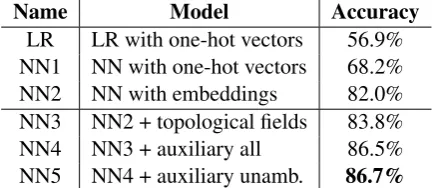
In the upper half of Table 3.2, we compare the LR baseline with two variations of the proposed neural network model. The baseline and the first variation (NN1) use the same one-hot feature vec-tors as input, as previous approaches utilize such feature representations. Our NN1 model outper-forms the logistic regression baseline (LR) by
11.3% in terms of absolute accuracy improve-ment. Note that our experiment only uses core fea-tures without hand-crafting combinatory feafea-tures, which would have improved the performance of the LR model. Thanks to the non-linearity, neu-ral networks can implicitly capture useful fea-ture combinations, thus leading to dramatic per-formance improvement from LR to NN1. Another substantial improvement (13.8%) is obtained by representing the word forms and POS tags with embeddings instead of one-hot vectors (compar-ing NN2 with NN1). Our lexical coverage analy-sis shows that the training set only covers71.7%of the word types that occur in the test set, while the embeddings have the lexical coverage of 89.5%, which can probably account for much of the im-proved accuracy of NN2. Note that, in both cases, the word forms are used without lemmatization or morphological analyses. The high lexical cover-age makes embeddings more robust when linguis-tic pre-processing is absent or inaccurate.
3.3 Impact of topological fields and auxiliary distributions
To test the benefits of using topological fields and auxiliary distributions for the task, we conduct further experiments to test three variations of our model. The NN3 model extends the NN2 model by adding the topological field features. The NN4 model further extends the NN3 model by adding auxiliary distributions that are estimated from all the PP attachments. Finally, the NN5 model
ex-Name Model Accuracy
LR LR with one-hot vectors 56.9% NN1 NN with one-hot vectors 68.2%
NN2 NN with embeddings 82.0%
NN3 NN2 + topological fields 83.8%
NN4 NN3 + auxiliary all 86.5%
[image:4.595.308.525.63.157.2]NN5 NN4 + auxiliary unamb. 86.7%
Table 1: Results on PP attachment disambiguation on the logistic regression baseline (LR) and our neural network models (NN*).
tends the NN4 model by adding auxiliary distribu-tions using only the unambiguous PP attachments. Although the unambiguous attachments are a sub-set of theauxiliary allset, the lexical association distributions of the two sets are different, thus pro-viding extra information to the model. These re-sults are shown in the lower half of Table 3.2. By exploiting topological fields as extra features, model NN3 obtains1.8%absolute improvements in accuracy over model NN2. Addingauxiliary all
features on top of NN3 leads to another2.7% im-provement in accuracy. The final0.2% improve-ment in accuracy is achieved by adding auxiliary distributions using only the unambiguous PP at-tachments. These results confirm the usefulness of topological fields and auxiliary distributions.
4 Error analysis
To answer the final part of our question “where we stand in PP attachment”, we take a random sample of 100 instances that were incorrectly attached by our most accurate model. We then analyzed each instance by hand and assigned it to one of four types of errors: (1) incorrect: the model made a clear attachment error; (2)discourse: the attach-ment can only be resolved with discourse-level information; (3) irrelevant: there are two attach-ment choices that give rise to the same interpre-tation, where the gold-standard marked one while the model marked the other (see Example 2). (4)
other: such as possible errors in the gold standard. The results are shown in Table 2.
(2) She is employee at-the AKG Women-politics with the GreensSie ist Mitarbeiterin beim AKG Frauenpolitik bei den Gr¨unen PP
PP
be seen as shortcomings of the data set, which should mark multiple attachment sites when there is no substantial shift in meaning. The 13 errors that require discourse analysis cannot be resolved as long as PP attachment and consequently pars-ing are treated as sentence-level tasks. This leaves 44/100 errors that should be solvable be future ad-vancements in PP attachment models, i.e. the ac-curacy ceiling of the task on the dataset is expected to be around92.6%.
Type #
Incorrect 44 Irrelevant 36 Discourse 13
Other 7
Table 2: Error analysis of a random sample of 100 PPs that are incorrectly attached by the best model.
5 Conclusion
This paper evaluated a state-of-the-art PP attach-ment model that combines various insights about the task from the literature on a realistic data set with multiple attachment sites per preposition. We showed that by jointly using these insights, we ob-tain a very substantial improvement over previous approaches to the task. To answer the question where we stand in PP attachment, we conducted a manual analysis of attachment errors. This anal-ysis showed that for this data set, the margin be-tween the best models and the ceiling (approxi-mately 92.6%) is quickly narrowing. Moreover, any improvements beyond that ceiling requires changes to gold standards to mark multiple correct structures and that certain ambiguities in PP at-tachment and parsing are resolved with discourse-level information.
The system discussed in this paper is largely language-independent, because it relies on word embeddings and bi-lexical preferences as the pri-mary features. The only exception to this are the topological field features. However, we should point out that the topological field model is also used to describe clause structure in other Ger-manic languages (e.g. Haeseryn et al. (1997) and Zwart (2014)). Moreover, similar linear prece-dence constraints have been found for other lan-guage families, such as Slavic (Penn, 1999).
In the future, we would like to integrate and evaluate the PP attachment model that was
dis-cussed in this work in a dependency parser. Our aim is to use the representations formed by the feed-forward neural network as additional inputs to the transition classifier. This would combine the power of phrasal representations similar to those proposed by Belinkov et al. (2014) with bi-lexical preferences trained on large corpora.
Acknowledgments
Financial support for the research reported in this paper was provided by the German Research Foundation (DFG) as part of the Collaborative Research Center “The Construction of Meaning” (SFB 833), project A3.
References
Yonatan Belinkov, Tao Lei, Regina Barzilay, and Amir Globerson. 2014. Exploring compositional archi-tectures and word vector representations for prepo-sitional phrase attachment. Transactions of the As-sociation for Computational Linguistics, 2:561–572.
Gerlof Bouma. 2009. Normalized (pointwise) mutual
information in collocation extraction. Proceedings
of the International Conference of the German So-ciety for Computational Linguistics and Language Technology (GSCL 2009), pages 31–40.
Hans Brunner, Greg Whittemore, Kathleen Ferrara, and Jiamiene Hsu. 1992. An assessment of writ-ten/interactive dialogue for information retrieval
ap-plications. Human-Computer Interaction, 7(2):197–
249.
Danqi Chen and Christopher Manning. 2014. A fast and accurate dependency parser using neural
net-works. InProceedings of the 2014 Conference on
Empirical Methods in Natural Language Process-ing (EMNLP), pages 740–750, Doha, Qatar, Octo-ber. Association for Computational Linguistics.
Dani¨el de Kok and Erhard Hinrichs. 2016. Transition-based dependency parsing with topological fields. In Proceedings of the 54th Annual Meeting of the Association for Computational Linguistics (Volume 2: Short Papers), pages 1–7, Berlin, Germany, Au-gust. Association for Computational Linguistics.
Dani¨el de Kok, Corina Dima, Jianqiang Ma, and Erhard Hinrichs. 2017. Extracting a PP attachment data set from a German dependency treebank using topolog-ical fields. InInternational Workshop on Treebanks and Linguistic Theories (TLT15), pages 89–98.
Dani¨el de Kok. 2015. Bootstrapping a neural net dependency parser for German using CLARIN
re-sources. InProceedings of the CLARIN 2015
Erich Drach. 1937. Grundgedanken der Deutschen Satzlehre.
John Duchi, Elad Hazan, and Yoram Singer. 2011. Adaptive subgradient methods for online learning
and stochastic optimization. Journal of Machine
Learning Research, 12(Jul):2121–2159.
Kilian A. Foth and Wolfgang Menzel. 2006. The benefit of stochastic PP attachment to a rule-based
parser. In Proceedings of the COLING/ACL 2006
Main Conference Poster Sessions, pages 223–230, Sydney, Australia, July. Association for Computa-tional Linguistics.
Walter Haeseryn, Kirsten Romijn, Guido Geerts, Jaap
de Rooij, and Maarten C. van den Toorn. 1997.
Al-gemene nederlandse spraakkunst, volume 2. Marti-nus Nijhoff, Groningen, The Netherlands.
Richard H.R. Hahnloser, Rahul Sarpeshkar, Misha A. Mahowald, Rodney J. Douglas, and H. Sebastian Se-ung. 2000. Digital selection and analogue ampli-fication coexist in a cortex-inspired silicon circuit.
Nature, 405(6789):947–951.
Donald Hindle and Mats Rooth. 1993. Structural
am-biguity and lexical relations. Computational
Lin-guistics, 19(1):103–120, March.
Tilman H¨ohle. 1986. Der Begriff ‘Mittelfeld’.
Anmerkungen ¨uber die Theorie der topologischen Felder. In A. Sch¨one, editor,Kontroversen alte und neue. Akten des 7. Internationalen Germanistenkon-gresses G¨ottingen, pages 329–340.
Sergey Ioffe and Christian Szegedy. 2015. Batch nor-malization: Accelerating deep network training by
reducing internal covariate shift. In Proceedings
of The 32nd International Conference on Machine Learning, pages 448–456.
Mark Johnson and Stefan Riezler. 2000. Exploit-ing auxiliary distributions in stochastic
unification-based grammars. In Proceedings of the 1st North
American chapter of the Association for Computa-tional Linguistics Conference, pages 154–161. As-sociation for Computational Linguistics.
Sandra K¨ubler, Steliana Ivanova, and Eva Klett. 2007. Combining dependency parsing with PP attachment. InFourth Midwest Computational Linguistics Collo-quium.
Sandra K¨ubler, Ryan McDonald, and Joakim Nivre.
2009. Dependency parsing, volume 1. Morgan &
Claypool Publishers.
Jonathan K. Kummerfeld, David Hall, James R. Cur-ran, and Dan Klein. 2012. Parser showdown at the Wall Street corral: An empirical investigation
of error types in parser output. In Proceedings of
the 2012 Joint Conference on Empirical Methods in Natural Language Processing and Computational Natural Language Learning, pages 1048–1059, Jeju Island, Korea, July. Association for Computational Linguistics.
Wang Ling, Chris Dyer, Alan W. Black, and Isabel Trancoso. 2015. Two/too simple adaptations of
word2vec for syntax problems. In Proceedings of
the 2015 Conference of the North American Chap-ter of the Association for Computational Linguistics: Human Language Technologies, pages 1299–1304, Denver, Colorado, May–June. Association for Com-putational Linguistics.
Tomas Mikolov, Ilya Sutskever, Kai Chen, Greg S Cor-rado, and Jeff Dean. 2013. Distributed representa-tions of words and phrases and their composition-ality. In C. J. C. Burges, L. Bottou, M. Welling,
Z. Ghahramani, and K. Q. Weinberger, editors,
Ad-vances in Neural Information Processing Systems 26, pages 3111–3119.
Seyed Abolghasem Mirroshandel, Alexis Nasr, and Joseph Le Roux. 2012. Semi-supervised depen-dency parsing using lexical affinities. In Proceed-ings of the 50th Annual Meeting of the Association for Computational Linguistics (Volume 1: Long Pa-pers), pages 777–785, Jeju Island, Korea, July. As-sociation for Computational Linguistics.
Patrick Pantel and Dekang Lin. 2000. An unsuper-vised approach to prepositional phrase attachment using contextually similar words. InProceedings of the 38th Annual Meeting of the Association for Com-putational Linguistics, pages 101–108, Hong Kong, October. Association for Computational Linguistics. Gerald Penn. 1999. Linearization and WH-extraction
in HPSG: Evidence from Serbo-Croatian. In
Robert D. Borsley and Adam Przepi´orkowski,
edi-tors,Slavic in Head-Driven Phrase Structure
Gram-mar, pages 149–182.
Jeffrey Pennington, Richard Socher, and Christopher Manning. 2014. GloVe: Global Vectors for word
representation. In Proceedings of the 2014
Con-ference on Empirical Methods in Natural Language Processing (EMNLP), pages 1532–1543, Doha, Qatar, October. Association for Computational Lin-guistics.
Adwait Ratnaparkhi. 1998. Statistical models for un-supervised prepositional phrase attachment. In Pro-ceedings of the 36th Annual Meeting of the Asso-ciation for Computational Linguistics and 17th In-ternational Conference on Computational Linguis-tics, Volume 2, pages 1079–1085, Montreal, Que-bec, Canada, August. Association for Computa-tional Linguistics.
Nitish Srivastava, Geoffrey Hinton, Alex Krizhevsky, Ilya Sutskever, and Ruslan Salakhutdinov. 2014. Dropout: A simple way to prevent neural networks
from overfitting. Journal of Machine Learning
Re-search, 15:1929–1958.
Heike Telljohann, Erhard Hinrichs, Sandra K¨ubler,
Heike Zinsmeister, and Kathrin Beck. 2006.
Tim Van de Cruys. 2011. Two multivariate
general-izations of pointwise mutual information. In
Pro-ceedings of the Workshop on Distributional Seman-tics and Compositionality, DiSCo ’11, pages 16–20, Stroudsburg, PA, USA. Association for Computa-tional Linguistics.
Gertjan van Noord. 2007. Using self-trained bilexical preferences to improve disambiguation accuracy. In
Proceedings of the Tenth International Conference on Parsing Technologies, pages 1–10, Prague, Czech Republic, June. Association for Computational Lin-guistics.
Martin Volk. 2001. Exploiting the WWW as a corpus
to resolve PP attachment ambiguities. In
Proceed-ings of Corpus Linguistics, volume 200.
Martin Volk. 2002. Combining unsupervised and su-pervised methods for pp attachment disambiguation. InProceedings of the 19th International Conference on Computational linguistics-Volume 1, pages 1–7. Association for Computational Linguistics.
Greg Whittemore, Kathleen Ferrara, and Hans Brun-ner. 1990. Empirical study of predictive powers of simple attachment schemes for post-modifier
prepo-sitional phrases. In Proceedings of the 28th
An-nual Meeting of the Association for Computational Linguistics, pages 23–30, Pittsburgh, Pennsylvania, USA, June. Association for Computational Linguis-tics.
Jan-Wouter Zwart. 2014. The syntax of Dutch.