What Do Recurrent Neural Network Grammars Learn About Syntax?
Adhiguna Kuncoro♠ Miguel Ballesteros♦ Lingpeng Kong♠
Chris Dyer♠♣ Graham Neubig♠ Noah A. Smith♥
♠School of Computer Science, Carnegie Mellon University, Pittsburgh, PA, USA
♦IBM T.J. Watson Research Center, Yorktown Heights, NY, USA
♣DeepMind, London, UK
♥Computer Science & Engineering, University of Washington, Seattle, WA, USA
{akuncoro,lingpenk,gneubig}@cs.cmu.edu
[email protected], [email protected], [email protected]
Abstract
Recurrent neural network grammars (RNNG) are a recently proposed prob-ablistic generative modeling family for natural language. They show state-of-the-art language modeling and parsing performance. We investigate what in-formation they learn, from a linguistic perspective, through various ablations to the model and the data, and by aug-menting the model with an attention mechanism (GA-RNNG) to enable closer inspection. We find that explicit modeling of composition is crucial for achieving the best performance. Through the attention mechanism, we find that headedness plays a central role in phrasal represen-tation (with the model’s latent attention largely agreeing with predictions made by hand-crafted head rules, albeit with some important differences). By training grammars without nonterminal labels, we find that phrasal representations depend minimally on nonterminals, providing support for the endocentricity hypothesis.
1 Introduction
In this paper, we focus on a recently proposed class of probability distributions, recurrent neural network grammars (RNNGs; Dyer et al., 2016), designed to model syntactic derivations of sen-tences. We focus on RNNGs as generative proba-bilistic models over trees, as summarized in§2.
Fitting a probabilistic model to data has often been understood as a way to test or confirm some aspect of a theory. We talk about a model’s as-sumptions and sometimes explore its parameters or posteriors over its latent variables in order to gain understanding of what it “discovers” from the
data. In some sense, such models can be thought of as mini-scientists.
Neural networks, including RNNGs, are capa-ble of representing larger classes of hypotheses than traditional probabilistic models, giving them more freedom to explore. Unfortunately, they tend to be bad mini-scientists, because their parameters are difficult for human scientists to interpret.
RNNGs are striking because they obtain state-of-the-art parsing and language modeling perfor-mance. Their relative lack of independence as-sumptions, while still incorporating a degree of linguistically-motivated prior knowledge, affords the model considerable freedom to derive its own insights about syntax. If they are mini-scientists, the discoveries they make should be of particular interest as propositions about syntax (at least for the particular genre and dialect of the data).
This paper manipulates the inductive bias of RNNGs to test linguistic hypotheses.1 We
be-gin with an ablation study to discover the impor-tance of the composition function in §3. Based on the findings, we augment the RNNG composi-tion funccomposi-tion with a novelgated attention mech-anism (leading to the GA-RNNG) to incorporate more interpretability into the model in§4. Using the GA-RNNG, we proceed by investigating the role that individual heads play in phrasal represen-tation (§5) and the role that nonterminal category labels play (§6). Our key findings are that lexi-cal heads play an important role in representing most phrase types (although compositions of mul-tiple salient heads are not infrequent, especially
1RNNGs have less inductive bias relative to traditional unlexicalized probabilistic context-free grammars, but more than models that parse by transducing word sequences to linearized parse trees represented as strings (Vinyals et al., 2015). Inductive bias is necessary for learning (Mitchell, 1980); we believe the important question is not “how little can a model get away with?” but rather the benefit of differ-ent forms of inductive bias as data vary.
for conjunctions) and that nonterminal labels pro-vide little additional information. As a by-product of our investigation, a variant of the RNNG with-out ensembling achieved the best reported super-vised phrase-structure parsing (93.6 F1; English PTB) and, through conversion, dependency pars-ing (95.8 UAS, 94.6 LAS; PTB SD). The code and pretrained models to replicate our results are pub-licly available2.
2 Recurrent Neural Network Grammars
An RNNG defines ajointprobability distribution over string terminals and phrase-structure nonter-minals.3 Formally, the RNNG is defined by a
triplehN,Σ,Θi, whereN denotes the set of non-terminal symbols (NP, VP, etc.), Σthe set of all terminal symbols (we assume that N ∩Σ = ∅), and Θ the set of all model parameters. Unlike previous works that rely on hand-crafted rules to compose more fine-grained phrase representations (Collins, 1997; Klein and Manning, 2003), the RNNG implicitly parameterizes the information passed through compositions of phrases (inΘand the neural network architecture), hence weakening the strong independence assumptions in classical probabilistic context-free grammars.
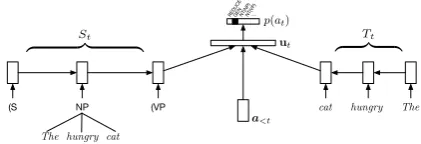
The RNNG is based on an abstract state ma-chine like those used in transition-based parsing, with its algorithmic state consisting of a stack of partially completed constituents, a buffer of already-generated terminal symbols, and a list of past actions. To generate a sentence x and its phrase-structure tree y, the RNNG samples a se-quence of actions to constructytop-down. Given
y, there is one such sequence (easily identified), which we call the oracle, a = ha1, . . . , aniused during supervised training.
The RNNG uses three different actions:
• NT(X), whereX ∈N, introduces an open
non-terminal symbol onto the stack, e.g., “(NP”; • GEN(x), where x ∈ Σ, generates a terminal
symbol and places it on the stack and buffer; and • REDUCE indicates a constituent is now
com-plete. The elements of the stack that comprise the current constituent (going back to the last
2https://github.com/clab/rnng/tree/
master/interpreting-rnng
3Dyer et al. (2016) also defined a conditional version of the RNNG that can be used only for parsing; here we focus on the generative version since it is more flexible and (rather surprisingly) even learns better estimates ofp(y|x).
The hungry cat
NP (VP
(S
REDUCEGENNT(NP)NT(VP)…
cat hungry The
a<t p(at)
ut
Tt z }| { St
[image:2.595.315.526.64.136.2]z }| {
Figure 1: The RNNG consists of a stack, buffer of generated words, and list of past actions that lead to the current configuration. Each component is embedded with LSTMs, and the parser state sum-maryut is used as top-layer features to predict a softmax over all feasible actions. This figure is due to Dyer et al. (2016).
open nonterminal) are popped, a composition functionis executed, yielding a composed rep-resentation that is pushed onto the stack.
At each timestep, the model encodes the stack, buffer, and past actions, with a separate LSTM (Hochreiter and Schmidhuber, 1997) for each component as features to define a distribution over the next action to take (conditioned on the full algorithmic state). The overall architecture is il-lustrated in Figure 1; examples of full action se-quences can be found in Dyer et al. (2016).
A key element of the RNNG is the composition function, which reduces a completed constituent into a single element on the stack. This function computes a vector representation of the new con-stituent; it also uses an LSTM (here a bidirectional one). This composition function, which we con-sider in greater depth in§3, is illustrated in Fig. 2.
NP
u v w
NP u v w NP
x x
Figure 2: RNNG composition function on each
REDUCEoperation; the network on the right
mod-els the structure on the left (Dyer et al., 2016).
[image:2.595.328.515.586.660.2]of strings and trees, defined as
p(x,y) =p(a) = n
Y
t=1
p(at|a1, . . . , at−1).
In other words, p(x,y) is defined as a product of local probabilities, conditioned on all past ac-tions. The joint probability estimate p(x,y) can be used for both phrase-structure parsing (finding arg maxyp(y|x)) and language modeling
(find-ing p(x) by marginalizing over the set of possi-ble parses forx). Both inference problems can be solved using an importance sampling procedure.4
We report all RNNG performance based on the corrigendum to Dyer et al. (2016).
3 Composition is Key
Given the same data, under both the discrimina-tive and generadiscrimina-tive settings RNNGs were found to parse with significantly higher accuracy than (re-spectively) the models of Vinyals et al. (2015) and Choe and Charniak (2016) that represent y as a “linearized” sequence of symbols and parentheses without explicitly capturing the tree structure, or even constraining the y to be a well-formed tree (see Table 1). Vinyals et al. (2015) directly predict the sequence of nonterminals, “shifts” (which con-sume a terminal symbol), and parentheses from left to right, conditional on the input terminal se-quencex, while Choe and Charniak (2016) used a sequential LSTM language model on the same lin-earized trees to create a generative variant of the Vinyals et al. (2015) model. The generative model is used to re-rank parse candidates.
Model F1
Vinyals et al. (2015) – PTB only 88.3 Discriminative RNNG 91.2 Choe and Charniak (2016) – PTB only 92.6
Generative RNNG 93.3
Table 1: Phrase-structure parsing performance on PTB §23. All results are reported using single-model performance and without any additional data.
The results in Table 1 suggest that the RNNG’s explicit composition function (Fig. 2), which
4Importance sampling works by using a proposal distri-butionq(y | x)that is easy to sample from. In Dyer et al. (2016) and this paper, the proposal distribution is the discrim-inative variant of the RNNG; see Dyer et al. (2016).
Vinyals et al. (2015) and Choe and Charniak (2016) must learn implicitly, plays a crucial role in the RNNG’s generalization success. Beyond this, Choe and Charniak’s generative variant of Vinyals et al. (2015) is another instance where generative models trained on the PTB outperform discrimina-tive models.
3.1 Ablated RNNGs
On close inspection, it is clear that the RNNG’s three data structures—stack, buffer, and action history—are redundant. For example, the action history and buffer contents completely determine the structure of the stack at every timestep. Every generated word goes onto the stack, too; and some past words will be composed into larger structures, but through the composition function, they are all still “available” to the network that predicts the next action. Similarly, the past actions are redun-dant with the stack. Despite this redundancy, only the stack incorporates the composition function. Since each of the ablated models is sufficient to encode all necessary partial tree information, the primary difference is that ablations with the stack use explicit composition, to which we can there-fore attribute most of the performance difference.
We conjecture that the stack—the component that makes use of the composition function—is critical to the RNNG’s performance, and that the buffer and action history are not. In transition-based parsers built on expert-crafted features, the most recent words and actions are useful if they are salient, although neural representation learners can automatically learn what information should be salient.
To test this conjecture, we train ablated RN-NGsthat lack each of the three data structures (ac-tion history, buffer, stack), as well as one that lacks both the action history and buffer.5 If our
conjec-ture is correct, performance should degrade most without the stack, and the stack alone should per-form competitively.
Experimental settings. We perform our exper-iments on the English PTB corpus, with §02–21 for training, §24 for validation, and §23 for test; no additional data were used for training. We
low the same hyperparameters as the generative model proposed in Dyer et al. (2016).6 The
gen-erative model did not use any pretrained word em-beddings or POS tags; a discriminative variant of the standard RNNG was used to obtain tree sam-ples for the generative model. All further experi-ments use the same settings and hyperparameters unless otherwise noted.
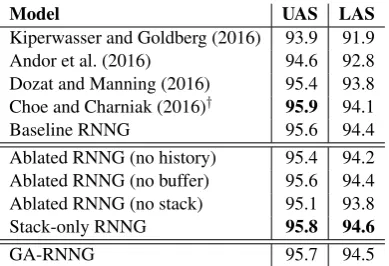
[image:4.595.310.505.61.194.2]Experimental results. We trained each abla-tion from scratch, and compared these models on three tasks: English phrase-structure parsing (la-beled F1), Table 2; dependency parsing, Table 3, by converting parse output to Stanford dependen-cies (De Marneffe et al., 2006) using the tool by Kong and Smith (2014); and language modeling, Table 4. The last row of each table reports the performance of a novel variant of the (stack-only) RNNG with attention, to be presented in§4.
Model F1
Vinyals et al. (2015)† 92.1
Choe and Charniak (2016) 92.6 Choe and Charniak (2016)† 93.8
Baseline RNNG 93.3 Ablated RNNG (no history) 93.2 Ablated RNNG (no buffer) 93.3 Ablated RNNG (no stack) 92.5 Stack-only RNNG 93.6
[image:4.595.97.265.317.465.2]GA-RNNG 93.5
Table 2: Phrase-structure parsing performance on PTB§23. † indicates systems that use additional
unparsed data (semisupervised). The GA-RNNG results will be discussed in§4.
Discussion.The RNNG with only a stack is the strongest of the ablations, and it even outperforms the “full” RNNG with all three data structures. Ablating the stack gives the worst among the new results. This strongly supports the importance of the composition function: a properREDUCE
oper-ation that transforms a constituent’s parts and non-terminal label into a single explicit (vector) repre-sentation is helpful to performance.
It is noteworthy that the stack alone is stronger than the original RNNG, which—in principle— can learn to disregard the buffer and action
his-6The model is trained using stochastic gradient descent, with a learning rate of 0.1 and a per-epoch decay of 0.08. All experiments with the generative RNNG used 100 tree sam-ples for each sentence, obtained by sampling from the local softmax distribution of the discriminative RNNG.
Model UAS LAS
Kiperwasser and Goldberg (2016) 93.9 91.9 Andor et al. (2016) 94.6 92.8 Dozat and Manning (2016) 95.4 93.8 Choe and Charniak (2016)† 95.9 94.1
Baseline RNNG 95.6 94.4
Ablated RNNG (no history) 95.4 94.2 Ablated RNNG (no buffer) 95.6 94.4 Ablated RNNG (no stack) 95.1 93.8
Stack-only RNNG 95.8 94.6
GA-RNNG 95.7 94.5
Table 3: Dependency parsing performance on PTB§23 with Stanford Dependencies (De Marn-effe and Manning, 2008). †indicates systems that
use additional unparsed data (semisupervised).
tory. Since the stack maintains syntactically “re-cent” information near its top, we conjecture that the learner is overfitting to spurious predictors in the buffer and action history that explain the train-ing data but do not generalize well.
A similar performance degradation is seen in language modeling (Table 4): the stack-only RNNG achieves the best performance, and ablat-ing the stack is most harmful. Indeed, model-ing syntax without explicit composition (the stack-ablated RNNG) provides little benefit over a se-quential LSTM language model.
Model Test ppl.(PTB)
IKN 5-gram 169.3
LSTM LM 113.4
RNNG 105.2
Ablated RNNG (no history) 105.7 Ablated RNNG (no buffer) 106.1 Ablated RNNG (no stack) 113.1
Stack-only RNNG 101.2
GA-RNNG 100.9
Table 4: Language modeling: perplexity. IKN refers to Kneser-Ney 5-gram LM.
We remark that the stack-only results are the best published PTB results for both phrase-structure and dependency parsing among super-vised models.
4 Gated Attention RNNG
[image:4.595.322.509.448.560.2]behavior is challenging. Fortunately, linguistic theories offer a number of hypotheses about the nature of representations of phrases that can pro-vide a conceptual scaffolding to understand them. 4.1 Linguistic Hypotheses
We consider two theories about phrasal represen-tation. The first is that phrasal representations are strongly determined by a privileged lexical head. Augmenting grammars with lexical head informa-tion has a long history in parsing, starting with the models of Collins (1997), and theories of syn-tax such as the “bare phrase structure” hypothe-sis of the Minimalist Program (Chomsky, 1993) posit that phrases are represented purely by sin-gle lexical heads. Proposals for multiple headed phrases (to deal with tricky cases like conjunction) likewise exist (Jackendoff, 1977; Keenan, 1987). Do the phrasal representations learned by RN-NGs depend on individual lexical heads or mul-tiple heads? Or do the representations combine all children without any salient head?
Related to the question about the role of heads in phrasal representation is the question of whether phrase-internal material wholly determines the representation of a phrase (an endocentric repre-sentation) or whether nonterminal relabeling of a constitutent introduces new information (exocen-tric representations). To illustrate the contrast, an endocentric representation is representing a noun phrase with a noun category, whereas S→NP VP exocentrically introduces a new syntactic category that is neither NP nor VP (Chomsky, 1970). 4.2 Gated Attention Composition
To investigate what the stack-only RNNG learns about headedness (and later endocentricity), we propose a variant of the composition function that makes use of an explicit attention mechanism (Bahdanau et al., 2015) and a sigmoid gate with multiplicative interactions, henceforth called GA-RNNG.
At everyREDUCEoperation, the GA-RNNG
as-signs an “attention weight” to each of its chil-dren (between 0 and 1 such that the total weight off all children sums to 1), and the parent phrase is represented by the combination of a sum of each child’s representation scaled by its attention weight and its nonterminal type. Our weighted sum is more expressive than traditional head rules, however, because it allows attention to be divided among multiple constituents. Head rules,
con-versely, are analogous to giving all attention to one constituent, the one containing the lexical head.
We now formally define the GA-RNNG’s com-position function. Recall thatutis the concatena-tion of the vector representaconcatena-tions of the RNNG’s data structures, used to assign probabilities to each of the actions available at timestept(see Fig. 1, the layer before the softmax at the top). For simplicity, we drop the timestep index here. Let ont denote
the vector embedding (learned) of the nonterminal being constructed, for the purpose of computing attention weights.
Now letc1,c2, . . .denote the sequence of vec-tor embeddings for the constituents of the new phrase. The length of these vectors is defined by the dimensionality of the bidirectional LSTM used in the original composition function (Fig. 2). We use semicolon (;) to denote vector concatenation operations.
The attention vector is given by:
a= softmax[c1c2 · · ·]>V[u;ont]
(1)
Note that the length ofais the same as the num-ber of constituents, and that this vector sums to one due to the softmax. It divides a single unit of attention among the constituents.
Next, note that the constituent source vector
m= [c1;c2;· · ·]ais a convex combination of the child-constituents, weighted by attention. We will combine this with another embedding of the non-terminal denoted astnt (separate fromont) using
a sigmoid gating mechanism:
g=σ(W1tnt +W2m+b) (2)
Note that the value of the gate is bounded between [0,1]in each dimension.
The new phrase’s final representation uses element-wise multiplication () with respect to both tnt and m, a process reminiscent of the
LSTM “forget” gate:
c=gtnt + (1−g)m. (3)
Experimental results. We include this model’s performance in Tables 2–4 (last row in all ta-bles). It is clear that the model outperforms the baseline RNNG with all three structures present and achieves competitive performance with the strongest, stack-only, RNNG variant.
5 Headedness in Phrases
We now exploit the attention mechanism to probe what the RNNG learns about headedness on the WSJ§23 test set (unseen before by the model).
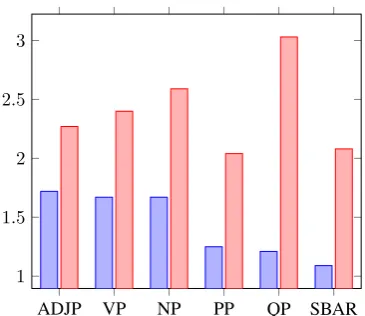
5.1 The Heads that GA-RNNG Learns The attention weight vectors tell us which con-stituents are most important to a phrase’s vector representation in the stack. Here, we inspect the attention vectors to investigate whether the model learns to center its attention around a single, or by extension a few, salient elements, which would confirm the presence of headedness in GA-RNNG. First, we consider several major nonterminal categories, and estimate the averageperplexityof the attention vectors. The average perplexity can be interpreted as the average number of “choices” for each nonterminal category; this value is only computed for the cases where the number of com-ponents in the composed phrase is at least two (otherwise the attention weight would be trivially 1). The minimum possible value for the perplexity is 1, indicating a full attention weight around one component and zero everywhere else.
Figure 3 (in blue) shows much less than 2 average “choices” across nonterminal categories, which also holds true for all other categories not shown. For comparison we also report the average perplexity of the uniform distribution for the same nonterminal categories (Fig. 3 in red); this repre-sents the highest entropy cases where there is no headedness at all by assigning the same attention weight to each constituent (e.g. attention weights of 0.25 each for phrases with four constituents). It is clear that the learned attention weights have much lower perplexity than the uniform distribu-tion baseline, indicating that the learned attendistribu-tion weights are quite peaked around certain compo-nents. This implies that phrases’ vectors tend to resemble the vector of one salient constituent, but not exclusively, as the perplexity for most cate-gories is still not close to one.
Next, we consider the how attention is dis-tributed for the major nonterminal categories in
Table 5, where the first five rows of each category represent compositions with highest entropy, and the next five rows are qualitatively analyzed. The high-entropy cases where the attention is most di-vided represent more complex phrases with con-junctions or more than one plausible head.
NPs. In most simple noun phrases (representa-tive samples in rows 6–7 of Table 5), the model pays the most attention to the rightmost noun
and assigns near-zero attention on determiners and possessive determiners, while also paying nontriv-ial attention weights to the adjectives. This finding matches existing head rules and our intuition that nouns head noun phrases, and that adjectives are more important than determiners.
We analyze the case where the noun phrase con-tains a conjunction in the last three rows of Table 5. The syntax of conjunction is a long-standing source of controversy in syntactic analysis (Johan-nessen, 1998,inter alia). Our model suggests that several representational strategies are used, when coordinating single nouns, both the first noun (8) and the last noun (9) may be selected. However, in the case of conjunctions of multiple nounphrases
(as opposed to multiple single-word nouns), the model consistently picks the conjunction as the head. All of these representational strategies have been argued for individually on linguistic grounds, and since we see all of them present, RNNGs face the same confusion that linguists do.
VPs. The attention weights on simple verb phrases (e.g., “VP→V NP”, 9) are peaked around the noun phrase instead of the verb. This implies that the verb phrase would look most similar to the noun under it and contradicts existing head rules that unanimously put the verb as the head of the verb phrase. Another interesting finding is that the model pays attention to polarityinformation, where negations are almost always assigned non-trivial attention weights.7 Furthermore, we find
that the model attends to the conjunction terminal in conjunctions of verb phrases (e.g., “VP→VP and VP”, 10), reinforcing the similar finding for conjunction of noun phrases.
PPs. In almost all cases, the model attends to the preposition terminal instead of the noun phrases or complete clauses under it, regardless of the type of preposition. Even when the
tional phrase is only used to make a connection between two noun phrases (e.g., “PP→NP after NP”, 10), the prepositional connector is still sidered the most salient element. This is less con-sistent with the Collins and Stanford head rules, where prepositions are assigned a lower prior-ity when composing PPs, although more consis-tent with the Johansson head rule (Johansson and Nugues, 2007).
ADJP VP NP PP QP SBAR
[image:7.595.78.261.216.374.2]1 1.5 2 2.5 3
Figure 3: Average perplexity of the learned atten-tion vectors on the test set (blue), as opposed to the average perplexity of the uniform distribution (red), computed for each major phrase type.
5.2 Comparison to Existing Head Rules To better measure the overlap between the atten-tion vectors and existing head rules, we converted the trees in PTB§23 into a dependency represen-tation using the attention weights. In this case, the attention weight functions as a “dynamic” head rule, where all other constituents within the same composed phrase are considered to modify the constituent with the highest attention weight, re-peated recursively. The head of the composed rep-resentation for “S” at the top of the tree is attached to a special root symbol and functions as the head of the sentence.
We measure the overlap between the resulting tree and conversion results of the same trees us-ing the Collins (1997) and Stanford dependencies (De Marneffe et al., 2006) head rules. Results are evaluated using the standard evaluation script (ex-cluding punctuation) in terms of UAS, since the attention weights do not provide labels.
Results. The model has a higher overlap with the conversion using Collins head rules (49.8
UAS) rather than the Stanford head rules (40.4 UAS). We attribute this large gap to the fact that the Stanford head rules incorporate more semantic considerations, while the RNNG is a purely syn-tactic model. In general, the attention-based tree output has a high error rate (≈90%) when the de-pendent is a verb, since the constituent with the highest attention weight in a verb phrase is of-ten the noun phrase instead of the verb, as dis-cussed above. The conversion accuracy is better for nouns (≈50% error), and much better for de-terminers (30%) and particles (6%) with respect to the Collins head rules.
Discussion. GA-RNNG has the power to in-fer head rules, and to a large extent, it does. It follows some conventions that are established in one or more previous head rule sets (e.g., preposi-tions head prepositional phrases, nouns head noun phrases), but attends more to a verb phrase’s nom-inal constituents than the verb. It is important to note that this is not the by-product of learn-ing a specific model for parslearn-ing; the trainlearn-ing ob-jective is joint likelihood, which is not a proxy loss for parsing performance. These decisions were selected because they make the data maxi-mally likely (though admittedly only locally max-imally likely). We leave deeper consideration of this noun-centered verb phrase hypothesis to fu-ture work.
6 The Role of Nonterminal Labels
Emboldened by our finding that GA-RNNGs learn a notion of headedness, we next explore whether heads are sufficient to create representations of phrases (in line with an endocentric theory of phrasal representation) or whether extra nontermi-nal information is necessary. If the endocentric hypothesis is true (that is, the representation of a phrase is built fromwithindepending on its com-ponents but independent of explicit category la-bels), then the nonterminal types should be easily inferred given the endocentrically-composed rep-resentation, and that ablating the nonterminal in-formation would not make much difference in per-formance. Specifically, we train a GA-RNNG on unlabeled trees (only bracketings without nonter-minal types), denoted U-GA-RNNG.
Noun phrases Verb phrases Prepositional phrases
1 Canadian (0.09)Auto (0.31)Workers (0.2) union (0.22) president (0.18) buying (0.31)and (0.25) selling (0.21) NP (0.23) ADVP (0.14)on (0.72)NP (0.14) 2 no (0.29) major (0.05)Eurobond (0.32)or (0.01) foreign (0.01) bond (0.1) offerings (0.22) ADVP (0.27)show (0.29)PRT (0.23) PP (0.21) ADVP (0.05)for (0.54)NP (0.40) 3 Saatchi (0.12) client (0.14) Philips (0.21) Lighting (0.24)Co. (0.29) pleaded (0.48)ADJP (0.23) PP (0.15) PP (0.08) PP (0.06) ADVP (0.02)because (0.73)of (0.18) NP (0.07) 4 nonperforming (0.18) commercial (0.23)real (0.25)estate (0.1)assets (0.25) received (0.33)PP (0.18) NP (0.32) PP (0.17) such (0.31)as (0.65)NP (0.04)
[image:8.595.81.518.63.134.2]5 the (0.1) Jamaica (0.1) Tourist (0.03) Board (0.17) ad (0.20)account (0.40) cut (0.27)NP (0.37)PP (0.22) PP (0.14) from (0.39)NP (0.49)PP (0.12) 6 the (0.0) final (0.18)hour (0.81) to (0.99)VP (0.01) of (0.97)NP (0.03) 7 their (0.0) first (0.23)test (0.77) were (0.77)n’t (0.22) VP (0.01) in (0.93)NP (0.07) 8 Apple (0.62), (0.02) Compaq (0.1) and (0.01) IBM (0.25) did (0.39)n’t (0.60)VP (0.01) by (0.96)S (0.04) 9 both (0.02) stocks (0.03) and (0.06)futures (0.88) handle (0.09)NP (0.91) at (0.99)NP (0.01) 10 NP (0.01) , (0.0)and (0.98)NP (0.01) VP (0.15)and (0.83)VP 0.02) NP (0.1)after (0.83)NP (0.06)
Table 5: Attention weight vectors for some representative samples for NPs, VPs, and PPs.
given bracketing structure, simple dimensional-ity reduction techniques could reveal conventional nonterminal categories with high accuracy; Petrov et al. (2006) also showed that latent variables can be used to recover fine-grained nonterminal cate-gories. We therefore expect that the vector em-beddings of the constituents that the U-GA-RNNG correctly recovers (on test data) will capture cate-gories similar to those in the Penn Treebank.
Experiments.Using the same hyperparameters and the PTB dataset, we first consider unlabeled
F1 parsing accuracy. On test data (with the usual split), the GA-RNNG achieves 94.2%, while the U-GA-RNNG achieves 93.5%. This result sug-gests that nonterminal category labels add a rel-atively small amount of information compared to purely endocentric representations.
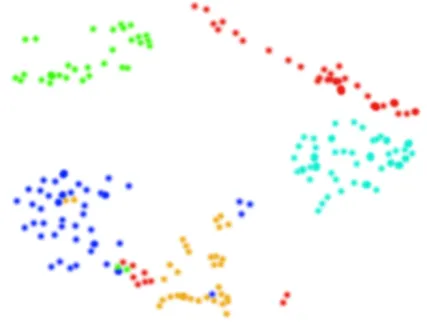
Visualization. If endocentricity is largely suf-ficient to account for the behavior of phrases, where do our robust intuitions for syntactic cate-gory types come from? We use t-SNE (van der Maaten and Hinton, 2008) to visualize composed phrase vectors from the U-GA-RNNG model ap-plied to the unseen test data. Fig. 4 shows that the U-GA-RNNG tends to recover nonterminal cate-gories as encoded in the PTB, even when trained without them.8 These results suggest
nontermi-nal types can be inferred from the purely endocen-tric compositional process to a certain extent, and that the phrase clusters found by the U-GA-RNNG largely overlap with nonterminal categories.
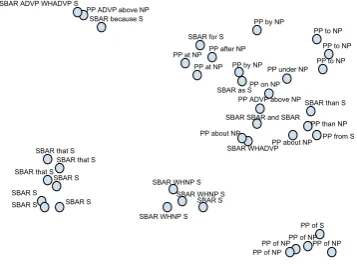
Analysis of PP and SBAR.Figure 4 indicates a certain degree of overlap between SBAR (red) and PP (yellow). As both categories are interest-ing from the linterest-inguistic perspective and quite sim-ilar, we visualize the learned phrase vectors of 40 randomly selected SBARs and PPs from the test set (using U-GA-RNNG), illustrated in Figure 5. First, we can see that phrase representations for PPs and SBARs depend less on the nonterminal
8We see a similar result for the non-ablated GA-RNNG model, not shown for brevity.
Figure 4: t-SNE on composed vectors when train-ing without nonterminal categories. Vectors in dark blue are VPs, red are SBARs, yellow are PPs, light blue are NPs, and green are Ss.
categories9 and more on the connector. For
in-stance, the model learns to cluster phrases that start with words that can be either prepositions or complementizers (e.g., for, at, to, under, by), regardless of whether the true nonterminal labels are PPs or SBARs. This suggests that SBARs that start with “prepositional” words are similar to PPs from the model’s perspective.
Second, the model learns to disregard the word
that, as “SBAR → thatS” and “SBAR→ S” are close together. This finding is intuitive, as comple-mentizerthatis often optional (Jaeger, 2010), un-like prepositional words that might describe rela-tive time and location. Third, certain categories of PPs and SBARs form their own separate clusters, such as those that involve the wordsbecauseand
of. We attribute these distinctions to the fact that these words convey different meanings than many prepositional words; the wordof indicates posses-sion whilebecauseindicates cause-and-effect re-lationship. These examples show that, to a cer-tain extent, the GA-RNNG is able to learn
[image:8.595.309.523.180.341.2]trivial semantic information, even when trained on a fairly small amount of syntactic data.
SBAR that S SBAR that S SBAR that S
SBAR S SBAR S SBAR S SBAR S
SBAR because S PP ADVP above NP SBAR ADVP WHADVP S
SBAR for S PP at NP
PP at NP PP after NP
PP by NP
PP under NP PP by NP SBAR as S
PP to NP PP to NP PP to NP PP on NP PP ADVP above NP SBAR SBAR and SBAR
SBAR than S PP than NP PP from S PP about NP SBAR WHADVP PP about NP
SBAR WHNP S SBAR WHNP S SBAR WHNP S
SBAR S
PP of S PP of NP
[image:9.595.74.253.105.237.2]PP of NP PP of NP PP of NP
Figure 5: Sample of PP and SBAR phrase repre-sentations.
7 Related Work
The problem of understanding neural network models in NLP has been previously studied for se-quential RNNs (Karpathy et al., 2015; Li et al., 2016). Shi et al. (2016) showed that sequence-to-sequence neural translation models capture a cer-tain degree of syntactic knowledge of the source language, such as voice (active or passive) and tense information, as a by-product of the transla-tion objective. Our experiment on the importance of composition function was motivated by Vinyals et al. (2015) and Wiseman and Rush (2016), who achieved competitive parsing accuracy without ex-plicit composition. In another work, Li et al. (2015) investigated the importance of recursive tree structures (as opposed to linear recurrent mod-els) in four different tasks, including sentiment and semantic relation classification. Their findings suggest that recursive tree structures are beneficial for tasks that require identifying long-range rela-tions, such as semantic relationship classification, with no conclusive advantage for sentiment classi-fication and discourse parsing. Through the stack-only ablation we demonstrate that the RNNG com-position function is crucial to obtaining state-of-the-art parsing performance.
Extensive prior work on phrase-structure parsing typically employs the probabilistic context-free grammar formalism, with lexicalized (Collins, 1997) and nonterminal (Johnson, 1998; Klein and Manning, 2003) augmentations. The conjecture that fine-grained nonterminal rules and labels can be discovered given weaker bracketing structures was based on several studies (Chiang
and Bikel, 2002; Klein and Manning, 2002; Petrov et al., 2006).
In a similar work, Sangati and Zuidema (2009) proposed entropy minimization and greedy famil-iarity maximization techniques to obtain lexical heads from labeled phrase-structure trees in an un-supervised manner. In contrast, we used neural attention to obtain the “head rules” in the GA-RNNG; the whole model is trained end-to-end to maximize the log probability of the correct ac-tion given the history. Unlike prior work, GA-RNNG allows the attention weight to be divided among phrase constituents, essentially propagat-ing (weighted) headedness information from mul-tiple components.
8 Conclusion
We probe what recurrent neural network gram-mars learn about syntax, through ablation sce-narios and a novel variant with a gated atten-tion mechanism on the composiatten-tion funcatten-tion. The composition function, a key differentiator between the RNNG and other neural models of syntax, is crucial for good performance. Using the atten-tion vectors we discover that the model is learning something similar to heads, although the attention vectors are not completely peaked around a sin-gle component. We show some cases where the attention vector is divided and measure the rela-tionship with existing head rules. RNNGs without access to nonterminal information during training are used to support the hypothesis that phrasal rep-resentations are largely endocentric, and a visu-alization of representations shows that traditional nonterminal categories fall out naturally from the composed phrase vectors. This confirms previous conjectures that bracketing annotation does most of the work of syntax, with nonterminal categories easily discoverable given bracketing.
Acknowledgments
References
Daniel Andor, Chris Alberti, David Weiss, Aliaksei Severyn, Alessandro Presta, Kuzman Ganchev, Slav Petrov, and Michael Collins. 2016. Globally nor-malized transition-based neural networks. InProc. of ACL.
Dzmitry Bahdanau, Kyunghyun Cho, and Yoshua Ben-gio. 2015. Neural machine translation by jointly learning to align and translate. InProc. of ICLR. David Chiang and Daniel M. Bikel. 2002. Recovering
latent information in treebanks. In Proc. of COL-ING.
Do Kook Choe and Eugene Charniak. 2016. Parsing as language modeling. InProc. of EMNLP.
Noam Chomsky. 1970. Remarks on nominalization. InReadings in English Transformational Grammar. Noam Chomsky. 1993.A Minimalist Program for
Lin-guistic Theory.
Michael Collins. 1997. Three generative, lexicalised models for statistical parsing. InProc. of EACL. Marie-Catherine De Marneffe and Christopher D.
Manning. 2008. Stanford typed dependencies man-ual.
Marie-Catherine De Marneffe, Bill MacCartney, and Christopher D. Manning. 2006. Generating typed dependency parses from phrase structure parses. In Proc. of LREC.
Timothy Dozat and Christopher D. Manning. 2016. Deep biaffine attention for neural dependency pars-ing. arXiv:1611.01734.
Chris Dyer, Adhiguna Kuncoro, Miguel Ballesteros, and Noah A. Smith. 2016. Recurrent neural net-work grammars. InProc. of NAACL.
Sepp Hochreiter and J¨urgen Schmidhuber. 1997. Long short-term memory.Neural Computation.
Ray Jackendoff. 1977.X’ Syntax.
T. Florian Jaeger. 2010. Redundancy and reduc-tion: Speakers manage syntactic information den-sity. Cognitive Psychology, 61(1).
Janne Bondi Johannessen. 1998. Coordination. Richard Johansson and Pierre Nugues. 2007.
Ex-tended constituent-to-dependency conversion for English. InProc. of NODALIDA.
Mark Johnson. 1998. PCFG models of linguistic tree representations. Computational Linguistics. Andrej Karpathy, Justin Johnson, and Fei-Fei Li. 2015.
Visualizing and understanding recurrent networks. arXiv:1506.02078.
Edward L. Keenan. 1987. Multiply-headed noun phrases.Linguistic Inquiry, 18(3):481–490. Eliyahu Kiperwasser and Yoav Goldberg. 2016.
Sim-ple and accurate dependency parsing using bidirec-tional LSTM feature representations.TACL. Dan Klein and Christopher D. Manning. 2002. A
generative constituent-context model for improved grammar induction. InProc. of ACL.
Dan Klein and Christopher D. Manning. 2003. Accu-rate unlexicalized parsing. InProc. of ACL. Lingpeng Kong and Noah A. Smith. 2014. An
em-pirical comparison of parsing methods for stanford dependencies. arXiv:1404.4314.
Jiwei Li, Dan Jurafsky, and Eduard Hovy. 2015. When are tree structures necessary for deep learning of rep-resentations? InProc. of EMNLP.
Jiwei Li, Xinlei Chen, Eduard Hovy, and Dan Jurafsky. 2016. Visualizing and understanding neural models in NLP. InProc. of NAACL.
Tom M. Mitchell. 1980. The need for biases in learn-ing generalizations.
Fernando Pereira and Yves Schabes. 1992. Inside-outside reestimation from partially bracketed cor-pora. InProc. of ACL.
Slav Petrov, Leon Barrett, Romain Thibaux, and Dan Klein. 2006. Learning accurate, compact, and inter-pretable tree annotation. InProc. of COLING-ACL. Federico Sangati and Willem Zuidema. 2009. Unsu-pervised methods for head assignments. InProc. of EACL.
Xing Shi, Inkit Padhi, and Kevin Knight. 2016. Does string-based neural MT learn source syntax? In Proc. of EMNLP.
Laurens van der Maaten and Geoffrey E. Hinton. 2008. Visualizing high-dimensional data using t-sne.Journal of Machine Learning Research, 9. Oriol Vinyals, Lukasz Kaiser, Terry Koo, Slav Petrov,
Ilya Sutskever, and Geoffrey Hinton. 2015. Gram-mar as a foreign language. InNIPS.