Improving Word Alignment Using Linguistic Code Switching Data
Fei Huang∗∗and Alexander Yates
Temple University
Computer and Information Sciences 324 Wachman Hall
Philadelphia, PA 19122
{fei.huang,yates}@temple.edu
Abstract
Linguist Code Switching (LCS) is a situation where two or more languages show up in the context of a single conversation. For example, in English-Chinese code switching, there might be a sentence like “·‚15©¨ k
‡meeting (We will have a meeting in 15 minutes)”. Traditional machine translation (MT) systems treat LCS data as noise, or just as regular sentences. However, if LCS data is processed intelligently, it can provide a useful signal for training word alignment and MT models. Moreover, LCS data is from non-news sources which can enhance the diversity of training data for MT. In this paper, we first extract constraints from this code switching data and then incorporate them into a word alignment model training procedure. We also show that by using the code switching data, we can jointly train a word alignment model and a language model using co-training. Our techniques for incorporating LCS data improve by 2.64 in BLEU score over a baseline MT system trained using only standard sentence-aligned corpora.
1 Introduction
Many language users are competent in multiple languages, and they often use elements of multiple languages in conversations with other speakers with competence in the same set of languages. For example, native Mandarin speakers who also speak English might use English words in a Chinese sentence, like “\• ù‡¯K
solutioníº(Do you know the solution to
this problem ?)”. This phenomenon of mixing
∗
*The author is working at Raytheon BBN Technologies now
languages within a single utterance is known as Linguistic Code Switching (LCS). Examples of these utterances are common in communities of speakers with a shared competency in multiple languages, such as Web forums for Chinese emigr´es to the United States. For example, more than 50% of the sentences we collected from a Web forum (MITBBS.com) contains both Chinese and English.
Traditional word alignment models take a sentence-level aligned corpus as input and gener-ate word-level alignments for each pair of parallel sentences. Automatically-gathered LCS data typically contains no sentence-level alignments, but it still has some advantages for training word alignment models and machine translation (MT) systems which are worth exploring. First, because it contains multiple languages in the same sentence and still has a valid meaning, it will tell the relationship between the words from different languages to some extent. Second, most LCS data is formed during people’s daily conversation, and thus it contains a diversity of topics that people care about, such as home furnishings, cars, entertainment, etc, that may not show up in standard parallel corpora. Moreover, LCS data is easily accessible from Web communities, such as MITBBS.com, Sina Weibo, Twitter, etc.
However, like most unedited natural language text on the Web, LCS data contains symbols like emotions, grammar and spelling mistakes, slang and strongly idiomatic usage, and a variety of other phenomena that are difficult to handle. LCS data with different language pairs may also need special handling. For instance, Sinha and Thakur (2005) focus on words in mixed English and Hindi texts where a single word contains elements from both languages; they propose techniques for translating such words into both pure English and pure Hindi. Our study focuses on Chinese-English LCS, where this is rarely a problem,
but for other language pairs, Sinha and Thakur’s techniques may be required as preprocessing steps. Primarily, though, LCS data requires special-purpose algorithms to use it for word alignment, since it contains no explicit alignment labels.
In this paper, we investigate two approaches to using LCS data for machine translation. The first approach focuses exclusively on word alignment, and uses patterns extracted from LCS data to guide the EM training procedure for word alignment over a standard sentence-aligned parallel corpus. We focus on two types of patterns in the LCS data: first, English words are almost never correct translations for any Chinese word in the same LCS utterance. Second, for sentences that are mostly Chinese but with some English words, if we propose substitutes for the English words using a Chinese language model, those substitutes are often good translations of the English words. We incorporate these patterns into EM training via the posterior regularization framework (Ganchev et al., 2010).
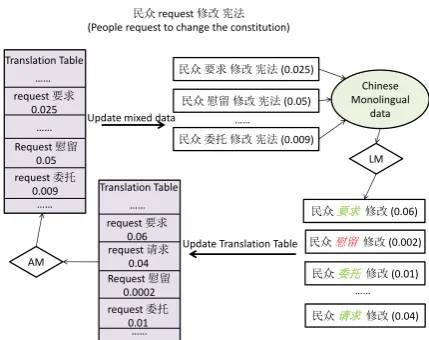
Our second approach treats the alignment and language model as two different and comple-mentary views of the data. We apply the co-training paradigm for semi-supervised learning to incorporate the LCS data into the training procedures for the alignment model and the language model. From the translation table of the alignment model, the training procedure finds candidate translations of the English words in the LCS data, and uses those to supplement the language model training data. From the language model, the training procedure identifies Chinese words that complete the Chinese sentence with high probability, and it uses the English word paired with these completion words as additional training points for translation probabilities. These models are trained repeatedly until they converge to similar predictions on the LCS data. In combination with a larger phrase-based MT system (Koehn et al., 2003), these two training procedures yield an MT system that achieves a BLEU score of 31.79 on an English-to-Chinese translation task, an improvement of 2.64 in BLEU score over a baseline MT system trained on only our parallel corpora.
The rest of this paper is organized as follows. The next section presents related work. Section 3 gives an overview of word alignment. Sections 4
and 5 detail our two algorithms. Section 6 presents our experiments and discusses results, and Section 7 concludes and discusses future work.
2 Related Work
There has been a lot of research on LCS from the theoretical and socio-linguistic communities (Nilep, 2006; De Fina, 2007). Computational research on LCS has studied how to identify the boundaries of an individual language within LCS data, or how to predict when an utterance will switch to another language (Chan et al., 2004; Solorio and Liu, 2008). Manandise and Gdaniec (2011) analyzed the effect on machine translation quality of LCS of Spanish-English and showed that LCS degrades the performance of the syntactic parser. Sinha and Thakur (2005) translate mixed Hindi and English (Hinglish) to pure Hindi and pure English by using two morphological analyzers from both Hindi and English. The difficulty in their problem is that Hindi and English are often mixed into a single word which uses only the English alphabet; approaches based only on the character set cannot tell these words apart from English words. Our current study is for a language pair (English-Chinese) where the words are easy to tell apart, but for MT using code-switching data for other language pairs (such as Hindi-English), we can leverage some of the techniques from their work to separate the tokens into source and target.
Like our proposed methods, other researchers have used co-training before for MT (Callison-Burch and Osborne, 2003). They use target strings in multiple languages as different views on translation. However, in our work, we treat the alignment model and language model as different views of LCS data.
which share one or more common pivot languages to build systems which non-parallel corpus is used. Unlike the data in these techniques, LCS data requires no manual alignment effort and is freely available in large quantities.
Another line of research has attempted to improve word alignment models by incorporating manually-labeled word alignments in addition to sentence alignments. Callison-Burch et al. (2004) tried to give a higher weight on manually labeled data compared to the automatic alignments. Fraser and Marcu (2006) used a log-linear model with features from IBM models. They alternated the traditional Expectation Maximization algorithm which is applied on a large parallel corpus with a discriminative step aimed at increasing alignment quality on a small, manually word-aligned corpus. Ambati et al.(2010) tried to man-ually correct the alignments which are informative during the unsupervised training and applied them to an active learning model. However, labeled word alignment data is expensive to produce. Our approach is complementary, in that we use mixed data that has no word alignments, but still able to learn constraints on word alignments.
Our techniques make use of posterior regular-ization (PR) framework (Ganchev et al., 2010), which has previously been used for MT (Graca et al., 2008), but with very different constraints on EM training and different goals. (Graca et al., 2008) use PR to enforce the constraint that one word should not translate to many words, and that if a wordstranslates to a wordtin one MT system, then a model for translation in the reverse direction should translate t to s. Both of these constraints apply to sentence-aligned training data directly, and complement the constraints that we extract from LCS data.
3 Statistical Word Alignment
Statistical word alignment (Brown et al., 1994) is the task identifying which words are translations of each other in a bilingual sentence corpus. It is primarily used for machine translation. The input to an alignment system is a sentence-level aligned bilingual corpus, which consists of pairs of sentences in two languages. One language is denoted as the target language, and the other language as the source language.
We now introduce the baseline model for word alignment and how we can incorporate the LCS
data to improve the model. IBM Model 1 (Brown et al., 1994) and the HMM alignment model (Vogel et al., 1996) are cascaded to form the baseline model for alignment. These two models have a similar formulation L =
P(t, a|s) = P(a)QjP(tj|saj) with a different distortion probability P(a). s and t denote the source and target sentences. a is the alignment, andaj is the index of the source language word
that generates the target language word at position
j. The HMM model assumes the alignments have a first-order Markov dependency, so thatP(a) =
Q
jP(aj|aj−aj−1). IBM Model 1 ignores the word position and uses a uniform distribution, so
P(a) = QjP(aj) whereP(aj) = |1t|, where|t|
is the length oft.
Expectation Maximization (Dempster et al., 1977) is typically used to train the alignment model. It tries to maximize the marginal likelihood of the sentence-level aligned pairs. For the HMM alignment model, the forward-backward algorithm can be used the optimize the posterior probability of the hidden alignmenta.
4 Learning Constraints for Word Alignments from LCS Data
We observed that most LCS sentences are predominantly in one language, which we call the majority language, with just a small number of words from another language, which we call the minority language. The grammar of each sentence appears to mirror the structure of the majority language. Speakers appear to be substituting primarily content words from the minority language, especially nouns and verbs, without changing the structure of the majority language. In this section, we explain two types of constraints we extract from the LCS data that can be helpful for guiding the training of a word alignment model, and we describe how we incorporate those constraints into a full training procedure.
4.1 Preventing bad alignments
After inspecting sentences in our LCS data, we found that the words from the target language occurring in the sentence are highly likely not to be the translation of the remaining source word. Figure 1 shows an example LCS sentence where the speaker has replaced the Chinese word “‡¦”
民众要求修改宪法
People request to change the Constitution 民众 request 修改宪法
Chinese Translation:
English Translation: LCS sentence:
Figure 1:The upper sentence is the original LCS sentence. The bottom ones are its translation in pure Chinese and English. Underlined words are the original words in the LCS sentence.
In most LCS utterances, the minority language replaces or substitutes for words in the majority language, and thus it does not serve as a translation of any majority-language words in the sentence. If we can enforce that a word alignment model avoids pairing words that appear in the same LCS sentence, we can significantly narrow down the possible choices of the translation candidates during word alignment training.
Formally, lettLCS be the set of target (Chinese)
words andsLCS be the source (English) words in
the same sentence of the LCS data. According to our observation, each sLCS
j in sLCS should not
be aligned with any wordtLCS
i intLCS. We call
every target-source word pair(tLCS
i , sLCSj ) from
LCS data ablocked alignment. For a set of word alignments WA={(sw, tw)}produced by a word
alignment model, define
φBA =
X
(sw,tw)∈WA
1[(sw, tw)∈BA] (1)
where BA is the set of blocked alignments extracted from the LCS data. We want to minimize
φBA. Figure 2 shows a graphical illustration of this constraint.
民众 (People)
修改 (change)
宪法 (constitution)
[image:4.595.345.489.463.522.2]request
Figure 2:Illustration of the blocked alignment constraint.
4.2 Encouraging alignments with substitutes proposed by a language model
Another perspective of using the LCS data is that if we can find some target word set tsimilar
from the target language which shares similar contexts as the source word sLCS
j in the LCS
data, then we can encourage sLCS
j to be aligned
with the each word tsimilar
m in tsimilar. Figure
3 shows example phrases (“¬¯ïÆ?U” ,
“ ¬¯‡¦?U”, “¬¯á ý?U” etc) that appear in a Chinese language model and which share the same left context and right context as the word “request.” Our second objective is to encourage minority language words like “request” to align with possible substitutes from the majority language’s language model. If we see any of “ïÆ, ‡¦, á ý” in the parallel corpus, we
should encourage the word “request” to be aligned with them. We call this target-source word pair
(tsimilar
m , sLCSj )anencouraged alignment.
Formally, we define
φEA=|C| − X
(sw,tw)∈WA
1[(sw, tw)∈EA] (2)
where|C|is the size of the parallel corpus and EA is the encouraged alignment set. We define this expression in such a way that if the optimization procedure minimizes it, it will increase the number of encouraged alignments.
民众
(People)
修改
(change)
宪法
(constitution) request
Trigrams
[image:4.595.111.252.535.582.2]民众 拒绝(refuse) 修改 民众 要求(request) 修改 民众 建议(suggest) 修改
Figure 3: Illustration of the encouraged alignment constraint. The dotted rectangle shows the candidate translations of the English word from the tri-gram output from the language model
Algorithm 1 shows the algorithm of calculating
tsimilar. (tLCS
l , sLCSj , tLCSr ) is a (target, source,
target)word tuple contained in the LCS data. l
andr denote the left and right target words to the source word. We use the language model output from the target language. For each pair of contexts
tl andtr for the source word, we find the exact
match of this pair in the ngram. Then we extract the middle word as the candidates for tsimilar.
Algorithm 1:findingtsimilar
1:Input:sLCS,tLCS, language modelLM
2: Settsimilar={}
3: Extract the 3 grams(tl, tm, tr) ∈gram3 from
LM
4: setS={}
5: Forjfrom1to size(gram3) if(tjl, tjr)∈S
addtjmintoCtj l,tjr else
put(tjl, tjr)intoS
setCtj
l,tjr ={} 6: Extract tuple(tLCS
l , sLCSj , tLCSr )
if(tLCS
l , tLCSr )∈S
addCtLCS
l ,tLCSr intot
similar
7:Output:tsimilar
is similar to a bilingual dictionary. However, in the bilingual dictionary, each source word might have several target translations (senses), so it might be ambiguous. The candidate translations used in EA are from language model (3 grams in this paper, but it can be extended to 5 grams), which will always match the contexts. Additionally, the bilingual dictionary contains the standard English/Chinese word pairs. But the LCS data is generated from people.s daily conversation; it
reflects usage in a variety of domains, including colloquial and figurative usages that may not appear in a dictionary.
4.3 Constrained parameter estimation
We incorporate φBA and φEA into the EM training procedure for the alignment model using posterior regularization (PR) (Ganchev et al., 2010). Formally, letxbe the sentence pairssand
t. During the E step, instead of using the posterior
p(a|x) to calculate the expected counts, the PR framework tries to find a distribution q(a)which is close to p(a|x), but which also minimizes the propertiesφ(a,x):
min
q,ξ [KL(q(a)||p(a|x, θ)) +σ||ξ||] (3)
s.t.Ea∼q[φ(a,x)]≤ξ (4)
where KL is the Kullback-Leibler divergence, σ
is a free parameter indicating how important the constraints are compared with the marginal log likelihood and ξ is a small violation allowed in
民众要求修改宪法 (0.025)
民众慰留修改宪法 (0.05)
民众委托修改宪法 (0.009) ……
Chinese Monolingual
data
民众要求 修改 (0.06)
民众慰留 修改 (0.002)
民众委托 修改 (0.01)
民众请求 修改 (0.04) …… ……
…… Translation Table
…… request 要求
0.025
Request 慰留
0.05 request 委托
0.009
…… Translation Table
…… request 要求
0.06
Request 慰留
0.0002 request 委托
0.01 request 请求
0.04
Update Translation Table Update mixed data
LM
AM
民众 request 修改宪法
[image:5.595.309.524.61.231.2](People request to change the constitution)
Figure 4:The framework of co-training in word alignment. AM represents alignment model and LM represents language model. Green italic words are the encouraged translation and red italic words are the discouraged translation.
the optimization. To impose multiple constraints, we define a norm ||ξ||A = p(ξtAξ), where A
is a diagonal matrix whose diagonal entries Aii
are free parameters that provide weights on the different constraints. Since we only have two constraints here from LCS data, A = 1 0
0α
where α controls the relative importance of the two constraints.
To make the optimization task in the E-step more tractable, PR transforms it to a dual problem:
max
λ≥0,kλk∗≤σ
−logX
a
p(a|x, θ) exp{−λ·φ(a,x)}
wherek·k∗is the dual norm ofk·kA. The gradient of this dual objective is−Eq[φ(a,x)]. A projected
subgradient descent algorithm is used to perform the optimization.
5 Co-training using the LCS data
The schema fits perfectly into our problem. We can treat the alignment model and the language model as two different views of the LCS data.
We use the same example “¬¯request ?U
•{” to show how co-training works, shown in Figure 4. From the translation table generated by the alignment model, we can get a set of candidate translations of “request”, such as “‘‡ ¦”,“ž¦”,etc. We can find the candidate with the
highest probability as the translation. Similarly, from the language model, we can extract all the ngrams containing “¬¯” and “?U” as the left and right words and pick the words in the middle such as “ïÆ,‡¦,áý” etc as the candidate
translations. We can then use the candidate with the highest probability as the translation for “request”. Thus both models can predict translations for the English (minority language) in this example. Each model’s predictions can be used as supplemental training data for the other model.
Algorithm 2 shows the co-training algorithm for word alignment. At each iteration, a language model and an alignment model are trained. The language model is trained on a Chinese-only corpus plus a corpus of probabilistic LCS sen-tences where the source words are replaced with target candidates from the alignment model. The alignment model is retrained using a translation table which is updated according to the output word pairs from the language model output and the LCS data. In order to take the sentence probability into consideration, we modify the language model training procedure: when it counts the number of times each ngram appears, instead of adding 1, it adds the probability from the translation model for ngrams in the LCS data that contain predicted translations.
6 Experiments and Results
6.1 Experimental Setup
We evaluated our LCS-driven training algorithms on an English-to-Chinese translation task. We use Moses (Koehn et al., 2003), a phrase-based translation system that learns from bilingual sentence-aligned corpora as the MT system. We supplement the baseline word alignment model in Moses with our LCS data, constrained training procedure, and co-training algorithm as well as IBM 3 model. Because IBM 3 model is a fertility based model which might also alleviate
Algorithm 2:Co-training for word alignment and language modeling
1: Input: parallel data Xp, LCS data XLCS,
language model training dataXl
2: Initialize translation tabletbfor IBM1 model 3: For iteration from 1 to MAX
tb←Train-IBM(Xp) tb0 ←Train-HMM(Xp|tb) 4: For each sentencexi inXLCS:
For each source wordsjinxi:
1) find the translationtj ofsj with
with probabilitypj fromtb0
2) replacesjwithtj and update
sentence’s probabilityps=ps∗p j
Xnew
l ←Xl∪xi
5: LM←Train-LM(Xnew
l )
6: Extract the tri-gramgram3from LM 7: For each sentencexiinXLCS:
run Algorithm 1: findingtsimilar
8: updatetb0using(t
m, sj)where tm ∈tsimilarandsj ∈xi
9:End For
10:Output:word alignment forXpand LM
some of the problems caused by LCS data. To clarify, we use IBM1 model and HMM models in succession for the baseline. We trained the IBM1 model first and used the resulting parameters as the initial parameter values to train HMM model. Parameters for the final MT system are tuned with Minimum Error Rate Training (MERT) (Och, 2003). The tuning set for MERT is the NIST MT06 data set, which includes 1664 sentences. We test the system on NIST MT02 (878 sentences). To evaluate the word alignment results, we manually aligned 250 sentences from NIST MT02 data set. For simplicity, we only have two types of labels for evaluating word alignments: either two words are aligned together or not. (Previous evaluation metrics also consider a third label for ”possible” alignments.) Out of the word-aligned data, we use 100 sentences as a development set and the rest as our testing set.
the language model. Because our modified ngram counts contain factions, we used Witten-Bell smoothing(Witten and Witten-Bell, 1991) which supports fractional counts. The 3-gram language model is trained on the Xinhua section of the Chinese Gigaword corpus (LDC2003T09) as well as the Chinese side of the parallel corpora. We also removed the sentences in MT02 from the Gigaword corpus if there is any to avoid the biases. We gather the LCS data from “MITBBS.com,” a popular forum for Chinese people living in the United States. This forum is separated by discussion topic, and includes topics such as “Travel”, “News”, and “Living style”. We extract data from 29 different topics. To clean up the LCS data, we get rid of HTML mark-up, and we remove patterns that are commonly repeated in forums, like “Re:” (for “reply” posts) and “[=
1]” (for “repost”). We change all English letters
written in Chinese font into English font. We stem the English words in both the parallel training data and the LCS data. After the cleaning step, we have 245,470 sentences in the LCS data. 120,922 of them actually contain both Chinese and English in the same sentence. 101,302 of them contain only Chinese, and we add these into the language model training data. We discard the sentences that only contain English.
6.2 Word Alignment Results
In order to incorporate the two constraints during the Posterior Regularization, we need to tune the parametersσ which controls the weights between the constraints and the marginal likelihood and
αwhich controls the relative importance between two constraints on development data. We varied
σ from 0.1 to 1000 and varied α over the set {0.01,0.1,1,10,100}. After testing the 25 different combinations of σ and α on the development data, we find that the setting with
σ = 100 and α = 0.1 achieves the best performance. During PR training, we trained the model 20 iterations for the dual optimization and 5 iterations for the modified EM.
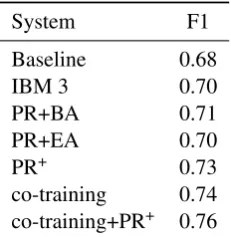
Table 1 shows the word alignment results. We can see that incorporating the LCS data into our alignment model improves the performance. Our best co-training+PR+ system outperforms the baseline by 8 points. Figure 5 shows an example of how BA is extracted from LCS data can help the word alignment performance. The
System F1
Baseline 0.68
IBM 3 0.70
PR+BA 0.71
PR+EA 0.70
PR+ 0.73
[image:7.595.359.475.62.181.2]co-training 0.74 co-training+PR+ 0.76
Table 1:Word alignment results (PR+means PR+BA+EA).
upper figure shows that alignment by the baseline system. We can see that the word “badminton” is aligned incorrectly with word “>™Ž(Taufik)” . However, in the LCS data, we see that “ >™ Ž(Taufik)” and “badminton” appear in the same sentence “>™Ž badminton x³ (Taufik
plays badminton so well)” and by adding the blocked constraint into the alignment model, it correctly learns that “>™Ž(Taufik)” should be aligned with something else, and it finds “Taufik” at end. Table 2 shows some of the translations of “badminton” before and after incorporating the LCS data. We can see that it contains some wrong translations like “® ¥¿(pingpong room)”,“>
™Ž(Taufik)”etc using baseline model. After using the LCS data as constraints and the co-training framework, these wrong alignments are eliminated and the translation “‹¥(another
way of expressing badminton)” get a higher probability. We found that IBM 3 model can also correct this specific case. However, our co-training+PR+ system still outperforms it by 6 points.
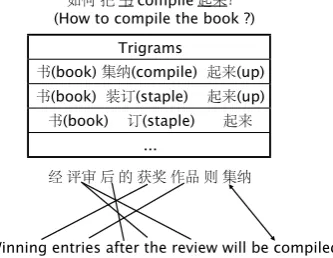
Figure 6 shows an example of how EA is extracted from LCS data can help the word alignment. The solid lines show the alignment by the baseline model and we can see that the word “compiled” is not aligned with any Chinese word. After using the LCS data and the language model, we find that “8B(compile)”
shows up in the same context “Ö(book) å
5(up)”as “compile” along with “C¾(staple)”
and “¾(staple)”, therefore “(compile,8B)” will
be an encouraged alignment. After adding the EA constraint, the model learns that “compile” should be aligned with “8B”.
6.3 Phrase-based machine translation
印尼 羽毛球 专家 认为 陶菲克 的 排名 很有利
Indonesia badminton experts think Taufik’s ranking favorable
印尼 羽毛球 专家 认为 陶菲克 的 排名 很有利
Indonesia badminton experts think Taufik’s ranking favorable Baseline:
[image:8.595.115.485.169.257.2]PR+BA:
Figure 5:After incorporating the BA constraint from the LCS data, the word “Taufik(>™Ž)” is aligned correctly.
Baseline PR+co-training
Translation Probability Translation Probability ‹f¥(badminton) 0.500 ‹f¥(badminton) 0.500
W ¥(pingpong)¿(room) 0.500 ‹¥(two of the three characters in badminton) 0.430 ‹(play)‹f(feather) 0.250 ‹(play)‹f(feather) 0.326
‹f¥(shuttlecock)Þ(head) 0.125 ‹f¥(shuttlecock)Þ(head) 0.105
... ... ... ...
>™Ž(Taufik) 0.005 ¥û(racket) 0.002
Table 2:Translation tables of “badminton” before and after incorporation of LCS data.
经 评审 后 的 获奖 作品 则 集纳
Winning entries after the review will be compiled
如何 把 书 compile 起来?
(How to compile the book ?)
Trigrams
书(book) 集纳(compile) 起来(up)
书(book) 装订(staple) 起来(up)
书(book) 订(staple) 起来
(up)...
Wednesday, October 16, 13
Figure 6: After incorporating the EA constraint from the LCS data, the word “compiled(8B)” is aligned correctly.
use different word alignment models’ outputs as the first step for Moses and keep the rest of Moses system the same. We incorporate Moses’s eight standard features as well as the lexicalized reordering model. We also use the grow-diag-final and alignment symmetrization heuristic.
Table 3 shows the machine translation results. We can see that 3 techniques we proposed for word alignment all improve the machine translation result over the baseline system as well as the IBM 3 model. However, although co-training has a bigger improvement on the word alignment compared with PR+, it actually has a lower BLEU score. This phenomenon shows that the improvement in the word alignment does not necessarily lead to the improvement on machine translation. After combining the co-training and the PR+ together, co-training+PR+ improved slightly over PR+for MT.
System BLEU score
Baseline 29.15
IBM 3 30.24
PR+ 31.59*
[image:8.595.99.266.304.433.2]co-training 31.04* co-training+PR+ 31.79*
Table 3: Machine translation results. All entries marked with an asterisk are better than the baseline with 95% statistical significance computed using paired bootstrap resampling (Koehn, 2004).
7 Conclusion and Future Work
In this paper, we explored two different ways to use LCS data in a MT system: 1) PR framework to incorporate with Blocked Alignment and Encouraged Alignment constraints. 2) A semi-supervised co-training procedure. Both techniques improve the performance of word alignment and MT over the baseline. Our techniques are currently limited to sentences where the LCS data contains very short (usually one word) phrases from a minority language. An important line of investigation for generalizing these approaches is to consider techniques that cover longer phrases in the minority language; this can help add more of the LCS data into training.
Acknowledgements
References
S.and Carbonell J. Ambati, V.and Vogel. 2010. Active semi-supervised learning for improving word alignment. InIn Proceedings of the Active Learning for NLP Workshop, NAACL.
Avrim Blum and Tom Mitchell. 1998. Combining labeled and unlabeled data with co-training. In
Annual Conference on Computational Learning Theaory.
P. F. Brown, S. Della Pietra, V. J. Della Pietra, and R. L. Mercer. 1994. The mathematics of statistical machine translation: Parameter estimation. Compu-tational Linguistics, 19(2):263–311.
Chris Callison-Burch and Miles Osborne. 2003. Co-training for statistical machine translation. In In Proceedings of the 6th Annual CLUK Research Colloquium.
Chris Callison-Burch, David Talbot, and Miles Os-borne. 2004. Statistical machine translation with word- and sentence-aligned parallel corpora. InIn Proceedings of ACL.
J. Y. C. Chan, P. C. Ching, and H. M. LEE, T.and Meng. 2004. Detection of language boundary in code-switching utterances by bi-phone probabilities. In
In Proceedings of the International Symposium on Chinese Spoken Language Processing.
A De Fina. 2007. Code-switching and the construction of ethnic identity in a community of practice. In
Language in Society, volume 36.
A. P. Dempster, N. M. Laird, and D. B. Rubin. 1977. Maximum likelihood from incomplete data via the em algorithm. In Royal Statistical Society, Ser, volume 39.
Andreas Eisele. 2006. Parallel corpora and
phrase-based statistical machine translation for new language pairs via multiple intermediaries. In
International Conference on Language Resources and Evaluation.
Alex Fraser and Daniel Marcu. 2006. Semi-supervised training for statistical word alignment. In In Proceedings of ACL.
Kuzman Ganchev, J. Graca, Jennifer Gillenwater, and Ben Taskar. 2010. Posterior regularization for structured latent variable models. In Journal of Machine Learning Research, volume 11.
J. Graca, K. Ganchev, and B. Taskar. 2008.
Expectation maximization and posterior constraints. InNIPS.
Philipp Koehn, Franz Josef Och, and Daniel Marcu. 2003. Statistical phrase-based translation. In
NAACL-HLT.
Philipp Koehn. 2004. Statistical significance tests for machine translation evaluation. InIn Proceedings of EMNLP.
Shankar Kumar, Franz Josef Och, and Wolfgang Macherey. 2007. Improving word alignment with bridge languages. InEMNLP.
Esme Manandise and Claudia Gdaniec. 2011. Mor-phology to the rescue redux: Resolving borrowings and code-mixing in machine translation. InSFCM. C. Nilep. 2006. Code switching in sociocultural
linguistics. In Colorado Research in Linguistics, volume 19.
Franz Josef Och. 2003. Minimum error rate training for statistical machine translation. InACL.
R.M.K. Sinha and A. Thakur. 2005. Machine
translation of bi-lingual hindi-english (hinglish) text. In In Proceedings of the 10th Conference on Machine Translation.
T. Solorio and Y. Liu. 2008. Learning to predict code-switching points. In In Proceedings of the Conference on Empirical Methods in Natural Language Processing (EMNLP).
A. Stolcke. 2002. An extensible language modeling toolkit. In Proc. Intl. Conf. on Spoken Language Processing, volume 2, pages 901–904.
S. Vogel, H. Ney, and C. Tillmann. 1996. Hmm-based word alignment in statistical translation. In
In Proc.COLING.