Original Article
Prognostic factors and surgical
outcome after decompressive surgery in aged
patients with metastatic spinal cord compression
Yaosheng Liu1, Ranyun Zhou2, Haifeng Qin3, Shubin Liu1, Lei Wang1
Departments of 1Orthopedic Surgery, 2Nursing, 3Pulmonary Neoplasms Internal Medicine, The Affiliated Hospital
of Academy of Military Medical Sciences, Beijing, China
Received September 15, 2017; Accepted January 16, 2018; Epub March 15, 2018; Published March 30, 2018
Abstract: To identify potential prognostic factors predicting postoperative survival and function outcome and to analyze surgical outcome after decompressive surgery of metastatic spinal cord compression (MSCC), especially in aged patients. Eleven preoperative characteristics for postoperative survival and functional outcome in a series of fifty-four aged patients with MSCC who were operated on with decompressive surgery were retrospectively analyzed. These characteristics included gender, primary site, preoperative ambulatory status, ECOG performance status, number of involved vertebrae, visceral metastases, preoperative chemotherapy, bone metastasis at cancer diag-nosis, the time developing motor deficits, preoperative albumin, and radical surgery at primary site. In multivariate analysis, primary site (HR, 2.33, 95% CI: 1.50-3.62; P<0.01) and visceral metastases (HR, 4.58, 95% CI: 2.21-9.48; P<0.01) were significantly associated with postoperative survival. Preoperative ambulatory status (HR, 4.98, 95% CI: 1.10-22.55; P=0.04) and visceral metastases (HR, 6.41, 95% CI: 1.43-28.77; P=0.02) were found to be sig-nificantly independent prognostic factors for postoperative function outcome. There was no significant consistency between the distribution of pre-operative and post-operative Frankel grades (P=0.20). The distribution of the total of Frankel grades after surgery was significantly different as compared with those before surgery (P=0.01). Eighteen complications were recorded within four weeks of surgery in 27.8% (15/54) of patients. Surgical treatment of aged patients with MSCC was found to be effective in terms of neurological recovery with a tolerable rate of complica-tions. Primary site, visceral metastases, and preoperative ambulatory status should be considered to help physi-cians select the best treatment option, especially for aged patients with MSCC.
Keywords: Aged patients, spine metastasis, spinal cord compression, surgery, prognosis
Introduction
Thanks to the development of molecularly tar-geted interventions, chemotherapies, and sys-tematic treatments cancer patients are living longer and growing older [1-3]. Aged patients usually have a poor tolerance to treatment, worse immune systems, and a relatively short-er life expectancy. These present challenges are for surgeons, in making a surgical decision, especially in those with metastatic spinal cord compression (MSCC). MSCC often occurs as an oncological emergency in approximately 5%-14% of patients with advanced cancer. MSCC involves intractable pain, weakness, incontinence, and even disability negatively affecting the aged patient’s quality of
remain-ing life [4, 5]. Notably, with careful patient selec-tion, surgery can achieve long duration of ambulation in aged patients with MSCC [6]. Thus, in order to remarkably maximize the qual-ity of life, personalized approaches are needed to avoid excessive and inadequate treatments. Such personalization should take into account an individual patient’s survival time and func-tion outcome after treatments, which can be estimated with the help of predictive prognostic factors.
Patients and methods
Fifty-four aged patients (ages 60 years or older) with MSCC who were operated on with posteri-or decompressive surgery and spine stabiliza-tion were retrospectively analyzed in this study at the Affiliated Hospital of Academy of Military Medical Sciences, Beijing, between 2011 and 2015. The diagnosis of bone metastasis was confirmed histologically, and with adequate diagnostic imaging including spinal CT or MRI, as well as with a bone scan. The data were col-lected from patients, their family members, treating surgeons, and from patient files. The Medical Research Ethics Board of the Affiliated Hospital of Academy of Military Medical Sciences approved this retrospective study and required neither patient approval nor informed consent for the review of patient images and medical records. The data were retrospective in nature and anonymized by the Medical Research Ethics Board.
We retrospectively analyzed eleven preopera-tive characteristics for postoperapreopera-tive survival and function outcome, including gender (female
vs. male), primary site (slow growth vs. moder-ate growth vs. rapid growth), preoperative ambulatory status (ambulatory vs. not ambula-tory), Eastern Cooperative Oncology Group (ECOG) performance status (1-2 vs. 3-4), num-ber of involved vertebrae (1-2 vs. ≥3, conformed to previous studies), visceral metastases (no
vs. yes), preoperative chemotherapy (no vs. yes), bone metastasis at cancer diagnosis (no
vs. yes), the time developing motor deficits (≤14 days vs. >14 days, conformed to previous stud-ies), preoperative albumin (≤35 g/l vs. >35 g/l, conformed to previous studies), and radical sur-gery at primary site (no vs. yes).
Primary cancer was classified into three groups. First, tumors that exhibited slow growth includ-ing hormone-dependent breast cancer, hor-mone-dependent prostate cancer, thyroid can-cer, multiple myeloma, and malignant lym- phoma. Second, moderate growth including lung cancer treated with molecularly targeted drugs, hormone-independent breast cancer, hormone-independent prostate cancer, renal cell carcinoma, endometrial cancer, ovarian cancer, and sarcoma. Third, rapid growth including lung cancer without molecularly tar-geted drugs, colorectal cancer, gastric cancer, pancreatic cancer, esophageal cancer, hepato-cellular carcinoma, head and neck cancer,
mel-anoma, malignant thymoma and cancers of unknown origin, which was developed from Katagiri et al. [7] The postoperative survival was defined as the time between the date of surgery and death or the latest follow up, and patients who were alive at the last follow up were censored in the postoperative survival analysis. Postoperative function outcome was graded based on Frankel grades preoperatively and about 4 weeks postoperatively (patients with Frankel D and E have the ability to walk). Time to development of motor deficits was defined as the time between deterioration of motor function to disability or surgery. Deter- ioration of motor function was defined as a change of at least one Frankel grade. Surgery-related complications were recorded with 4 weeks. In patients who had surgery for more than one metastasis, all sites were included in the analysis. However, only the first surgical procedure was accounted for in the survival analysis.
The indication for surgery was a neurological deficit due to spinal cord compression. Patients were operated on with posterior decompres-sive surgery and spine stabilization. Local radiotherapy, systemic chemotherapy, endo-crine therapy, or targeted therapy were routine-ly performed after the wound healed, about 3-4 weeks after the surgery, if applicable.
The Kaplan-Meier method was used to evalu-ate postoperative survival. Univarievalu-ate and mul-tivariate analysis of postoperative survival were estimated by the simple and multiple Cox pro-portional hazards regression models, respec-tively. Logistic regression model was used to analyze the univariate and multivariate analysis of postoperative function outcome (ambulato-ry=0, not ambulatory=1). Kappa test, Wilcoxon rank test or Kruskal-Wallis rank test, and a Chi-square test were performed to analyze function outcome after surgery. A P value of 0.05 or less was considered statistically significant. Stati- stical analysis was performed using SAS 9.2 software.
Results
Patient characteristics
overall survival was 6.6 months (95% CI, 4.5-10.8 months), and 6-month and 12-month sur-vival rates were 57.9% and 31.8%, respectively (Figure 1). At the latest follow up, seven patients were alive with a mean follow-up of 10.7 months (range, 2.3-48.6 months).
Prognostic factors
[image:3.612.88.381.96.320.2]In univariate analysis, primary site (HR, 2.01, 95% CI: 1.32-3.06; P<0.01), visceral metasta-ses (HR, 3.31, 95% CI: 1.72-6.36; P<0.01), and
Table 1. The primary cancer sites in the entire cohort of 54 aged patients with MSCC
Primary site No. of patients
Slow growth 9
Hormone-dependent breast cancer 3 Hormone-dependent prostate cancer 4
Thyroid cancer 2
Moderate growth 13
Lung cancer treated with molecularly targeted drugs 9 Hormone-independent breast cancer 3 Hormone-independent prostate cancer 1
Rapid growth 32
Lung cancer without molecularly targeted drugs 17
Colorectal cancer 2
Pancreatic cancer 1
Esophageal cancer 5
Urological cancers (except renal cell cancer) 2
Head and neck cancer 2
Cancers of unknown 3
[image:3.612.90.382.352.542.2]Abbreviations: MSCC, metastatic spinal cord compression.
Figure 1. Kaplan-Meier survival curves of postoperative overall survival for aged patients with metastatic spinal cord compression.
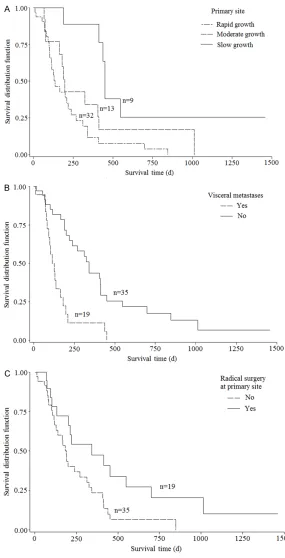
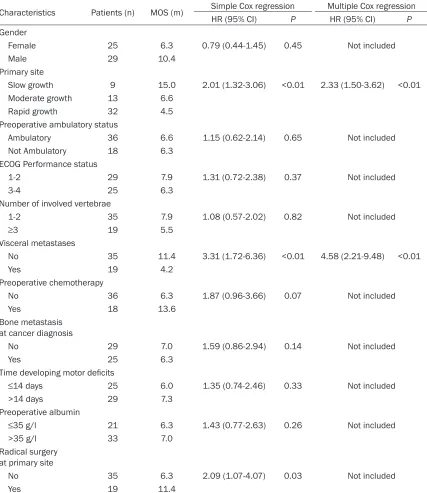
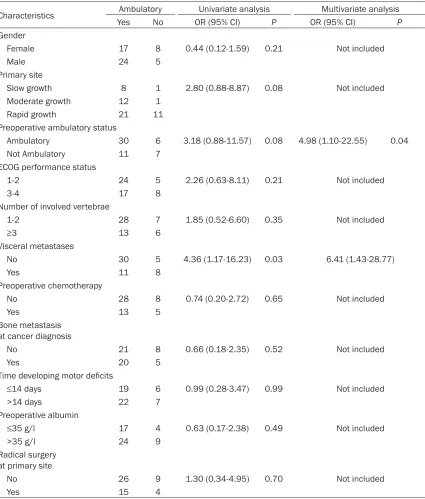
radical surgery at primary site (HR, 2.09, 95% CI: 1.07-4.07, P=0.03) were signifi-cantly associated with post-operative survival (Figure 2). According to the multiple Cox proportional hazards re- gression model, two of the above four factors, pri- mary site (HR, 2.33, 95% CI: 1.50-3.62; P<0.01) and vis-ceral metastases (HR, 4.58, 95% CI: 2.21-9.48, P<0.01) maintained significant im- pact on postoperative sur-vival (Table 2). In univariate analysis of postoperative function outcome, only vis-ceral metastases (OR, 4.36, 95% CI: 1.17-16.23; P=0.03) were significant, while vis-ceral metastases (OR, 6.41, 95% CI: 1.43-28.77; P=0.02) and preoperative ambulato-ry status (OR, 4.98, 95% CI: 1.10-22.55; P=0.04) were significantly associated with postoperative function out-come based on multivariate analysis (Table 3).
Function outcome
The distribution of pre-oper-ative and post-operpre-oper-ative Frankel grades is shown in
Complications
[image:4.612.89.374.69.627.2]Eighteen complications occurred within four weeks of surgery in 15 of the 54 patients. Local
Figure 2. Kaplan-Meier survival curves for preoperative factors in aged pa-tients with metastatic spinal cord compression after decompressive surgery: (A) primary site, (B) visceral metastases, and (C) radical surgery at primary site.
complications were obse- rved in 5 patients, systemic complications in 7 pa- tients, and 3 patients had both local and systemic com-plications. More details are shown in Table 5. Patients with postoperative complica-tions (4.2 months; 95% CI, 2.3-6.6 months) were found to have a shorter median survival than those who did not (10.4 months; 95% CI, 6.0-13.7 months) (P=0.01).
Discussion
The most appropriate treat-ments for patients with MSCC are still being debat-ed. In 2005, a prospective randomized trial strongly showed that decompressive surgery followed by ra- diotherapy was superior to radiotherapy alone [8], while a matched pair analysis did not find any benefit of sur-gery followed by radiothera-py compared with radiother-apy alone, in 2010 [9]. More recently, a 2014 meta-analy-sis indicated that direct decompressive surgery fol-lowed by radiotherapy may produce better clinical im- provement of ambulation status and survival than radiotherapy alone [10]. Notably, aged patients with MSCC were not excluded in the above mentioned stud-ies. Generally, direct de- compressive surgery has become the standard treat-ment for selected patients with MSCC, including aged patients with MSCC.
Table 2. Univariate and multivariate analysis of preoperative characteristics for postoperative survival in aged patients with MSCC
Characteristics Patients (n) MOS (m) Simple Cox regression Multiple Cox regression HR (95% CI) P HR (95% CI) P
Gender
Female 25 6.3 0.79 (0.44-1.45) 0.45 Not included
Male 29 10.4
Primary site
Slow growth 9 15.0 2.01 (1.32-3.06) <0.01 2.33 (1.50-3.62) <0.01 Moderate growth 13 6.6
Rapid growth 32 4.5 Preoperative ambulatory status
Ambulatory 36 6.6 1.15 (0.62-2.14) 0.65 Not included Not Ambulatory 18 6.3
ECOG Performance status
1-2 29 7.9 1.31 (0.72-2.38) 0.37 Not included
3-4 25 6.3
Number of involved vertebrae
1-2 35 7.9 1.08 (0.57-2.02) 0.82 Not included
≥3 19 5.5
Visceral metastases
No 35 11.4 3.31 (1.72-6.36) <0.01 4.58 (2.21-9.48) <0.01
Yes 19 4.2
Preoperative chemotherapy
No 36 6.3 1.87 (0.96-3.66) 0.07 Not included
Yes 18 13.6
Bone metastasis at cancer diagnosis
No 29 7.0 1.59 (0.86-2.94) 0.14 Not included
Yes 25 6.3
Time developing motor deficits
≤14 days 25 6.0 1.35 (0.74-2.46) 0.33 Not included >14 days 29 7.3
Preoperative albumin
≤35 g/l 21 6.3 1.43 (0.77-2.63) 0.26 Not included
>35 g/l 33 7.0
Radical surgery at primary site
No 35 6.3 2.09 (1.07-4.07) 0.03 Not included
Yes 19 11.4
Abbreviations: MSCC, metastatic spinal cord compression; MOS, median overall survival; m, months; HR, hazard ratio; CI, confi-dence interval; ECOG, Eastern Cooperative Oncology Group.
proposed a scoring system to enable physi-cians to identify the appropriate candidates for decompression and stabilization in patients with MSCC [12]. However, this score was par-ticularly for non-small cell lung cancer patients, making it not useful for drawing conclusions, especially on aged patients with MSCC.
Table 3. Univariate and multivariate analysis of preoperative characteristics for postoperative func-tion outcome in aged patients with MSCC
Characteristics Ambulatory Univariate analysis Multivariate analysis
Yes No OR (95% CI) P OR (95% CI) P
Gender
Female 17 8 0.44 (0.12-1.59) 0.21 Not included
Male 24 5
Primary site
Slow growth 8 1 2.80 (0.88-8.87) 0.08 Not included Moderate growth 12 1
Rapid growth 21 11 Preoperative ambulatory status
Ambulatory 30 6 3.18 (0.88-11.57) 0.08 4.98 (1.10-22.55) 0.04 Not Ambulatory 11 7
ECOG performance status
1-2 24 5 2.26 (0.63-8.11) 0.21 Not included
3-4 17 8
Number of involved vertebrae
1-2 28 7 1.85 (0.52-6.60) 0.35 Not included
≥3 13 6
Visceral metastases
No 30 5 4.36 (1.17-16.23) 0.03 6.41 (1.43-28.77)
Yes 11 8
Preoperative chemotherapy
No 28 8 0.74 (0.20-2.72) 0.65 Not included
Yes 13 5
Bone metastasis at cancer diagnosis
No 21 8 0.66 (0.18-2.35) 0.52 Not included
Yes 20 5
Time developing motor deficits
≤14 days 19 6 0.99 (0.28-3.47) 0.99 Not included
>14 days 22 7
Preoperative albumin
≤35 g/l 17 4 0.63 (0.17-2.38) 0.49 Not included
>35 g/l 24 9
Radical surgery at primary site
No 26 9 1.30 (0.34-4.95) 0.70 Not included
Yes 15 4
Abbreviations: MSCC, metastatic spinal cord compression; OR, odds ratio; CI, confidence interval; ECOG, Eastern Cooperative Oncology Group.
breast cancer and lung cancer. The scoring sys-tem for patients with breast cancer alone included five prognostic factors, including vis-ceral metastases, time developing motor defi-cits, ambulatory status, number of involved ver-tebrae, and ECOG performance score. Patients with lung cancer alone included the above four prognostic factors, ECOG performance status, time developing motor deficit, visceral
metasta-ses, and ambulatory status. However, partici-pants included in the Rades’ studies were treated with radiotherapy alone. Also, function outcome was not considered.
defi-Table 4. Neurological recovery of the aged patient with MSCC before and 4 weeks after operation
Neurological status before operation
Neurological status 4 weeks after operation
Totala Totalb
Not ambulatory Ambulatory
A B C D E
Not ambulatory A 0 0 0 0 0 0
18
B 0 1 2 3 1 7
C 0 1c 3 5 2 11
Ambulatory D 0 1 5 21 9 36
36
E 0 0 0 0 0 0
Totala 0 3 10 29 12 39 P
1=0.20
Totalb 13 41 P
2=0.01 P3=0.29
[image:7.612.88.523.87.218.2]aRegarding Frankel grades; bRegarding ambulatory status (Frankel D/E has the ability to walk). cOne patient with Frankel B died within 4 weeks postoperatively. P1The distribution of Frankel grades before operation compared with those after operation, Kappa test; P2The total of Frankel grades before operation compared with those after operation, Wilcoxon rank test or Kruskal-Wallis rank test. P3The difference of ambulatory status between pre- and post-operation, Chi-square test. Abbreviations: MSCC, metastatic spinal cord compression
Table 5. Complications of surgery for aged patients with MSCC within 4 weeks after operation (pa-tients may have more than one complication)
Complications Patients (n) Follow-up after operation Local complications
Operation site infection 3 2.3, 3.1, and 6.3 months died
Wound dehiscence 1 10.4 months alive
Cerebrospinal fluid leakage 1 4.2 months died
Epidural hematoma 1 15.0 months died
Sacral pressure sores 2 3.4 and 4.3 months died Systemic complications
Pneumonia 3 3.4 months alive, 6.6 and 9.0 months died
Pulmonary embolism 1 4.3 months died
Stroke 1 3.3 months died
Septicemia 2 1.8 and 2.3 months died
Intestinal bleeding 1 4.2 months died
Multiple organ failure 2 16 days and 2.5 months died
Abbreviations: MSCC, metastatic spinal cord compression.
cits. To our knowledge, this is the largest popu-lation-based study specifically and systemati-cally addressing the prognostic factors and surgical outcome for aged patients with MSCC after surgery. We found that primary site, vis-ceral metastases, and radical surgery at pri-mary site were significantly associated with postoperative survival in univariate analysis. According to the multiple Cox proportional haz-ards regression model, two of above four fac-tors, primary site and visceral metastases maintain significant impact on postoperative survival. As for the univariate analysis of the postoperative function outcome, only visceral metastases were significant, while visceral
metastases and preoperative ambulatory sta-tus were significantly associated with postop-erative function outcome based on multivariate analysis. Chi et al. [15] showed that surgery, breast cancer tumor type, and higher Frankel score (patients with Frankel D and E were ambulatory) are significantly predictive of bet-ter ambulation outcome.
[image:7.612.90.522.317.502.2]which suggests that decompressive surgery could change the function outcome. Function outcome is more favorable after surgery when compared with those before surgery (P=0.01). In the entire cohort of 54 patients, 83.3% (30/36) patients maintained their ambulatory status, 61.1% (11/18) non-ambulatory patients before operation regained the ability to walk, and 75.9% (41/54) patients were ambulatory after surgery. 55%-90% of patients had the ability to walk in other studies [6, 15]. Eighteen complications occurred within four weeks of surgery in 27.8% (15/54) patients, 27%-35% patients experienced surgical complications in other reports [16, 17]. In our series, operation site infection was observed in three cases, which was successfully treated by continuous irrigation combined with antibiotics. Cere- brospinal fluid leakage was found in one case and required percutaneous lumbar drainage. One patient showed epidural hematoma and required surgical removal. One patient who experienced wound dehiscence had received radiation therapy to the operation site 7 days postoperatively. Patients should not receive radiotherapy until the operation wound has healed, preoperative baths for patients are given, and early mobilization which can mini-mize postoperative complications.
In conclusion, surgical treatment of aged patients with MSCC is found to be effective in terms of neurological recovery with a tolerable rate of complications. Our findings suggest that primary site and visceral metastases are sig-nificantly associated with postoperative surviv-al. Visceral metastases and preoperative ambulatory status are independent prognostic factors for postoperative function outcome. Those factors can help select the individual treatment, especially for aged patients with MSCC. For patients with slow growth cancer, ambulatory, and no visceral metastases sur-gery should be adopted. However, great care should be taken in cases with rapid growth can-cer, non-ambulatory, and visceral metastases. Importantly, visceral metastases should always be carefully evaluated because this factor is found to be related to both postoperative sur-vival and function outcome. Nevertheless, a larger prospective study is still needed.
Acknowledgements
This work was supported by Beijing Municipal Science and Technology Commission (NO.
Z161100000516101 and NO. Z17110000- 1017176).
Disclosure of conflict of interest
None.
Abbreviations
MSCC, metastatic spinal cord compression; MOS, median overall survival; m, months; HR, hazard ratio; CI, confidence interval; ECOG, Eastern Cooperative Oncology Group.
Address correspondence to: Yaosheng Liu, De- partment of Orthopedic Surgery, The Affiliated Hospital of Academy of Military Medical Sciences, No.8, Fengtaidongda Rd, Beijing 100071, China. Tel: 028-010-66947317; Fax: +028010-66947317; E-mail: [email protected]; Ranyun Zhou, De- partment of Nursing, The Affiliated Hospital of Academy of Military Medical Sciences, No.8, Fengtaidongda Rd, Beijing 100071, China. Tel: 028-010-66947317; Fax: +028028-010-66947317; E-mail: [email protected]
References
[1] Gregory TM, Coriat R, Mir O. Prognostic scoring systems for spinal metastases in the era of anti-VEGF therapies. Spine (Phila Pa 1976) 2013; 38: 965-6.
[2] Morgen SS, Lund-Andersen C, Larsen CF, Engelholm SA, Dahl B. Prognosis in patients with symptomatic metastatic spinal cord com-pression: survival in different cancer diagnosis in a cohort of 2321 patients. Spine (Phila Pa 1976) 2013; 38: 1362-67.
[3] Lei M, Liu Y, Yan L, Tang C, Liu S, Zhou S. Pos-terior decompression and spine stabilization for metastatic spinal cord compression in the cervical spine. a matched pair analysis. Eur J Surg Oncol 2015; 41: 1691-98.
[4] Robson P. Metastatic spinal cord compression: a rare but important complication of cancer. Clin Med (Lond) 2014; 14: 542-5.
[5] Cole JS, Patchell RA. Metastatic epidural spi-nal cord compression. Lancet Neurol 2008; 7: 459-66.
[6] Itshayek E, Or O, Kaplan L, Schroeder J, Bar-zilay Y, Rosenthal G, Shoshan Y, Fraifeld S, Co-hen JE. Are they too old? surgical treatment for metastatic epidural spinal cord compression in patients aged 65 years and older. Neurol Res 2014; 36: 530-43.
system for patients with skeletal metastasis. Cancer Med 2014; 3: 1359-67.
[8] Patchell RA, Tibbs PA, Regine WF, Payne R, Sa-ris S, Kryscio RJ, Mohiuddin M, Young B. Direct decompressive surgical resection in the treat-ment of spinal cord compression caused by metastatic cancer: a randomized trial. Lancet 2005; 366: 643-8.
[9] Rades D, Huttenlocher S, Dunst J, Bajrovic A, Karstens JH, Rudat V, Schild SE. Matched pair analysis comparing surgery followed by radio-therapy and radioradio-therapy alone for metastatic spinal cord compression. J Clin Oncol 2010; 28: 3597-604.
[10] Lee CH, Kwon JW, Lee J, Hyun SJ, Kim KJ, Jahng TA, Kim HJ. Direct decompressive sur-gery followed by radiotherapy versus radiother-apy alone for metastatic epidural spinal cord compression: a meta-analysis. Spine (Phila Pa 1976) 2014; 39: E587-92.
[11] Rades D, Evers JN, Bajrovic A, Veninga T, Karstens JH, Schild SE. Metastatic spinal cord compression: a validated survival score for el-derly patients. Strahlenther Onkol 2014; 190: 919-24.
[12] Lei M, Liu Y, Tang C, Yang S, Liu S, Zhou S. Pre-diction of survival prognosis after surgery in patients with symptomatic metastatic spinal cord compression from non-small cell lung cancer. BMC Cancer 2015; 15: 853.
[13] Rades D, Conde A, Garcia R, Cacicedo J, Sege-din B, Perpar A, Schild SE. A new instrument for estimation of survival in elderly patients ir-radiated for metastatic spinal cord compres-sion from breast cancer. Radiat Oncol 2015; 10: 173.
[14] Rades D, Conde-Moreno AJ, Segedin B, Venin-ga T, Cacicedo J, Schild SE. A prognostic instru-ment to estimate the survival of elderly pa-tients irradiated for metastatic epidural spinal cord compression from lung cancer. Clin Lung Cancer 2016 ;17: 279-84.
[15] Chi JH, Gokaslan Z, McCormick P, Tibbs PA, Kryscio RJ, Patchell RA. Selecting treatment for patients with malignant epidural spinal cord compression-does age matter? : results from a randomized clinical trial. Spine (Phila Pa 1976) 2009; 34: 431-5.
[16] Crnalic S, Hildingsson C, Wikström P, Bergh A, Löfvenberg R, Widmark A. Outcome after sur-gery for metastatic spinal cord compression in 54 patients with prostate cancer. Acta Orthop 2012; 83: 80-6.