The Projector: An Interactive Annotation Projection Visualization Tool
Alan Akbik and Roland Vollgraf Zalando Research
Charlottenstraße 4, 10969 Berlin [email protected]
Abstract
Previous works proposedannotation pro-jectionin parallel corpora to inexpensively generate treebanks or propbanks for new languages. In this approach, linguistic an-notation is automatically transferred from a resource-rich source language (SL) to translations in a target language (TL). However, annotation projection may be adversely affected bytranslational diver-gences between specific language pairs. For this reason, previous work often re-quired careful qualitative analysis of pro-jectability of specific annotation in order to define strategies to address quality and coverage issues. In this demonstration, we present THE PROJECTOR, an
interac-tive GUI designed to assist researchers in such analysis: it allows users to execute and visually inspect annotation projection in a range of different settings. We give an overview of the GUI, discuss use cases and illustrate how the tool can facilitate discus-sions with the research community.
1 Introduction
Natural language processing research relies heav-ily on the availability of textual corpora annotated with various levels of syntactic and semantic in-formation such astreebanks(Marcus et al.,1993) orpropbanks(Palmer et al.,2005). However, the manual creation of such resources is known to be highly costly and therefore difficult to scale across languages and domains (Hovy et al.,2006).
Annotation Projection. As a cost-effective alter-native, previous work suggested the use of annota-tion projecannota-tion(Yarowsky et al.,2001) in parallel corpora to automatically create NLP resources for new languages. This approach requires only a
par-The mouse is eating cheese
MEAL
dobj
EAT.01
Die Maus isst gerade Käse
DET NOUN VERB VERB NOUN
CONSUMER
nsubj det
aux
the mouse eats cheese
DET NOUN VERB NOUN det nsubj
dobj
now
?
? MEAL EAT.01
[image:1.595.345.487.221.351.2]CONSUMER
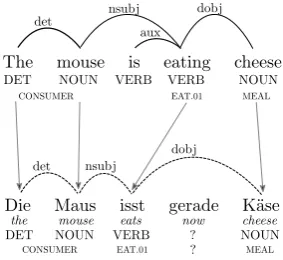
Figure 1: An English sentence with syntactic and seman-tic annotations predicted by a parser, and a German trans-lation. These annotations are transferred onto aligned Ger-man words, thus automatically labeling the GerGer-man sentence (with exception of the unaligned German wordgerade).
allel corpus consisting of sentences in a resource-rich source language (SL) and their translations in a target language (TL), as well as existing parsers for the SL. It leverages the hypothesis that trans-lated sentences will share a degree of syntactic and, in particular, semantic parallelism (Pad´o and Lapata, 2009), thus allowing us to automatically transfer linguistic annotations from SL to TL.
For example, consider Figure1which shows an English SL sentence and its German TL transla-tion, with word-level alignments indicated as lines between the sentences. State-of-the-art parsers and semantic role labelers (SRL) are used to pre-dict labels for the English sentence. Following the word alignments, this annotation is then trans-ferred onto the German sentence. The English word cheese, for instance, is aligned to the Ger-manK¨ase(cheese). We therefore learn thatK¨ase
is also a noun (NOUN), that in this sentence it is a direct object (dobj) and that it takes the semantic role ofMEAL. Following this process, we can thus
automatically annotate the German sentence with (partial) syntactic and semantic labels.
A Need for Qualitative Analysis. However,
while annotation projection has been successfully employed to transfer various types of annota-tion (Yarowsky et al.,2001;Hwa et al.,2005;Pad´o and Lapata,2009;Van der Plas et al.,2011; Ak-bik et al., 2015), it is not always clear how well specific annotation can be transferred to a spe-cific TL. Previous work noted a range of issues in-cluding non-literal translations and general trans-lational divergences (Dorr, 1994) between lan-guages which cause incorrect annotation to be pro-jected. For this reason, previous work often in-cluded qualitative analyses and carefully defined heuristics to address these problems.
Contributions. To facilitate such analysis and discussion, we present THE PROJECTOR, a
web-based UI that visualizes the projection of syntactic and shallow semantic annotation in parallel sen-tences1. Our tool enables researchers to execute annotation projection for manually created exam-ples or pre-loaded corpora, and allows researchers to visually inspect individual sentence pairs and types of linguistic annotation.
This paper is structured as follows: we first re-view relevant related work in annotation projec-tion. We then give an overview of THE PROJEC -TOR, briefly sketch use cases for this tool and
dis-cuss directions for future research.
2 Previous Work
Syntactic Annotation Projection. Early work proposed the projection of shallow and deep syn-tactic information in parallel corpora, including part-of-speech tags (Yarowsky et al., 2001), syn-tactic chunks (Yarowsky and Ngai,2001) and de-pendency trees (Hwa et al.,2005). However, these works also noted problems stemming from trans-lational divergences (Dorr, 1994; Van Leuven-Zwart,1989), i.e. systematic differences between languages on the structural and semantic realiza-tion levels. This may cause incorrect labels to be projected, or annotation gaps in the TL corpus. For instance, as Figure 1 shows, while a contin-uous process may be expressed in English using
gerunds(the wordeating), the continuous verb as-pect generally does not exist in German which in-stead uses an adverbial construction (the word ger-ade, meaningnow, which is unaligned and there-fore remains unlabeled in Figure1).
To filter out and correct such errors,
previ-1A screencast is available athttps://vimeo.com/
217035646
ous work defined various heuristics such as fil-tering of infrequent alignments (Yarowsky et al.,
2001), transformation rules that encode linguis-tic knowledge (Hwa et al., 2005) and the use of cross-lingual word clusters as constraints in pro-jection (T¨ackstr¨om et al., 2012). More recently,
Tiedemann (2014) argued that the ongoing har-monization of linguistic annotation across lan-guages as pursued by theuniversal dependencies
project (Nivre et al., 2016) has produced tagsets without language-specific syntax that can more easily be projected2.
Semantic Annotation Projection.Previous work also investigated the applicability of annotation projection to shallow semantic annotation such as semantic role labels (SRL). Pad´o and Lapata
(2009) first analyzed the viability of transferring SRL in the FRAMENET-formalism (Baker et al.,
1998) and found a greater degree of parallelism for semantic than syntactic annotation. Van der Plas et al.(2011) applied this approach to the verb-centric PROPBANK-formalism of SRL (Palmer
et al.,2005).
In our previous work, we defined a two-step process of filtering and semi-supervised learning to address problems caused by non-literal transla-tions and coverage gaps (Akbik et al.,2015). We applied our approach to generate propbanks for 7 languages from 3 language groups (Akbik et al.,
2015), and experimented with projecting both syntactic and semantic annotation to three low-resource languages (Akbik et al.,2016b). Qualita-tive analysis revealed propositions evoked by com-plex predication (Bonial et al.,2014) to be a major source of translational divergences of shallow se-mantics (Akbik et al.,2016a).
Qualitative Analysis. Previous works illustrated the need for qualitative analysis to identify error sources and define strategies to address transla-tional divergences. However, to the best of our knowledge, no visualization tool is available that specifically addresses this task. While there ex-ist tools that focus on inspecting and correcting word alignments (Gilmanov et al.,2014) as well as frameworks for visualization of various layers of linguistic annotation (Krause and Zeldes, 2016), THE PROJECTOR differs in that it specializes in
the projection of various types of linguistic anno-tation in parallel corpora and interactive analysis.
Figure 2: THEPROJECTOR’s main view showing a gold-labeled English sentence from ONTONOTESand a word-aligned German translation. The German sentence is labeled using annotation projection.
3 THEPROJECTORUser Interface
THEPROJECTORis a Web-based GUI that allows
users to inspect alignments and projected anno-tation. We give an overview of the layout, input fields and visualization options (sec. 3.1) discuss the two main usage modes (sec.3.2), and illustrate two example usage scenarios (sec.3.3).
3.1 Layout
Figure2illustrates THEPROJECTOR’s main view.
It is divided into input fields (top right), visualiza-tion opvisualiza-tions (top left) and the visualizavisualiza-tion pane (bottom half).
3.1.1 Input Fields
The input fields are grouped to the top left of the main screen. Two selection options are manda-tory: the first is the target language dropdown option to indicate the TL of the annotation pro-jection approach3. The second is theinputoption that can either be set tomanual (users manually supply a sentence or sentence pair) or used to se-lect a pre-loaded monolingual corpus in CoNLL-U
3At time of writing, we tested setups with the following TLs: Chinese, French, German and Japanese - through there is no principal limitation on the scope of TLs
format. At time of writing, we pre-loaded both the ONTONOTES(Hovy et al.,2006) and theuniversal dependenciescorpora (Nivre et al.,2016).
There are two textual inputs, namely the SL sentenceand theTL sentencefields. Users popu-late these fields with a transpopu-lated sentence pair. At least one of the two fields must be populated - in this case, a translation is automatically generated using the Google Translate API (Wu et al.,2016). The fields can either be populated by manually en-tering a sentence, or - if a corpus is selected as in-put option - be populated by selecting a sentence using thecorpus navigator. Once the selection is complete and at least one sentence field populated, users hit thegobutton to execute and visualize an-notation projection.
3.1.2 Visualization Options
Visualization options are divided into options that pertain to the source or target sentence. On the source side, users can check which layers of vi-sualization should be displayed. Options include PoS tags, dependency trees and semantic frames and roles.
orprojectedusing annotation projection. By tog-gling between these options, users compare be-tween predicted and projected annotation. Since SRL information is projected onto entire TL con-stituents, users additionally specify whether they are identified using predicted or projected depen-dency tree information. In addition, users choose whether or not to show the word alignments.
3.1.3 Visualization Pane
The visualization pane displays annotation pro-jection for a sentence pair according to the cur-rent settings. If activated, dependency trees are displayed above a sentence. PoS tags are placed directly beneath each word. SRL labels are dis-played as boxes around constituents, where each layer corresponds to one semantic frame.
3.2 Modes
The tool supports two general modes of interac-tion: (1) aninteractive modein which users sup-ply an example sentence (or sentence pair) and ex-ecute alignment, parsing and projection on-the-fly, and (2) acorpus modein which a gold-labeled cor-pus is loaded that can be browsed and employed in annotation projection.
3.2.1 Interactive Mode
The first mode is intended for analysis of specific linguistic constructs in the source or target lan-guage. Researchers select “manual” as input op-tion and create an example sentence for the con-struct of interest. To analyze how a SL concon-struct transfers to a TL, users enter the example sentence in the source field. Similarly, to investigate a spe-cific TL construct, they enter the example sentence in the target field. Users may supply the corre-sponding SL or TL translation themselves or sim-ply leave the other field blank - if only one sen-tence is provided, our tool uses the Google Trans-late API to automatically retrieve a translation and fill in the missing field.
Parsing pipelines. Upon clicking go, the SL sentence is sent to a pipeline of NLP tools, namely the STANFORDNLP tools (Manning et al.,
2014) to tokenize, lemmatize, PoS tag and depen-dency parse the sentence and MATEPLUS (Roth
and Woodsend, 2014) to predict SRL annota-tion. We used the standard models provided for STANFORDNLP and trained MATEPLUSover the
version 3 release of propbank annotations ( Bo-nial et al., 2014) for the ONTONOTES corpus.
The target language sentence is parsed using the transition-based MATE parser (Bohnet and Nivre,
2012) which we trained for each TL over version 1.4 release of the universal dependency treebank.
Alignment and projection. Word alignments are heuristically detected on-the-fly using word co-occurrence weights as determined by the Berke-leyAligner (DeNero and Liang, 2007) over the 2016 release of the OPENSUBTITLESparallel
cor-pus for all supported language pairs (Tiedemann,
2012). Using these alignments, we execute an-notation projection of all syntactic and semantic information. Word-level PoS tags and semantic frames are simply transferred to aligned words in the target language, while dependencies are trans-ferred to corresponding word pairs. For semantic roles (which label entire constituents), we identify the best matching TL constituent using the Jaccard distance as described in (Pad´o and Lapata,2009).
Results. The GUI displays the sentence pair with all predicted and projected annotations. Users may change visualization options, and experiment with modifications to the sentence pair (for instance, chose a different translation).
3.2.2 Corpus Mode
The second mode is to enable qualitative analy-sis for cases in which a gold labeled corpus al-ready exists either for the source or target lan-guage. This setting allows us to inspect annota-tion projecannota-tion without interference from poten-tially incorrect parses4. Users select a corpus in the input field, and then browse sentences using the navigation field. Depending on whether the gold-labeled corpus is loaded for the SL or TL side, a different pipeline of tools is executed:
Gold-labeled SL corpus. If users select an En-glish gold corpus (ONTONOTES in the current
setup), no SL parsing pipeline is executed. In-stead, the sentence is automatically translated into the selected TL and the alignment, TL parsing and projection pipeline executed. If the translation is incorrect or lacking, users may manually enter a better TL translation and re-execute the approach.
Gold-labeled TL corpus. If users select a TL gold corpus (the universal dependency treebanks in the current setup), the currently selected sen-tence is first translated into English and then parsed using the default English parsing pipeline
and word-aligned. The annotation is then pro-jected back onto the TL sentence where it can be compared to the original gold labels.
3.3 Example Scenarios
We now present two example usage scenarios.
3.3.1 Scenario 1: Study of Translational Divergences
In the first scenario, a user may be interested to study the effects of specific items of SL or TL syn-tax known to be divergent between languages. For instance, as previously discussed, one might study how continuous aspects in English verbs are trans-ferred to a language that has no such verb aspect. German, for instance, expresses this information either implicitly or through a variety of more com-plex constructions.
To investigate this, the user may type in a num-ber of sentences in both English and German that convey continuous information and investigate an-notation projection. One example may be the sen-tence pair in Figure 1: Here, the user finds that (1) the continuous aspect does not introduce errors since universal PoS tags and dependencies do not reflect such information, but that (2) the adverbial construction in German remains unlabeled. Other examples (see the accompanying screencast) show that syntactic projection is sometimes affected, while semantic projection is more robust. Based on these investigations, the user may conclude that either heuristic rules or a semi-supervised learning approach are appropriate to close the quality and coverage gap.
3.3.2 Scenario 2: Adding A Layer of Annotation
A second example scenario is to investigate adding a layer of annotation to an already existing TL treebank. For instance, the universal dependen-cies treebanks are annotated with gold-standard PoS and dependency information for over 40 lan-guages. However, there is as-yet no semantic layer of annotation. Previous work proposed to re-use English propositions as a layer of annotations for the universal treebanks (Akbik et al.,2015; Haver-inen et al.,2015), but the applicability of these la-bels is a matter of ongoing discussion.
To investigate, a user may load a TL univer-sal dependency corpus and browse example sen-tences. Each sentence is automatically translated into English, labeled with semantic roles which
are then projected back onto the TL. Users qual-itatively analyze whether the propositions are fit-ting and identify sources of errors such as subopti-mal automatic translations, source language pars-ing errors and translational divergences.
4 Demonstration and Outlook
We present THE PROJECTORas a hands-on demo
where users can enter sentences or sentence pairs and request parsing and on-the-fly annotation pro-jection. In order to enable the research commu-nity to quickly set up annotation projection experi-ments and discuss crosslingual syntax and seman-tics, we plan to make the toolkit publicly avail-able, either through an online demo or in form of open source code. Our current work on THEPRO -JECTORfocuses on extending the functionality of
the demo and the projection framework. This in-cludes adding additional layers of annotation, such as named entities and word senses, into the pars-ing and projection pipeline. We also aim to en-able more flexibility in choosing SL parsers and heuristics to address translational divergences, as proposed in previous work.
Acknowledgements
We would like to thank the anonymous reviewers for their helpful comments. This project has received funding from the European Union’s Horizon 2020 research and innovation pro-gramme under grant agreement no 732328 (“FashionBrain”).
References
Alan Akbik, Laura Chiticariu, Marina Danilevsky, Yunyao Li, Shivakumar Vaithyanathan, and Huaiyu Zhu. 2015. Generating high quality proposition banks for multilingual semantic role labeling. In
ACL 2015, 53rd Annual Meeting of the Association for Computational Linguistics, pages 397–407. Alan Akbik, Xinyu Guan, and Yunyao Li. 2016a.
Mul-tilingual aliasing for auto-generating proposition banks. InCOLING 2016, 26th International
Con-ference on Computational Linguistics, pages 3466–
3474.
Alan Akbik, Kumar Vishwajeet, and Yunyao Li. 2016b. Towards semi-automatic generation of proposition banks for low-resource languages. InEMNLP 2016, Conference on Empirical Methods on Natural
Lan-guage Processing, pages 993–998.
Bernd Bohnet and Joakim Nivre. 2012. A transition-based system for joint part-of-speech tagging and labeled non-projective dependency parsing. In
EMNLP-CoNLL 2012: Conference on Empiri-cal Methods in Natural Language Processing and
Computational Natural Language Learning, pages
1455–1465.
Claire Bonial, Julia Bonn, Kathryn Conger, Jena D. Hwang, and Martha Palmer. 2014. Propbank: Se-mantics of new predicate types. InLREC 2014, 9th International Conference on Language Resources
and Evaluation, pages 3013–3019.
John DeNero and Percy Liang. 2007. The berke-ley aligner. http://code.google.com/p/
berkeleyaligner/.
Bonnie J Dorr. 1994. Machine translation divergences: A formal description and proposed solution. Com-putational Linguistics, 20(4):597–633.
Timur Gilmanov, Olga Scrivner, and Sandra K¨ubler. 2014. Swift aligner, a multifunctional tool for parallel corpora: Visualization, word alignment, and (morpho)-syntactic cross-language transfer. In
LREC 2014, 9th International Conference on
Lan-guage Resources and Evaluation, pages 2913–2919.
Katri Haverinen, Jenna Kanerva, Samuel Kohonen, Anna Missil¨a, Stina Ojala, Timo Viljanen, Veronika Laippala, and Filip Ginter. 2015. The finnish propo-sition bank. Language Resources and Evaluation, 49(4):907–926.
Eduard Hovy, Mitchell Marcus, Martha Palmer, Lance Ramshaw, and Ralph Weischedel. 2006. Ontonotes: the 90% solution. InHuman Language Technology
Conference of the NAACL, pages 57–60.
Rebecca Hwa, Philip Resnik, Amy Weinberg, Clara Cabezas, and Okan Kolak. 2005. Bootstrapping parsers via syntactic projection across parallel texts.
Natural language engineering, 11(03):311–325.
Thomas Krause and Amir Zeldes. 2016. Annis3: A new architecture for generic corpus query and vi-sualization. Digital Scholarship in the Humanities, 31(1):118–139.
Christopher D. Manning, Mihai Surdeanu, John Bauer, Jenny Finkel, Steven J. Bethard, and David Mc-Closky. 2014. The Stanford CoreNLP natural lan-guage processing toolkit. In ACL 2014. 52nd An-nual Meeting of the Association for Computational Linguistics: System Demonstrations, pages 55–60. Mitchell P Marcus, Mary Ann Marcinkiewicz, and
Beatrice Santorini. 1993. Building a large annotated corpus of english: The penn treebank. Computa-tional linguistics, 19(2):313–330.
Joakim Nivre, Marie-Catherine de Marneffe, Filip Gin-ter, Yoav Goldberg, Jan Hajic, Christopher D Man-ning, Ryan McDonald, Slav Petrov, Sampo Pyysalo, Natalia Silveira, et al. 2016. Universal dependencies
v1: A multilingual treebank collection. In LREC 2016, 10th International Conference on Language
Resources and Evaluation, pages 1659–1666.
Sebastian Pad´o and Mirella Lapata. 2009. Cross-lingual annotation projection for semantic roles. Journal of Artificial Intelligence Research, 36(1):307–340.
Martha Palmer, Daniel Gildea, and Paul Kingsbury. 2005. The proposition bank: An annotated cor-pus of semantic roles. Computational linguistics, 31(1):71–106.
Lonneke Van der Plas, Paola Merlo, and James Hen-derson. 2011. Scaling up automatic cross-lingual semantic role annotation. In ACL 2011, 49th An-nual Meeting of the Association for Computational Linguistics, pages 299–304.
Michael Roth and Kristian Woodsend. 2014. Composi-tion of word representaComposi-tions improves semantic role labelling. InEMNLP 2014, Conference on
Empiri-cal Methods in Natural Language Processing, pages
407–413.
Oscar T¨ackstr¨om, Ryan McDonald, and Jakob Uszko-reit. 2012. Cross-lingual word clusters for direct transfer of linguistic structure. In NAACL 2012, Conference of the North American Chapter of the Association for Computational Linguistics: Human
language technologies, pages 477–487.
J¨org Tiedemann. 2012. Parallel data, tools and inter-faces in opus. In LREC 2012, 8th International
Conference on Language Resources and Evaluation,
pages 2214–2218.
J¨org Tiedemann. 2014. Rediscovering annotation pro-jection for cross-lingual parser induction. In COL-ING 2014, 25th International Conference on Com-putational Linguistics, pages 1854–1864.
Kitty Van Leuven-Zwart. 1989. Translation and origi-nal: Similarities and dissimilarities, i. International Journal of Translation Studies, 1(2):151–181. Yonghui Wu, Mike Schuster, Zhifeng Chen, Quoc V
Le, Mohammad Norouzi, Wolfgang Macherey, Maxim Krikun, Yuan Cao, Qin Gao, Klaus Macherey, et al. 2016. Google’s neural ma-chine translation system: Bridging the gap between human and machine translation. arXiv preprint
arXiv:1609.08144.
David Yarowsky and Grace Ngai. 2001. Inducing mul-tilingual pos taggers and np bracketers via robust projection across aligned corpora. InNAACL 2001, 2nd Meeting of the North American Chapter of the Association for Computational Linguistics on Lan-guage Technologies, pages 1–8.
David Yarowsky, Grace Ngai, and Richard Wicen-towski. 2001. Inducing multilingual text analysis tools via robust projection across aligned corpora.
In HLT 2001, 1st International Conference on