Learning Word Relatedness over Time
Guy D. Rosin1, Eytan Adar2, Kira Radinsky1,3 1Technion – Israel Institute of Technology, Haifa, Israel
2University of Michigan, Ann Arbor, USA 3eBay Research, Israel
{guyrosin,kirar}@cs.technion.ac.il, [email protected]
Abstract
Search systems are often focused on pro-viding relevant results for the “now”, as-suming both corpora and user needs that focus on the present. However, many corpora today reflect significant longitudi-nal collections ranging from 20 years of the Web to hundreds of years of digitized newspapers and books. Understanding the
temporal intent of the user and retrieving the most relevant historical content has be-come a significant challenge. Common search features, such as query expansion, leverage the relationship between terms but cannot function well across all times when relationships vary temporally. In this work, we introduce a temporal relation-ship model that is extracted from longitu-dinal data collections. The model supports the task of identifying, given two words,
whenthey relate to each other. We present an algorithmic framework for this task and show its application for the task of query expansion, achieving high gain.
1 Introduction
The focus of large-scale Web search engines is largely on providing the best access to present snapshots of text – what we call the “Now Web”. The system constraints and motivating use cases of traditional information retrieval (IR) systems, coupled with the relatively short history of the Web, has meant that little attention has been paid to how search engines will function when search must scale not only to the number of documents but also temporally. Most IR systems assume fixed language models and lexicons. They focus only on the leading edge of query behavior (i.e., what does the user likely mean today when they type
“Jaguar”). In this context, features as basic as dis-ambiguation and spelling corrections are fixed to what is most likely today or within the past few years (Radinsky et al., 2013), query expansions and synonyms are weighted towards current infor-mation (Shokouhi and Radinsky, 2012), and re-sults tend to include the most recent and popular content. While this problem would seem to be speculative in that it will be years until we need to address it, the reality is the rate of change (Adar et al., 2009) of the Web, language, and culture have simply compressed the time in which critical changes happen.
The “Now Web” assumptions are entirely rea-sonable for temporally coherent text collections and allow users (and search engines) to ignore the complexity of changing language and concentrate on a narrower (though by no means simpler) set of issues. The reality is that this serves a significant user population effectively. There are nonethe-less a growing number of both corpora and users who require access not just to what is relevant at a particular instant (e.g., Hathitrust (Willis and Efron,2013), historical news corpora, the Internet Archives, and even fast changing Twitter feeds). Within such contexts, a search engine will need to vary the way it functions (e.g., disambigua-tion) and interacts (e.g., suggested query expan-sions) depending on the period and temporal scale of documents being queried. This, of course, is further complicated by the fact that Web pages are constantly evolving and replaced.
Take for example the query “Prime Minister Ariel Sharon”. When fed into a news archive search engine, the likely intent was finding results about Sharon’srole as Israel’s Prime Minister, a role held from2001 to 2006. Singh et al. (2016) refer to this as aHistorical Query Intent. However, most popular search engines return results about Sharon’s death in 2011, when he was no longer
prime minister. The searcher may take the addi-tional step of filtering results to a time period, but this requires knowing what that period should be. Other query features are also unresponsive to tem-poral context. For example, the top query sugges-tions for this query focus on more recent events of his death: “Former prime minister Sharon dies at 85”, “Former prime minister Sharon’s condi-tion worsens”, etc. While these mightsatisfy the searcher if they are looking for the latest results, or the results most covered by the press, there are clearly other possible needs (Bingham,2010).
In this paper, we focus on the task of measuring word relatedness over time. Specifically, we infer whether two words (tokens) relate to each other during a certain time range. This task is an essen-tial building block of many temporal applications and we specifically targettime-sensitive query ex-pansion (QE). Our focus is on semantic related-nessrather thansemantic similarity. Relatedness assumes many different kinds of specific relations (e.g. meronymy, antonymy, functional associa-tion) and is often more useful for computational linguistics applications than the more narrow no-tion of similarity (Budanitsky and Hirst,2006).
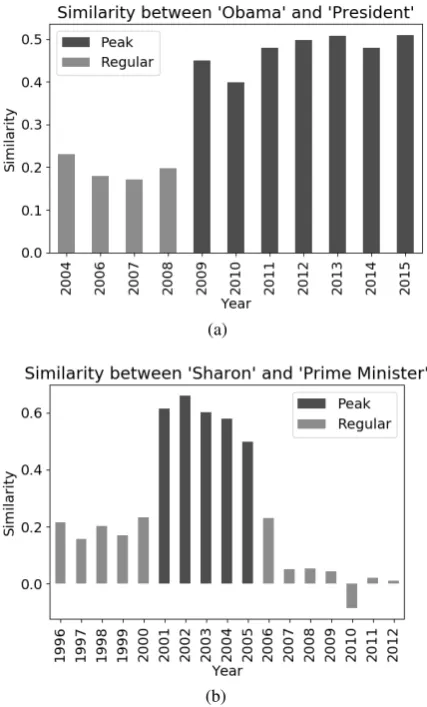
We present several temporal word-relatedness algorithms. Our method utilizes a large scale tem-poral corpus spanning over 150 years (The New York Times archive) to generate temporal deep word embeddings. We describe several algorithms to measure word relatedness over time using these temporal embeddings. Figure1apresents the per-formance of one of those algorithms on the words “Obama” and “President”. Note that the high-est relatedness score for the words appears during the presidential term of Barack Obama. Similarly, Figure1b shows a high score for “Ariel Sharon” and “prime minister” only during his term.
Using the approach above, we present a spe-cific application – producing temporally appropri-ate query-expansions. For example, consider the query: “Trump Businessman”. Figure2shows the non-temporal query expansion suggestions which focus heavily on the first entity (i.e., “Trump”) and his current “state” (i.e., a focus on Donald Trump as President, rather than presenting suggestions about Trump’s business activity as implied by the query). We present an empirical analysis present-ing the strengths and weaknesses of the different temporal query-expansion algorithms and compar-ing them to current word-embeddcompar-ings-based QE
(a)
[image:2.595.310.524.62.416.2](b)
Figure 1: Similarity identified by our algorithms between words over time. Dark gray indicates high similarity whereas light gray indicates non-significant similarity.
algorithms (Kuzi et al.,2016;Diaz et al.,2016). In this paper we describe a novel problem of evaluating word relatedness over time and con-tribute our datasets to evaluate this task to the com-munity1. Second, we present novel representa-tions and algorithms for evaluating this task and show high performance. We share our code with the community as well. Finally, we present the application of this task to query-expansion and present several methods built on top of the tem-poral relatedness algorithms that show high per-formance for QE.
2 Related Work
Understanding the semantic change of words has become an active research topic (Section 2.1). Most work has focused on identifying semantic
Figure 2: Query expansions for the terms “Trump Businessman”. Most results are referring to his term as president and not to his business activity.
drifts and word meaning changes. A lot of effort has been made into analyzing texts temporally: several methods for temporal information extrac-tion were recently proposed (Ling and Weld,2010;
Kuzey and Weikum,2012;Talukdar et al.,2012), as well as publicly released knowledge bases, such as YAGO2 (Hoffart et al., 2013). These meth-ods automatically extract temporal relational facts from free text or semi-structured data. In addi-tion, Pustejovsky et al. (2003); UzZaman et al.
(2012) and others annotated texts temporally, and extracted events as well as temporal expressions.
Work in Information Retrieval (IR, Section2.2) has discussed the concept of ‘time’ as a contextual parameter for understanding user intent. Largely, this research utilizes query-log analysis with the timeof the queryas a context signal. In this work, we leverage the temporal variation in word relat-edness to understand, and better accommodate, in-tent.
2.1 Word Dynamics
Continuous word embeddings (Mikolov et al.,
2013) have been shown to effectively encapsu-late reencapsu-latedness between words. Radinsky et al.
(2011) used temporal patterns of words from a large corpus for the task of word similarity. They showed that words that co-occur in history have a stronger relation. In our work, we focus on iden-tifyingwhena relation holds. Numerous projects have studied the change of word meanings over time, and specifically focused on identification of the change itself. Sagi et al.(2009) used Latent Semantic Analysis for detecting changes in word meaning. Wijaya and Yeniterzi(2011) character-ized 20 clusters to describe the nature of meaning change over time, whereasMitra et al.(2014) used other clustering techniques to find changes in word senses. Mihalcea and Nastase (2012) identified changes in word usage over time by the change in their related part-of-speech. Others have investi-gated the use of word frequency to identify epochs (Popescu and Strapparava,2013).
Jatowt and Duh(2014) represented a word em-bedding over the Google Books corpus (granu-larity of decades) and presented qualitative eval-uation for several words. Hamilton et al. (2016) built Word2Vec embedding models on the Google Books corpus to detect known word shifts over 30 words and presented a dozen new shifts from the data. The authors presented two laws that gov-ern the change of words – frequent words change more slowly and polysemous words change more quickly. Finally, Kenter et al. (2015) studied changes in meaning (represented by a few seed words), and monitored the changing set of words that are used to denote it.
In our work, we focus on learning relatedness of words over time. We evaluate the technique using a large scale analysis showing its prediction accu-racy. Moreover, we define the task of identifying the temporality of relatedness between two words. We show that understanding the temporal behavior of entities improves performance on IR tasks.
2.2 Temporal Search
The temporal aspects of queries and ranking gained significant attention in IR literature. Some have focused on characterizing query behavior over time. For example, different queries change in popularity over time (Wang et al., 2003) and even by time of day (Beitzel et al., 2004). Jones and Diaz (2007) described queries to have three temporarilty patterns: atemporal, temporally un-ambiguous and temporally un-ambiguous. Others have leveraged temporal variance to look for in-dicators of query intent (Kulkarni et al., 2011). Several efforts (Shimshoni et al., 2009; Chien and Immorlica, 2005; M. Vlachos and Gunop-ulos, 2004; Zhao et al., 2006; Shokouhi, 2011;
Radinsky et al., 2012) were done to not only characterize the temporal query behavior but also model it via time-series analysis. Radinsky and colleagues modeled changes in the frequency of clicked URLs, queries, and clicked query-URL pairs by using time-series analysis and show its application for improving ranking and query auto-suggestions (Radinsky et al.,2013;Shokouhi and Radinsky, 2012). Singh et al.(2016) focused on serving the specific needs of historians, and intro-duced the notion of aHistorical Query Intentfor this purpose.
based on the time the query was issued or the document was changed, our work focuses on un-derstanding the subtle changes of language over time that indicate a temporal intent. We show that understanding the temporal relatedness between words is a building block needed for understand-ing better query intent. Given two words or en-tities we identify when their relatedness was the strongest to help produce better query expansions.
3 Temporal Relatedness Dynamics and Semantics
To address the task of understanding temporal re-latedness, our approach consists of three main steps: (1) Represent relatedness using word em-beddings over time (Section 3.1). (2) Model re-latednesschangeover time as a time series (Sec-tion3.2). (3) Combine these to identify when re-latedness relations hold temporally (Section3.3).
3.1 Representing Relatedness using Word Embeddings
In our work we leverage the distributed represen-tation framework of Word2Vec (Mikolov et al.,
2013) (specifically skip-grams). Intuitively, given a word wt, skip-grams attempt to predict
sur-rounding words, e.g. wt−2, wt−1, wt+1, wt+2 for a window size ofc= 2.
Definition 3.1. Let Ci be the word context for a
wordwi. In this work, we consider the context to
be the surrounding words of a window size of n Ci ={wi−n, wi−1, wi+1, wi+n}. We defineCitto
be the context for a wordwi in time periodt, i.e.
only in the documents written during timet.
Definition 3.2. We define the word context of a
specific embedding of a year y for a word wi,
to be{wc ∈ Ciy}. Intuitively, a specific
embed-ding represents the embedembed-ding of a word in a cer-tain year. We denote the vector representation of a wordwiin a yearybyviy.
Definition 3.3. We define the word context of a
global embeddingfor a word wi to beCi.
Intu-itively, a global embedding represents the embed-ding of a word over all time periods. We denote the vector representation of a wordwibyvi.
Using Word2Vec, we approximate the seman-tic relatedness between two entities by the co-sine similarity between their embeddings (Turney et al.,2010).
Definition 3.4. A temporal relation (e1, e2, t), whereeiare entities andtis a referenced time
pe-riod, is said to be true ife1, e2relate duringt, i.e. their semantic relatedness during that time is rela-tively high. For example:(Christopher Nolan, The Dark Knight, 2008)is true, due to the fact that the movie, which was released in 2008, was directed by Nolan.
Definition 3.5. The dynamics of two entities
e1, e2 is defined to be the time series of the se-mantic relatedness ofe1ande2:
Dynamics(e1, e2) =
cos(vt1
1 , v2t1), . . . , cos(vt1n, vt2n)
(1)
wheret1, . . . , tnare all the time periods.
We model entities’ relatedness change over time by constructing theirdynamics. Recall Figure1a, which shows the semantic distance between the vector representations ofBarack Obamaand Pres-identover the years. Semantic distance is an accu-rate indicator of the time period when Obama was president. Therefore, our goal is to detect the time periods of high relatedness using peak detection.
3.2 Understanding Relatedness Dynamics
When considering a relationship between entities, detecting time periods of high relatedness enables us to reveal and identify what we call “periods of interest” – time periods in which the entities were the closest. In this section, we present an algo-rithm to identify these “periods of interest”. Intu-itively, when considering thedynamicsof two en-tities, its peaks represent the lowest distances over time. More formally, given two entitiese1, e2 we want to construct their dynamics and find peaks in it, i.e. the following sequence of time peri-ods: ti |cos(v1ti, vt2i)is relatively high, andti <
tjifi < j .
Traditional peak detection algorithms focus on detecting peaks that are sharp and isolated (i.e. not too many surrounding points have similar val-ues) (Palshikar et al., 2009). In our case, rela-tions often imply continuous periods of peaks, e.g. Obama was president for eight years. Therefore, we need to detect peaks, as well as periods of con-tinuous peaks (i.e., steps).
LetL = (t1, v1),(t2, v2), . . . ,(tn.vn) be a list
of tuples, wheretiare time periods andviare
The first step is to find relative maxima: we scanLand look for pairs(ti, vi)such thatvi−1 <
vi > vi+1, i.e. vi is a local maximum. We apply
two minimum thresholds in order to filter insignifi-cant points: An absolute threshold, which below it we consider the peak not to be significant enough, and a relative threshold which facilitates removing points that are much lower than the highest max-imum. The final step of the algorithm is to find plateaus which will also be considered part of the peak. For each peak point, the algorithm considers the point’s surrounding neighbors. Using a thresh-old relative to the current peak, those identified as close in their value to the current peak are added to the peak list.
3.3 Learning Temporal Relatedness
We define the task of learning temporal related-ness: given two entities e1, e2, identify whether they relate to each other during a certain year y, i.e., whether the temporal relation (e1, e2, y) is true. For example, in Figure 1a, Obama was re-lated to President in 2010 but not in 2005.
3.3.1 Specific Classifier
The first method we present to classify word re-latedness, employs a classifier that receives as in-putsvicorresponding to the entitieseiand an
ad-ditional feature of the year. In our evaluation (Sec-tion 4) we will use about 40 years of data, i.e. the year feature will have 40 possible values. The classifier will predict, given two entities, whether they relate to each other during a referenced year.
LetCl:Rn → {0,1}be a classifier mapping a
vector ofn featuresF = (f1, . . . , fn)to a label
L∈ {0,1}. Let our feature vector be of the form:
F = (v1ykvy2ky) (2)
where v1y is the first entity’s specific embedding (i.e. at time y), vy2 is the second entity’s spe-cific embedding andy is the year. As a prelimi-nary step, we need to trainClon a diverse dataset of positive and negative examples, i.e. true and false temporal relations. For this purpose, we uti-lize our temporal relations dataset (Section3.4.2). From each relation, we extract a temporal relation
(e1, e2, y), calculate its feature vector and use it for training.
Given a new temporal relation, we applyClto predict whether it is true, i.e. whether its entities relate during the referenced time.
3.3.2 Temporal Classifier
Here we use a classifier similar to the one de-scribed in Section3.3.1(training is performed the same way), combined with input from the enti-tiesdynamics. First, we build the dynamics, i.e. build specific word embeddings of e1 and e2 for every yeary, and calculate their cosine similarity
cos(vy1, v2y). We then apply our peak detection al-gorithm (Section3.2) on thedynamicsand use its output as one of the classifier’s features (denoted byisPeak). As a result, our feature vector is:
F = (vy1kvy2kykisP eak) (3)
3.4 Leveraging World Knowledge
We apply our techniques to two corpora: the first is a temporal corpora (Section3.4.1), which we used for creating word embeddings, and the second is a relational corpora (Section3.4.2), which we used for training our models and for evaluation.
3.4.1 Temporal Corpora
For constructing the corpora, we used The New York Times archive2, with articles from 1981 to 2016 (9GB of text in total). Specific word embeddings were generated for every time pe-riod (i.e., year) using Word2Vec. Each year’s data was used to create word embeddings using Word2Vec’s skip-gram with negative sampling ap-proach (Mikolov et al.,2013), with the Gensim li-brary (ˇReh˚uˇrek and Sojka,2010). We trained the models with the following parameters: window size of 5, learning rate of 0.05 and dimensional-ity of 140. We filtered out words with less than 30 occurrences during that year.
We observe both ambiguity (Apple, the com-pany and the fruit) and variability (different phrases referring to the same entity, e.g., Presi-dent Obama, Barack H. Obama,Obama). While such ‘noise’ may be problematic, both the scale of the data and stylistic standards of The New York Times help. Additionally, we ensure a connection to an entity database (Wikipedia) and perform ad-ditional cleaning methods (lemmatization, remov-ing stopwords).
3.4.2 Relational Corpora
In this work, we use YAGO2 (Hoffart et al.,2013) as our relational corpora due to its temporal focus. The YAGO2 knowledge base contains millions of facts about entities, automatically extracted from
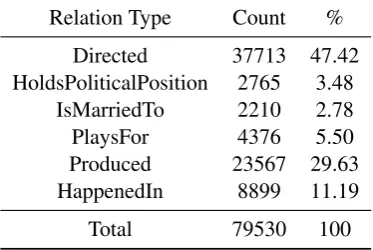
Relation Type Count % Directed 37713 47.42 HoldsPoliticalPosition 2765 3.48
IsMarriedTo 2210 2.78 PlaysFor 4376 5.50 Produced 23567 29.63 HappenedIn 8899 11.19
[image:6.595.88.275.64.189.2]Total 79530 100
Table 1: Relations Dataset Composition
Wikipedia and other sources. We use relations from YAGO2 to build our own dataset of tempo-ral relations, which we use in all of our algorithms and evaluation – as a source for temporal relations. The dataset consists of temporal relations in the following format: (entity1, entity2, year, type,
class), where entity1 and entity2 are entities,
type is a relation type, and class is true if the relation holds on year. For example, (Tim Bur-ton, Batman Returns, 1992, Directed, true) and
(Battle Mogadishu, Somalia, 2010, HappenedIn, true). Table 1 shows the exact dataset composi-tion. We built our dataset on all the relation types that have a temporal dimension in YAGO2: Di-rected, HoldsPoliticalPosition, IsMarriedTo, Pro-duced, PlaysFor, HappenedIn. The dataset con-tains 80K of such relations.
4 Evaluation
4.1 Experimental Methodology
We compare the methods described in Section3.3, where for Cl we chose to use a Support Vector Machine (SVM)3, with an RBF kernel and C=1.0 (chosen empirically). Two baselines were used for comparison. The first is the common non-temporal model, i.e. a classifier that uses the global (all-time) word embeddings and the follow-ing features: the two entities’ global embeddfollow-ings, and a year. More formally,
F = (v1||v2||y) (4)
Given a new temporal relation, the classifier pre-dicts whether it is true during the referenced year, and we output the classifier’s prediction. The sec-ond baseline we compare against is a standard text 3We used the implementation by the scikit-learn
li-brary (Pedregosa et al.,2011).
classifier that uses the global word embeddings as its only features, i.e.F = (v1||v2).
The dataset on which we perform the evalua-tion is described in Secevalua-tion4.2. The dataset is not balanced: it contains more negative examples than positive ones. Therefore, for evaluating the meth-ods that involve a classifier we use stratified 10-fold cross validation. We remove relations from consideration if there is insufficient data in the cor-pora for that year (i.e., one of the entities was fil-tered out due to low incidence).
4.2 Dataset Construction
Recall that our relational corpora consists of 80K temporal relations in the following format:
(entity1, entity2, year, type, class), where type is a relation type, andclass is true if the relation holds onyear.
For training and evaluating our classifiers we need negative examples as well as positive exam-ples. We generate negative examples in the follow-ing way: for every relation in the corpora, we ran-domly sample 10 negative examples. We exclude the years of the true examples from the dataset’s year range, and then randomly choose years for the negative examples. To illustrate, let us observe the case ofObama, President: Obama was president from 2009-2016, so we sample negative examples from 1981 to 2008, such as (Obama, President, 1990, HoldsPoliticalPosition, false). The resulting dataset contains 420K relations. We refer to it as theTemporal Relations Dataset4.
4.3 Main Results
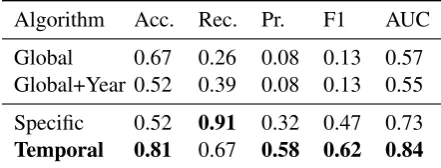
Table 2presents the results of our experiments.
Baselines: The Global and Global+Year base-lines produced an AUC of 0.55 and 0.57, respec-tively. They both performed much worse com-pared to our methods, with F1 of 0.13.
Specific Classifierproduced an AUC of 0.72. It has the highest recall score of all methods (0.88), but its other scores are relatively low.
Temporal Classifierproduced an AUC of 0.83. As reported inTable 2, it performed significantly better compared to all other methods, with p < 0.05. We applied the Wilcoxon signed-rank test to calculate statistical significance.
Algorithm Acc. Rec. Pr. F1 AUC Global 0.67 0.26 0.08 0.13 0.57 Global+Year 0.52 0.39 0.08 0.13 0.55 Specific 0.52 0.91 0.32 0.47 0.73
[image:7.595.71.292.63.147.2]Temporal 0.81 0.67 0.58 0.62 0.84
Table 2: Relatedness Learning Evaluation Results (Accuracy, Recall, Precision, F1, AUC)
4.4 Performance Analysis
We tuned Word2Vec parameters by empirically testing on a random subset of our dataset: we set the vector size to be 140 and used a mini-mum threshold of 30 occurrences (per year). We found that this balanced the removal of noisy data while ensuring that key entities were retained. For constructing the Word2Vec models, the amount of data is crucial or it may lead to unreliable (Hellrich and Hahn, 2016) or inaccurate results. We saw a clear correlation between accuracy and num-ber of occurrences of a participating word. That drove our decision to evaluate our algorithms only on New York Times articles from 1981 onwards – where the number of articles per year is suffi-ciently large.
5 Task Example: Query Expansion
Temporal relatedness learning can be used for var-ious NLP and IR-related tasks. For example, it is a common practice in IR to expand user queries to improve retrieval performance (Carpineto and Ro-mano,2012). Our technique allows us to produce temporally appropriate expansions. Specifically, given a query ofnentitiesQ = {e1, e2, . . . , en},
our task is to expand Q with additional search terms to add to it to improve retrieval of relevant documents.
For example, consider the query “Trump Busi-nessman” (Figure2). Current QE methods, which do not have a temporal aspect, focus on Donald Trump as President of the United States, a poten-tially erroneous result depending on the temporal focus of the searcher. A reasonable temporal ex-pansion, might contain terms that relate to Donald Trump’s business activity, such as “billionaire” or “real estate”. Using our technique, the temporal focus of a query can be identified and appropriate expansions offered to the end-user. Specifically, we can analyze the relationship between the query
entities to identify the “most relevant” time period – when those entities were strongly connected. In-tuitively, the QE algorithms will identify the most relevant time periodt for the query entities, and find semantically related terms from that time, to expand the query with.
To tackle this task, we use the algorithms de-scribed in Section 3.3. Several different algo-rithms can utilize the temporal relation models for the task of query expansion. Let us introduce the following definitions for our QE algorithms:
Definition 5.1. LetNNt
K(e)be the set ofKterms
that are the closest to an entityein timet.
Definition 5.2. LetNNK(e) be the set of
“glob-ally” (all-time) closest terms to an entitye.
Definition 5.3. Mutual closenessbetween an en-tityxand a queryQis defined by the sum of co-sine similarities betweenx and everye ∈ Q, i.e.
Mcos(x, Q) :=
X
e∈Q
cos(x, e) (5)
5.1 Query Expansion Algorithms
We describe alternative strategies to provide tem-poral query expansion ranging from a generic baseline to algorithms that leverage our embed-ding and classifiers. As a running example, we use the query: “Steven Spielberg, Saving Private Ryan” (Spielberg directed the movie in 1998). ‘Reasonable’ (temporally relevant) expansions for this query might include: actors who played in this movie, other Spielberg films or similar films from the same time and genre, etc.
5.1.1 Baseline
Following the results of Roy et al.(2016), we con-sider a baseline method that expands each entity separately, based on global Word2Vec similarity. We define the set of candidate expansion terms as
C = [
e∈Q
NNK(e) (6)
i.e., for each entity, we choose the closestKglobal terms. For each c ∈ C, we compute the mu-tual closeness Mcos(c, Q) and sort the terms in
Lucas and Spielberg have worked together. How-ever, Inglourious Basterds was created at 2009 and was directed by Quentin Tarantino.
5.1.2 Globally-Based Classifier
We use a heuristic and assume that the most rele-vant time periodtfor the entities of the query is the time when the entities were the closest. We use the classifier from our baseline method in Sec-tion 4.1, whose goal is to estimate how relevant a year is to a given set of nentities. Its features are the global word embeddings, as well as a year:
F = (v1kv2k. . .kvnky).
We apply the classifier to every year y, and choose the one with the highest returned proba-bility of the true label as the most relevant timet.
t= arg max
y {Cl(v1, v2, . . . , vn, y)} (7)
We take as candidate-expansion terms theK clos-est terms to each entity from that year, separately:
C = [
e∈Q
NNKt (e) (8)
Cis then filtered as described in the baseline. To train the classifier, for each temporal rela-tion in our temporal relarela-tions dataset, we calculate its feature vector and use it for training. Consid-ering our example, this method wrongly chooses
t = 2004. In that year the entity Saving Private Ryandoes not exist, so we end up with a wrong expansion of “Francis Ford Coppola film”.
5.1.3 Temporal Classifier
As we have seen in the previous subsection, the globally-based classifier is limited in cases where time-specific knowledge might yield better results. Thus, in this method we use the specific classi-fier from Section 3.3.1. Its features are the en-tities’ specific embeddings, and a year: F = (v1ykv2yk. . .kvnyky). We then continue as
de-scribed in the previous method (findt, choose can-didate terms and filter).
For our example, this method chooses correctly
t= 1998, which is exactly the year ofSaving Pri-vate Ryan release. Its expansion is “Tom Hanks, Movie”. Since Tom Hanks had a lead role in the movie, the expansion is reasonable. The next al-gorithm produces the same expansion as well.
5.1.4 Temporal Model Classifier
This method uses the temporal classifier from Section 3.3.2. Its feature vector is: F =
(v1ykv2yk. . .kvnykykisPeak). The rest is the same
as described in Section5.1.3.
5.2 Query Expansion Evaluation
Dataset. To evaluate temporal query expansion we use our temporal relations dataset, which will be made publicly available (described in Sec-tion3.4.2). First, we evaluate on queries consist-ing of two entities (n = 2): for each relation, we create a distinct query that consists of its two enti-ties concatenated. We search The New York Times corpus with this query5. We compare search per-formance when applying the various QE methods described in Section5.1. To evaluate the methods that involve a classifier, we use stratified 10-fold cross validation, as the previous task was evalu-ated (Section4.1). We useK= 2for all methods, i.e. we generate two expansion terms per query.
In addition, we evaluate on queries consisting of three entities (n = 3): we created a new dataset, which contains triplets of entities instead of pairs, by merging every two related (true) relations from our relations dataset. Two relations are considered related if they share an entity, and their time peri-ods overlap. We then generate negative relations as described in Section4.2. In this new dataset, each temporal relation consists of three entities, a year and a binary classification.
Evaluation Metrics. Though a complete eval-uation of QE is beyond the scope of this paper we describe here an evaluation suited for the tempo-ral case. It should be noted that the technique we propose here would likely be used alongside es-tablished QE techniques (e.g., log mining).
First, when providing query expansions and suggestions we would like for them to not only retrieve relevant content, but temporally-relevant content. To test the latter we say that given a temporal relation, a retrieved article is considered “true” if it were published within the referenced time, and “false” otherwise. Additional manual validation was done to evaluate its relevance to the query. This metric, while not the most accurate one, allows us to distinguish between results from the most relevant time period and others. Preci-sion of the top 10 retrieved documents (P@10) is used to evaluate the retrieval effectiveness.
Results. The results of the QE evaluation are reported inTable 3. We observe a consistent
Method P@10
n= 2 n= 3
[image:9.595.310.527.62.186.2]Baseline (Roy et al.,2016) 14.0% 17.7% Globally-Based Classifier 18.0% 22.7% Temporal Classifier 27.1% 38.5% Temporal Model Classifier 29.4% 39%
Table 3: Results of QE Algorithms Evaluation
havior for different query sizes (n = 2,3). For our temporal classifiers, forn = 3there is a 30% increase in precision, compared ton= 2.
All of our methods performed significantly bet-ter compared to the baseline (statistical signifi-cance testing has been performed using paired t-test with p < 0.05). This establishes our claim that utilizing temporal knowledge yields more temporal–promising results. TheTemporal Model Classifier showed the best performance of all. This, too, suits our claim and fits to the results from the previous task (Section4.3).
5.3 Textual Relevance
To validate results, we compared our query expan-sion algorithms’ performance on different relation types and found big differences. On the relations
HoldsPoliticalPosition, HappenedIn and IsMar-riedTo, the temporal algorithms achieved around 50% accuracy, while on Directed and Produced
they got only 20%. This difference is reasonable, as our models were built upon a news corpus.
Let us observe an example of using the QE al-gorithms with the query “Vicente Fox President” (Fox was president of Mexico from 2000 to 2006). The baseline expands with Mexico’s two previous presidents (Zedillo and Salinas). This makes sense as the baseline doesn’t take time into account. The globally-based classifier expands with Roh Moo-hyun, who was president of Korea during the same time period. Temporal Classifier expands with “Ricardo Lagos, National Action Party” (Lagos was president of Chile during that time. The lat-ter is Fox’s political party). TheTemporal Model Classifier expands with ‘presidential’ and Fran-cisco Labastida (the candidate who lost the elec-tions to Fox).
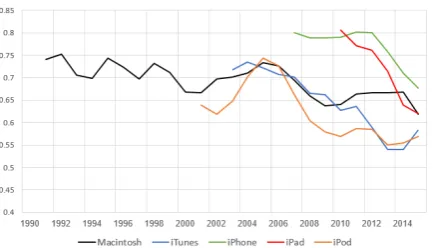
[image:9.595.76.287.66.160.2]Figure 3 shows the similarity between Apple and its top products since 1990. We can infer which products were the most significant at each time. Take as example the query “Apple Steve
Figure 3: Similarity between Apple and its top products over time. The y-axis is cosine similarity.
Jobs”. Using our technique, we can find the most relevant time period for this query, which is from Apple’s foundation in 1976 until Jobs’ death in 2011. Leveraging Figure 3, we can expand this query focusing on the most popular products of that time.
6 Conclusions
We believe that as corpora evolve to include temporally-varying datasets, new techniques must be devised to support traditional and new IR meth-ods. In this paper, we introduced a novel technique for extracting relations in temporal datasets. The technique is efficient at large scales and works in an unsupervised manner. Our experiments demon-strate the viability of the extraction technique as well as describing ways that it can be used in downstream applications. We specifically demon-strate a number of query expansion algorithms that can benefit from this technique.
References
Eytan Adar, Jaime Teevan, Susan T. Dumais, and Jonathan L. Elsas. 2009. The web changes every-thing: understanding the dynamics of web content. InWSDM’09.
S. M. Beitzel, E. C. Jensen, A. Chowdhury, D. Gross-man, and O. Frieder. 2004. Hourly analysis of a very large topically categorized web query log. In Proceedings of the Special Interest Group on Infor-mation Retrieval (SIGIR).
Adrian Bingham. 2010. the digitization of newspaper archives: Opportunities and challenges for histori-ans. Twentieth Century British History, 21(2):225– 231.
relatedness. Computational Linguistics, 32(1):13– 47.
Claudio Carpineto and Giovanni Romano. 2012. A sur-vey of automatic query expansion in information re-trieval. ACM Comput. Surv., 44(1).
S. Chien and N. Immorlica. 2005. Semantic similarity between search engine queries using temporal cor-relation. InWWW, pages 2–11.
Fernando Diaz, Bhaskar Mitra, and Nick Craswell. 2016. Query expansion with locally-trained word embeddings. InACL’16.
William L. Hamilton, Jure Leskovec, and Dan Jurafsky. 2016. Diachronic word embeddings reveal statisti-cal laws of semantic change. InACL’16.
Johannes Hellrich and Udo Hahn. 2016. Bad company - neighborhoods in neural embedding spaces consid-ered harmful. InCOLING.
Johannes Hoffart, Fabian M Suchanek, Klaus Berberich, and Gerhard Weikum. 2013. Yago2: A spatially and temporally enhanced knowledge base from wikipedia. Artificial Intelligence, 194:28–61.
Adam Jatowt and Kevin Duh. 2014. A framework for analyzing semantic change of words across time. In JCDL ’14.
Rosie Jones and Fernando Diaz. 2007. Temporal pro-files of queries. ACM Transactions on Information Systems, 25.
Tom Kenter, Melvin Wevers, Pim Huijnen, and Maarten de Rijke. 2015. Ad hoc monitoring of vo-cabulary shifts over time. InCIKM ’15.
Anagha Kulkarni, Jaime Teevan, Krysta M. Svore, and Susan T. Dumais. 2011. Understanding temporal query dynamics.
Erdal Kuzey and Gerhard Weikum. 2012. Extraction of temporal facts and events from wikipedia. In 2nd Temporal Web Analytics Workshop, pages 25– 32. ACM.
Saar Kuzi, Anna Shtok, and Oren Kurland. 2016. Query expansion using word embeddings. In CIKM’16.
Xiao Ling and Daniel S Weld. 2010. Temporal infor-mation extraction. InAAAI, volume 10, pages 1385– 1390.
Z. Vagena M. Vlachos, C. Meek and D. Gunopu-los. 2004. Identifying similarities, periodicities and bursts for online search queries. InSIGMOD.
Rada Mihalcea and Vivi Nastase. 2012. Word epoch disambiguation: Finding how words change over time. InACL’12.
Tomas Mikolov, Ilya Sutskever, Kai Chen, Greg S Cor-rado, and Jeff Dean. 2013. Distributed representa-tions of words and phrases and their compositional-ity. InAdvances in neural information processing systems, pages 3111–3119.
Sunny Mitra, Ritwik Mitra, Martin Riedl, Chris Bie-mann, Animesh Mukherjee, and Pawan Goyal. 2014. That’s sick dude!: Automatic identification of word sense change across different timescales. In ACL’14.
G Palshikar et al. 2009. Simple algorithms for peak detection in time-series. InProc. 1st Int. Conf. Ad-vanced Data Analysis, Business Analytics and Intel-ligence, pages 1–13.
F. Pedregosa, G. Varoquaux, A. Gramfort, V. Michel, B. Thirion, O. Grisel, M. Blondel, P. Pretten-hofer, R. Weiss, V. Dubourg, J. Vanderplas, A. Pas-sos, D. Cournapeau, M. Brucher, M. Perrot, and E. Duchesnay. 2011. Scikit-learn: Machine learning in Python. Journal of Machine Learning Research, 12:2825–2830.
Octavian Popescu and Carlo Strapparava. 2013. Be-hind the times: Detecting epoch changes using large corpora. InIJCNLP’13.
James Pustejovsky, Jos´e M Castano, Robert Ingria, Roser Sauri, Robert J Gaizauskas, Andrea Set-zer, Graham Katz, and Dragomir R Radev. 2003. Timeml: Robust specification of event and tempo-ral expressions in text. New directions in question answering, 3:28–34.
Kira Radinsky, Eugene Agichtein, Evgeniy Gabrilovich, and Shaul Markovitch. 2011. A word at a time: Computing word relatedness using temporal semantic analysis. In Proceedings of International World Wide Web Conference (WWW).
Kira Radinsky, Krysta Svore, Susan Dumais, Jaime Teevan, Alex Bocharov, and Eric Horvitz. 2012. Modeling and predicting behavioral dynamics on the web. In Proceedings of International World Wide Web Conference (WWW).
Kira Radinsky, Krysta M. Svore, Susan T. Dumais, Mi-lad Shokouhi, Jaime Teevan, Alex Bocharov, and Eric Horvitz. 2013. Behavioral dynamics on the web: Learning, modeling, and prediction. ACM Transactions on Information Systems, 31(3):16.
Radim ˇReh˚uˇrek and Petr Sojka. 2010. Software Frame-work for Topic Modeling with Large Corpora. In Proceedings of the LREC 2010 Workshop on New Challenges for NLP Frameworks, pages 45–50, Val-letta, Malta. ELRA.
Eyal Sagi, Stefan Kaufmann, and Brady Clark. 2009. Semantic density analysis: Comparing word mean-ing across time and phonetic space. InWorkshop on Geometrical Models of Natural Language Seman-tics.
Yair Shimshoni, Niv Efron, and Yossi Matias. 2009. On the predictability of search trends. InTechnical Report.
Milad Shokouhi. 2011. Detecting seasonal queries by time-series analysis. InProceedings of the Special Interest Group on Information Retrieval (SIGIR). Milad Shokouhi and Kira Radinsky. 2012.
Time-sensitive query auto-completion. InProceedings of the Special Interest Group on Information Retrieval (SIGIR).
Jaspreet Singh, Wolfgang Nejdl, and Avishek Anand. 2016. History by diversity: Helping historians search news archives. InCHIIR’16, pages 183–192. Partha Pratim Talukdar, Derry Wijaya, and Tom Mitchell. 2012. Coupled temporal scoping of rela-tional facts. In5th ACM international conference on Web search and data mining, pages 73–82. ACM. Peter D Turney, Patrick Pantel, et al. 2010. From
frequency to meaning: Vector space models of se-mantics. Journal of artificial intelligence research, 37(1):141–188.
Naushad UzZaman, Hector Llorens, James Allen, Leon Derczynski, Marc Verhagen, and James Pustejovsky. 2012. Tempeval-3: Evaluating events, time ex-pressions, and temporal relations. arXiv preprint arXiv:1206.5333.
P. Wang, M. W. Berry, and Y. Yang. 2003. Mining lon-gitudinal web queries: trends and patterns. Journal of the American Society for Information Science and Technology (JASIST), 54:743–758.
Derry Tanti Wijaya and Reyyan Yeniterzi. 2011. Un-derstanding semantic change of words over cen-turies. In2011 International Workshop on DETect-ing and ExploitDETect-ing Cultural diversiTy on the Social Web, DETECT ’11.
Craig Willis and Miles Efron. 2013. Finding informa-tion in books: Characteristics of full-text searches in a collection of 10 million books.Proceedings of the American Society for Information Science and Tech-nology, 50(1):1–10.