97
Scaling Multi-Domain Dialogue State Tracking via Query Reformulation
Pushpendre Rastogi [email protected]
Alexa AI
Amazon.com, Inc., USA
Arpit Gupta [email protected]
Alexa AI
Amazon.com, Inc., USA
Tongfei Chen∗ [email protected] Johns Hopkins University
Baltimore, MD,USA
Lambert Mathias [email protected]
Alexa AI
Amazon.com, Inc., USA
Abstract
We present a novel approach to dialogue state tracking and referring expression resolution tasks. Successful contextual understanding of multi-turn spoken dialogues requires resolving referring expressions across turns and track-ing the entities relevant to the conversation across turns. Tracking conversational state is particularly challenging in a multi-domain scenario when there exist multiple spoken lan-guage understanding (SLU) sub-systems, and each SLU sub-system operates on its domain-specific meaning representation. While previ-ous approaches have addressed the disparate schema issue by learning candidate transforma-tions of the meaning representation, in this pa-per, we instead model the reference resolution as a dialogue context-aware user query reformu-lation task —the dialog state is serialized to a sequence of natural language tokens represent-ing the conversation. We develop our model for query reformulation using a pointer-generator network and a novel multi-task learning setup. In our experiments, we show a significant im-provement in absolute F1 on an internal as well as a, soon to be releasedpublic corpora respec-tively.
1 Introduction
Dialogueassistantsare used by millions of people today to fulfill a variety of tasks. Such assistants also serve as a digital marketplace1(Kumar et al.,
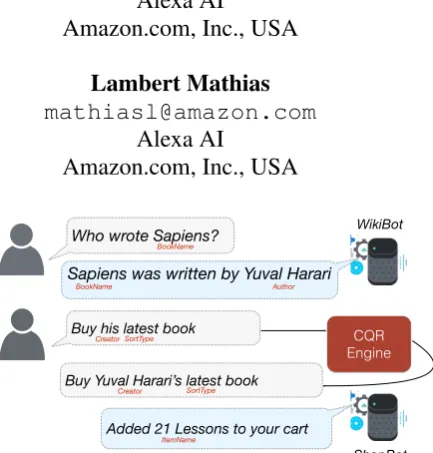
2017) where any developer can build a domain-specific, task-oriented, dialogue agentoffering a service such as booking cabs, ordering food, lis-tening to music, shopping etc. Also, these agents may interact with each other, when completing a task on behalf of the user. Figure1shows one such interaction where the agent – ShopBot – must in-terpret the output of the agent – WikiBot. Often
∗
Work done while the author was at Alexa AI 1https://dialogflow.com
Added 21 Lessons to your cart
Who wrote Sapiens?
BookName
Buy his latest book
Creator SortType
Sapiens was written by Yuval Harari
BookName Author
ItemName
WikiBot
ShopBot
Buy Yuval Harari’s latest book
Creator SortType
[image:1.595.308.525.124.351.2]CQR Engine
Figure 1: An example dialog where the second utterance by the user BUY HIS LATEST BOOKis reformulated as BUY YUVALHARARI’S LATEST BOOK. This refor-mulated user query is then input to SHOPBOTso that it can understand the user’s request using its existing SLU logic for handling single-turn queries. This approach does not require any changes to the agent itself and can be scaled to multiple heterogeneous domains.
accomplishing this task requires understanding the context of a dialogue, communicating the conver-sational state to multiple agents and updating the state as the conversation proceeds.
Tracking the dialogue state across multiple agents is challenging because agents are typically built for single-turn experiences, and must be la-boriously updated to handle the context provided by other agents into their respective domain spe-cific meaning representation. (Naik et al.,2018) proposedcontext carryover, a scalable approach to handle disparate schemas by learning mappings across the meaning representations, thereby elimi-nating the need to update the agents. However, the challenge of the agent’s domain-specific SLU accu-racy and choice of meaning representation remains. For example, in Figure1the SHOPBOTcannot
a burden on the developer to relabel their data and update their SLU models, and is expensive and un-scalable. Moreover, this approach cannot leverage the syntactic regularities imposed across agents by the natural language itself.
In this work, we propose a novel approach for enabling seamless interaction between agents de-veloped by different developers by using natural language as the API. We build upon the pointer-generator network (PGN) proposed by (See et al.,
2017) – originally for news article summarization – to rewrite user utterances and disambiguate them. Furthermore, we describe a new Multi-task Learn-ing (MTL) objective to directly influence the atten-tion of the PGN without requiring any extra manu-ally annotated training data. Our results show that the new MTL objective reduces the error by3.2%
on slots coming from distances≥3, compared to the basic PGN by (See et al.,2017).
2 Technical Details
Task We define a sequence of D dialogue
turns,xt= (ut−D+1, rt−D+1, . . . , ut−1, rt−1, ut), whereutis the user utterance at timetandrtis
the corresponding system response.xtis the total information that our system has at timet. For ex-ample, the first row in Figure2showsx2encoded as a single token sequence corresponding to the dialogue in Figure1. The query rewriting task is to learn a functionfθ, with parametersθ, which
mapsxtto itsrewriteytwhich is another string, i.e.yt=fθ(xt).ytshould contain all the
informa-tion needed by the agent to fulfill the user’s request and it should be understandable by the agent as a standalone user request.
ModelWe use the pointer-generator (PGN) ar-chitecture (See et al.,2017) to constructfθ. The
PGN is a hybrid architecture which combines sequence-to-sequence model with pointer networks. This combination allows the PGN to summarize an input sequence by eithercopyingfrom the input sentence, orgeneratinga new word with a decoder RNN. We now describe the operation of the PGN in detail and focus on a single input sequencex with the subscript t omitted for simplicity. Let us slightly abuse notation and considerx,yas se-quences of tokens. We index the tokens of x,y byl, krespectively. The PGN uses a two-layer Bi-Directional LSTM (BiLSTM) encoder to compute the hidden state vectorhlforxl.2
2For sake of brevity, we omit the update equations for the
We now describe howykis generated. At time k, the probability of copying a token from the input pcopyis computed via a softmax over the attention weights computed using non-linear function of the encoder-LSTM hidden statesh and the decoder LSTM’s hidden statehdecoderk .pmix– a soft switch to decide between copying and generating – is com-puted using another non-linear function ofhdeck and the final output distribution is given by
p(yk) =pmixpgen(yk) + (1−pmix)pcopy(yk) (1)
At decoding time, we can use either beam-search or greedily pick the token with the highest probability and move on to the next step. This is our baseline architecture for utterance rewriting.
EvaluationIdeallyytshould be judged as a cor-rect rewrite if the downstream SLU system can parse yt, invoke the correct agent with the cor-rect slots, and the agent can then take the right action. However, evaluating this notion of cor-rectness would have required probing and instru-menting thousands of downstream agents and is not scalable to implement. Therefore, we used a simpler notion of correctness based on a manually collected set ofgolden rewrites,Yi,t∗ , in this paper. Section4.3describes the metrics we use to evaluate our model’s predictionyi,t against the golden set Yi,t∗ .
Learning For training the model, we have a rewrites-corpus {xit,y∗itj}
I,T ,J
i=1,t=1,j=1. I is the number of dialogs, T is the maximum number of turns in a dialog and J is the number of gold rewrites at a turn in a dialog. y∗i,t,j denotes the jth optimal rewrite for the user utterance at turn tin theith dialogue –x
ti;y∗i,t,j,k is thekth token
iny∗i,t,j. Our training objective is to maximize the log-likelihood:
arg max θ
X
i,t,j,k
logpθ(y∗i,t,j,k). (2)
2.1 Multi Task Learning (MTL): Entity-Copy Auxiliary Objective
In Figure2, both the referencesy2∗,1, y∗2,2 contain the same subset of entities – U3, and S1 – even though their order, and other tokens, in the gold rewrites have changed. This implies that for the task of rewriting utterances, the subset of entities that should be copied from the input dialog remains the same, irrespective of the dynamics of the de-coder LSTM. Based on this observation we define
Inputxt=2 BOOKQUERYl=1Who wroteEntityU1:BookNameSapiens l=4 INFORMSYSTEMINTENT EntityU1:SapiensTitle was written
by EntityYuval HarariS1:Authorl=10 UNKUISERNTENT Buy EntityU2:Entityhis EntitylatestU3:Entity book ENDl=16
Refer.Yt∗=2
[image:3.595.77.531.63.115.2]y∗2,j=1=Buyk=1EntityS1EntityU3 bookk=4, y2∗,2=BuyEntityU3 book byEntityS1
Figure 2: An example of sequential input received by our utterance disambiguation seq2seq model and a list of reference outputs. The words in short-caps denote the domain and intent predicted by the SLU system which are concatenated to the beginning of the sequence. Words beginning withEntityare placeholders used to delexicalize names of entities. Both references 1 and 2 are input to the SLU system during training. We explicitly named the indices at a few locations to aid the reader.
… ENTITYU1 System ENTITYU1 was … ENTITYS1 Shop buy his ….
BookName InformIntent BookName Author BuyIntent
<START> buy
X(1- Pgen) X(Pgen)
{
Attention Distribution{
V
ocabular
y
Distribution
Decoder
Hidden States
Final Distribution “ENTITYS1”
Pgen ∫
∫ Multi-Task Learning
e7,2,4 = -1 e7,2,10 = 1
Let the dialog in Figure 1 be the 7th dialog in corpus. Therefore i=7. We are rewriting the second turn therefore t=2.
h10 h4
gφ gφ
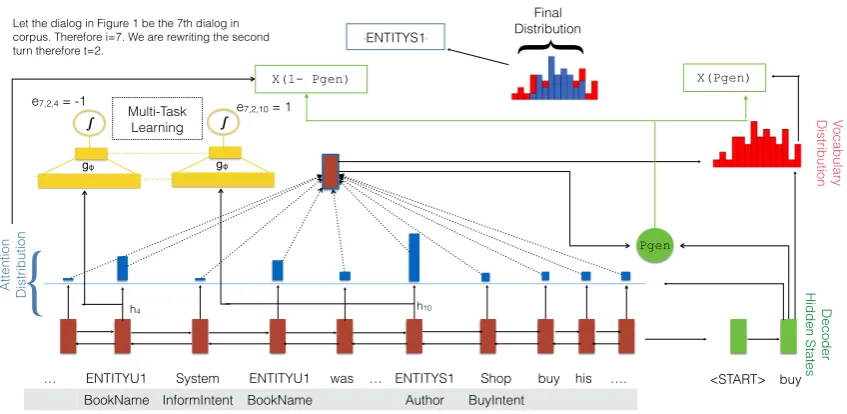
Figure 3: Model Architecture of the CQR Model which performs Multi-Task Learning for Pointer-Generator Networks. We show a snapshot just before decoder generates the word ENTITYS1 orYuval Harari. Also, we show for MTL ENTITYU1 gets the label−1as it is not one of the final slots, and ENTITYS1 gets a label of 1
an auxiliary task and augment the learning objec-tive as shown in Figure3.
As mentioned earlier, the copy distributionpcopyk is a function of the encoder hidden state h = (h1, . . . , hl, . . . , h|x|)which does not change with k. Ifxlwas an entity token thenhlshould be
infor-mative enough to decide whether that token should be copied or not. Therefore, we add a two layer feed-forward neural network,gφ, that takeshlas
input and predicts whether thelthtoken should be copied or not. Given the probability gφ(hl) we
minimize the binary cross-entropy loss, and back-propagate throughhlwhich influencesθ. The
aux-iliary objective should improve the generalization because it forces the encoders representation to be-come more informative about whether an entity should be copied or not. At inference timegφis not
used. Formally, letei,t,ltake the following value:
ei,t,l=
1 ifxi,t,lis an entity andxi,t,l∈ Yi,t∗ −1 ifxi,t,lis an entity andxi,t,l∈ Y/ i,t∗
0 Otherwise
Letλ >0be a hyperparameter. We add a binary log-likelihood objective to objective 2 to create objective3. We refer to the PGN model trained with objective3asCQRin Table4.
X
i,t,j,k
logp(yi,t,j,k∗ )+λX i,t
|xi,t|
X
l=1
ei,t,lloggφ(hi,t,l) (3)
3 DataSet and Preprocessing
[image:3.595.89.513.226.433.2]3.1 Generating gold rewrites
We used two separate approaches to generate gold rewrites for the INTERNAL and INCAR datasets. For the INCARdataset we collected 6 rewrites for
each utterance that had a reference to a previously mentioned entity.3 For the INTERNAL dataset, which has over 100K sentences the above approach would be prohibitively expensive. Therefore, in-stead of gathering completely new manual annota-tion we used a semi-manual process. We utilized a template dataset that is keyed by theDomain, In-tentandSlotspresent in that utterance and contains the top-5 most common and unambiguous phrasing for that key. For example to create the rewrite in Figure 1 we filled the template:
BuyCreator’sSortType ItemType
This template was chosen randomly from other valid alternatives such as BuySortType ItemType
byCreator. These valid alternatives were
deter-mined on the basis of existing manualdomain, in-tent,andschemaSLU annotations which indicated which slots were required to answer the user’s ut-terance.
3.2 Role-based Entity Indexing
In this step, the entity words in xt are replaced
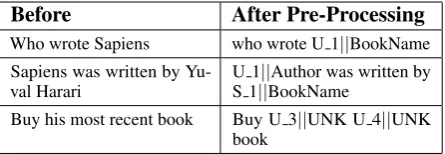
with their canonical versions. Our results show that this significantly improved both BLEU and Entity F1 measures. To replace entity words we use string matching methods to extract tokens for dialogue. We maintain two separate namespaces for user entities and system entities respectively. However, if an entity appears again in dialogue, we donot assign it a new canonical token but used already assigned one. Also, as seen in Figure 2 we also add the entity tag to slot representation. Lastly, as re-writing happens before any SLU component we do not have this information forut. Inutwe
only replace entities with canonical tokens, but do not add any information about entity. Table1show how to transform dialogue from Figure 1.
3https://github.com/alexa/
alexa-dataset-contextual-query-rewrite
Before After Pre-Processing
Who wrote Sapiens who wrote U 1||BookName
Sapiens was written by Yu-val Harari
U 1||Author was written by S 1||BookName
[image:4.595.308.531.62.139.2]Buy his most recent book Buy U 3||UNK U 4||UNK book
Table 1: Replacing entities with the role-based canonical versions.
3.3 Abstractified Possessives
Generalizing on rare words and rare contexts is the true test of any NLP system, and linguists have long argued in favor of syntactically motivated models that abstract away from lexical entries as much as possible (Klein and Manning, 2003). In this preprocessing step, we show the benefit of such abstraction. While testing the PGN architecture we noticed that the sequence decoder would some-times generate an off-topic rewrite if the input se-quence contained a rare word. In order to avoid this problem we augmented the input sequence with ad-ditional features to mark the syntactic function of words. Specifically we used the Google Syntac-tic N-gram Corpus (Goldberg and Orwant,2013) to add syntactic features to each word in the dia-logue. We harvested a list of top1000words that appear most frequently after possessive pronouns. We concatenated three types of extra features to the words in a dialogue. The first feature was the QUESTIONfeature which was concatenated to the7
question words. The second feature was theP RP$
tag which we concatenated to specific possessive pronouns. Finally we added a tag called PSBL – short for possessible – for the top1000words that we found from the SyntacticN-Gram Corpus.
We decided not to use POS tags because we did not have manually POS tagged data on our domain and off-the-shelf POS tagger4did not perform well on our dataset.
4 Experiments
4.1 Dataset
We used two datasets to evaluate our method. The first is a public dataset (Regan et al.,2019) we call INCAR, which is an extension to (Eric and Manning,2017). The dataset consists of3,031 di-alogues from three domains: Calendar Scheduling, Weather, and Navigation, that are useful for an in-car conversational assistant. We crowd-sourced six
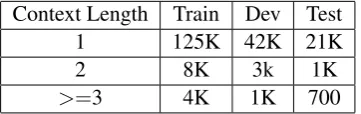
rewrites for each utterance in the corpus that had a reference to previously mentioned entities. The second dataset, called INTERNAL, is an internal benchmark dataset we collected over six domains – weather, music, video, local business search, movie showtimes and general question answering. Table2
describes the data statistics for this internal collec-tion. About40%of the dialogues in this corpus are cross-domain, which makes it much harder than the INCARdataset.
Context Length Train Dev Test
1 125K 42K 21K
2 8K 3k 1K
[image:5.595.92.273.206.263.2]>=3 4K 1K 700
Table 2:INTERNALdata statistics. Each turn consists of a user and a system turn i.e context length = 2 implies two turns.
4.2 Training
We used OpenNMT (Klein et al.,2017) toolkit for all our experiments. We modified it to include the multi-task loss function as described in Sec-tion2.1. Unless explicitly mentioned here, we used the default parameters defined in OpenNMT recipe. Various hyper-parameters were tuned on a reduced training set and the development set. Our encoder was a 128-dimensional bi-directional LSTM. We used the Adagrad optimizer with a learning rate of
0.15, and we randomly initialized 128-dimensional word embeddings. The word embeddings were shared between the encoder LSTM and the decoder LSTM.λin Eq.3was set to0.01. We trained the model for20epochs with early stopping on a vali-dation set.
4.3 Evaluation Metrics
BLEU:has been widely used in machine transla-tion tasks (Papineni et al.,2002), dialogue tasks (Eric and Manning, 2017), and chatbots (Ritter et al.,2011). It gives us an intrinsic measure to evaluate quality of re-writes without caring about downstream SLU evaluation.
Response Entity F1 (ResF1):We measure this metric for the INCAR dataset, following the ap-proach outlined by (Madotto et al.,2018)5. The Response Entity F1 micro-averages over the entire set of system responses and compare the entities in plain text. The entities in each gold system re-sponse are selected by a predefined entity list. This
5Evaluation script available at
https://github.com/HLTCHKUST/Mem2Seq
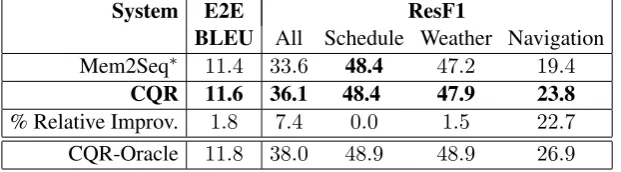
metric evaluates the ability to generate relevant en-tities and to capture the semantics of the dialogue. We reimplemented theMem2SeqH1 architecture in (Madotto et al.,2018)6and we refer to our im-plementation as Mem2Seq∗. We use utterances produced by our proposed(CQR) system in the dialogue instead of original utterances while evalu-ating using Mem2Seq∗. Note that our reimplemen-tation, Mem2Seq∗, achieves a Response Entity F1 of33.6which is higher than the best overall Entity F1 score of33.4reported in (Madotto et al.,2018). Entity F1: This measures micro F1 between en-tities in the hypothesized rewrite and gold rewrite. This is different from F1 reported by (Madotto et al., 2018) as they evaluate F1 over system en-tities, whereas here we evaluate the entities over the user turn. We employ a recent state-of-art bi-directional LSTM with CRF decoding (Ma and Hovy,2016) to implement our SLU system.
5 Results
5.1 INTERNALDataset Results
On INTERNALdataset we show CQR significantly improves over (Naik et al.,2018) in Table4.CQR also improves F1 for current turn slots as it can leverage context and distill necessary information to improve SLU. Further, we can see that most im-provements upon the baseline PGN model (M0) come from pre-processing steps like canonicaliz-ing entities. In the baseline model, it has to learn to generate entity tokens individually, whereas in M1the model only has to learn to copy tokens like
USER ENT 1. Finally, our proposed multi-task learning model (CQR) improves both BLEU and EntityF1 at most distances. Specifically, we see an improvement of 4.2% overM2for slots at dis-tances≥3. In Table4distance is measured differ-ently from Table2, here we count User and System turns individually to showcase how distance affects EntityF1. If an entity is repeated multiple times in the context, we consider its closest occurrence to report results.
5.2 INCARDataset Results
For INCARdataset we pick the best modelCQR from Table4and re-train on the respective dataset. On the navigation domain we observe significant
6The
Dialogue U: Find me a Starbucks in Redmond S: I found a Starbucks in Redmond WA. It’s 15.7 miles away on NE 76th St. It’s open now until 9:00 PM.
U: How do I get there?
PGN how can i get to redmond
CQR how do i get to the starbucks on NE 76th St WA
Gold how do i get to the starbucks on NE 76th St
Dialogue U: How is the weather tomorrow?
S: In Chicago there will be mostly sunny weather
U: What about saturday?
PGN what is the weather in chicago on saturday ?
CQR what is the weather in chicago on saturday ?
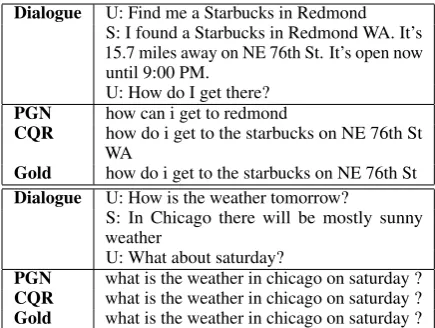
[image:6.595.71.289.61.225.2]Gold what is the weather in chicago on saturday ? Table 3: Examples of generated responses for Internal Dataset
improvement. We believe this is because there are on average2.3slots were referred from history in rewrites requiring copy from dialog as compared to1.3and1.1in schedule and weather domain re-spectively. Also, we compare with an oracle CQR (i.e., gold-rewrite from our data collection, instead of predicted re-write) to measure the potential of query-rewriting and motivate further research on this topic. We can see that the CQR model performs better than the Mem2Seq∗ model, indicating that query rewriting is a viable alternative to dialogue state tracking. This is important in environments where changing the NLU systems to leverage mem-ory structures is not always feasible. We claim that query rewriting is a simpler approach in such situations, with no loss in performance.
6 Related Work
Probabilistic methods for task-oriented dialogue systems typically divide an automatic dialogue agent into modules such as automatic speech recog-nition(ASR) for converting speech to text, spoken language understanding(SLU) for classifying the domain and intent of the current utterance and tag-ging the slots in the current utterance, dialogue state tracking(DST) for tracking what has happened in the dialogue so far, and dialogue policy for de-ciding what actions to take next (Young,2000). In this traditional framework, SLU is seen as a low-level task that interprets the user’s current utterance in isolation, without accounting for the dialogue history. For example, in Figure1the platform sys-tem parses the utterance WHO WROTE SAPIENS, to infer that the user intends to query for informa-tion about a book, and then the platform performs
BIO style tagging with an intent-specific schema to label the mentionSAPIENSas the slot key BOOK -NAME. Most SLU systems perform this without any context information. Some recent work fo-cussed on contextual SLU (Shi et al.,2015;Liu et al., 2015;Chen et al., 2016) propose memory architectures to incorporate contextual information while performing the SLU step. However because their task was restricted to domain-intent classifi-cation and slot tagging for the current utterance only, a higher level DST module is still required to combine information from previous turns with the current utterance to create a single dialogue state.
DST is considered to be a higher-level module as it has to combine information from previous user utterances and system responses with the current utterance to infer its full meaning. Many deep-learning based methods have recently been pro-posed for DST such as neural belief tracker (Mrkˇsi´c et al., 2017), and self-attentive dialogue state tracker (Zhong et al.,2018) which are suitable for small-scale domain-specific dialogue systems; as well as more scalable approaches such as (Rastogi et al.,2017;Xu and Hu,2018) that solve the prob-lem of an infinite number of slot values and (Naik et al., 2018) who additionally solve the problem of huge number of disparate schemas in each do-main. End-to-End approaches based on deep learn-ing have also been proposed recently to replace such modular architectures, like (Madotto et al.,
2018;Eric and Manning,2017).
Unfortunately, all of the above approaches fail to address the problem that, as the number of domain-specific chatbots on a dialogue platform grows larger, the DST module becomes increasingly com-plex as it tries to handle the interactions between different chatbots and their different schemas. For example, consider the scenario shown in Figure1. Chatbot A, the BOOK chatbot, can understand
domain-specific utterances like “who wrote X ?” annotated with a special schema with slot keys such as BOOKNAME, AUTHOR. In order to
disam-biguate utteranceu2the DST in the conversational platform must know that the CREATORslot-key in the SHOPPINGchatbot co-refers to the AUTHOR
System Entity F1 BLEU
d=0 d=1 d=2 d≥3
P R F1 P R F1 P R F1 P R F1
(Naik et al.,2018) 95.1 95.1 95.1 74.9 78.4 76.6 72.2 82.2 76.9 10.4 46.3 17.0 N/A
PGN (M0) 99.0 78.1 87.4 95.9 62.1 75.4 95.2 57.3 71.5 87.3 65.5 74.9 83.4
+Canonical Ent. (M1) 98.7 93.9 96.3 92.9 93.5 93.2 94.4 96.9 95.6 69.8 78.5 73.9 89.9
+Syntax Info (M2) 98.6 93.9 96.2 92.9 93.5 93.2 94.3 96.9 95.6 69.8 78.5 73.9 89.9
+MTL (CQR) 98.5 94.0 96.2 93.7 93.8 93.7 94.2 97.4 95.8 75.2 79.0 77.1 90.3
[image:7.595.72.543.62.188.2]% Relative Improv. 3.6 -1.2 1.2 25.1 19.6 22.3 30.5 18.5 24.6 623.1 70.6 353.5 N/A
Table 4: Comparison of Pointer-Generator variants to traditional state tracking approach on the INTERNALdataset. We measure entity F1 across slots from different distances separately. Slot distance is counted per utterance starting from the current user utterance. Therefore, slots at d=0 are slots from the current user utterance that should have been copied. d=1 refers to slots from system response in the last turn, d=2 refers to slots from the user in last turn and d≥3 aggregates all other turns.d≥3 is the most challenging test-subset whereCQRhas the highest benefit.
System E2E ResF1
BLEU All Schedule Weather Navigation
Mem2Seq∗ 11.4 33.6 48.4 47.2 19.4
CQR 11.6 36.1 48.4 47.9 23.8
% Relative Improv. 1.8 7.4 0.0 1.5 22.7
CQR-Oracle 11.8 38.0 48.9 48.9 26.9
Table 5: Comparison of PGN variants proposed in this paper on the INCARdataset in comparison to the state tracking approach. Our proposed CQR model outperforms the MemSeq* system, which is a stronger baseline than the Mem2Seq results published inMadotto et al.(2018).
be no co-referent pronouns in the current utterance. For example, a user may say “what’s the address” instead of saying “what is its address”, creating a case of zero-anaphora.
Finally, we will mention that Seq2Seq models with Attention (Sutskever et al.,2014;Bahdanau et al.,2014) have seen rapid adoption in automatic summarisation (See et al.,2017;Rush et al.,2015). Exploring black-box methods like query re-writing allow us to benefit from the progress made in these fields and apply them to state tracking and refer-ence resolution tasks in dialogue.
7 Conclusion
In this work we made three fundamental con-tributions. First, we proposed contextual query rewriting(CQR) as a novel way to interpret an in-put utterance in context given a dialogue history. For example, we can rewrite BUY HIS LATEST BOOKas BUYYUVALHARARI’S MOST RECENT BOOK, given the dialogue history, as shown in Fig-ure 1. The output of CQR can directly be fed to the domain-specific downstream SLU system which drastically simplifies the construction of task-specific dialogueagents. Since we do not need to
change either the spoken language understanding or the dialogue state tracker downstream, our ap-proach is a black-box apap-proach that improves the modularity of industrial-scale, dialogue-asistants. Second, we investigated how to optimally use a Pointer-Generator Network for the CWR task us-ing Multi-Task Learnus-ing and task-specific prepro-cessing. Finally, we demonstrated the efficacy of our approach on two datasets. On INCARdataset released by (Eric and Manning, 2017), we were able to show that re-writing of the user utterance can benefit end-to-end models. On a proprietary INTERNALdataset we showed that our approach
can greatly improve the experience when referring to entities from much further away in a dialogue history, resulting in relative improvements in En-tity F1 of greater than 20% on the most challenging subset of the test-data.
[image:7.595.145.456.271.357.2]References
Dzmitry Bahdanau, Kyunghyun Cho, and Yoshua Ben-gio. 2014. Neural machine translation by jointly learning to align and translate. arXiv preprint arXiv:1409.0473.
Yun-Nung Vivian Chen, Dilek Hakkani-Tr, Gokhan Tur, Jianfeng Gao, and Li Deng. 2016.End-to-end mem-ory networks with knowledge carryover for multi-turn spoken language understanding. In17th Annual Meeting of the International Speech Communication Association. ISCA.
Mihail Eric and Christopher D Manning. 2017. Key-value retrieval networks for task-oriented dialogue. arXiv preprint arXiv:1705.05414.
Yoav Goldberg and Jon Orwant. 2013. A dataset of syntactic-ngrams over time from a very large corpus of english books. InSecond Joint Conference on Lexical and Computational Semantics (* SEM), Vol-ume 1: Proceedings of the Main Conference and the Shared Task: Semantic Textual Similarity, volume 1, pages 241–247.
Dan Klein and Christopher D Manning. 2003. Accurate unlexicalized parsing. In Proceedings of the 41st Annual Meeting on Association for Computational Linguistics-Volume 1, pages 423–430. Association for Computational Linguistics.
Guillaume Klein, Yoon Kim, Yuntian Deng, Jean
Senel-lart, and Alexander M. Rush. 2017. OpenNMT:
Open-source toolkit for neural machine translation. InProc. ACL.
Anjishnu Kumar, Arpit Gupta, Julian Chan, Sam Tucker, Bjorn Hoffmeister, Markus Dreyer, Stanislav Peshter-liev, Ankur Gandhe, Denis Filiminov, Ariya Rastrow, et al. 2017. Just ask: building an architecture for ex-tensible self-service spoken language understanding. arXiv preprint arXiv:1711.00549.
Chunxi Liu, Puyang Xu, and Ruhi Sarikaya. 2015. Deep contextual language understanding in spoken dia-logue systems. InSixteenth annual conference of the international speech communication association.
Xuezhe Ma and Eduard Hovy. 2016. End-to-end se-quence labeling via bi-directional lstm-cnns-crf. In Proceedings of the 54th Annual Meeting of the As-sociation for Computational Linguistics (Volume 1: Long Papers), volume 1, pages 1064–1074.
Andrea Madotto, Chien-Sheng Wu, and Pascale Fung. 2018. Mem2seq: Effectively incorporating knowl-edge bases into end-to-end task-oriented dialog sys-tems. arXiv preprint arXiv:1804.08217.
Nikola Mrkˇsi´c, Diarmuid ´O S´eaghdha, Tsung-Hsien Wen, Blaise Thomson, and Steve Young. 2017. Neu-ral belief tracker: Data-driven dialogue state tracking. InProceedings of the 55th Annual Meeting of the Association for Computational Linguistics (Volume 1: Long Papers), pages 1777–1788, Vancouver, Canada. Association for Computational Linguistics.
Chetan Naik, Arpit Gupta, Hancheng Ge, Lambert Mathias, and Ruhi Sarikaya. 2018. Contextual slot carryover for disparate schemas. In 19th Annual Meeting of the International Speech Communication Association.
Kishore Papineni, Salim Roukos, Todd Ward, and Wei-Jing Zhu. 2002. Bleu: a method for automatic eval-uation of machine translation. In Proceedings of the 40th annual meeting on association for compu-tational linguistics, pages 311–318. Association for Computational Linguistics.
Abhinav Rastogi, Dilek Hakkani-T¨ur, and Larry Heck. 2017. Scalable multi-domain dialogue state tracking. InAutomatic Speech Recognition and Understanding Workshop (ASRU), 2017 IEEE, pages 561–568. IEEE.
Michael Regan, Pushpendre Rastogi, Arpit Gupta Gupta, and Lambert Mathias. 2019. A dataset for resolv-ing referrresolv-ing expressions in spoken dialogue via contextual query rewrites (cqr). arXiv preprint arXiv:1903.11783.
Alan Ritter, Colin Cherry, and William B Dolan. 2011. Data-driven response generation in social media. In Proceedings of the conference on empirical meth-ods in natural language processing, pages 583–593. Association for Computational Linguistics.
Alexander M. Rush, Sumit Chopra, and Jason Weston. 2015. A neural attention model for abstractive sen-tence summarization. In Proceedings of the 2015 Conference on Empirical Methods in Natural Lan-guage Processing, pages 379–389, Lisbon, Portugal. Association for Computational Linguistics.
Abigail See, Peter J. Liu, and Christopher D. Manning. 2017.Get to the point: Summarization with pointer-generator networks. InProceedings of the 55th An-nual Meeting of the Association for Computational Linguistics (Volume 1: Long Papers), pages 1073– 1083. Association for Computational Linguistics.
Yangyang Shi, Kaisheng Yao, Hu Chen, Yi-Cheng Pan, Mei-Yuh Hwang, and Baolin Peng. 2015. Contex-tual spoken language understanding using recurrent neural networks. InICASSP 2015.
Ilya Sutskever, Oriol Vinyals, and Quoc V. Le. 2014. Se-quence to SeSe-quence Learning with Neural Networks. InNIPS, page 9.
Puyang Xu and Qi Hu. 2018. An end-to-end approach for handling unknown slot values in dialogue state tracking. InProceedings of the 56th Annual Meeting of the Association for Computational Linguistics (Vol-ume 1: Long Papers), pages 1448–1457, Melbourne, Australia. Association for Computational Linguistics.