Proceedings of NAACL-HLT 2019, pages 2519–2531 2519
Abstractive Summarization of
Posts
with Multi-level Memory Networks
Byeongchang Kim Hyunwoo Kim Gunhee Kim
Department of Computer Science and Engineering & Center for Superintelligence Seoul National University, Seoul, Korea
{byeongchang.kim,hyunwoo.kim}@vision.snu.ac.kr [email protected]
Abstract
We address the problem of abstractive summa-rization in two directions: proposing a novel dataset and a new model. First, we col-lectReddit TIFU dataset, consisting of 120K posts from the online discussion forum Red-dit. We use such informal crowd-generated posts as text source, in contrast with exist-ing datasets that mostly use formal documents as source such as news articles. Thus, our dataset could less suffer from some biases that key sentences usually locate at the be-ginning of the text and favorable summary candidates are already inside the text in sim-ilar forms. Second, we propose a novel ab-stractive summarization model named multi-level memory networks (MMN), equipped with multi-level memory to store the informa-tion of text from different levels of abstracinforma-tion. With quantitative evaluation and user stud-ies via Amazon Mechanical Turk, we show the Reddit TIFU dataset is highly abstrac-tive and the MMN outperforms the state-of-the-art summarization models. The code and dataset are available at http://vision. snu.ac.kr/projects/reddit-tifu.
1 Introduction
Abstractive summarization methods have been un-der intensive study, yet they often suffer from in-ferior performance compared to extractive meth-ods (Allahyari et al.,2017;Nallapati et al.,2017;
See et al., 2017). Admittedly, by task defini-tion, abstractive summarization is more challeng-ing than extractive summarization. However, we argue that such inferior performance is partly due to some biases of existing summarization datasets. The source text of most datasets (Over et al.,2007;
Hermann et al.,2015;Cohan et al.,2018;Grusky et al.,2018;Narayan et al.,2018a) originates from formal documents such as news articles, which have some structural patterns of which extractive
methods better take advantage.
In formal documents, there could be a strong tendency that key sentences locate at the begin-ning of the text and favorable summary candi-dates are already inside the text in similar forms. Hence, summarization methods could generate good summaries by simply memorizing keywords or phrases from particular locations of the text. Moreover, if abstractive methods are trained on these datasets, they may not show much abstrac-tion (See et al.,2017), because they are implicitly forced to learn structural patterns (Kedzie et al.,
2018). Grusky et al. (2018) and Narayan et al.
(2018a) recently report similar extractive bias in existing datasets. They alleviate this bias by col-lecting articles from diverse news publications or regarding intro sentences as gold summary.
Different from previous approaches, we pro-pose to alleviate such bias issue by changing the source of summarization dataset. We exploit user-generated posts from the online discussion forum
Reddit, especially TIFU subreddit, which are more casual and conversational than news articles. We observe that the source text inRedditdoes not follow strict formatting and disallows models to simply rely on locational biases for summariza-tion. Moreover, the passages rarely contain sen-tences that are nearly identical to the gold sum-mary. Our new large-scale dataset for abstrac-tive summarization named as Reddit TIFU con-tains 122,933 pairs of an online post as source text and its corresponding long or short summary sen-tence. These posts are written by many different users, but each pair of post and summary is cre-ated by the same user.
levels of abstraction (i.e. word-level, sentence-level, paragraph-level and document-level). This design is motivated by that abstractive summariza-tion is highly challenging and requires not only to understand the whole document, but also to find salient words, phrases and sentences. Our model can sequentially read such multiple levels of infor-mation to generate a good summary sentence.
Most abstractive summarization methods (See et al.,2017;Li et al.,2017;Zhou et al.,2017;Liu et al.,2018;Cohan et al.,2018;Paulus et al.,2018) employ sequence-to-sequence (seq2seq) models (Sutskever et al., 2014) where an RNN encoder embeds an input document and another RNN decodes a summary sentence. Our MMN has two major advantages over seq2seq-based mod-els. First, RNNs accumulate information in a few fixed-length memories at every step regardless of the length of an input sequence, and thus may fail to utilize far-distant information due to van-ishing gradient. It is more critical in summariza-tion tasks, since input text is usually very long (>300 words). On the other hand, our convolu-tional memory explicitly captures long-term infor-mation. Second, RNNs cannot build representa-tions of different ranges, since hidden states are sequentially connected over the whole sequence. This still holds even with hierarchical RNNs that can learn multiple levels of representation. In con-trast, our model exploits a set of convolution op-erations with different receptive fields; hence, it can build representations of not only multiple lev-els but also multiple ranges (e.g. sentences, para-graphs, and the whole document).
Our experimental results show that the proposed MMN model improves abstractive summarization performance on both our new Reddit TIFU and ex-isting Newsroom-Abs (Grusky et al., 2018) and XSum (Narayan et al., 2018a) datasets. It out-performs several state-of-the-art abstractive mod-els with seq2seq architecture such as (See et al.,
2017;Zhou et al.,2017;Li et al.,2017). We eval-uate with quantitative language metrics (e.g. per-plexity and ROUGE (Lin,2004)) and user studies via Amazon Mechanical Turk (AMT).
The contributions of this work are as follows.
1. We newly collect a large-scale abstractive summarization dataset named Reddit TIFU. As far as we know, our work is the first to use non-formal text for abstractive summa-rization.
2. We propose a novel model namedmulti-level memory networks(MMN). To the best of our knowledge, our model is the first attempt to leverage memory networks for the abstrac-tive summarization. We discuss the unique updates of the MMN over existing memory networks in Section2.
3. With quantitative evaluation and user studies via AMT, we show that our model outper-forms state-of-the-art abstractive summariza-tion methods on both Reddit TIFU, News-room abstractive subset and XSum dataset.
2 Related Work
Our work can be uniquely positioned in the con-text of the following three topics.
Neural Abstractive Summarization. Many deep neural network models have been proposed for abstractive summarization. One of the most dominant architectures is to employ RNN-based seq2seq models with attention mechanism such as (Rush et al., 2015; Chopra et al., 2016; Nallap-ati et al., 2016; Cohan et al., 2018; Hsu et al.,
2018;Gehrmann et al., 2018).In addition, recent advances in deep network research have been promptly adopted for improving abstractive sum-marization. Some notable examples include the use of variational autoencoders (VAEs) (Miao and Blunsom, 2016;Li et al., 2017), graph-based at-tention (Tan et al.,2017), pointer-generator mod-els (See et al.,2017), self-attention networks (Liu et al.,2018), reinforcement learning (Paulus et al.,
2018; Pasunuru and Bansal, 2018), contextual agent attention (Celikyilmaz et al., 2018) and in-tegration with extractive models (Hsu et al.,2018;
Gehrmann et al.,2018).
Compared to existing neural methods of ab-stractive summarization, our approach is novel to replace an RNN-based encoder with explicit multi-level convolutional memory. While RNN-based encoders always consider the whole se-quence to represent each hidden state, our multi-level memory network exploits convolutions to control the extent of representation in multiple lev-els of sentences, paragraphs, and the whole text.
News-TIFU by forgetting my chemistry textbook and all of my notes in a city five hours away
(…) So the past three days I was at a sporting event in Windsor. I live pretty far from Windsor, around a 5 hour drive. (…) A five hour drive later, I finally got back home. I was ready to start catching up on some homework when I realized I left my binder (which has all of my assignments, homework etc.) in it, and my chemistry textbook back in Windsor.
I also have a math and chem test next week which I am now so completely screwed for. (…)
[Long Summary] (29 words)
[Source Text] (282 words)
TL;DRI forgot my chemistry textbook and binder full of
notes in Windsor, which is five hour drive away and I am now screwed for the rest of the semester.
[Short Summary] (16 words)
Figure 1: An example post of theTIFUsubreddit.
room (Grusky et al., 2018) and XSum (Narayan et al., 2018a) datasets. Cohan et al. (2018) in-troduce datasets of academic papers from arXiv and PubMed. Hu et al. (2015) propose the LC-STS dataset as a collection of Chinese microblog’s short text each paired with a summary. However, it selects only formal text posted by verified or-ganizations such as news agencies or government institutions. Compared to previous summarization datasets, our dataset is novel in that it consists of posts from the online forum Reddit.
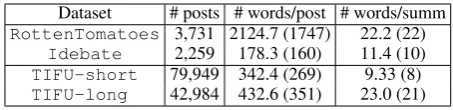
Rotten Tomatoes and Idebate dataset (Wang and Ling,2016) use online text as source, but they are relatively small in scale: 3.7K posts of Rotten-Tomatoes compared to 80K posts of TIFU-short as shown in Table1. Moreover, Rotten Tomatoes use multiple movie reviews written by different users as single source text, and one-sentence consensus made by another professional editor as summary. Thus, each pair of this dataset could be less coher-ent than that of our TIFU, which is written by the same user. The Idebate dataset is collected from short arguments of debates on controversial top-ics, and thus the text is rather formal. On the other hand, our dataset contains the posts of interesting stories happened in daily life, and thus the text is more unstructured and informal.
Neural Memory Networks. Many
mem-ory network models have been proposed to im-prove memorization capability of neural networks (Kaiser et al., 2017; Na et al., 2017;Yoo et al.,
2019). Weston et al.(2014) propose one of early memory networks for language question answer-ing (QA); since then, many memory networks have been proposed for QA tasks (Sukhbaatar
Dataset # posts # words/post # words/summ
RottenTomatoes 3,731 2124.7 (1747) 22.2 (22)
Idebate 2,259 178.3 (160) 11.4 (10)
TIFU-short 79,949 342.4 (269) 9.33 (8)
[image:3.595.305.532.61.116.2]TIFU-long 42,984 432.6 (351) 23.0 (21)
Table 1: Statistics of the Reddit TIFU dataset com-pared to existing opinion summarization corpora, Rot-tenTomatoesandIdebate(Wang and Ling,2016). We show average and median (in parentheses) values.
et al., 2015; Kumar et al., 2016; Miller et al.,
2016). Park et al.(2017) propose a convolutional read memory network for personalized image cap-tioning. One of the closest works to ours may be
Singh et al.(2017), which use a memory network for text summarization. However, they only deal with extractive summarization by storing embed-dings of individual sentences into memory.
Compared to previous memory networks, our MMN has four novel features: (i) building a multi-level memory network that better abstracts multi-level representation of a long document, (ii) employing a dilated convolutional memory write mechanism to correlate adjacent memory cells, (iii) proposing normalized gated tanh units to avoid covariate shift within the network, and (iv) generating an output sequence without RNNs.
3 Reddit TIFU Dataset
We introduce the Reddit TIFU dataset whose key statistics are outlined in Table1. We collect data from Reddit, which is a discussion forum platform with a large number of subreddits on diverse topics and interests. Specifically, we crawl all the posts from 2013-Jan to 2018-Mar in theTIFU subred-dit, where every post should strictly follow the posting rules, otherwise they are removed. Thanks to the following rules1, the posts in this subreddit
can be an excellent corpus for abstractive summa-rization: Rule 3: Posts and titles without context will be removed. Your title must make an attempt to encapsulate the nature of your f***up. Rule 11: All posts must end with a TL;DR summary that is descriptive of your f***up and its consequences. Thus, we regard the body text as source, the ti-tle as short summary, and the TL;DR summary as long summary. As a result, we make two sets of datasets: TIFU-shortandTIFU-long. Figure1
shows an example post of theTIFUsubreddit.
6
4
2
0
Newsroom CNN/DailyMail Newsroom-Abs XSum Reddit TIFU
Relative Location
D
ens
ity
0.25 0.50 0.75 0.25 0.50 0.75 0.25 0.50 0.75 0.25 0.50 0.75 0.25 0.50 0.75
Figure 2: Relative locations of bigrams of gold summary in the source text across different datasets.
PG Lead Ext-Oracle PG/Lead PG/Oracle
Dataset R-1 R-2 R-L R-1 R-2 R-L R-1 R-2 R-L Ratio (R-L) Ratio (R-L)
CNN/DM(Nallapati et al.,2016) 36.4 15.7 33.4 39.6 17.7 36.2 54.7 30.4 50.8 0.92x 0.66x
NY Times(Sandhaus,2008) 44.3 27.4 40.4 31.9 15.9 23.8 52.1 31.6 46.7 1.70x 0.87x
Newsroom(Grusky et al.,2018) 26.0 13.3 22.4 30.5 21.3 28.4 41.4 24.2 39.4 0.79x 0.57x
Newsroom-Abs(Grusky et al.,2018) 14.7 2.2 10.3 13.7 2.4 11.2 29.7 10.5 27.2 0.92x 0.38x
XSum(Narayan et al.,2018a) 29.7 9.2 23.2 16.3 1.6 12.0 29.8 8.8 22.7 1.93x 1.02x
[image:4.595.76.524.63.144.2]TIFU-short 18.3 6.5 17.9 3.4 0.0 3.3 8.0 0.0 7.7 5.42x 2.32x TIFU-long 19.0 3.7 15.1 2.8 0.0 2.7 6.8 0.0 6.6 5.59x 2.29x
Table 2: Comparison of F1 ROUGE scores between different datasets (row) and methods (column).PGis a state-of-the-art abstractive summarization method, andLeadandExt-Oracleare extractive ones. PG/Leadand
PG/Oracleare the ROUGE-L ratios ofPGwithLeadandExt-Oracle, respectively. We report the numbers for each dataset (row) from the corresponding cited papers.
3.1 Preprocessing
We build a vocabulary dictionary V by choosing the most frequentV(=15K) words in the dataset. We exclude any urls, unicodes and special char-acters. We lowercase words, and normalize digits to 0. Subreddit names and user ids are replaced with @subreddit and @userid token, respectively. We use markdown2 package to strip markdown format, andspacy3to tokenize words. Common prefixes of summary sentences (e.g. tifu by, tifu-, tl;dr, etc) are trimmed. We do not take OOV words into consideration, since our vocabulary with size 15K covers about 98% of word frequencies in our dataset. We set the maximum length of a doc-ument as 500. We exclude the gold summaries whose lengths are more than 20 and 50 for TIFU-shortandTIFU-long, respectively. They amount to about 0.6K posts in both datasets (i.e. less than 1% and 3%). We use these maximum lengths, based on previous datasets (e.g. 8, 31, 56 words on average per summary in Gigaword, DUC, and CNN/DailyMail datasets, respectively). We ran-domly split the dataset into 95% for training, 5% for test.
3.2 Abstractive Properties of Reddit TIFU
We discuss some abstractive characteristics found in Reddit TIFU dataset, compared to existing
sum-2
https://python-markdown.github.io/. 3https://spacy.io.
marization datasets based on news articles.
Weak Lead Bias. Formal documents including news articles tend to be structured to emphasize key information at the beginning of the text. On the other hand, key information in informal online text data are more spread across the text. Figure
2plots the density histogram of the relative loca-tions of bigrams of gold summary in the source text. In the CNN/DailyMail and Newsroom, the bigrams are highly concentrated on the front parts of documents. Contrarily, our Reddit TIFU dataset shows rather uniform distribution across the text.
This characteristic can be also seen from the ROUGE score comparison in Table2. TheLead
baseline simply creates a summary by selecting the first few sentences or words in the document. Thus, a high score of the Lead baseline implicates a strong lead bias. TheLeadscores are the lowest in our TIFU dataset, in which it is more difficult for models to simply take advantage of locational bias for the summary.
Strong Abstractness. Besides the locational bias, news articles tend to contain wrap-up sen-tences that cover the whole article, and they of-ten have resemblance to its gold summary. Its existence can be measured by the score of the
Output
Input
Softmax
Query
c AttentionVector
(a) Multi-level Memory (b) Sequence Decoder
!" !# !$ %"
Document Embedding
&'()*+ &", &
#
, &
$, -./
-.0
12. -).3
42,
52
%26" %2 FC
Layer
Max Pool
&7 47
[image:5.595.80.522.64.279.2]…
Figure 3: Illustration of the proposedmulti-level memory network(MMN) model.
Conv Weight
Norm Sigmoid
Conv Weight
Norm Tanh
Layer Norm
Conv Weight
Norm Sigmoid
Conv Weight
Norm × 0.5
(a) (b)
Figure 4: Comparison between (a) the gated linear unit (Gehring et al.,2017) and (b) the proposed normalized gated tanh unit.
In Table 2, the ROUGE scores of the
Ext-Oracleare the lowest in our TIFU dataset. It means that the sentences that are similar to gold summary scarcely exist inside the source text in our dataset. This property forces the model to be trained to focus on comprehending the entire text instead of simply finding wrap-up sentences.
Finally, PG/Lead and PG/Oracle in Table
2are the ROUGE-L ratios ofPGwithLead and
Ext-Oracle, respectively. These metrics can quantify the dataset according to the degree of dif-ficulty for extractive methods and the suitability for abstractive methods, respectively. High scores of the TIFU dataset in both metrics show that it is potentially an excellent benchmark for evaluation of abstractive summarization systems.
4 Multi-level Memory Networks (MMN)
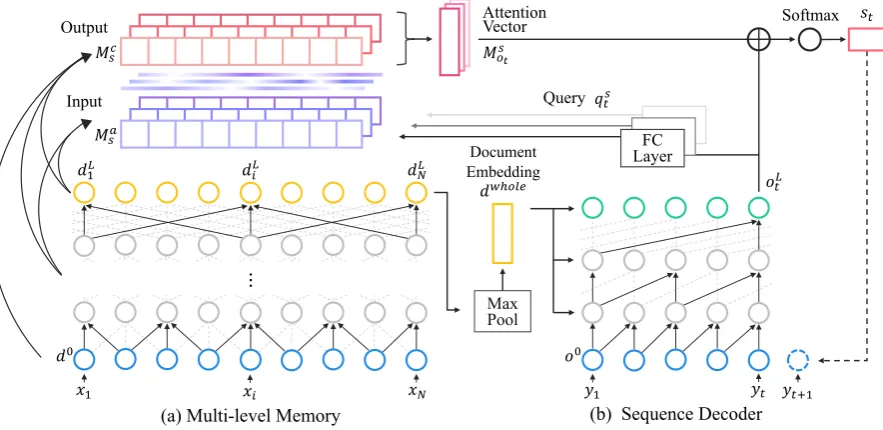
Figure3 shows the proposedmulti-level memory network (MMN) model. The MMN memorizes the source text with a proper representation in the memory and generates a summary sentence one word at a time by extracting relevant information from memory cells in response to previously gen-erated words. The input of the model is a source text {xi} = x1, ..., xN, and the output is a se-quence of summary words{yt}=y1, ..., yT, each of which is a symbol from the dictionaryV.
4.1 Text Embedding
Online posts include lots of morphologically sim-ilar words, which should be closely embedded. Thus, we use thefastText(Bojanowski et al.,
2016) trained on the Common Crawl corpus, to initialize the word embedding matrixWemb. We use the same embedding matrix Wemb for both source text and output sentences. That is, we represent a source text{xi}Ni=1 in a distributional
space as {d0i}N
i=1 by d0i = Wembxi wherexi is a one-hot vector for i-th word in the source text. Likewise, output words {yt}Tt=1 is embedded as
{o0t}T
t=1, andd0i ando0t ∈R300.
4.2 Construction of Multi-level Memory
As shown in Figure3(a), the multi-level memory network takes the source text embedding{d0i}N
i=1
as an input, and generates S number of memory tensors {Ma/cs }Ss=1 as output, where superscript
[image:5.595.75.274.320.448.2]repre-sentation, respectively. The multi-level memory network is motivated by that when human under-stand a document, she does not remember it as a single whole document but ties together several levels of abstraction (e.g. word-level, sentence-level, paragraph-level and document-level). That is, we generate S sets of memory tensors, each of which associates each cell with different num-ber of neighboring word embeddings based on the level of abstraction. To build memory slots of such multi-level memory, we exploit a multi-layer CNN as the write network, where each layer is chosen based on the size of its receptive field.
However, one issue of convolution is that large receptive fields require many layers or large filter sizes. For example, stacking 6 layers with a filter size of 3 results in a receptive field size of 13,i.e. each output depends on 13 input words. In order to grow the receptive field without increasing the computational cost, we exploit thedilated convo-lution (Yu and Koltun, 2016;Oord et al., 2016a) for the write network.
Memory Writing with Dilated Convolution. In dilated convolution, the filter is applied over an area larger than its length by skipping input values with a certain gap. Formally, for a 1-Dn-length inputx ∈ Rn×300 and a filter w : {1, ..., k} → R300, the dilated convolution operationF ons
el-ements of a sequence is defined as
F(x, s) =
k
X
i=1
w(i)∗xs+d·(i−bk/2c)+b, (1)
where d is the dilation rate, k is the filter size, s−d·(i− bk/2c) accounts for the direction of dilation andw ∈ Rk×300×300 andb ∈
R300 are
the parameters of the filter. Withd= 1, the dilated convolution reduces to a regular convolution. Us-ing a larger dilation enables a sUs-ingle output at the top level to represent a wider range of input, thus effectively expanding the receptive field.
To the embedding of a source text{d0i}N i=1, we
recursively apply a series of dilated convolutions F(d0) ∈
RN×300. We denote the output of the
l-th convolution layer as{dli}N i=1.
Normalized Gated Tanh Units. Each convolu-tion is followed by our new activaconvolu-tion of normal-ized gated tanh unit(NGTU), which is illustrated in Figure4(b):
GTU(dl) =tanh(Ffl(dl))◦σ(Fgl(dl)), (2)
dl+1=LayerNorm(dl+GTU(dl)), (3)
whereσis a sigmoid,◦is the element-wise multi-plication andFfl andFgl denote the filter and gate forl-th layer dilated convolution, respectively.
The NGTU is an extension of the existing gated tanh units (GTU) (Oord et al.,2016a,b) by apply-ing weight normalization (Salimans and Kingma,
2016) and layer normalization (Ba et al., 2016). This mixed normalization improves earlier work ofGehring et al. (2017), where only weight nor-malization is applied to the GLU. As in Figure
4(a), it tries to preserve the variance of activations throughout the whole network by scaling the out-put of residual blocks by√0.5. However, we ob-serve that this heuristic does not always preob-serve the variance and does not empirically work well in our dataset. Contrarily, the proposed NGTU not only guarantees preservation of activation vari-ances but also significantly improves the perfor-mance.
Multi-level Memory. Instead of using only the last layer output of CNNs, we exploit the outputs of multiple layers of CNNs to construct S sets of memories. For example, memory constructed from the 4-th layer, whose receptive field is 31, may have sentence-level embeddings, while mem-ory from the 8-th layer, whose receptive field is 511, may have document-level embeddings. We obtain each s-th level memory Ma/cs by resem-bling key-value memory networks (Miller et al.,
2016):
Mas =dm(s), Msc=dm(s)+d0. (4)
Recall thatMas andMcs ∈ RN×300are input and
output memory matrix, respectively. m(s) indi-cates an index of convolutional layer used for the s-th level memory. For example, if we setS = 3
andm = {3,6,9}, we make three-level memo-ries, each of which uses the output of the 3-rd, 6-th, and 9-th convolution layer, respectively. To output memory representation Mcs, we add the document embeddingd0as a skip connection.
4.3 State-Based Sequence Generation
We discuss how to predict the next wordyt+1 at
time steptbased on the memory state and previ-ously generated wordsy1:t. Figure3(b) visualizes
the overall procedure of decoding.
We first apply max-pooling to the output of the last layer of the encoder network to build a whole document embeddingdwhole∈R300:
The decoder is designed based on WaveNet (Oord et al.,2016a) that uses a series of causal di-lated convolutions, denoted byFˆ(ol1:t)∈Rt×300.
We globally condition dwhole to obtain embed-dings of previously generated wordsol1:tas:
hlf /g = ˆFf /gl (o1:l t+Wlf /gdwhole), (6)
hla=tanh(hlf)◦σ(hlg), (7)
ol1:+1t =LayerNorm(ol1:t+hla), (8)
wherehlf /g are the filter and gate hidden state re-spectively, and learnable parameters areWfl and
Wgl ∈ R300×300. We initialize o0
t = Wembyt. We set the level of the decoder network toL = 3
for TIFU-short andL= 5for TIFU-long.
Next, we generate S number of query vectors {qst}S
s=1at timetto our memory network as
qst =tanh(WsqoLt +bsq), (9)
whereWsq∈R300×300andbs
q ∈R300. Each of these query vectors{qst}S
s=1 is fed into
the attention function of each level of memory. As in (Vaswani et al.,2017), the attention function is
Msot =softmax(q
s t(Mas)T √
demb )M c
s, (10)
where we setdemb = 300for the embedding di-mension andMsot ∈R300.
Next, we obtain the output word probability:
st=softmax(Wo[M1ot;...;M
S ot;o
L
t]), (11)
where Wo ∈ R(300×(S+1))×V. Finally, we
se-lect the word with the highest probabilityyt+1 =
argmaxs∈V(st). Unlessyt+1is an EOS token, we
repeat generating the next word by feeding yt+1
into the output convolution layer of Eq.(8).
4.4 Training
We use the softmax cross-entropy loss from esti-mated yt to its target yGT ,t. However, it forces the model to predict extremes (zero or one) to dis-tinguish among the ground truth and alternatives. The label smoothing alleviates this issue by acting as a regularizer that makes the model less confi-dent in its prediction. We smooth the target distri-bution with a uniform prior distridistri-butionu(Pereyra et al., 2017;Edunov et al., 2017;Vaswani et al.,
2017). Thus, the loss over the training setDis
L=−Xlogpθ(y|x)−DKL(u||pθ(y|x)).
We implement label smoothing by modifying the ground truth distribution for word yGT,t to be p(yGT ,t) = 1−andp(y0) =/V fory0 6=yGT ,t whereis a smoothing parameter set to 0.1. Fur-ther details can be found in the Appendix.
5 Experiments
5.1 Experimental Setting
Evaluation Metrics. We evaluate the summa-rization performance with two language metrics: perplexity and standard F1 ROUGE scores (Lin,
2004). We remind that lower perplexity and higher ROUGE scores indicate better performance.
Datasets. In addition to Reddit TIFU, we also evaluate on two existing datasets: abstractive sub-set ofNewsroom(Grusky et al.,2018) andXSum
(Narayan et al.,2018a). These are suitable bench-marks for evaluation of our model in two aspects. First, they are specialized for abstractive summa-rization, which meets well the goal of this work. Second, they have larger vocabulary size (40K, 50K) than Reddit TIFU (15K), and thus we can evaluate the learning capability of our model.
Baselines. We compare with three abstractive summarization methods, one basic seq2seq model, two heuristic extractive methods and variants of our model. We choose PG (See et al., 2017),
SEASS(Zhou et al.,2017),DRGD(Li et al.,2017) as the state-of-the-art methods of abstractive sum-marization. We test the attention based seq2seq model denoted ass2s-att(Chopra et al.,2016). As heuristic extractive methods, theLead-1uses the first sentence in the text as summary, and the
Ext-Oracletakes the sentence with the highest average score of F1 ROUGE-1/2/L with the gold summary in the text. Thus,Ext-Oraclecan be viewed as an upper-bound for extractive methods. We also test variants of our method MMN-*. To validate the contribution of each component, we exclude one of key components from our model as follows: (i)-NoDilatedwith conven-tional convolutions instead, (ii)-NoMultiwith no multi-level memory (iii)-NoNGTUwith exist-ing gated linear units (Gehring et al.,2017). That is, -NoDilatedquantifies the improvement by the dilated convolution, -NoMultiassesses the effect of multi-level memory, and-NoNGTU vali-dates the normalized gated tanh unit.
TIFU-short
Methods PPL R-1 R-2 R-L
Lead-1 n/a 3.4 0.0 3.3
Ext-Oracle n/a 8.0 0.0 7.7
s2s-att(Chopra et al.,2016) 46.2 18.3 6.4 17.8
PG(See et al.,2017) 40.9 18.3 6.5 17.9
SEASS(Zhou et al.,2017) 62.6 18.5 6.4 18.0
DRGD(Li et al.,2017) 69.2 14.6 3.3 14.2
MMN 32.1 20.2 7.4 19.8
MMN-NoDilated 31.8 19.5 6.8 19.1
MMN-NoMulti 34.4 19.0 6.1 18.5
MMN-NoNGTU 40.8 18.6 5.6 18.1
TIFU-long
Lead-1 n/a 2.8 0.0 2.7
Ext-Oracle n/a 6.8 0.0 6.6
s2s-att(Chopra et al.,2016) 180.6 17.3 3.1 14.0
PG(See et al.,2017) 175.3 16.4 3.0 13.5
SEASS(Zhou et al.,2017) 387.0 17.5 2.9 13.9
DRGD(Li et al.,2017) 176.6 16.8 2.0 13.6
MMN 114.1 19.0 3.7 15.1 MMN-NoDilated 124.2 17.6 3.4 14.1
MMN-NoMulti 124.5 14.0 1.5 11.8
[image:8.595.71.294.59.295.2]MMN-NoNGTU 235.4 14.0 2.6 12.1
Table 3: Summarization results measured by perplexity and ROUGE-1/2/L on the TIFU-short/long dataset.
Newsroom-Abs XSum
Methods R-1 R-2 R-L R-1 R-2 R-L
s2s-att 6.2 1.1 5.7 28.4 8.8 22.5
PG 14.7 2.2 11.4 29.7 9.2 23.2
ConvS2S - - - 31.3 11.1 25.2
T-ConvS2S - - - 31.9 11.5 25.8
MMN(Ours) 17.5 4.7 14.2 32.0 12.1 26.0
Table 4: Summarization results in terms of ROUGE-1/2/L on Newsroom-Abs (Grusky et al., 2018) and XSum (Narayan et al.,2018a). ExceptMMN, all scores are referred to the original papers.T-ConvS2Sis the topic-aware convolutional seq2seq model.
5.2 Quantitative Results
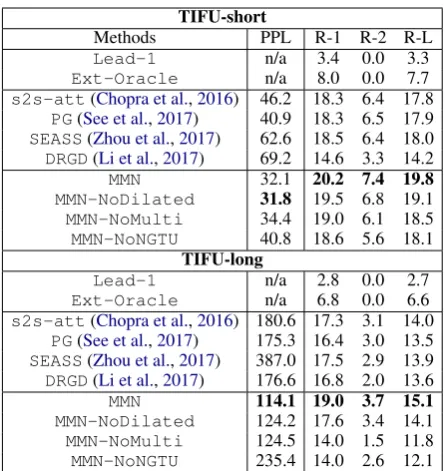
Table3compares the summarization performance of different methods on the TIFU-short/long dataset. Our model outperforms the state-of-the-art abstractive methods in both ROUGE and per-plexity scores. PG utilizes a pointer network to copy words from the source text, but it may not be a good strategy in our dataset, which is more abstractive as discussed in Table2. SEASS
shows strong performance in DUC and Gigaword dataset, in which the source text is a single long sentence and the gold summary is its shorter ver-sion. Yet, it may not be sufficient to summarize much longer articles of our dataset, even with its second-level representation. DRGD is based on the variational autoencoder with latent variables to capture the structural patterns of gold summaries. This idea can be useful for the similarly structured formal documents but may not go well with
di-TIFU-short TIFU-long
vs. Baselines Win Lose Tie Win Lose Tie
s2s-att 43.0 28.3 28.7 32.0 24.0 44.0
PG 38.7 28.0 33.3 42.3 33.3 24.3
SEASS 35.7 28.0 36.3 47.0 37.3 15.7
[image:8.595.312.522.62.135.2]DRGD 46.7 17.3 15.0 61.0 23.0 16.0 Gold 27.0 58.0 15.0 22.3 73.7 4.0
Table 5: AMT results on the TIFU-short/long between our MMN and four baselines and gold summary. We show percentages of responses that turkers vote for our approach over baselines.
verse online text in the TIFU dataset.
These state-of-the-art abstractive methods are not as good as our model, but still perform better than extractive methods. Although the
Ext-Oracleheuristic is an upper-bound for ex-tractive methods, it is not successful in our highly abstractive dataset; it is not effective to simply retrieve existing sentences from the source text. Moreover, the performance gaps between abstrac-tive and extracabstrac-tive methods are much larger in our dataset than in other datasets (See et al., 2017;
Paulus et al., 2018; Cohan et al., 2018), which means too that our dataset is highly abstractive.
Table4compares the performance of our MMN on Newsroom-Abs and XSum dataset. We report the numbers from the original papers. Our model outperforms not only the RNN-based abstractive methods but also the convolutional-based methods in all ROUGE scores. Especially, even trained on single end-to-end training procedure, our model outperformsT-ConvS2S, which necessitates two training stages of LDA andConvS2S. These re-sults assure that even on formal documents with large vocabulary sizes, our multi-level memory is effective for abstractive datasets.
5.3 Qualitative Results
We perform two types of qualitative evaluation to complement the limitation of automatic language metrics as summarization evaluation.
[image:8.595.82.283.342.417.2](…) I decided to go over to my friends house to a small party at 1 in the morning. I knew my parents would say no so I snuck out of the house. (…) I had been talking to my mom about how sad even hearing the theme song made me. Also she had seen me watching a bunch of sad anime theme songs and tearing up a little so she must have thought I was depressed. When I got home today my mom was practically in tears. (…)
[Source Text]
(GT) sneaking out of my friends house last night (Ours) sneaking out of my friends house
(s2s-att) sneaking out of town (PG) not watching my friends
(SEASS) accidentally spoiling my mom song
(DRGD) watching a movie [Short Summary]
(…) Saturday was on my way to a party and this dog was walking in the road. (…) Since it was a holiday I couldn't get her scanned for a chip but she was obviously neglected. Missing fur from flea infestation, (…) Yesterday I was able to go get her scanned for a chip. No chip. So I get ready to take her home and deflea her. (…) Anyway a third party today starts accusing me of stealing (…) and talking about pressing charges. (…) [Source Text]
(GT)Saved a dog. Had to give dog back to possible abusers. Being accused of stealing the fucking dog. No good deed goes unpunished.
(Ours) tried to help a dog got a bit and got accused of stealing
(s2s-att)got accused of being a dog by stealing a _UNK bit the dog and accused of stealing dog to the police
(SEASS) called a dog a _UNK might get charged with _UNK [Long Summary]
(PG) _EOS
(DRGD) i was a _UNK dog and I wasn’t playing attention and got arrested for being a _UNK _UNK
Figure 5: Examples of abstractive summary generated by our model and baselines. In each set, we too show the source text and gold summary.
and the gold summary (Gold).
Table 5 summarizes the results of AMT tests, which validate that human annotators significantly prefer our results to those of baselines. As ex-pected, the gold summary is voted the most.
Summary Examples. Figure5shows selected examples of abstractive summarization. Baselines often generate the summary by mostly focusing on some keywords in the text, while our model produces the summary considering both keywords and the whole context thanks to multi-level mem-ory. We present more examples in the Appendix.
6 Conclusions
We introduced a new datasetReddit TIFUfor ab-stractive summarization on informal online text. We also proposed a novel summarization model namedmulti-level memory networks(MMN). Ex-periments showed that the Reddit TIFU dataset
is uniquely abstractive and the MMN model is highly effective. There are several promising fu-ture directions. First, ROUGE metrics are lim-ited to correctly capture paraphrased summaries, for which a new automatic metric of abstractive summarization may be required. Second, we can explore the data in other online forums such as Quora, Stackoverflow and other subreddits.
Acknowledgments
We thank Chris Dongjoo Kim, Yunseok Jang and the anonymous reviewers for their helpful com-ments. This work was supported by Kakao and Kakao Brain corporations and IITP grant funded by the Korea government (MSIT) (No. 2017-0-01772, Development of QA systems for Video Story Understanding to pass the Video Turing Test). Gunhee Kim is the corresponding author.
References
Mehdi Allahyari, Seyedamin Pouriyeh, Mehdi Assefi, Saeid Safaei, Elizabeth D Trippe, Juan B Gutierrez, and Krys Kochut. 2017. Text Summarization Tech-niques: A Brief Survey. InarXiv:1707.02268.
Jimmy Lei Ba, Jamie Ryan Kiros, and Geoffrey E Hin-ton. 2016. Layer Normalization. InStat.
Piotr Bojanowski, Edouard Grave, Armand Joulin, and Tomas Mikolov. 2016. Enriching Word Vectors with Subword Information. InTACL.
Asli Celikyilmaz, Antoine Bosselut, Xiaodong He, and Yejin Choi. 2018. Deep Communicating Agents for Abstractive Summarization. InNAACL-HLT.
Sumit Chopra, Michael Auli, and Alexander M Rush. 2016. Abstractive Sentence Summarization With Attentive Recurrent Neural Networks. In NAACL-HLT.
Arman Cohan, Franck Dernoncourt, Doo Soon Kim, Trung Bui, Seokhwan Kim, Walter Chang, and Na-zli Goharian. 2018. A Discourse-Aware Attention Model for Abstractive Summarization of Long Doc-uments. InNAACL-HLT.
Sergey Edunov, Myle Ott, Michael Auli, David Grang-ier, and Marc’Aurelio Ranzato. 2017. Classical Structured Prediction Losses for Sequence to Se-quence Learning. InNAACL-HLT.
Jonas Gehring, Michael Auli, David Grangier, Denis Yarats, and Yann N Dauphin. 2017. Convolutional Sequence to Sequence Learning. InICML.
Xavier Glorot and Yoshua Bengio. 2010. Understand-ing the Difficulty of TrainUnderstand-ing Deep Feedforward Neural Networks. InAISTATS.
Max Grusky, Mor Naaman, and Yoav Artzi. 2018. Newsroom: A Dataset of 1.3 Million Summaries with Diverse Extractive Strategies. InNAACL-HLT.
Karl Moritz Hermann, Tomas Kocisky, Edward Grefenstette, Lasse Espeholt, Will Kay, Mustafa Su-leyman, and Phil Blunsom. 2015. Teaching Ma-chines to Read and Comprehend. InNIPS.
Wan-Ting Hsu, Chieh-Kai Lin, Ming-Ying Lee, Kerui Min, Jing Tang, and Min Sun. 2018. A Unified Model for Extractive and Abstractive Summariza-tion using Inconsistency Loss. InACL.
Baotian Hu, Qingcai Chen, and Fangze Zhu. 2015. Lc-sts: A large scale chinese short text summarization dataset. InEMNLP.
Łukasz Kaiser, Ofir Nachum, Aurko Roy, and Samy Bengio. 2017. Learning to Remember Rare Events. InICLR.
Chris Kedzie, Kathleen McKeown, and Hal Daume III. 2018. Content Selection in Deep Learning Models of Summarization. InEMNLP.
Diederik Kingma and Jimmy Ba. 2015. Adam: A Method for Stochastic Optimization. InICLR.
Ankit Kumar, Ozan Irsoy, Jonathan Su, James Brad-bury, Robert English, Brian Pierce, Peter Ondruska, Ishaan Gulrajani, and Richard Socher. 2016. Ask me Anything: Dynamic Memory Networks for Nat-ural Language Processing. InICML.
Piji Li, Wai Lam, Lidong Bing, and Zihao Wang. 2017. Deep Recurrent Generative Decoder for Abstractive Text Summarization. InEMNLP.
Chin-Yew Lin. 2004. ROUGE: A Package for Auto-matic Evaluation of Summaries. InTSBO.
Peter J Liu, Mohammad Saleh, Etienne Pot, Ben Goodrich, Ryan Sepassi, Lukasz Kaiser, and Noam Shazeer. 2018. Generating Wikipedia by Summariz-ing Long Sequences. InICLR.
Yishu Miao and Phil Blunsom. 2016. Language as a Latent Variable: Discrete Generative Models for Sentence Compression. InEMNLP.
Alexander Miller, Adam Fisch, Jesse Dodge, Amir-Hossein Karimi, Antoine Bordes, and Jason Weston. 2016. Key-Value Memory Networks for Directly Reading Documents. InEMNLP.
Seil Na, Sangho Lee, Jisung Kim, and Gunhee Kim. 2017. A Read-Write Memory Network for Movie Story Understanding. InICCV.
Ramesh Nallapati, Feifei Zhai, and Bowen Zhou. 2017. SummaRuNNer: A Recurrent Neural Net-work Based Sequence Model for Extractive Summa-rization of Documents. InAAAI.
Ramesh Nallapati, Bowen Zhou, Cicero dos Santos, Caglar Gulcehre, and Bing Xiang. 2016. Ab-stractive Text Summarization Using Sequence-to-sequence RNNs and Beyond. InCoNLL.
Courtney Napoles, Matthew Gormley, and Benjamin Van Durme. 2012. Annotated Gigaword. In
NAACL-HLT AKBC-WEKEX.
Shashi Narayan, Shay B. Cohen, and Mirella Lapata. 2018a. Don’t Give Me the Details, Just the Sum-mary! Topic-Aware Convolutional Neural Networks for Extreme Summarization. InEMNLP.
Shashi Narayan, Shay B Cohen, and Mirella Lapata. 2018b. Ranking Sentences for Extractive Summa-rization with Reinforcement Learning. In NAACL-HLT.
Aaron van den Oord, Sander Dieleman, Heiga Zen, Karen Simonyan, Oriol Vinyals, Alex Graves, Nal Kalchbrenner, Andrew Senior, and Koray Kavukcuoglu. 2016a. WaveNet: A Generative Model for Raw Audio. InSSW.
Aaron van den Oord, Nal Kalchbrenner, Lasse Espe-holt, Oriol Vinyals, Alex Graves, et al. 2016b. Con-ditional Image Generation With Pixelcnn Decoders. InNIPS.
Paul Over, Hoa Dang, and Donna Harman. 2007. DUC in Context. InIPM.
Cesc Chunseong Park, Byeongchang Kim, and Gun-hee Kim. 2017. Attend to You: Personalized Image Captioning with Context Sequence Memory Net-works. InCVPR.
Ramakanth Pasunuru and Mohit Bansal. 2018. Multi-Reward Reinforced Summarization with Saliency and Entailment. InNAACL-HLT.
Romain Paulus, Caiming Xiong, and Richard Socher. 2018. A Deep Reinforced Model for Abstractive Summarization. InICLR.
Gabriel Pereyra, George Tucker, Jan Chorowski, Łukasz Kaiser, and Geoffrey Hinton. 2017. Regu-larizing Neural Networks by Penalizing Confident Output Distributions. InICLR.
Alexander M Rush, Sumit Chopra, and Jason Weston. 2015. A Neural Attention Model for Abstractive Sentence Summarization. InEMNLP.
Tim Salimans and Diederik P Kingma. 2016. Weight Normalization: A Simple Reparameterization to Ac-celerate Training of Deep Neural Networks. In
NIPS.
Evan Sandhaus. 2008. New York Times Annotated Corpus. InLDC.
Abhishek Kumar Singh, Manish Gupta, and Vasudeva Varma. 2017. Hybrid MemNet for Extractive Sum-marization. InCIKM.
Sainbayar Sukhbaatar, Jason Weston, Rob Fergus, et al. 2015. End-to-end Memory Networks. InNIPS.
Ilya Sutskever, Oriol Vinyals, and Quoc V Le. 2014. Sequence to Sequence Learning with Neural Net-works. InNIPS.
Jiwei Tan, Xiaojun Wan, and Jianguo Xiao. 2017. Ab-stractive Document Summarization with a Graph-based Attentional Neural Model. InACL.
Ashish Vaswani, Noam Shazeer, Niki Parmar, Jakob Uszkoreit, Llion Jones, Aidan N Gomez, Łukasz Kaiser, and Illia Polosukhin. 2017. Attention is All You Need. InNIPS.
Lu Wang and Wang Ling. 2016. Neural Network-Based Abstract Generation for Opinions and Argu-ments. InNAACL-HLT.
Jason Weston, Sumit Chopra, and Antoine Bordes. 2014. Memory Networks. InICLR.
Seungjoo Yoo, Hyojin Bahng, Sunghyo Chung, Junsoo Lee, Jaehyuk Chang, and Jaegul Choo. 2019. Col-oring with Limited Data: Few-shot Colorization via Memory-Augmented Networks. InCVPR.
Fisher Yu and Vladlen Koltun. 2016. Multi-scale Con-text Aggregation by Dilated Convolutions. InICLR.
Qingyu Zhou, Nan Yang, Furu Wei, and Ming Zhou. 2017. Selective Encoding for Abstractive Sentence Summarization. InACL.
A Implementation Details
All the parameters are initialized with the Xavier method (Glorot and Bengio, 2010). We apply the Adam optimizer (Kingma and Ba,2015) with β1 = 0.9, β2 = 0.999and = 1e−8. We
ap-ply weight normalization (Salimans and Kingma,
2016) to all layers. We set learning rate to 0.001 and clip gradient at 0.3. At every 4 epochs, we divide learning rate by 10 until it reaches 0.0001. We train our models up to 12 epochs for TIFU-short and 60 epochs for TIFU-long.
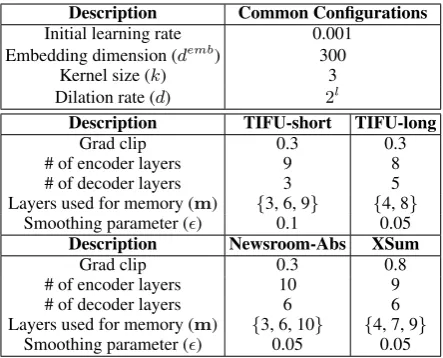
Table6summarizes the setting of hyperparam-eters for our model in all experiments on TIFU-short/long dataset, Newsroom abstractive subset and XSum.
B Novel N-gram Ratios
Table 7compares the ratios of novel N-grams in the reference summary between datasets. Follow-ing (See et al., 2017;Narayan et al., 2018a), we compute this ratio as follows; we first count the
Description Common Configurations
Initial learning rate 0.001 Embedding dimension (demb) 300
Kernel size (k) 3
Dilation rate (d) 2l
Description TIFU-short TIFU-long
Grad clip 0.3 0.3
# of encoder layers 9 8
# of decoder layers 3 5
Layers used for memory (m) {3, 6, 9} {4, 8} Smoothing parameter () 0.1 0.05
Description Newsroom-Abs XSum
Grad clip 0.3 0.8
# of encoder layers 10 9
# of decoder layers 6 6
[image:11.595.307.529.61.240.2]Layers used for memory (m) {3, 6, 10} {4, 7, 9} Smoothing parameter () 0.05 0.05
Table 6: Model hyperparameters in experiments on TIFU-short/long, Newsroom abstractive subset and XSum.
Novel N-gram Ratio
Dataset 1-gram 2-gram 3-gram 4-gram
CNN/DailyMail 10.3 49.9 70.5 80.3
NY Times 11.0 45.5 67.2 77.9
Newsroom 15.6 45.4 57.2 62.2
Newsroom-Ext 1.5 5.9 8.9 11.1
Newsroom-Mix 11.6 47.0 66.5 76.8
Newsroom-Abs 33.9 83.9 97.1 99.5
XSum 35.8 83.5 95.5 98.5
TIFU-short 29.7 71.5 88.1 93.8
[image:11.595.313.521.298.411.2]TIFU-long 27.4 76.7 92.5 97.0
Table 7: Comparison of novel N-gram ratios between Reddit TIFU and other summarization datasets.
number of N-grams in the reference summary that do not appear in the source text and divide it with the total number of N-grams. The higher the ra-tio is, the less the identical N-grams are in the source text. TheCNN/DailyMail,New York Times,Newsroomdatasets all, for example, ex-hibit low novel 1-gram ratios as 10.3%, 11.0%, 15.6 % respectively. This means that about 90% of the words in reference summary already exist inside the source text. It is due to that the sum-maries from formal documents (e.g. news and aca-demic papers) tend to have same expressions with the source documents. Therefore, these datasets may be more suitable for extractive summariza-tion than abstractive one; on the other hand, our dataset is more abstractive.
We also compare the novel N-gram ratio for
XSumand three subsets ofNewsroom;
(i) Newsroom-Ext, a subset favorable for extractive methods, (ii) Newsroom-Mix, a subset favorable for mixed methods, and (iii)
abstrac-(…) We use an internal messaging application software at work which has been great for communicating with other teammates. A lot of us have started using it to complain about things we are not happy about at work. (…) This leads me to today where just as i am about to go home my manager calls me in to a private meeting looking really upset. Then they mentioned the program name and that they had received an email, and suddenly I realized I had fucked up one of the quirks of this program is that when someone is offline it emails them the message. A recently ex co-worker is still active on the chat for quick questions for the next 2 weeks. They came online so we started having a conversation, then another co-worker walked up to me for a chat who has been having a rough week and complained about our boss. When they finished their rant, I then messaged my ex co-worker that my boss wasn't popular with the staff at the moment as that was the second minor complaint I had heard that week. They had gone offline, so an email was sent to their old work email. Past employees emails get sent to the boss, in case important emails are sent to them. So after the meeting I still have my job. I had an awkward conversation with my boss (…) (…) This weekend I went out and bought myself a motorcycle! I've been planning on buying one this summer and I finally went out and did it. (…) I geared up and went on my way for my first ride. (…) I went all the way back to my house and alas, no phone. So I spent the next 4 hours walking the route to my girlfriends house looking along the side of the road for my phone. These are all back roads to my girlfriends house so I had to really get in the undergrowth to look for my phone. It got dark and I headed home feeling dejected. The next morning my friend came over with my phone! The only damage was a few scuffs to my otterbox. I couldn't believe he found it, and as it turns out it fell off my bike and tumbled onto the side of his driveway. I chalked this up as a win and considered myself lucky. Until yesterday. I woke up with poison ivy all over my body. And when I say all over my body, I mean ALL OVER my body. I have some on my arms, legs, face, and most importantly all over my dick. And the worst spot of them all is on my dick. I have never been so uncomfortable in my life. I must have had some of the oil on my hands and scratched an itch down there. Needless to say I haven't been on my new motorcycle since I've had this and I've been doing as little moving as possible at my job and at home. F***.
[Source Text]
(Gold) taking a ride on my new motorcycle
(Ours) buying my new motorcycle
(s2s-att) trying to be a good samaritan
(PG)not wearing my cargo helmet
[Short Summary]
(SEASS)going for a ride
(DRGD)getting my phone stuck
(…) Later that night, the rest of the family proceeded to play cards and become quite intoxicated. Me, being the little shit that I was, and probably still am, took this opportunity to raid the liquor cooler, and made off with a bottle of wine. I, along with a few other of my underage cousins, ran off to consume our loot. Now, in most situations, this really wouldn't be a that big deal, however, getting drunk at 18 wasn't where my f*** up occurred. (…) John tells her it'll be okay, that he will smooth talk it over with them, and that she should bring them a bottle of their favorite wine. Well John and Jane are having dinner outside to meet the parents, and when Jane goes to retrieve her gift of wine to John's parents, she discovers the wine is gone. Jane then begins to panic, and starts tearing up the surrounding area looking for it. John's parents have no idea what she's freaking out about, or why John would bring crazy to the family reunion. (…) Jane now slips into complete hysteria, and runs inside to lock herself in the bathroom. (…) The day after, John convinces his parents to try again, and all goes very well, especially since last night's thief is still recovering from his first wine hangover. (…)
[Source Text]
(Gold) stealing a bottle of wine
(Ours) getting drunk and stealing a wine bottle
(s2s-att) getting drunk and making a family cry
(PG)ruining my future dinner vacation
[Short Summary]
(SEASS)accidentally stealing alcohol from my cousin’s
parent’s party
(DRGD)smoking a cigarette
[Source Text]
(Gold) message program at work emailed a private message
between a past co worker and myself to my boss saying how people where not happy with them
(Ours) sent a message to my boss and now i ’m in a meeting
with my boss
(s2s-att) i lied about my boss to get my job and now i ’m in a
job with a new job
[Long Summary]
(PG)i got a program that sacked from work and i got sent to a metting by my boss
(…) My girlfriend and I have just started to "get a bit more uncomfortable with each other". (…) My curfew for the night had been midnight, however we both got a bit carried away in the beautiful setting (…) I had over extended my curfew by around an hour. This prompted my mother to call me angrily and groggily claiming that she was mad at me. I defended myself by saying that we both fell asleep listening to the docile tones of Steve Harvey on "Family Feud". (…) I sent my girlfriend a text that said something along the lines of "X acts of affection. Comments questions, or complaints?" However upon hitting the send button I noticed that it was heading in the direction of my birth giver. I panicked and luckily managed to put it into airplane mode! (…) I quickly googled "How to prevent texts from sending" and it said to simply delete the text while it was on airplane mode. I did so, and proceeded to turn airplane mode off, however the "always correct Internet" was wrong and I hear my mom receive the text in the next room over. I quickly went into her room to try and crack her phone's code in order to diffuse the bomb (…) I then asked my mother for her phone so that I could "call mine". She reluctantly agreed and I hurriedly rushed to my room. (…)
[Source Text]
(Gold) did some funky stuff with my date
(Ours) accidentally sent an inappropriate text to a girl and
then accidentally sent it to my mother’s phone and now i’m trouble
(PG)tifu by answering an airplane call and accidentally adding my mothers phone and her phone to find out she was sleeping on me
[Long Summary]
(SEASS)I accidentally sent a text to my mom that I was
sending her a text from the _UNK bomb
tive methods. We summarize two interesting ob-servations as follows. First, as expected, the more favorable for abstractive methods is, the higher novel n-gram ratio is. Second, novel n-gram ratios of Newsroom-Abs and XSum are higher than those of our dataset, even though their data sources are news publications. Thus, we argue that novel n-gram ratios are pretty good but not a sufficient measure to find extractive bias in the summariza-tion dataset.
C More Examples