Improving Pronoun Translation for Statistical Machine Translation
Liane Guillou
School of Informatics University of Edinburgh Edinburgh, UK, EH8 9AB [email protected]
Abstract
Machine Translation is a well–established field, yet the majority of current systems translate sentences in isolation, losing valu-able contextual information from previ-ously translated sentences in the discourse. One important type of contextual informa-tion concerns who or what a coreferring pronoun corefers to (i.e., its antecedent). Languages differ significantly in how they achieve coreference, and awareness of an-tecedents is important in choosing the cor-rect pronoun. Disregarding a pronoun’s an-tecedent in translation can lead to inappro-priate coreferring forms in the target text, seriously degrading a reader’s ability to un-derstand it.
This work assesses the extent to which
source-language annotationof coreferring
pronouns can improve English–Czech Sta-tistical Machine Translation (SMT). As with previous attempts that use this method, the results show little improvement. This paper attempts to explain why and to pro-vide insight into the factors affecting per-formance.
1 Introduction
It is well-known that in many natural languages, a pronoun that corefers must bear similar features to its antecedent. These can include similar num-ber, gender (morphological or referential), and/or animacy. If a pronoun and its antecedent occur in the same unit of translation (N-gram or syntactic tree), these agreement features can influence the translation. But this locality cannot be guaranteed in either phrase-based or syntax-based Statistical Machine Translation (SMT). If it is not within the
same unit, a coreferring pronoun will be trans-lated without knowledge of its antecedent, mean-ing that its translation will simply reflect local fquency. Incorrectly translating a pronoun can re-sult in readers/listeners identifying the wrong an-tecedent, which can mislead or confuse them.
There have been two recent attempts to solve this problem within the framework of phrase-based SMT (Hardmeier & Federico, 2010; Le Nagard & Koehn, 2010). Both involve anno-tation projection, which in this context means annotating coreferential pronouns in the source-language with features derived from the transla-tion of their aligned antecedents, and then build-ing a translation model of the annotated forms. When translating a coreferring pronoun in a new source-language text, the antecedent is identified and its translation used (differently in the two at-tempts cited above) to annotate the pronoun prior to translation.
The aim of this work was to better understand why neither of the previous attempts achieved more than a small improvement in translation quality associated with coreferring pronouns. Only by understanding this will it be possible to ascertain whether the method ofannotation pro-jectionis intrinsically flawed or the unexpectedly small improvement is due to other factors.
Errors can arise when:
1. Deciding whether or not a third person pro-noun corefers;
2. Identifying the pronoun antecedent;
3. Identifying the head of the antecedent, which serves as the source of its features;
4. Aligning the source and target texts at the phrase and word levels.
Factoring out the first two decisions would show whether the lack of significant improvement was simply due to imperfect coreference resolu-tion. In order to control for these errors several different manually annotated versions of the Penn
Wall Street Journalcorpus were used, each pro-viding different annotations over the same text. The BBN Pronoun Coreference and Entity Type corpus (Weischedel & Brunstein, 2005) was used to provide coreference information in the source-language and exclude non-referential pronouns. It also formed the source-language side of the parallel training corpus. The PCEDT 2.0 cor-pus (Hajiˇc et al., 2011), which contains a close Czech translation of the PennWall Street Journal
corpus, provided reference translations for test-ing and the target-language side of the parallel corpus for training. To minimise (although not completely eliminate) errors associated with an-tecedent head identification (item 3 above), the parse trees in the Penn Treebank 3.0 corpus (Mar-cus et al., 1999) were used. The gold stan-dard annotation provided by these corpora al-lowed me to assume perfect identification of core-ferring pronouns and coreference resolution and near–perfect antecedent head noun identification. These assumptions could not be made if state-of-the-art methods had been used as they cannot yet achieve sufficiently high levels of accuracy.
The remainder of the paper is structured as fol-lows. The use of pronominal coreference in En-glish and Czech and the problem of anaphora res-olution are described in Section 2. The works of Le Nagard & Koehn (2010) and Hardmeier & Federico (2010) are discussed in Section 3, and the source-language annotation projection method is described in Section 4. The results are presented and discussed in Section 5 and future work is outlined in Section 6.
2 Background
2.1 Anaphora Resolution
Anaphora resolution involves identifying the an-tecedent of a referring expression, typically a pro-noun or pro-noun phrase that is used to refer to some-thing previously mentioned in the discourse (its antecedent). Where multiple referring expres-sions refer to the same antecedent, they are said to becoreferential. Anaphora resolution and the re-lated task of coreference resolution have been the
subject of considerable research within Natural Language Processing (NLP). Excellent surveys are provided by Strube (2007) and Ng (2010).
Unresolved anaphora can add significant trans-lation ambiguity, and their incorrect transtrans-lation can significantly decrease a reader’s ability to un-derstand a text. Accurate coreference in trans-lation is therefore necessary in order to produce understandable and cohesive texts. This justifies recent interest (Le Nagard & Koehn, 2010; Hard-meier & Federico, 2010) and motivates the work presented in this paper.
2.2 Pronominal Coreference in English
Whilst English makes some use of case, it lacks the grammatical gender found in other languages. For monolingual speakers, the relatively few dif-ferent pronoun forms in English make sentences easy to generate: Pronoun choice depends on the number and gender of the entity to which they re-fer. For example, when talking about ownership of a book, English uses the pronouns “his/her” to refer to a book that belongs to a male/female owner, and “their” to refer to one with multi-ple owners (irrespective of their gender). One source of difficulty is that the pronoun “it” has both a coreferential and a pleonastic function. A pleonastic pronoun is one that is not referential. For example, in the sentence “It is raining”, “it” does not corefer with anything. Coreference res-olution algorithms must exclude such instances in order to prevent the erroneous identification of an antecedent when one does not exist.
2.3 Pronominal Coreference in Czech
explicit subject pronoun may be omitted if it is in-ferable from other grammatical features such as verb morphology. This is in contrast with En-glish which exhibits relatively fixed Subject-Verb-Object (SVO) order and only drops subject pro-nouns in imperatives (e.g. “Stop babbling”) and coordinated VPs.
Differences between the choice of coreferring expressions used in English and Czech can be seen in the following simple examples:
1. The dog has a ball. I can seeitplaying out-side.
2. The cow is in the field. I can seeitgrazing.
3. The car is in the garage. I will takeitto work.
In each example, the English pronoun “it” refers to an entity that has a different gender in Czech. Its correct translation requires identifying the gender (and number) of its antecedent and en-suring that the pronoun agrees. In 1 “it” refers to the dog (“pes”, masculine, animate) and should be translated as “ho”. In 2, “it” refers to the cow (“kr´ava”, feminine) and should be translated as “ji”. In 3, “it” refers to the car (“auto”, neuter) and should be translated as “ho”.
In some cases, the same pronoun is used for both animate and inanimate masculine genders, but in general, different pronouns are used. For example, with possessive reflexive pronouns in the accusative case:
English: I admiredmy (own)dog
Czech: Obdivoval jsmesv´ehopsa
English: I admiredmy (own)castle
Czech: Obdivoval jsmesv ˚ujhrad
Here “sv´eho” is used to refer to a dog (mascu-line animate, singular) and “sv˚uj” to refer to a cas-tle (masculine inanimate, singular), both of which belong to the speaker.
Because a pronoun may take a large number of morphological forms in Czech and because case is not checked in annotation projection, the method presented here for translating coreferring pronouns does not guarantee their correct form.
3 Related Work
Early work on integrating anaphora resolution with Machine Translation includes the rule-based
approaches of Mitkov et al. (1995) and Lappin & Leass (1994) and the transfer-based approach of Saggion & Carvalho (1994). Work in the 1990’s culminated in the publication of a special issue of Machine Translation on anaphora resolution (Mitkov, 1999). Work then appears to have been on hold until papers were published by Le Na-gard & Koehn (2010) and Hardmeier & Federico (2010). This resurgence of interest follows ad-vances since the 1990’s which have made new ap-proaches possible.
The work described in this paper resembles that of Le Nagard & Koehn (2010), with two main dif-ferences. The first is the use of manually anno-tated corpora to extract coreference information and morphological properties of the target trans-lations of the antecedents. The second lies in the choice of language pair. They consider English-French translation, focussing on gender-correct translation of the third person pronouns “it” and “they”. Coreference is more complex in Czech with both number and gender influencing pronoun selection. Annotating pronouns with both num-ber and gender further exacerbates the problem of data sparseness in the training data, but this can-not be avoided if the aim is to improve their trans-lation. This work also accommodates a wider range of English pronouns.
In contrast, Hardmeier & Federico (2010) focus on English-German translation and model coref-erence using a word dependency module inte-grated within the log-linear SMT model as an ad-ditional feature function.
Annotation projection has been used elsewhere in SMT. Gimpel & Smith (2008) use it to capture long–distance phenomena within a single sen-tence in the source-language text via the extrac-tion of sentence-level contextual features, which are used to augment SMT translation models and better predict phrase translation. Projection tech-niques have also been applied to multilingual Word Sense Disambiguation whereby the sense of a word may be determined in another language (Diab, 2004; Khapra et al., 2009).
4 Methodology
4.1 Overview
It stands on a hill.
The castle is old. Hrad je starý.
It stands on a hill. The castle is old.
Hrad je starý.
It.mascin.sg stands on a hill.
Masculine inanimate, singular
Translate:
Translate: Input:
The castle is old. It stands on a hill.
(1) Identification of coreferential pronoun (2) Identification of
antecedent head
(3) English – Czech mapping of antecedent head
(4) Extraction of number and gender of Czech word
[image:4.595.151.441.78.233.2](5) Annotation of English pronoun with number and gender of Czech word
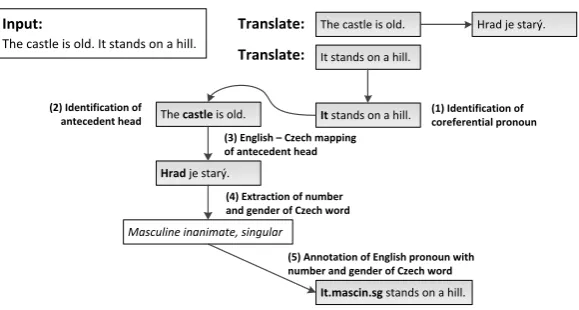
Figure 1: Overview of the Annotation Process
task. In the first step, pronouns are annotated in the source-language text before the text is trans-lated by a phrase-based SMT system in the second step. This approach leaves the translation cess unaffected. In this work, the following nouns are annotated: third person personal pro-nouns (except instances of “it” that are pleonastic or that corefer with clauses or VPs), reflexive per-sonal pronouns and possessive pronouns, includ-ing reflexive possessives. Relative pronouns are excluded as they are local dependencies in both English and Czech and this work is concerned with the longer range dependencies typically ex-hibited by the previously listed pronoun types.
Annotation of the English source-language text and its subsequent translation into Czech is achieved using two phrase-based translation sys-tems. The first, hereafter called theBaseline sys-tem, is trained using English and Czech sentence– aligned parallel training data with no annotation. The second system, hereafter called theAnnotated system, is trained using the same target data, but in the source-language text, each coreferring pro-noun has been annotated with number, gender and animacy features. These are obtained from the existing (Czech reference) translation of the head of its English antecedent. Word alignment of En-glish and Czech is obtained from the PCEDT 2.0 alignment file which maps English words to their corresponding t-Layer (deep syntactic, tectogram-matical) node in the Czech translation. Starting with this t-Layer node the annotation layers of the PCEDT 2.0 corpus are traversed and the number and gender of the Czech word are extracted from the morphological layer (m-Layer).
The Baseline system serves a dual purpose. It forms the first stage of the two-step translation process, and as described in Section 5, it provides a baseline against which Annotated system trans-lations are compared.
The annotation process used here is shown in Figure 1. It identifies coreferential pronouns and their antecedents using the annotation in the BBN Pronoun Coreference and Entity Type cor-pus, and obtains the Czech translation of the En-glish antecedent from the translation produced by the Baseline system. Because many an-tecedents come from previous sentences, these sentences must be translated before translating the current sentence. Here I follow Le Nagard & Koehn (2010) in translating the complete source-language text using the Baseline system and then extracting the (here, Czech) translations of the En-glish antecedents from the output. This provides a simple solution to the problem of obtaining the Czech translation prior to annotation. In contrast Hardmeier & Federico (2010) translate sentence by sentence using a process which was deemed to be more complex than was necessary for this project.
Training Dev. Final
[image:5.595.81.279.73.122.2]Parallel Sentences 47,549 280 540 Czech Words 955,018 5,467 10,110 English Words 1,024,438 6,114 11,907
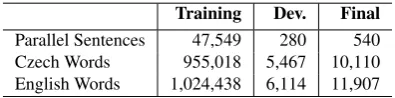
Table 1: Sizes of the training and testing datasets
4.2 Baseline and Annotated systems
Both systems are phrase-based SMT models, trained using the Moses toolkit (Hoang et al., 2007). They share the same 3-gram language model constructed from the target-side text of the parallel training corpus and the Czech mono-lingual 2010 and 2011 News Crawl corpora1. The language model was constructed using the SRILM toolkit (Stolcke, 2002) with interpolated Kneser-Ney discounting (Kneser & Ney, 1995). In addition, both systems are forced to use the same word alignments (constructed using Giza++ (Och & Ney, 2003) in both language pair direc-tions and using stemmed training data in which words are limited to the first four characters) in order to mitigate the effects of Czech word in-flection on word alignment statistics. This helps to ensure that the Czech translation of the head of the antecedent remains constant in both steps of the two-step process. If this were to change it would defeat the purpose of pronoun annotation as different Czech translations could result in dif-ferent gender and/or number.
The Baseline system was trained using the Penn Wall Street Journal corpus with no anno-tation, while the Annotated system was trained with an annotated version of the same text (see Table 1), with the target-language text being the same in both cases. The PennWall Street Journal
corpus was annotated using the process described above, with the number and gender of the Czech translation of the antecedent head obtained from the PCEDT 2.0 alignment file.
4.3 Processing test files
Two test files were used (see Table 1) – one called ‘Final’ and the other, ‘Development’ (Dev). A test file is first translated using the Baseline system with a trace added to the Moses decoder. Each coreferential English pronoun is then identified using the BBN Pronoun Coreference and Entity Type corpus and the head of its antecedent is
ex-1Provided for the Sixth EMNLP Workshop on Statistical
Machine Translation (Callison-Burch et al., 2011)
tracted from the annotated NPs in the Penn Tree-bank 3.0 corpus. The sentence number and word position of the English pronoun and its antecedent head noun(s) are extracted from the input English text and used to identify the English/Czech phrase pairs that contain the Czech translations of the En-glish words. Using this information together with the phrase alignments (output by the Moses de-coder) and the phrase-internal word alignments in the phrase translation table, a Czech transla-tion is obtained from the Baseline system. Num-ber, gender and animacy (if masculine) features of the Czech word identified as the translation of the head of the antecedent are extracted from a pre-built morphological dictionary of Czech words constructed from the PCEDT 2.0 corpus for the purpose of this work. A copy of the original English test file is then constructed, with each coreferential pronoun annotated with the ex-tracted Czech features.
The design of this process reflects two assump-tions. First, the annotation of the Czech words in the m-Layer of the PCEDT 2.0 corpus is both accurate and consistent. Second, as the Base-line and Annotated systems were trained using the same word alignments, the Czech translation of the head of the English antecedent should be the same in the output of both. Judging by the very small number of cases in which the antecedent translations differed (3 out of 458 instances), this assumption was proved to be reasonable. These differences were due to the use of different phrase tables for each system as a result of training on different data (i.e. the annotation of English pro-nouns or lack thereof). This would not be an is-sue for single-step translation systems such as that used by Hardmeier & Federico (2010).
4.4 Evaluation
use a strict recall and precision based metric for English–German translation, I found it unsuitable for English–Czech translation, given the highly inflective nature of Czech.
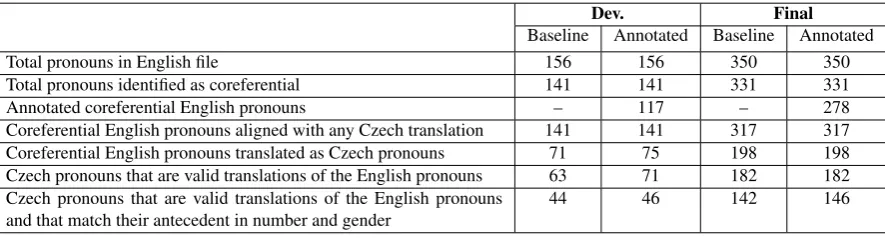
Given the importance of evaluation to the goal of assessing the effectiveness ofannotation pro-jection for improving the translation of corefer-ring pronouns, I carried out two separate types of evaluation — an automated evaluation which could be applied to the entire test set, and an in-depth manual assessment that might provide more information, but could only be performed on a subset of the test set. The automated evaluation is based on the fact that a Czech pronoun must agree in number and gender with its antecedent. Thus one can count the number of pronouns in the translation output for which this agreement holds, rather than simply score the output against a sin-gle reference translation. To obtain these figures, the automated evaluation process counted:
1. Total pronouns in the input English test file.
2. Total English pronouns identified as corefer-ential, as per the annotation of the BBN Pro-noun Coreference and Entity Type corpus.
3. Total coreferential English pronouns that are annotated by the annotation process.
4. Total coreferential English pronouns that are aligned with any Czech translation.
5. Total coreferential English pronouns trans-lated as any Czech pronoun.
6. Total coreferential English pronouns trans-lated as a Czech pronoun corresponding to avalidtranslation of the English pronoun.
7. Total coreferential English pronouns trans-lated as a Czech pronoun (that is a valid translation of the English pronoun) agreeing in number and gender with the antecedent.
The representation of valid Czech translations of English pronouns takes the form of a list pro-vided by an expert in Czech NLP, which ignores case and focusses solely on number and gender.
In contrast, the manual evaluation carried out by that same expert, who is also a native speaker of Czech, was used to determine whether devi-ations from the single reference translation pro-vided in the PCEDT 2.0 corpus were valid alter-natives or simply poor translations. The following judgements were provided:
1. Whether the pronoun had been translated correctly, or in the case of a dropped pro-noun, whether pro-drop was appropriate;
2. If the pronoun translation was incorrect, whether a native Czech speaker would still be able to derive the meaning;
3. For input to the Annotated system, whether the pronoun had been correctly annotated with respect to the Czech translation of its identified antecedent;
4. Where an English pronoun was translated differently by the Baseline and Annotated systems, which was better. If both translated an English pronoun to a valid Czech transla-tion, equal correctness was assumed.
In order to ensure that the manual assessor was directed to the Czech translations aligned to the English pronouns, additional markup was automatically inserted into the English and Czech texts: (1) coreferential pronouns in both English and Czech texts were marked with the head noun of their antecedent (denoted by *), and (2) coreferential pronouns in the English source texts were marked with the Czech translation of the antecedent head, and those in the Czech target texts were marked with the original English pronoun that they were aligned to:
English text input to the Baseline system:the u.s. , claiming some success in its trade diplomacy , ...
Czech translation output by the Baseline system:
usa , tvrd´ı nˇekteˇr´ı jej´ı(its) obchodn´ı ´uspˇech v diplo-macii , ...
English text input to the Annotated system: the u.s.*, claiming some success in its(u.s.,usa).mascin.pl trade diplomacy , ...
Czech translation output by the Annotated sys-tem:usa ,*tvrd´ı nˇekteˇr´ı ´uspˇechu ve sv´e(its.mascin.pl)
obchodn´ı diplomacii , ...
5 Results and Discussion
5.1 Automated Evaluation
Dev. Final
Baseline Annotated Baseline Annotated
Total pronouns in English file 156 156 350 350
Total pronouns identified as coreferential 141 141 331 331
Annotated coreferential English pronouns – 117 – 278
Coreferential English pronouns aligned with any Czech translation 141 141 317 317 Coreferential English pronouns translated as Czech pronouns 71 75 198 198 Czech pronouns that are valid translations of the English pronouns 63 71 182 182 Czech pronouns that are valid translations of the English pronouns
and that match their antecedent in number and gender
[image:7.595.75.518.73.192.2]44 46 142 146
Table 2: Automated Evaluation Results for both test sets
Criterion Baseline System Better Annotated System Better Systems Equal
Overall quality 9/31(29.03%) 11/31(35.48%) 11/31(35.48%)
Quality when annotation is correct 3/18(16.67%) 9/18(50.00%) 6/18(33.33%)
Table 3: Manual Evaluation Results: A direct comparison of pronoun translations that differ between systems
Taking the accuracy of pronoun translation to be the proportion of coreferential English pro-nouns having a valid Czech translation that agrees in both number and gender with their antecedent, yields the following on the two test sets:
Baseline system:
Development — 44/141 (31.21%) Final — 142/331 (42.90%) Annotated system:
Development — 46/141 (32.62%) Final — 146/331 (44.10%)
There are, however, several reasons for not tak-ing this evaluation as definitive. Firstly, it relies on the accuracy of the word alignments output by the decoder to identify the Czech translations of the English pronoun and its antecedent. Secondly, these results fail to capture variation between the translations produced by the Baseline and Anno-tated systems. Whilst there is a fairly high de-gree of overlap, for approximately 1/3 of the “De-velopment” set pronouns and 1/6 of the “Final” set pronouns, the Czech translation is different. Since the goal of this work was to understand what is needed in order to improve the transla-tion of coreferential pronouns, manual evaluation was critical for understanding the potential capa-bilities of source-side annotation.
5.2 Manual Evaluation
The sample files provided for manual evaluation contained 31 pronouns for which the translations provided by the two systems differed (differences) and 72 for which the translation provided by the systems was the same (matches). Thus, the
sam-ple comprised 103 of the 472 coreferential pro-nouns (about 22%) from across both test sets. Of this sample, it is thedifferences that indicate the relative performance of the two systems. Of the 31 pronouns in this set, 16 were 3rd-person pro-nouns, 2 were reflexive personal pronouns and 13 were possessive pronouns.
The results corresponding to evaluation crite-rion 4 in Section 4.4 provide a comparison of the overall quality of pronoun translation for both sys-tems. These results for the “Development” and “Final” test sets (see Table 3) suggest that the per-formance of the Annotated system is comparable with, and even marginally better than, that of the Baseline system, especially when the pronoun an-notation is correct.
An example of where the Annotated system produces a better translation than the Baseline system is:
Annotated English:he saidmexicocould be one of the
next countries to be removed from the priority list because of
its.neut.sgefforts to craft a new patent law .
Baseline translation:ˇrekl , ˇzemexikoby mohl b´yt jeden z dalˇs´ıch zem´ı , aby byl odvol´an z prioritou seznam , protoˇze
jej´ısnahy podpoˇrit nov´e patentov´y z´akon .
Annotated translation:ˇrekl , ˇzemexikoby mohl b´yt je-den z dalˇs´ıch zem´ı , aby byl odvol´an z prioritou seznam , protoˇzejehosnahy podpoˇrit nov´e patentov´y z´akon .
the more correct translation: “jeho” (neuter, sin-gular), which agrees with the antecedent in both number and gender.
An analysis of the judgements on the remain-ing three evaluation criteria (outlined in Section 4.4) for the 31differencesprovides further infor-mation. The Baseline system appears to be more accurate, with 19 pronouns either correctly trans-lated (in terms of number and gender) or appro-priately dropped, compared with 17 for the An-notated system. Of those pronouns, the meaning could still be understood for 7/12 for the Baseline system compared with 8/14 for the Annotated sys-tem. On the surface this may seem strange but it appears to be due to a small number of cases in which the translations produced by both systems were incorrect but those produced by the Anno-tated system were deemed to be marginally better. Due to the small sample size it is difficult to form a complete picture of where one system may per-form consistently better than the other. The anno-tation of both number and gender was accurate for 18 pronouns. Whilst this accuracy is not particu-larly high, the results (see Table 3) suggest that translation is more accurate for those pronouns that are correctly annotated.
Whilst pro-drop in Czech was not explicitly handled in the annotation process, manual evalu-ation revealed that both systems were able to suc-cessfully ‘learn’ a few (local) scenarios in which pro-drop is appropriate. This was unexpected but found to be due to instances in which there are short distances between the pronoun and verb in English. For example, many of the occurrences of “she” in English appear in the context of “she said...” and are translated correctly with the verb form “...ˇrekla...”.
An example of where the Annotated system correctly drops a pronoun is:
Annotated English:“ this is the worstshakeoutever in the junk market , and it could take years beforeit.fem.sg’ s over , ” says mark bachmann , a senior vice president at standard & poor ’ s corp . , a credit rating company .
Baseline translation:“ je to nejhorˇs´ıkrize, kdy na trhu s rizikov´ymi obligacemi , a to m˚uˇze trvat roky , neˇz jetopryˇc , ” ˇr´ık´a mark bachmann , hlavn´ı viceprezident spoleˇcnosti standard & poor ’s corp . , ´uvˇerov´y rating spoleˇcnosti .
Annotated translation: “ je to nejhorˇs´ıkrize, kdy na trhu s rizikov´ymi obligacemi , a to m˚uˇze trvat roky , neˇz je!! pryˇc , ” ˇr´ık´a mark bachmann , hlavn´ı viceprezident spoleˇcnosti standard & poor ’s corp . , ´uvˇerov´y rating spoleˇcnosti .
In this example, the Baseline system
trans-lates “it” incorrectly as the neuter singular pro-noun “to”, whereas the Annotated system cor-rectly drops the subject pronoun (indicated by!!) — this is a less trivial example than “she said”. In the case of the Baseline translation “to” could be interpreted as referring to the whole event, which would be correct, but poor from a stylistic point of view.
An example of where the Annotated system fails to drop a pronoun is:
Annotated English:taiwanhas improvedits.mascin.sg*
standing with the u.s. by initialing a bilateral copyright agreement , amendingits.mascin.sg** trademark law and introducing legislation to protect foreign movie producers from unauthorized showings of their.mascan.pl films .
Annotated translation: tchaj-wan zlepˇsen´ı sv´e
postaven´ı s usa o initialing bilater´aln´ıch autorsk´ych pr´av na
jehoobchodn´ı dohody , ´uprava z´akona a zaveden´ı z´akona na ochranu zahraniˇcn´ı filmov´e producenty z neopr´avnˇen´e showings sv´ych film˚u .
Reference translation: tchaj-wanzlepˇsil svou reputaci v usa , kdyˇz podepsal bilater´aln´ı smlouvu o autorsk´ych pr´avech , pozmˇenil !! z´akon o ochrann´ych zn´amk´ach a zavedl legislativu na ochranu zahraniˇcn´ıch filmov´ych produ-cent˚u proti neautorizovan´emu prom´ıt´an´ı jejich film˚u .
In this example, the English pronoun “its”, which refers to “taiwan” is annotated as mascu-line inanimate and singular. The first occurrence of “its” is marked by*and the second occurrence by ** in the annotated English text above. The second occurrence should be translated either as a reflexive pronoun (as the first occurrence is cor-rectly translated) or it should be dropped as in the reference translation (!! indicates the position of the dropped pronoun).
In addition to the judgements, the manual as-sessor also provided feedback on the evalua-tion task. One of the major difficulties encoun-tered concerned the translation of pronouns in sentences which exhibit poor syntactic structure. This is a criticism of Machine Translation as a whole, but of the manual evaluation of pronoun translation in particular, since the choice of core-ferring form is sensitive to syntactic structure. Also the effects of poor syntactic structure are likely to introduce an additional element of sub-jectivity if the assessor must first interpret the structure of the sentences output by the transla-tion systems.
5.3 Potential Sources of Error
incor-rect identification of the English antecedent head noun, (2) incorrect identification of the Czech translation of the antecedent head noun in the Baseline output due to errors in the word ments, and (3) errors in the PCEDT 2.0 align-ment file (affecting training only). While “per-fect” annotation of the BBN Pronoun Coreference and Entity Type, the PCEDT 2.0 and the Penn Treebank 3.0 corpora has been assumed, errors in these corpora cannot be completely ruled out.
6 Conclusion and Future Work
Despite factoring out three major sources of er-ror — identifying coreferential pronouns, finding their antecedents, and identifying the head of each antecedent — through the use of manually anno-tated corpora, the results of the Annoanno-tated system show only a small improvement over the Baseline system. Two possible reasons for this are that the statistics in the phrase translation table have been weakened in the Annotated system as a result of including both number and gender in the anno-tation and that the size of the training corpus is relatively small.
However, more significant may be the avail-ability of only a single reference translation. This affects the development and application of au-tomated evaluation metrics as a single reference cannot capture the variety of possible valid trans-lations. Coreference can be achieved without ex-plicit pronouns. This is true of both English and Czech, with sentences that contain pronouns hav-ing common paraphrases that lack them. For ex-ample,
the u.s. , claiming some success in its trade diplomacy , ...
can be paraphrased as:
the u.s. , claiming some success in trade diplo-macy , ...
A target-language translation of the former might actually be a translation of the latter, and hence lack the pronoun shown in bold. Given the range of variability in whether pronouns are used in conveying coreference, the availability of only a single reference translation is a real problem.
Improving the accuracy of coreferential pro-noun translation remains an open problem in Ma-chine Translation and as such there is great scope for future work in this area. The investigation re-ported here suggests that it is not sufficient to fo-cus solely on the source-side and further
opera-tions on the target side (besides post-translation application of a target-language model) need also be considered. Other target–side operations could involve the extraction of features to score multi-ple candidate translations in the selection of the ‘best’ option – for example, to ‘learn’ scenar-ios in which pro-drop is appropriate and to select translations that contain pronouns of the correct morphological inflection. This requires identifica-tion of features in the target side, their extracidentifica-tion and incorporation in the translation process which could be difficult to achieve within a purely sta-tistical framework given that the antecedent of a pronoun may be arbitrarily distant in the previous discourse.
The aim of this work was to better understand why previous attempts at using annotation projec-tion in pronoun translaprojec-tion showed less than ex-pected improvement. Thus it would be beneficial to conduct an error analysis to show the frequency of the errors described in Section 5.3 appear.
I will also be exploring other directions re-lated to problems identified during the course of the work completed to date. These include, but are not limited to, handling pronoun dropping in pro-drop languages, developing pronoun-specific automated evaluation metrics and addressing the problem of having only one reference translation for use with such metrics. In this regard, I will be considering the use of paraphrase techniques to generate synthetic reference translations to aug-ment an existing reference translation set. Ini-tial efforts will focus on adapting the approach of Kauchak & Barzilay (2006) and back–translation methods for extracting paraphrases (Bannard & Callison-Burch, 2005) to the more specific prob-lem of pronoun variation.
Acknowledgements
References
Colin Bannard and Chris Callison-Burch. 2005. Para-phrasing with Bilingual Parallel Corpora. In
Pro-ceedings of the 43rd Annual Meeting of the ACL,
pages 597–604.
Chris Callison-Burch, Philipp Koehn, Christof Monz and Omar Zaidan. 2011. Findings of the 2011 Workshop on Statistical Machine Translation. In
Proceedings of the Sixth Workshop on Statistical
Machine Translation, pages 22–64.
Mona Diab. 2004. An Unsupervised Approach for Bootstrapping Arabic Sense Tagging. In Proceed-ings of the Workshop on Computational Approaches
to Arabic Script-based Languages, pages 43–50.
Kevin Gimpel and Noah A. Smith. 2008. Rich Source-Side Context for Statistical Machine Trans-lation. In Proceedings of the Third Workshop on
Statistical Machine Translation, pages 9–17.
Barbara J. Grosz, Scott Weinstein and Aravind K. Joshi. 1995. Centering: A Framework for Mod-eling the Local Coherence Of Discourse.
Computa-tional Linguistics, 21(2):203–225.
Christian Hardmeier and Marcello Federico. 2010. Modelling Pronominal Anaphora in Statistical Ma-chine Translation. In Proceedings of the 7th In-ternational Workshop on Spoken Language
Trans-lation, pages 283–290.
Philipp Koehn, Hieu Hoang, Alexandra Birch, Chris Callison-Burch, Marcello Federico, Nicola Bertoldi, Brooke Cowan, Wade Shen, Christine Moran, Richard Zens. Chris Dyer, Ondˇrej Bojar, Alexandra Constantin and Evan Herbst. 2007. Moses: Open Source Toolkit for Statistical Ma-chine Translation. InProceedings of the 45th An-nual Meeting of the ACL on Interactive Poster and
Demonstration Sessions, pages 177–180.
Jerry R. Hobbs. 1978. Resolving Pronominal Refer-ences. Lingua, 44:311–338.
Jan Hajiˇc, Eva Hajiˇcov´a, Jarmila Panevov´a, Petr Sgall, Silvie Cinkov´a, Eva Fuˇc´ıkov´a, Marie Mikulov´a, Petr Pajas, Jan Popelka, Jiˇr´ı Semeck´y, Jana ˇSindlerov´a, Jan ˇStˇep´anek, Josef Toman, Zdeˇnka Ureˇsov´a and Zdenˇek ˇZabokrtsk´y. 2011. Prague Czech-English Dependency Treebank 2.0. Institute of Formal and Applied Linguistics. Prague, Czech Republic.
David Kauchak and Regina Barzilay. 2006. Para-phrasing For Automatic Evaluation. InProceedings of the Main Conference on Human Language
Tech-nology Conference of the NAACL, June 5–7, New
York, USA, pages 455–462.
Mitesh M. Khapra, Sapan Shah, Piyush Kedia and Pushpak Bhattacharyya. 2009. Projecting Param-eters for Multilingual Word Sense Disambiguation.
InProceedings of the 2009 Conference on
Empiri-cal Methods in Natural Language Processing,
Au-gust 6–7, Singapore, pages 459–467.
Reinhard Kneser and Hermann Ney. 1995. Im-proved Backing-Off for M-gram Language
Model-ing. IEEE International Conference on Acoustics,
Speech, and Signal Processing, May 9–12, Detroit,
USA, 1:181–184.
Shalom Lappin and Herbert J. Leass. 1994. An Algo-rithm for Pronominal Anaphora Resolution.
Com-putational Linguistics, 20:535–561.
Ronan Le Nagard and Philipp Koehn. 2010. Aid-ing Pronoun Translation with Co-reference Resolu-tion. InProceedings of the Joint Fifth Workshop on
Statistical Machine Translation and MetricsMATR,
pages 252–261.
Vincent Ng. 2010. Supervised Noun Phrase Corefer-ence Research: The first 15 years. InProceedings
of the 48th Meeting of the ACL, pages 1396–1411.
Mitchell P. Marcus, Beatrice Santorini, Mary A. Marcinkiewicz and Ann Taylor. 1999. Penn Tree-bank 3.0 LDC Calalog No.: LDC99T42. Linguistic Data Consortium.
Ruslan Mitkov, Sung-Kwon Choi and Randall Sharp. 1995. Anaphora Resolution in Machine Transla-tion. InProceedings of the Sixth International Con-ference on Theoretical and Methodological Issues
in Machine Translation, July 5-7, Leuven, Belgium,
pages 5–7.
Ruslan Mitkov. 1999. Introduction: Special Issue on Anaphora Resolution in Machine Translation and Multilingual NLP. Machine Translation, 14:159– 161.
Franz J. Och and Hermann Ney. 2003. A Systematic Comparison of Various Statistical Alignment
Mod-els. Computational Linguistics, 29(1):19–51.
Kishore Papineni, Salim Roukos, Todd Ward and Wei-Jing Zhu. 2002. BLEU: a method for automatic evaluation of machine translation. InProceedings
of the 40th Annual Meeting of the ACL, pages 311–
318.
Horacio Saggion and Ariadne Carvalho. 1994. Anaphora Resolution in a Machine Translation
Sys-tem. In Proceedings of the International
Con-ference on Machine Translation: Ten Years On,
November, Cranfield, UK, 4.1-4.14.
Andreas Stolcke. 2002. SRILM — An Extensible Language Modeling Toolkit. InProceedings of In-ternational Conference on Spoken Language
Pro-cessing, September 16-20, Denver, USA, 2:901–
904.
Michael Strube. 2007. Corpus-based and Ma-chine Learning Approaches to Anaphora Resolu-tion. Anaphors in Text: Cognitive, Formal and
Applied Approaches to Anaphoric Reference, John
Benjamins Pub Co.