It’s a Contradiction—No, it’s Not:
A Case Study using Functional Relations
Alan Ritter, Doug Downey, Stephen Soderland and Oren Etzioni Turing Center
Department of Computer Science and Engineering University of Washington
Box 352350 Seattle, WA 98195, USA
{aritter,ddowney,soderlan,etzioni}@cs.washington.edu
Abstract
Contradiction Detection (CD) in text is a difficult NLP task. We investigate CD over functions (e.g., BornIn(Person)=Place), and present a domain-independent algorithm that automatically discovers phrases denoting functions with high precision. Previous work on CD has investigated hand-chosen sentence pairs. In contrast, we automatically harvested from the Web pairs of sentences thatappear contradictory, but were surprised to find that most pairs are in fact consistent. For example, “Mozart was born in Salzburg” doesnot con-tradict “Mozart was born in Austria” despite the functional nature of the phrase “was born in”. We show that background knowledge about meronyms (e.g., Salzburg is in Austria), synonyms, functions, and more is essential for success in the CD task.
1 Introduction and Motivation
Detecting contradictory statements is an important and challenging NLP task with a wide range of potential applications including analysis of politi-cal discourse, of scientific literature, and more (de Marneffe et al., 2008; Condoravdi et al., 2003; Harabagiu et al., 2006). De Marneffeet al.present a model of CD that defines the task, analyzes different types of contradictions, and reports on a CD system. They report 23% precision and 19% recall at detect-ing contradictions in the RTE-3 data set (Voorhees, 2008). Although RTE-3 contains a wide variety of contradictions, it does not reflect the prevalence of
seeming contradictions and the paucity of genuine
contradictions, which we have found in our corpus.
1.1 Contradictions and World Knowledge
Our paper is motivated in part by de Marneffeet al.’s work, but with some important differences. First, we introduce a simple logical foundation for the CD task, which suggests that extensive world knowl-edge is essential for building a domain-independent CD system. Second, we automatically generate a large corpus ofapparentcontradictions found in ar-bitrary Web text. We show that most of these appar-ent contradictions are actually consistappar-ent statemappar-ents due to meronyms (Alan Turing was born in London
and in England), synonyms (George Bush is mar-ried tobothMrs. Bush and Laura Bush), hypernyms (Mozart died of both renal failure and kidney dis-ease), and reference ambiguity (one John Smith was born in 1997 and a different John Smith in 1883). Next, we show how background knowledge enables a CD system to discard seeming contradictions and focus on genuine ones.
De Marneffeet al.introduced a typology of con-tradiction in text, but focused primarily on contra-dictions that can be detected from linguistic evi-dence (e.g. negation, antonymy, and structural or lexical disagreements). We extend their analysis to a class of contradictions that can only be detected utilizing background knowledge. Consider for ex-ample the following sentences:
1) “Mozart was born in Salzburg.” 2) “Mozart was born in Vienna.” 3) “Mozart visited Salzburg.” 4) “Mozart visited Vienna.”
Sentences 1 & 2 are contradictory, but 3 & 4 are not. Why is that? The distinction is not syntactic. Rather, sentences 1 and 2 are contradictory because
the relation expressed by the phrase “was born in” can be characterized here as a function from peo-ple’s names to their unique birthplaces. In contrast, “visited” does not denote a functional relation.1
We cannot assume that a CD system knows, in advance, all the functional relations that might ap-pear in a corpus. Thus, a central challenge for a function-based CD system is to determine which re-lations are functional based on a corpus. Intuitively, we might expect that “functional phrases” such as “was born in” would typically map person names to unique place names, making function detection easy. But, in fact, function detection is surprisingly difficult because name ambiguity (e.g., John Smith), common nouns (e.g., “dad” or “mom”), definite de-scriptions (e.g., “the president”), and other linguistic phenomena can mask functions in text. For example, the two sentences “John Smith was born in 1997.” and “John Smith was born in 1883.” can be viewed as either evidence that “was born in” does not de-note a function or, alternatively, that “John Smith” is ambiguous.
1.2 A CD System Based on Functions
We report on the AUCONTRAIRECD system, which addresses each of the above challenges. First, AU -CONTRAIRE identifies “functional phrases” statis-tically (Section 3). Second, AUCONTRAIRE uses these phrases to automatically create a large cor-pus of apparent contradictions (Section 4.2). Fi-nally, AUCONTRAIRE sifts through this corpus to
find genuine contradictions using knowledge about synonymy, meronymy, argument types, and ambi-guity (Section 4.3).
Instead of analyzing sentences directly, AUCON
-TRAIRErelies on the TEXTRUNNEROpen Informa-tion ExtracInforma-tion system (Banko et al., 2007; Banko and Etzioni, 2008) to map each sentence to one or more tuples that represent the entities in the sen-tences and the relationships between them (e.g.,
was born in(Mozart,Salzburg)). Using extracted tu-ples greatly simplifies the CD task, because nu-merous syntactic problems (e.g., anaphora, rela-tive clauses) and semantic challenges (e.g., quantifi-cation, counterfactuals, temporal qualification) are
1Although we focus on function-based CD in our case study, we believe that our observations apply to other types of CD as well.
delegated to TEXTRUNNERor simply ignored. Nev-ertheless, extracted tuples are a convenient approxi-mation of sentence content, which enables us to fo-cus on function detection and function-based CD.
Our contributions are the following:
• We present a novel model of the Contradiction Detection (CD) task, which offers a simple log-ical foundation for the task and emphasizes the central role of background knowledge.
• We introduce and evaluate a new EM-style al-gorithm for detecting whether phrases denote functional relations and whether nouns (e.g., “dad”) are ambiguous, which enables a CD sys-tem to identify functions in arbitrary domains.
• We automatically generate a corpus of seem-ing contradictions from Web text, and report on a set of experiments over this corpus, which provide a baseline for future work on statistical function identification and CD.2
2 A Logical Foundation for CD
On what basis can a CD system conclude that two statements T andH are contradictory? Logically, contradiction holds whenT |=¬H. As de Marneffe
et al.point out, this occurs whenT andH contain antonyms, negation, or other lexical elements that suggest thatT andHare directly contradictory. But other types of contradictions can only be detected with the help of a body of background knowledge K: In these cases,T andHaloneare mutually con-sistent. That is,
T |=\ ¬H∧H|=\ ¬T
A contradiction betweenT andH arises only in the context ofK. That is:
((K∧T)|=¬H)∨((K∧H)|=¬T)
Consider the example of Mozart’s birthplace in the introduction. To detect a contradiction, a CD system must know that A) “Mozart” refers to the same entity in both sentences, that B) “was born in” denotes a functional relation, and that C) Vienna and Salzburg are inconsistent locations.
2
Of course, world knowledge, and reasoning about text, are often uncertain, which leads us to associate probabilities with a CD system’s conclusions. Nev-ertheless, the knowledge baseKis essential for CD. We now turn to a probabilistic model that helps us simultaneously estimate the functionality of re-lations (B in the above example) and ambiguity of argument values (A above). Section 4 describes the remaining components of AUCONTRAIRE.
3 Detecting Functionality and Ambiguity
This section introduces a formal model for comput-ing the probability that a phrase denotes a function based on a set of extracted tuples. An extracted tuple takes the formR(x, y)where (roughly)xis the sub-ject of a sentence,yis the object, andRis a phrase denoting the relationship between them. If the re-lation denoted byRis functional, then typically the objectyis a function of the subjectx. Thus, our dis-cussion focuses on this possibility, though the anal-ysis is easily extended to the symmetric case.
Logically, a relation R is functional in a vari-able x if it maps it to a unique variable y: ∀x, y1, y2 R(x, y1)∧R(x, y2) ⇒ y1 = y2. Thus, given a large random sample of ground instances of R, we could detect with high confidence whetherR is functional. In text, the situation is far more com-plex due to ambiguity, polysemy, synonymy, and other linguistic phenomena. Deciding whetherRis functional becomes a probabilistic assessment based on aggregated textual evidence.
The main evidence that a relationR(x, y)is func-tional comes from the distribution of y values for a given x value. If R denotes a function and x is unambiguous, then we expect the extractions to be predominantly a singley value, with a few outliers due to noise. We aggregate the evidence that R is
locallyfunctional for a particularx value to assess whetherRisgloballyfunctional for allx.
We refer to a set of extractions with the same relation R and argument x as a contradiction set
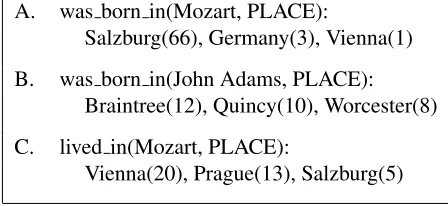
R(x,·). Figure 1 shows three example contradic-tion sets. Each example illustrates a situacontradic-tion com-monly found in our data. Example A in Figure 1 shows strong evidence for a functional relation. 66 out of 70 TEXTRUNNERextractions forwas born in (Mozart, PLACE) have the samey value. An am-biguous x argument, however, can make a
func-tional relation appear non-functional. Example B depicts a distribution of y values that appears less functional due to the fact that “John Adams” refers to multiple, distinct real-world individuals with that name. Finally, example C exhibits evidence for a non-functional relation.
A. was born in(Mozart, PLACE):
Salzburg(66), Germany(3), Vienna(1)
B. was born in(John Adams, PLACE): Braintree(12), Quincy(10), Worcester(8)
C. lived in(Mozart, PLACE):
[image:3.612.312.536.148.251.2]Vienna(20), Prague(13), Salzburg(5)
Figure 1: Functional relations such as example A have a different distribution ofyvalues than non-functional rela-tions such as C. However, an ambiguousxargument as in B, can make a functional relationappearnon-functional.
3.1 Formal Model of Functions in Text
To decide whether R is functional in x for all x, we first consider how to detect whether R is lo-cally functionalfor a particular value ofx. The local functionality ofR with respect toxis the probabil-ity thatRis functional estimated solely on evidence from the distribution ofy values in a contradiction setR(x,·).
To decide the probability thatRis a function, we define global functionality as the average local func-tionality score for eachx, weighted by the probabil-ity thatxis unambiguous. Below, we outline an EM-style algorithm that alternately estimates the proba-bility thatRis functional and the probability thatx is ambiguous.
Let R∗x indicate the event that the relation R is locally functional for the argumentx, and thatxis locally unambiguous for R. Also, let D indicate the set of observed tuples, and defineDR(x,·)as the multi-set containing the frequencies for extractions of the formR(x,·). For example the distribution of extractions from Figure 1 for example A is
Dwas born in(Mozart,·)={66,3,1}.
Let θfR be the probability that R(x,·) is locally functional for a randomx, and letΘf be the vector of these parameters across all relationsR. Likewise, θu
We wish to determine the maximum a pos-teriori (MAP) functionality and ambiguity pa-rameters given the observed data D, that is arg maxΘf,ΘuP(Θf,Θu|D). By Bayes Rule:
P(Θf,Θu|D) = P(D|Θ
f,Θu)P(Θf,Θu)
P(D) (1)
We outline a generative model for the data, P(D|Θf,Θu). Let us assume that the eventR∗x de-pends only on θRf and θux, and further assume that given these two parameters, local ambiguity and lo-cal functionality are conditionally independent. We obtain the following expression for the probability ofR∗xgiven the parameters:
P(R∗x|Θf,Θu) =θRfθxu
We assume each set of data DR(x,·) is gener-ated independently of all other data and parameters, givenR∗x. From this and the above we have:
P(D|Θf,Θu) =Y R,x
P(DR(x,·)|R∗x)θ f Rθ
u x
+P(DR(x,·)|¬R∗x)(1−θ f Rθxu)
(2)
These independence assumptions allow us to ex-press P(D|Θf,Θu) in terms of distributions over DR(x,·) given whether or notR∗xholds. We use the URNSmodel as described in (Downey et al., 2005) to estimate these probabilities based on binomial distributions. In the single-urn URNSmodel that we utilize, the extraction process is modeled as draws of labeled balls from an urn, where the labels are either correct extractions or errors, and different labels can be repeated on varying numbers of balls in the urn.
Let k = maxDR(x,·), and let n = PDR(x,·); we will approximate the distribution over DR(x,·) in terms of k and n. If R(x,·) is locally func-tional and unambiguous, there is exactly one cor-rect extraction label in the urn (potentially repeated multiple times). Because the probability of correct-ness tends to increase with extraction frequency, we make the simplifying assumption that the most fre-quently extracted element is correct.3 In this case,k is the number of correct extractions, which by the
3
As this assumption is invalid when there is not a unique maximal element, we default to the priorP(R∗x)in that case.
URNS model has a binomial distribution with pa-rametersnandp, wherepis the precision of the ex-traction process. IfR(x,·) isnotlocally functional and unambiguous, then we expectkto typically take on smaller values. Empirically, the underlying fre-quency of the most frequent element in the¬R∗xcase tends to follow a Beta distribution.
Under the model, the probability of the evidence givenR∗xis:
P(DR(x,·)|Rx∗)≈P(k, n|R∗x) =
n k !
pk(1−p)n−k
And the probability of the evidence given¬R∗xis:
P(DR(x,·)|¬Rx∗)≈P(k, n|¬Rx∗)
= nk R1
0
p0k+αf−1(1−p0)n+βf−1−k B(αf,βf) dp
0
= n k
Γ(n−k+βf)Γ(αf+k)
B(αf, βf)Γ(αf +βf +n)
(3)
where nis the sum over DR(x,·), Γ is the Gamma function andB is the Beta function. αf andβf are the parameters of the Beta distribution for the¬R∗x case. These parameters and the prior distributions are estimated empirically, based on a sample of the data set of relations described in Section 5.1.
3.2 Estimating Functionality and Ambiguity
Substituting Equation 3 into Equation 2 and apply-ing an appropriate prior gives the probability of pa-rameters Θf and Θu given the observed data D. However, Equation 2 contains a large product of sums—with two independent vectors of coefficients, Θf andΘu—making it difficult to optimize analyti-cally.
If we knew which arguments were ambiguous, we would ignore them in computing the function-ality of a relation. Likewise, if we knew which rela-tions were non-functional, we would ignore them in computing the ambiguity of an argument. Instead, we initialize theΘf and Θu arrays randomly, and then execute an algorithm similar to Expectation-Maximization (EM) (Dempster et al., 1977) to arrive at a high-probability setting of the parameters.
Equation 3. Likewise, for fixed Θf, for any given x we can compute the expected fraction of locally functional relationsRthat are locally unambiguous forx.
Specifically, we repeat until convergence:
1. SetθRf = s1 R
P
xP(R∗x|DR(x,·))θxufor allR.
2. Setθxu = s1 x
P
RP(Rx∗|DR(x,·))θfRfor allx.
In both steps above, the sums are taken over only thosexorRfor whichDR(x,·)is non-empty. Also, the normalizer sR = Pxθxu and likewise sx =
P
Rθ f R.
As in standard EM, we iteratively update our pa-rameter values based on an expectation computed over the unknown variables. However, we alter-nately optimize two disjoint sets of parameters (the functionality and ambiguity parameters), rather than just a single set of parameters as in standard EM. Investigating the optimality guarantees and conver-gence properties of our algorithm is an item of future work.
By iteratively setting the parameters to the expec-tations in steps 1 and 2, we arrive at a good setting of the parameters. Section 5.2 reports on the perfor-mance of this algorithm in practice.
4 System Overview
AUCONTRAIRE identifies phrases denoting func-tional relations and utilizes these to find contradic-tory assertions in a massive, open-domain corpus of text.
AUCONTRAIREbegins by finding extractions of the form R(x, y), and identifies a set of relations R that have a high probability of being functional. Next, AUCONTRAIRE identifies contradiction sets
of the formR(x,·). In practice, most contradiction sets turned out to consist overwhelmingly of seem-ing contradictions—assertions that do not actually contradict each other for a variety of reasons that we enumerate in section 4.3. Thus, a major chal-lenge for AUCONTRAIRE is to tease apart which pairs of assertions inR(x,·)represent genuine con-tradictions.
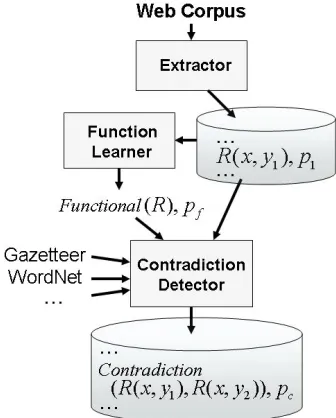
Here are the main components of AUCONTRAIRE
as illustrated in Figure 2:
Extractor: Create a set of extracted assertions E
[image:5.612.346.514.60.269.2]from a large corpus of Web pages or other docu-ments. Each extractionR(x, y) has a probabilityp
Figure 2: AUCONTRAIREarchitecture
of being correct.
Function Learner:Discover a set of functional re-lationsF from among the relations inE. Assign to each relation inF a probability pf that it is func-tional.
Contradiction Detector: Query E for assertions
with a relation R in F, and identify sets C of po-tentially contradictory assertions. Filter out seeming contradictions in C by reasoning about synonymy, meronymy, argument types, and argument ambigu-ity. Assign to each potential contradiction a proba-bilitypcthat it is a genuine contradiction.
4.1 Extracting Factual Assertions
AUCONTRAIRE needs to explore a large set of factual assertions, since genuine contradictions are quite rare (see Section 5). We used a set of extrac-tionsE from the Open Information Extraction sys-tem, TEXTRUNNER(Banko et al., 2007), which was
run on a set of 117 million Web pages.
TEXTRUNNER does not require a pre-defined set of relations, but instead uses shallow linguistic anal-ysis and a domain-independent model to identify phrases from the text that serve as relations and phrases that serve as arguments to that relation. TEXTRUNNER creates a set of extractions in a
sin-gle pass over the Web page collection and provides an index to query the vast set of extractions.
Although its extractions are noisy, TEXTRUNNER
cor-rect, based in part on corroboration of facts from different Web pages (Downey et al., 2005).
4.2 Finding Potential Contradictions
The next step of AUCONTRAIRE is to find
contra-diction sets inE.
We used the methods described in Section 3 to estimate the functionality of the most frequent rela-tions inE. For each relationRthat AUCONTRAIRE
has judged to be functional, we identify contradic-tion setsR(x,·), where a relationRand domain ar-gumentxhave multiple range argumentsy.
4.3 Handling Seeming Contradictions
For a variety of reasons, a pair of extractions R(x, y1) andR(x, y2) may not be actually contra-dictory. The following is a list of the major sources of false positives—pairs of extractions that are not genuine contradictions, and how they are handled by AUCONTRAIRE. The features indicative of each
condition are combined using Logistic Regression, in order to estimate the probability that a given pair, {R(x, y1), R(x, y2)}is a genuine contradiction.
Synonyms: The set of potential contradictions
died from(Mozart,·) may contain assertions that Mozart died fromrenal failureand that he died from
kidney failure. These are distinct values of y, but do not contradict each other, as the two terms are synonyms. AUCONTRAIREuses a variety of
knowl-edge sources to handle synonyms. WordNet is a re-liable source of synonyms, particularly for common nouns, but has limited recall. AUCONTRAIRE also utilizes synonyms generated by RESOLVER (Yates and Etzioni, 2007)— a system that identifies syn-onyms from TEXTRUNNER extractions. Addition-ally, AUCONTRAIRE uses edit-distance and token-based string similarity (Cohen et al., 2003) between apparently contradictory values ofyto identify syn-onyms.
Meronyms: For some relations, there is no
con-tradiction when y1 and y2 share a meronym,
i.e. “part of” relation. For example, in the set
born in(Mozart,·) there is no contradiction be-tween the y values “Salzburg” and “Austria”, but “Salzburg” conflicts with “Vienna”. Although this is only true in cases where y occurs in an up-ward monotone context (MacCartney and Manning, 2007), in practice genuine contradictions between
y-values sharing a meronym relationship are ex-tremely rare. We therefore simply assigned contra-dictions between meronyms a probability close to zero. We used the Tipster Gazetteer4 and WordNet to identify meronyms, both of which have high pre-cision but low coverage.
Argument Typing: Two y values are not
contra-dictory if they are of different argument types. For example, the relation born in can take a date or a location for the y value. While a person can be born in only one year and in only one city, a per-son can be born in both a year and a city. To avoid such false positives, AUCONTRAIRE uses a
sim-ple named-entity tagger5 in combination with large dictionaries of person and location names to as-sign high-level types (person, location, date, other) to each argument. AUCONTRAIRE filters out ex-tractions from a contradiction set that do not have matching argument types.
Ambiguity: As pointed out in Section 3, false con-tradictions arise when a singlexvalue refers to mul-tiple real-world entities. For example, if the con-tradiction set born in(John Sutherland, ·) includes birth years of both 1827 and 1878, is one of these a mistake, or do we have a grandfather and grandson with the same name? AUCONTRAIREcomputes the probability that an x value is unambiguous as part of its Function Learner (see Section 3). Anxvalue can be identified as ambiguous if its distribution of yvalues is non-functional for multiple functional re-lations.
If a pair of extractions,{R(x, y1), R(x, y2)}, does not fall into any of the above categories and R is functional, then it is likely that the sentences under-lying the extractions are indeed contradictory. We combined the various knowledge sources described above using Logistic Regression, and used 10-fold cross-validation to automatically tune the weights associated with each knowledge source. In addi-tion, the learning algorithm also utilizes the follow-ing features:
• Global functionality of the relation,θfR
• Global unambiguity ofx,θux
4http://crl.nmsu.edu/cgi-bin/Tools/CLR/
clrcat
5http://search.cpan.org/˜simon/
• Local functionality ofR(x,·)
• String similarity (a combination of token-based similarity and edit-distance) betweeny1 andy2 • The argument types (person, location, date, or
other)
The learned model is then used to estimate how likely a potential contradiction{R(x, y1), R(x, y2)} is to be genuine.
5 Experimental Results
We evaluated several aspects of AUCONTRAIRE: its ability to detect functional relations and to de-tect ambiguous arguments (Section 5.2); its preci-sion and recall in contradiction detection (Section 5.3); and the contribution of AUCONTRAIRE’s key
knowledge sources (Section 5.4).
5.1 Data Set
To evaluate AUCONTRAIRE we used TEXTRUN
-NER’s extractions from a corpus of 117 million Web pages. We restricted our data set to the 1,000 most frequent relations, in part to keep the experiments tractable and also to ensure sufficient statistical sup-port for identifying functional relations.
We labeled each relation as functional or not, and computed an estimate of the probability it is functional as described in section 3.2. Section 5.2 presents the results of the Function Learner on this set of relations. We took the top 2% (20 relations) as F, the set of functional relations in our exper-iments. Out of these, 75% are indeed functional. Some examples include: was born in, died in, and
was founded by.
There were 1.2 million extractions for all thou-sand relations, and about 20,000 extractions in 6,000 contradiction sets for all relations inF.
We hand-tagged 10% of the contradiction sets R(x,·)whereR∈ F, discarding any sets with over 20 distinct y values since the x argument for that set is almost certainly ambiguous. This resulted in a data set of 567 contradiction sets containing a total of 2,564 extractions and 8,844 potentially contradic-tory pairs of extractions.
We labeled each of these 8,844 pairs as contradic-tory or not. In each case, we inspected the original sentences, and if the distinction was unclear, con-sulted the original source Web pages, Wikipedia ar-ticles, and Web search engine results.
In our data set, genuine contradictions over func-tional relations are surprisingly rare. We found only 110 genuine contradictions in the hand-tagged sam-ple, only 1.2% of the potential contradiction pairs.
5.2 Detecting Functionality and Ambiguity
We ran AUCONTRAIRE’s EM algorithm on the thousand most frequent relations. Performance con-verged after 5 iterations resulting in estimates of the probability that each relation is functional and each xargument is unambiguous. We used these proba-bilities to generate the precision-recall curves shown in Figure 3.
The graph on the left shows results for function-ality, while the graph on the right shows precision at finding unambiguous arguments. The solid lines are results after 5 iterations of EM, and the dashed lines are from computing functionality or ambiguity with-out EM (i.e. assuming uniform values ofΘc when computingΘf and vice versa). The EM algorithm improved results for both functionality and ambigu-ity, increasing area under curve (AUC) by 19% for functionality and by 31% for ambiguity.
Of course, the ultimate test of how well AUCON
-TRAIREcan identify functional relations is how well the Contradiction Detector performs on automati-cally identified functional relations.
5.3 Detecting Contradictions
We conducted experiments to evaluate how well AUCONTRAIRE distinguishes genuine contradic-tions from false positives.
The bold line in Figure 4 depicts AUCONTRAIRE
performance on the distribution of contradictions and seeming contradictions found in actual Web data. The dashed line shows the performance of AU
-CONTRAIRE on an artificially “balanced” data set
that we constructed to contain 50% genuine contra-dictions and 50% seeming ones.
Functionality
Recall
Precision
0.0 0.2 0.4 0.6 0.8 1.0
0.0
0.2
0.4
0.6
0.8
1.0
AuContraire No Iteration
Ambiguity
Recall
Precision
0.0 0.2 0.4 0.6 0.8 1.0
0.0
0.2
0.4
0.6
0.8
1.0
[image:8.612.109.492.63.227.2]AuContraire No Iteration
Figure 3: After 5 iterations of EM, AUCONTRAIREachieves a 19% boost to area under the precision-recall curve (AUC) for functionality detection, and a 31% boost to AUC for ambiguity detection.
Recall
Precision
0.0 0.2 0.4 0.6 0.8 1.0
0.0
0.2
0.4
0.6
0.8
1.0
[image:8.612.90.264.274.426.2]Web Distribution Balanced Data
Figure 4: Performance of AUCONTRAIREat distinguish-ing genuine contradictions from false positives. The bold line is results on the actual distribution of data from the Web. The dashed line is from a data set constructed to have 50% positive and 50% negative instances.
5.4 Contribution of Knowledge Sources
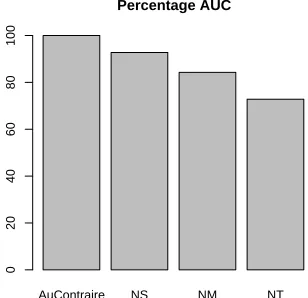
We carried out an ablation study to quantify how much each knowledge source contributes to AU -CONTRAIRE’s performance. Since most of the knowledge sources do not apply to numeric argu-ment values, we excluded the extractions where y is a number in this study. As shown in Figure 5, performance of AUCONTRAIRE degrades with no
knowledge of synonyms (NS), with no knowledge of meronyms (NM), and especially without argu-ment typing (NT). Conversely, improveargu-ments to any of these three components would likely improve the performance of AUCONTRAIRE.
The relatively small drop in performance from
no meronyms does not indicate that meronyms are not essential to our task, only that our knowledge sources for meronyms were not as useful as we hoped. The Tipster Gazetteer has surprisingly low coverage for our data set. It contains only 41% of the y values that are locations. Many of these are matches on a different location with the same name, which results in incorrect meronym information. We estimate that a gazetteer with complete coverage would increase area under the curve by approxi-mately 40% compared to a system with meronyms from the Tipster Gazetteer and WordNet.
AuContraire NS NM NT
Percentage AUC
0
20
40
60
80
100
Figure 5: Area under the precision-recall curve for the full AUCONTRAIREand for AUCONTRAIREwith knowl-edge removed. NS has no synonym knowlknowl-edge; NM has no meronym knowledge; NT has no argument typing.
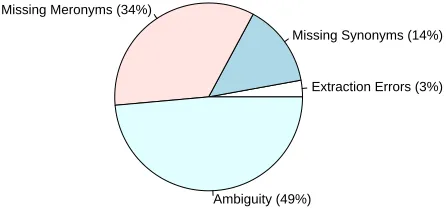
[image:8.612.346.500.452.601.2]Figure 6 reveals the central importance of world knowledge for the CD task. About half of the errors (49%) are due to ambiguousx-arguments, which we found to be one of the most persistent obstacles to discovering genuine contradictions. A sizable por-tion is due to missing meronyms (34%) and missing synonyms (14%), suggesting that lexical resources with broader coverage than WordNet and the Tipster Gazetteer would substantially improve performance. Surprisingly, only 3% are due to errors in the extrac-tion process.
Extraction Errors (3%) Missing Synonyms (14%) Missing Meronyms (34%)
Ambiguity (49%)
Figure 6: Sources of errors in contradiction detection.
All of our experimental results are based on the automatically discovered set of functions F. We would expect AUCONTRAIRE’s performance to im-prove substantially if it were given a large set of functional relations as input.
6 Related Work
Condoravdiet al.(2003) first proposed contradiction detection as an important NLP task, and Harabagiu
et al.(2006) were the first to report results on con-tradiction detection using negation, although their evaluation corpus was a balanced data set built by manually negating entailments in a data set from the Recognizing Textual Entailment confer-ences (RTE) (Dagan et al., 2005). De Marneffeet al.(2008) reported experimental results on a contra-diction corpus created by annotating the RTE data sets.
RTE-3 included an optional task, requiring sys-tems to make a 3-way distinction: {entails, contra-dicts, neither}(Voorhees, 2008). The average per-formance for contradictions on the RTE-3 was preci-sion 0.11 at recall 0.12, and the best system had pre-cision 0.23 at recall 0.19. We did not run AUCON
-TRAIREon the RTE data sets because they contained
relatively few of the “functional contradictions” that AUCONTRAIRE tackles. On our Web-based data sets, we achieved a precision of 0.62 at recall 0.19, and precision 0.92 at recall 0.51 on the balanced data set. Of course, comparisons across very different data sets are not meaningful, but merely serve to un-derscore the difficulty of the CD task.
[image:9.612.74.297.225.329.2]In contrast to previous work, AUCONTRAIRE is the first to do CD on data automatically extracted from the Web. This is a much harder problem than using an artificially balanced data set, as shown in Figure 4.
Automatic discovery of functional relations has been addressed in the database literature as Func-tional Dependency Mining (Huhtala et al., 1999; Yao and Hamilton, 2008). This focuses on dis-covering functional relationships between sets of at-tributes, and does not address the ambiguity inherent in natural language.
7 Conclusions and Future Work
We have described a case study of contradiction de-tection (CD) based on functional relations. In this context, we introduced and evaluated the AUCON
-TRAIRE system and its novel EM-style algorithm for determining whether an arbitrary phrase is func-tional. We also created a unique “natural” data set ofseeming contradictionsbased on sentences drawn from a Web corpus, which we make available to the research community.
We have drawn two key lessons from our case study. First, many seeming contradictions (approx-imately 99% in our experiments) are not genuine contradictions. Thus, the CD task may be much harder on natural data than on RTE data as sug-gested by Figure 4. Second, extensive background knowledge is necessary to tease apart seeming con-tradictions from genuine ones. We believe that these lessons are broadly applicable, but verification of this claim is a topic for future work.
Acknowledgements
References
M. Banko and O. Etzioni. 2008. The tradeoffs between traditional and open relation extraction. In Proceed-ings of ACL.
M. Banko, M. Cafarella, S. Soderland, M. Broadhead, and O. Etzioni. 2007. Open information extraction from the Web. InProcs. of IJCAI.
W.W. Cohen, P. Ravikumar, and S.E. Fienberg. 2003. A comparison of string distance metrics for name-matching tasks. InIIWeb.
Cleo Condoravdi, Dick Crouch, Valeria de Paiva, Rein-hard Stolle, and Daniel G. Bobrow. 2003. Entailment, intensionality and text understanding. InProceedings of the HLT-NAACL 2003 workshop on Text meaning, pages 38–45, Morristown, NJ, USA. Association for Computational Linguistics.
I. Dagan, O. Glickman, and B. Magnini. 2005. The PASCAL Recognising Textual Entailment Challenge. Proceedings of the PASCAL Challenges Workshop on Recognising Textual Entailment, pages 1–8.
Marie-Catherine de Marneffe, Anna Rafferty, and Christopher D. Manning. 2008. Finding contradic-tions in text. InACL 2008.
A.P. Dempster, N.M. Laird, and D.B. Rubin. 1977. Max-imum likelihood from incomplete data via the EM al-gorithm. Journal of the Royal Statistical Society Se-ries B, 39(1):1–38.
D. Downey, O. Etzioni, and S. Soderland. 2005. A Prob-abilistic Model of Redundancy in Information Extrac-tion. InProcs. of IJCAI.
Sanda Harabagiu, Andrew Hickl, and Finley Lacatusu. 2006. Negation, contrast and contradiction in text pro-cessing. InAAAI.
Yk¨a Huhtala, Juha K¨arkk¨ainen, Pasi Porkka, and Hannu Toivonen. 1999. TANE: An efficient algorithm for discovering functional and approximate dependencies. The Computer Journal, 42(2):100–111.
B. MacCartney and C.D. Manning. 2007. Natural Logic for Textual Inference. InWorkshop on Textual Entail-ment and Paraphrasing.
Ellen M. Voorhees. 2008. Contradictions and justifica-tions: Extensions to the textual entailment task. In Proceedings of ACL-08: HLT, pages 63–71, Colum-bus, Ohio, June. Association for Computational Lin-guistics.
Hong Yao and Howard J. Hamilton. 2008. Mining func-tional dependencies from data. Data Min. Knowl. Dis-cov., 16(2):197–219.