Rationale-Augmented Convolutional Neural Networks
for Text Classification
Ye Zhang,1 Iain Marshall,2 Byron C. Wallace3
1Department of Computer Science, University of Texas at Austin
2Department of Primary Care and Public Health Sciences, Kings College London 3College of Computer and Information Science, Northeastern University
[email protected], [email protected] [email protected]
Abstract
We present a new Convolutional Neural Net-work (CNN) model for text classification that jointly exploits labels on documents and their constituent sentences. Specifically, we con-sider scenarios in which annotators explic-itly mark sentences (or snippets) that sup-port their overall document categorization, i.e., they provide rationales. Our model ex-ploits such supervision via a hierarchical ap-proach in which each document is represented by a linear combination of the vector repre-sentations of its component sentences. We propose a sentence-level convolutional model that estimates the probability that a given sen-tence is a rationale, and we then scale the contribution of each sentence to the aggre-gate document representation in proportion to these estimates. Experiments on five classifi-cation datasets that have document labels and associated rationales demonstrate that our ap-proach consistently outperforms strong base-lines. Moreover, our model naturally provides explanations for its predictions.
1 Introduction
Neural models that exploit word embeddings have recently achieved impressive results on text classifi-cation tasks (Goldberg, 2015). Feed-forward Con-volutional Neural Networks (CNNs), in particular, have emerged as a relatively simple yet powerful class of models for text classification (Kim, 2014).
These neural text classification models have tended to assume a standard supervised learning set-ting in which instance labels are provided. Here we consider an alternative scenario in which we assume
that we are provided a set of rationales (Zaidan et al., 2007; Zaidan and Eisner, 2008; McDonnell et al., 2016) in addition to instance labels, i.e., sen-tences or snippets that support the corresponding document categorizations. Providing such rationales during manual classification is a natural interaction for annotators, and requires little additional effort (Settles, 2011; McDonnell et al., 2016). Therefore, when training new classification systems, it is natu-ral to acquire supervision at both the document and sentence level, with the aim of inducing a better pre-dictive model, potentially with less effort.
Learning algorithms must be designed to capital-ize on these two types of supervision. Past work (Section 2) has introduced such methods, but these have relied on linear models such as Support Vector Machines (SVMs) (Joachims, 1998), operating over sparse representations of text. We propose a novel CNN model for text classification that exploits both document labels and associated rationales.
Specific contributions of this work as follows. (1) This is the first work to incorporate rationales into neural models for text classification. (2) Empiri-cally, we show that the proposed model uniformly outperforms relevant baseline approaches across five datasets, including previously proposed models that capitalize on rationales (Zaidan et al., 2007; Mar-shall et al., 2016) and multiple baseline CNN vari-ants, including a CNN equipped with an attention mechanism. We also report state-of-the-art results on the important task of automatically assessing the risks of bias in the studies described in full-text biomedical articles (Marshall et al., 2016). (3) Our model naturally providesexplanationsfor its
tions, providing interpretability.
We have made available online both a Theano1 and a Keras implementation2of our model.
2 Related Work
2.1 Neural models for text classification
Kim (2014) proposed the basic CNN model we de-scribe below and then build upon in this work. Prop-erties of this model were explored empirically in (Zhang and Wallace, 2015). We also note that Zhang et al. (2016) extended this model to jointly accom-modate multiple sets of pre-trained word embed-dings. Roughly concurrently to Kim, Johnson and Zhang (2014) proposed a similar CNN architecture, although they swapped in one-hot vectors in place of (pre-trained) word embeddings. They later de-veloped a semi-supervised variant of this approach (Johnson and Zhang, 2015).
In related recent work on Recurrent Neural Net-work (RNN) models for text, Tang et al. (2015) pro-posed using a Long Short Term Memory (LSTM) layer to represent each sentence and then passing another RNN variant over these. And Yang et al. (2016) proposed a hierarchical network with two levels of attention mechanisms for document clas-sification. We discuss this model specifically as well as attention more generally and its relationship to our proposed approach in Section 4.3.
2.2 Exploitingrationales
In long documents the importance of sentences varies; some are more central than others. Prior work has investigated methods to measure the rel-ative importance sentences (Ko et al., 2002; Murata et al., 2000). In this work we adopt a particular view of sentence importance in the context of document classification. In particular, we assume that docu-ments comprise sentences that directly support their categorization. We call such sentencesrationales.
The notion of rationales was first introduced by Zaidan et al. (2007). To harness these for classifi-cation, they proposed modifying the Support Vec-tor Machine (SVM) objective function to encode a preference for parameter values that result in in-stances containing manually annotated rationales
1https://github.com/yezhang-xiaofan/Rationale-CNN 2https://github.com/bwallace/rationale-CNN
being more confidently classified than ‘pseudo’-instances from which these rationales had been stripped. This approach dramatically outperformed baseline SVM variants that do not exploit such ra-tionales. Yessenalina et al. (2010) later developed an approach togeneraterationales.
Another line of related work concerns models that capitalize on dual supervision, i.e., labels on indi-vidualfeatures. This work has largely involved in-serting constraints into the learning process that fa-vor parameter values that align witha priori feature-label affinities or rankings (Druck et al., 2008; Mann and McCallum, 2010; Small et al., 2011; Settles, 2011). We do not discuss this line of work further here, as our focus is on exploiting provided ratio-nales, rather than individual labeled features.
3 Preliminaries: CNNs for text classification
Convolution layer
word embedding 1 max pooling
Patients were randomized
to placebo
or intervention Four feature
maps Sentence feature
vectoro
[image:2.612.350.497.331.554.2]Softmax layer
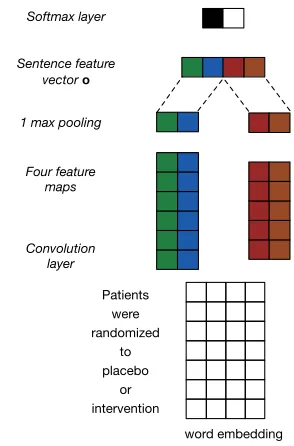
Figure 1: A toy example of a CNN for sentence classification. Here there are four filters, two with heights 2 and two with heights 3, resulting in feature maps with lengths 6 and 5 respectively.
We first review the simple one-layer CNN for sentence modeling proposed by Kim (2014). Given a sentence or document comprisingnwords w1, w2,...,wn, we replace each word with its d
We then apply convolution operations on this ma-trix using multiple linear filters, these will have the same width d but may vary in height. Each filter thus effectively considers distinct n-gram features, wherencorresponds to the filter height. In practice, we introduce multiple, redundant features of each height; thus each filter height might have hundreds of corresponding instantiated filters. Applying filter iparameterized byWi ∈ Rhi·dto the instance
ma-trix induces afeature mapfi ∈Rn−hi+1. This
pro-cess is performed by sliding the filter from the top of the matrix (the start of the document or sentence) to the bottom. At each location, we apply element-wise multiplication between filteriand sub-matrix A[j : j +hi −1], and then sum up the resultant
matrix elements. In this way, we induce a vector (feature map) for each filter.
We next run the feature map through an element-wise non-linear transformation. Specifically, we use the Rectified Linear Unit, or ReLU (Krizhevsky et al., 2012). We extract the maximum valueoi from
each feature mapi(1-max pooling).
Finally, we concatenate all of the features oi to
form a vector representation o ∈ R|F| for this in-stance, where|F|denotes the total number of filters. Classification is then performed on top of o, via a
softmax function. Dropout (Srivastava et al., 2014) is often applied at this layer as a means of regular-ization. We provide an illustrative schematic of the basic CNN architecture just described in Figure 1. For more details, see (Zhang and Wallace, 2015).
This model was originally proposed for sentence classification (Kim, 2014), but we can adapt it for document classification by simply treating the doc-ument as one long sentence. We will refer to this basic CNN variant asCNNin the rest of the paper. Below we consider extensions that account for doc-ument structure.
4 Rationale-Augmented CNN for Document Classification
We now move to the main contribution of this work: a rationale-augmented CNN for text classi-fication. We first introduce a simple variant of the above CNN that models document structure (Section 4.1) and then introduce a means of incorporating rationale-level supervision into this model (Section
4.2). In Section 4.3 we discuss connections to atten-tion mechanisms and describe a baseline equipped with one, inspired by Yang et al. (2016).
4.1 Modeling Document Structure
Recall that rationales are snippets of text marked as having supported document-level categorizations. We aim to develop a model that can exploit these an-notations during training to improve classification. Here we achieve this by developing a hierarchical model that estimates the probabilities of individual sentences being rationales and uses these estimates to inform the document level classification.
As a first step, we extend the CNN model above to explicitly account for document structure. Specif-ically, we apply a CNN to each individual sentence in a document to obtain sentence vectors indepen-dently. We then sum the respective sentence vectors to create a document vector.3 As before, we add a softmax layer on top of the document-level vector to perform classification. We perform regularization by applying dropout both on the individual sentence vectors and the final document vector. We will re-fer to this model asDoc-CNN. Doc-CNN forms the basis for our novel approach, described below.
4.2 RA-CNN
In this section we present the Rationale-Augmented CNN (RA-CNN). Briefly, RA-CNN induces a document-level vector representation by taking a
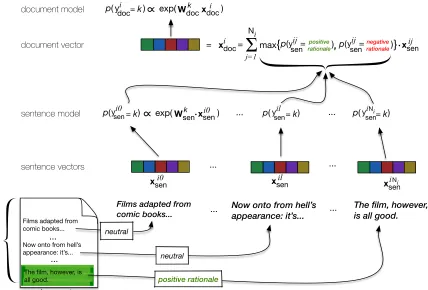
weighted sum of its constituent sentence vectors. Each sentence weight is set to reflect the estimated probability that it is a rationale in support of the most likely class. We provide a schematic of this model in Figure 2.
RA-CNN capitalizes on both sentence- and document-level supervision. There are thus two steps in the training phase: sentence level training anddocument leveltraining. For the former, we ap-ply a CNN to each sentencejin documentito obtain sentence vectorsxijsen. We then add a softmax layer parametrized by Wsen; this takes as input sentence vectors. We fit this model to maximize the probabil-ities of the observed rationales:
3We also experimented with taking the average of sentence
p( )
sentence vectors
Films adapted from
comic books... ... Now onto from hell’s appearance: it’s... ... The film, however, is all good.
... ...
sentence model
Σ
... ...
ydoci
yseni0
p( ) Wsen
xseni0
xseni0
exp( . )
.xsenij
= k k
xsenil x
seni
yil
sen= k
Ni
j=1
Ni
p( )yi
sen= k
Ni
xdoci Wdocxdoci
exp( k )
p( )= k
document i
Films adapted from comic books...
Now onto from hell’s appearance: it’s...
...
...
The film, however, is all good.
N i
sentences
positive rationale
neutral neutral
= =
document model
max{ yij }
sen=rationalepositive
p( yij )
sen=rationalenegative ,p(
)
[image:4.612.89.517.67.357.2]document vector
Figure 2: A schematic of our proposed Rationale-Augmented Convolution Neural Network (RA-CNN). The sentences comprising a text are passed through a sentence model that outputs probabilities encoding the likelihood that sentences are neutral or a (positive or negative) rationale. Sentences likely to be rationales are given higher weights in the global document vector, which is the input to the document model.
p(ysenij =k;E,C,Wsen) = exp(W
(k)T sen xijsen) PKsen
k=1exp(W (k)T sen xijsen)
(1) Whereysenij denotes the rationale label for sentencej in documenti,Ksendenotes the number of possible classes for sentences, E denotes the word embed-ding matrix,Cdenotes the convolution layer param-eters, and Wsen is a matrix of weights (comprising one weight vector per sentence class).
In our setting, each sentence has three possible labels (Ksen = 3). When a rationale sentence ap-pears in a positive document,4 it is apositive ratio-nale; when a rationale sentence appears in a negative document, it is anegative rationale. All other
sen-4All of the document classification tasks we consider here
are binary, although extension of our model to multi-class sce-narios is straight-forward.
tences belong to a third, neutral class: these are non-rationales. We also experimented with having only two sentence classes:rationalesandnon-rationales, but this did not perform as well as explicitly main-taining separate classes for rationales of different polarities.
that corresponding sentences are rationales in the most likely direction. More precisely:
xidoc = Ni
X
j=1
xijsen·max{pijpos, pijneg} (2)
WhereNiis the number of sentences in theith
doc-ument. The intuition is that sentences likely to be ra-tionales will have greater influence on the resultant document vector representation, while the contribu-tion of neutral sentences (which are less relevant to the classification task) will be minimized.
The final classification is performed by a softmax layer parameterized byWdoc; the inputs to this layer are the document vectors. TheWdocparameters are trained using the document-level labels,yidoc:
p(yidoc=k;E,C,Wdoc) = exp(W
(k)T doc xidoc) PKdoc
k=1exp(W (k)T doc xidoc)
(3) whereKdocis the cardinality of the document label set. We optimize over parameters to minimize cross-entropy loss (w.r.t. the document labels).
We note that the sentence- and document-level models share word embeddingsE and convolution layer parameters C, but the document-level model
has its own softmax parametersWdoc. When train-ing the document-level model,E, CandWdoc are fit, but we holdWsenfixed.
The above two-step strategy can be equivalently described as follows. We first estimate E, C and
Wsen, which parameterize our model for identifying rationales in documents. We then move to fitting our document classification model. For this we initialize the word embedding and convolution parameters to theEandCestimates from the preceding step. We
then directly minimize the document level classifica-tion objective, tuningEandCand simultaneously
fittingWdoc.
Note that this sequential training strategy differs from the alternating training approach commonly used in multi-task learning (Collobert and Weston, 2008). We found that the latter approach does not work well here, leading us to instead adopt the cascade-like feature learning approach (Collobert and Weston, 2008) just described.
One nice property of our model is that it naturally provides explanations for its predictions: the model identifies rationales and then categorizes documents informed by these. Thus if the model classifies a test instance as positive, then by construction the sen-tences associated with the highestpijposestimates are those that the model relied on most in coming to this disposition. These sentences can of course be out-put in conjunction with the prediction. We provide concrete examples of this in Section 7.2.
4.3 Rationales as ‘Supervised Attention’
One may view RA-CNN as a supervised variant of a model equipped with anattention mechanism (Bah-danau et al., 2014). On this view, it is apparent that rather than capitalizing on rationales directly, we could attempt to let the model learn which sentences are important, usingonly the document labels. We therefore construct an additional baseline that does just this, thereby allowing us to assess the impact of learning directly from rationale-level supervision.
Following the recent work of Yang et al. (2016), we first posit for each sentence vector a hidden rep-resentation uijsen. We then define a sentence-level context vectorus, which we multiply with eachuijsen to induce a weightαij. Finally, the document
vec-tor is taken as a weighted sum over sentence vecvec-tors, where weights reflectα’s. We have:
uijsen=tanh(Wsxijsen+bs) (4)
αij = exp(u T suijsen) PNi
j exp(uTsuijsen)
(5)
xidoc= Ni
X
j
αijxijsen (6)
where xidoc again denotes the document vector fed
into a softmax layer, andWs,usandbsare learned
during training. We will refer to this attention-based method asAT-CNN.
5 Datasets
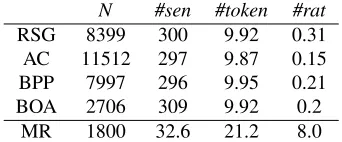
with each document categorization. We summarize attributes of all datasets used in this work in Table 1.
5.1 Risk of Bias (RoB) Datasets
We used a collectionRisk of Bias(RoB) text classifi-cation datasets, described at length elsewhere (Mar-shall et al., 2016). Briefly, the task concerns as-sessing the reliability of the evidence presented in full-text biomedical journal articles that describe the conduct and results of randomized controlled trials (RCTs). This involves, e.g., assessing whether or not patients were properly blinded as to whether they were receiving an active treatment or a comparator (such as a placebo). If such blinding is not done correctly, it compromises the study by introducing statistical bias into the treatment efficacy estimate(s) derived from the trial.
A formal system for making bias assessments is codified by the Cochrane Risk of Bias Tool (Hig-gins et al., 2011). This tool defines multiple do-mains; the risk of bias may be assessed in each of these. We consider four domains here. (1) Random sequence generation (RSG): were patients were as-signed to treatments in a truly random fashion? (2) Allocation concealment (AC): were group assign-ments revealed to the person assigning patients to groups (so that she may have knowingly or unknow-ingly) influenced these assignments? (3) Blinding of Participants and Personnel (BPP): were all trial participants and individuals involved in running the trial blinded as to who was receiving which treat-ment? (4) Blinding of outcome assessment (BOA): were the parties who measured the outcome(s) of in-terest blinded to the intervention group assignments? These assessments are somewhat subjective. To in-crease transparency, researchers performing RoB as-sessment therefore record rationales (sentences from articles) supporting their assessments.
5.2 Movie Review Dataset
We also ran experiments on a movie review (MR) dataset with accompanying rationales. Pang and Lee (2004) developed and published the original ver-sion of this dataset, which comprises 1000 positive and 1000 negative movie reviews from the Internet Movie Database (IMDB).5 Zaidan et al. (2007) then
5http://www.imdb.com/
N #sen #token #rat
RSG 8399 300 9.92 0.31
AC 11512 297 9.87 0.15
BPP 7997 296 9.95 0.21
BOA 2706 309 9.92 0.2
[image:6.612.341.512.58.129.2]MR 1800 32.6 21.2 8.0
Table 1: Dataset characteristics. Nis the number of instances,#senis the average sentence count,#token
is the average token per-sentence count and#rat is the average number of rationales per document.
augmented this dataset by adding rationales corre-sponding to the binary classifications for 1800 doc-uments, leaving the remaining 200 for testing. Be-cause 200 documents is a modest test sample size, we ran 9-fold cross validation on the 1800 annotated documents (each fold comprising 200 documents). The rationales, as originally marked in this dataset, were sub-sentential snippets; for the purposes of our model, we considered the entire sentences contain-ing the marked snippets as rationales.
6 Experimental Setup
6.1 Baselines
We compare against several baselines to assess the advantages of directly incorporating rationale-level supervision into the proposed CNN architecture. We describe these below.
SVMs. We evaluated a few variants of linear Sup-port Vector Machines (SVMs). These rely on sparse representations of text. We consider variants that ex-ploit uni- and bi-grams; we refer to these asuni-SVM
andbi-SVM, respectively. We also re-implemented the rationale augmented SVM (RA-SVM) proposed by Zaidan et al. (2007), described in Section 2.
RoB assessments in the respective domains. Special features extracted from these predicted rationales are then activated in thedocument-levelmodel, inform-ing the final classification. This model is the state-of-the-art on this task.
CNNs. We compare against several baseline CNN variants to demonstrate the advantages of our ap-proach. We emphasize that our focus in this work is not to explore how to induce generally ‘better’ document vector representations – this question has been addressed at length elsewhere, e.g., (Le and Mikolov, 2014; Jozefowicz et al., 2015; Tang et al., 2015; Yang et al., 2016).
Rather, the main contribution here is an augmen-tation of CNNs for text classification to capitalize on rationale-level supervision, thus improving perfor-mance and enhancing interpretability. This informed our choice of baseline CNN variants: standard CNN (Kim, 2014), Doc-CNN (described above) and AT-CNN (also described above) that capitalizes on an (unsupervised) attention mechanism at the sentence level, described in Section 4.3.6
6.2 Implementation/Hyper-Parameter Details Sentence splitting. To split the documents from all datasets into sentences for consumption by our Doc-CNN and RA-Doc-CNN models, we used the Natural Language Toolkit (NLTK)7sentence splitter.
SVM-based models. We kept the 50,000 most
frequently occurring features in each dataset. For estimation we used SGD. We tuned the C hyper-parameter using nested development sets. For the RA-SVM, we additionally tuned theµandCcontrast
parameters, as per Zaidan et al. (2007).
CNN-based models. For all models and datasets
we initialized word embeddings to pre-trained vec-tors fit via Word2Vec. For the movie reviews dataset these were 300-dimensional and trained on Google News.8 For the RoB datasets, these were 200-dimensional and trained on biomedical texts in PubMed/PubMed Central (Pyysalo et al., 2013).9
6We also experimented briefly with LSTM and GRU (Gated
Recurrent Unit) models, but found that simple CNN performed better than these. Moreover, CNNs are relatively robust and less sensitive to hyper-parameter selection.
7http://www.nltk.org/api/nltk.tokenize.html 8https://code.google.com/archive/p/word2vec/ 9http://bio.nlplab.org/
Training proceeded as follows. We first extracted all sentences from all documents in the training data. The distribution of sentence types is highly imbalanced (nearly all are neutral). Therefore, we downsampled sentences before each epoch, so that sentence classes were equally represented. After training on sentence-level supervision, we moved to document-level model fitting. For this we initialized embedding and convolution layer parameters to the estimates from the preceding sentence-level training step (though these were further tuned to optimize the document-level objective).
For RA-CNN, we tuned the dropout rate (range: 0-.9) applied at the sentence vector level on each training fold (using a subset of the training data as a validation set) during the document level training phase. Anecdotally, we found this has a greater ef-fect than the other model hyperparameters, which we thus set after a small informal process of exper-imentation on a subset of the data. Specifically, we fixed the dropout rate at the document level to 0.5, and we used 3 different filter heights: 3, 4 and 5, following (Zhang and Wallace, 2015). For each fil-ter height, we used 100 feature maps for the baseline CNN, and 20 for all the other CNN variants.
For parameter estimation we used ADADELTA (Zeiler, 2012), mini-batches of size 50, and an early stopping strategy (using a validation set).
7 Results and Discussion
7.1 Quantitative Results
For all CNN models, we replicated experiments 5 times, where each replication constituted 5-fold and 9-fold CV respectively the RoB and the movies datasets, respectively. We report the mean and ob-served ranges in accuracy across these 5 replications for these models, because attributes of the model (notably, dropout) and the estimation procedure ren-der model fitting stochastic (Zhang and Wallace, 2015). We do not report ranges for SVM-based models because the variance inherent in the estima-tion procedure is much lower for these simpler, lin-ear models.
Method RSG AC BPP BOA
Uni-SVM 72.16 72.81 72.80 65.85
Bi-SVM 74.82 73.62 75.13 67.29
RA-SVM 72.54 74.11 75.15 66.29
MT-SVM 76.15 74.03 76.33 67.50
CNN 72.50 (72.22, 72.65) 72.16 (71.49, 72.93) 75.03 (74.16, 75.44) 63.76 (63.12, 64.15)
Doc-CNN 72.60 (72.43, 72.90) 72.92 (72.19, 73.48) 74.24 (74.03, 74.38) 63.64 (63.23, 64.37)
AT-CNN 74.14 (73.40, 74.58) 73.66 (73.12, 73.92) 74.29 (74.09, 74.74) 63.34 (63.21, 63.49)
RA-CNN 77.42 (77.33, 77.59) 76.14 (75.89, 76.29) 76.47 (76.15, 76.75) 69.67 (69.33, 69.93)
[image:8.612.93.520.55.183.2]Human 85.00 80.00 78.10 83.20
Table 2: Accuracies on the four RoB datasets. Uni-SVM: unigram SVM, Bi-SVM: Bigram SVM, RA-SVM: Rationale-augmented SVM (Zaidan et al., 2007), MT-SVM: a multi-task SVM model specifically designed for the RoB task, which also exploits the available sentence supervision (Marshall et al., 2016). We also report an estimate of human-level performance, as calculated using subsets of the data for each domain that were assessed by two experts (one was arbitrarily assumed to be correct). We report these numbers for reference; they are not directly comparable to the cross-fold estimates reported for the models.
observe that CNN/Doc-CNN do not necessarily im-prove over the results achieved by SVM-based mod-els, which prove to be strong baselines for longer document classification. This differs from previ-ous comparisons in the context of classifying shorter texts. In particular, in previous work (Zhang and Wallace, 2015) we observed that CNN outperforms SVM uniformly on sentence classification tasks (the average sentence-length in these datasets was about 10). In contrast, in the datasets we consider in the present paper, documents often comprise hundreds of sentences, each in turn containing multiple words. We believe that it is in these cases that explicitly modeling which sentences are most important will result in the greatest performance gains, and this aligns with our empirical results.
Another observation is that AT-CNN does of-ten improve performance over vanilla variants of CNN (i.e., without attention), especially on the RoB datasets, probably because these comprise longer documents. However, as one might expect, RA-CNN clearly outperforms AT-RA-CNN by exploiting rationale-level supervision directly. And by exploit-ing rationale information directly, RA-CNN is able to consistently perform better than baseline CNN and SVM model variants. Indeed, we find that RA-CNN outperformed MT-SVM on all of the RoB datasets, and this was accomplished without exploit-ing cross-domain correlations (i.e., without multi-task learning).
Method Accuracy
Uni-SVM 86.44
Bi-SVM 86.94
RA-SVM 88.89
CNN 85.59 (85.27, 86.17)
Doc-CNN 87.14 (86.70, 87.60)
AT-CNN 86.69 (86.28, 87.17)
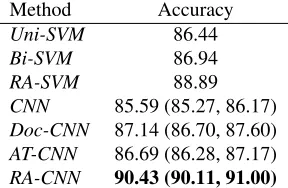
RA-CNN 90.43 (90.11, 91.00)
Table 3: Accuracies on the movie review dataset.
7.2 Qualitative Results: Illustrative Rationales
In addition to realizing superior classification perfor-mance, RA-CNN also providesexplainable catego-rizations. The model can provide the highest scoring rationales (ranked by max{ppos, pneg}) for any given target instance, which in turn – by construction – are those that most influenced the final document classi-fication.
For example, a sample positive rationale support-ing a correct designation of a study as besupport-ing at low risk of bias with respect to blinding of outcomes assessment reads simplyThe study was performed double blind. An example rationale extracted for a study (correctly) deemed at high risk of bias, mean-while, reads as the present study is retrospective, there is a risk that the woman did not properly re-call how and what they experienced ....
Turning to the movie reviews dataset, an exam-ple rationale extracted from a glowing review of ‘Goodfellas’ (correctly classified as positive) reads
[image:8.612.355.499.278.372.2]from an unfavorable review of ‘The English Patient’ asserts thatthe only redeeming qualities about this film are the fine acting of Fiennes and Dafoe and the beautiful desert cinematography.
In each of these cases, the extracted rationales directly support the respective classifications. This provides direct, meaningful insight into the auto-mated classifications, an important benefit for neural models, which are often seen as opaque.
8 Conclusions
We developed a new model (RA-CNN) for text clas-sification that extends the CNN architecture to di-rectly exploitrationaleswhen available. We showed that this model outperforms several strong, rele-vant baselines across five datasets, including vanilla and hierarchical CNN variants, and a CNN model equipped with an attention mechanism. Moreover, RA-CNN automatically provides explanations for classifications made at test time, thus providing in-terpretability.
Moving forward, we plan to explore additional mechanisms for exploiting supervision at lower lev-els in neural architectures. Furthermore, we believe an alternative approach may be a hybrid of the AT-CNN and RA-AT-CNN models, wherein an auxiliary loss might be incurred when the attention mecha-nism output disagrees with the available direct su-pervision on sentences.
Acknowledgments
Research reported in this article was supported by the National Library of Medicine (NLM) of the Na-tional Institutes of Health (NIH) under award num-ber R01LM012086. The content is solely the re-sponsibility of the authors and does not necessarily represent the official views of the National Institutes of Health. This work was also made possible by the support of the Texas Advanced Computer Center (TACC) at UT Austin.
References
Dzmitry Bahdanau, Kyunghyun Cho, and Yoshua Ben-gio. 2014. Neural machine translation by jointly
learning to align and translate. arXiv preprint
arXiv:1409.0473.
Ronan Collobert and Jason Weston. 2008. A unified ar-chitecture for natural language processing: Deep neu-ral networks with multitask learning. InProceedings of the 25th international conference on Machine
learn-ing, pages 160–167. ACM.
Gregory Druck, Gideon Mann, and Andrew McCallum. 2008. Learning from labeled features using
gener-alized expectation criteria. In Proceedings of the
31st annual international ACM SIGIR conference on Research and development in information retrieval, pages 595–602. ACM.
Yoav Goldberg. 2015. A primer on neural network
mod-els for natural language processing. arXiv preprint
arXiv:1510.00726.
Julian PT Higgins, Douglas G Altman, Peter C Gøtzsche, Peter J¨uni, David Moher, Andrew D Oxman, Je-lena Savovi´c, Kenneth F Schulz, Laura Weeks, and Jonathan AC Sterne. 2011. The cochrane collabo-rations tool for assessing risk of bias in randomised trials.Bmj, 343:d5928.
Thorsten Joachims. 1998. Text categorization with sup-port vector machines: Learning with many relevant features. Springer.
Rie Johnson and Tong Zhang. 2014. Effective use of word order for text categorization with convolutional neural networks. arXiv preprint arXiv:1412.1058. Rie Johnson and Tong Zhang. 2015. Semi-supervised
convolutional neural networks for text categorization
via region embedding. InAdvances in Neural
Infor-mation Processing Systems (NIPs), pages 919–927. Rafal Jozefowicz, Wojciech Zaremba, and Ilya Sutskever.
2015. An empirical exploration of recurrent network
architectures. In Proceedings of the 32nd
Interna-tional Conference on Machine Learning (ICML-15), pages 2342–2350.
Yoon Kim. 2014. Convolutional neural networks for sen-tence classification. arXiv preprint arXiv:1408.5882. Youngjoong Ko, Jinwoo Park, and Jungyun Seo. 2002.
Automatic text categorization using the importance of
sentences. In Proceedings of the 19th international
conference on Computational linguistics-Volume 1, pages 1–7. Association for Computational Linguistics. Alex Krizhevsky, Ilya Sutskever, and Geoffrey E Hinton. 2012. Imagenet classification with deep convolutional
neural networks. In Advances in neural information
processing systems, pages 1097–1105.
Quoc V Le and Tomas Mikolov. 2014. Distributed repre-sentations of sentences and documents. arXiv preprint arXiv:1405.4053.
Iain J Marshall, Jo¨el Kuiper, and Byron C Wallace. 2015. Automating risk of bias assessment for clinical trials.
Biomedical and Health Informatics, IEEE Journal of, 19(4):1406–1412.
Iain J Marshall, Jo¨el Kuiper, and Byron C Wallace. 2016. Robotreviewer: evaluation of a system for automatically assessing bias in clinical trials. Jour-nal of the American Medical Informatics Association, 23(1):193–201.
Tyler McDonnell, Matthew Lease, Tamer Elsayad, and
Mucahid Kutlu. 2016. Why Is That Relevant?
Collecting Annotator Rationales for Relevance
Judg-ments. InProceedings of the 4th AAAI Conference on
Human Computation and Crowdsourcing (HCOMP).
10 pages.
Masaki Murata, Qing Ma, Kiyotaka Uchimoto, Hiromi Ozaku, Masao Utiyama, and Hitoshi Isahara. 2000. Japanese probabilistic information retrieval using
lo-cation and category information. In Proceedings of
the fifth international workshop on on Information re-trieval with Asian languages, pages 81–88. ACM. Bo Pang and Lillian Lee. 2004. A sentimental education:
Sentiment analysis using subjectivity summarization
based on minimum cuts. InProceedings of the 42nd
annual meeting on Association for Computational Lin-guistics, page 271. Association for Computational Lin-guistics.
Sampo Pyysalo, Filip Ginter, Hans Moen, Tapio Salakoski, and Sophia Ananiadou. 2013. Distribu-tional semantics resources for biomedical text
pro-cessing. Proceedings of Languages in Biology and
Medicine.
Burr Settles. 2011. Closing the loop: Fast, interactive semi-supervised annotation with queries on features
and instances. In Proceedings of the Conference on
Empirical Methods in Natural Language Processing, pages 1467–1478. Association for Computational Lin-guistics.
Kevin Small, Byron Wallace, Thomas Trikalinos, and Carla E Brodley. 2011. The constrained weight space svm: learning with ranked features. InProceedings of the 28th International Conference on Machine Learn-ing (ICML-11), pages 865–872.
Nitish Srivastava, Geoffrey Hinton, Alex Krizhevsky,
Ilya Sutskever, and Ruslan Salakhutdinov. 2014.
Dropout: A simple way to prevent neural networks
from overfitting. The Journal of Machine Learning
Research, 15(1):1929–1958.
Duyu Tang, Bing Qin, and Ting Liu. 2015. Document modeling with gated recurrent neural network for sen-timent classification. InProceedings of the 2015 Con-ference on Empirical Methods in Natural Language Processing, pages 1422–1432.
Zichao Yang, Diyi Yang, Chris Dyer, Xiaodong He, Alex Smola, and Eduard Hovy. 2016. Hierarchical atten-tion networks for document classificaatten-tion. In Proceed-ings of the 2016 Conference of the North American Chapter of the Association for Computational Linguis-tics: Human Language Technologies.
Ainur Yessenalina, Yejin Choi, and Claire Cardie. 2010. Automatically generating annotator rationales to im-prove sentiment classification. InProceedings of the ACL 2010 Conference Short Papers, pages 336–341. Association for Computational Linguistics.
Omar F Zaidan and Jason Eisner. 2008. Modeling tators: A generative approach to learning from anno-tator rationales. InProceedings of the Conference on Empirical Methods in Natural Language Processing, pages 31–40. Association for Computational Linguis-tics.
Omar Zaidan, Jason Eisner, and Christine D Piatko. 2007. Using” annotator rationales” to improve ma-chine learning for text categorization. InHLT-NAACL, pages 260–267. Citeseer.
Matthew D Zeiler. 2012. Adadelta: an adaptive learning rate method.arXiv preprint arXiv:1212.5701. Ye Zhang and Byron C. Wallace. 2015. A sensitivity
analysis of (and practitioners’ guide to) convolutional
neural networks for sentence classification. arXiv
preprint arXiv:1510.03820.