Transition-Based Dependency Parsing with Heuristic Backtracking
Jacob Buckman♣ Miguel Ballesteros♦ Chris Dyer♠♣
♣School of Computer Science, Carnegie Mellon University, Pittsburgh, PA, USA ♦NLP Group, Pompeu Fabra University, Barcelona, Spain
♠Google DeepMind, London, UK
[email protected], [email protected], [email protected]
Abstract
We introduce a novel approach to the decoding problem in transition-based parsing: heuris-tic backtracking. This algorithm uses a se-ries of partial parses on the sentence to locate the best candidate parse, using confidence es-timates of transition decisions as a heuristic to guide the starting points of the search. This allows us to achieve a parse accuracy compa-rable to beam search, despite using fewer tran-sitions. When used to augment a Stack-LSTM transition-based parser, the parser shows an unlabeled attachment score of up to 93.30% for English and 87.61% for Chinese.
1 Introduction
Transition-based parsing, one of the most prominent dependency parsing techniques, constructs a depen-dency structure by reading words sequentially from the sentence, and making a series of local decisions (called transitions) which incrementally build the structure. Transition-based parsing has been shown to be both fast and accurate; the number of transi-tions required to fully parse the sentence is linear relative to the number of words in the sentence.
In recent years, the field has seen dramatic im-provements in the ability to correctly predict tran-sitions. Recent models include the greedy Stack-LSTM model of Dyer et al. (2015) and the globally normalized feed-forward networks of Andor et al. (2016). These models output a local decision at each transition point, so searching the space of possible paths to the predicted tree is an important compo-nent of high-accuracy parsers.
One common search technique is beam search. (Zhang and Clark, 2008; Zhang and Nivre, 2011; Bohnet and Nivre, 2012; Zhou et al., 2015; Weiss et al., 2015; Yazdani and Henderson, 2015) In beam-search, a fixed number of candidate transition quences are generated, and the highest-scoring se-quence is chosen as the answer. One downside to beam search is that it often results in a significant amount of wasted predictions. A constant number of beams are explored at all points throughout the sentence, leading to some unnecessary exploration towards the beginning of the sentence, and poten-tially insufficient exploration towards the end.
One way that this problem can be mitigated is by using a dynamically-sized beam (Mejia-Lavalle and Ramos, 2013). When using this technique, at each step, prune all beams whose scores are below some values, wheresis calculated based upon the distri-bution of scores of available beams. Common meth-ods for pruning are removing all beams below some percentile, or any beams which scored below some constant percentage of the highest-scoring beam.
Another approach to solving this issue is given by Choi and McCallum (2013). They introduced se-lectional branching, which involves performing an initial greedy parse, and then using confidence esti-mates on each prediction to spawn additional beams. Relative to standard beam-search, this reduces the average number of predictions required to parse a sentence, resulting in a speed-up.
In this paper, we introduce heuristic backtracking, which expands on the ideas of selectional branching by integrating a search strategy based on a heuristic function (Pearl, 1984): a function which estimates
the future cost of taking a particular decision. When paired with a good heuristic, heuristic backtracking maintains the property of reducing wasted predic-tions, but allows us to more fully explore the space of possible transition sequences (as compared to se-lectional branching). In this paper, we use a heuristic based on the confidence of transition predictions.
We also introduce a new optimization: heuristic backtracking with cutoff. Since heuristic backtrack-ing produces results incrementally, it is possible to stop the search early if we have found an answer that we believe to be the gold parse, saving time propor-tional to the number of backtracks remaining.
We compare the performance of these various decoding algorithms with the Stack-LSTM parser (Dyer et al., 2015), and achieve slightly higher ac-curacy than beam search, in significantly less time.
2 Transition-Based Parsing With Stack-LSTM
Our starting point is the model described by Dyer et al. (2015).1 The parser implements the arc-standard
algorithm (Nivre, 2004) and it therefore makes use of a stack and a buffer. In (Dyer et al., 2015), the stack and the buffer are encoded with Stack-LSTMs, and a third sequence with the history of actions taken by the parser is encoded with another Stack-LSTM. The three encoded sequences form the parser state ptdefined as follows,
pt= max{0,W[st;bt;at] +d}, (1)
whereWis a learned parameter matrix,bt,stand
atare the stack LSTM encoding of buffer, stack and
the history of actions, anddis a bias term. The out-putpt(after a component-wise rectified linear unit
(ReLU) nonlinearity (Glorot et al., 2011)) is then used to compute the probability of the parser action at timetas:
p(zt|pt) =
exp g>ztpt+qzt P
z0∈A(S,B)exp g>z0pt+qz0, (2)
wheregz is a column vector representing the
(out-put) embedding of the parser action z, and qz is a
bias term for action z. The setA(S, B) represents
1We refer to the original work for details.
the valid transition actions that may be taken in the current state. The objective function is:
Lθ(w,z) =
|z|
X
t=1
logp(zt|pt) (3)
wherezrefers to parse transitions.
3 Heuristic Backtracking
Using the Stack-LSTM parsing model of Dyer et al. (2015) to predict each decision greedily yields very high accuracy; however, it can only explore one path, and it therefore can be improved by conduct-ing a larger search over the space of possible parses. To do this, we introduce a new algorithm, heuristic backtracking. We also introduce a novel cutoff ap-proach to further increase speed.
3.1 Decoding Strategy
We model the space of possible parses as a tree, where each node represents a certain parse state (with complete values for stack, buffer, and action history). Transitions connect nodes of the tree, and leaves of the tree represent final states.
During the first iteration, we start at the root of the tree, and greedily parse until we reach a leaf. That is, for each node, we use the Stack-LSTM model to calculate scores for each transition (as described in Section 2), and then execute the highest-scoring transition, generating a child node upon which we repeat the procedure. Additionally, we save an or-dered list of the transition scores, and calculate the confidence of the node (as described in Section 3.2). When we reach the leaf node, we backtrack to the location that is most likely to fix a mistake. To find this, we look at all explored nodes that still have at least one unexplored child, and choose the node with the lowest heuristic confidence (see Section 3.2). We rewind our stack, buffer, and action history to that state, and execute the highest-scoring transition from that node that has not yet been explored. At this point, we are again in a fully-unexplored node, and can greedily parse just as before until we reach another leaf.
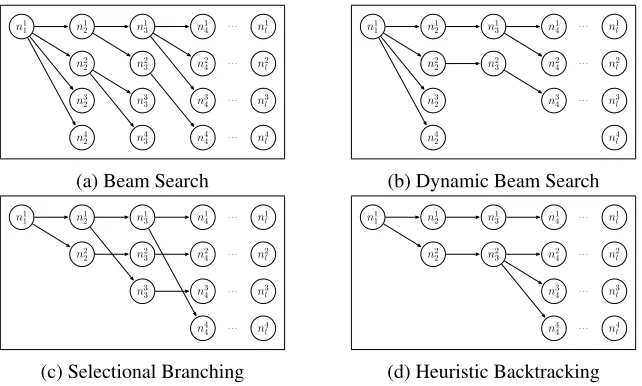
n1 1 n 1 2 n2 2 n3 2 n4 2 n1 3 n2 3 n3 3 n4 3 n1 4 n2 4 n3 4 n4 4 n1 l n2 l n3 l n4 l . . . . . . . . . . . .
(a) Beam Search
n1 1 n 1 2 n2 2 n3 2 n4 2 n1 3 n2 3 n1 4 n2 4 n3 4 n1 l n2 l n3 l n4 l . . . . . . . . .
(b) Dynamic Beam Search
n1 1 n 1 2 n2 2 n1 3 n2 3 n3 3 n1 4 n2 4 n3 4 n4 4 n1 l n2 l n3 l n4 l . . . . . . . . . . . .
(c) Selectional Branching
n1 1 n 1 2 n2 2 n1 3 n2 3 n1 4 n2 4 n3 4 n4 4 n1 l n2 l n3 l n4 l . . . . . . . . . . . .
[image:3.612.147.468.55.248.2](d) Heuristic Backtracking
Figure 1: Visualization of various decoding algorithms
sum of the log probabilities of all individual transi-tions as the overall score for the parse.
3.2 Calculating Error Likelihood
Let nindicate a node, which consists of a state, a buffer, and an action history. We may refer to a specific node as nji, which means it has i actions
in its action history and it is part of the history of the jth leaf (and possibly subsequent leaves). Let
the functionT(n)represent a sorted vector
contain-ing all possible transitions from n, and S(n) rep-resent a sorted vector containing the scores of all of these transitions, in terms of log probabilities of each score. We can index the scores in order of value, so
T1(n)is the highest-scoring transition andS1(n)is
its score,T2(n) is the second-highest-scoring
tran-sition, etc. Here, let un indicate the ranking of the
transition leading to the first unexplored child of a noden. Also, letV(n)represent the total score of
all nodes in the history ofn, i.e. the sum of all the
scores of individual transitions that allowed us to get ton.
To calculate the confidence of an individual node, Choi and McCallum (2013) simply found the score margin, or difference in probability between the top-scoring transition and the second-highest top-scoring transition: C(n) = S1(n)−S2(n). In selectional
branching, the only states for which the confidence was relevant were the states in the first greedy parse, i.e. statesn1i for alli. For heuristic backtracking, we
wish to generalize this to any statenji for alliandj.
We do this in the following way:
H(nji) = (V(n1i)−V(nji)) + (S(u
nji)−1(n
j i) +S(u
nji)(n
j i)) (4)
Intuitively, this formula means that the node that will be explored first is the node that will yield a parse that scores as close to the greedy choice as possible. The first term ensures that it has a history of good choices, and the second term ensures that the new child node being explored will be nearly as good as the prior child.
3.3 Number of Predictions
As discussed earlier, we use number of predictions made by the model as a proxy for the speed; exe-cution speed may vary based on system and algo-rithmic implementation, but prediction count gives a good estimate of the overall work done by the al-gorithm.
Consider a sentence of lengthl, which requires at
most2ltransitions with the greedy decoder (Nivre,
2004). The number of predictions required for heuristic backtracking forbleaves is guaranteed to
be less than or equal to a beam search withbbeams.
When doing a beam search, the first transition will require 1 prediction, and then every subsequent tran-sition will require 1 prediction per beam, orb
predic-tions. This results in a total ofb(2l−1) + 1
predic-tions.
subsequent prediction will require a number of pre-dictions dependent on the target of the backtrack: backtracking to nji will require 2l − (i+ 1)
pre-dictions. Note that0 < i < 2l. Thus, each
back-track will require at maximum 2l−1 predictions.
Therefore, the maximum total amount of predictions is2l+ (b−1)(2l−1) =b(2l−1) + 1.
However, note that on average, there are signifi-cantly fewer. Assuming that all parts of a sentence have approximately equal score distributions, the av-erage backtrack will be wherei=l, and reduce
pre-dictions by 50%.
An intuitive understanding of this difference can be gained by viewing the graphs of various decoding methods in Figure 1. Beam search has many nodes which never yield children that reach an end-state; dynamic beam search has fewer, but still several. Se-lectional branching has none, but suffers from the re-striction that every parse candidate can be no more than one decision away from the greedy parse. With heuristic backtracking, there is no such restriction, but yet every node explored is directly useful for generating a candidate parse.
3.4 Early Cutoff
Another inefficiency inherent to beam search is the fact that all b beams are always fully explored.
Since the beams are calculated in parallel, this is in-evitable. However, with heuristic backtracking, the beams are calculated incrementally; this gives us the opportunity to cut off our search at any point. In or-der to leverage this into more efficient parsing, we constructed a second Stack-LSTM model, which we call the cutoff model. The cutoff model uses a sin-gle Stack-LSTM2that takes as input the sequence of
parser states (see Eq 1), and outputs a boolean vari-able predicting whether the entire parse is correct or incorrect.
To train the cutoff model, we used stochastic gra-dient descent over the training set. For each training example, we first parse it greedily using the Stack-LSTM parser. Then, for as long as the parse has at least one mistake, we pass it to the cutoff model as a negative training example. Once the parse is com-pletely correct, we pass it to the cutoff model as a positive training example. The loss function that we
22 layers and 300 dimensions.
use is:
Lθ =−log p(t|s) (5)
where s is the LSTM encoded vector and t is the truth (parse correct/incorrect).
When decoding using early cutoff, we follow the exact same procedure as for normal heuristic back-tracking, but after every candidate parse is gener-ated, we use it as input to our cutoff model. When our cutoff model returns our selection as correct, we stop backtracking and return it as the answer. If we makebattempts without finding a correct parse, we follow the same procedure as before.
4 Experiments and Results
To test the effectiveness of heuristic backtrack-ing, we compare it with other decoding tech-niques: greedy, beam search,3, dynamic beam
search (Mejia-Lavalle and Ramos, 2013), and selec-tional branching (Choi and McCallum, 2013). We then try heuristic backtracking (see Section 3.1), and heuristic backtracking with cutoff (see Section 3.4). Note that beam search wasnotused for early-update training (Collins and Roark, 2004). We use the same greedy training strategy for all models, and we only change the decoding strategy.
We tested the performance of these algorithms on the English SD and Chinese CTB.4 A single model
was trained using the techniques described in Sec-tion 2, and used as the transiSec-tion model for all decod-ing algorithms. Each decoddecod-ing technique was tested with varying numbers of beams; asbincreased, both
the predictions per sentence and accuracy trended upwards. The results are summarized in Table 1.5
Note that we report results for only the highest-accuracyb(in the development set) for each.
We also report the results of the cutoff model in Table 2. The same greedily-trained model as above was used to generate candidate parses and confi-dence estimates for each transition, and then the cut-off model was trained to use these confidence esti-3Greedy and beam-search were already explored by Dyer et al. (2015)
4Using the exact same settings as Dyer et al. (2015) with pretrained embeddings and part-of-speech tags.
English
Decoding Pred/Sent UAS LAS
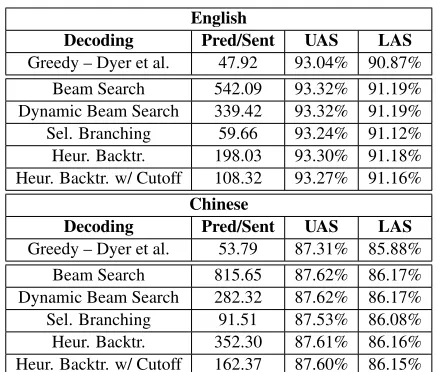
Greedy – Dyer et al. 47.92 93.04% 90.87% Beam Search 542.09 93.32% 91.19% Dynamic Beam Search 339.42 93.32% 91.19% Sel. Branching 59.66 93.24% 91.12% Heur. Backtr. 198.03 93.30% 91.18% Heur. Backtr. w/ Cutoff 108.32 93.27% 91.16%
Chinese
Decoding Pred/Sent UAS LAS
[image:5.612.76.295.54.240.2]Greedy – Dyer et al. 53.79 87.31% 85.88% Beam Search 815.65 87.62% 86.17% Dynamic Beam Search 282.32 87.62% 86.17% Sel. Branching 91.51 87.53% 86.08% Heur. Backtr. 352.30 87.61% 86.16% Heur. Backtr. w/ Cutoff 162.37 87.60% 86.15% Table 1: UAS and LAS of various decoding meth-ods. Pred/Sent refers to number of predictions made by the Stack-LSTM per sentence.
mates to discriminate between correctly-parsed and incorrectly-parsed sentences.
5 Discussion
In Table 1 we see that in both English and Chi-nese, the best heuristic backtracking performs ap-proximately as well as the best beam search, while making less than half the predictions. This supports our hypothesis that heuristic backtracking can per-form at the same level as beam search, but with in-creased efficiency.
Dynamic beam search also performed as well as full beam search, despite demonstrating a re-duction in predictions on par with that of heuris-tic backtracking. Since the implementation of dy-namic beam search is very straightforward for sys-tems which have already implemented beam search, we believe this will prove to be a useful finding.
Heuristic backtracking with cutoff outperformed greedy decoding, and reduced transitions by an addi-tional 50%. However, it increased accuracy slightly less than full heuristic backtracking. We believe this difference could be mitigated with an improved cut-off model; as can be seen in Table 2, the cutcut-off model was only able to discriminate between correct and incorrect parses around 75% of the time. Also, note that while predictions per sentence were low, the overall runtime was increased due to running the cutoff LSTM multiple times per sentence.
Language Cutoff Accuracy
English 72.43%
Chinese 75.18%
Table 2: Test-set accuracy of cutoff model on En-glish and Chinese.
6 Related Work
Heuristic backtracking is most similar to the work of Choi and McCallum (2013), but is distinguished from theirs by allowing new beams to be initialized from any point in the parse, rather than only from points in the initial greedy parse. Heuristic back-tracking also bears similarity to greedy-best-first-search (Pearl, 1984), but is unique in that it guaran-tees thatbcandidate solutions will be found within b(2l−1) + 1predictions. Our work also relates to beam-search parsers (Zhang and Clark, 2008,inter alia).
7 Conclusions
We have introduced a novel decoding algorithm, called heuristic backtracking, and presented evi-dence that it performs at the same level as beam search for decoding, while being significantly more efficient. We have demonstrated this for both En-glish and Chinese, using a parser with strong re-sults with a greedy decoder. We expect that heuris-tic backtracking could be applied to any other transition-based parser with similar benefits.
We plan on experimenting with various heuristics and cutoff models, such as adapting the attention-based models of Bahdanau et al. (2014) to act as a guide for both the heuristic search and cutoff. Acknowledgments
Miguel Ballesteros was supported by the Euro-pean Commission under the contract numbers FP7-ICT-610411 (project MULTISENSOR) and H2020-RIA-645012 (project KRISTINA).
References
Daniel Andor, Chris Alberti, David Weiss, Aliaksei Severyn, Alessandro Presta, Kuzman Ganchev, Slav Petrov, and Michael Collins. 2016. Globally
nor-malized transition-based neural networks. CoRR,
[image:5.612.350.503.57.99.2]Dzmitry Bahdanau, Kyunghyun Cho, and Yoshua Ben-gio. 2014. Neural machine translation by jointly
learning to align and translate. CoRR, abs/1409.0473.
Bernd Bohnet and Joakim Nivre. 2012. A transition-based system for joint part-of-speech tagging and
la-beled non-projective dependency parsing. In
Proceed-ings of the 2012 Joint Conference on Empirical Meth-ods in Natural Language Processing and Computa-tional Natural Language Learning, EMNLP-CoNLL ’12, pages 1455–1465, Stroudsburg, PA, USA. Asso-ciation for Computational Linguistics.
Jinho D. Choi and Andrew McCallum. 2013. Transition-based dependency parsing with selectional branching. InProceedings of the 51st Annual Meeting of the As-sociation for Computational Linguistics (Volume 1: Long Papers), pages 1052–1062, Sofia, Bulgaria, Au-gust. Association for Computational Linguistics. Michael Collins and Brian Roark. 2004.
Incremen-tal parsing with the perceptron algorithm. In
Pro-ceedings of the 42Nd Annual Meeting on Association for Computational Linguistics, ACL ’04, Stroudsburg, PA, USA. Association for Computational Linguistics. Chris Dyer, Miguel Ballesteros, Wang Ling, Austin
Matthews, and Noah A. Smith. 2015. Transition-based dependency parsing with stack long short-term
memory. In Proceedings of the 53rd Annual
Meet-ing of the Association for Computational LMeet-inguistics and the 7th International Joint Conference on Natu-ral Language Processing of the Asian Federation of Natural Language Processing, ACL 2015, July 26-31, 2015, Beijing, China, Volume 1: Long Papers, pages 334–343. The Association for Computer Linguistics. Xavier Glorot, Antoine Bordes, and Yoshua Bengio.
2011. Deep sparse rectifier neural networks. InProc.
AISTATS.
Manuel Mejia-Lavalle and Cesar Geovani Pereyra Ramos. 2013. Beam search with dynamic pruning for
artificial intelligence hard problems. InProceedings of
the 2013 International Conference on Mechatronics, Electronics and Automotive Engineering, November. Joakim Nivre. 2004. Incrementality in deterministic
de-pendency parsing. InProceedings of the Workshop on
Incremental Parsing: Bringing Engineering and Cog-nition Together.
Judea Pearl. 1984. Heuristics: Intelligent Search
Strate-gies for Computer Problem Solving. Addison-Wesley. David Weiss, Chris Alberti, Michael Collins, and Slav Petrov. 2015. Structured training for neural network
transition-based parsing. In Proceedings of the 53rd
Annual Meeting of the Association for Computational Linguistics and the 7th International Joint Conference on Natural Language Processing (Volume 1: Long Pa-pers), pages 323–333, Beijing, China, July. Associa-tion for ComputaAssocia-tional Linguistics.
Majid Yazdani and James Henderson. 2015. Incremen-tal recurrent neural network dependency parser with
search-based discriminative training. InCoNLL, pages
142–152. ACL.
Yue Zhang and Stephen Clark. 2008. A tale of
two parsers: Investigating and combining graph-based and transition-based dependency parsing using
beam-search. In Proceedings of the Conference on
Em-pirical Methods in Natural Language Processing, EMNLP ’08, pages 562–571, Stroudsburg, PA, USA. Association for Computational Linguistics.
Yue Zhang and Joakim Nivre. 2011. Transition-based dependency parsing with rich non-local features. In
Proceedings of the 49th Annual Meeting of the Asso-ciation for Computational Linguistics: Human Lan-guage Technologies: Short Papers - Volume 2, HLT ’11, pages 188–193, Stroudsburg, PA, USA. Associa-tion for ComputaAssocia-tional Linguistics.
Hao Zhou, Yue Zhang, Shujian Huang, and Jiajun Chen.
2015. A neural probabilistic structured-prediction
model for transition-based dependency parsing. In