Cross-Lingual Sentiment Analysis using modified BRAE
Sarthak Jain
Department of Computer Engineering Delhi Technological University
DL, India
Shashank Batra
Department of Computer Engineering Indian Institute of technology, Delhi
DL, India
Abstract
Cross-Lingual Learning provides a mech-anism to adapt NLP tools available for la-bel rich languages to achieve similar tasks for label-scarce languages. An efficient cross-lingual tool significantly reduces the cost and effort required to manually an-notate data. In this paper, we use the Recursive Autoencoder architecture to de-velop a Cross Lingual Sentiment Analysis (CLSA) tool using sentence aligned cor-pora between a pair of resource rich (En-glish) and resource poor (Hindi) language. The system is based on the assumption that semantic similarity between different phrases also implies sentiment similarity in majority of sentences. The resulting sys-tem is then analyzed on a newly developed Movie Reviews Dataset in Hindi with la-bels given on a rating scale and compare performance of our system against exist-ing systems. It is shown that our approach significantly outperforms state of the art systems for Sentiment Analysis, especially when labeled data is scarce.
1 Introduction
Sentiment Analysis is a NLP task that deals with extraction of opinion from a piece of text on a topic. This is used by a large number of advertising and media companies to get a sense of public opin-ion from their reviews. The ever increasing user generated content has always been motivation for sentiment analysis research, but majority of work has been done for English Language. However, in recent years, there has been emergence of increas-ing amount of text in Hindi on electronic sources but NLP Frameworks to process this data is sadly miniscule. A major cause for this is the lack of annotated datasets in Indian Languages.
One solution is to create cross lingual tools be-tween a resource rich and resource poor language that exploit large amounts of unlabeled data and sentence aligned corpora that are widely available on web through bilingual newspapers, magazines, etc. Many different approaches have been identi-fied to perform Cross Lingual Tasks but they de-pend on the presence of MT-System or Bilingual Dictionaries between the source and target lan-guage.
In this paper, we use Bilingually Constrained Recursive Auto-encoder (BRAE) given by (Zhang et al., 2014) to perform Cross Lingual sentiment analysis. Major Contributions of this paper are as follows: First, We develop a new Rating scale based Movie Review Dataset for Hindi. Second, a general framework to perform Cross Lingual Classification tasks is developed by modifying the architecture and training procedure for BRAE model. This model exploits the fact that phrases in two languages, that share same semantic meaning, can be used to learn language independent seman-tic vector representations. These embeddings can further be fine-tuned using labeled dataset in En-glish to capture enough class information regard-ing Resource poor language. We train the resultant framework on English-Hindi Language pair and evaluate it against state of the art SA systems on existing and newly developed dataset.
2 Related Work
2.1 Sentiment Analysis in Hindi
In recent years, there have been emergence of works on Sentiment Analysis (both monolingual and cross-lingual) for Hindi. (Joshi et al., 2010) provided a comparative analysis of Unigram based In-language, MT based Cross Lingual and Word-Net based Sentiment classifier, achieving highest accuracy of 78.14%. (Mittal et al., 2013) described a system based on Hindi SentiWordNet for
ing positive/negative polarity to movie reviews. In this approach, overall semantic orientation of the review document was determined by aggregating the polarity values of the words in the document assigned using the WordNet. They also included explicit rules for handling Negation and Discourse relations during preprocessing in their model to achieve better accuracies.
For Languages where labeled data is not present, approaches based on cross-lingual sentiment anal-ysis are used. Usually, such methods need inter-mediary machine translation system (Wan et al., 2011; Brooke et al., 2009) or a bilingual dictionary (Ghorbel and Jacot, 2011; Lu et al., 2011) to bridge the language gap. Given the subtle and different ways in which sentiments can be expressed and the cultural diversity amongst different languages, an MT system has to be of a superior quality to per-form well(Balamurali et al., 2012).
(Balamurali et al., 2012) present an alterna-tive approach to Cross Lingual Sentiment Analy-sis (CLSA) using WordNet senses as features for supervised sentiment classification. A document in Resource Poor Language was tested for polarity through a classifier trained on sense marked and polarity labeled corpora in Resource rich language. The crux of the idea was to use the linked Word-Nets of two languages to bridge the language gap. Recently, (Popat et al., 2013) describes a Cross Lingual Clustering based SA System. In this ap-proach, features were generated using syntagmatic property based word clusters created from unla-beled monolingual corpora, thereby eliminating the need for Bilingual Dictionaries. These features were then used to train a linear SVM to predict positive or negative polarity on a tourism review dataset.
2.2 Autoencoders in NLP Tasks
Autoencoders are neural networks that learn a low dimensional vector representation of fixed-size in-puts such as image segments or bag-of-word rep-resentations of documents. They can be used to efficiently learn feature encodings that are useful for classification. The Autoencoders were first applied in a recursive setting by Pollack (1990) in recursive auto-associative memories (RAAMs). However, RAAMs needed fixed recursive data structures to learn vector representations, whereas RAE given by (Socher et al., 2011) builds recur-sive data structure using a greedy algorithm. The RAE can be pre-trained with an unsupervised
algo-rithm and then fine-tuned according to the label of the phrase, such as the syntactic category in pars-ing(Socher et al., 2013), the polarity in sentiment analysis, etc. The learned structures are not neces-sarily syntactically accurate but can capture more of the semantic information in the word vectors.
3 BRAE Framework
(Zhang et al., 2014) used the RAE along with a Bilingually Constrained Model to simultaneously learn phrase embeddings for two languages in se-mantic vector space. The core idea behind BRAE is that a phrase and its correct translation should share the same semantic meaning. Thus, they can supervise each other to learn their seman-tic phrase embeddings. Similarly, non-translation pairs should have different semantic meanings, and this information can also be used to guide learning semantic phrase embeddings. In this method, a standard recursive autoencoder (RAE) pre-trains the phrase embedding with an unsuper-vised algorithm by greedily minimizing the re-construction error (Socher et al., 2011), while the bilingually-constrained model learns to finetune the phrase embedding by minimizing the seman-tic distance between translation equivalents and maximizing the semantic distance between non-translation pairs.
In this section, We will briefly present the struc-ture and training algorithm for BRAE model. Af-ter that, we show how this model can be adapted to perform CLSA.
3.1 Recursive Auto-encoder Framework
In this model, each wordwkin the vocabularyV of given language corresponds to a vectorxk ∈Rn and stacked into a single word embedding matrix
L ∈ Rn×|V|. This matrix is learned using DNN (Collobert and Weston, 2008; Mikolov et al., 2013) and serves as input to further stages of RAE.
Using this matrix, a phrase (w1w2. . . wm) is first projected into a list of vectors(x1, x2, . . . xm). The RAE learns the vector representation of the phrase by combining two children vectors recur-sively in a bottom-up manner. For two children
c1 =x1, c2 =x2, the auto-encoder computes the parent vectory1:
y1 =f(W(1)[c1;c2] +b(1));y1 ∈Rn (1)
chil-𝑝
𝑡𝑝
𝑠good was
It था
अच्छा यह
[image:3.595.73.291.60.152.2]transformations
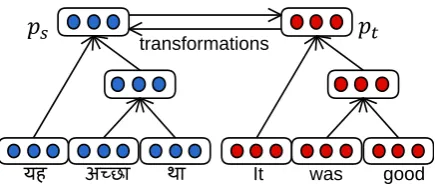
Figure 1: An illustration of BRAE structure
dren :
[c′1;c′2] =W(2)p+b(2) (2)
and tries to minimize the reconstruction error (Eu-clidean Distance)Erec([c1;c2])between the inputs [c1;c2]and their reconstructions[c′1;c′2].
Giveny1, Eq.1 is used again to computey2 by setting the children to be[c1;c2] = [y1;x3]. The same auto-encoder is re-used until the vector of the whole phrase is generated. For unsupervised phrase embedding, the sum of reconstruction er-rors at each node in binary treeyis minimized:
Erec(x;θ) =arg miny∈A(x)∑ k∈y
Erec([c1;c2]k)
(3) WhereA(x)denotes all the possible binary trees that can be built from inputsx. A greedy algorithm is used to generate the optimal binary treey∗. The parametersθrec = (θ(1), θ(2))are optimized over all the phrases in the training data. For further de-tails, please refer (Socher et al., 2011)
3.2 Semantic Error
The BRAE model jointly learns two RAEs for source languageLSand target languageLT. Each RAE learn semantic vector representation ps and
pt of phrasess andt respectively in translation-equivalent phrase pair (s, t) in bilingual corpora (shown in Fig.1). The transformation between the two is defined by:
p′
t=f(Wstps+bts), p′s =f(Wtspt+bst) (4)
whereθst = (Wst, bts), θts = (Wts, bst)are new pa-rameters introduced.
The semantic error between learned vector rep-resentationspsandptis calculated as :
Esem(s, t;θ) =Esem∗ (t|s;θst) +Esem∗ (s|t;θts) (5) where Esem∗ (s|t;θts) is the semantic distance of
ps given pt and vice versa. To calculate it, we
first calculate Euclidean distance between origi-nal pt and transformation p′t asDsem(s|t, θts) =
1
2∥pt−p′t∥2. The max-semantic-margin distance between them is then defined as
E∗
sem(s|t, θst) =max{0, Dsem(s|t, θts) −Dsem(s|t′, θts) + 1}
(6)
where we simultaneously minimize the distance between translation pairs and maximized between non-translation pairs. Here t′ in non-translation pair(s, t′)is obtained by replacing the words int with randomly chosen target language words. We calculate theEsem∗ (t|s;θts)in similar manner.
3.3 BRAE Objective Function
Thus, for the phrase pair(s, t), the joint error be-comes:
E(s, t, θ) =E(s|t, θ) +E(t|s, θ)
E(s|t, θ) =αErec(s;θrecs ) + (1−α)Esem∗ (s|t, θst))
E(t|s, θ) =αErec(t;θrect ) + (1−α)Esem∗ (t|s, θst)) (7) The hyper-parameterαweighs the reconstruction and semantic errors. The above equation indi-cates that the Parameter sets θt = (θts, θtrec) and
θs = (θts, θrecs ) on each side respectively can be optimized independently as long as the phrase rep-resentation of other side is given to compute se-mantic error.
The final BRAE objective over the phrase pairs training set(S, T)becomes:
JBRAE= N1
∑
(s,t)∈(S,T)
E(s, t;θ) +λBRAE 2 ∥θ∥2
(8)
3.4 Unsupervised Training of BRAE
The word embedding matricesLsandLtare pre-trained using unlabeled monolingual data with Word2Vec toolkit (Mikolov et al., 2013). All other parameters are initialized randomly. We use SGD algorithm for parameter optimization. For full gra-dient calculations for each parameter set, please see (Zhang et al., 2014).
1. RAE Training Phase: Apply RAE Frame-work (Sec. 3.1) to pre-train the source and target phrase representations ps and pt respectively by optimizingθrecs andθrect using unlabeled monolin-gual datasets.
parametersθsand obtain source-side phrase repre-sentationp′s, and vice-versa forps. Calculate the joint error over the bilingual training corpus. On reaching a local minima or predefined no. of iter-ations (30 in our case), terminate this phase, other-wise setps=p′s,pt=p′t, and repeat.
4 Adapting Model for Classifying Sentiments
At the end of previous Training procedure, we ob-tain high quality phrase embeddings in both source and target language and transformation function between them. We now extend that model to per-form cross lingual supervised tasks, specifically CLSA.
To achieve this, we need to modify the learned semantic phrase embeddings such that they can capture information about sentiment. Since we only use monolingual labeled datasets from this point onwards, the supervised learning phases will occur independently for each RAE as we do not have any ''phrase pairs'' now. Thus, the new se-mantic vector space generated for word and phrase embeddings may no longer be in sync with their corresponding transformations.
We propose following modifications to the sys-tem to deal with this problem. LetLSandLT rep-resent Resource rich and Resource poor language respectively in above model.
Modifications in architecture: We first in-clude a softmax (σ) layer on top of each parent node in RAE for LS to predict a K-dimensional multinomial distribution over the set of output classes defined by the task (e.g : polarity, Ratings).
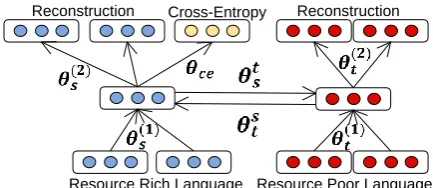
d(p;θce) =σ(Wcep) (9) Given this layer, we calculate cross entropy er-rorEce(pk, t, Wce)generated for nodepkin binary tree, wheretis target multinomial distribution or one-hot binary vector for target label. We use this layer to capture and predict actual sentiment in-formation about the data in bothLS andLT (de-scribed in next section). We show a node in modi-fied architecture in Fig.2.
Penalty for Movement in Semantic Vector space: During subsequent training phases, we in-clude the euclidean norm of the difference between the original and new phrase embeddings as penalty in reconstruction error at each node of the tree.
Erec∗ ([c1;c2];θ) =Erec([c1;c2];θ) +λ2p∥p−p∗∥2
(10)
[image:4.595.308.525.61.155.2]Resource Rich Language Resource Poor Language Reconstruction Cross-Entropy Reconstruction
Figure 2: An illustration of BRAE segment with Cross Entropy layer
Herepis the phrase representation we get during forward propagation of current training iteration andp∗is the representation we get if we apply the parameters obtained at the end of the Cross training phase to children[c1;c2]of that node. The reason to do this is twofold.
First, during supervised training, the error will back propagate through RAEs for both languages affecting their respective weights matrices and word embeddings. This will modify the semantic representation of phrases captured during previous phases of training procedure and adversely affect the transformations derived from them. Therefore we need to include some procedure such that the transformation information learned during Cross-training phase is not lost.
Secondly, we observe that the information about the semantic similarity of a word or phrase also im-plies sentiment similarity between the two. That is when dealing with bilingual data, words or phrases that appear near each other in semantic space typi-cally represent common sentiment information and we want our model to create a decision boundary around these vectors instead of modifying them too much.
Disconnecting the RAEs: We fix the trans-formation weights between the two RAEs, i.e. in subsequent training steps the transformation weights(θt
the accuracies were affected severely as infor-mation learned during previous phases was lost and the weights were not been able to capture enough information about the modified phrase em-beddings and generalize well on test phrases not encountered in labeled training set of Resource Scarce Language.
4.1 Supervised Training Phases
We now explain supervised training procedure us-ing only monolus-ingual labeled data for each lan-guage. These training phases occur at the end of BRAE training. In each training phase, we use SGD algorithm to perform parameter optimiza-tion.
4.1.1 Phase I : Resource Rich language
In this phase, we only modify the parameters of
RAELS, i.e. θsrecandθceby optimizing following
objective over (sentence, label) pairs (x, t) in its labeled corpus.
JS = N1
∑
(x,t)
E(x, t;θ) + λ2S∥θ∥2
(11)
whereE(x, t;θ)is the sum over the errors obtained at each node of the tree that is constructed by the greedy RAE:
E(x, t;θ) = ∑ k∈RAELS(x)
κE∗
rec([c1;c2]k;θs)
+ (1−κ)Ece(pk, t;θce)
(12) To compute this gradient, we first greedily con-struct all trees and then derivatives for these trees are computed efficiently via back-propagation through structure (Goller and Kuchler, 1996). The gradient for our new reconstruction function (Eq. 10) w.r.t topat a given node is calculated as
∂E∗ rec
∂p = ∂Erec
∂p +λp(p−p∗) (13)
The first term ∂Erec
∂p is calculated as in standard RAE model. The partial derivative in above equa-tion is used to compute parameter gradients in stan-dard back-propagation algorithm.
4.1.2 Phase II : Resource Poor Language
In this phase, we modify the parameters of
RAELT andθceby optimizing ObjectiveJT over
(sentence, label) pairs(x, t)in labeled corpus for
LT (much smaller than that forLS). The equation
forJT is similar to Eq.11 and Eq.12 but withθtand
ηas parameters instead ofθsandκrespectively. Since cross-entropy layer is only associated with
LS, we need to traverse the transformation param-eters to obtain sentiment distribution for each node (green path in Fig.2). That is, we first transformpt to source side phrasep′s and then apply the cross entropy weights to it.
d(pt, θce) =σ(Wce.f(Wstpt+bts)) (14)
We use the similar back-propagation through structure approach for gradient calculation in Phase I. During back propagation, 1) we do not update the transformation weights, 2) we transfer error signals during back-propagation from Cross-entropy layer toθ(1)t as if the transformation was an additional layer in the network.
4.1.3 Predicting overall sentiment
To predict overall sentiment associated with the sentence inLT, we use the phrase embeddingspt of the top layer of theRAELT and it transforma-tion p′s. Together, we train a softmax regression classifier on concatenation of these two vector us-ing weight matrixW ∈RK×2n
5 Experimental Work
We perform experiments on two kind of sentiment analysis systems : (1) that gives +ve/-ve polarity to each review and (2) assigns ratings in range 1 -4 to each review.
5.1 External Datasets Used
For pre-training the word embeddings and RAE Training, we used HindMonoCorp 0.5(Bojar et al., 2014) with 44.49M sentences (787M Tokens) and English Gigaword Corpus.
For Cross Training, we used the bilingual sentence-aligned data from HindEnCorp1(Bojar et
al., 2014) with 273.9k sentence pairs (3.76M En-glish, 3.88M Hindi Tokens). This dataset contains sentence pair obtained from Bilingual New Arti-cles, Wikipedia entries, Automated Translations, etc. Training and Validation division is 70% and 30% for all above datasets.
In Supervised Phase I, we
used IMDB11 dataset available at
http://ai.stanford.edu/~amaas/data/sentiment/
and first used by (Maas et al., 2011) for +ve/-ve
system containing 25000 +ve and 25000 -ve movie reviews.
For 4-ratings system, we use Rotten Toma-toes Review dataset (scale dataset v1.0) found at http://www.cs.cornell.edu/People/pabo/movie-review-data. The dataset is divided into four author-specific corpora, containing 1770, 902, 1307, and 1027 documents and each document has accompanying 4-Ratings ({0, 1, 2, 3}) label.
5.2 Rating Based Hindi Movie Review (RHMR) Dataset
We crawled the Hindi Movie Reviews Website2to obtain 2945 movie reviews. Each Movie Review on this site is assigned rating in range 1 to 4 by at least three reviewers. We first discard reviews that whose sum of pairwise difference of ratings is greater than two. The final rating for each review is calculated by taking the average of the ratings and rounding up to nearest integer. The fraction of Re-views obtained in ratings 1-4 are [0.20, 0.25, 0.35, 0.20] respectively. Average length of reviews is 84 words. For +ve/-ve polarity based system, we group the reviews with ratings {1, 2} as negative and {3, 4} as positive.
5.3 Experimental Settings
We used following Baselines for Sentiment Anal-ysis in Hindi :
Majority class: Assign the most frequent class in the training set (Rating:3 / Polarity:+ve)
Bag-of-words: Softmax regression on Binary Bag-of-words
We also compare our system with state of the art Monolingual and Cross Lingual System for Senti-ment Analysis in Hindi as described by (Popat et al., 2013) using the same experimental setup. The best systems in each category given by them are as below:
WordNet Based: Using Hindi-SentiWordNet3, each word in a review was mapped to correspond-ing synset identifiers. These identifiers were used as features for creating sentiment classifiers based on Binary/Multiclass SVM trained on bag of words representation using libSVM library.
Cross Lingual (XL) Clustering Based: Here, joint clustering was performed on unlabeled bilin-gual corpora which maximizes the joint likelihood of monolingual and cross-lingual factors.. For de-tails, please refer the work of (Popat et al., 2013).
2
http://hindi.webdunia.com/bollywood-movie-review/ 3http://www.cfilt.iitb.ac.in/
Each word in a review was then mapped to its clus-ter identifier and used as features in an SVM.
Our approaches
Basic RAE:We use the Semi-Supervised RAE based classification where we first trained a stan-dard RAE using Hindi monolingual corpora, then applied supervised training procedure as described in (Socher et al., 2011). This approach doesn't use bilingual corpora, but is dependent on amount of labeled data in Hindi.
BRAE-U:We neither include penalty term, nor fix the transformations weights in our proposed system.
BRAE-P:We only include the penalty term but allow the transformation weights to be modified in proposed system.
BRAE-F: We add the penalty term and fix the transformation weights during back propagation in proposed system.
5.4 Experimental Setup
We combined the text data from all English Datasets (English Gigaword + HindEnCorp En-glish Portion + IBMD11 + Scale Dataset) de-scribed above to train the word embeddings us-ing Word2Vec toolkit and RAE. Similarly, we combined text data from all Hindi Datasets (HindMonoCorp + HindiEnCorp Hindi Portion + RHMR) to train word embeddings and RAE for Hindi.
We used MOSES Toolkit (Koehn et al., 2007) to obtain high quality bilingual phrase pairs from HindEnCorp to train our BRAE model. After removing the duplicates, 364.3k bilingual phrase pairs were obtained with lengths ranging from 1-6, since bigger phrases reduced the performance of the system in terms of Joint Error of BRAE model. We randomly split our RHMR dataset into 10 segments and report the average of 10-fold cross validation accuracies for each setting for both Rat-ings and Polarity classifiers.
We also report 5-fold cross validation accuracy on Standard Movie Reviews Dataset (hereby re-ferred as SMRD) given by (Joshi et al., 2010) which contains 125 +ve and 125 -ve reviews in Hindi. The dataset can be obtained at http://www.cfilt.iitb.ac.in/Resources.html.
in 10% increments (150 examples) of training set size (each class sampled in proportion of original set). For each size, we sample the data 10 times with replacement and trained the model. For each sample, we calculated 10-fold cross validation ac-curacy as described above. Final acac-curacy for each size was calculated by averaging the accuracies ob-tained on all 10 samples. Similar kind of evalua-tion is done for all other Baselines explored.
In subsequent section, the word 'significant' im-plies that the results were statistically significant (p <0.05)with paired T-test
5.5 BRAE Hyper Parameters
We empirically set the learning rate as 0.05. The word vector dimension was selected as 80 from set [40,60,80,100,120] using Cross Validation. We used joint error of BRAE model to selectαas 0.2 from range[0.05,0.5]in steps of 0.05. Also,λL was set as 0.001 for DNN trained for word embed-ding andλBRAE as 0.0001.
For semi-supervised phases , we used 5-fold cross validation on training set to selectκandηin range[0.0,1.0]in steps of 0.05 with optimal value obtained atκ = 0.2andη = 0.35. Parameterλp was selected as 0.01 , λS as 0.1 and λT as 0.04 after selection in range[0.0,1.0]in steps of 0.01.
5.6 Results
Dataset RHMR SMRD
Classifier Ratings Polarity Polarity
Majority class 35.19 51.83 52.34
Bag-of-Words 51.98 62.52 68.47
WordNet based 55.47 67.29 75.5
XL Clustering 72.34 84.46 84.71
Basic RAE 75.53 79.31 81.06
BRAE-U 76.01 82.66 84.83
BRAE-P 79.70 84.85 87.00
[image:7.595.312.521.63.155.2]BRAE-F 81.22 90.50 90.21
[image:7.595.71.296.468.608.2]Table 1: Accuracies obtained for various Exper-imental Settings. Model are trained on complete labeled training datasets
Table 1 present the results obtained for both rat-ings based and polarity classifier on RHMR and MRD Dataset. Our model gives significantly bet-ter performance for ratings based classification than any other baseline system currently used for SA in Hindi. The margin of accuracy obtained against next best classifier is about 8%. Also, for
A↓/P → P-1 P-2 P-3 P-4
A-1 83.19 15.28 1.53 0.00
A-2 12.23 82.20 5.57 0.00
A-3 0.00 9.03 81.26 9.71
A-4 0.00 1.87 19.69 78.44
F1-score 0.83 0.78 0.82 0.80
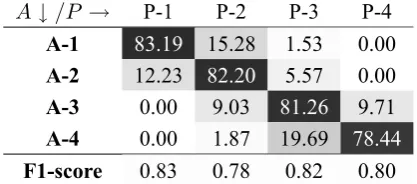
Table 2: Confusion Matrix for Ratings by BRAE-F,Across: Predicted Rating,Downward: Actual Rating
+ve/-ve polarity classifier, the accuracy showed an improvement of 6% over next highest baseline.
In Table 2, we calculate the confusion matrix for our model(BRAE-F) for the 4-Ratings case. Value in a cell(Ai, Pj)represents the percentage of ex-amples in actual rating class i that are predicted as rating j. We also show the F1 score calcu-lated for each individual rating class. It clearly shows that our model has low variation in F1-scores and thereby its performance among various rating classes.
In Fig. 3, we show the variation in accuracy of the classifiers with amount of sentiment labeled Training data used. We note that our approach con-sistently outperforms the explored baselines at all dataset sizes. Also, our model was able to attain accuracy comparable to other baselines at about 50% less labeled data showing its strength in ex-ploiting the unlabeled resources.
0 0.2 0.4 0.6 0.8 1
50 60 70 80 90
Majority BOW WordNet XL
RAE BRAE-U BRAE-P BRAE-F
Figure 3: Variation of Accuracy (+ve/-ve Polarity) with Size of labeled Dataset(Hindi),x-axis: Frac-tion of Dataset Used,y-axis:%age Accuracy Ob-tained
[image:7.595.308.522.494.673.2]New Word/Phrase Similar Words/Phrases Sentiment label
depressing gloomyउदास Rating : 1
नराशाजनक discouraging नराशा मक Polarity : -ve
was painful was difficultक ठन था Rating : 2
ददनाक था was badखराब था Polarity : -ve
should be awarded was appreciatedसराहना क गई Rating : 4 स मा नत कया जाना चा हए will get accoladesवाहवाह मलना चा हए Polarity : +ve
[image:8.595.89.510.62.191.2]public won't come no one will comeकोई नह ं आएगा Rating : 1 लोग नह ं आएगा viewers won't comeदशक नह ं आएगा Polarity : -ve
Table 3: Semantically similar phrases obtained for new phrases and their assigned label
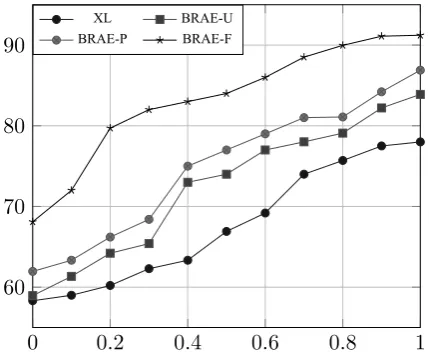
with amount of Unlabeled Bilingual Training Data used for Cross Lingual models explored. Again we increase size of bilingual dataset in 10% incre-ments and calculate the accuracy as described pre-viously. In Fig. 4, we observed that performance of the proposed approach steadily increases with amount of data added, yet even at about 50000 (20%) phrase pairs, our model produces remark-able gains in accuracy.
0 0.2 0.4 0.6 0.8 1
60 70 80 90
XL BRAE-U
BRAE-P BRAE-F
Figure 4: Variation of Accuracy (+ve/-ve polarity) with Size of Unlabeled Bilingual Corpora,x-axis:
Fraction of Training Data Used,y-axis: %age Ac-curacy Obtained
We also observed that the model which restricts modification to transformation weights during su-pervised phase II does better than the one which allows the modification at all dataset sizes. This result appears to be counterintuitive to normal op-eration of neural network based models, but sup-ports our hypothesis as explained in previous sec-tions.
5.7 Performance and Error Analysis
Analysis on the test results showed that the major advantage given by our model occurs due to pres-ence of unknown words (i.e.words not present in labeled dataset) in test data. Since we restricted the movement in semantic vector space, our model was able to infer the sentiment for a unknown word/phrase by comparing it with semantically similar words/phrases. In Table 3, we extracted the Top-2 semantically similar phrases in training set for small new phrases and sentiment labeled assigned to them by our model (the phrases are manually translated from Hindi for reader's under-standing). As we can see, our model was able to extract grammatically correct phrases with similar semantic nature as given phrase and assign correct sentiment label to it.
Secondly, We found that our model was able to correctly infer word sense for polysemous words that adversely affected the quality of sentiment classifiers in our baselines. This eliminates the need for manually constructed fine grained lexi-cal resource like WordNets and development of automated annotation resources. For example, to a phrase like "Her acting of a schizophrenic mother made our heartsweep", the baselines clas-sifiers assigned negative polarity due to presence of words like 'weep', yet our model was correctly able to predict positive polarity and assigned it a rating of 3.
Error Analysis of test results showed that errors made by our model can be classified in two major categories :
[image:8.595.74.289.382.558.2]assign-ing a sassign-ingle polarity/ratassign-ing to the review.
2) Presence of subtle contextual references af-fected the quality of predictions made by our clas-sifier. For example, sentence like''His poor acting generally destroys a movie, but this time it didn't''
got a rating of 2 due to presence of phrase with negative sense (here the phrase doesn't have am-biguous sense), yet the actual sentiment expressed is positive due to temporal dependence and gen-eralization. Also, "This movie made his last one looked good" makes a reference to entities exter-nal to the review, which again forces our model to make wrong prediction of rating 3.
Analyzing these aspects and making correct pre-dictions on such examples needs further work.
6 Conclusion and Future Work
This study focused on developing a Cross Lin-gual Supervised Classifier based on BilinLin-gually Constrained Recursive Autoencoder. To achieve this, our model first learns phrase embeddings for two languages using Standard RAE, then fine tune these embeddings using Cross Training procedure. After imposing certain restrictions on these em-beddings, we perform supervised training using labeled sentiment corpora in English and a much smaller one in Hindi to get the final classifier.
The experimental work showed that our model was remarkably effective for classification of Movie Reviews in Hindi on a rating scale and predicting polarity using least amount of data to achieve same accuracy as other systems explored. Moreover it reduces the need for MT System or lexical resources like Linked WordNets since the performance is not degraded too much even when we lack large quantity of labeled data.
In Future, we hope to 1) extend this system to learn phrase representations among multiple lan-guages simultaneously, 2) apply this framework to other cross Lingual Tasks such as Paraphrase de-tection, Question Answering, Aspect Based Opin-ion Mining etc and 3) Learning different weight matrices at different nodes to capture complex re-lations between words and phrases.
References
Balamurali, Aditya Joshi, and Pushpak Bhattacharyya. 2012. Cross-lingual sentiment analysis for Indian languages using linked wordnets. InProceedings of COLING 2012: Posters, pages 73--82. The COL-ING 2012 Organizing Committee.
Ondřej Bojar, Vojtěch Diatka, Pavel Rychlý, Pavel Straňák, Vít Suchomel, Aleš Tamchyna, and Daniel Zeman. 2014. HindEnCorp - Hindi-English and Hindi-only Corpus for Machine Translation. In Pro-ceedings of the Ninth International Conference on Language Resources and Evaluation (LREC'14). Eu-ropean Language Resources Association (ELRA).
Julian Brooke, Milan Tofiloski, and Maite Taboada. 2009. Cross-linguistic sentiment analysis: From en-glish to spanish. InRANLP, pages 50--54.
Ronan Collobert and Jason Weston. 2008. A unified architecture for natural language processing: Deep neural networks with multitask learning. In Pro-ceedings of the 25th international conference on Ma-chine learning, pages 160--167. ACM.
Hatem Ghorbel and David Jacot. 2011. Further experi-ments in sentiment analysis of french movie reviews. InAdvances in Intelligent Web Mastering--3, pages 19--28. Springer.
Christoph Goller and Andreas Kuchler. 1996. Learn-ing task-dependent distributed representations by backpropagation through structure. InNeural Net-works, 1996., IEEE International Conference on, volume 1, pages 347--352. IEEE.
Aditya Joshi, AR Balamurali, and Pushpak Bhat-tacharyya. 2010. A fall-back strategy for sentiment analysis in hindi: a case study. Proceedings of the 8th ICON.
Philipp Koehn, Hieu Hoang, Alexandra Birch, Chris Callison-Burch, Marcello Federico, Nicola Bertoldi, Brooke Cowan, Wade Shen, Christine Moran, Richard Zens, et al. 2007. Moses: Open source toolkit for statistical machine translation. In Pro-ceedings of the 45th annual meeting of the ACL on interactive poster and demonstration sessions, pages 177--180. Association for Computational Linguis-tics.
Bin Lu, Chenhao Tan, Claire Cardie, and Benjamin K Tsou. 2011. Joint bilingual sentiment classifica-tion with unlabeled parallel corpora. In Proceed-ings of the 49th Annual Meeting of the Association for Computational Linguistics: Human Language Technologies-Volume 1, pages 320--330. Associa-tion for ComputaAssocia-tional Linguistics.
Andrew L. Maas, Raymond E. Daly, Peter T. Pham, Dan Huang, Andrew Y. Ng, and Christopher Potts. 2011. Learning word vectors for sentiment analy-sis. InProceedings of the 49th Annual Meeting of the Association for Computational Linguistics: Hu-man Language Technologies, pages 142--150. Asso-ciation for Computational Linguistics.
Namita Mittal, Basant Agarwal, Garvit Chouhan, Nitin Bania, and Prateek Pareek. 2013. Sentiment analy-sis of hindi review based on negation and discourse relation. Inproceedings of International Joint Con-ference on Natural Language Processing, pages 45--50.
Kashyap Popat, Balamurali A.R, Pushpak Bhat-tacharyya, and Gholamreza Haffari. 2013. The haves and the have-nots: Leveraging unlabelled cor-pora for sentiment analysis. InProceedings of the 51st Annual Meeting of the Association for Compu-tational Linguistics (Volume 1: Long Papers), pages 412--422. Association for Computational Linguis-tics.
Richard Socher, Jeffrey Pennington, Eric H Huang, An-drew Y Ng, and Christopher D Manning. 2011. Semi-supervised recursive autoencoders for predict-ing sentiment distributions. InProceedings of the Conference on Empirical Methods in Natural Lan-guage Processing, pages 151--161. Association for Computational Linguistics.
Richard Socher, John Bauer, Christopher D Manning, and Andrew Y Ng. 2013. Parsing with composi-tional vector grammars. In In Proceedings of the ACL conference. Citeseer.
Chang Wan, Rong Pan, and Jiefei Li. 2011. Bi-weighting domain adaptation for cross-language text classification. InIJCAI Proceedings-International Joint Conference on Artificial Intelligence, vol-ume 22, page 1535.