W H A T SORT OF TREES D O WE SPEAK?
A C O M P U T A T I O N A L MODEL OF THE S Y N T A X - P R O S O D Y INTERFACE
IN TOKYO JAPANESE
Pete Whitelock
Sharp Laboratories of Europe Ltd. Neave House, Winsmore Lane Abingdon, Oxon., OX14 5UD, Britain
A B S T R A C T
What is the r e l a t i o n s h i p b e t w e e n syntax, prosody and phonetics? This paper argues for a declarative constraint-based t h e o r y , in which each step in a derivation adds diverse constraints to a pool. Some of these describe well formed objects in the feature structure domain, in terms of both syntactic and prosodic features. Some characterise the relative prominence of constituents as a partial order over some discrete domain (playing the role of metrical grid). Some are simultaneous equations in the reals, whose solutions represent the pitch level of phonetic objects - high and low tones. The elements of such a theory are illustrated with a treatment of prosodic phrasing and tone scaling in Tokyo Japanese, and the theory is compared to Selkirk and Tateishi's analysis based on the Strict Layer Hypothesis.
I N T R O D U C T I O N
In explorations of the relationship between syntax, phonology and phonetics, it is now generally agreed that hierarchical prosodic representations are an i m p o r t a n t o r g a n i s i n g c o n c e p t . As Pierrehumbert and Beckman (P&B, 1988), vividly put it ' W e speak trees, not strings'. One influential view of the geometry of ~ree representations is Selkirk's (1981) Strict Layer Hypothesis. For Selkirk and others, prosodic structures and syntactic structures are objects of different kinds. Yet the nature of the mapping between them remains a question to which explicit, accurate and declarative answers have still to be formulated.
This paper presents an alternative view in which phonetic constraints are incrementally associated directly with syntactic derivations. More exactly, derivations must simultaneously meet the well- formedness conditions on syntactic and prosodic labelling, thereby guaranteeing the declarative nature of the syntax-prosody interface. In turn, prosodic labels are associated with a set of equational constraints on phonetic objects. The theory is illustrated with a treatment of prosodic phrasing and tone scaling in standard, i.e. Tokyo, Japanese.
The possibility of e q u a t i n g syntactic and prosodic structure in this way follows from a view of syntax with two characteristics. First, some commonly assumed syntactic constituents which never correspond to prosodic units are insufficiently motivated, so such constructions are given an alternative syntactic analysis which respects prosodic constituency. Secondly, the derivation of an expression with a given semantic interpretation, and hence its prosodic structure, may be systematically under-determined by that interpretation. Syntactic structure is thus at least partly motivated by prosodic data, in accord with the concrete view of syntax presupposed in constraint-based grammars.
Conversely, the results of Kubozono's (1987) careful phonetic experiments point to the existence of prosodic structures that are organised recursively and in other ways incompatible with the Strict Layer Assumption. Distinctions in syntactic constituency which have been argued to be unimportant for prosodic phrasing do appear to have clear phonetic exponents under controlled conditions, weakening the argument for autonomous prosodic structures.
The paper is organised as follows. The elements of the syntactic model used in the analysis of Japanese are presented. We then approach the syntax-prosody interface from the opposite end, and look at the p r o s o d i c phonetics of Japanese utterances, trying to classify features of pitch contours. First, several relatively uncontroversial elements in the phonology of Japanese prosody are discussed - the minor phrase, the accentual and phrasal tones, declination and downstep. Then the Strict Layer Hypothesis and its application to minor phrasing and tone scaling are considered. Data from Kubozono (1987) is introduced to argue instead for the t h e o r y assumed here, and a preliminary treatment is presented.
A C A T E G O R I A L U N I F I C A T I O N A P P R O A C H T O J A P A N E S E
I will identify the fundamental unit of Japanese syntax with the traditional category~ b u n s e t s u (phrase), comprising an open-class "item with
cliticised closed-class affixes. The open class lexical items are broadly classifiable as nouns and verbs. As described in Whitelock (1987), the closed-class i t e m s m a y be classified in t w o o r t h o g o n a l dimensions. First, they form phrases with items of a certain category. Second, they indicate that such a phrase stands in some syntactic relationship (e.g. subject, modifier) to another phrase with a certain category. Thus the phrases of the language fall into the following four categories:
nominal - adverbial, e.g.
keiko ni (Keiko-DAT), genki ni (healthily)
nominal - adnominal
keiko no (Keiko-GEN), g~nki na (healthy)
verbal - adverbial
waratte (laugh-and), amaku (sweetly)
verbal - adnominal
warau (that laughs), amakatta (that was sweet)
The bunsetsu generally behaves as a prosodic unit. Although the syntactic structure of a phrase like (1) is generally taken to be as in (la), its prosodic structure must be as in (lb).
(i) N a o k o n o a n t n o N a o k o ' s b r o t h e r 's
(la) [ [ [ N a o k o no] ant] no]
(ib) [ [ N a o k o no] [ant no]]
P r o p o s a l s to h a n d l e s u c h ' b r a c k e t i n g paradoxes' have been made within the framework of extended Categorial G r a m m a r (e.g. Moortgat, 1989). We will assume a Categorial Unification G r a m m a r (CUG) (Uszkoreit (1986), K a r t u n n e n (1987)). W h e r e a s an e x t e n d e d CG m i g h t c a p t u r e the p o l y m o r p h i s m of a bunsetsu b y the derivation step of type-raising, in CUG it m a y be represented simultaneously by the use of multiple features in the complex categories. Syntactic bracketings such as that shown in (la) are never assigned.
Each complex category or sign includes a set of s e l f features, plus the s i g n - v a l u e d f e a t u r e s a r g u m e n t and r e s u l t , which t o g e t h e r with a d i r e c t i o n constitute a f u n c t i o n . The relevant structure of a typical sign, for the bunsetsu keiko hi,
is shown in (2).
(2) s e l f : [ l ] c a t : n
f u n c t i o n : a r g : [ 2 ] s e l f : c a t : s d i r : r i g h t
res: [ 2 ] s e l f : i o b j : [ l ]
This sign says 'if a functor is looking for me, it probably needs to know I ' m a noun. But 1 am also a function from a sentence of which I am the indirect object into itself'. Note the assumption that well- formedness of the functional representations (i.e. those which include subj, obj etc.) is independently characterised (cf. Coherence and Completeness in LFG (Kaplan and Bresnan, 1982)). This leads to a massive simplification in the combinatorial syntax. Karttunen (1987) proposes a similar treatment for Finnish. Furthermore, I treat free verb forms as S, an a p p r o a c h m o t i v a t e d b y the z e r o - p r o n o m i n a l property of Japanese (see Whitelock 1991 for further details). Also note, contra other work in extended CG (e.g. Barry a n d Pickering (1990)), that this f o r m u l a t i o n i d e n t i f i e s t h e f u n c t i o n in a combination with the d e p e n d e n t in a functional dependency representation, and the a r g u m e n t with the h e a d .
The syntactic rules define three ways of building signs. (3) s h o w s rule A (essentially function application) in PATR-II notation.
(3) M --) D , H (A)
< D f u n c t i o n d i r > = r i g h t < D f u n c t i o n a r g > = H < D f u n c t i o n r e s > = M
The backward version of this rule (L) is the rule of morphological combination. Unlike a syntactic functor, a morphological functor, i.e. an affix, will typically have quite distinct values of <function arg> and <function result>.
The chaining rule (C) in (4) constructs the • mother sign with self features from the functor sign • rather than the result sign.
(4) M --) D , H (C)
< D f u n c t i o n d i r > = r i g h t < D f u n c t i o n a r g > = H <D f u n c t i o n r e s f u n c t i o n >
= < M f u n c t i o n > < D s e l f > = < M s e l f >
Finally, the merging rule (M) in (5) combines two functors looking for the same argument:
(5) M --) D1 , D2 (M)
< D I f u n c t o r > = < D 2 f u n c t o r > < D I f u n c t o r > = < M f u n c t o r > < M s e l f > = n i l
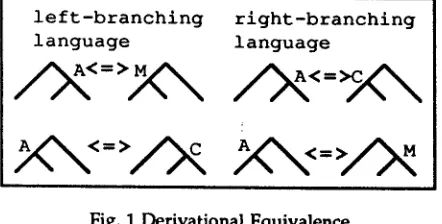
languages. Like an extended CG, but unlike the Lambek calculus, CUG is not structurally complete (i.e. not every substring may be given an analysis). M e r g i n g a n d c h a i n i n g b o t h c o r r e s p o n d approximately to composition in extended CG. However, the CUG formulation brings out the essential difference between them. A constituent built by chaining represents a head lacking a dependent, while merging combines dependents lacking a head. Their effect on derivation depends on the headedness of the language concerned. The main effects are summarised in Fig. 1 (where <=> denotes truth equivalence).
l e f t - b r a n c h i n g r i g h t - b r a n c h i n g
l a n g u a g e l a n g u a g e
Fig. 1 Derivationa! Equivalence
The important aspects of this model are as follows. First, all structures are directly generated by the grammar. The <=> is not a rule for deriving one structure from another. Secondly, the branching structure may be sensitive tO constraints other than semantic ones. In particular, applicatively right- branching structures m a y be given alternative, psychologically more plausible, analyses. Such analyses are useful in m o d e l l i n g intonation p h e n o m e n a such as the prosodic bracketing of English phrases like (6) (generated using the English Chain rule), whose applicative bracketing is given in (6a).
(6) [this is the dog][that bit the cat] [that chased the raft[that ...
(6a) [this[is[the[dog[that[bit[the[cat [that[chased[the[rat[that ....
T H E P H O N E T I C S OF P R O S O D Y
1 8 0 -
•0@@~ •@
@@•@ • • • •
• 0 @ 0
1 4 0 - • e • • •
n o m i m • n o • s o r e w a u m a .'i
i 0 0 -
Fig. 2 A pitch trace
Fig. 2 shows a pitch trace for the Japanese utterance (7) which will be used to introduce the major features of the prosodic organisation of the language.
(7) Sore-wa uma-i nomimono de-su
That-TOP tasty-PRES drink COP-PRES
That is a tasty drink.
O • o e e 4
f
s o r e w a
i
" )
u ~ i
" @ • •
(
I~
. . . _ .s o n o
Fig. 3a Minor Phrases
In Fig 3a, the division of the utterance into minor phrases (~t) (P&B's accentual phrase) is highlighted. A minor phrase shows exactly one pitch peak; in this u t t e r a n c e , the m i n o r phrases correspond exactly to bunsetsu. In the section on minor phrasing below, we will look more closely at the relationship between the two.
• H H* k
[image:3.596.68.289.251.363.2]s o r e w a u m a i n o m i m • n L ~
Fig. 3b Tones and Accent
Fig. 3b draws attention to the distinction in shape between the first and the latter two minor phrases. The steep drop in pitch from m a to i in u m a i , and from m i to m • in n o m i m o n o , represents the pitch accent proper. The presence and location of a pitch accent is a lexical property, and its shape is fixed. In contrast, the gentle fall covering 'the rewa of s o r e w a is a result of s o r e ' s lexical specification as unaccented. In such cases, a lower pitch peak than the accented one is realised early i n - t h e minor phrase. In fact, in minor phrases with a late accent, this early peak is also distinguishable, so this "phrasal' tone can be assumed present in all minor phrases. Note the phonetic justification of this prosodic category as the d o m a i n of high tone linking.
[image:3.596.325.543.418.527.2]The diagram is annotated according to the notation of Pierrehumbert (1980). The pitch accent is represented as a sequence of tones, here H+L, with the tone that is aligned with the text marked *, hence H*+L. The L tone of the accent is aligned with respect to this. The phrasal H tone and the boundary L tones, L%, are also shown. P&B clearly demonstrate that their sparse tone model, built from pitch accents, phrasal H tones and b o u n d a r y L tones, is superior to the standard Autosegmental account (e.g. Haraguchi, 1977), where each mora has a fully specified tone. Their careful phonetic e x p e r i m e n t s s h o w that pitch is a s i m p l e interpolation between certain critical points.
In this paper, the alignment of tones will not be considered. In English, the repertoire of pitch accents leads to phrases with a variety of tunes, including alignment contrasts such as that between H+L* and H*+L. But in Japanese, the tunes are restricted to the ones in (8).
(8) (L%) H (L%) u n a c c e n t e d
(L%) H H * + L (L%) a c c e n t e d
I have bracketed the b o u n d a r y tones at both ends to indicate that they belong to both preceding and following phrases - they are ambiphrasal. More exactly, I treat a boundary tone between two minor phrases as a property of the major phrase which dominates both of them, though I don't discuss L- tone scaling in the paper.
In fig. 3c, the overall downward slope of the pitch trace is picked out. Such a slope, about 10Hz/sec, is often cited as an intonational universal and linked to physiological properties of the speech system. Experiments demonstrate that the second of two equal tones is typically perceived as higher. This phonetic property, declination, must be clearly distinguished from the phonological p r o p e r t y downstep or catathesis, as also illustrated in fig. 3c.
J w v
• d o w n s t e p
• e e • • @ • u -
• 0 @@
e • e
t i o n • • •e
s o r e w a u m a i n o m i m e n e e . .
Fig. 3c Declination and Downstep
The pitch difference between the accent H tones of the last two phrases is significantly greater than can be accounted for by declination alone. Several authors (Poser, 1987, P&B, Kubozono) have
d e m o n s t r a t e d that this effect occurs precisely because an accent lowers all tones in a subsequent phrase. P&B quantify the fact of downstep with a speaker specific constant c, (,, 0.5, in a pitch range normalised to 1). In effect, a tone in a phrase following an accented phrase is c times the height it would be following an unaccented phrase. The p r o s o d i c c a t e g o r y major p h r a s e is justified phonetically as the domain of downstep; the precise character of major phrases is a point at issue in this paper.
s o r e w a u m a i n o m i m e n o
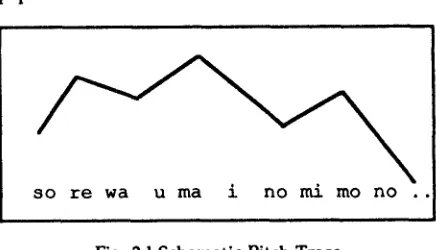
Fig. 3d Schematic Pitch Trace
Fig. 3d shows a schematisation of the same pitch contour, correcting for declination and connecting adjacent peaks and t r o u g h s with straight line s e g m e n t s .
ordered f i n i m s e t o f p r o s o d i c categories: ~,Hn >,forexample:
< . . . . p r o s o d i c w o r d (CO),
m i n o r p h r a s e ( ~ ) ,
m a j o r p h r a s e (4),
u t t e r a n c e ( V ) >
T H E S T R I C T LAYER H Y P O T H E S I S
The Strict Layer Hypothesis posits a totally < l i 0 , . . •
Each local tree in a prosodic representation is licensed by a phrase structure rule of the form Hi "-~ H i - l " , f o r i E 1 .. n . T h u s a category of one type dominates all and only the categories of o n e other type, and prosodic trees are fixed in depth and n-ary branching.
Acceding to Selkirk and Tateishi (S&T, 1989) the s y n t a x - p r o s o d y m a p p i n g is then d e f i n e d b y associating with each II b i E 0 .. n, a parameter pair of the form:
[image:4.596.335.553.222.347.2]The p a r a m e t e r settings entail that a prosodic boundary between constituents of category H i must coincide with the edge of a syntactic constituent of c a t e g o r y X b a r . Note b y SLH that a prosodic b o u n d a r y b e t w e e n H i must also be a b o u n d a r y between Flj, for all j < i.
M I N O R P H R A S I N G
For S&T, the e d g e p a r a m e t e r for Japanese prosodic categories is uniformly set to left. The X b a r value associated with the major phrase ((~) is X max. Therefore, a major phrase boundary must appear at the left edge of any maximal projection.
syntactic structure
I
,&,,
A
.
NI no N2 ga
prosodic
~
N1
structures
prosodic boundaries
~
~
[image:5.596.64.290.302.461.2]by S&T's SPI
0~ b)
Fig. 4 Minor Phrasing (S&T)
It is not easy to give such a straightforward a c c o u n t of m i n o r p h r a s i n g . U n d e r c e r t a i n circumstances, a sequence Of two bunsetsu m a y be realised as a single minor phrase. For S&T bunsetsu is never a syntactic category, but rather appears as the prosodic category word (0)). It is the prosodic word rather than the minor phrase which has the parameter setting, in this case X lex. So an upcoming lexical item must initiate a prosodic word, but m a y or m a y not initiate a minor phrase. The analysis is s u m m a r i s e d in fig. 4. One slight methodological problem is that the prosodic word has no phonetic justification.
In the alternative analysis pursued here, two boolean-valued features m a j o r and m i n o r are used to prosodically classify syntactic constituents. A single constituent m a y not be both < m i n o r +> and <major +>, though it m a y be neither. Each of these f e a t u r e s p e c i f i c a t i o n s is a s s o c i a t e d w i t h characteristic phonetic equations. A constituent labelled <minor +> will contribute a constraint that relates the pitch of the H tones to the value of a register. A constituent labelled < m a j o r +> will
contribute two sets of constraints - over the relative values of its daughter's registers, and on the pitch of the intermediate L% tones. These constraints are discussed below.
The admissible prosodic labellings are defined as those which extend the following prosodic rules. in (9) (+(~), the mother is constrained to be a major phrase, while in (10) (-4~), the mother is constrained not to be a major phrase, though it m a y or m a y not be a minor phrase.
(9) M o t h e r - ~ L e f t R i g h t ( + ~ )
< M o t h e r m a j o r > = + < M o t h e r m i n o r > = - < L e f t m a j o r > = < L e f t m i n o r > = - ~ < R i g h t m a j o r > = < R i g h t m i n o r > = - 6
(i0) M o t h e r - 9 L e f t R i g h t ( - ~ )
< M o t h e r m a j o r > = - < L e f t m a j o r > = - < L e f t m i n o r > = - < R i g h t m a j o r > = - < R i g h t m i n o r > = -
Note h o w the category major phrase is recursive (or compound, in the sense of Ladd (1990)), while minor phrase is a single layer.
The syntax-prosody interface (SPI) is defined as a subset of <prosodic rules X syntactic rules>. For instance, the optionality of minor phrase formation follows from the inclusion of <+~),A> and <-4~,A> in SPI.
syntactic structure
A
N
made
phrasing
A
prosodic
structure?
F i g . 5 A problem for SLH
S&T assume that a minor phrase boundary may never a p p e a r within a bunsetsu (£0). H o w e v e r , Kubozono shows that such phrasings can occur, when the phrase contains both an accented lexical item and a particle with its o w n accent, such as
[image:5.596.321.544.560.694.2]made, ' u p to'. The SLH cannot license structures as in fig. 5. In the theory assumed here, this data is simply described by the inclusion in SPI of <+(~,L> as well as <-~,L>.
T O N E S C A L I N G
T w o - e l e m e n t p h r a s e s : W h e n t w o m i n o r phrases are combined, the accentedness of the first element provides the strongest constraints on the form of the second - if the first element is accented, the second element is downstepped. In addition, an accented element is higher than an unaccented one (this is true of previous L% tones as well as H tones). We associate with the prosodic rule +(~ a scaling equation as in (11):
(ii) M o t h e r -~ L e f t R i g h t (+¢)
< R i g h t r e g i s t e r > = f ( < L e f t r e g i s t e r > ,
< R i g h t d o w n s t e p > )
If the v a l u e s of these f e a t u r e s are real, normalised to speaker range, and f is multiplication, this treatment is very similar to P&Bs. I assume the feature <Right d o w n s t e p > takes the values d n (n > 0), where n is the number of downstepping tones in Left and d is the speaker specific constant (<1) that determines the quantitative aspects of downstep.
For each constituent P h r a s e labelled < m i n o r +>, a set of equations as in (12) is added to the constraint pool:
(12) < P h r a s e a c c e n t p i t c h > = < P h r a s e r e g i s t e r > < P h r a s e p h r a s a l h i g h p i t c h > =
g ( < P h r a s e r e g i s t e r > , u )
This continues to follow P&B (with g = multiplication) and u (<1) a s p e a k e r constant representing the ratio of phrasal to accent high.
T h r e e - e l e m e n t p h r a s e s : K u b o z o n o considers three element phrases and contrasts the intonation of those with right and left branching applicative structures. For instance, fig. 6 contrasts the two cases in (13), in which all elements are accented. The difference between the second peaks in the two structures is significant at < 1%, the difference between the third at <.1%.
(13a) ao'i o'okina me'ron (right branching)
blue big melon
(13b) ao'i re'monno nio'i (left branching)
blue melon smell
Fig. 6 Three-element Phrases
To describe this, I assign a metrical labelling to a derivation. I a s s u m e that contra English, the
p r i m a r y phonetic e x p o n e n t of such labelling in Japanese is pitch, that is, the H tones in stronger constituents are higher. The labelling associated with the A (and C) rule is as follows:
In a s t r u c t u r e o f t h e f o r m : [A X Y] or [C X Y] Y is s t r o n g i f f it b r a n c h e s
This gives the following labellings for the trees in fig. 6.
a) [W IS S WI] b) [Is S W] W]
Labelling rules m a y of course be overridden by d i s c o u r s e factors. Space p r e c l u d e s a detailed description of prominence projection, that is, the correlation of metrical labelling with discrete terminal grid values. N o t e that the s t a n d a r d Liberman and Prince convention equates the grid values of the last element in the two cases, in conflict with the data. One formulation would assume a feature, say p r o m i n e n c e , which takes the values 1 or p (>1) as a constituent is labelled W or S. Downstepping and prominence interact, with the formulation in (14) replacing that given in (11) above:
(14) < R i g h t r e g i s t e r > =
f ( < L e f t r e g i s t e r > , < R i g h t d o w n s t e p > , < R i g h t p r o m i n e n c e > )
< L e f t r e g i s t e r > = < M o t h e r r e g i s t e r >
Note that the register of a constituent is that of its left daughter. If the entire phrase is given the
register value 1, and f is multi-plication, the h i g h
tones in fig. 6 receive the following pitch values.
R i g h t - b r a n c h i n g c a s e H2 = HI * d * p = d * p H3 = H2 * d = d 2 * p
[image:6.596.327.553.98.228.2]These figures capture the fact that both second and third elements in the right-branching structure ~re boosted with respect to their left-branching counterparts.
S&T's data shows the same effect as that of Kubozono in fig. 6. Their analysis is schematised in fig. 7. The difference between the two cases follows from the binary opposition d o w n s t e p / n o downstep. However, this analysis is no longer supported by Selkirk (p.c.), following Kubozono's clear demon- stration that downstep does apply in right-branching phrases. If the first element of a right branching phrase is unaccented, the second element is even higher.
V V
~ = downstep ~ = no downstep
Fig. 7 Three-Element Phrases (S&T)
Four-element phrases: When we turn to four- element phrases, we find further evidence for i~ecursively structured prosodic domains. Fig. 8 summarises Kubozono's data. All trees represent applicative structures. In structures 1 and 2, the first two elements are a d e p e n d e n t and its head, indisputibly a constituent. In structures 3 and 4, the first two elements are dependents of the same head. This is a non-standard constituent built by the Merge rule. Syntactically, such a constituent appears in coordinate sentence constructions with "gapped' pre-final verbs. Finally, in structure 5, the first two elements do not form a syntactic constituent of any sort, being a head and the dependent of ~iifferent head.
These functional equivalence classes correlate closely with the relative heights of the two pitch peaks - - the tighter the connection between the two elements, the lower the second peak. This account compares favourably with other theories that only postulate one such relationship, such as Lambek g r a m m a r w h e r e e v e r y pair of phrases is a ~:onstituent, or those with two, such as phrase-
8~ructure grammar, or Barry and Pickering's (1990) ve~'sion of Lambek with d e p e n d e n c y and non- ~ependency constituents.
However, in principle Barry and Pickering's model could generalise as follows. They characterise any string whose analysis involves abstraction over a function symbol as a non-dependency constituent. But as many further distinctions as the data warrants may be made by considering the number of functors abstracted over. Kubozono's data for four-element phrases s u p p o r t s the case for at least three distinctions (no functor abstraction, one, more than one). Whether further distinctions need to be supported is unclear, as the systematic phonetic exploration of five-element phrases has yet to be carried out.
Fig. 8 Four-Element Phrases
C O N C L U S I O N S
A constraint-based model of syntax and prosodic phonetics has been i n t r o d u c e d and analyses of Japanese phonological phenomena have b e e n o u t l i n e d . S p a c e p r e c l u d e s d e t a i l e d consideration of the model's application to other dialects and languages. However, a similar model has been argued for by Briscoe (pc) on the basis of English.
The model has been implemented in a Prolog version of PATR-II augmented with a simultaneous equation solver. Most of the data given above have been described with varying degrees of accuracy. Formulating and testing the predictions of diverse hypotheses with the system is easy due to the basic generative approach. Further cycles of phonetic experiments and modelling of the results are needed to distinguish between alternative analyses and refine the accuracy of the model.
[image:7.596.309.528.245.488.2] [image:7.596.56.276.278.400.2]If this early exploration turns out to be on the right track, and it is indeed possible to describe the prosodic properties of speech within an integrated declarative model of grammar, then future speech synthesis systems will be able to exploit diverse information on-line in the generation of natural intonation.
ACKNOWLEDGMENTS
This work was carried out while I was a visiting fellow at the Centre for Cognitive Science, University of Edinburgh. I would like to thank Ewan Klein for making this possible. I am grateful to all the members of the Phonology workshop, especially Bob Ladd who read and commented on earlier drafts. Jo Calder and Mike Reape had me as an office mate, and helped me in all sorts of ways, so special thanks to them.
REFERENCES
Barry, Guy and Martin Pickering (1990) Dependency and Constituency in Categorial Grammar. in Edinburgh Working Papers in
Cognitive Science, Voi. 5: Studies in Categorial
Grammar, G. Barry and G. Morrill (eds.). Centre for
Cognitive Science, Univ. of Edinburgh.
Haraguchi, Shosuke (1977) The Tone Pattern of Japanese: An Autosegmental Theory of Tonology. Kaitakusha, Tokyo.
Kaplan, Ronald and Joan Bresnan (1982) Lexical Functional Grammar: A Formal System for Grammatical Representation. in The Mental
R e p r e s e n t a t i o n o f Grammatical Relations, J.
Bresnan (ed.) MIT.
Karttunen, Lauri (1989) Radical Lexicalism. in Alternative Conceptions of Phrase Structure, M.R. Baltin and A.S. Kroch (eds.), Chicago.
Kubozono, Haruo (1987) The Organization of
J a p a n e s e P r o s o d y PhD Thesis, Dept. of
Linguistics, Univ. of Edinburgh.
Ladd, D. Robert (1990) Compound Prosodic Domains, submitted to Language.
Moortgat, Michael (1989) C a t e g o r i a l
Investigations: Logical and Linguistic Aspects of the Lambek Calculus. Forts, Dordrecht.
Pierrehumbert, Janet (1980) The Phonology and Phonetics of English Intonation. Doctoral diss. MIT.
Pierrehumbert, Janet and Mary Beckman (1988)
Japanese T o n e Structure, MIT Press, Cambridge.
Poser, William J. (1984) T h e P h o n e t i c s and
Phonology of T o n e and Intonation in Japanese.
Doctoral diss. MIT.
Selkirk, Elisabeth (1981) On Prosodic Structure and its Relation to Syntactic Structure, in N o r d i c
P r o s o d y vol. 2, ed. T. E. Fretheim, Tapir,
Trondheim.
Selkirk, Elisabeth and Koichi Tateishi, (1989) Constraints on Minor Phrase Formation in Japanese,
in Proceedings of the CLS 24.
Uszkoreit, Hans (1986) Categorial Unification Grammars. COLING 11, Bonn.
Whitelock, Peter J. (1987) A feature-based categorial morpho-syntax of Japanese. in Natural Language Parsing and Linguistic T h e o r i e s , U. Reyle and C. Rohrer (eds.) Reidel, Dordrecht.
Whitelock, Peter J. (1991) Some Aspects of a
C o m p u t a t i o n a l G r a m m a r o f J a p a n e s e ,