Universal Semantic Parsing
Siva Reddy†∗ Oscar T¨ackstr¨om‡ Slav Petrov‡ Mark Steedman†† Mirella Lapata†† †Stanford University
‡Google Inc. ††University of Edinburgh
[email protected],{oscart,slav}@google.com,{steedman,mlap}@inf.ed.ac.uk
Abstract
Universal Dependencies (UD) offer a uni-form cross-lingual syntactic representation, with the aim of advancing multilingual ap-plications. Recent work shows that se-mantic parsing can be accomplished by transforming syntactic dependencies to log-ical forms. However, this work is lim-ited to English, and cannot process de-pendency graphs, which allow handling complex phenomena such as control. In this work, we introduce UDEPLAMBDA, a semantic interface for UD, which maps natural language to logical forms in an almost language-independent fashion and can process dependency graphs. We per-form experiments on question answering against Freebase and provide German and Spanish translations of the WebQuestions and GraphQuestions datasets to facilitate multilingual evaluation. Results show that UDEPLAMBDAoutperforms strong base-lines across languages and datasets. For English, it achieves a 4.9F1point
improve-ment over the state-of-the-art on Graph-Questions.
1 Introduction
The Universal Dependencies (UD) initiative seeks to develop cross-linguistically consistent annota-tion guidelines as well as a large number of uni-formly annotated treebanks for many languages (Nivre et al.,2016). Such resources could advance multilingual applications of parsing, improve com-parability of evaluation results, enable cross-lingual learning, and more generally support natural lan-guage understanding.
∗Work done at the University of Edinburgh
Seeking to exploit the benefits of UD for natu-ral language understanding, we introduce UDEP -LAMBDA, a semantic interface for UD that maps natural language to logical forms, representing un-derlying predicate-argument structures, in an al-most language-independent manner. Our frame-work is based on DEPLAMBDA (Reddy et al.,
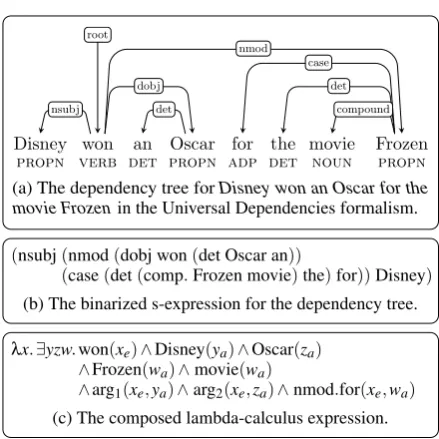
2016) a recently developed method that converts English Stanford Dependencies (SD) to logical forms. The conversion process is illustrated in Figure1and discussed in more detail in Section2. Whereas DEPLAMBDAworks only for English, U-DEPLAMBDA applies to any language for which UD annotations are available.1 Moreover, DEP -LAMBDA can only process tree-structured inputs whereas UDEPLAMBDA can also process depen-dency graphs, which allow to handle complex con-structions such as control. The different treatments of various linguistic constructions in UD compared to SD also require different handling in UDEP -LAMBDA(Section3.3).
Our experiments focus on Freebase semantic parsing as a testbed for evaluating the framework’s multilingual appeal. We convert natural language to logical forms which in turn are converted to ma-chine interpretable formal meaning representations for retrieving answers to questions from Freebase. To facilitate multilingual evaluation, we provide translations of the English WebQuestions (Berant et al.,2013) and GraphQuestions (Su et al.,2016) datasets to German and Spanish. We demonstrate that UDEPLAMBDAcan be used to derive logical forms for these languages using a minimal amount of language-specific knowledge. Aside from devel-oping the first multilingual semantic parsing tool for Freebase, we also experimentally show that U-DEPLAMBDAoutperforms strong baselines across
1As of v1.3, UD annotations are available for 47 languages athttp://universaldependencies.org.
languages and datasets. For English, it achieves the strongest result to date on GraphQuestions, with competitive results on WebQuestions. Our imple-mentation and translated datasets are publicly avail-able athttps://github.com/sivareddyg/udeplambda.
2 DEPLAMBDA
Before describing UDEPLAMBDA, we provide an overview of DEPLAMBDA (Reddy et al., 2016) on which our approach is based. DEPLAMBDA converts a dependency tree to its logical form in three steps: binarization, substitution, and com-position, each of which is briefly outlined below. Algorithm1describes the steps of DEPLAMBDA in lines 4-6, whereas lines 2 and 3 are specific to UDEPLAMBDA.
Binarization A dependency tree is first mapped to a Lisp-style s-expression indicating the order of semantic composition. Figure1(b)shows the s-expression for the sentenceDisney won an Os-car for the movie Frozen, derived from the depen-dency tree in Figure1(a). Here, the sub-expression
(dobj won(det Oscar an))indicates that the logi-cal form of the phrasewon an Oscar is derived by composing the logical form of the labeldobjwith the logical form of the wordwonand the logical form of the phrasean Oscar, derived analogously. The s-expression can also be interpreted as a bi-narized tree with the dependency label as the root node, and the left and right expressions as subtrees.
A composition hierarchy is employed to impose a strict traversal ordering on the modifiers to each head in the dependency tree. As an example,won has three modifiers in Figure1(a), which according to the composition hierarchy are composed in the orderdobj>nmod>nsubj. In constructions like coordination, this ordering is crucial to arrive at the correct semantics. Lines 7-17 in Algorithm1
describe the binarization step.
Substitution Each symbol in the s-expressions is substituted for a lambda expression encoding its semantics. Words and dependency labels are assigned different types of expressions. In general, words have expressions of the following kind: ENTITY ⇒λx.word(xa); e.g. Oscar⇒λx.Oscar(xa)
EVENT ⇒λx.word(xe); e.g. won⇒λx.won(xe)
FUNCTIONAL⇒λx.TRUE; e.g. an⇒λx.TRUE
Here, the subscripts ·a and·e denote the types
of individuals (Ind) and events (Event), respec-tively, whereasxdenotes a paired variable(xa,xe)
Disney won an Oscar for the movie Frozen
propn verb det propn adp det noun propn
nsubj
dobj
nmod
det
case det
compound root
(a) The dependency tree forDisney won an Oscar for the movie Frozenin the Universal Dependencies formalism.
(nsubj(nmod(dobj won(det Oscar an))
(case(det(comp.Frozen movie)the)for))Disney)
(b) The binarized s-expression for the dependency tree.
λx.∃yzw.won(xe)∧Disney(ya)∧Oscar(za) ∧Frozen(wa)∧movie(wa)
∧arg1(xe,ya)∧arg2(xe,za)∧nmod.for(xe,wa)
[image:2.595.306.526.61.281.2](c) The composed lambda-calculus expression.
Figure 1: The mapping of a dependency tree to its logical form with the intermediate s-expression.
of type Ind×Event. Roughly speaking, proper nouns and adjectives invokeENTITYexpressions, verbs and adverbs invokeEVENTexpressions, and common nouns invoke bothENTITYandEVENT ex-pressions (see Section3.3), while remaining words invokeFUNCTIONALexpressions. DEPLAMBDA enforces the constraint that every s-expression is of the typeη=Ind×Event→Bool, which simpli-fies the type system considerably.
Expressions for dependency labels glue the semantics of heads and modifiers to articulate predicate-argument structure. These expressions in general take one of the following forms:
COPY ⇒λf gx.∃y.f(x)∧g(y)∧rel(x,y)
e.g. nsubj,dobj,nmod,advmod
INVERT ⇒λf gx.∃y.f(x)∧g(y)∧reli(y,x) e.g.amod,acl
MERGE ⇒λf gx.f(x)∧g(x)
e.g.compound,appos,amod,acl
HEAD ⇒λf gx.f(x)
e.g.case,punct,aux,mark.
As an example of COPY, consider the lambda expression fordobjin(dobj won(det Oscar an)): λf gx.∃y.f(x)∧g(y)∧arg2(xe,ya). This
expres-sion takes two functions f andgas input, where
f represents the logical form ofwonandg repre-sents the logical form ofan Oscar. The predicate-argument structure arg2(xe,ya)indicates that the
arg2of the eventxe, i.e.won, is the individualya,
i.e. the entityOscar. Since arg2(xe,ya)mimics the
Expressions that invert the dependency direc-tion are referred to as INVERT (e.g.amod in run-ning horse); expressions that merge two subexpres-sions without introducing any relation predicates are referred to asMERGE(e.g.compoundinmovie Frozen); and expressions that simply return the par-ent expression semantics are referred to asHEAD (e.g.caseinfor Frozen). While this generalization applies to most dependency labels, several labels take a different logical form not listed here, some of which are discussed in Section3.3. Sometimes the mapping of dependency label to lambda expres-sion may depend on surrounding part-of-speech tags or dependency labels. For example,amodacts asINVERTwhen the modifier is a verb (e.g. in run-ning horse), and asMERGEwhen the modifier is an adjective (e.g. inbeautiful horse).2 Lines 26-32 in Algorithm1describe the substitution procedure.
Composition The final logical form is computed by beta-reduction, treating expressions of the form
(f x y)as the function f applied to the arguments x and y. For example,(dobj won(det Oscar an))
results inλx.∃z.won(xe)∧Oscar(za)∧arg2(xe,za)
when the expression fordobjis applied to those forwonand(det Oscar an). Figure1(c)shows the logical form for the s-expression in Figure 1(b). The binarized s-expression is recursively converted to a logical form as described in lines 18-25 in Algorithm1.
3 UDEPLAMBDA
We now introduce UDEPLAMBDA, a semantic in-terface for Universal Dependencies.3 Whereas DEPLAMBDAonly applies to English Stanford De-pendencies, UDEPLAMBDAtakes advantage of the cross-lingual nature of UD to facilitate an (almost) language independent semantic interface. This is accomplished by restricting the binarization, sub-stitution, and composition steps described above to rely solely on information encoded in the UD representation. As shown in Algorithm 1, lines 4-6 are common to both DEPLAMBDAand UDEP -LAMBDA, whereas lines 2 and 3 applies only to UDEPLAMBDA. Importantly, UDEPLAMBDAis designed to not rely on lexical forms in a language 2We use Tregex (Levy and Andrew,2006) for substitu-tion mappings and Cornell SPF (Artzi,2013) as the lambda-calculus implementation. For example, inrunning horse, the tregex/label:amod/=target</postag:verb/matchesamodto itsINVERTexpressionλf gx.∃y.f(x)∧g(y)∧amodi(ye,xa).
3In what follows, all references to UD are to UD v1.3.
Algorithm 1:UDEPLAMBDASteps
1 FunctionUDepLambda(depTree): 2 depGraph=Enhancement(depTree)
#See Figure 2(a) for a depGraph.
3 bindedTree=SplitLongDistance(depGraph)
#See Figure 2(b) for a bindedTree.
4 binarizedTree=Binarization(bindedTree)
#See Figure 1(b) for a binarizedTree.
5 logicalForm=Composition(binarizedTree) 6 returnlogicalForm
7 FunctionBinarization(tree): 8 parent=GetRootNode(tree); 9 {(label1,child1),(label2,child2)...}
=GetChildNodes(parent)
10 sortedChildren=SortUsingLabelHierarchy
({(label1,child1),(label2,child2)...})
11 binarziedTree.root=parent 12 for label, child∈sortedChildren: 13 temp.root=label
14 temp.le ft=binarziedTree 15 temp.right=Binarization(child) 16 binarziedTree=temp
17 returnbinarizedTree
18 FunctionComposition(binarizedTree):
19 mainLF =Substitution(binarizedTree.root) 20 ifbinarziedTree has left and right children: 21 le ftLF=Composition(binarziedTree.le ft) 22 rightLF=Composition(binarziedTree.right) 23 mainLF=BetaReduce(mainLF,le ftLF) 24 mainLF=BetaReduce(mainLF,rightLF) 25 returnmainLF
26 FunctionSubstitution(node): 27 logicalForms= [ ]
28 for tregexRule, template∈substitutionRules: 29 iftregexRule.match(node):
30 l f=GenLambdaExp(node, template)
31 logicalForms.add(l f) 32 returnlogicalForms
to assign lambda expressions, but only on informa-tion contained in dependency labels and postags.
-LAMBDA is designed to work with dependency graphs as well (Section3.2). Finally, several con-structions differ in structure between UD and SD, which requires different handling in the semantic interface (Section3.3).
3.1 Enhancement
BothSchuster and Manning(2016) andNivre et al.
(2016) note the necessity of an enhanced UD rep-resentation to enable semantic applications. How-ever, such enhancements are currently only avail-able for a subset of languages in UD. Instead, we rely on a small number of enhancements for our main application—semantic parsing for question-answering—with the hope that this step can be re-placed by an enhanced UD representation in the fu-ture. Specifically, we define three kinds of enhance-ments: (1) long-distance dependencies; (2) types of coordination; and (3) refined question word tags. These correspond to line 2 in Algorithm1.
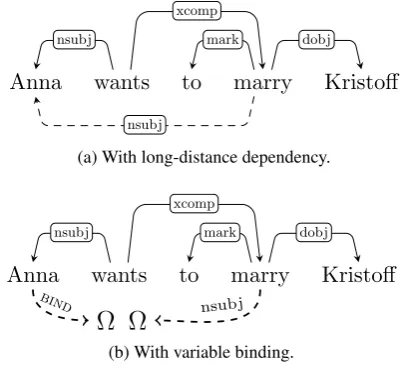
First, we identify long-distance dependencies in relative clauses and control constructions. We fol-lowSchuster and Manning(2016) and find these using the labelsacl(relative) andxcomp(control). Figure2(a)shows the long-distance dependency in the sentenceAnna wants to marry Kristoff. Here, marry is provided with its missingnsubj(dashed arc). Second, UD conflates all coordinating con-structions to a single dependency label,conj. To obtain the correct coordination scope, we refine
conj to conj:verb, conj:vp, conj:sentence,
conj:np, and conj:adj, similar to Reddy et al.
(2016). Finally, unlike the PTB tags (Marcus et al.,
1993) used by SD, the UD part-of-speech tags do not distinguish question words. Since these are cru-cial to question-answering, we use a small lexicon to refine the tags for determiners (DET), adverbs (ADV) and pronouns (PRON) toDET:WH,ADV:WH andPRON:WH, respectively. Specifically, we use a list of 12 (English), 14 (Spanish) and 35 (Ger-man) words, respectively. This is the only part of UDEPLAMBDAthat relies on language-specific information. We hope that, as the coverage of mor-phological features in UD improves, this refine-ment can be replaced by relying on morphological features, such as the interrogative feature (INT).
3.2 Graph Structures and BIND
To handle graph structures that may result from the enhancement step, such as those in Figure2(a), we propose a variable-binding mechanism that differs
Anna wants to marry Kristoff
nsubj
xcomp
mark dobj
nsubj
(a) With long-distance dependency.
Anna wants to marry Kristoff
Ω Ω
nsubjxcomp
mark dobj
bind
nsubj
[image:4.595.314.518.63.247.2](b) With variable binding.
Figure 2: The original and enhanced dependency trees forAnna wants to marry Kristoff.
from that of DEPLAMBDA. This is indicated in line 3 of Algorithm 1. First, each long-distance dependency is split into independent arcs as shown in Figure2(b). Here,Ωis a placeholder for the sub-ject ofmarry, which in turn corresponds toAnnaas indicated by the binding ofΩvia the pseudo-label BIND. We treatBINDlike an ordinary dependency label with semanticsMERGEand process the result-ing tree as usual, via the s-expression:
(nsubj(xcomp wants(nsubj(mark
(dobj marry Kristoff)to)Ω) (BINDAnnaΩ)), with the lambda-expression substitutions: wants,marry∈EVENT;to∈FUNCTIONAL; Anna,Kristoff∈ENTITY;
mark∈HEAD;BIND∈MERGE;
xcomp=λf gx.∃y.f(x)∧g(y)∧xcomp(xe,ye).
These substitutions are based solely on unlexi-calized context. For example, the part-of-speech tagPROPNofAnnainvokes anENTITYexpression.
The placeholder Ωhas semantics λx.EQ(x,ω), whereEQ(u,ω)is true iffuandωare equal (have the same denotation), which unifies the subject vari-able ofwantswith the subject variable ofmarry.
After substitution and composition, we get:
λz.∃xywv.wants(ze)∧Anna(xa)∧arg1(ze,xa)∧EQ(x,ω)
∧marry(ye)∧xcomp(ze,ye)∧arg1(ye,va)∧EQ(v,ω)
∧Kristoff(wa)∧arg2(ye,wa),
This expression may be simplified further by replacing all occurrences ofvwithxand removing the unification predicatesEQ, which results in:
This expression encodes the fact thatAnnais the arg1of themarryevent, as desired. DEPLAMBDA,
in contrast, cannot handle graph-structured input, since it lacks a principled way of generating s-expressions from graphs. Even given the above s-expression,BINDin DEPLAMBDAis defined in a way such that the composition fails to unifyv
andx, which is crucial for the correct semantics. Moreover, the definition ofBINDin DEPLAMBDA does not have a formal interpretation within the lambda calculus, unlike ours.
3.3 Linguistic Constructions
Below, we highlight the most pertinent differences between UDEPLAMBDAand DEPLAMBDA, stem-ming from the different treatment of various lin-guistic constructions in UD versus SD.
Prepositional Phrases UD uses a content-head analysis, in contrast to SD, which treats function words as heads of prepositional phrases, Accord-ingly, the s-expression for the phrase president in 2009 is(nmod president(case 2009 in))in U-DEPLAMBDAand(prep president(pobj in 2009)) in DEPLAMBDA. To achieve the desired semantics,
λx.∃y.president(xa)∧president event(xe)∧
arg1(xe,xa)∧2009(ya)∧prep.in(xe,ya),
DEPLAMBDA relies on an intermediate logical form that requires some post-processing, whereas UDEPLAMBDA obtains the desired logical form directly through the following entries:
in∈FUNCTIONAL;2009∈ENTITY; case∈HEAD; president=λx.president(xa)∧president event(xe)
∧arg1(xe,xa);
nmod=λf gx.∃y.f(x)∧g(y)∧nmod.in(xe,ya).
Othernmod constructions, such as possessives
(nmod:poss), temporal modifiers (nmod:tmod)
and adverbial modifiers (nmod:npmod), are han-dled similarly. Note how the common noun presi-dent, evokes both entity and event predicates above.
Passives DEPLAMBDA gives special treatment to passive verbs, identified by the fine-grained part-of-speech tags in the PTB tag together with de-pendency context. For example, An Oscar was won is analyzed asλx.won.pass(xe)∧Oscar(ya)∧
arg1(xe,ya), where won.pass represents a passive
event. However, UD does not distinguish be-tween active and passive forms.4While the labels
4UD encodes voice as a morphological feature, but most syntactic analyzers do not produce this information yet.
nsubjpassorauxpassindicate passive
construc-tions, such clues are sometimes missing, such as in reduced relatives. We therefore opt to not have sep-arate entries for passives, but aim to produce identi-cal logiidenti-cal forms for active and passive forms when possible (for example, by treatingnsubjpassas direct object). With the following entries,
won∈EVENT;an,was∈FUNCTIONAL; auxpass∈HEAD; nsubjpass=λf gx.∃y.f(x)∧g(y)∧arg2(xe,ya),
the lambda expression forAn Oscar was won be-comesλx.won(xe)∧Oscar(ya)∧arg2(xe,ya),
iden-tical to that of its active form. However, not having a special entry for passive verbs may have unde-sirable side-effects. For example, in the reduced-relative constructionPixar claimed the Oscar won for Frozen, the phrase the Oscar won ... will receive the semantics λx.Oscar(ya)∧won(xe)∧ arg1(xe,ya), which differs from that ofan Oscar
was won. We leave it to the target application to disambiguate the interpretation in such cases.
Long-Distance Dependencies As discussed in Section 3.2, we handle long-distance dependen-cies evoked by clausal modifiers (acl) and con-trol verbs (xcomp) with the BIND mechanism, whereas DEPLAMBDAcannot handle control con-structions. Forxcomp, as seen earlier, we use the mappingλf gx.∃y.f(x)∧g(y)∧xcomp(xe,ye). For
acl we use λf gx.∃y.f(x)∧g(y), to conjoin the main clause and the modifier clause. However, not allaclclauses evoke long-distance dependencies, e.g. in the news that Disney won an Oscar, the clausethat Disney won an Oscaris a subordinating conjunction ofnews. In such cases, we instead assignacltheINVERTsemantics.
Questions Question words are marked with the enhanced part-of-speech tagsDET:WH, ADV:WH andPRON:WH, which are all assigned the seman-ticsλx.${word}(xa)∧TARGET(xa). The predicate
TARGETindicates thatxarepresents the variable of
interest, that is the answer to the question.
3.4 Limitations
language target people
x e1 y e2 Ghana
speak .arg2
speak .arg1
people .arg1
people .nmod.in
typ
e
typ
e
(a) English
sprache target
x e1 Ghana
gesprochen .arg2
gesprochen .nmod.in
typ
e
(b) German
lengua target
x e1 Ghana
lengua .arg1
lengua .nmod.de
typ
e
(c) Spanish
language
.human language target
x m Ghana
location.country .official language.2
location.country .official language.1
typ
e
[image:6.595.77.527.65.133.2](d) Freebase
Figure 3: The ungrounded graphs forWhat language do the people in Ghana speak?,Welche Sprache wird in Ghana gesprochen? andCu´al es la lengua de Ghana?, and the corresponding grounded graph.
would have to make the substitution ofnsubj de-pend on lexical context, such that whenwindow occurs asnsubjwithbroke, the predicate arg2is
invoked rather than arg1. UDEPLAMBDA does
not address this problem, and leave it to the tar-get application to infer context-sensitive semantics of arg1 and arg2. To measure the impact of this
limitation, we present UDEPLAMBDASRL in Sec-tion4.4which addresses this problem by relying on semantic roles from semantic role labeling (Palmer et al.,2010).
Other constructions that require lexical informa-tion are quantifiers likeevery,someandmost, nega-tion markers likenoandnot, and intentional verbs likebelieve and said. UD does not have special labels to indicate these. We discuss how to handle quantifiers in this framework in the supplementary material.
Although in the current setup UDEPLAMBDA rules are hand-coded, the number of rules are only proportional to the number of UD labels, mak-ing rule-writmak-ing manageable.5 Moreover, we view UDEPLAMBDA as a first step towards learning rules for converting UD to richer semantic repre-sentations such as PropBank, AMR, or the Paral-lel Meaning Bank (Palmer et al.,2005;Banarescu et al.,2013;Abzianidze et al.,2017)..
4 Cross-lingual Semantic Parsing
To study the multilingual nature of UDEPLAMBDA, we conduct an empirical evaluation on question answering against Freebase in three different lan-guages: English, Spanish, and German. Before discussing the details of this experiment, we briefly outline the semantic parsing framework employed.
5UD v1.3 has 40 dependency labels, and the number of substitution rules in UDEPLAMBDAare 61, with some labels having multiple rules, and some representing lexical seman-tics.
4.1 Semantic Parsing as Graph Matching
UDEPLAMBDA generates ungrounded logical forms that are independent of any knowledge base, such as Freebase. We use GRAPHPARSER(Reddy
et al., 2016) to map these logical forms to their grounded Freebase graphs, via corresponding un-grounded graphs. Figures 3(a)to 3(c)show the ungrounded graphs corresponding to logical forms from UDEPLAMBDA, each grounded to the same Freebase graph in Figure3(d). Here, rectangles de-note entities, circles dede-note events, rounded rectan-gles denote entity types, and edges between events and entities denote predicates or Freebase relations. Finally, theTARGETnode represents the set of val-ues ofxthat are consistent with the Freebase graph, that is the answer to the question.
GRAPHPARSER treats semantic parsing as a graph-matching problem with the goal of finding the Freebase graphs that are structurally isomorphic to an ungrounded graph and rank them according to a model. To account for structural mismatches, GRAPHPARSER uses two graph transformations: CONTRACTandEXPAND. In Figure3(a)there are two edges betweenxandGhana. CONTRACT col-lapses one of these edges to create a graph isomor-phic to Freebase.EXPAND, in contrast, adds edges to connect the graph in the case of disconnected components. The search space is explored by beam search and model parameters are estimated with the averaged structured perceptron (Collins,2002) from training data consisting of question-answer pairs, using answerF1-score as the objective.
4.2 Datasets
While WebQuestions is dominated by simple entity-attribute questions, GraphQuestions contains a large number of compositional questions involving aggregation (e.g. How many children of Eddard Stark were born in Winterfell?) and comparison (e.g. In which month does the average rainfall of New York City exceed 86 mm?). The number of training, development and test questions is 2644, 1134, and 2032, respectively, for WebQuestions and 1794, 764, and 2608 for GraphQuestions.
To support multilingual evaluation, we created translations of WebQuestions and GraphQuestions to German and Spanish. For WebQuestions two professional annotators were hired per language, while for GraphQuestions we used a trusted pool of 20 annotators per language (with a single annotator per question). Examples of the original questions and their translations are provided in Table1.
4.3 Implementation Details
Here we provide details on the syntactic analyzers employed, our entity resolution algorithm, and the features used by the grounding model.
Dependency Parsing The English, Spanish, and German Universal Dependencies (UD) treebanks (v1.3;Nivre et al 2016) were used to train part of speech taggers and dependency parsers. We used a bidirectional LSTM tagger (Plank et al.,2016) and a bidirectional LSTM shift-reduce parser ( Kiper-wasser and Goldberg,2016). Both the tagger and parser require word embeddings. For English, we used GloVe embeddings (Pennington et al.,2014) trained on Wikipedia and the Gigaword corpus. For German and Spanish, we used SENNA em-beddings (Collobert et al., 2011;Al-Rfou et al.,
2013) trained on Wikipedia corpora (589M words German; 397M words Spanish).6Measured on the UD test sets, the tagger accuracies are 94.5 (En-glish), 92.2 (German), and 95.7 (Spanish), with corresponding labeled attachment parser scores of 81.8, 74.7, and 82.2.
Entity Resolution We followReddy et al.(2016) and resolve entities in three steps: (1) potential en-tity spans are identified using seven handcrafted part-of-speech patterns; (2) each span is associated with potential Freebase entities according to the Freebase/KG API; and (3) the 10-best entity link-ing lattices, scored by a structured perceptron, are
6https://sites.google.com/site/rmyeid/projects/polyglot.
WebQuestions
en What language do the people in Ghana speak? de Welche Sprache wird in Ghana gesprochen? es ¿Cu´al es la lengua de Ghana?
en Who was Vincent van Gogh inspired by? de Von wem wurde Vincent van Gogh inspiriert? es ¿Qu´e inspir´o a Van Gogh?
[image:7.595.305.527.62.237.2]GraphQuestions en NASA has how many launch sites? de Wie viele Abschussbasen besitzt NASA? es ¿Cu´antos sitios de despegue tiene NASA? en Which loudspeakers are heavier than 82.0 kg? de Welche Lautsprecher sind schwerer als 82.0 kg? es ¿Qu´e altavoces pesan m´as de 82.0 kg?
Table 1: Example questions and their translations.
k WebQuestions GraphQuestions
en de es en de es
1 89.6 82.8 86.7 47.2 39.9 39.5 10 95.7 91.2 94.0 56.9 48.4 51.6
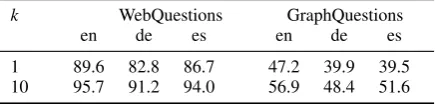
Table 2: Structured perceptronk-best entity linking accuracies on the development sets.
input to GRAPHPARSER, leaving the final disam-biguation to the semantic parsing problem. Table2
shows the 1-best and 10-best entity disambiguation
F1-scores for each language and dataset.
Features We use features similar toReddy et al.
(2016): basic features of words and Freebase re-lations, and graphfeatures crossing ungrounded events with grounded relations, ungrounded types with grounded relations, and ungrounded answer type crossed with a binary feature indicating if the answer is a number. In addition, we add features encoding the semantic similarity of ungrounded events and Freebase relations. Specifically, we used the cosine similarity of the translation-invariant em-beddings ofHuang et al.(2015).7
4.4 Comparison Systems
We compared UDEPLAMBDAto four versions of GRAPHPARSERthat operate on different represen-tations, in addition to prior work.
SINGLEEVENT This model resembles the
learning-to-rank model of Bast and Haussmann
(2015). An ungrounded graph is generated by con-necting all entities in the question with theTARGET node, representing a single event. Note that this
[image:7.595.308.526.276.328.2]WebQuestions GraphQuestions
Method en de es en de es
SINGLEEVENT 48.5 45.6 46.3 15.9 8.8 11.4 DEPTREE 48.8 45.9 46.4 16.0 8.3 11.3
CCGGRAPH 49.5 – – 15.9 – –
[image:8.595.307.527.64.218.2]UDEPLAMBDA 49.5 46.1 47.5 17.7 9.5 12.8 UDEPLAMBDASRL 49.8 46.2 47.0 17.7 9.1 12.7
Table 3: F1-scores on the test data.
baseline cannot handle compositional questions, or those with aggregation or comparison.
DEPTREE An ungrounded graph is obtained
di-rectly from the original dependency tree. An event is created for each parent and its dependents in the tree. Each dependent is linked to this event with an edge labeled with its dependency relation, while the parent is linked to the event with an edge labeled arg0. If a word is a question word, an additional TARGETpredicate is attached to its entity node.
CCGGRAPH This is the CCG-based semantic
representation ofReddy et al.(2014). Note that this baseline exists only for English.
UDEPLAMBDASRL This is similar to UDEP -LAMBDA except that instead of assumingnsubj,
dobjandnsubjpasscorrespond to arg1, arg2and
arg2, we employ semantic role labeling to identify
the correct interpretation. We used the systems of
Roth and Woodsend(2014) for English and Ger-man andBjrkelund et al.(2009) for Spanish trained on the CoNLL-2009 dataset (Haji et al.,2009).8
4.5 Results
Table3shows the performance of GRAPHPARSER with these different representations. Here and in what follows, we use averageF1-score of predicted
answers (Berant et al.,2013) as the evaluation met-ric. We first observe that UDEPLAMBDA consis-tently outperforms the SINGLEEVENT and DEP -TREErepresentations in all languages.
For English, performance is on par with CCG-GRAPH, which suggests that UDEPLAMBDAdoes not sacrifice too much specificity for universal-ity. With both datasets, results are lower for Ger-man compared to Spanish. This agrees with the lower performance of the syntactic parser on the German portion of the UD treebank. While U-DEPLAMBDASRL performs better than UDEP -8The parser accuracies (%) are 87.33, 81.38 and 79.91for English, German and Spanish respectively.
Method GraphQ. WebQ.
SEMPRE(Berant et al.,2013) 10.8 35.7 JACANA(Yao and Van Durme,2014) 5.1 33.0 PARASEMPRE(Berant and Liang,2014) 12.8 39.9
QA (Yao,2015) – 44.3
AQQU(Bast and Haussmann,2015) – 49.4 AGENDAIL (Berant and Liang,2015) – 49.7 DEPLAMBDA(Reddy et al.,2016) – 50.3 STAGG (Yih et al.,2015) – 48.4 (52.5) BILSTM (T¨ure and Jojic,2016) – 24.9 (52.2) MCNN (Xu et al.,2016) – 47.0 (53.3) AGENDAIL-RANK(Yavuz et al.,2016) – 51.6 (52.6)
UDEPLAMBDA 17.7 49.5
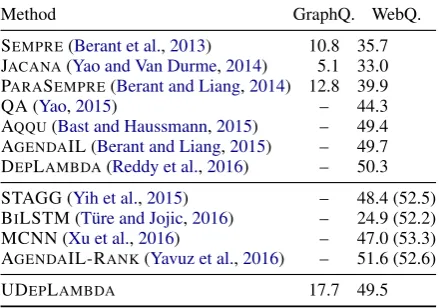
Table 4:F1-scores on the English GraphQuestions
and WebQuestions test sets (results with additional task-specific resources in parentheses).
LAMBDAon WebQuestions for English, we do not see large performance gaps in other settings, sug-gesting that GRAPHPARSERis either able to learn context-sensitive semantics of ungrounded predi-cates or that the datasets do not contain ambiguous
nsubj, dobjand nsubjpass mappings. Finally,
while these results confirm that GraphQuestions is much harder compared to WebQuestions, we note that both datasets predominantly contain single-hop questions, as indicated by the competitive perfor-mance of SINGLEEVENTon both datasets.
Table 4 compares UDEPLAMBDA with previ-ously published models which exist only for En-glish and have been mainly evaluated on Web-Questions. These are either symbolic like ours (first block) or employ neural networks (second block). Results for models using additional task-specific training resources, such as ClueWeb09, Wikipedia, or SimpleQuestions (Bordes et al.,2015) are shown in parentheses. On GraphQuestions, we achieve a new state-of-the-art result with a gain of 4.8F1
-points over the previously reported best result. On WebQuestions we are 2.1 points below the best model using comparable resources, and 3.8 points below the state of the art. Most related to our work is the English-specific system ofReddy et al.
(2016). We attribute the 0.8 point difference inF1
-score to their use of the more fine-grained PTB tag set and Stanford Dependencies.
5 Related Work
[image:8.595.70.292.64.145.2]attempts to develop semantic interfaces for HPSG (Copestake et al.,2005), LFG (Kaplan and Bresnan,
1982; Dalrymple et al.,1995;Crouch and King,
2006), TAG (Kallmeyer and Joshi,2003;Gardent and Kallmeyer,2003;Nesson and Shieber,2006), and CCG (Baldridge and Kruijff,2002;Bos et al.,
2004;Artzi et al.,2015). Unlike existing semantic interfaces, UDEPLAMBDAuses dependency syn-tax, a widely available syntactic resource.
A common trend in previous work on seman-tic interfaces is the reliance on rich typed feature structures or semantic types coupled with strong type constraints, which can be very informative but unavoidably language specific. Instead, UDEP -LAMBDArelies on generic unlexicalized informa-tion present in dependency treebanks and uses a simple type system (one type for dependency labels, and one for words) along with a combinatory mech-anism, which avoids type collisions. Earlier at-tempts at extracting semantic representations from dependencies have mainly focused on language-specific dependency representations (Spreyer and Frank,2005;Simov and Osenova,2011;Hahn and Meurers, 2011; Reddy et al., 2016;Falke et al.,
2016; Beltagy, 2016), and multi-layered depen-dency annotations (Jakob et al., 2010;B´edaride and Gardent,2011). In contrast, UDEPLAMBDA derives semantic representations for multiple lan-guages in a common schema directly from Univer-sal Dependencies. This work parallels a growing interest in creating other forms of multilingual se-mantic representations (Akbik et al.,2015; Vander-wende et al.,2015;White et al.,2016;Evang and Bos,2016).
We evaluate UDEPLAMBDAon semantic pars-ing for question answerpars-ing against a knowledge base. Here, the literature offers two main modeling paradigms: (1) learning of task-specific grammars that directly parse language to a grounded repre-sentation (Zelle and Mooney,1996;Zettlemoyer and Collins, 2005;Berant et al.,2013;Flanigan et al.,2014;Pasupat and Liang,2015;Groschwitz et al.,2015); and (2) converting language to a lin-guistically motivated task-independent tion that is then mapped to a grounded representa-tion (Kwiatkowski et al.,2013;Reddy et al.,2014;
Krishnamurthy and Mitchell,2015;Gardner and Krishnamurthy,2017). Our work belongs to the latter paradigm, as we map natural language to Freebase indirectly via logical forms. Capitalizing on natural-language syntax affords interpretability,
scalability, and reduced duplication of effort across applications (Bender et al.,2015). Our work also re-lates to literature on parsing multiple languages to a common executable representation (Cimiano et al.,
2013;Haas and Riezler,2016). However, existing approaches still map to the target meaning represen-tations (more or less) directly (Kwiatkowksi et al.,
2010;Jones et al.,2012;Jie and Lu,2014).
6 Conclusions
We introduced UDEPLAMBDA, a semantic inter-face for Universal Dependencies, and showed that the resulting semantic representation can be used for question-answering against a knowledge base in multiple languages. We provided translations of benchmark datasets in German and Spanish, in the hope to stimulate further multilingual research on semantic parsing and question answering in gen-eral. We have only scratched the surface when it comes to applying UDEPLAMBDAto natural lan-guage understanding tasks. In the future, we would like to explore how this framework can benefit ap-plications such as summarization (Liu et al.,2015) and machine reading (Sachan and Xing,2016).
Acknowledgements
This work greatly benefited from discussions with Michael Collins, Dipanjan Das, Federico Fancellu, Julia Hockenmaier, Tom Kwiatkowski, Adam Lopez, Valeria de Paiva, Martha Palmer, Fernando Pereira, Emily Pitler, Vijay Saraswat, Nathan Schneider, Bonnie Webber, Luke Zettlemoyer, and the members of ILCC Edinburgh University, the Microsoft Research Redmond NLP group, the Stan-ford NLP group, and the UW NLP and Linguistics group. We thank Reviewer 2 for useful feedback. The authors would also like to thank the Univer-sal Dependencies community for the treebanks and documentation. This research is supported by a Google PhD Fellowship to the first author. We ac-knowledge the financial support of the European Research Council (Lapata; award number 681760).
References
European Chapter of the Association for Compu-tational Linguistics. Association for CompuCompu-tational Linguistics, Valencia, Spain, pages 242–247. Alan Akbik, laura chiticariu, Marina Danilevsky,
Yun-yao Li, Shivakumar Vaithyanathan, and Huaiyu Zhu. 2015. Generating High Quality Proposition Banks for Multilingual Semantic Role Labeling. In Pro-ceedings of the Association for Computational Lin-guistics and the International Joint Conference on Natural Language Processing. Association for Com-putational Linguistics, Beijing, China, pages 397– 407.
Rami Al-Rfou, Bryan Perozzi, and Steven Skiena. 2013. Polyglot: Distributed Word Representations for Multilingual NLP. In Proceedings of the Com-putational Natural Language Learning. Sofia, Bul-garia, pages 183–192.
Yoav Artzi. 2013. Cornell SPF: Cornell Semantic Pars-ing Framework. arXiv:1311.3011 [cs.CL].
Yoav Artzi, Kenton Lee, and Luke Zettlemoyer. 2015. Broad-coverage CCG Semantic Parsing with AMR. InProceedings of the Empirical Methods on Natural Language Processing. pages 1699–1710.
Jason Baldridge and Geert-Jan Kruijff. 2002. Coupling CCG and Hybrid Logic Dependency Semantics. In Proceedings of the Association for Computational Linguistics. pages 319–326.
Laura Banarescu, Claire Bonial, Shu Cai, Madalina Georgescu, Kira Griffitt, Ulf Hermjakob, Kevin Knight, Philipp Koehn, Martha Palmer, and Nathan Schneider. 2013. Abstract Meaning Representation for Sembanking. InLinguistic Annotation Workshop and Interoperability with Discourse. Sofia, Bulgaria, pages 178–186.
Hannah Bast and Elmar Haussmann. 2015. More Ac-curate Question Answering on Freebase. In Pro-ceedings of ACM International Conference on Infor-mation and Knowledge Management. pages 1431– 1440.
Paul B´edaride and Claire Gardent. 2011. Deep Seman-tics for Dependency Structures. In Proceedings of Conference on Intelligent Text Processing and Com-putational Linguistics. pages 277–288.
Islam Beltagy. 2016. Natural Language Semantics Us-ing Probabilistic Logic. Ph.D. thesis, Department of Computer Science, The University of Texas at Austin.
Emily M. Bender, Dan Flickinger, Stephan Oepen, Woodley Packard, and Ann Copestake. 2015. Lay-ers of Interpretation: On Grammar and Composition-ality. In Proceedings of the International Confer-ence on Computational Semantics. Association for Computational Linguistics, London, UK, pages 239– 249.
Jonathan Berant, Andrew Chou, Roy Frostig, and Percy Liang. 2013. Semantic Parsing on Freebase from Question-Answer Pairs. InProceedings of the Em-pirical Methods on Natural Language Processing. pages 1533–1544.
Jonathan Berant and Percy Liang. 2014. Semantic Pars-ing via ParaphrasPars-ing. In Proceedings of the Asso-ciation for Computational Linguistics. pages 1415– 1425.
Jonathan Berant and Percy Liang. 2015. Imitation Learning of Agenda-Based Semantic Parsers. Trans-actions of the Association for Computational Lin-guistics3:545–558.
Anders Bjrkelund, Love Hafdell, and Pierre Nugues. 2009. Multilingual Semantic Role Labeling. In Proceedings of Computational Natural Language Learning (CoNLL 2009): Shared Task. Association for Computational Linguistics, Boulder, Colorado, pages 43–48.
Antoine Bordes, Nicolas Usunier, Sumit Chopra, and Jason Weston. 2015. Large-scale simple ques-tion answering with memory networks. CoRR abs/1506.02075.
Johan Bos, Stephen Clark, Mark Steedman, James R. Curran, and Julia Hockenmaier. 2004. Wide-Coverage Semantic Representations from a CCG Parser. InProceedings of the Conference on Com-putational Linguistics. pages 1240–1246.
Philipp Cimiano, Vanessa Lopez, Christina Unger, Elena Cabrio, Axel-Cyrille Ngonga Ngomo, and Sebastian Walter. 2013. Multilingual question an-swering over linked data (QALD-3): Lab overview. In Information Access Evaluation. Multilinguality, Multimodality, and Visualization. Springer, Valencia, Spain, volume 8138.
Michael Collins. 2002. Discriminative Training Meth-ods for Hidden Markov Models: Theory and Exper-iments with Perceptron Algorithms. InProceedings of the Empirical Methods on Natural Language Pro-cessing. pages 1–8.
Ronan Collobert, Jason Weston, Leon Bottou, Michael Karlen, Koray Kavukcuoglu, and Pavel Kuks. 2011. Natural language processing (almost) from scratch. Journal of Machine Learning Research 12:2493– 2537.
Ann Copestake, Dan Flickinger, Carl Pollard, and Ivan A. Sag. 2005. Minimal Recursion Semantics: An Introduction. Research on Language and Com-putation3(2-3):281–332.
Dick Crouch and Tracy Holloway King. 2006. Seman-tics via f-structure rewriting. InProceedings of the LFG’06 Conference. CSLI Publications, page 145. Mary Dalrymple, John Lamping, Fernando C. N.
Kilian Evang and Johan Bos. 2016. Cross-lingual Learning of an Open-domain Semantic Parser. In Proceedings of the Conference on Computational Linguistics. The COLING 2016 Organizing Com-mittee, Osaka, Japan, pages 579–588.
Tobias Falke, Gabriel Stanovsky, Iryna Gurevych, and Ido Dagan. 2016. Porting an Open Information Ex-traction System from English to German. In Pro-ceedings of the Empirical Methods in Natural Lan-guage Processing. Association for Computational Linguistics, Austin, Texas, pages 892–898.
Jeffrey Flanigan, Sam Thomson, Jaime Carbonell, Chris Dyer, and Noah A. Smith. 2014. A Discrimi-native Graph-Based Parser for the Abstract Meaning Representation. In Proceedings of the Association for Computational Linguistics. pages 1426–1436. Claire Gardent and Laura Kallmeyer. 2003. Semantic
Construction in Feature-based TAG. InProceedings of European Chapter of the Association for Compu-tational Linguistics. pages 123–130.
Matt Gardner and Jayant Krishnamurthy. 2017. Open-Vocabulary Semantic Parsing with both Distribu-tional Statistics and Formal Knowledge. In Proceed-ings of Association for the Advancement of Artificial Intelligence.
Jonas Groschwitz, Alexander Koller, and Christoph Te-ichmann. 2015. Graph parsing with s-graph gram-mars. InProceedings of the Association for Compu-tational Linguistics. pages 1481–1490.
Carolin Haas and Stefan Riezler. 2016. A Corpus and Semantic Parser for Multilingual Natural Language Querying of OpenStreetMap. In Proceedings of the North American Chapter of the Association for Computational Linguistics: Human Language Tech-nologies. Association for Computational Linguistics, San Diego, California, pages 740–750.
Michael Hahn and Detmar Meurers. 2011. On deriv-ing semantic representations from dependencies: A practical approach for evaluating meaning in learner corpora. In Proceedings of the Int. Conference on Dependency Linguistics (Depling 2011). Barcelona, pages 94–103.
Jan Haji, Massimiliano Ciaramita, Richard Johans-son, Daisuke Kawahara, Maria Antnia Mart, Llus Mrquez, Adam Meyers, Joakim Nivre, Sebastian Pad, Jan tpnek, and others. 2009. The CoNLL-2009 shared task: Syntactic and semantic dependencies in multiple languages. InProceedings of the Compu-tational Natural Language Learning: Shared Task. Association for Computational Linguistics, pages 1– 18.
Kejun Huang, Matt Gardner, Evangelos Papalex-akis, Christos Faloutsos, Nikos Sidiropoulos, Tom Mitchell, Partha P. Talukdar, and Xiao Fu. 2015.
Translation Invariant Word Embeddings. In Pro-ceedings of the Empirical Methods in Natural Lan-guage Processing. Lisbon, Portugal, pages 1084– 1088.
Max Jakob, Mark´eta Lopatkov´a, and Valia Kordoni. 2010. Mapping between Dependency Structures and Compositional Semantic Representations. In Pro-ceedings of the Fifth International Conference on Language Resources and Evaluation.
Zhanming Jie and Wei Lu. 2014. Multilingual Seman-tic Parsing : Parsing Multiple Languages into Se-mantic Representations. InProceedings of the Con-ference on Computational Linguistics. Dublin City University and Association for Computational Lin-guistics, Dublin, Ireland, pages 1291–1301.
Bevan Keeley Jones, Mark Johnson, and Sharon Gold-water. 2012. Semantic Parsing with Bayesian Tree Transducers. InProceedings of the Association for Computational Linguistics. Association for Compu-tational Linguistics, Stroudsburg, PA, USA, pages 488–496.
Laura Kallmeyer and Aravind Joshi. 2003. Factor-ing predicate argument and scope semantics: Under-specified semantics with LTAG. Research on Lan-guage and Computation1(1-2):3–58.
Ronald M Kaplan and Joan Bresnan. 1982. Lexical-functional grammar: A formal system for gram-matical representation. Formal Issues in Lexical-Functional Grammarpages 29–130.
Eliyahu Kiperwasser and Yoav Goldberg. 2016. Sim-ple and Accurate Dependency Parsing Using Bidi-rectional LSTM Feature Representations. Transac-tions of the Association for Computational Linguis-tics4:313–327.
Jayant Krishnamurthy and Tom M. Mitchell. 2015. Learning a Compositional Semantics for Freebase with an Open Predicate Vocabulary. Transactions of the Association for Computational Linguistics 3:257–270.
Tom Kwiatkowksi, Luke Zettlemoyer, Sharon Goldwa-ter, and Mark Steedman. 2010. Inducing Probabilis-tic CCG Grammars from Logical Form with Higher-Order Unification. In Proceedings of the Empiri-cal Methods on Natural Language Processing. pages 1223–1233.
Tom Kwiatkowski, Eunsol Choi, Yoav Artzi, and Luke Zettlemoyer. 2013. Scaling Semantic Parsers with On-the-Fly Ontology Matching. In Proceedings of the Empirical Methods on Natural Language Pro-cessing. pages 1545–1556.
Fei Liu, Jeffrey Flanigan, Sam Thomson, Norman Sadeh, and Noah A. Smith. 2015. Toward Ab-stractive Summarization Using Semantic Represen-tations. In Proceedings of North American Chap-ter of the Association for Computational Linguistics. pages 1077–1086.
Mitchell P. Marcus, Mary Ann Marcinkiewicz, and Beatrice Santorini. 1993. Building a large annotated corpus of English: The Penn Treebank. Computa-tional linguistics19(2):313–330.
Richard Montague. 1973. The Proper Treatment of Quantification in Ordinary English. In K.J.J. Hin-tikka, J.M.E. Moravcsik, and P. Suppes, editors, Approaches to Natural Language, Springer Nether-lands, volume 49 of Synthese Library, pages 221– 242.
Rebecca Nesson and Stuart M. Shieber. 2006. Simpler TAG Semantics Through Synchronization. In Pro-ceedings of the 11th Conference on Formal Gram-mar. Center for the Study of Language and Informa-tion, Malaga, Spain, pages 129–142.
Joakim Nivre, Marie-Catherine de Marneffe, Filip Gin-ter, Yoav Goldberg, Jan Hajic, Christopher D. Man-ning, Ryan McDonald, Slav Petrov, Sampo Pyysalo, Natalia Silveira, Reut Tsarfaty, and Daniel Zeman. 2016. Universal Dependencies v1: A Multilingual Treebank Collection. InProceedings of the Tenth In-ternational Conference on Language Resources and Evaluation. European Language Resources Associa-tion (ELRA), Paris, France.
Joakim Nivre et al. 2016. Universal dependencies 1.3. LINDAT/CLARIN digital library at the Institute of Formal and Applied Linguistics, Charles University in Prague.
Martha Palmer, Daniel Gildea, and Paul Kingsbury. 2005. The proposition bank: An annotated corpus of semantic roles. Computational linguistics31(1):71– 106.
Martha Palmer, Daniel Gildea, and Nianwen Xue. 2010. Semantic role labeling. Synthesis Lectures on Hu-man Language Technologies3(1):1–103.
Panupong Pasupat and Percy Liang. 2015. Composi-tional Semantic Parsing on Semi-Structured Tables. InProceedings of the Association for Computational Linguistics. pages 1470–1480.
Jeffrey Pennington, Richard Socher, and Christopher Manning. 2014. Glove: Global Vectors for Word Representation. In Proceedings of the Empirical Methods in Natural Language Processing. Associ-ation for ComputAssoci-ational Linguistics, Doha, Qatar, pages 1532–1543.
Barbara Plank, Anders Søgaard, and Yoav Goldberg. 2016. Multilingual Part-of-Speech Tagging with Bidirectional Long Short-Term Memory Models and Auxiliary Loss. InProceedings of the Annual Meet-ing of the Association for Computational LMeet-inguistics. Berlin, Germany, pages 412–418.
Siva Reddy, Mirella Lapata, and Mark Steedman. 2014. Large-scale Semantic Parsing without Question-Answer Pairs. Transactions of the Association for Computational Linguistics2:377–392.
Siva Reddy, Oscar T¨ackstr¨om, Michael Collins, Tom Kwiatkowski, Dipanjan Das, Mark Steedman, and Mirella Lapata. 2016. Transforming Dependency Structures to Logical Forms for Semantic Parsing. Transactions of the Association for Computational Linguistics4:127–140.
Michael Roth and Kristian Woodsend. 2014. Compo-sition of Word Representations Improves Semantic Role Labelling. In Proceedings of the Empirical Methods in Natural Language Processing (EMNLP). Association for Computational Linguistics, Doha, Qatar, pages 407–413.
Mrinmaya Sachan and Eric Xing. 2016. Machine Com-prehension using Rich Semantic Representations. In Proceedings of the Association for Computational Linguistics. Association for Computational Linguis-tics, Berlin, Germany, pages 486–492.
Sebastian Schuster and Christopher D. Manning. 2016. Enhanced English Universal Dependencies: An Im-proved Representation for Natural Language Under-standing Tasks. InProceedings of the Tenth Interna-tional Conference on Language Resources and Eval-uation. European Language Resources Association (ELRA), Paris, France.
Kiril Simov and Petya Osenova. 2011. Towards Min-imal Recursion Semantics over Bulgarian Depen-dency Parsing. InProceedings of the International Conference Recent Advances in Natural Language Processing 2011. RANLP 2011 Organising Commit-tee, Hissar, Bulgaria, pages 471–478.
Kathrin Spreyer and Anette Frank. 2005. Projecting RMRS from TIGER Dependencies. InProceedings of the HPSG 2005 Conference. CSLI Publications. Yu Su, Huan Sun, Brian Sadler, Mudhakar Srivatsa,
Izzeddin Gur, Zenghui Yan, and Xifeng Yan. 2016. On Generating Characteristic-rich Question Sets for QA Evaluation. In Proceedings of the Empirical Methods in Natural Language Processing. Austin, Texas, pages 562–572.
Ferhan T¨ure and Oliver Jojic. 2016. Simple and Ef-fective Question Answering with Recurrent Neural Networks.CoRRabs/1606.05029.
Aaron Steven White, Drew Reisinger, Keisuke Sak-aguchi, Tim Vieira, Sheng Zhang, Rachel Rudinger, Kyle Rawlins, and Benjamin Van Durme. 2016. Uni-versal Decompositional Semantics on UniUni-versal De-pendencies. InProceedings of the Empirical Meth-ods in Natural Language Processing. Association for Computational Linguistics, Austin, Texas, pages 1713–1723.
Kun Xu, Siva Reddy, Yansong Feng, Songfang Huang, and Dongyan Zhao. 2016. Question Answering on Freebase via Relation Extraction and Textual Evi-dence. InProceedings of the Association for Compu-tational Linguistics. Association for CompuCompu-tational Linguistics, Berlin, Germany, pages 2326–2336. Xuchen Yao. 2015. Lean Question Answering over
Freebase from Scratch. In Proceedings of North American Chapter of the Association for Computa-tional Linguistics. pages 66–70.
Xuchen Yao and Benjamin Van Durme. 2014. Infor-mation Extraction over Structured Data: Question Answering with Freebase. InProceedings of the As-sociation for Computational Linguistics. pages 956– 966.
Semih Yavuz, Izzeddin Gur, Yu Su, Mudhakar Srivatsa, and Xifeng Yan. 2016. Improving Semantic Parsing via Answer Type Inference. InProceedings of the Empirical Methods in Natural Language Processing. Association for Computational Linguistics, Austin, Texas, pages 149–159.
Wen-tau Yih, Ming-Wei Chang, Xiaodong He, and Jianfeng Gao. 2015. Semantic Parsing via Staged Query Graph Generation: Question Answering with Knowledge Base. InProceedings of the Association for Computational Linguistics. pages 1321–1331. John M. Zelle and Raymond J. Mooney. 1996.
Learn-ing to Parse Database Queries UsLearn-ing Inductive Logic Programming. InProceedings of Association for the Advancement of Artificial Intelligence. pages 1050– 1055.