
Proceedings of the Third Conference on Machine Translation (WMT), Volume 2: Shared Task Papers, pages 496–503
The RWTH Aachen University Supervised
Machine Translation Systems for WMT 2018
Julian Schamper, Jan Rosendahl, Parnia Bahar,Yunsu Kim, Arne Nix and Hermann Ney
Human Language Technology and Pattern Recognition Group Computer Science Department
RWTH Aachen University D-52056 Aachen, Germany
<surname>@i6.informatik.rwth-aachen.de
Abstract
This paper describes the statistical machine translation systems developed at RWTH Aachen University for the German→English, English→Turkish and Chinese→English translation tasks of the EMNLP 2018 Third Conference on Machine Translation
(WMT 2018). We use ensembles of neural machine translation systems based on the Transformer architecture. Our main focus is on the German→English task where we scored first with respect to all automatic metrics provided by the organizers. We identify data selection, fine-tuning, batch size and model dimension as important hyperpa-rameters. In total we improve by 6.8% BLEU
over our last year’s submission and by 4.8% BLEU over the winning system of the 2017 German→English task. In English→Turkish task, we show 3.6% BLEUimprovement over
the last year’s winning system. We further report results on the Chinese→English task where we improve 2.2% BLEU on average
over our baseline systems but stay behind the 2018 winning systems.
1 Introduction
In this paper we describe the supervised statis-tical machine translation (SMT) systems devel-oped by RWTH Aachen University for the news translation task of the EMNLP 2018 Third Con-ference on Machine Translation (WMT 2018). We use ensembles of neural machine translation systems to participate in the German→English, English→Turkish and Chinese→English tasks of the WMT 2018 evaluation campaign.
For this year’s WMT we switch towards the Transformer architecture (Vaswani et al., 2017) implemented in Sockeye (Hieber et al., 2017). We experiment with different selections from the training data and various model configurations.
This paper is organized as follows: In Section2
we describe our data preprocessing. Our trans-lation software and baseline setups are explained in Section 3. The results of the experiments for the various language pairs are summarized in Sec-tion4.
2 Preprocessing
For all our experiments on German, English and Turkish we utilize a simple preprocessing pipeline which consists of minor text normalization steps (e.g. removal of some special UTF-8 charac-ters) followed by tokenization from Moses (Koehn et al., 2007) and frequent casing from the Jane toolkit (Vilar et al., 2010). The Chinese side is segmented using theJieba4segmenter1except for the Books 1-10 and data2011data sets which were already segmented as mentioned in (Sennrich et al.,2017).
We apply byte-pair encoding (BPE) to segment words into subword units for all language pairs (Sennrich et al., 2016b). Our BPE models are trained jointly for the source and the target lan-guage with the exception of the Chinese→English
task. For every language pair we use the paral-lel data to train the BPE operations, excluding any synthetic data and the ParaCrawl corpus of the German→English task. To reduce the number of
rare events we apply a vocabulary threshold of 50 as described in (Sennrich et al., 2017) in all our German→English systems. We end up with
vo-cabulary sizes of 45k and 34k for German and En-glish respectively if 50k joint merge operations are used.
3 MT Systems
All systems submitted by RWTH Aachen are based on the Transformer architecture
imple-1https://github.com/fxsjy/jieba
mented in the Sockeye sequence-to-sequence framework for Neural Machine Translation. Sock-eye is built on the Python API of MXNet (Chen et al.,2015).
In the Transformer architecture both encoder and decoder consist of stacked layers. A layer in the encoder consists of two sub-layers: a multi-head self-attention layer followed by a feed for-ward layer. The decoder contains an additional multi-head attention layer that connects encoder and decoder. Before and after each of these sub-layers preprocessing respectively postprocessing operations are applied. In our setup layer nor-malization (Ba et al.,2016) is applied as prepro-cessing operation while the postproprepro-cessing oper-ation is chosen to be dropout (Srivastava et al.,
2014) followed by a residual connection (He et al.,
2016).2 For our experiments we use 6 layers in both encoder and decoder and vary the size of their internal dimension. We set the number of heads in the multi-head attention to 8 and apply label smoothing (Pereyra et al.,2017) of 0.1 throughout training.
We train our models using the Adam opti-mizer (Kingma and Ba,2014) with a learning rate of0.0001(for En→Tr and Zh→En) respectively
0.0003(for De→En). A warmup period with con-stant or increasing learning rate was not used. We employ an annealing scheme that scales down the learning rate if no improvement in perplexity on the development set is seen for several consecutive evaluation checkpoints. During training we apply dropout ranging from0.1 to0.3. All batch sizes
are specified on the token level and are chosen to be as big as the memory of the GPUs allows. In case of the utilization of multiple GPUs we use synchronized training, i.e. we increase the effec-tive batch size, which seems to have better conver-gence properties (Popel and Bojar,2018).
The weights of embedding matrices and the pro-jection layer prior to the softmax layer are not shared in our architecture and for all translation runs a beam size of 12 is used.
4 Experimental Evaluation
In this section we present our results on the three tasks we participated in, with the primary focus on
2Note that this is by now also the default behavior of the
Tensor2Tensor implementationhttps://github.com/ tensorflow/tensor2tensor, differing from the orig-inal paper.
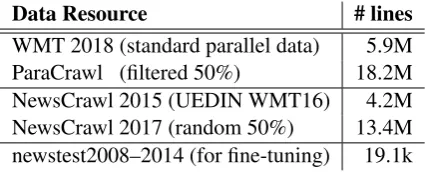
[image:2.595.310.523.63.149.2]Data Resource # lines WMT 2018 (standard parallel data) 5.9M ParaCrawl (filtered 50%) 18.2M NewsCrawl 2015 (UEDIN WMT16) 4.2M NewsCrawl 2017 (random 50%) 13.4M newstest2008–2014 (for fine-tuning) 19.1k
Table 1: Number of parallel sentence pairs or monolin-gual sentences of our different training data resources (De→En). Our strongest systems from Table3use all these resources.
building a strong system for the German→English
system.
For evaluation we usemteval-v13afrom the Moses toolkit (Koehn et al.,2007) andTERCom3
to score our systems on the BLEU(Papineni et al., 2002) respectively TER (Snover et al.,2006) mea-sures. In addition we reportCTERscores4(Wang et al.). All reported scores are given in percentage and the specific options of the tools are set to be consistent with the calculations of the organizers.
4.1 German→English
In most experiments for the German→English
task we use a subset of the data resources listed in Table 1. All models use the Transformer ar-chitecture as described in Section3. Our baseline model is very similar to the ”base” Transformer of the original paper (Vaswani et al., 2017), e.g. dmodel = 512anddff = 2048, however we do not use weight-tying.
Throughout our experiments we analyze vari-ous aspects of our experimental setup (e.g. sev-eral data conditions or the model size). We evalu-ate our models every 20k iterations and select the best checkpoint based on BLEUcalculated on our development setnewstest2015afterwards. To handle all different variations in a well organized way, we use the workflow manager Sisyphus ( Pe-ter et al.,2018).
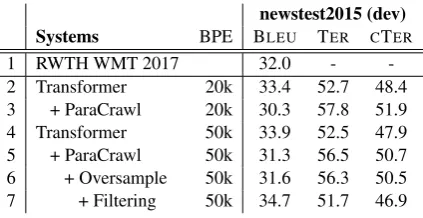
In Table 2 we carefully analyze different data conditions. We can see that the Transformer model with 20k BPE merging operation already beats our last year’s final submission by 1.4% BLEU. The Transformer model was trained using the standard parallel WMT 2018 data sets (namely Europarl, CommonCrawl, NewsCommentary and Rapid, in total 5.9M sentence pairs) as well as the 4.2M
newstest2015 (dev) Systems BPE BLEU TER CTER
1 RWTH WMT 2017 32.0 -
[image:3.595.76.288.62.171.2]-2 Transformer 20k 33.4 52.7 48.4 3 + ParaCrawl 20k 30.3 57.8 51.9 4 Transformer 50k 33.9 52.5 47.9 5 + ParaCrawl 50k 31.3 56.5 50.7 6 + Oversample 50k 31.6 56.3 50.5 7 + Filtering 50k 34.7 51.7 46.9
Table 2: Baseline results and analysis of data condi-tions (De→En). Our baseline starts of with the stan-dard WMT 2018 training data excluding ParaCrawl but including already backtranslated NewsCrawl 2015. ”Filtering” refers to filtering ParaCrawl only (50% LM driven).
tence pairs of synthetic data created in (Sennrich et al., 2016a). Last year’s submission is an en-semble of several carefully crafted models using an RNN-encoder and decoder which was trained on the same data plus 6.9M additional synthetic sentences (Peter et al.,2017).
We try 20k and 50k merging operations for BPE and find that 50k performs better by 0.5% to 1.0% BLEU. Hence, we use this for all further exper-iments. As Table 2 shows, just adding the new ParaCrawl corpus to the existing data hurts the per-formance by up to 3.1% BLEU.
To counter this effect we oversample Com-monCrawl, Europarl and NewsCommentary with a factor of two. Rapid and the synthetic news data are not oversampled. As we can observe in Row 6 of Table 2 this gives a minor improve-ment, but is not enough to counter the negative effects from adding ParaCrawl. Therefore we train a 3-gram language model on the monolin-gual English NewsCrawl2007-2017 data sets us-ing KenLM (Heafield, 2011) to rank the corpus and select the best 50% of sentence pairs. To-gether with oversampling this yields an improve-ment of 3.4% BLEUover the naive concatenation of all training data and 0.8% BLEUover the cor-responding system that does not use ParaCrawl at all.
Using the best data configuration described we start to use multiple GPUs instead of one and in-crease the model size. Each GPU handles a share of the data and the update steps are synchronized, such that the effective batch size is increased. As before we choose the batch size on word level in such a way that the memory of all GPUs is fully used. Note that due to time constraints and the size
of the models the reported results are taken from models which did not yet fully converge. Each model in Table3is trained using 4 GPUs for close to 8 days.
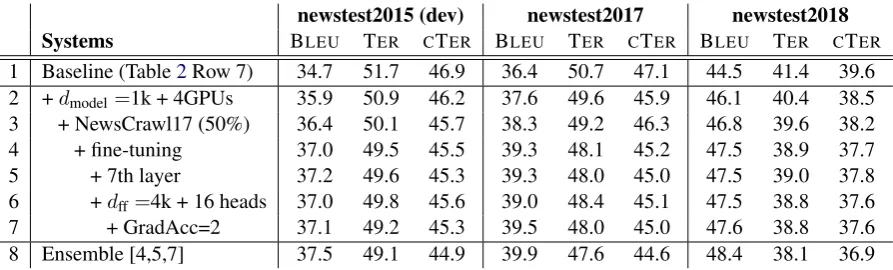
First we double the dimension of the model to dmodel= 1024. As can be seen from Ta-ble3, together with the increased batch size, this yields a major improvement of 1.2% BLEU on newstest2015.
Using a basic English→German system
we backtranslate 26.9M sentences from the NewsCrawl 2017 monolingual corpus. This system uses the same transformer configuration as used for the baseline De→En system and
is trained on the standard parallel WMT 2018 dataset (5.9M sentence pairs). It achieves 28.7% BLEU and 38.9% BLEU on newstest2015
and newstest2018respectively. After exper-imenting with several thresholds we added half of the backtranslated data (randomly selected) to our training data which gave us 0.5% BLEU extra on the development set. Even though the system is trained on 17.6M synthetic news sentences from NewsCrawl 2015 (4.2M) and NewsCrawl 2017 (13.4M), fine-tuning on old test sets (newstest2008tonewstest2014) improves it by 0.6% BLEU onnewstest2015
and 1.0% BLEU on newstest2017. We set the checkpoint frequency down to 50 updates only and select the best out of 14 fine-tuned checkpoints (selected on newstest2015). Overall we find it beneficial to match the learning conditions which are present for the checkpoint which is fine-tuned: Especially important seems to be the usage of a similar learning rate in contrast to using the comparably high initial learning rate (0.0003).
newstest2015 (dev) newstest2017 newstest2018
Systems BLEU TER CTER BLEU TER CTER BLEU TER CTER
1 Baseline (Table2Row 7) 34.7 51.7 46.9 36.4 50.7 47.1 44.5 41.4 39.6
2 +dmodel=1k + 4GPUs 35.9 50.9 46.2 37.6 49.6 45.9 46.1 40.4 38.5
3 + NewsCrawl17 (50%) 36.4 50.1 45.7 38.3 49.2 46.3 46.8 39.6 38.2
4 + fine-tuning 37.0 49.5 45.5 39.3 48.1 45.2 47.5 38.9 37.7
5 + 7th layer 37.2 49.6 45.3 39.3 48.0 45.0 47.5 39.0 37.8
6 +dff=4k + 16 heads 37.0 49.8 45.6 39.0 48.4 45.1 47.5 38.8 37.6
7 + GradAcc=2 37.1 49.2 45.3 39.5 48.0 45.0 47.6 38.8 37.6
[image:4.595.76.523.62.197.2]8 Ensemble [4,5,7] 37.5 49.1 44.9 39.9 47.6 44.6 48.4 38.1 36.9
Table 3: Main results for the German→English task (Rows 7 and 8 show the submitted system). Note that using multiple GPUs does not only result in a higher data throughput but also multiplies the effective batch size and therefore affects the convergence. However if only one GPU is available the results could be still reproduced by using just gradient accumulation.
nt2015 nt2017
Systems BLEU BLEU TER CTER
Winner 2017 - 35.1 52.4 48.9
RWTH 2017 32.0 33.1 54.2
[image:4.595.74.287.276.345.2]-RWTH 2018 37.5 39.9 47.6 44.6
Table 4: Comparison with last years’ submissions on newstest2015+2017(De→En). The winning sys-tem of 2017 was submitted by UEDIN. Missing scores are due to inconsistent calculations or unavailability.
the German→English task.
Because checkpoint averaging helped in the past we tried several versions based on last or best checkpoints of different distances but no version turned out to be helpful in our case.
Finally model ensembling brought perfor-mance up to 37.5% BLEU and 39.9% BLEU on newstest2015andnewstest2017. Overall we achieved an improvement of 2.8% and 3.5% BLEUover our baseline.
Table 4 shows that we improved our system by 6.2% BLEU on average on newstest2015+2017 since previous year and by 4.8% BLEUonnewstest2017over the winning system of 2017 (Sennrich et al.,2017).
4.2 English→Turkish
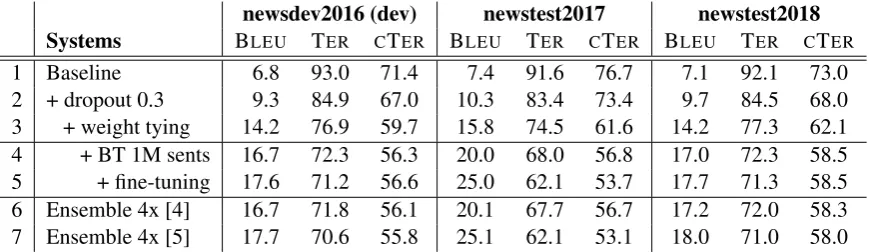
The English→Turkish task is in a low-resource setting where the given parallel data consists of only around 200k sentences. We therefore apply dropout to various parts of our Trans-former model: attention/activation of each layer, pre/post-processing between the layers, and also embedding—with a dropout probability of 0.3. This gives a strong regularization and yields 2.6%
BLEU improvement compared to the baseline in newstest2018(Row 2 of Table5).
Although the English and Turkish languages are from different linguistic roots, we find that the performance is better by 4.5% BLEU in newstest2018when sharing their vocabularies by tying the embedding matrices (Row 3 of Ta-ble 5). They are also tied with the transpose of the output layer projection as done in (Vaswani et al., 2017). We accordingly use BPE tokens jointly learned for both languages (20k merge op-erations). Since the training signals are weak from the given data, we argue that this kind of parameter sharing helps to avoid overfitting and copy proper nouns correctly.
Checkpoint frequency is set to 4k. Other model parameters and training hyperparameters are the same as described in Section3.
Table5also shows results with back-translated data from Turkish News Crawl 2017 (Row 4, +3.8% BLEU innewstest2018). Using more than 1M sentences of back-translations does not help, which might be due to the low quality of back-translations generated with a weak model (trained only with 200k parallel sentences). Note that we oversample the given parallel data to make the ratio of the parallel/synthetic data 1:1. An ensemble of this setup with four different ran-dom seeds shows a slight improvement up to 0.2% BLEU(Row 4 vs. 6).
Finally, we fine-tune the models with
newsdev2016 (dev) newstest2017 newstest2018 Systems BLEU TER CTER BLEU TER CTER BLEU TER CTER 1 Baseline 6.8 93.0 71.4 7.4 91.6 76.7 7.1 92.1 73.0 2 + dropout 0.3 9.3 84.9 67.0 10.3 83.4 73.4 9.7 84.5 68.0 3 + weight tying 14.2 76.9 59.7 15.8 74.5 61.6 14.2 77.3 62.1 4 + BT 1M sents 16.7 72.3 56.3 20.0 68.0 56.8 17.0 72.3 58.5 5 + fine-tuning 17.6 71.2 56.6 25.0 62.1 53.7 17.7 71.3 58.5 6 Ensemble 4x [4] 16.7 71.8 56.1 20.1 67.7 56.7 17.2 72.0 58.3 7 Ensemble 4x [5] 17.7 70.6 55.8 25.1 62.1 53.1 18.0 71.0 58.0
Table 5: English→Turkish results. Row 6 is the submitted system.
0.7% BLEU for the single model (Row 4 vs. 5) and 0.8% BLEUfor the ensemble (Row 6 vs. 7) in newstest2018.
4.3 Chinese→English
We use all available parallel data totaling 24.7M
sentence pairs with 620M English and 547M
Chinese words and follow the preprocessing de-scribed in Section 2. We then learn BPE with
50k merge operations on each side separately. newsdev2017 and newstest2017 contain-ing2002and2001 sentences are used as our
de-velopment and test sets respectively. We also re-port results onnewstest2018with3981
sam-ples. We remove sentences longer than 80
sub-words. We save and evaluate the checkpoints ac-cording to the BLEUscore on the development set every10k iterations.
In order to augment our training data, we back-translate the NewsCrawl2017 monolingual cor-pus consisting of approximately25M samples
us-ing a En→Zh NMT system resulting in a total
of49.5 sentence pairs for training. The En→Zh
NMT model is based on the RNN with attention encoder-decoder architecture (Bahdanau et al.,
2014) implemented in Returnn5 (Zeyer et al.,
2018). The network is similar to (Bahar et al.,
2017) with 4-layer of bidirectional encoders using long-short term memory cells (LSTM) ( Hochre-iter and Schmidhuber, 1997). We apply a layer-wise pre-training scheme that leads to both better convergence and faster training speed during the initial pre-train epochs (Zeyer et al., 2018). We start using only the first layer in the encoder of the model and add new layers during the train-ing progress. We apply a learntrain-ing rate schedul-ing scheme, where we lower the learnschedul-ing rate if
5https://github.com/rwth-i6/returnn
the perplexity on the development set does not im-prove anymore.
For Zh→En, we run different Transformer con-figurations which differ slightly from the model described in Section 3. Our aim is to investigate the effect of various hyperparameters especially the model size, the number of layers and the num-ber of heads. According to the total numnum-ber of parameters, we call these models as below:
• Transformer base: a6-layer multi-head at-tention (8heads) consisting of512nodes
fol-lowed by a feed forward layer equipped with
1024nodes both in the encoder and the de-coder. The total number of parameters is
121M. Training is done using mini-batches of 3000.
• Transformer medium: a4-layer multi-head
attention (8 heads) consisting of1024nodes
followed by a feed forward layer equipped with4096nodes both in the encoder and the
decoder. The total number of parameters is
271M. Training is done using mini-batches of 2000.
• Transformer large: a6-layer multi-head
at-tention (16 heads) consisting of 1024nodes
followed by a feed forward layer equipped with4096nodes both in the encoder and the
decoder. The total number of parameters is
330M. Training is done using mini-batches of 6500on 4 GPUs.
newsdev2017 (dev) newstest2017 newstest2018
Systems BLEU TER CTER BLEU TER CTER BLEU CTER
1 Base 23.3 66.8 62.1 23.9 67.2 61.5 24.1 63.8
2 Medium 24.5 65.5 61.0 24.8 65.8 60.9 25.4 63.2
3 Large 24.6 65.2 60.7 25.3 65.6 60.5 26.0 62.8
4 Ensemble (linear) [1,2,3] 25.4 64.5 59.9 25.9 64.9 59.9 26.7 61.8
5 Ensemble (log-linear) [1,2,3] 25.4 64.4 60.1 26.1 64.8 59.4 26.4 62.0
[image:6.595.73.528.64.167.2]6† Ensemble (linear) 4 checkpoints of [3] 24.4 65.4 60.9 25.6 65.2 60.1 26.7 62.1
Table 6: Results measured in BLEU[%], TER[%] andCTER[%] for Chinese→English. The TERcomputation on
newstest2018fails. † indicates the submitted system which is the ensemble of 4 non-converged checkpoints
of the large Transformer.
model size and increasing the batch size up to
6500provides an additional boost of 0.4% BLEU, 0.3% TERand 0.4%CTERon average on all sets (see Row 2 and 3). Furthermore, we try an en-semble of best checkpoints based on BLEUeither using various models or using different snapshots of the large Transformer. We use both linear and log-linear ensembling which does not make a dif-ference in terms of BLEU as shown in the Table. Log-linear ensembling is slightly better in terms of TERand is a little bit worse in terms ofCTER. We also combine the 4 best checkpoints of the large Transformer shown in Row 6 of Table6.
5 Conclusion
This paper describes the RWTH Aachen Univer-sity’s submission to the WMT 2018 shared news translation task. For German→English our
ex-periments start with a strong baseline which al-ready beats our submission to WMT 2017 by 1.4% BLEU on newstest2015. Our final submis-sion is an ensemble of three Transformer mod-els which beats our and the strongest submis-sion of last year by 6.8% BLEUrespectively 4.8% BLEU on newstest2017. It is ranked first on
newstest2018by all automatic metrics for this year’s news translation task6. We suspect that the strength of our systems is especially grounded in the usage of the recently established Transformer architecture, the usage of filtered ParaCrawl in ad-dition to careful experiments on data conad-ditions, the usage of rather big models and large batch sizes, and effective fine-tuning on old test sets.
In English→Turkish task, we show that proper regularization (high dropout rate, weight tying) is crucial for the low-resource setting, yielding
6http://matrix.statmt.org/matrix/
systems_list/1880
a total of up to +7.4% BLEU. Our best system is using 1M sentences synthetic data generated with back-translation (+2.8% BLEU), fine-tuned with test sets of previous year’s tasks (+0.7% BLEU), and ensembled over four different train-ing runs (+0.3% BLEU), leading to 18.0% BLEU innewstest2018. Note that itsCTERis better or comparable to the top-ranked system submis-sions7. Innewstest2017, our system, even if it is not fine-tuned, outperforms the last year’s win-ning system by +3.6% BLEU.
For our Chinese→English system multiple
GPU training that allows for larger models and an increased batch size results in the best preform-ing spreform-ingle system. A linear ensemble of different Transformer configurations provides 0.7% BLEU, 0.6% TERand 0.8% CTERon average on top of the single best model.
Acknowledgements
This work has received funding from the Euro-pean Research Council (ERC) (under the Euro-pean Union’s Horizon 2020 research and in-novation programme, grant agreement No 694537, project ”SEQCLAS”) and the Deutsche Forschungsgemeinschaft (DFG; grant agreement NE 572/8-1, project ”CoreTec”). The GPU com-puting cluster was supported by DFG (Deutsche Forschungsgemeinschaft) under grant INST 222/1168-1 FUGG.
The work reflects only the authors’ views and none of the funding agencies is responsible for
7http://matrix.statmt.org/matrix/
any use that may be made of the information it contains.
References
Jimmy Lei Ba, Jamie Ryan Kiros, and Geoffrey E Hin-ton. 2016. Layer normalization. arXiv preprint arXiv:1607.06450. Version 1.
Parnia Bahar, Jan Rosendahl, Nick Rossenbach, and Hermann Ney. 2017. The RWTH Aachen machine translation systems for IWSLT 2017. In 14th In-ternational Workshop on Spoken Language Trans-lation, pages 29–34.
Dzmitry Bahdanau, Kyunghyun Cho, and Yoshua Bengio. 2014. Neural machine translation by jointly learning to align and translate. CoRR, abs/1409.0473.
Tianqi Chen, Mu Li, Yutian Li, Min Lin, Naiyan Wang, Minjie Wang, Tianjun Xiao, Bing Xu, Chiyuan Zhang, and Zheng Zhang. 2015. MXNet: A flex-ible and efficient machine learning library for het-erogeneous distributed systems. arXiv preprint arXiv:1512.01274. Version 1.
Kaiming He, Xiangyu Zhang, Shaoqing Ren, and Jian Sun. 2016. Deep residual learning for image recog-nition. In2016 IEEE Conference on Computer Vi-sion and Pattern Recognition, CVPR 2016, Las Ve-gas, NV, USA, June 27-30, 2016, pages 770–778. IEEE Computer Society.
Kenneth Heafield. 2011. KenLM: Faster and smaller language model queries. In Proceedings of the EMNLP 2011 Sixth Workshop on Statistical Ma-chine Translation, pages 187–197, Edinburgh, Scot-land, United Kingdom.
Felix Hieber, Tobias Domhan, Michael Denkowski, David Vilar, Artem Sokolov, Ann Clifton, and Matt Post. 2017. Sockeye: A toolkit for neural machine translation. arXiv preprint arXiv:1712.05690. Ver-sion 2.
Sepp Hochreiter and J¨urgen Schmidhuber. 1997. Long short-term memory. Neural Computation, 9(8):1735–1780.
Diederik P Kingma and Jimmy Ba. 2014. Adam: A method for stochastic optimization. arXiv preprint arXiv:1412.6980. Version 9.
Philipp Koehn, Hieu Hoang, Alexandra Birch, Chris Callison-Burch, Marcello Federico, Nicola Bertoldi, Brooke Cowan, Wade Shen, Christine Moran, Richard Zens, et al. 2007. Moses: Open source toolkit for statistical machine translation. In Pro-ceedings of the 45th annual meeting of the ACL on interactive poster and demonstration sessions, pages 177–180. Association for Computational Linguis-tics.
Kishore Papineni, Salim Roukos, Todd Ward, and Wei-Jing Zhu. 2002. BLEU: A method for automatic evaluation of machine translation. InProceedings of the 41st Annual Meeting of the Association for Com-putational Linguistics, pages 311–318, Philadelphia, Pennsylvania, USA.
Gabriel Pereyra, George Tucker, Jan Chorowski, Lukasz Kaiser, and Geoffrey E. Hinton. 2017. Reg-ularizing neural networks by penalizing confident output distributions. CoRR, abs/1701.06548.
Jan-Thorsten Peter, Eugen Beck, and Hermann Ney. 2018. Sisyphus, a workflow manager designed for machine translation and automatic speech recogni-tion. In2018 Conference on Empirical Methods in Natural Language Processing, Brussels, Belgium.
Jan-Thorsten Peter, Andreas Guta, Tamer Alkhouli, Parnia Bahar, Jan Rosendahl, Nick Rossenbach, Miguel Graa, and Ney Hermann. 2017. The RWTH Aachen University English-German and German-English machine translation system for WMT 2017. In EMNLP 2017 Second Conference on Machine Translation, Copenhagen, Denmark.
Martin Popel and Ondˇrej Bojar. 2018. Training tips for the transformer model. The Prague Bulletin of Mathematical Linguistics, 110(1):43–70.
Rico Sennrich, Alexandra Birch, Anna Currey, Ulrich Germann, Barry Haddow, Kenneth Heafield, An-tonio Valerio Miceli Barone, and Philip Williams. 2017. The University of Edinburgh’s neural MT sys-tems for WMT17. In Proceedings of the Second Conference on Machine Translation, WMT 2017, Copenhagen, Denmark, September 7-8, 2017, pages 389–399.
Rico Sennrich, Barry Haddow, and Alexandra Birch. 2016a. Edinburgh neural machine translation sys-tems for WMT 16. InProceedings of the First Con-ference on Machine Translation, volume 2: Shared Task Papers, pages 368–373, Berlin, Germany.
Rico Sennrich, Barry Haddow, and Alexandra Birch. 2016b. Neural machine translation of rare words with subword units. InProceedings of the 54th An-nual Meeting of the Association for Computational Linguistics (Volume 1: Long Papers), volume 1, pages 1715–1725.
Matthew Snover, Bonnie Dorr, Richard Schwartz, Lin-nea Micciulla, and John Makhoul. 2006. A study of translation edit rate with targeted human annotation. InProceedings of the 7th Conference of the Associa-tion for Machine TranslaAssocia-tion in the Americas, pages 223–231, Cambridge, Massachusetts, USA.
Ashish Vaswani, Noam Shazeer, Niki Parmar, Jakob Uszkoreit, Llion Jones, Aidan N Gomez, Łukasz Kaiser, and Illia Polosukhin. 2017. Attention is all you need. InAdvances in Neural Information Pro-cessing Systems, pages 5998–6008.
David Vilar, Daniel Stein, Matthias Huck, and Her-mann Ney. 2010. Jane: Open source hierarchi-cal translation, extended with reordering and lexi-con models. InProceedings of the Joint Fifth Work-shop on Statistical Machine Translation and Metric-sMATR, pages 262–270. Association for Computa-tional Linguistics.
Weiyue Wang, Jan-Thorsten Peter, Hendrik Rosendahl, and Hermann Ney. CharacTer: Translation Edit Rate on Character Level. InThe 54th Annual Meet-ing of the Association for Computational LMeet-inguistics - proceedings of the First Conference on Machine Translation (WMT) : August 7-12, 2016, Berlin, Germany : ACL 2016. - Volume 2, Shared Task Pa-pers, pages 505–510, Stroudsburg, PA. Association for Computational Linguistics.
Albert Zeyer, Tamer Alkhouli, and Hermann Ney. 2018. RETURNN as a generic flexible neural toolkit with application to translation and speech recogni-tion. InProceedings of ACL 2018, Melbourne, Aus-tralia, July 15-20, 2018, System Demonstrations, pages 128–133.
6 Appendix
For our very first experiments with Sockeye a con-figuration8 from the Sockeye git repository pro-vided a good starting point.
For our strongest single De→En model
(Ta-ble3, Row 7) we ended up with the following op-tions:
--num-layers 6:6 --encoder transformer --decoder transformer --num-embed 1024:1024
--transformer-model-size 1024 --transformer-feed-forward
-num-hidden 4096
--transformer-attention-heads 16 --transformer-positional
-embedding-type fixed --transformer-preprocess n --transformer-postprocess dr --embed-dropout 0:0
--transformer-dropout-prepost 0.1 --transformer-dropout-act 0.1
8https://github.com/awslabs/sockeye/
blob/arxiv_1217/arxiv/code/transformer/ sockeye/train-transformer.sh
--transformer-dropout -attention 0.1 --label-smoothing 0.1 --learning-rate-reduce-num
-not-improved 3
--checkpoint-frequency 20000 --batch-type word
--batch-size 5000 --device-ids -4
--grad-accumulation 2 # see∗
∗Note that the--grad-accumulation op-tion is introduced by us and is not provided by the official Sockeye version. It refers to the accumula-tion of gradients, described in Secaccumula-tion4.1, which increases the effective batch-size: In the provided config the effective batch size is 10000.
![Table 6: Results measured in BLEU [%], TER [%] and CTER [%] for Chinese→English. The TER computation onnewstest2018 fails](https://thumb-us.123doks.com/thumbv2/123dok_us/1351425.667315/6.595.73.528.64.167/table-results-measured-bleu-chinese-english-computation-onnewstest.webp)
